
Merchants National Bank (Indianapolis, IN)

Episode Information

Episode UID
86901599
Episode Type
Suspension โ†’ Reopening
Bank Type
national
Bank ID
8690 national
Charter Number
869
Start Date
March 10, 1933
Location
Indianapolis, Indiana (39.768, -86.158)

Metadata

Model
gpt-5-mini (chosen from majority vote of a three-model LLM ensemble)
Short Digest
2295dde91032de20

Response Measures

None

Description

Suspension is the March 1933 federal/state banking holiday that closed banks; reopening reported March 14โ€“16.

Events (3)

1. March 9, 1865 Chartered
Source
historical_nic
2. March 10, 1933 Suspension
Cause
Government Action
Cause Details
Federal/state banking holiday and national bank restrictions declared in March 1933 (banking emergency)
Newspaper Excerpt
reopening of the banks ... President's anti-hoarding order ... national bank restriction went into effect
Source
newspapers
3. March 14, 1933 Reopening
Newspaper Excerpt
23 CITY BANKS ARE REOPENED FOR BUSINESS ... There was a bustle of activity at the Merchants National bank, but no unusual crowds. Bank employes reported business was normal, with deposits exceding withdrawals.
Source
newspapers

Newspaper Articles (5)

Article from Evening Star, October 11, 1893

Click image to open full size in new tab

Article Text

IRON HALL AFFAIRS. They Take a Sensational Turn at Indianapolis. INDIANAPOLIS, Oct. 11.-Matters in the Iron Hall case took a sensational turn yesterday. It was charged by D. W. Howe, who represents the members of the order, in taking exceptions to the receiver's report, that Receiver James Failey had violated the law in that he is a stockholder in the Merchants' National Bank, which is the depository of the funds. He asserts further that none of the interest which has accrued from the fund has been placed to the credit of the order, but has been appropriated and used by the bank. Then he also charged that the attorneys for the receiver attempted to negotiate with Somerby, who is under criminal indictment. A proposition was made to Somerby by the attorneys for the receiver, of which the following were the terms: Dismissal of the appeal; trial of the receivership case before Judge Taylor, to be submitted on evidence already heard; Somerby to execute in supreme sitting power of attorney to such persons as plaintiffs might designate, such persons to appear and represent the supreme sitting in all cases of the states in order that the funds in these states should come into the hands of the receiver here. For these considerations It is asserted all criminal proceedings in Marion county were to be dismissed.


Article from The Buffalo News, February 27, 1933

Click image to open full size in new tab

Article Text

BANKS LIMIT WITHDRAWALS 27 Withdrawals checking accounts, savings accounts and deposits evidenced certificates Indianapolis banks, restricted Monday per the amount on posit. statement clearing said "other portions balances be released from time to time justify


Article from The Indianapolis Times, March 14, 1933

Click image to open full size in new tab

Article Text

23 CITY BANKS ARE REOPENED FOR BUSINESS Financial Houses Operated Under Uniform Restrictions. (Continued from Page One) crowded throughout the morning, as citizens transacted their banking business for the last week. Many persons carried several pay roll checks, some of them bearing as many as three or four indorsements, indicating they had been circulated for cash during the bank holiday. There was a bustle of activity at the Merchants National bank, but no unusual crowds. Bank employes reported business was normal, with deposits exceding withdrawals. Postal savings deposits Monday totaled $22,621, largest for any day since the national bank restriction went into effect, according to Leslie D. Clancy, postmaster. Withdrawals Are Low Withdrawals Monday were $2,630, lowest for any day over the same period, Clancy said. Activities in money orders were about $100,000 less, he said. Double parking was popular in front of and around many banks, as car owners dashed into the buildings to make deposits or to obtain cash for current needs. Traffic officers appeared to regard the double parking offenses tolerantly, provided traffic was not blocked. Opening of the Bankers Trust Company was quiet, only about six persons being on hand when business was resumed. At the Indiana Trust Company, which opened at 8, officials said that there had been fewer than a dozen people in the lobby during the first hour of business. Only two persons were in the bank at the time the report was made. Regular morning opening hours were followed by the Fountain Square State bank, associated with the clearing house. The Fidelity Trust Company and Madison Avenue State bank opened for business under clearing house and state banking commissioner's restrictions. Other banks which opened, under the restrictions, were the Security Trust Company, Union Trust Company, Livestock Exchange bank. Brightwood State .bank and the State Bank of Massachusetts Avenue. Branches Are Opening In addition to the central bank of the Fletcher Trust Company, market and Pennsylvania streets, the company also opened its twelve branches. They are: Broad Ripple, 6235 Bellefontaine street; East Tenth, 2122 East Tenth street; East Side, 2506 East Washington street; Roosevelt Avenue, 1533 Roosevelt avenue; Irvington, 5501 East Washington street; West Michigan, 2601 West Michigan street; West Indianapolis, 1233 Oliver avenue; Sixteenth Street, 1541 North Illinois street; Thirtieth Street, 3001 North Illinois street; South Side, 1126 South Meridian street; East Washington, 500 East Washington street, and West Side. 474 West Washington street. Indianapolis banks reported more than $500,000 in gold and gold certificates, withdrawn from hiding places, had been exchanged at the banks for currency since the President's anti-hoarding order was issued. $40,000 in One Lot Much of this was in gold coins. One man took $40,000 in gold coins and old-fashioned large gold certificates to a bank here Monday, obtaining currency in exchange. A woman exchanged $3,000 in gold coins. The banks have until Thursday to report to the treasury the names of persons who have withdrawn gold or gold certificates and not returned them. Congress has fixed a penalty of $10,000 fine and up to ten years in prison for hoarding. Much of the gold and gold certificates being hoarded was withdrawn, bankers believe, because of fear of possible inflation and consequent cheapening of currency. The flow of gold back to the treasury will increase the gold reserve to the point where issuance of additional currency will not result in inflation, bankers said.

Article from The Indianapolis Times, March 15, 1933

Click image to open full size in new tab

Article Text

This flood of currency, filling bank vaults, is believed to have relieved local banks of the necessity of asking for any of the new currency printed by the government as an emergency measure. The difference between the total and cash deposits is accounted for by check deposits. Total withdrawal figures for the day will not be available until all checks have been cleared. So far as could be learned, none of the banks here had received any of the new currency and it was considered unlikely that any would be sought. More Currency Than Needed Several of the banks reported that they had more currency than they wanted to keep on hand and were shipping large quantities to the federal reserve bank at Chicago. Bankers expressed themselves as pleased with the attitude of confidence displayed by the public with reopening of the banks. Survey of downtown banks at noon revealed that crowds practically were back to normal. Most banks reported much smaller crowds than on Tuesday. Fred C. Dickson, Indiana Trust Company president, said there was no line of customers at tellers' windows in the bank today. The Indiana Trust Company shipped $37,400 in gold Monday and took in $28,200 in gold and gold certificates Tuesday. Postal Deposits Boom "The public should be complimented on the way it has acted during the banking emergency," Dickson said. "There is a certain service the banks owe the public and while the President's proclamation prevents this service in full, the public has accepted the situation graciously." Postal savings deposits Tuesday were six times greater than withdrawals, Postmaster Leslie D. Clancy said today. Deposits were $24,842, and withdrawals $4,459, he said. Money orders sold totaled $28,916, while those cashed amounted to $154,642. One of the federal reserve system member banks reported that its deposits Tuesday exceeded withdrawals by more than $500,000. One of the clearing house banks reported cash deposits six times as great as withdrawals. Cash deposits at the Merchants National bank Tuesday were twice as great as for any other one day in the history of the bank, which was founded in 1865, according to Otto Frenzel, cashier. Withdrawals were slightly under normal, he said. Cash Deposits Heavy The Indiana National bank and the Union Trust Company both had the heaviest cash deposits in their history, according to Arthur V. Brown, president of both banks. "Cash deposits in the two banks were five times as great as for any one other day in history of both banks," Brown said. "This fine spirit of the public is a direct indication of an early revival of business. "The present system of banking was praised by the public, and President Roosevelt, Governor Paul V. McNutt, and other officials who helped plan the system deserve high commendation. "The liquid condition of the banks at the present time is a forward step in renewal of business." Other Banks Reopen Reopening of the banks today was almost complete. In addition to the Class A banks reopened Tuesday, the Northwestern State bank and Central State bank reopened today in this class. Six other banks were reopened in Class B, limiting withdrawals to 5 per cent on old deposits, but ac(Turn to Page Two) 4 Cless!


Article from The Indianapolis Times, March 16, 1933

Click image to open full size in new tab

Article Text

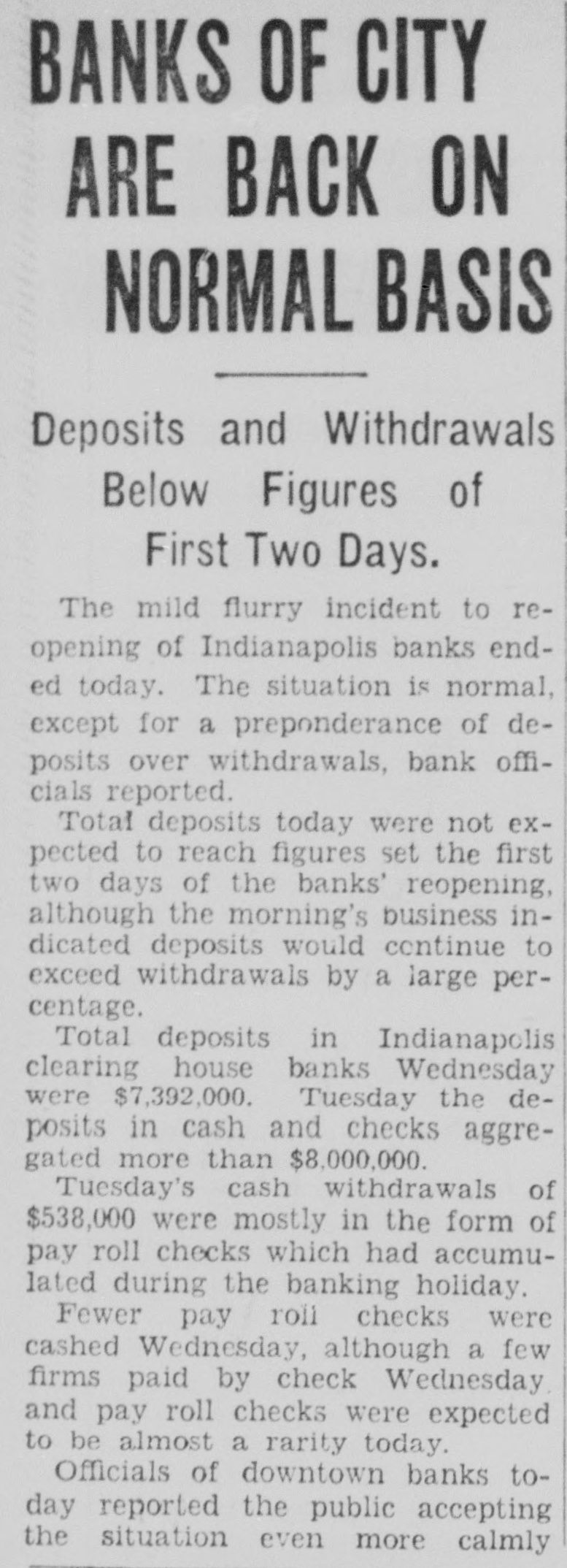
# BANKS OF CITY ARE BACK ON NORMAL BASIS Deposits and Withdrawals Below Figures of First Two Days. The mild flurry incident to reopening of Indianapolis banks ended today. The situation is normal, except for a preponderance of deposits over withdrawals, bank officials reported. Total deposits today were not expected to reach figures set the first two days of the banks' reopening, although the morning's business indicated deposits would continue to exceed withdrawals by a large percentage. Total deposits in Indianapolis clearing house banks Wednesday were $7,392,000. Tuesday the deposits in cash and checks aggregated more than $8,000,000. Tuesday's cash withdrawals of $538,000 were mostly in the form of pay roll checks which had accumulated during the banking holiday. Fewer pay roll checks were cashed Wednesday, although a few firms paid by check Wednesday. and pay roll checks were expected to be almost a rarity today. Officials of downtown banks today reported the public accepting the situation even more calmly