Western Exchange Fire & Marine Insurance Company (Omaha, NE)

Episode Information

Episode UID
8670059890694
Episode Type
Run โ†’ Suspension โ†’ Reopening
Bank Type
state
Bank ID
867005989 hash
Start Date
October 1, 1857*
Location
Omaha, Nebraska (41.259, -95.938)

Metadata

Model
gpt-5-mini (chosen from majority vote of a three-model LLM ensemble)
Short Digest
dacde3d53ad4ac49

Response Measures

None

Description

Sources describe heavy withdrawals and a prior suspension with active steps toward resumption; exact suspension date not given.

Events (3)

1. October 1, 1857* Run
Cause
Correspondent
Cause Details
Heavy withdrawals and inability to obtain timely aid from eastern correspondents to meet demands.
Measures
Cashier Tuttle pledged his private property and other property under his control to secure depositors and bill-holders.
Newspaper Excerpt
the real cause of the suspension was the difficulty of procuring aid from the east in time to meet the heavy demand upon the institution.
Source
newspapers
2. October 1, 1857* Suspension
Cause
Correspondent
Cause Details
Bank had suspended following heavy demands and failures in nearby banks; lack of eastern support cited as immediate trigger.
Newspaper Excerpt
The Western Exchange, Fire and Marine Insurance Company ... which is also suspended
Source
newspapers
3. October 3, 1857 Other
Newspaper Excerpt
We are gratified to learn that the prospects for the resumption of business by this bank are extremely flattering. ... within sixty days from the date of suspension, we confidently expect it will be again in operation.
Source
newspapers

Newspaper Articles (3)

Article from The Council Bluffs Nonpareil, October 3, 1857

Click image to open full size in new tab

Article Text

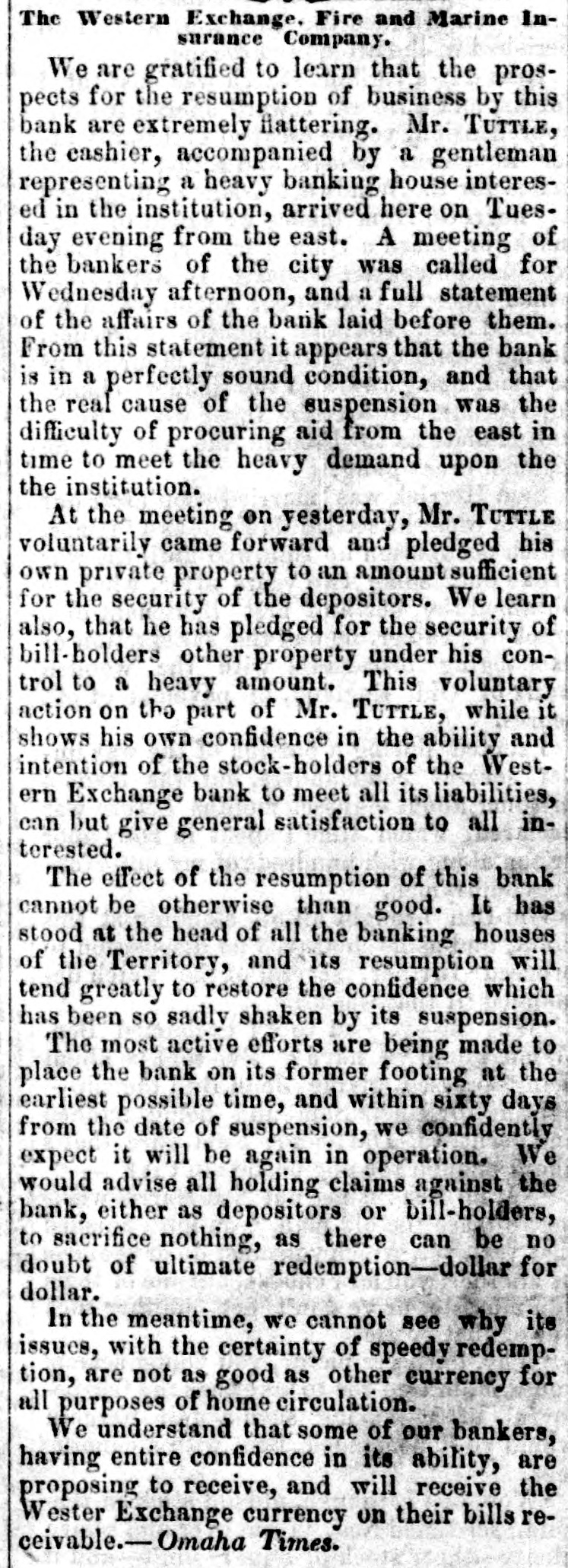
# The Western Exchange. Fire and Marine Insurance Company. We are gratified to learn that the prospects for the resumption of business by this bank are extremely flattering. Mr. TUTTLE, the cashier, accompanied by a gentleman representing a heavy banking house interested in the institution, arrived here on Tuesday evening from the east. A meeting of the bankers of the city was called for Wednesday afternoon, and a full statement of the affairs of the bank laid before them. From this statement it appears that the bank is in a perfectly sound condition, and that the real cause of the suspension was the difficulty of procuring aid from the east in time to meet the heavy demand upon the institution. At the meeting on yesterday, Mr. TUTTLE voluntarily came forward and pledged his own private property to an amount sufficient for the security of the depositors. We learn also, that he has pledged for the security of bill-holders other property under his control to a heavy amount. This voluntary action on the part of Mr. TUTTLE, while it shows his own confidence in the ability and intention of the stock-holders of the Western Exchange bank to meet all its liabilities, can but give general satisfaction to all interested. The effect of the resumption of this bank cannot be otherwise than good. It has stood at the head of all the banking houses of the Territory, and its resumption will tend greatly to restore the confidence which has been so sadly shaken by its suspension. The most active efforts are being made to place the bank on its former footing at the earliest possible time, and within sixty days from the date of suspension, we confidently expect it will be again in operation. We would advise all holding claims against the bank, either as depositors or bill-holders, to sacrifice nothing, as there can be no doubt of ultimate redemption-dollar for dollar. In the meantime, we cannot see why its issues, with the certainty of speedy redemption, are not as good as other currency for all purposes of home circulation. We understand that some of our bankers, having entire confidence in its ability, are proposing to receive, and will receive the Wester Exchange currency on their bills receivable.- Omaha Times.

Article from The New York Herald, October 10, 1857

Click image to open full size in new tab

Article Text

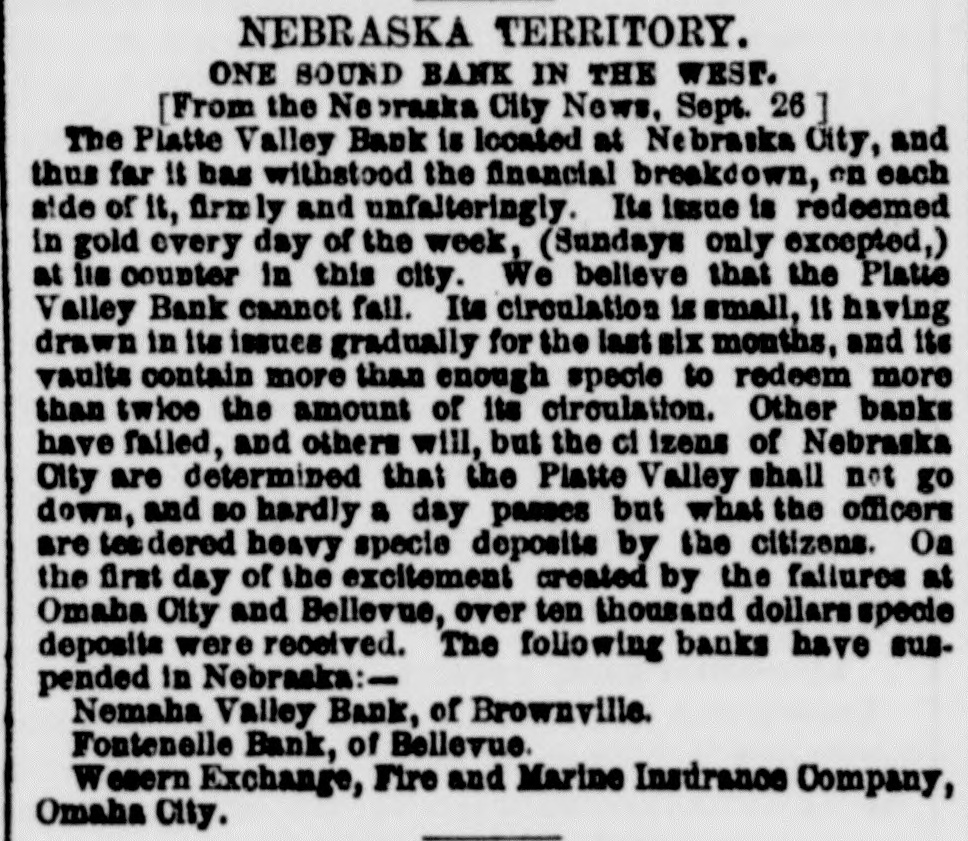
NEBRASKA TERRITORY. ONE SOUND BANK IN THE WEST. [From the Nebraska City News, Sept. 26 The Platte Valley Bank is located at Nebraska City, and thus far it has withstood the financial breakdown, on each side of it, firmly and unfalteringly. Its issue is redeemed in gold every day of the week, (Sundays only excepted,) at tis counter in this city. We believe that the Platte Valley Bank cannot fail. Its circulation is small, it having drawn in its issues gradually for the last six months, and its vaults contain more than enough specie to redeem more than twice the amount of its circulation. Other banks have failed, and others will, but the ci izens of Nebraska City are determined that the Platte Valley shall not go down, and so hardly a day passes but what the officers are tesdered heavy specie deposits by the citizens. Oa the first day of the excitement created by the failures at Omaha City and Bellevue, over ten thousand dollars specie deposits were received. The following banks have suspended in Nebraska:Nemaha Valley Bank, of Brownville. Fontenelle Bank, of Bellevue. Wesern Exchange, Fire and Marine Insurance Company, Omaha City.


Article from Nebraska Advertiser, July 8, 1858

Click image to open full size in new tab

Article Text

Banking in Nebraska. We are opposed to granting any more Bank Charters in Nebraska, and in favor of wiping out all heretofore granted, that have closed their doors; and, further, around those that have sustained themselves, we are in favor of throwing such guards, protections, or restrictions as will give confidence to the bill-holder. We are opposed in the first place to granting Bank Charters in Nebraska, because the United States law, passed July 1st, 1836, Section 1, which reads as follows, is yet in existence, and such grants, therefore would be unconstitutional. "Sec, 1. No act of any of the Territories of the United States incorporating any institution with Banking powers or privileges, hereafter to be passed, shall have any force or effect whatever until approved and confirmed by Congress." We are not prepared to say we are opposed to Banking in toto, and in every form, or by any principle whatever. There is perhaps, owing to the nature of the business of our country, a demand for something of the kind. But where and when they do exist, the most ample security should be given the bill-holder; and the Banker or Bankers should be money lenders not money borrowers. We are opposed to more Banks in Nebraska, because we have not the home capitol to engage in a legitimate safe, reliable and healthy system of Banking, and the consequence would be as has been, that non-resident operatives, unknown, unreliable men conduct affairs, and upon regular "wild cat" principles, and in the end the people are most shamfully swindled out of their hard earned means. As shedding further light and in substantiation of the forgoing idea, we give place to the following extract from a communication in the St. Louis Republican, written by a resident of this Territory evidently well posted. He says: "The Nemaha Valley Bank, located at Brownville, and which is suspended, is wholly ownedin the State of Illinois. A part of the Stock of Platte Valley Bank, located at Nebraska City, is owned in the Territory, the balance in Missouri and Illinois. The Fontenelle Bank of Bellvue, located at Belleve, which is hopeS lessly defunci and the grossest swindle of the whole is wholly owned in Illinois and Iowa. The Western Exchange Fire, and Marine Insurance commonly called the Western Exchange Bank,) iccated at Omaha City, and which is also suspended S is at present wholly owned at Galva, Iir linois, and was formerly owned in Iowa and Ill. The Bank of Nebraska, located at Omaha, is wholly owned in Iowa. The Bank of Florence, which has also suspended is also owned in Iowa. The Bank of De Soto, located at De Soto, is owned in Wisconsin, and the Bank of Tekamah, located at Tekamah, and which has recently suspended, is owned in Indiana and Missouri. These are all the d banks in the Territory--all others have no legal existence whatever. Here then are the facts-these institutions are not owned or controlled by the citizens of Nebraska, (except the controlling influence of one of them-the Platte Valley) d but are managed by the citizens of other states, and are made the vehicles of the grossest frauds upon community-and ]then the whole charge of fraud, corrupis tion and swindle, and all that is mean, to dishenest and dishonorable, is heaped on or the citizens of Nebraska! Is this fair ?