Second Bank of the United States (Philadelphia, PA)

Episode Information

Episode Type
Run → Suspension → Closure
Start Date
May 13, 1837
Location
Philadelphia, Pennsylvania (39.952, -75.164)
Bank Type
federal

Metadata

Notes

Multiple suspensions (1837, 1839, 1841) with resumption in 1838 and final assignment in 1841; causes tied to heavy specie drafts and runs.

Events (8)

1. May 13, 1837 Suspension
Cause
Macro News
Cause Details
Article reports suspension tied to virtual suspension/ actions of the U.S. Treasury and broader 1837 money-market convulsions.
Newspaper Excerpt
The immediate reasons which induced the Bank of the United States to suspend...because of the SUSPENSION OF THE GOVERNMENT!
Source
newspapers
2. August 1, 1838* Reopening
Newspaper Excerpt
Resumption of Specie Payments - the banks of this city...all resumed the payment of gold and silver for their notes yesterday.
Source
newspapers
3. August 17, 1838 Reopening
Newspaper Excerpt
The resumption of specie payments by the banks was without commotion...The Bank of the United States...nothing was seen to lead any one to believe that a run was attempted.
Source
newspapers
4. October 9, 1839 Run
Cause
Correspondent
Cause Details
Heavy draft of specie for New York and consequent withdrawals from Philadelphia banks precipitated a run.
Measures
Led to suspension of specie payments by the Philadelphia banks (including the U.S. Bank).
Newspaper Excerpt
The immediate cause of the Philadelphia suspension, it is said, was a heavy draft of specie for New York, followed by a run on the Philadelphia Banks.
Source
newspapers
5. October 9, 1839 Suspension
Cause
Correspondent
Cause Details
Suspension caused by heavy specie drafts to meet demands in New York and ensuing run.
Newspaper Excerpt
The Philadephia Banks, including the United States Bank of Pennsylvania, suspended specie payments on the 9th instant; the immediate cause...a heavy draft of specie for New York, followed by a run.
Source
newspapers
6. February 4, 1841 Suspension
Cause
Local Banks
Cause Details
Massive demands for specie from eastern correspondents and heavy steady withdrawals exhausted reserves, forcing suspension.
Newspaper Excerpt
The Bank of the United States has again suspended specie payments...paid out in specie within an ace of six millions of dollars!
Source
newspapers
7. September 6, 1841 Receivership
Newspaper Excerpt
The assignment...proceeds of the remaining portion of the assets to be appropriated for the benefit of the general creditors; assignees named for the bank.
Source
newspapers
8. September 6, 1841 Other
Newspaper Excerpt
the Directors of the Bank of the United States made an assignment of most of the valuable assets of that institution...called a 'partial assignment'.
Source
newspapers

Newspaper Articles (25)

Article from The Rhode-Island Republican, May 24, 1837

Click image to open full size in new tab

Article Text

UNITED STATES BANK.

We regret to see, in these disastrous convulsions in the money market, and when mutual efforts at conciliation are proper, the tone of aggravation and perversion which characterizes the organ of Mr. Biddle's bank in this city.

After that bank has suspended specie payments with six or seven millions of eirculation out, and only one or two millions of specie to redeem it, and in a panic which its friends have inflamed if not caused, and thus developed its weekness, in common with other banking institutions; in such a crisis, brought on by over trading, &c., all the blame is attempted to be laid to some of the deposite banks, or to the government.

We extract the following from the National Intelligencer of this morning: Philadelphia, Saturday, May 13. The immediate reasons which induced the Bank of the United States to suspend, have been made known. It is because of the SUSPENSION OF THE GOVERNMENT! The bank holds some large claims upon the Treasury, and on presenting them for payment, the Treasury of the United States refused by its agents, to pay its liabilities in specie. In consequence of this virtual bankruptcy and actual suspension of the Treasury, the United States Bank felt itself obliged to suspend, and thus prevent its specie being withdrawn for objects foreign to its institution.

Now, did the public ever witness a greater piece of assurance, when the United States Bank has been, and still is indebted to the government near eight millions of dollars, a large part of which ought justly to have been paid last year and when the bank is believed not to hold a claim of a single dollar's worth against the Treasury, unless it has been buying some upon speculation.


Article from Cheraw Gazette, May 31, 1837

Click image to open full size in new tab

Article Text

means specie with the except treasury, from the so banks not counce find all their notes collected so into the Treasury for the into specie that and veried the paid immediately banks deposite for duties banks con. use Government, while the banks of the their debts to the other in will not nor the Treasury in for instance, this specie, pay Take, pay warrants indemnity example. specie. under the French France. The claimant moneys due him in for him: had certain Government imported i(in gold of distribution an order for his of his own and he The obtained when the receiving day portion. share received arrived, But, his instead of iden' gold, be has of the own proper not silver, but the notes banks which very notes itself wo id refuse to vernment deposite neither gold receive which the from Go- he claimant for any debt So long, this very owe to the Government. the Go. might as the Government and banks will not pay in it would be rashness to pay specie to them; other vernment therefore banks, specie and, those as to in banks cannot make a discrimination al. they whom they will pay, the Govern- only hose is to concur with in the general ternative ment banks the this. suspension. They Philadelphia banks saw unequal thought Our it useless to carry on so were to intercourse, in which they refused pay an to New York, while New for if the PennsylPennsylvania ; York New York to pay banks to paid while those of have been vania the whole revenue would specie turned did not, into Pennsylvania notes, and demanded. the midst of these disorders, the Bank In the United States occupies a peculiar Had con. poof and has special duties. sulted sition, merely its ownstrength, it reserve. would have But continued its payments without Like all the other Pennsylvania of our 1st. it owed a duty to the citizens stand banks. State and it was not disposed the to other own from a general movement of might aloof State institutions, which however it regret, it could not consure. to 2d. It was not inclined, moreover, the a refusal to receive it, paper other State banks which of still less to force discredit, pay the specie, by debts its had in Pennsyl- specie, ceased to debtors to pay their were alvania other citizens in other States thus when to in a less costly medium of down, for the the merchants and lowed States, breaking pay benefit manufacturers other and mechanics of Pennsylvania. While the vaults of all the of other the 3d. closed, the Government would have no but the Bank of banks United procure were States specie resource the the United risk to which ought not to assume for bull States, the only source of supply offices of ion being to the Government and the land as 4th. well The as for deposite exportation. banks of the the Govern- bank would not pay their debts to should ment the United States. Why, then, these of Bank of the United States pay to the institutions, on account of the Government, for their notes, when these ? There very specie banks would not pay their own debts reciprowould have been an equal want of city and of justice in such a proceeding. There was another reason moment against 5th. and decisive. From the failed it, final the deposite banks of New York it was that comply with their engagemen's banks o that all the other deposite the same, that there must a throughout versal must manifest do suspension the the be country, midst uni- of that the Treasury itself, in and its nominal abundance, must be practically bankrupt. Insuch a state of things. the first i:-how consid is how to escape from moment to cration at the earliest practicable not be provide a condition which should to change the necessity which comit. The old associations, the the manded tolerated connexions, beyond established credit, the United extensive capital of the Bank of the for large render it the natural rallying point It States resumption of specie payments. waste seemed the wiser, therefore, not to be doubt- its strength in a struggle which might in its while the Executive persevered, all its resourful, policy, but to husband favorable mopresent to profit by the first ces so to as take the lead in the early resump the ment of specie payments. According, that tion of the United States assumes efforts will poBank From this moment its itself silion. itself strong, and to make anxbe to keep S prepared and always and sironger; to assist alway in recalling the currency to the point ious exchanges of the country It will co. the which they have fallen. with the from cordially and zealonsly banks, operate banks, with all the other aid and Government with any other influences which can in that object. In the mean time two great duties devolve banks and the country. on the first regards foreign nations-the to forThe our own. We owe a debt resoursecond by no means large for our present ccs, eigners but disproportioned to our


Article from Staunton Spectator, and General Advertiser, July 13, 1837

Click image to open full size in new tab

Article Text

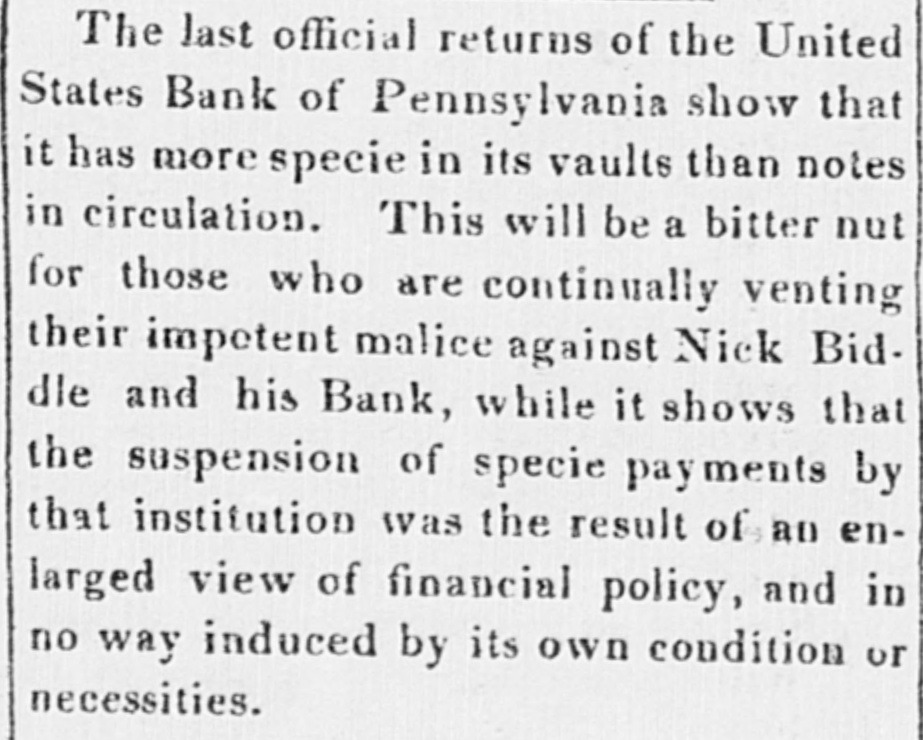
The last official returns of the United States Bank of Pennsylvania show that it has more specie in its vaults than notes in circulation. This will be a bitter nut for those who are continually venting their impotent malice against Nick Biddle and his Bank, while it shows that the suspension of specie payments by that institution was the result of an enlarged view of financial policy, and in no way induced by its own condition or necessities.


Article from The Madisonian, August 18, 1838

Click image to open full size in new tab

Article Text

SPECIE PAYMENTS.

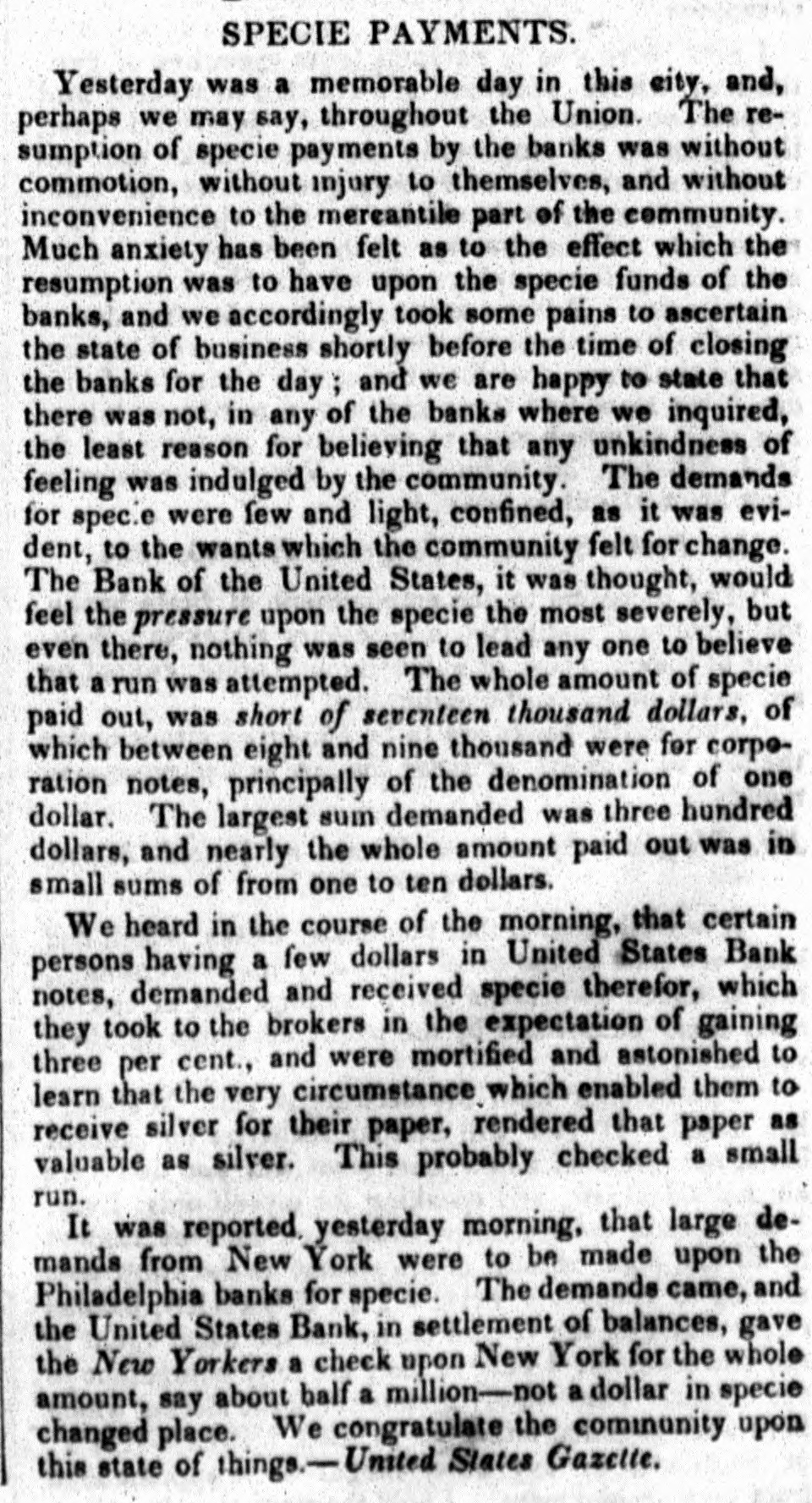
Yesterday was a memorable day in this city, and, perhaps we may say, throughout the Union. The resumption of specie payments by the banks was without commotion, without injury to themselves, and without inconvenience to the mercantile part of the community. Much anxiety has been felt as to the effect which the resumption was to have upon the specie funds of the banks, and we accordingly took some pains to ascertain the state of business shortly before the time of closing the banks for the day; and we are happy to state that there was not, in any of the banks where we inquired, the least reason for believing that any unkindness of feeling was indulged by the community. The demands for specie were few and light, confined, as it was evident, to the wants which the community felt for change. The Bank of the United States, it was thought, would feel the pressure upon the specie the most severely, but even there, nothing was seen to lead any one to believe that a run was attempted. The whole amount of specie paid out, was short of seventeen thousand dollars, of which between eight and nine thousand were for corporation notes, principally of the denomination of one dollar. The largest sum demanded was three hundred dollars, and nearly the whole amount paid out was in small sums of from one to ten dollars.

We heard in the course of the morning, that certain persons having a few dollars in United States Bank notes, demanded and received specie therefor, which they took to the brokers in the expectation of gaining three per cent., and were mortified and astonished to learn that the very circumstance which enabled them to receive silver for their paper, rendered that paper as valuable as silver. This probably checked a small run.

It was reported, yesterday morning, that large demands from New York were to be made upon the Philadelphia banks for specie. The demands came, and the United States Bank, in settlement of balances, gave the New Yorkers a check upon New York for the whole amount, say about half a million—not a dollar in specie changed place. We congratulate the community upon this state of things.—United States Gazette.


Article from Edgefield Advertiser, August 23, 1838

Click image to open full size in new tab

Article Text

PHILADELPHIA

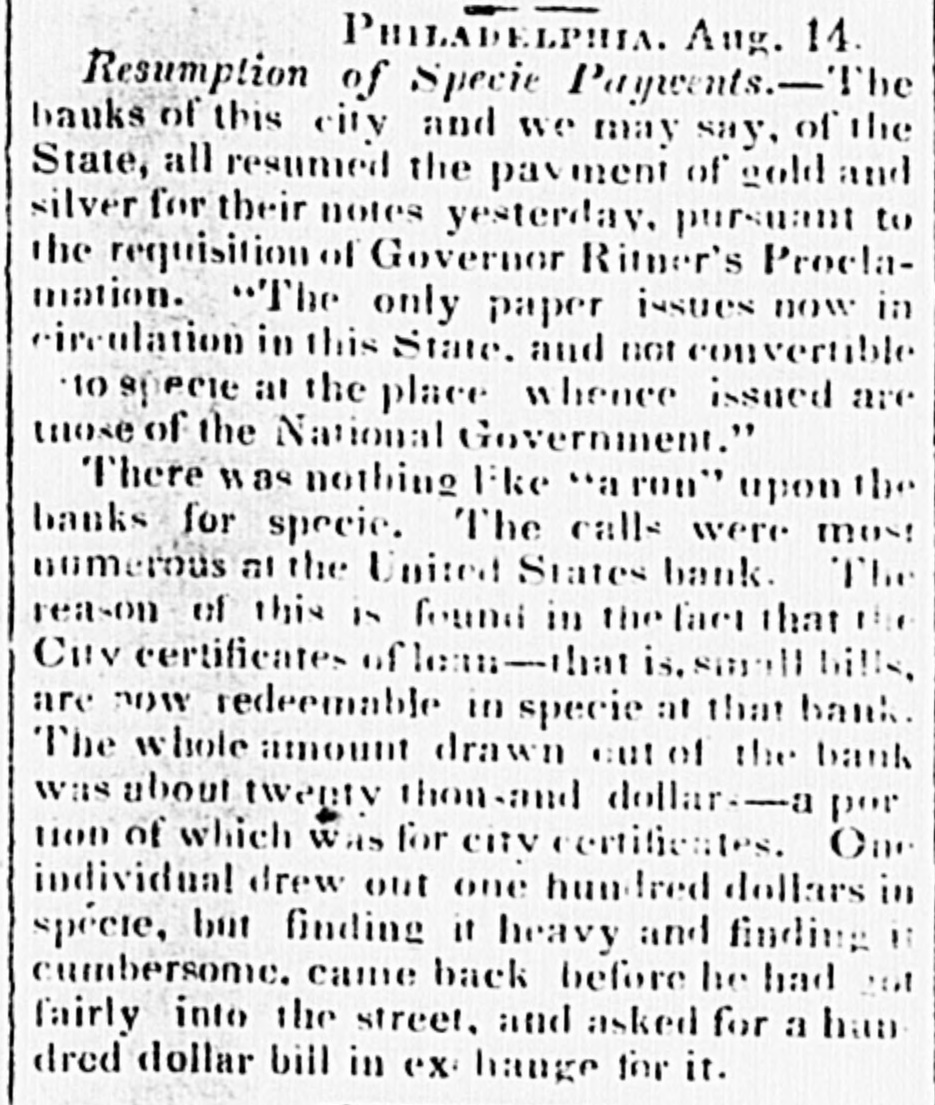
Aug. 14 Resumption of Specie Paycents - 'he banks of this city and we may say, of the State, all resumed the payment of gold and silver for their notes yesterday. pursuant to the requisition of Governor Rimer's Procla mation. The only paper issues now in ein ulation in this State. and not convertible to specie at the place whence issued are those of the National Government." There was nothing like "aron" upon the banks for specie. The calls were most numerous at the United States bank. reason of this IS found in the fact that the City certificates oflean-that is. small bills are now redeemable in specie at that bank The whole amount drawn out of the bank was about twenty thousand dollar.-a por 1100 of which was for CITV certificates. O individual drew out one hundred dollars in specie, but finding it heavy and finding cumbersome. came back before he had fairly into the street, and asked for a han dred dollar bill in ex hange for it.


Article from Edgefield Advertiser, October 17, 1839

Click image to open full size in new tab

Article Text

Suspension of Specie Payments.

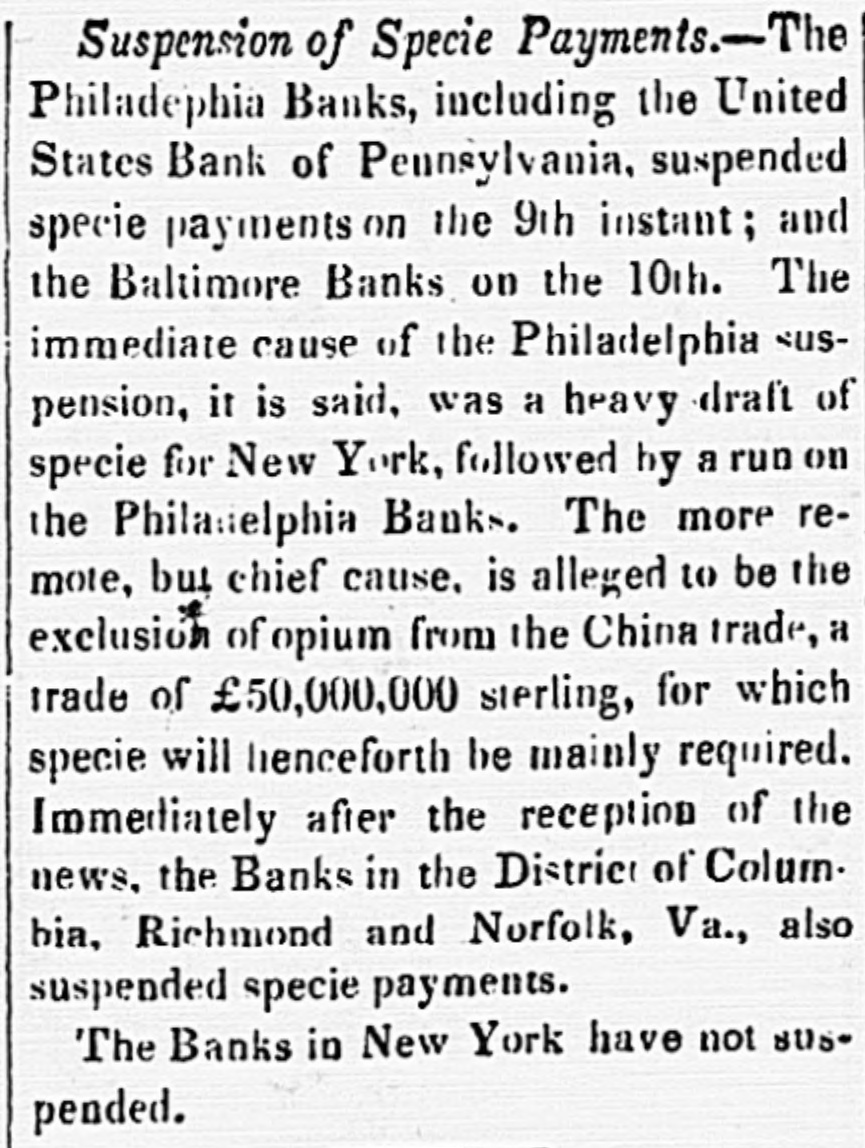
The Philadephia Banks, including the United States Bank of Pennsylvania, suspended specie payments on the 9th instant; and the Baltimore Banks on the 10th. The immediate cause of the Philadelphia suspension, it is said, was a heavy draft of specie for New York, followed by a run on the Philadelphia Banks. The more remote, but chief cause, is alleged to be the exclusion of opium from the China trade, a trade of £50,000,000 sterling, for which specie will henceforth be mainly required.

Immediately after the reception of the news, the Banks in the District of Columbia, Richmond and Norfolk, Va., also suspended specie payments.

'The Banks in New York have not suspended.


Article from True American, October 22, 1839

Click image to open full size in new tab

Article Text

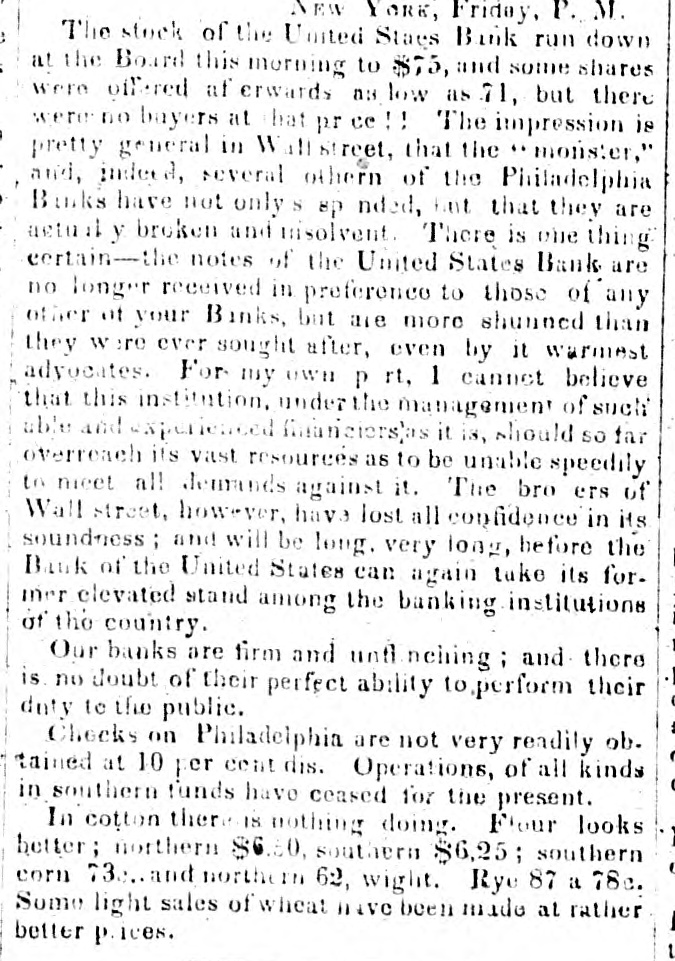
P. YORK, Friday, The stock of the United Stays Bank run down at the Board this morning to $75, and some shares were offered af erwards as low as 71, but there were no bayers at hat pr : ! The impression is pretty general in Wall street, that the monster," and, indeed, several othern of the Philadelphia Banks have not only S sp nded, but that they are actual y broken and misolvent. There is one thing certain-the notes of the United States Bank are no longer received in preference to those of any other of your Banks, but are more shunned than they were ever sought after, even by it warmest advocates. For my own P rt. 1 cannot believe that this institution, under the management of such able and experienced financiers)as it is, should so far overreach its vast resources as to be unable speedily to meet all demands against it. The bro ers of Wall street, however, have lost all confidence in its soundness; and will be long. very long, before the Bank of the United States can again take its for. mer elevated stand among the banking institutions of the country. Our banks are firm and unti inching ; and there is no doubt of their perfect ability to perform their duty to the public. Checks on Philadelphia are not very readily ob. tained at 10 per cent dis. Operations, of all kinds in southern funds have ceased for the present. In cotton ther 18 nothing doing. Flour looks better northern $0.00 southern $6.25 southern corn 73. and northern 62, wight. Rye 87 a 78c. Some light sales of wheat neve been made at rather better Ices.


Article from Cheraw Gazette and Pee Dee Farmer, October 25, 1839

Click image to open full size in new tab

Article Text

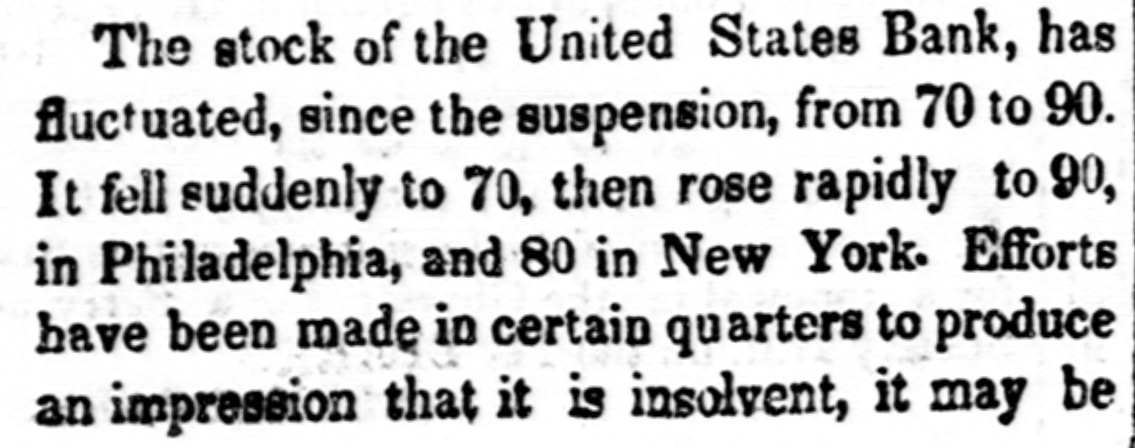
The stock of the United States Bank, has fluctuated, since the suspension, from 70 to 90. It fell suddenly to 70, then rose rapidly to 90, in Philadelphia, and 80 in New York. Efforts have been made in certain quarters to produce an impression that it is insolvent, it may be


Article from Richmond Enquirer, November 29, 1839

Click image to open full size in new tab

Article Text

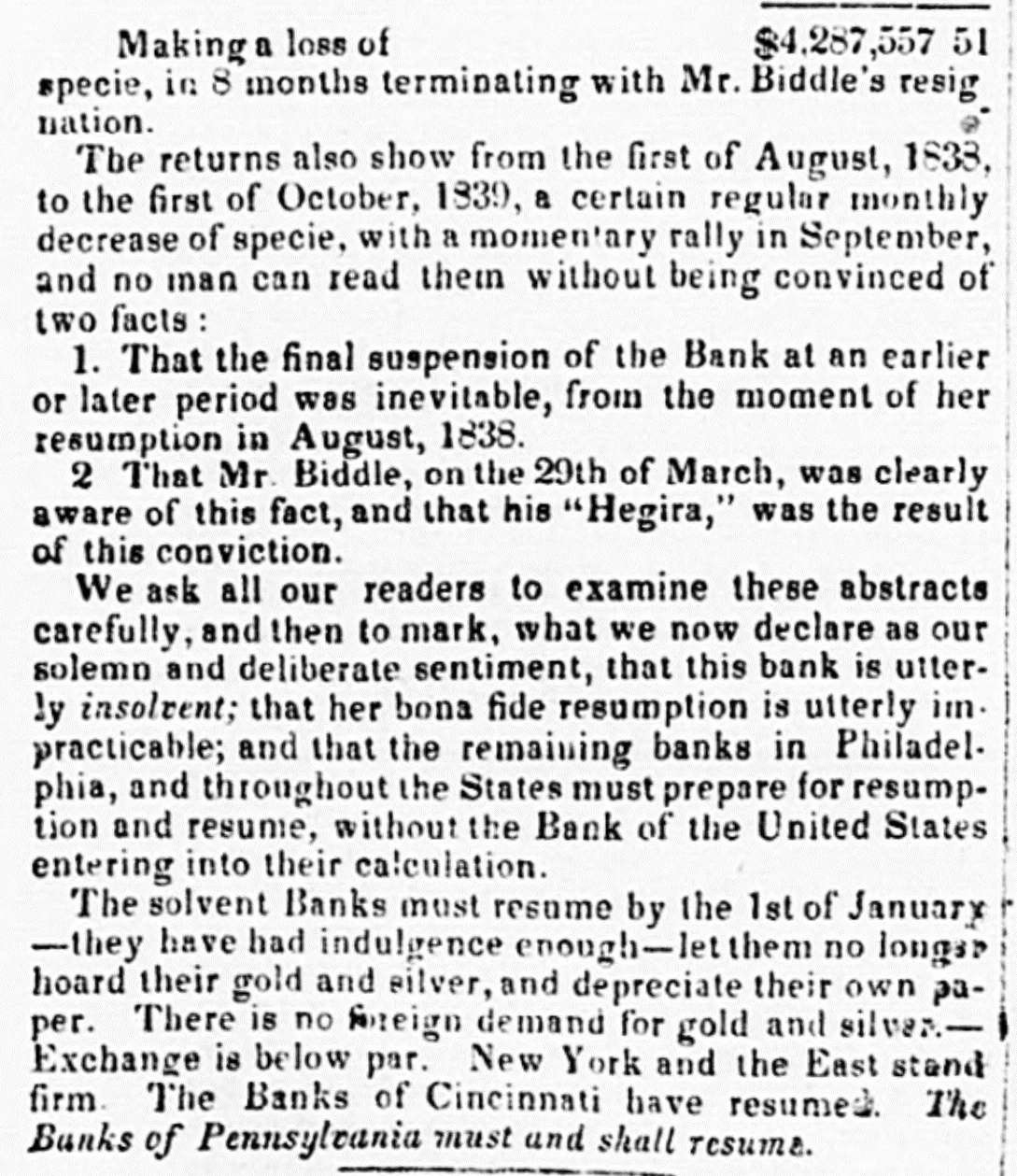
Making a loss of $4,287,557 51 specie, in 8 months terminating with Mr. Biddle's resignation.

The returns also show from the first of August, 1833, to the first of October, 1839, a certain regular monthly decrease of specie, with a momentary rally in September, and no man can read them without being convinced of two facts: 1. That the final suspension of the Bank at an earlier or later period was inevitable, from the moment of her resumption in August, 1838. 2 That Mr. Biddle, on the 29th of March, was clearly aware of this fact, and that his "Hegira," was the result of this conviction.

We ask all our readers to examine these abstracts carefully, and then to mark, what we now declare as our solemn and deliberate sentiment, that this bank is utterly insolvent; that her bona fide resumption is utterly impracticable; and that the remaining banks in Philadelphia, and throughout the States must prepare for resumption and resume, without the Bank of the United States entering into their calculation.

The solvent Banks must resume by the 1st of January -they have had indulgence enough-let them no longer hoard their gold and silver, and depreciate their own paper. There is no foreign demand for gold and silver. Exchange is below par. New York and the East stand firm. The Banks of Cincinnati have resumed. The Banks of Pennsylvania must and shall resume.


Article from Lexington Union, October 31, 1840

Click image to open full size in new tab

Article Text

Extraordinary Law Case

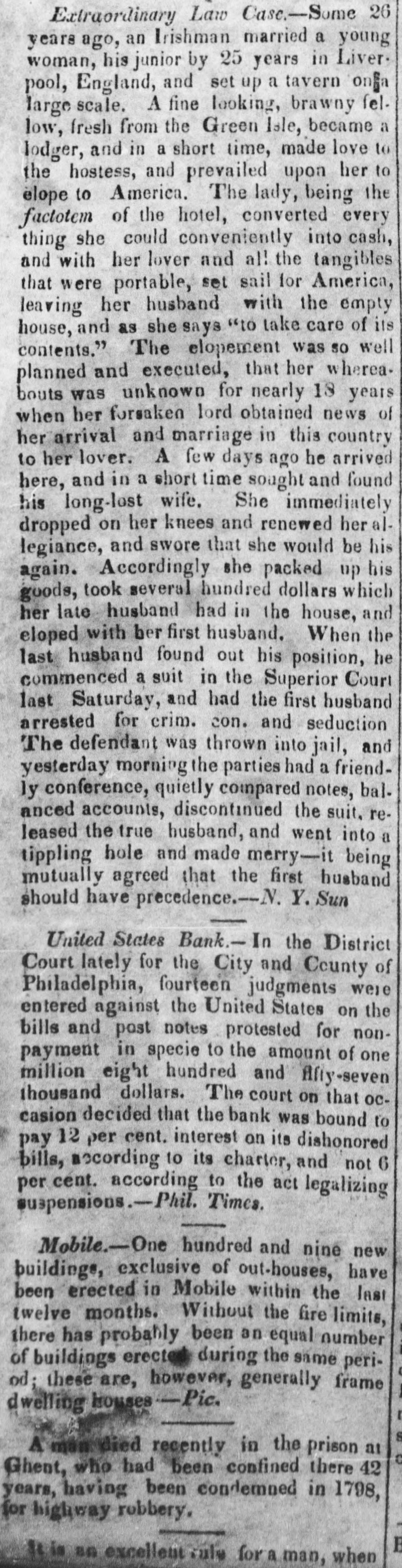
-Some 26 years ago, an Irishman married a young woman, his junior by 25 years in Liver pool, England, and set up a tavern onga large scale. A fine looking, brawny fel. low, fresh from the Green Isle, became a lodger, and in a short time, made love to the hostess, and prevailed upon her to elope to America. The lady, being the factotem of the hotel, converted every thing she could conveniently into cash, and with her lover and all the tangibles that were portable, set sail for America, leaving her husband with the empty house, and as she says "to take care of its contents." The elopement was so well planned and executed, that her whereabouts was unknown for nearly 18 years when her forsaken lord obtained news of her arrival and marriage in this country to her lover. A few days ago he arrived here, and in a short time sought and found his long-lost wife. She immediately dropped on her knees and renewed her allegiance, and swore that she would be his again. Accordingly she packed up his goods, took several hundred dollars which her late husband had in the house, and eloped with ber first husband. When the last husband found out his position, he commenced a suit in the Superior Court last Saturday, and had the first husband arrested for crim. con. and seduction The defendant was thrown into jail, and yesterday morning the parties had a friendly conference, quietly compared notes, balanced accounts, discontinued the suit, released the true husband, and went into a tippling hole and made merry-it being mutually agreed that the first husband should have precedence.--N. Y. Sun / United States Bank.-In the District Court lately for the City and County of Philadelphia, fourteen judgments were entered against the United States on the bills and post notes protested for nonpayment in specie to the amount of one million eight hundred and Alty-seven thousand dollars. The court on that OCcasion decided that the bank was bound to pay 12 per cent. interest on its dishonored bills, according to its charter, and not 6 per cent. according to the act legalizing suspensions.-Phil. Times. Mobile.-One hundred and nine new buildings, exclusive of out-houses, have been erected in Mobile within the last twelve months. Without the fire limits, there has probably been an equal number of buildings erector during the same period; these are, however, generally frame dwelling houses-Pic. A man died recently in the prison at Ghent, who had been confined there 42 years, having been condemned in 1798, for highway robbery. It is an excellent rule for a man, when


Article from The Camden Journal, January 13, 1841

Click image to open full size in new tab

Article Text

The New York Herald of Friday, speaking of exchange on the South and the indications of a general resumption, has the following remarks: The rates of premium on specie indicate the degree of depreciation of the local currencies throughout the South, and the different degrees of indebtedness to the commercial centre of the Union. It will be observed that the rate of bills on England, being in deprecriated currencies, are generally lower than at this port, and are in every instance below par for specie. Whether the proposed resumption will extend to all these points or not, is yet problematical. Letters from New Orleans are confident that it cannot be effected there. The resumption by the United States Bank is a juggle, and will in all probability not last three months. New Orleans is a commanding point, and the branch of the United States Bauk there and the Merchants Bank, exert as great an influence as the mother bank does in Philadelphia. Popular opinion does not set so strongly in favor of resumption in the former, as in the latter city. It is therefore feared that non-resumption in New Orleans will be made the cloak for another suspension at an early day, unless the deposites of the federal government are restored the United States Bank. If this cannot be effected, a new suspension and derangement of affairs, will make it the instrument of new political intrigues.


Article from The Charlotte Journal, January 21, 1841

Click image to open full size in new tab

Article Text

MONEY CONCERNS

The Philadelphia Enquirer of Saturday says We understand that the United States Bank has now in her vaults more than $4,000,000 in specie. All doubts as to a general resumption have disappeared, and we begin to indulge a hope that out community will glide so gradually from suspension into resumption that the affair will not create a momentary sensation.The truth is, very little difficulty is expe. rienced even now with regard to small change."


Article from Rutland Herald, January 26, 1841

Click image to open full size in new tab

Article Text

The Resumption

- The Philadelphia United States Gazette of Monday says, Saturday was the second day of resumption. and the number and character of the demands upon the United States Bank were such as to show that calls for silver were less from a distrust of the character of the notes, than from a real want of a circulating medium. The day of resumption was the death day of foreign small notes, and of course a very considerable sum of silver was required to make even the ordinary purchases in the market Saturday also, besides being market day, is also pay day in the establishments where many hands are employed. This requires a considerable amount of money in sums less than five dollars: and when a great amount is paid, it is probable that the wants of the workmen, or workingmen, rendered convenient a draft upon the Bank for silver, in place of the note or check. The demands on the other Banks, it states, were evidently with no view to a run. The United States Bank continued to receive remittances from all quarters, to supply her a vaults against any strong attacks.


Article from Virginia Free Press, February 11, 1841

Click image to open full size in new tab

Article Text

JOHN WHITE, Chairman F. A. RATBOLD, Secretary. The Philadelphia U. S."Gazette accompanies the foregoing annunciation with the following remarks:In the short space of twenty days, since its vaults were opened, we understand that the Bank has paid out nearly six millions of dollars ia specie funds. The daily increase of the demands up. on its vaulte, from the eastward, render. ed it im possible for the Bank longer to resist the torrent. It Sas reluciantly yielded to the force of imperious circum. stances. The great error, we consider, arose from the Legislature requiring the Banks to resume before they were prepared for it : for how can the Banks pay the people, before the people pay the Banks? hen the Bank of England suspended specie payments, it required twenty-two years to resume. The immense resources of the Bank of the United States, and the zeal and integrity of its Directors are a sofficient pledge to the public, that is the shortest possible period. it will resume specie payments. and discharge, with good faith, all its obligations. Forbeerance and moderation are, therefore, alike enjoined by justice and sound policy.


Article from Martinsburg Gazette, February 11, 1841

Click image to open full size in new tab

Article Text

F. A. RAYBOLD, Secretary. The Philadelphia U. S. Gazette accompanies the foregoing annunciation with the following remarks: In the short space of twenty days, since its vaults were opened, we understand that the Bank has paid out nearly six millions of dollars in specie funds. The daily increase of the demands upon its vaults, from the eastward, rendered it impossible for the Bank longer to resist the torrent. It has reluctantly yielded to the force of imperious circumstances. The great error, we consider, arose from the Legislature requiring the Banks to resume before they were prepared for it; for how can the Basks pay the people, before the people pay the Banks When the Bank of England suspended specie payments, it required twenty-two years to resume. The immense resources of the Bank of the United States, and the zeal and integrity of its Direc. tors are a sufficient pledge to the public that, in the shortest possible period, it will resume specie payments, and discharge, with good faith. all its obligations. Forbearance and moderation are, therefore, alike enjoined by justice and sound policy. The Philadelphia Ledger of yesterday saysA great degree of excitement prevailed in this city yesterday afternoon and evening, in consequence of a rumor which prevailed in regard to the United States Bank. The cause which gave rise to this excitement was, as we learn, a failure on the part of the Bank to meet certain demands against it. As far as we could best ascertain the facts, there was a heavy draft presented about 24 'clock, by the runner of the Brokers between this city and New York. We hear the sum stated as high as three hundred thousand dollars, which the Bank failed to meet, the officer saying "it could not be paid," and the runner withdrew. Two other drafts, one for twenty thousand dollars, presented by a broker in Third street. and another for about the same amount, by another broker, was also refused payment.


Article from Southern Argus, February 24, 1841

Click image to open full size in new tab

Article Text

PHILADELPHIA, FEB. 4, 1841, Aalf-past 10, P. M. Editors of the Charleston Courier: Gentlemen-Circumstances of a very ex- citing nature having transpired in our city, to- day, I haston to inform you of it. The Bank of the United States has again suspended spe- cie payments, the cause of which is very ob- vious. Many and very heavy demands have been made upon it from the eastword, and a systematized attempt has been made since the resumption, by means of steady and heavy de- mands for specie, to crush its prospects and, if possible, to cause it to wind up. In order to effect this purpose, all the instant liabilities which could be procured, were brought up and presented to the Bank for payment specie being invariably demanded. The quantity of specie paid out by the bank to our own citi- zens, has been very triffing, and the extent to which this system has been carried will be at once seen, when it is known that since the fifteenth of January last, the bank has paid out in specie within an ace of six millions of dol- lars! The suspension of the bank is a measure of self-defence, not only as regards the private interests of the bank, but also of depositors.- Time will afford the bank an opportunity to collect, and convert into specie funds, its im- mense resources, add a few months will, no doubt, see the stockholders prepared to meet every engagement of the bank. The Board of Directors held a meeting this evening, and, after carefully reviewing the circumstances of the case, passed the resolution to suspend spe- cie payments for the present. A gpeat depression in the value of stock of the United States Bank will of course take plaso, yet should there be any of it held in your meridian, I would say that a just confidence may be placed in the solvency of the bank, and of its perfect ability to meet, at a short day, all its liabilities.

Great excitement has been produced in this city by the news, and various rumors are afloat, but none of them deserve the slightest consid- eration. We had another riot in the upper part of the city, caused by the Directors of the Trenton Rail Road again attempting to lay the rails through a part of Kensington, where the people are unitedly opposed to it. About one hundred and fifty workmen came out to work, and for some hours proceeded without hin- drance, but at one o'clock in the afternoon, an iminense mob rushed on them and fairy clear- ed them off. Some few fights took place, when the workmen retired and have not since returned to the work. Last night, about ten o'clock, the mob again gathered, and collecting all the sills and crosstics used on the road, piled them up and set fire to them. The following is from the Philadelphia Uni- ted States Gazette of Friday last:

BANK OF THE UNITED STATES. This institution, we regret to say, has again been re- duced to the painful alternative of suspending specie paymeuts.

In the short space of twenty days, since its vaults were opened, we understand that the Bank has paid out nearly six millions of dollars in specie funds. The daily increase of the demands upon its vaults, from the eastward, rendered it impossi- ble for the Bank longer to resist the torrent.- It has reluctantly yielded to the force of impe- rious circumstances. The great error, we consider, arose from the Legislature requiring the Banks to resume before they were prepar- ed for it; for how can the Banks pay the peo- ple, before the people pay the Banks? When the Banks of England suspended specie pay- ments, it required twenty-two years to re- sume. The immense resources of the Bank of the Uuited States, and the zeal and integrity of its Directors, are a sufficient pledge to the public, that in the shortest possible period, it will resume specie payments, and discharge, with good faith, all its obligations. Forbear- ance and moderation are, therefore, alike en- joined by justice and sound policy. We annex the resolutions passed by the Board of Directors, at the special meeting held last evening:

BANK OF THE UNITED STATES, February 4, 1841.

At a special meeting of the Board of Direc- tors of the Bank of the United States, held at the Banking House, the following preamble and resolutions were unanimously adopted. Whereas, The Bank of the United States in compliance with its pledge to the public, has made a fair and bonafide effort to resume and maintain specie payments, having since the 15th of January last, paid out an amount little if at all short of six millions of dollars, in coin or specie funds, and whereas the effort to maintain specie payments by this Bank has been rendered abortive by the intentional ac- cumulation and extraordinary enforcements of its instant liabilities, therefore, Resolved, That this Bank is under the ne- cessity for the present, of suspending specie payments. Resolved, That every exertion will be made by the Directors to collect the lebts and con- vert into cash the assets of this Bank, for the purpose of resuming payments in specie at the earliest practicable moment. Resolved, That the foregoing preamble and resolutions be published. Extract from the minutes. A. LARDNER, Cashier.

THE CITY AND COUNTY BANKS.

It will be seen by the subjoined proceedings of the Delegates from the different Banks in the city and county of Philadelphia, that they have unanimously resolved to continue specie payments for all their liabilities, which shows a firm confidence in their means of meeting engagements:

DELEGATE MEETING OF THE CITY AND COUNTY BANKS.

At a meeting of Delegates from the Banks


Article from Indiana State Sentinel, August 11, 1841

Click image to open full size in new tab

Article Text

STRONG REASONS FOR SUPPORTING A NATIONAL BANK.-The Branch of the United States Bank in this city, has been assigned over to the Mother Bank in Philadelphia, the whole of their suspended or past dues, and unpaid notes, and among them we find the following. The reader can draw his own inference from this development oeA no


Article from Lynchburg Virginian, September 13, 1841

Click image to open full size in new tab

Article Text

From the Philadelphia U. S. Gazelle, Sept. 6.

U. S. BANK ASSIGNMENT.

On Saturday, the Directors of the Bank of the United States made an assignment of most of the valuable assets of that institution to the following named gentlemen:-James Robinson, President; J. S. Newbold, a Director; Richard Bayard, of Delaware; Thomas S. Taylor, Cashier; Herman Cope, Assistant Cashier.

The preferences, if they can be so denominated, are one or two small demands; next, those individuals are to be secured who have made themselves responsible for any liabilities of the Bank, particularly those who have entered security on judgments recently obtained against the Bank on its notes, amounting, we think, to nearly two hundred thousand dollars. The proceeds of the remaining portion of the assets to be appropriated for the benefit of the general creditors.

With reference to this assignment, we may remark that it is called a "partial assignment," not general; because a general assignment would not be valid without the assignees entering security for twice the nominal amount assigned, and no set of men in this or any other city of the Union could find such security, or, at any rate, none would accept a trust of such little profit upon such an onerous condition. The assignment is, therefore, partial, aud is authorized by an act of Assembly granting the Bank power to make partial assignments without asking security from the assignees. Without knowing, we presume the schedule of property assigned contains nearly all the valuable property of the Bank not included in the two former assignments, viz: the one for the benefit of the city banks, and the other for the benefit of the note holders.

One condition of this assignment is well worthy of remark, viz: the assignees may receive notes of the United States Bauk for any bills receivable, notes or bonds due; and they have, besides, power granted to sell any of the assets, taking in payment therefor notes of the United States Bank.

It is thought by some that notes of the Bank will now be of more value, as they are likely to be called for, either to pay habilities or to purchase assets; and we would take occasion to say that it is probable that the want of some provision of the kind in a former assignment for the exclusive benefit of the note holders, has led to the non fulfilment of the general expectation that the assignment would tend to keep the notes nearly at par. Though in that partial assignment (for the benefit of the note hol-ders) the assignees are allowed to receive notes of the Bank for the payment of bills and accounts be-coming due, yet such a provision has proved una-vailing, inasmuch as it is probable that the best of that class of assets were assigned for the benefit of the city banks, and another class of securities were given to the assignees who act for the note holders, while they were not allowed to sell those assets for any thing but par money, at any rate, not for United States Bank notes. That assignment, therefore, without any fault in the assignees, fails of one great object proposed.

We may here remark that this assignment does not interfere with or supersede the other twospe-cial assignments to which we have referred.

The course now adopted by the Board of Di-rectors has been rendered necessary by the great eunberefts instituted against the Bank, on some of which judgment had been rendered and security given, while others were rapidly maturing for juug-ment, and the numbers constantly increasing. These suits were absorbing the funds of the Bank; it may, therefore, be fairly inferred that the Direc-tors have consulted and protected the interests of both noteholders and stockholders as well as they could under existing circumstances.

We learn that in the whole of the business con-nected with this assignment, the utmost harmony and entire unanimity prevailed at the Board of Di-rectors, the old and new members heartily concur-ring in the general plan and in its details.

With reference to the assignees, we may add, for those of our readers who do not reside in this neighborhood, that their character and standing are such as to insure confidence in whatever they un-dertake.

Of course the Board of Directors continue to met, though the banking business necessarily clo-ses.

The assignment allows to Messrs. Robinson, Bayard and Newbold fifteen hundred dollars a year each for their services, and to Messrs. Taylor and Cope four thousand dollars a year each. This is rather a diminution than an increase of expenses, inasmuch as Mr. Robinson relinquishes his salary of five thousand dollars a year as President, and Messr. Taylor and Cope have received as Cashier and Assistant Cashier the same salary which is now given to them. The new arrangement will, of course, cause the dismissal of most of the clerks hitherto employed in the institution. Mr. Robin-son continues to act as President, while he dis-charges the duty of trustee.


Article from The New York Herald, January 11, 1842

Click image to open full size in new tab

Article Text

This bond is endorsed as follows :" For value received, the BANK OF THE UNITED STATES guarantees the paymant of the principal and interest of the within bond in the manner specified there. in. J. COWPERTHWAITE, Cashier. BANK OF THE U.S. Oct. 1st, 1838." The bond is further endorsed, " Richard Alsop."These bonds, to the number of 312, fell due as specified, on the 1st inst. and on application to Jas. Iddings, As sistant Cashier of the Bank of the United States in New York, payment was refused, and at the request of J.E. Thayer, protest was made, and notices served on the following persons :-" Richard Alsop.Esq. Philadelphia; " Bank of the United States, Philadelphia, Pennsylvania ;" Jas. Robertson, Esq., President, and Thos. E. Tay. lor, Cashier of the U. S. Bank, Pa.; " The Planters Bank of the State of Mississippi, Natchez, Miss." These bonds are mostly held in Boston, and when negotiated in this market, it was understood Mr. Alsop was to receive the proceeds-he now, however, resists payment as endorser, because the bond purports to be sealed, although a close observer could discover no seal upon the instrument : suits were immediately commenced against him in the United States Court; and as we before stated, the rents of the U. S. Bank building in New York, were at tached. Since then the farm and other property of Mr. Alsop, in Connecticut, have been attached. The eastern creditors have long enough been harrassed by the practical repudiation, insolvency and dishonor of Pennsylvania, and seem now determined to have justice if the protection of the federal government can give it. In the Stock market affairs are very gloomy and prices again fellte-day-Delaware and Hudson 1 & per cent; Illinois 6 per cent, 1; Bank of Commerce Scrip 2 per cent; Harlemt; Mohawk R. R. 2 per cent; Canton 1; sales of bills on Philadelphia 41 a5; Baltimore 4; Mobile 17; New Orleans 10. Another sacrifice of the State credit was made at auction to-day to feed that vampyre, the Erie Rail Road, in the shape of $100,000, 6 per cent stocks. The effect of these repeatedly forced sales, may be seen in the fact that New York State 6 per cents, redeemable next June, were sold at the board at 96, which is equal to 14 per cent per annum on the investment. The Delaware and Raritan Canal and Camden and Amboy Railroad Transportation Company have declared a dividend of three per cent for the last six months, pay. able on the 15th inst. The Paterson and Hudson Railroad Company have this day declared a dividend of two and a half per cent, payable on the 20th inst. The Connecticut River Banking Company has declared a dividend of three per cent for the last six months, payable on the 10th inst. The Connecticut River Company has. declared a dividend of two dollars and fl fty cents, pay able on the 10th inst. Bela Latham, William Conclin, and E. W. Hubbard, have been appointed Bank Commis sioners for the State of Ohio. The Bank of Columbus, Geo., has withdrawn from the list of suspended institutions, and has resumed specie payments. A creditable move, and one which we trust will be extensively followed. The Farmers' Bank of Orleans, a free Bank, having failed, the Comptreller has issued a notice to that effect. The affairs of the Bank are stated as follows:FARMERS' BANK OF ORLEANS. Amount of circulating notes registered and is. sued to the Bank, $85,385 $78 650 Secured by bonds and mortgages stocks-Indiana 5's 75.000 $153,650 The bills at the best are, therefore, worth but 70 cents on the dollar. John Brough, Esq., auditor of the State of Ohio, has, in a letter utterly denied any connection with that ex ploded concern, the Lebanon Miami Bank. The State Bank of Illinois has issued the following notice STATE BANK OE ILLINOIS,? Dec. 29th, 1841. At a meeting of the Directors of this Bank, held on the 21st inst. the following preamble and resolution were adopted, viz: Whereas a circular has been received from the President of the State Bank of Indiana, setting forth that the said bank will be prepared to unite with the banks of Ohio and Kentucky in the resumption of specie pay. ment, on the first day of August next :-Therefore, Resolved. That the State Bank of Illinois and its Branches will be prepared to join with the banks of Ohio, Indiana and Kentucky in the resumption of specie payment, en the said 1st of August next." By order of the Board, N.H.RIDGELY,Cashier. This amounts to nothing. The same professions have been made these three years. The banks are never all ready at the same time. The following was the condition of the Bank on the 13th November last, as compared with the previous year STATE BANK OF ILLINOIS


Article from New-York Tribune, March 30, 1842

Click image to open full size in new tab

Article Text

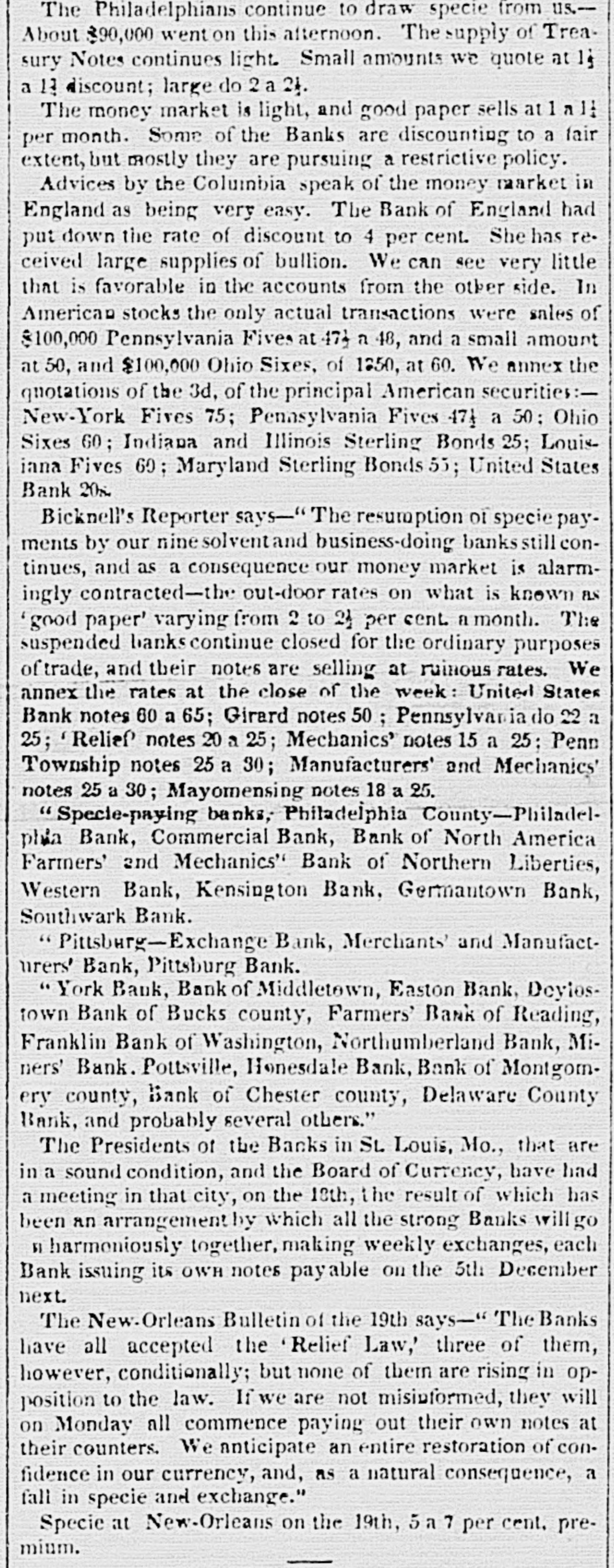
us.The Philadelphians continue to draw specie from About $90,000 went on this afternoon. The supply of Treasury Notes continues light. Small amounts we quote at 1g a 13 discount; large do 2 a 21. The money market is light, and good paper sells at 1 all per month. Some of the Banks are discounting to a fair extent, but mostly they are pursuing a restrictive policy. Advices by the Columbia speak of the money market in England as being very easy. The Bank of England had put down the rate of discount to 4 per cent. She has received large supplies of bullion. We can see very little that is favorable in the accounts from the other side. In American stocks the only actual transactions were sales of $100,000 Pennsylvania Fives at 471 a 48, and a small amount at 50, and $100,000 Ohio Sixes, of 1250, at 60. We annex the quotations of the 3d, of the principal American securities:New-York Fives 75; Penasylvania Fives 47 a 50: Ohio Sixes 60; Indiana and Illinois Sterling Bonds 25; Louisiana Fives 60: Maryland Sterling Bonds 55; United States Bank 20th Bicknell's Reporter says-" The resumption of specie payments by our nine solventar business-doing banks sill continues, and as a consequence our money market is alarmingly contracted-the out-door rates on what is known as good paper' varying from 2 to 2) per cent. a month. The suspended banks continue closed for the ordinary purposes of trade, and their notes are selling at ruinous rates. We annex the rates at the close of the week: United States Bank notes 60 a 65; Girard notes 50 Pennsylvan ia do 22 a 25; 'Relief' notes 20 a 25; Mechanics' notes 15 a 25: Penn Township notes 25 a 30; Manufacturers' and Mechanics' notes 25 a 30; Mayomensing notes 18 a 25. Specie-paying banks; Philadelphia County-Philadelphia Bank, Commercial Bank, Bank of North America Farmers' and Mechanics" Bank of Northern Liberties, Western Bank, Kensington Bank. Germantown Bank, Southwark Bank. Pittsburg-Exchange Bank, Merchants' and Manufacturers' Bank, Pittsburg Bank. "York Bank, Bank of Middletown, Easton Bank, Deylostown Bank of Bucks county, Farmers' Bank of Reading, Franklin Bank of Washington, Northumberland Bank, Miners' Bank. Pottsville, Honesdale Bank, Bank of Montgomery county, Bank of Chester county, Delaware County Bank, and probably several others." The Presidents of the Backs in St. Louis, Mo., that are in a sound condition, and the Board of Currency, have had a meeting in that city, on the 18th, the result of which has been an arrangemently which all the strong Banks will go 51 harmoniously together, making weekly exchanges, each Bank issuing its OWB notes payable on the 5th December next. The New.Orleans Bulletin of the 19th says- The Banks have all accepted the 'Relief Law,' three of them, however, conditionally; but none of them are rising in opposition to the law. If we are not misinformed, they will on Monday all commence paying out their own notes at their counters. We anticipate an entire restoration of confidence in our currency, and, as a natural consequence, a fall in specie and exchange." Specie at New-Orleans on the 19th, 5a7 per cent. premium.


Article from The New York Herald, November 3, 1842

Click image to open full size in new tab

Article Text

Philadelphia

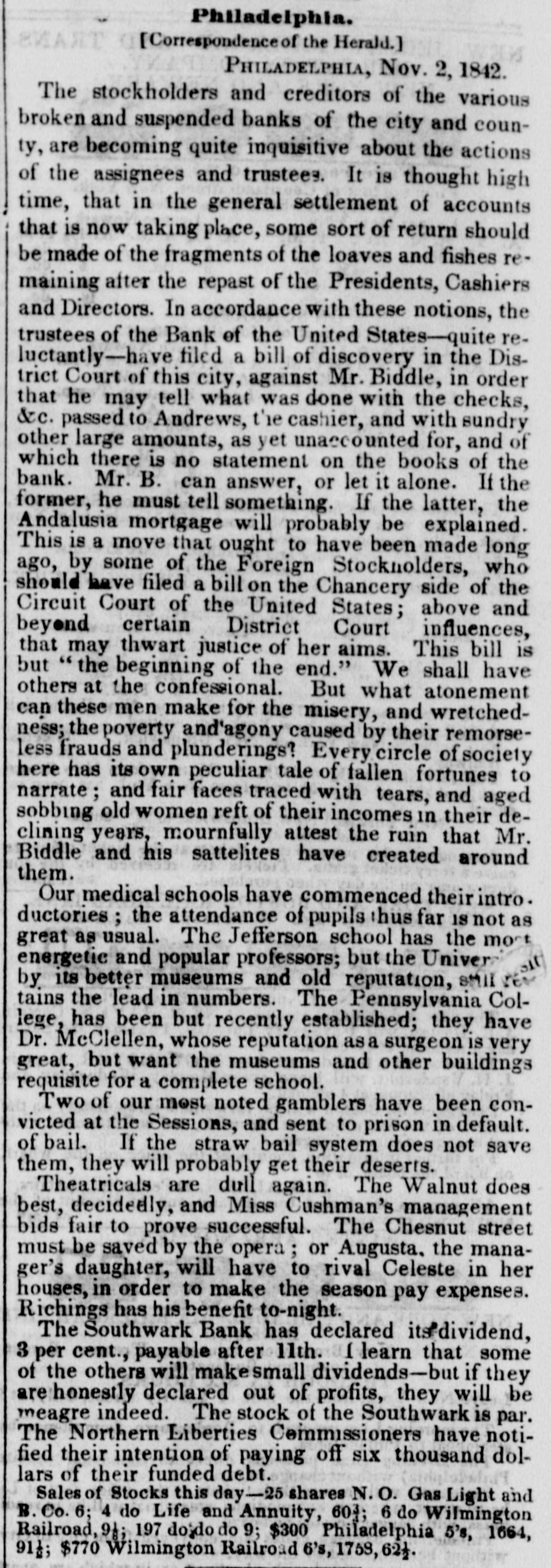
[Correspondence of the Herald.] PHILADELPHIA, Nov. 2, 1842. The stockholders and creditors of the various broken and suspended banks of the city and county, are becoming quite inquisitive about the actions of the assignees and trustees. It is thought high time, that in the general settlement of accounts that is now taking place, some sort of return should be made of the fragments of the loaves and fishes remaining after the repast of the Presidents, Cashiers and Directors. In accordance with these notions, the trustees of the Bank of the United States-quite reluctantly-have filed a bill of discovery in the District Court of this city, against Mr. Biddle, in order that he may tell what was done with the checks, &c. passed to Andrews, t'1e cashier, and with sundry other large amounts, as yet unaccounted for, and of which there is no statement on the books of the bank. Mr. B. can answer, or let it alone. It the former, he must tell something. If the latter, the Andalusia mortgage will probably be explained. This is a move that ought to have been made long ago, by some of the Foreign Stocknolders, who should have filed a bill on the Chancery side of the Circuit Court of the United States; above and beyond certain District Court influences, that may thwart justice of her aims. This bill is but the beginning of the end." We shall have others at the confessional. But what atonement can these men make for the misery, and wretchedness; the poverty and'agony caused by their remorseless frauds and plunderings? Every circle of society here has its own peculiar tale of fallen fortunes to narrate; and fair faces traced with tears, and aged sobbing old women reft of their incomes in their declining years, mournfully attest the ruin that Mr. Biddle and his sattelites have created around them. Our medical schools have commenced their intro. ductories; the attendance of pupils thus far IS not as great as usual. The Jefferson school has the most energetic and popular professors; but the Univer by its better museums and old reputation, still tains the lead in numbers. The Pennsylvania College, has been but recently established; they have Dr. McClellen, whose reputation as a surgeon is very great, but want the museums and other buildings requisite for a complete school. Two of our most noted gamblers have been convicted at the Sessions, and sent to prison in default. of bail. If the straw bail system does not save them, they will probably get their deserts. Theatricals are dull again. The Walnut does best, decidedly, and Miss Cushman's management bids fair to prove successful. The Chesnut street must be saved by the opera; or Augusta. the manager's daughter, will have to rival Celeste in her houses, in order to make the season pay expenses. Richings has his benefit to-night. The Southwark Bank has declared itsdividend, 3 per cent., payable after 11th. I learn that some of the others will make small dividends-but if they are honestly declared out of profits, they will be meagre indeed. The stock of the Southwark is par. The Northern Liberties Commissioners have notified their intention of paying off six thousand dollars of their funded debt. Sales of Stocks this day-25 shares N.O. Gas Light and Co. 6; 4 do Life and Annuity, 603; 6 do Wilmington Railroad, 9$; 197 do:do do 9; $300 Philadelphia 5's, 1664, 91 ; $770 Wilmington Railroad 6's, 1758, 621.


Article from Wheeling Times and Advertiser, March 21, 1843

Click image to open full size in new tab

Article Text

BOSTON. Dec 10, 1842. Dear Sir-Governer Lincoln, the collector of this eport, has furnished me with a copy of your letter to him of the 29th ultimo, asking for information to fur- nish grounds for forming an opinion of what will probably be the amount of accruing revenue, under the present tariff, for the half year ending 30th June, 1844. to which he has invited every attention and asked for a response upon the several points suggested. With this request I very readily comply.

The great difficulty in the case arises from the circumstance that the opinion to be formed must be made up during the presence of a revulsion in trade of a severe and general character, and must have reference of that revulsion, and the greater or less degree in which retu cing activity and prospe- ity shall promote general increased consumption, especially that of foreign commodities.

I have seen many of these revulsions in my day. and have paid a good deal of attention to their course and accompaniments-Their causes are somewhat various, and frequently involve great dif- ferences of opinion, but their course is generally pretty uniform. and, to an accurate observer, fur- nishes some data by which to judge when their termination may be expected, and in what condition they will leave the body politic. The most severe within my recollection was that of 1819, resulting from the change from a long continued depreciated paper curtency to a sound one, both in Europe and The United States Severe revulsions occurred in 1826 and 1829; a moderate one in 1832; an artifi- eal, and of course short, one in 1834. That of 18- 37 was excessively severe, growing ont of the wild overtrade of 1835-6, and. by its derangement of the currency, may be considered as intimately con- nected with the present state of things.

A revulsion shows its first symptoms in the rise of the foreign exchanges to the point which causes the export of specie ton degree which makes it necessary for the banks "to apply the screws" or in other words check their discoun's, according to the greater or less intensity of the eccasion, but to the point necessary to stop the outflow of specie, which constitutes their life blood. This produces a dis- tressing scarcity of money, a reduction of prices in stocks and all commodities, failures more or less numerous, a reduction in the amount of imports, -dul ness and stagnation in trade.

A violent pressure in the money market seldom continues to the commercial cities over three or four -months-I should say never so long 3 six. A very short time sutfices to check the export of specie, which, if the pressure is severe, soon begins to flow back by importation. Money hecomes plenty in the banks, but a great distrust of credit oxists; of course it can only be obtained on undoubted security.- The holder and more enterprising operators being. many of them, swept off the board, caution becomes the order of the day but, as money continues to become more and more plenty, prices gradually rise, operations in trade are successful, success inspires confidence, importations increase, and things resume their usual course. until a too rapid motion of the wheel brings on overtrade and ancther crisi, i should fix the term of a year as about the usual pe- riod of damushed importation, growing out of a vi- olent revulsion and as indicating a return of average activity in trade.

To apply these remarks to our present case. The tremendous revulsien of 1837 commenced in the month of March, and was so violent as to cause the suspension of the Banks, This changed in a great measure the usual course of events, and in truth greatly aggravated the usual evils of a revulsion.- New York and New England adopted the proper course, of reduction of the inflated circulating me- drum to the specie basis, and their banks actually resumed in April, 1838, and their trade resumed its usua! course.

The policy of the United States Bank, influen- cing the whole South and West, was different. Mr Biddle was opposed to resumption, and made no preparations for it, but, on the contrary, extended his operations. At the same time, in July, after the successful resumption in New York, under the pressure of public opinion, the bank undertook a resumption, all unprepared as it was. By the free use of its credit, then unbounded, the bank was en- abled to keep up a system of inflation through the whole South and West, under which trade revived to an unusual degree, under an art ficial system. which continued until October 1839, when the cre- dit of the bank had been so shaken that it broke down in irretrievable bankruptcy. The whole South and West went with it, and thus was produ- ced another paralyisis and revulsion of the severest kind.

This continued through the greater part of the year 1840; but in 1811 trade revived again to its fu 1 average extent, notwithstanding the deprecia ted state of the currency throughout the large por- tion of the country..

The early part of the year 1842, however, found the system of irredeemable bank paper coming to a close. The banks of Philadelphia and Baitumore resumed specie payments. In New Orleans a spe- cie currency was resumed, whilst nearly alt the banks in that city went by the board in one gene- ral crash.

In the mean time, Virginia, ard the whole South and West, with the exception of Alabama, have ban- ished the miserable currency of irredeemable pa- per, and established that of a legitimate and whole- some character. But this could not be done with out a crisis-a pressure in the money market and a paralysis in trade. It is the penalty inevitable from the adoption of this false system of miscalled relief. This sufficiently accounts for the stagna- tion of the last six of eight months, and the great consequent reduction of prices.

In the mean time it seems reasonable, to sup pose that this stagnation and depression has nearly reached its term. A large import of specie has in- ken place, and money has become exceeding abun- dant in all the commercial cities. This state of things Lever fails to set trade in motion, The goneral discredit in the interior, including their banks, has thus far retarded it, but cannot do so much longer,

The country is not in deht abroad. Large crops are in the process of finding a market, which, even at the present low prices, prepare the way for an increased consumption. A great check upon im- portation has existed for six months, and the storks of foreign goods are by no means excessive.

It is inevitable that a very considerable improve- ment in trade should take place during the first half the year 1843.

The importations, however, during this period

Article from The New York Herald, February 15, 1844

Click image to open full size in new tab

Article Text

MONEY MARKET.

Wednesday, Feb. 14-6 P. M. Stocks closed to-day without much variation from yesterday's prices. Vicksburg declined ⅛ per cent. Kentucky 6's up ½; Illinois ¼. Long Island, Paterson, Harlem, Stonington, Ohio 6's, Pennsylvania 5's and Norwich left off at yesterday's quotations. The sales were to a moderate extent.

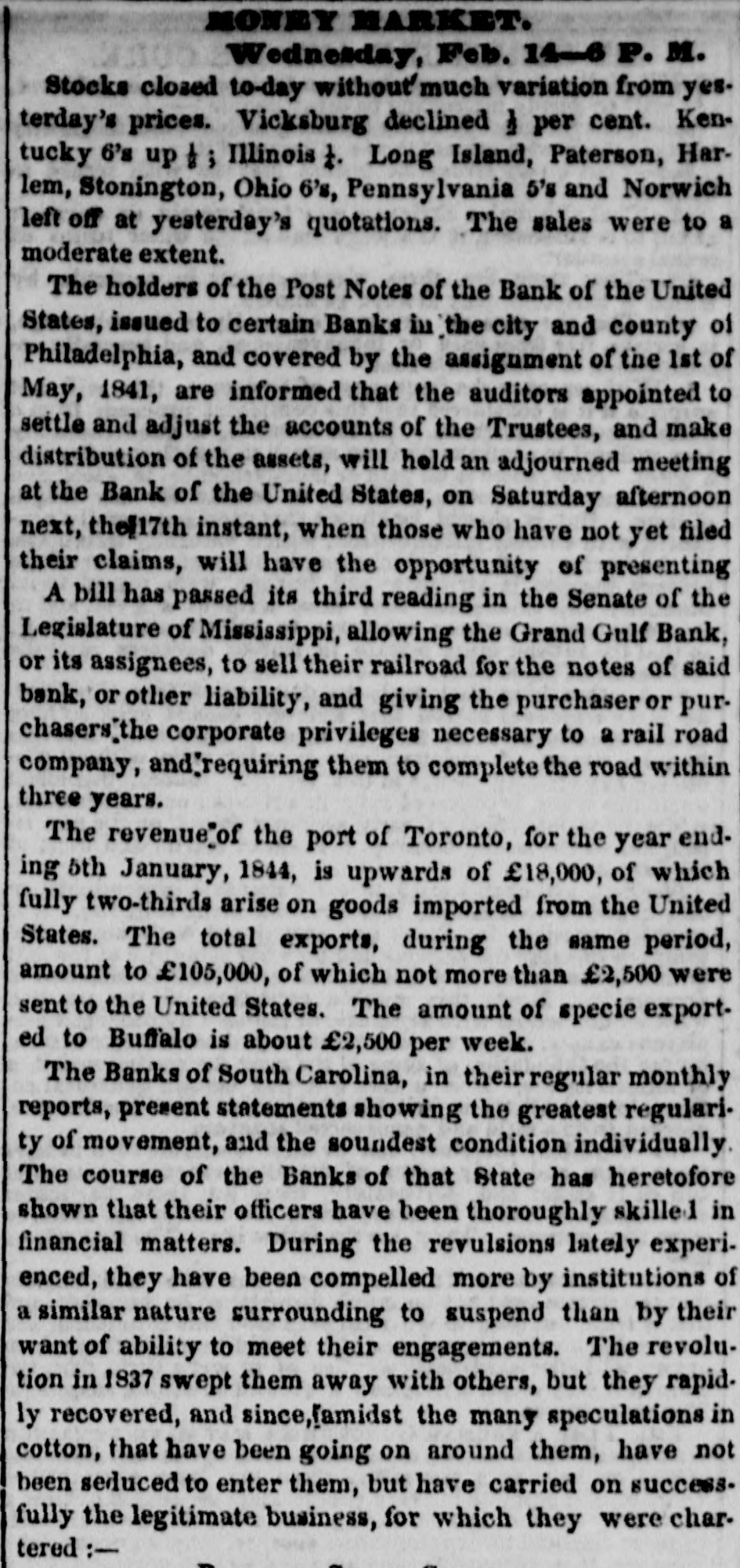
The holders of the Post Notes of the Bank of the United States, issued to certain Banks in the city and county of Philadelphia, and covered by the assignment of the 1st of May, 1841, are informed that the auditors appointed to settle and adjust the accounts of the Trustees, and make distribution of the assets, will hold an adjourned meeting at the Bank of the United States, on Saturday afternoon next, the 17th instant, when those who have not yet filed their claims, will have the opportunity of presenting

A bill has passed its third reading in the Senate of the Legislature of Mississippi, allowing the Grand Gulf Bank, or its assignees, to sell their railroad for the notes of said bank, or other liability, and giving the purchaser or purchasers the corporate privileges necessary to a rail road company, and requiring them to complete the road within three years.

The revenue of the port of Toronto, for the year ending 5th January, 1844, is upwards of £18,000, of which fully two-thirds arise on goods imported from the United States. The total exports, during the same period, amount to £105,000, of which not more than £2,500 were sent to the United States. The amount of specie exported to Buffalo is about £2,500 per week.

The Banks of South Carolina, in their regular monthly reports, present statements showing the greatest regularity of movement, and the soundest condition individually. The course of the Banks of that State has heretofore shown that their officers have been thoroughly skilled in financial matters. During the revulsions lately experienced, they have been compelled more by institutions of a similar nature surrounding to suspend than by their want of ability to meet their engagements. The revolution in 1837 swept them away with others, but they rapidly recovered, and since, famidst the many speculations in cotton, that have been going on around them, have not been seduced to enter them, but have carried on successfully the legitimate business, for which they were chartered :-


Article from The Daily Dispatch, March 2, 1852

Click image to open full size in new tab

Article Text

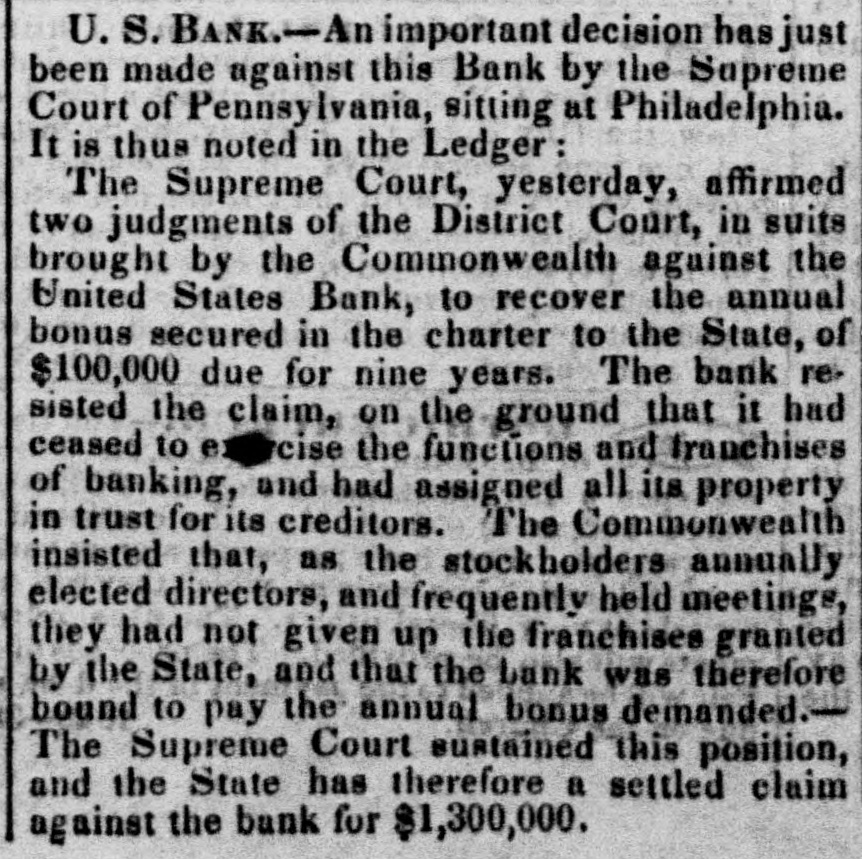
U. S. BANK.- An important decision has just been made against this Bank by the Supreme Court of Pennsylvania, sitting at Philadelphia. It is thus noted in the Ledger: The Supreme Court, yesterday, affirmed two judgments of the District Court, in suits brought by the Commonwealth against the United States Bank, to recover the annual bonus secured in the charter to the State, of $100,000 due for nine years. The bank resisted the claim, on the ground that it had ceased to er cise the functions and franchises of banking, and had assigned all its property in trust for its creditors. The Commonwealth insisted that, as the stockholders annually elected directors, and frequently held meetings, they had not given up the franchises granted by the State, and that the bank was therefore bound to pay the annual bonus demanded.The Supreme Court sustained this position, and the State has therefore a settled claim against the bank for $1,300,000.


Article from The Republic, March 2, 1852

Click image to open full size in new tab

Article Text

UNITED STATES BANK

The supreme court of Pennsylvania, on the 27th ultimo, as we learn from the Philadelphia Ledger, affirmed two judgments of the district court, in suits brought by the Commonwealth against the United States Bank, to recover the annual bonus secured in the charter to the State, of $100,000 due for nine years. The bank resisted the claim, on the ground that it had ceased to exercise the functions and franchises of banking, and had assigned all its property in trust to its creditors. The Commonwealth insisted that, as the stockholders annually elected direc. tors, and frequently held meetings, they had not given up the franchise granted by the State, and that the bank was therefore bound to pay the annual bonus demanded. The supreme court sus. tained this position ; and the State has therefore a settled claim against the bank for $1,300,000.