Beaver National Bank (New York, NY)

Episode Information

Episode UID
863401294
Episode Type
Suspension β†’ Closure
Bank Type
national
Bank ID
86340 national
Charter Number
8634
Start Date
October 26, 1907
Location
New York, New York (40.714, -74.006)

Metadata

Model
gpt-5-mini (chosen from majority vote of a three-model LLM ensemble)
Short Digest
b74fc6484fc67b99

Response Measures

None

Description

Federal examiners effectively assumed charge during the October 1907 crisis; bank later went into voluntary liquidation.

Events (4)

1. April 6, 1907 Chartered
Source
historical_nic
2. October 26, 1907 Suspension
Cause
Government Action
Cause Details
Savings banks invoked 30-90 day notice clause and banks collectively suspended cash payments during the October 1907 panic; federal examiners took charge of Beaver National to avoid immediate suspension.
Newspaper Excerpt
All of the savings banks in New York today refused to pay depositors on demand... took advantage of the clause... which permits them to demand from thirty to ninety days' notice
Source
newspapers
3. January 3, 1908 Other
Newspaper Excerpt
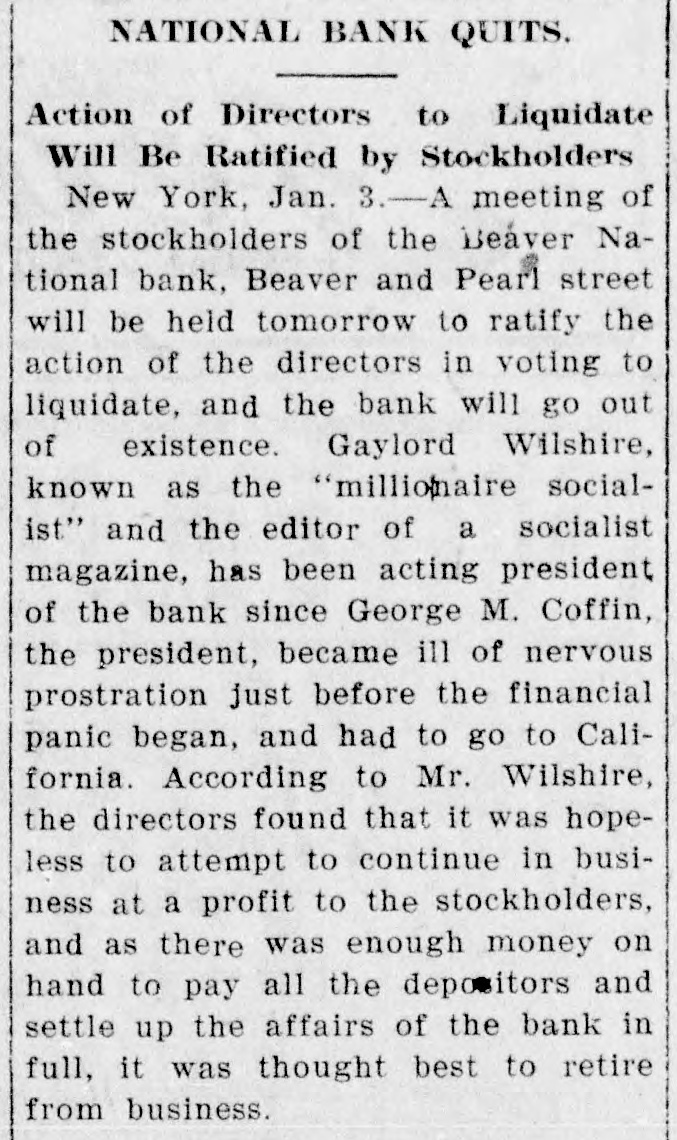
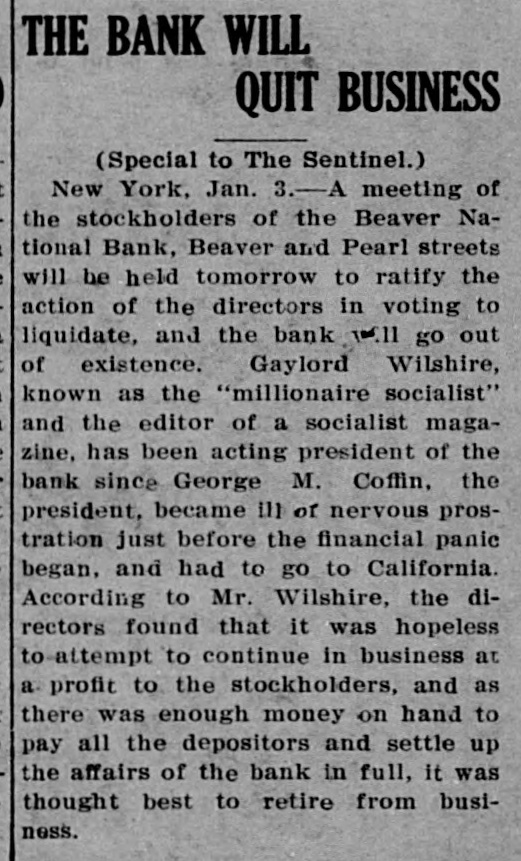
A meeting of the stockholders of the Beaver National Bank... will ratify the action of the directors in voting to liquidate, and the bank will go out of existence.
Source
newspapers
4. January 14, 1908 Voluntary Liquidation
Source
historical_nic

Newspaper Articles (23)

Article from New-York Tribune, April 14, 1907

Click image to open full size in new tab

Article Text

TOPICS OF THE STREET active FOREIGN TRADING.-Foreign houses factors In in the local market. ance. the London market buying on Tinto stronger tone. with a marked rally prices in ures in shares. these issues also being Paris. The money market at strong exchange capitals was quiet. An advance in the the foreign for rate sufficient to check gold Egyptian foreign that point had a favorable influence. withdrawals land will circles it is thought that the Bank In some count not make a further reduction of Eng. ered rate in the near future. while it be not improbable that considerable difficulty will is consid. experienced in preventing an advance. MARKET GOSSIP.-The bear party dence the of vigorous health, and in its shows ever last three days it has met with no operations ef worthy of the name. As a consequence opposition interest ing has been materially increased, the short houses operations of many substantial represent that believe the absence of public speculative general warrants lower prices, irrespective of the fact buying his conditions are sound. James R. that following are said to be bearish on the Keene and man Union shares while despite the dividend Harriin the and Southern Pacific there has been position last week the sale of shares that noted out of the market. though this selling have been represented than necessities compelling sales may have adverse investment sentiment on the rather erable man roads. Boston sold Amalgamated in Harri= active volume. Charles Head Co., however, considbuyers, and some stock went to were is parently from Standard Oil sources, where orders no evidence of bearishness on the market there for deed, the chances are No. 26 Broadway is Inthe long pull. An active floor trader bullish bull terday that while the bear account had increased,a said yes market needed something more than interest the upon which to depend, and that a short short account there was no indication of beyond port. Investment buying has dwindled to small sup. proportions. but this Is not surprising. as the reinvestment while of April disbursements has run its there is not in the public's hands much course, nels capital, owing to the activity of funds in idla of trade. Flower & Co. were heavy sellers chanAmerican Smelting, and Morison Brothers had large ders selling orders in Pennsylvania. Stop were caught in a number of issues on the decline. and the known weak long accounts were "gunned for" with considerable success. ment. ment being helped by an unfavorable bank the move Street sentiment favored the view of state active declines this week, barring the development further of an outside demand. COPPER MARKET CONDITIONS.-Several New York metal selling agencies are now 241/2 trolytic copper for June delivery on the selling basis elec- of cents. f. O. b., New York. The market. however, cies is practically at a standstill. The that have made the quotation of 241/2 cents se tle with the producers for which they sell on the basis of average prices reported by "The Engineer Metals S ing and Mining Journal." The United 2514 ing Company, which is maintaining the price cents, settles with its companies on the basis of actual sales. The selling agencies which have made the 243 cent quotation admit that they have but little copper for sale this side of July, that it is possible quotations may be shaded several cents, but say there is no occasion for any radical reduction in prices. A representative of one of the leading selling agencies says: Copper may go down to 24. 23. or. possibly. 2316 cents a pound. and then, again. it down at all. Everybody is looking for may not but may be disappointed believe that lower prices, basis of cents for copper consumers would purchase enormously even to as great an extent as did when the Amalgamated interests cut the metal they cents after fictitious quotations at 17 cents. Con- to ditions, however, are different. There solutely no stocks and no legitimate reason drop quotations. Consumption is ahead of production, and there is just as much reason to maintain the price of copper at 25 cents as there was put the price there. There has been no change in trade conditions except the general knowledge that prices of the metal are abnormally high, and that some time they will have to come down." STEEL BILLETS AND BARS Steel billets are extremely scarce at Pittsburg. and are available only by shipment from other producing points Eastern steel is offered in Pittsburg. an unusual though by no means unprecedented occurrence, pointing at once to the scarcity In Pittsburg and an easier tone in billets in the East. Agricultural implement interests have abandoned their idea of obtaining concessions on steel bar contracts, as they usually have. and a number have placed contracts at the full price for the second half of this year. With a concession they would have bought to July next BEAVER NATIONAL BANK OPEN FOR BUSINESS. Beaver National Bank. at Beaver and Pearl streets, announces that it is open for business. The management states that it will make a special effort to foster and serve the mercantile interests of the community. and is prepared to grant every service consistent with the safe and sound administration of its affairs. George M Coffin is president of the bank: S. H. Vandergrift and T. P. Welsh vice-presidents, and J. D. Loughline assistant cashier The bank's depositaries are the National City Bank and the Empire Trust Company. RAILROAD GROSS EARNINGS.-The total gross earnings of twenty-nine roads for the first week of April amounted to $7,489,379. as compared with $6,588,533 in the corresponding period a year ago, an increase of $900,846. or 13.71 per cent. For the fourth week of March the total gross earnings of forty-one roads aggregated $14,765,658. as against $13,485,514 in the same week last year, an increase of $1,250,144. or 9.49 per cent. DIVIDENDS DECLARED-Dividends have been declared as follows: Grand Rapids & Indiana reg= ular semi-annual 1% per cent, payable on April 25: Dominion Natural Gas Company regular 2 per cent, payable on April 25: British Columbia Packs ers' Association 31/2 per cent on the preferred stock en account of back dividends, payable on May 30 Grand Trunk Railway of Canada semi-annual per cent on the guaranteed non-cumulative stock 23/2 per cent on the first preferred. 2% per cent on the second preferred. and an annual dividend of 3 per cent on the third preferred, payable on April 300 PIG IRON SCERTIFICATES.-pig Iron certificates at the New York Produce Exchange were quiet and unchanged. There were no sales. Prices for stand< ard foundry follow: Cash. $22.75 bid: April, $23.0 $24 50; May. $22.75 bid: June, $22.25 bid: July, $210 $21 75; August, $21@$21.5 September, $20 @$21 Oetober, $21 asked. MOVEMENT OF COTTON.-"The Financial Chronicle" reports the total receipts of cotton for the week ended April 12 at 113,585 bales, against 109,008 bales in the preceding week. making the total receipts since September 1, 1906, 9,084,066 bales against 6,856,598 bales for the same period of 1905-06 showing an increase since September 1. 1906 2,177,468 bales
Article from The Washington Times, October 26, 1907

Click image to open full size in new tab

Article Text

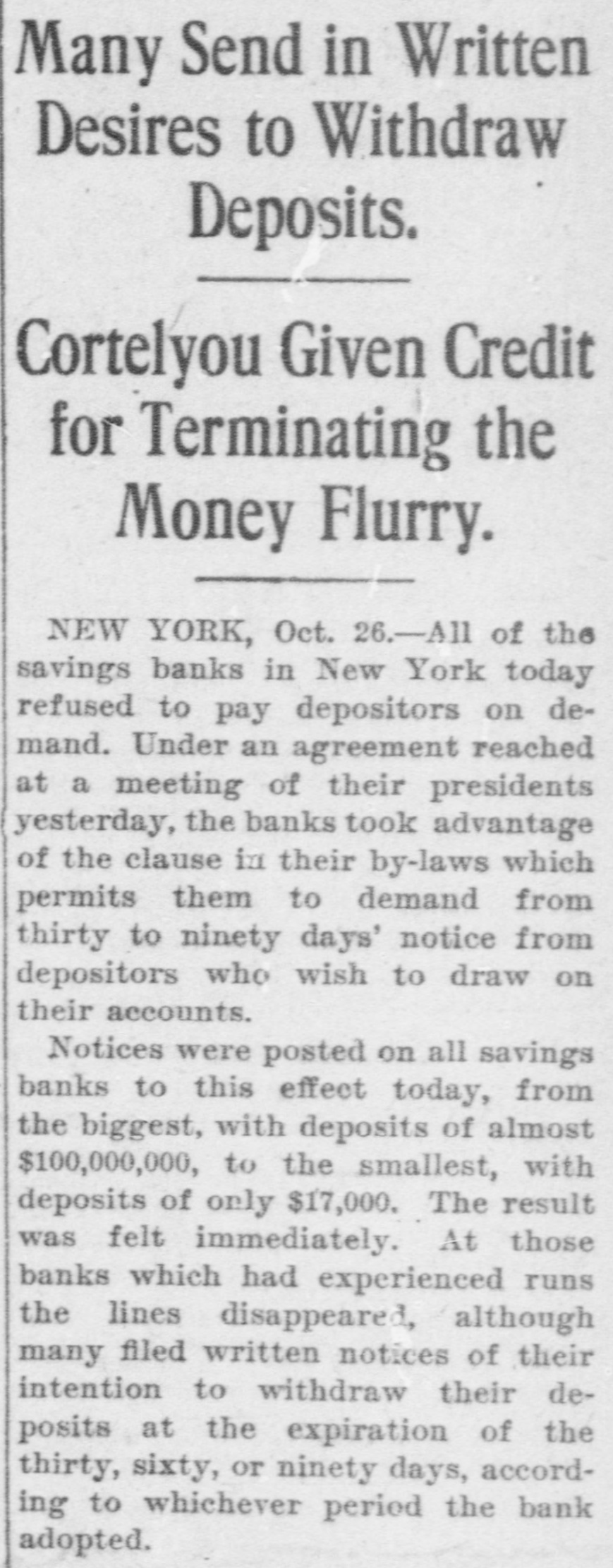
Many Send in Written Desires to Withdraw Deposits. Cortelyou Given Credit for Terminating the Money Flurry. NEW YORK, Oct. 26.-All of the savings banks in New York today refused to pay depositors on demand. Under an agreement reached at a meeting of their presidents yesterday, the banks took advantage of the clause in their by-laws which permits them to demand from thirty to ninety days' notice from depositors who wish to draw on their accounts. Notices were posted on all savings banks to this effect today, from the biggest, with deposits of almost $100,000,000, to the smallest, with deposits of only $17,000. The result was felt immediately. At those banks which had experienced runs the lines disappeared, although many filed written notices of their intention to withdraw their deposits at the expiration of the thirty, sixty, or ninety days, according to whichever period the bank adopted.


Article from New-York Tribune, October 26, 1907

Click image to open full size in new tab

Article Text

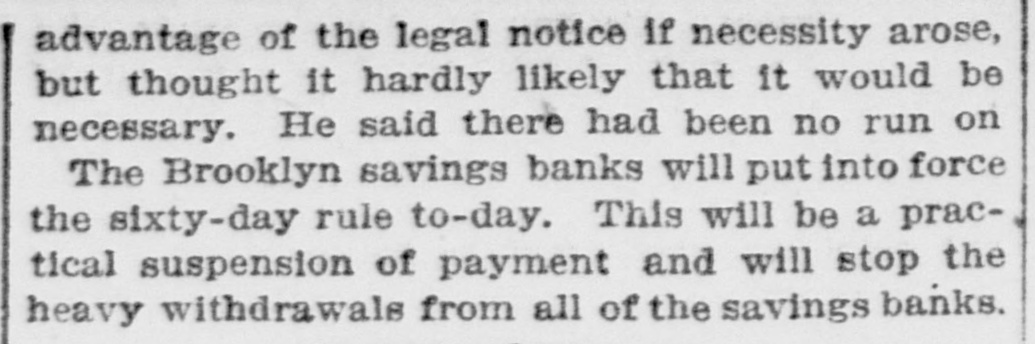
advantage of the legal notice If necessity arose, but thought it hardly likely that it would be necessary. He said there had been no run on The Brooklyn savings banks will put into force the sixty-day rule to-day. This will be a practical suspension of payment and will stop the heavy withdrawals from all of the savings banks.


Article from The Madison Daily Leader, October 30, 1907

Click image to open full size in new tab

Article Text

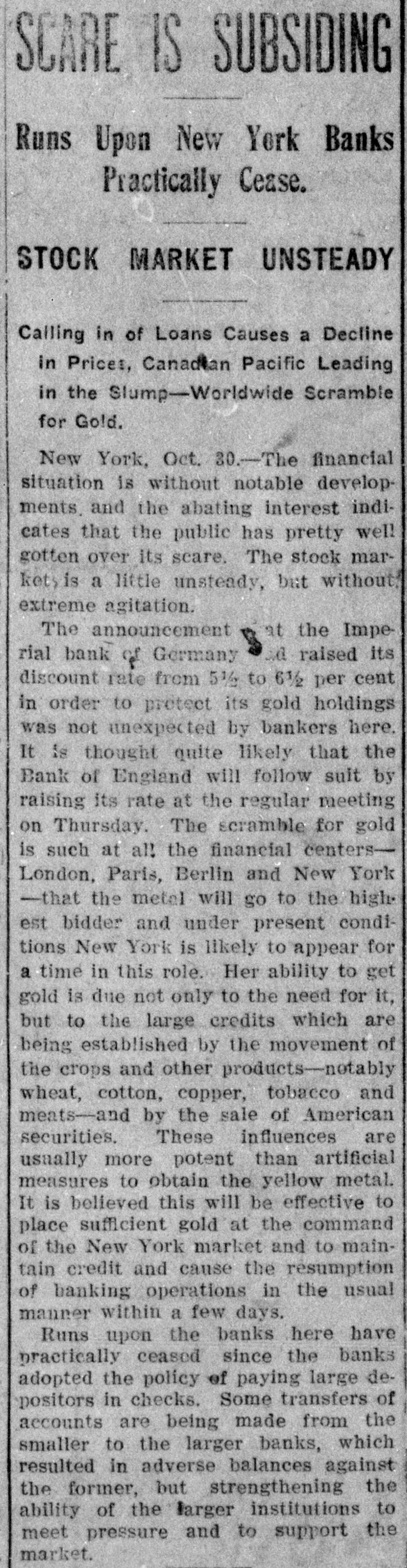
SCARE IS SUBSIDING Runs Upon New York Banks Practically Cease. STOCK MARKET UNSTEADY Calling in of Loans Causes a Decline in Prices, Canadian Pacific Leading in the Slump-Worldwide Scramble for Gold. New York, Oct. 30.-The financial situation is without notable developments. and the abating interest indicates that the public has pretty well gotten over its scare. The stock markets is a little unsteady, but without extreme agitation. The announcement at the ImpeS rial bank of Germany a raised its discount rate from 5 1/2 to 6 1/2 per cent in order to protect its gold holdings was not unexpected by bankers here. It is thought quite likely that the Bank of England will follow suit by raising its rate at the regular meeting on Thursday. The scramble for gold is such at all the financial centersLondon, Paris, Berlin and New York -that the metel will go to the highest bidder and under present conditions New York is likely to appear for a time in this role. Her ability to get gold is due not only to the need for it, but to the large credits which are being established by the movement of the crops and other products-notably wheat, cotton, copper, tobacco and meats-and by the sale of American securities. These influences are usually more potent than artificial measures to obtain the yellow metal. It is believed this will be effective to place sufficient gold at the command of the New York market and to maintain credit and cause the resumption of banking operations in the usual manner within a few days. Runs upon the banks here have practically ceased since the banks adopted the policy of paying large depositors in checks. Some transfers of accounts are being made from the smaller to the larger banks, which resulted in adverse balances against the former, but strengthening the ability of the larger institutions to meet pressure and to support the market.


Article from Jamestown Weekly Alert, October 31, 1907

Click image to open full size in new tab

Article Text

A Sensible Arrangement-As will be seen by a statement of the officers of the Jamestown banks, precautionary measures were adopted Tuesday to prevent an unnecessary withdrawal of currency from the banks. This action was deemed necesasry on account of financial *troubles in New York, that have created a temporary scarcity of currency and gold, for the usual necessities of business. This is not due to local conditions of any kind. The Jamestown banks were never in a more flourishing condition, and their solvency is beyond any question. The trouble seems to be with the immense amount of business to be transacted, especially in the northwest at his special time of the year. and the difficulty of securing the necessary currency from the east to move the crop. The New York and Chicago banks have declined to ship currency or balances due to the western banks and it is necessary that the banks of the northwest take the same steps that the Chicago and New York banks have taken, in withholding currency withdrawals of the"present. The plan established by the banks will not greatly inconvenience depositors. Any one who has a checking account at any of the banks can pay store bills or any other bills by check or draft just the same as in currency. Ans debt to be paid outside of the city, may be paid_in"the same*way. The action taken_by the banks is an unusual one, but is the only safe. sensible and business-like way, in dealing with an: emergency, the cause of which has no relation to any local conditions, but exists outside of Jamestown, and the state of North Dakota, and which orginated in New York City, where the banks have been compelled to refuse to ship 'currency to the west for moving crops and for other necessities. Currency will be paid out, but in small amounts, and the certificates of the various banks will be substituted for currency where payments are desired in large amounts These certificates are guaranteed by the banks and securities of double the amount have been deposited with the trus. tee, Alfred Steel, as a guarantee that the certificates will be redeemed. There is no Fcause or any reason for any alarm and it is believed that these unusual conditions of a currency shortage will be removed within a short time. Every sensible, reasonable person will understand that the interests of the general community are vastly superior to that of a few individuals, and that by this united action on the part of the banks, the absolute safety of depositors interests is thus secured and business not interfered with.


Article from The Newspaper, November 15, 1907

Click image to open full size in new tab

Article Text

Whatever change cccurs now will be for the better. Apparently we are now all in the same boat with New York and as her condition improves ours will mend. Two great factors have combined to force the troubles of New York on the rest of the country. One was the fact that the rest of the country had several hundred million dollars in New York banks which had united in refusing to pay it out. The other was that the crop moving period having arrived, western and southern banks, unable to get their money from New York, were getting it from the other reserve centers, Chicago being the chief. With thirty or forty million dollars tied up in New York, Chicago could not meet the strain and not only suspended as New York had done, the making of case payments, but advised and forced the other cities of the west to do the same. The effect will be to keep money in the banks, to expand the currency by the injection of certified checks, cashier's checks and clearing house certificates, and to give the country time to regain its financial equilibrium." In the midst of this time of plenty everyone is asking, "How did it happen?" The WorldHerald throws some light upon the situation in this way:-"The four great banking institutions in New York belong to what is known as the Standard Oil crowd." They are the National City bank, with $193,900,000 deposits; the National Bank of Commerce, with $145,000,000 deposits; the First National with $107,000,000 and the Park National with $90,500. 000. Then there are eight great trust companies which are banks that do a banking business, practically without reserve. They are the Farmers Loan and Trust company, with $88,000,000 deposits; the Knickerbocksr, with $70,000,000; the Central with $67,000,000; the United States with $65,000,000; the Trust Company of America, with $61,000,000; the Union Trust company, with $58,000,000; the New York Guarantee and Morton, with $59,000,000 each. In those institutions was concentrated al most exactly $1,000,000,000 and there was where the trouble began. The trust companies were competitors of these and other


Article from The Ranch, November 15, 1907

Click image to open full size in new tab

Article Text

THE FINANCIAL SITUATION. The practical suspension of currency payment on the part of most of the banks of the principal cities of the West no doubt came as a rude shock to most Western farmers and business men. While everybody in the West knew that New York was having quite severe financial trouble, it had not been supposed that it would affect Western interests to any extent. The action of the New York banks suspending currency payments there, however, brought trouble to us in the West very quickly. We will endeavor to give our readers a working idea of the situation at the present time. Banks in small towns and villages do not, for obvious reasons, care to carry any large surplus of cash in their safes. Whenever, therefore, they accumulate more cash in their safes than they need for the ordinary conduct of their business they send the surplus to a bank in some convenient nearby city, Seattle for example. The Seattle bank pays them a small interest on this surplus cash and stands ready to send it back to the country bank whenever the latter calls for it, by letter, phone, or telegraph. Banks in cities like Seattle and Spokane, in turn, keep their surplus cash in the larger banks in the same city, or in Chicago, or New York, and when they need this they call upon the banks with which they have it deposited. The Chicago banks in the same manner send this surplus cash to their correspondent banks in New York City. When business is running along in a normal way the money flows back and forth between these different banks as it is needed to meet the business transactions of the country. The country banker finds that his cash on hand is running lower than it should to meet the demands of his customers so he calls up the Seattle bank in which he has his surplus deposited and tells it to send out by express five thousand or ten thousand or more dollars in cash. The Seattle bank in turn calls for some of its surplus cash from the bank in Chicago with which it is deposited, and Chicago calls from New York. This is the best and safest way for the banks to handle their cash. For some weeks past there have been panicky conditions in New York. These conditions grew worse until people became frightened and began to draw their money out of the banks and store it away. This caused several small banks in New York to close their doors, not because they were not sound financially, but because they did not have enough cash on hands to stand a run. The closing of these banks frightened more people and the situation. grew daily worse until the banks of New York and Chicago got together and determined to refuse to pay out money but instead to pay demands for cash in clearing house certificates, checks and drafts. Consequently, when a bank in Seattle or Spokane drew against its deposits in a New York or Chicago bank, they did not get the cash which they had been accustomed to getting, but were merely credited with that amount against the clearing houses in these Eastern cities. On the other hand, when the country banks in turn, drew against the banks of Spokane, Seattle, Portland and Tacoma, the banks of the Western cities had to pay out their cash. A situation of this sort would soon have lowered very materially the reserves on hand in the Western banks, so all the Northwestern and Western cities were finally compelled to adopt the clearing house certificate plan to protect themselves and their depositors. These banks would have had sufficient money on hands to meet all demands from their depositors, but they were not in position to pay out money to the country banks in cash, and then get only clearing house credit from the larger cities when they attempted to supplement this withdrawal by calling in their own deposits in the East. There is nothing about the financial situation to cause the slightest alarm. There are few who know better than the readers of The Ranch the splendid crops which were produced in the Northwest this year and the top-notch prices which the farmers received for them. Business of all sorts in the cities was never better and the


Article from Lewiston Evening Teller, November 22, 1907

Click image to open full size in new tab

Article Text

Chicago banks are ready to resume cash business and will do so whenever New York banks consent and co-operate. The magnates who have been asking the people to have confidence can now reciprocate and loosen up the wheels of trade bot' east and west. It was the east that locked the doors on western reserves and started the flurry among western institutions. but in spite of that the west has had no run on its. banks and has only used due precaution In guarding its cash waiting for the east to get over its scare and resume normal business relations. New York can very properly be instructed that the only proper way to resume is to resume.


Article from The Roswell Daily Record, December 3, 1907

Click image to open full size in new tab

Article Text

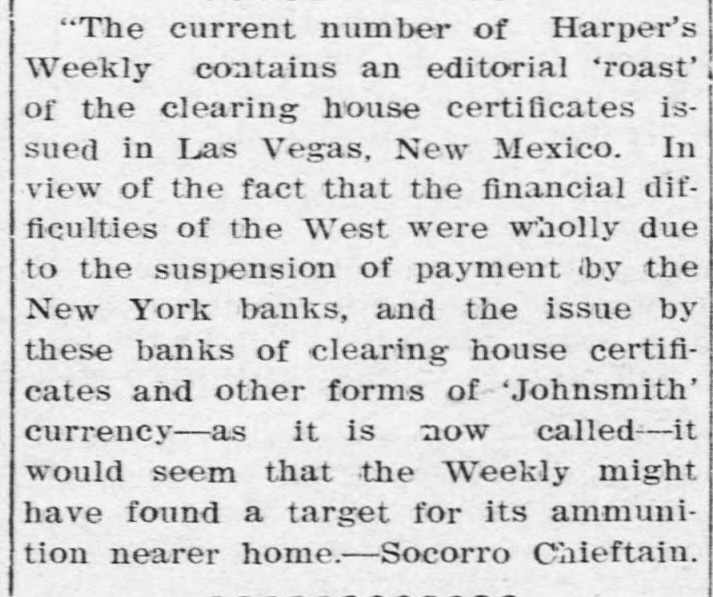
"The current number of Harper's Weekly contains an editorial 'roast' of the clearing house certificates issued in Las Vegas, New Mexico. In view of the fact that the financial difficulties of the West were wholly due to the suspension of payment by the New York banks, and the issue by these banks of clearing house certificates and other forms of 'Johnsmith' currencyβ€”as it is now calledβ€”it would seem that the Weekly might have found a target for its ammunition nearer home.β€”Socorro Chieftain.


Article from Deseret Evening News, December 3, 1907

Click image to open full size in new tab

Article Text

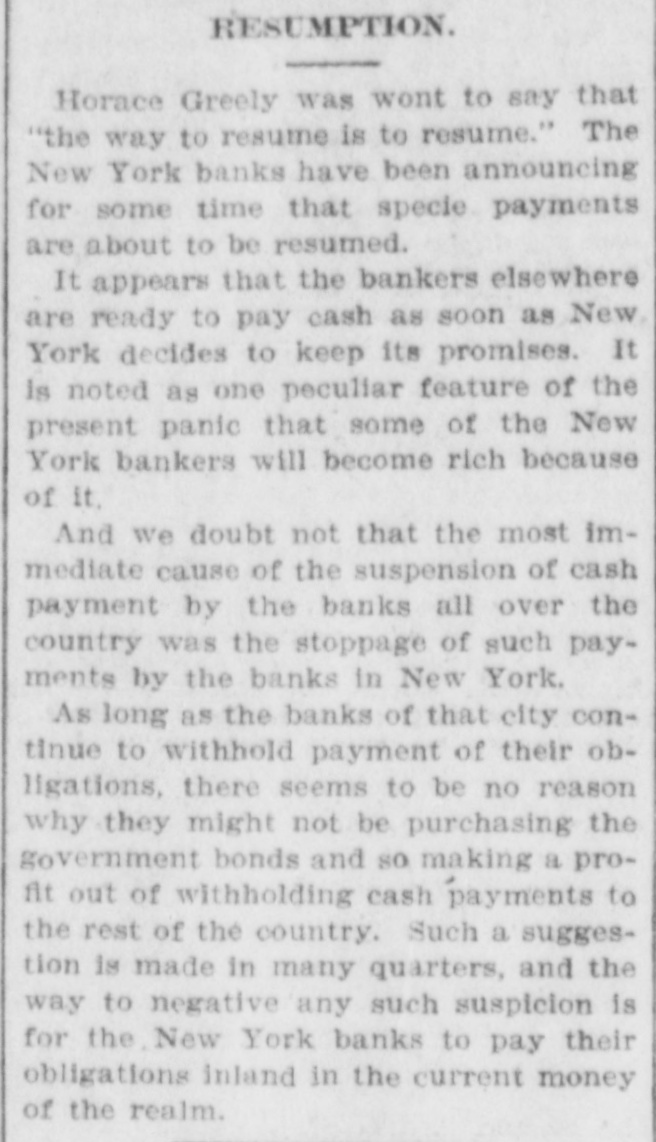
# RESUMPTION. Horace Greely was wont to say that "the way to resume is to resume." The New York banks have been announcing for some time that specie payments are about to be resumed. It appears that the bankers elsewhere are ready to pay cash as soon as New York decides to keep its promises. It is noted as one peculiar feature of the present panic that some of the New York bankers will become rich because of it. And we doubt not that the most immediate cause of the suspension of cash payment by the banks all over the country was the stoppage of such payments by the banks in New York. As long as the banks of that city continue to withhold payment of their obligations, there seems to be no reason why they might not be purchasing the government bonds and so making a profit out of withholding cash payments to the rest of the country. Such a suggestion is made in many quarters, and the way to negative any such suspicion is for the New York banks to pay their obligations inland in the current money of the realm.


Article from Albuquerque Morning Journal, December 27, 1907

Click image to open full size in new tab

Article Text

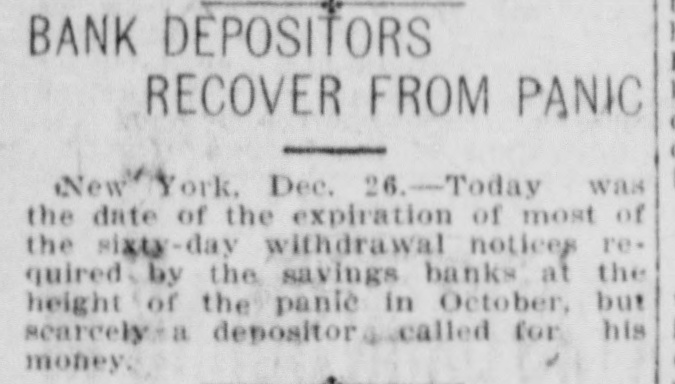
BANK DEPOSITORS RECOVER FROM PANIC (New York. Dec. 26.-Today was the date of the expiration of most of the sixty-day withdrawal notices re. quired by the savings banks at the height of the paniè in October, but searcely a depositor called for his money


Article from The Waxahachie Daily Light, January 3, 1908

Click image to open full size in new tab

Article Text

NATIONAL BANK QUITS. Action of Directors to Liquidate Will Be Ratified by Stockholders New York, Jan. 3.-A meeting of the stockholders of the Beaver National bank. Beaver and Pearl street will be held tomorrow to ratify the action of the directors in voting to liquidate, and the bank will go out of existence. Gaylord Wilshire, known as the "millionaire socialist" and the editor of a socialist magazine, has been acting president of the bank since George M. Coffin, the president, became ill of nervous prostration just before the financial panic began, and had to go to California. According to Mr. Wilshire, the directors found that it was hopeless to attempt to continue in business at a profit to the stockholders, and as there was enough money on hand to pay all the depositors and settle up the affairs of the bank in full, it was thought best to retire from business.


Article from Bluefield Evening Leader, January 3, 1908

Click image to open full size in new tab

Article Text

BANK PAYS ALL DEPOSITORS IN FULL AND CLOSES ITS DOORS- EDITOR OF THE SOCIALIST MAGAZINE HAS BEEN ACTING PRESIDENT. of (New York, Jan. 3. A meeting the stockholders of the Beaver National Bank, Beaver and Pearl streets, will be held tomorrow to ratify the action of the directors in votin gto liquidate, and the bank will go out of existence Gaylord Wilshire, known as the "millionaire socialist" and the editor of a socialist magazine, has been acting president of the bank since George M. Coffin the president, became III of nervous prostration just before the financial panic began, and had to go to California. According to Mr. Wilshire, the directors found that it was hopeless to attempt to continue in business at a profit to the stockholders, and as there was enough money on hand to pay all the depositors and settle up the affairs of the bank in full it was thought best to retire from business.


Article from Coeur D'alene Evening Press, January 3, 1908

Click image to open full size in new tab

Article Text

NATIONAL BANK QUITS Meeting Will be held to Ratify Action of Directors. NEW YORK, Jan. 3.-A meeting of the stockholders of the Beaver National bank, Beaver and Pearl streets, will be held tomorrow to ratify the action of the directors in voting to liquidate, and the bank will go out of existence. Gaylord Wilshire, known as the "millionaire socialist" and the editor of a socialist magazine, has been acting president of the bank since George M. Coffin, the president, became ill of nervous prostration just before the financial panic began, and had to go to California. According to Mr. Wilshire, the directors found it was hopeless to attempt to continue in business at a profit to the stockholders, and as there was enough money on hand to pay all the depositors and settle up the affairs of the bank in full, It was thought best to retire from business.


Article from Pine Bluff Daily Graphic, January 3, 1908

Click image to open full size in new tab

Article Text

NATIONAL BANK QUITS BUSINESS New York, Jan. 3.-A meeting of the stockholders of the Beaver National Bank, Beaver and Pearl streets, will be held tomorrow to ratify the action of the directors in voting to liquidate, and the bank will go out of existence. Gaylord Wilshire, known as the "millionaire socialist," and the editor of a socialist magazine, has been acting president of the bank since George M. Coffin, the president, became ill of nervous prostration just before the financial panic began and had to go to California. According to Mr. Wilshire, the directors found that it was hopeless to attempt to continue in business at a profit to the stockholders, and as here was enough money on hand to pay all depositors and settle up the affairs of the bank in full, it was thought best to retire from business.


Article from The Daily Ardmoreite, January 3, 1908

Click image to open full size in new tab

Article Text

NATIONAL BANK SUITS. Beaver National of New York Closes Tomorrow. Ardmoreite Special. New York. Jan. 3.-A meeting of the stockholders of the Beaver National Bank, Beaver and Pearl streets. will be held tomorrow to ratify the action of the directors in voting to liquidate. and the bank will go out of existence. Gaylord Wilshire, known as the 'millionaire socialist" and the editor of a socialist magazine. has been acting president of the bank since Geo. M. Coffin, the president, became ill of nervous prostration just before the financial panic began, and had to go to California. According to Mr. Wilshire, the directors found that it was hopeless to attempt to continue in business at a profit to the stockholders, and as there was enough money on hand to pay all the depositors and settle up the affairs of the bank in full, it was thought best to retire from business.


Article from The Daily Sentinel, January 3, 1908

Click image to open full size in new tab

Article Text

THE BANK WILL QUIT BUSINESS (Special to The Sentinel.) New York, Jan. 3.-A meeting of the stockholders of the Beaver National Bank, Beaver and Pearl streets will be held tomorrow to ratify the action of the directors in voting to liquidate, and the bank 11 go out of existence. Gaylord Wilshire, known as the "millionaire socialist" and the editor of a socialist magazine, has been acting president of the bank since George M. Coffin, the president, became ill of nervous prostration just before the financial panic began. and had to go to California. According to Mr. Wilshire, the directors found that it was hopeless to attempt to continue in business at a. profit to the stockholders, and as there was enough money on hand to pay all the depositors and settle up the affairs of the bank in full, it was thought best to retire from business.


Article from The Fairmont West Virginian, January 4, 1908

Click image to open full size in new tab

Article Text

National Bank Quits. NEW YORK. Jan. 3.-A meeting of the stockholders of the Beaver National Bank, Beaver and Pearl streets, will be held to-morrow to ratify the action of the directors in voting to liquidate, and the bank will go out of existence. Gaylord Wilshire, known as the "millionaire socialist" and the editor of a socialist magazine, has been acting president of the bank since George M. Coffin, the president, became ill of nervous prostration just before the financiall panic began. and had to go to California. According to Mr. Wilshire, the directors found that it was hopeless to attemp to continue in business at a profit to the stockholders, and as theer was enough money on hand to pay all the depositors and settle up the affairs of the bank in full, it was thought best to retire from business.


Article from Semi-Weekly Herald, January 6, 1908

Click image to open full size in new tab

Article Text

wrecked sailors, believed to be the of a crew bark only the Norwegian survivors Germanic, of sixteen were of brought here today by the steamer Hothan Newton. They were picked up in mid-ocean on December 17 in terfrom eight vessel had abandays rible after condition their exposure, been doned. Another boat which contained eight men has not been found. The captain of the bank who remained on board until all men found places in the small boats, went down with his ship. Shanghai, Jan. 3.-Wu Ting Fang, recently reappointed to the post of Chinese minister to the United States, will sail early this morning, taking with him a number of young Chinese students. St. Petersburg, Jan. 3.-Niaeteen conspirators, charged with plotting to kill the dowager empress, mother of the czar, weer arrested here. They had made all the arrangements to slay her with a bomb. Secret police are suppressing details. For some time the dowager has suffered from a mania that some one was going to assassinate her, and not many months ago she was officially declared insane by the czar's personal physician. Columbus, O., Jan. 3-Victory perched upon the banners of Secretary Taft's political army when the Ohio Republican state central committee by vote of 14 to 7. which never varied in the battle of amendments which raged all the afternoon, ordered the state convention held at Columbus on March 3 and 4, six weeks earlier than usual and directed that delegates to this convention be selected by direct vote of primaries throughout the state on February 11. Bay City, Mich., Jan. 3.-Prominent officers of the Salvation army from various parts of the country are assembling here today for the congress and meetings to be held here during the next four days. The feature of the gathering will be the dedication of the new Salvation Army barracks in this city. Telluride, Jan. 3-John dehring held up the National club this morning about 7 o'clock and got away with the roulette dealer's bank roll. Gehring, who had been gambling all night and lost his wad, concluded that it would be a good time to replenish his cash supply, as there was no one in the room at the time but hilmself and the dealer. After obtaining the money he stepped out the back way and went to his home in the west part of the city. Here he left his gun. telling his wife that he had done something desperate, and headed westward. Officers are after him and it is likely he will be apprehended soon. New Yrk, Jan. 3.-A meeting of the stockholders of the Beaver National bank, Beaver and Pearl streets, will be held tomorrow to ratify the action of the directors in voting to liquidate, and the bank will go out of existence. Gaylord Wilshire, known as the "millionaire socialist" and the editor of a socialist magazine, has been acting president of the bank since George M. Coffin, the president, became ill of nervous prostration just before the financial panic began, and had to go to California. According to Mr. Wilshire, the directors found that it was hopeless to attempt to continue in business at a profit to the stockholders, and as there was enough money on hand to pay all the depositors and settle up the affairs of the bank in full, it was thought best to retire from business. Salt Lake City, Utah, Jan. 3.-Advices from Ely, Nev., state that probably ten days more will be required before the rescuers reach Brown, McDonald and Bailey, the three miners who have been imprisoned since December 1 in the Alpha shaft of the Giroux mine at Ely. It is likely that the men will have been six weeks in their tomb-like prison before they can be freed. They are able to talk with their rescuers over the mine telephone and declare that they are very well satisfied with their quarters and that there is no particular hurry about getting them out. Water and food is sent down to the men through a six. foot pipe, and they have considerable room for exercise. Air is constantly forced in to them. To while away the time the men occasionally hold vocal concerts, singing over the telephone


Article from Semi-Weekly Herald, January 16, 1908

Click image to open full size in new tab

Article Text

NEW YORK BANKS TO RETIRE. New York, Jan. 15.-The elimination of the Heinzes and Morses from various banks with which they were associated when the recent panic in Wall street began and announcement that the Beaver National bank, with which Gaylord Whilshire, the eminent socialist, was connected, will retire from business were features at the annual meeting of the banks. The Mercantile election was postponed until February 11, but changes with men in the directorate is expected confirmed at a stockholders meeting to give Edwin Gould control of the bank.


Article from New-York Tribune, February 14, 1908

Click image to open full size in new tab

Article Text

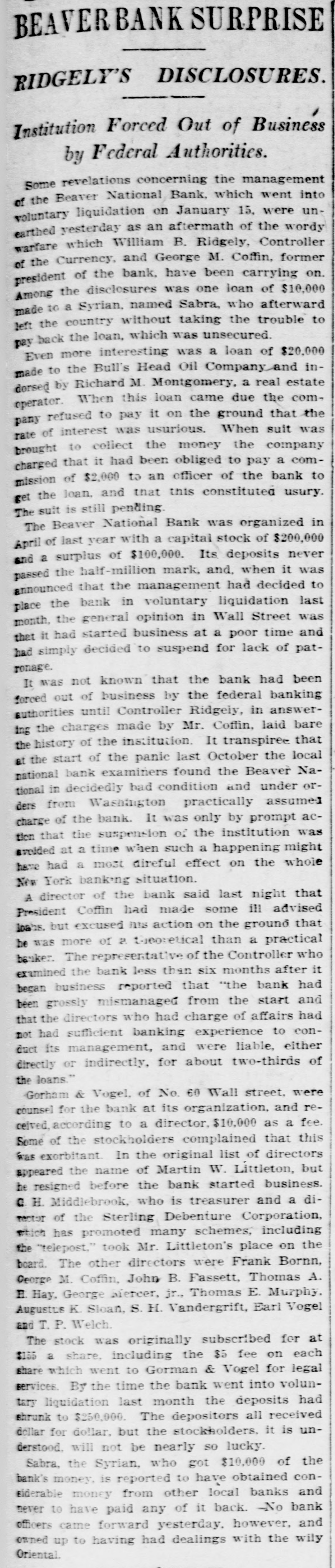
BEAVER BANK SURPRISE RIDGELY'S DISCLOSURES Institution Forced Out of Business by Federal Authorities. Some revelations concerning the management of the Beaver National Bank, which went into voluntary liquidation on January 15. were unearthed yesterday as an aftermath of the wordy warfare which William B. Ridgely, Controller the Currency, and George M. Coffin. former of have been president of the bank, carrying on. Among the disclosures was one loan of $10,000 made to a Syrian, named Sabra, who afterward left the country without taking the trouble to back the was pay loan. interesting which unsecured loan of Even more was a $20,000 made to the Bull's Head Oil Company and indorsed by Richard M. Montgomery, a real estate operator. When this loan came due the company refused to pay it on the ground that the rate of interest was usurious. When suit was brought to collect the money the company charged that it had been obliged to pay a commission of $2,000 to an officer of the bank to get the loan. and that this constituted usury. The suit is still pending. The Beaver National Bank was organized in April of last year with a capital stock of $200,000 and a surplus of $100,000. Its deposits never passed the half-million mark, and, when it was announced that the management had decided to place the bank in voluntary liquidation last month, the general opinion in Wall Street was that it had started business at a poor time and had simply decided to suspend for lack of patronage It was not known that the bank had been forced out of business by the federal banking authorities until Controller Ridgely, in answering the charges made by Mr. Coffin. laid bare the history of the institution It transpiree that at the start of the panic last October the local national bank examiners found the Beaver National in decidedly had condition and under orders from Washington practically assume charge of the bank. It was only by prompt action that the suspension of the institution was avoided at a time when such a happening might have had a most direful effect on the whole New York banking situation. A director of the bank said last night that President Coffin had made some ill advised loans. but excused ms action on the ground that he was more of a Cigosetical than a practical banker. The representative of the Controller who examined the bank less than six months after it began business reported that "the bank had been grossly mismanaged from the start and that the directors who had charge of affairs had not had sufficient banking experience to conduct its management, and were liable, either directly or indirectly, for about two-thirds of the loans." Gorham & Vogel, of No. 60 Wall street, were counsel for the bank at its organization, and received, according to a director, $10,000 as a fee. Some of the stockholders complained that this was exorbitant. In the original list of directors appeared the name of Martin W. Littleton, but he resigned before the bank started business. CH Middlebrook, who is treasurer and a director of the Sterling Debenture Corporation, which has promoted many schemes, including the "telepost," took Mr. Littleton's place on the board. The other directors were Frank Bornn, George M. Coffin, John B. Fassett, Thomas A. Hay, George Mercer, jr., Thomas E. Murphy. Augustus K. Sloan, S.H. Vandergrift, Earl Vogel and T.P. Welch. The stock was originally subscribed for at $155 a share, including the $5 fee on each share which went to Gorman & Vogel for legal services. By the time the bank went into voluntary liquidation last month the deposits had shrunk to $250,000. The depositors all received dollar for dollar. but the stockholders, it is understood. will not be nearly so lucky. Sabra, the Syrian, who got $10,000 of the bank's money, is reported to have obtained conelderable money from other local banks and never to have paid any of it back. -No bank officers came forward yesterday, however, and owned up to having had dealings with the wily Oriental


Article from Tulsa Daily World, November 16, 1911

Click image to open full size in new tab

Article Text

# NECESSITY FOR CURRENCY REFORM. The National Citizens' league for the promotion of a sound banking system in the United States is receiving support and encouragement from every section in the country. It is purely a non-partisan organization and is approaching the subject of currency legislation from a business and not a political point of view. The indications are constantly growing brighter for the successful solution of this problem of national finances upon a basis that will make panics and consequent disasters a thing of the past. In discussing this subject the Saturday Evening Post relates the circumstances which Germany was recently called upon to face and asks the pertinent question, "What would have happenned here?" Upon this point the Post says: "They might have had a panic in Berlin this fall. There had been speculation and overtrading. Credit was under a severe strain. Some eighty million dollars of treasury notes were maturing. The war-clouded political horizon caused France to draw in her money, and the amount of Parsian funds lying at call in Berlin was estimated at 200 million dollars. In some parts of the empire signs of uneasiness among bank depositors appeared. The failure of the Bank of Egypt did not help matters. "The gravity of the situation appears from the fact that in a single week the Imperial Bank lost thirty-nine million dollars of its cash reserve. This is a rather larger loss of cash reserve than the New York associated banks suffered in October, 1907, when they resorted to clearing house loan certificates and restricted cash payments-leading to a wholesale dislocation of the country's banking system. There was no restriction of cash payments at Berlin, however. On the contrary, in six business days the Imperial bank increased its loans and discounts by 145 million dollars, and in order to do so increased its note issue by 154 million dollars. "Thus, notwithstanding the severe strain and the large loss of cash. October settlements were met without a hitch and Berlin paid back to Paris a 150 million dollars of call loans. Ten days later the discount rate at Berlin had fallen to 4 per cent. "All of which shows how a great central bank can deal with a crisis. What would have happened here under like conditions? Perhaps another suspension of cash payments; another breakdown of the banking system; another six or eight months of business doldrums-because we haven't the apparatus to meet a crisis. We know we are rather more liable to fiscal conflagrations than any other great nation; but we rely upon nothing but a volunteer bucket brigade to put them out."


Article from New-York Tribune, December 9, 1913

Click image to open full size in new tab

Article Text

# Resent Charge of Swanson That They Caused Panic of 1907. # DIVISIONS BY PARTY FORGOTTEN IN DEBATE Nelson Urges Passage of Hitchcock Billβ€”Senate Action Possible This Week. [From The Tribune Bureau.] Washington, Dec. 8.--Senators Root and O'Gorman joined forces to-day in defend-ing the bankers of New York, who were made the targets by Senator Swanson in a speech, from the often reiterated attack that they had brought about the panic of 1907 by withholding from the country banks their reserves. Senator O'Gorman declared that the Senator from Virginia was not conversant with the facts when he repeated the charge. "If the Senator had taken ad-vantage of the hearings before the Bank-ing and Currency Committee," he said, "he would not have made the statement. More misapprehension exists about the banking and currency question than about any other public question. Much of the inaccuracies are based upon ignorance and a desire to aid in disseminating in-formation that thoughtful people know to be without real foundation." Senator O'Gorman charged Senator Swanson with misrepresenting the facts "by indulging in what I conceive to be unwarranted, inaccurate and unfair crit-icism of New York. He does himself an injustice and does an injustice to his own constituents, whose views he does not re-flect. They are not going to be misled by the thoughtless vaporings of Populistic doctrine, whether they hear it on the hustings or in the Senate chamber." Senator Swanson declared in defence of his position that the statement of the Controller of the Currency on August 22, 1907, showed that the New York banks owed a total of $409,000,000 to their reserve depositors, national and state. "In Octo-ber," he added, "the banks of Richmond had due them between $2,000,000 and $3,000,000, and they could not get the money. The New York banks suspended payment. It was impossible to get shipments of currency from them, although they had $224,000,000 in their vaults."