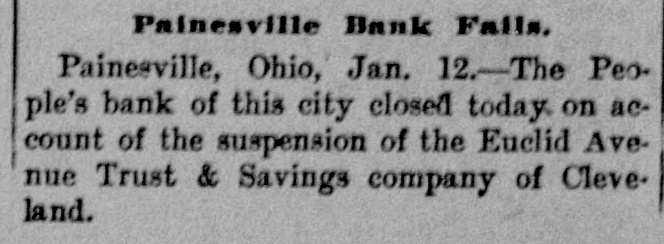
One source shows an OCR typo ('Fuelld' corrected to 'Euclid').
Events (2)
1.January 10, 1902Suspension
Cause
Local Shock
Cause Details
Unable to realize on assets after exposure to the Everett-Moore syndicate collapse and Detroit & Toledo securities going into receivership.
Newspaper Excerpt
The Euclid Avenue Trust and Savings Company assigned this morning to Frank H. Ginn.
Source
newspapers
same day
2.January 10, 1902Receivership
Newspaper Excerpt
The Euclid Avenue Trust and Savings Company assigned this morning to Frank H. Ginn. The latter's bond was fixed at $250,000 by Judge Bloch of the Insolvency Court.
Source
newspapers
Newspaper Articles (20)
1.January 10, 1902The Seattle StarSeattle, WA
Click image to open full size in new tab
Article Text
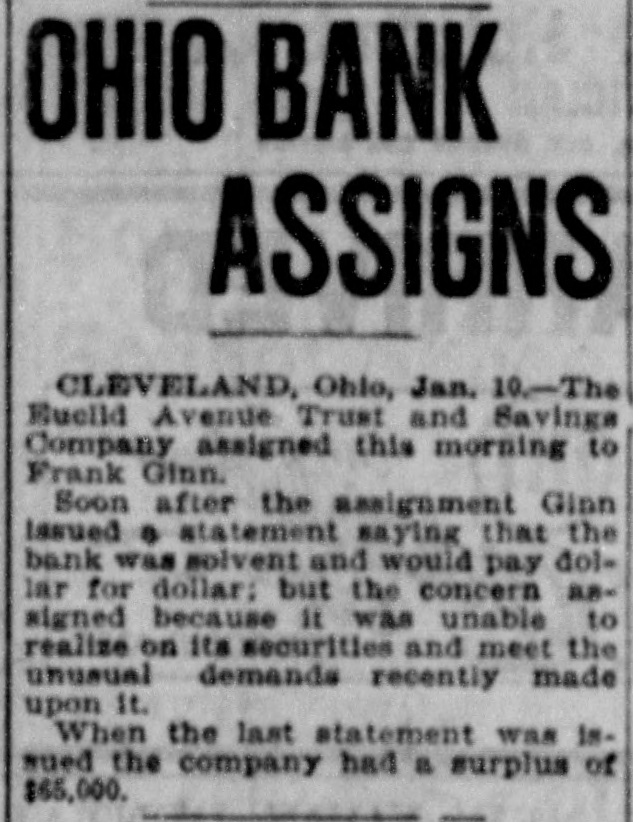
OHIO BANK ASSIGNS CLEVELAND, Ohio, Jan. 10.-The Fuelld Avenue Trust and Savings Company assigned this morning to Frank Ginn. Boon after the assignment Ginn Issued . statement saying that the bank was molvent and would pay dollar for dollar: but the concern assigned because It was unable to realize on its securities and meet the unusual demands recently made upon It. When the last statement was issued the company had a surplus of $65,000.
2.January 10, 1902Rock Island ArgusRock Island, IL
Click image to open full size in new tab
Article Text
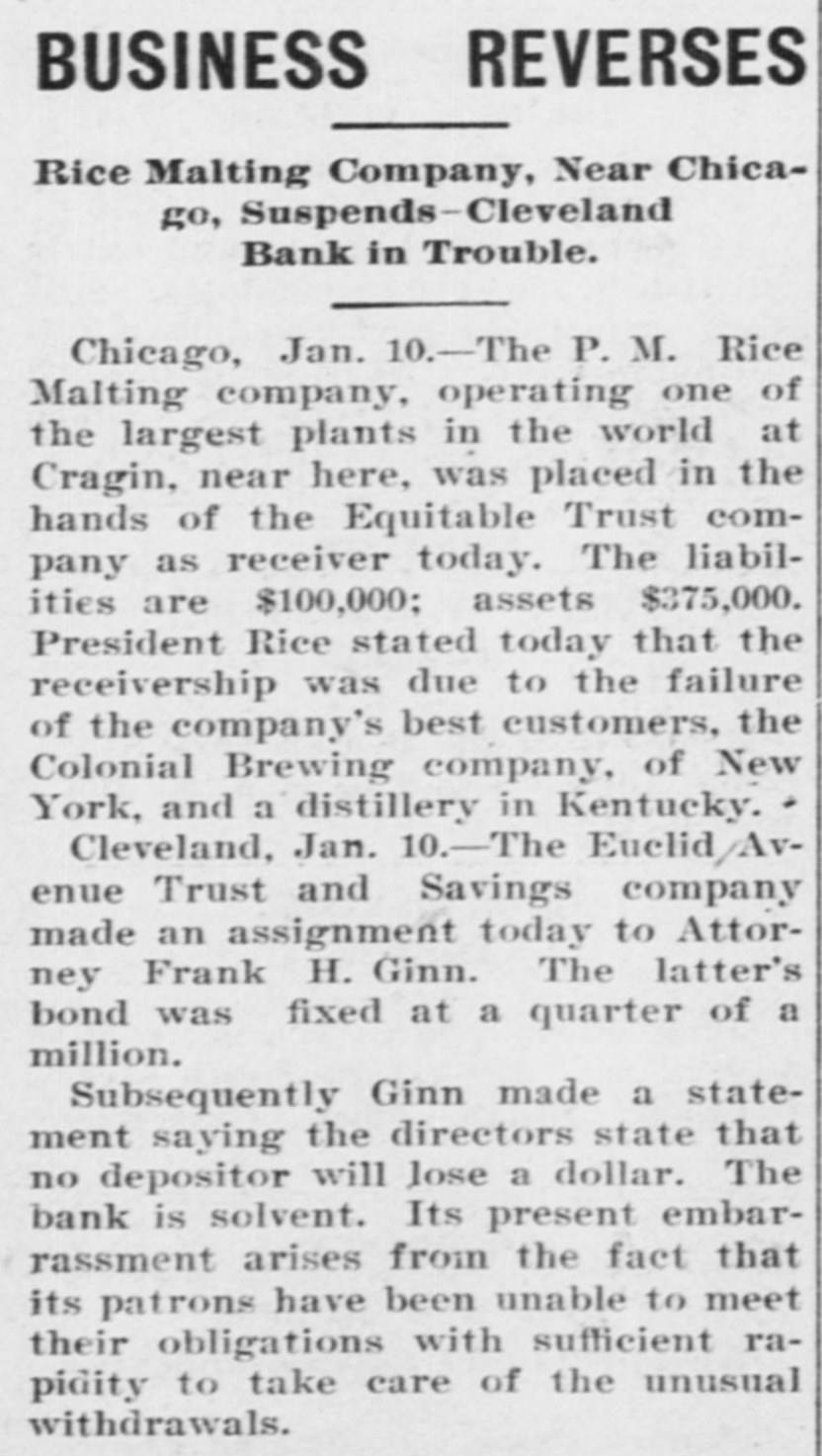
BUSINESS REVERSES Rice Malting Company, Near Chicago, Suspends-Cleveland Bank in Trouble. Chicago, Jan. 10.-The P. M. Rice Malting company, operating one of the largest plants in the world at Cragin, near here, was placed in the hands of the Equitable Trust company as receiver today. The liabilities are $100,000; assets $375,000. President Rice stated today that the receivership was due to the failure of the company's best customers, the Colonial Brewing company, of New York, and a distillery in Kentucky. Cleveland, Jan. 10.-The Euclid/Avenue Trust and Savings company made an assignment today to Attorney Frank H. Ginn. The latter's bond was fixed at a quarter of a million. Subsequently Ginn made a statement saying the directors state that no depositor will lose a dollar. The bank is solvent. Its present embarrassment arises from the fact that its patrons have been unable to meet their obligations with sufficient rapidity to take care of the unusual withdrawals.
3.January 10, 1902The Evening TimesWashington, DC
Click image to open full size in new tab
Article Text
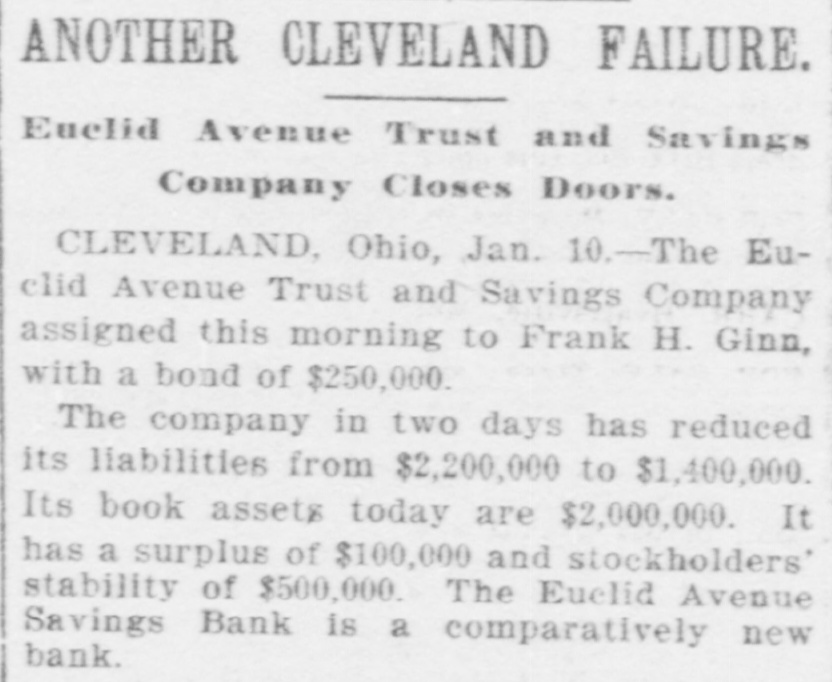
ANOTHER CLEVELAND FAILURE
Euclid Avenue Trust and Savings Company Closes Doors. CLEVELAND, Ohio, Jan. 10.-The Euclid Avenue Trust and Savings Company assigned this morning to Frank H. Ginn, with a bond of $250,000. The company in two days has reduced its liabilities from $2,200,000 to $1,400,000. Its book assets today are $2,000,000. It has a surplus of $100,000 and stockholders' stability of $500,000. The Euelid Avenue Savings Bank is a comparatively new bank.
4.January 11, 1902Evening StarWashington, DC
Click image to open full size in new tab
Article Text
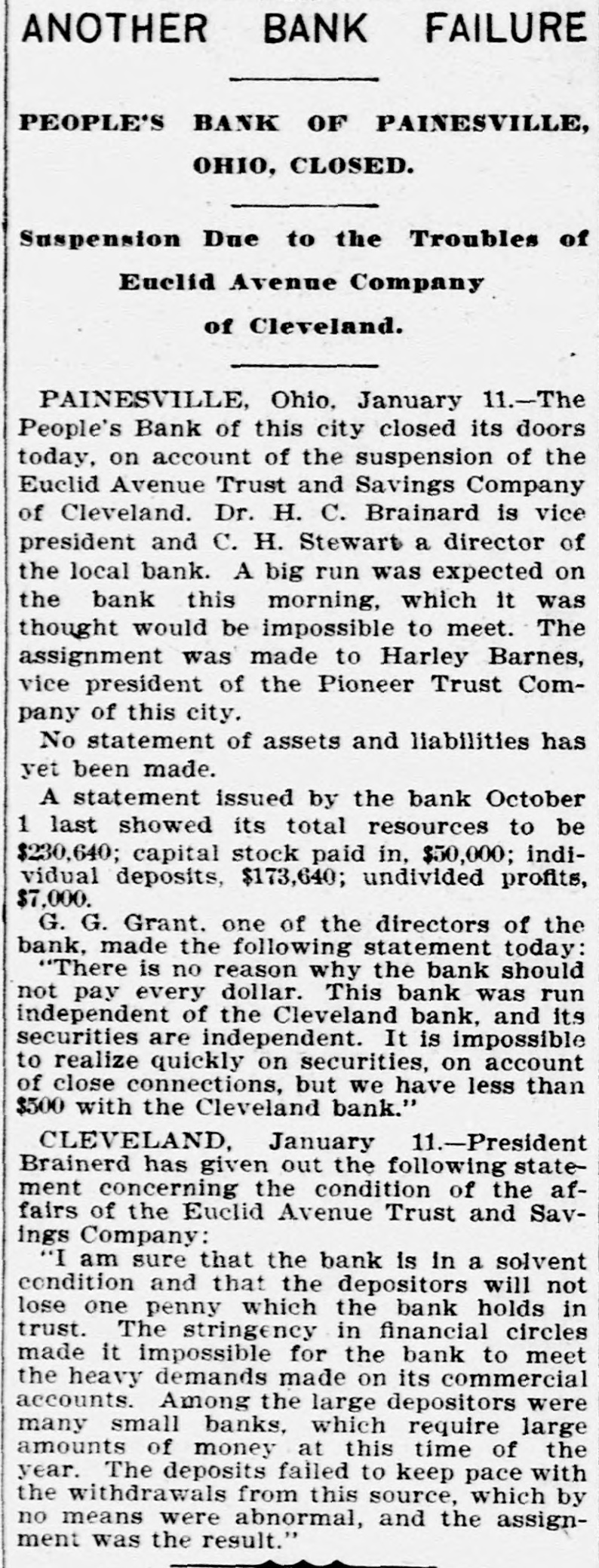
FAILURE ANOTHER BANK PEOPLE'S BANK OF PAINESVILLE, OHIO, CLOSED. Suspension Due to the Troubles of Euclid Avenue Company of Cleveland. PAINESVILLE, Ohio. January 11.-The People's Bank of this city closed its doors today, on account of the suspension of the Euclid Avenue Trust and Savings Company of Cleveland. Dr. H. C. Brainard is vice president and C. H. Stewart a director of the local bank. A big run was expected on the bank this morning, which it was thought would be impossible to meet. The assignment was made to Harley Barnes, vice president of the Pioneer Trust Company of this city. No statement of assets and liabilities has yet been made. A statement issued by the bank October 1 last showed its total resources to be $230,640; capital stock paid in, $50,000; individual deposits, $173,640; undivided profits, $7,000. G. G. Grant. one of the directors of the bank, made the following statement today: "There is no reason why the bank should not pay every dollar. This bank was run independent of the Cleveland bank, and its securities are independent. It is impossible to realize quickly on securities, on account of close connections, but we have less than $500 with the Cleveland bank." CLEVELAND, January 11.-President Brainerd has given out the following statement concerning the condition of the affairs of the Euclid Avenue Trust and Savings Company: "I am sure that the bank is in a solvent condition and that the depositors will not lose one penny which the bank holds in trust. The stringency in financial circles made it impossible for the bank to meet the heavy demands made on its commercial accounts. Among the large depositors were many small banks, which require large amounts of money at this time of the year. The deposits failed to keep pace with the withdrawals from this source, which by no means were abnormal, and the assignment was the result."
5.January 11, 1902Arizona RepublicanPhoenix, AZ
Click image to open full size in new tab
Article Text
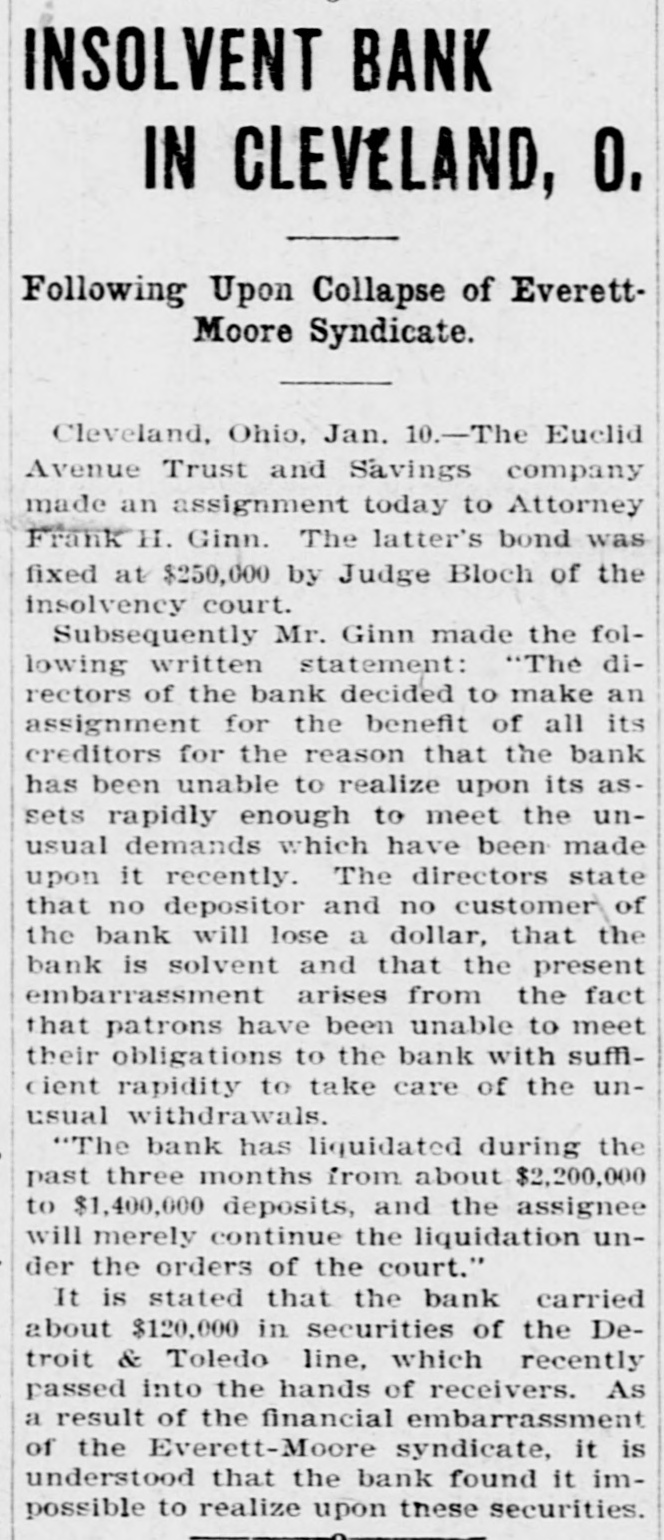
INSOLVENT BANK IN CLEVELAND, 0. Following Upon Collapse of EverettMoore Syndicate. Cleveland, Ohio, Jan. 10.-The Euclid Avenue Trust and Savings company made an assignment today to Attorney Frank H. Ginn. The latter's bond was fixed at $250,000 by Judge Bloch of the insolvency court. Subsequently Mr. Ginn made the following written statement: "The directors of the bank decided to make an assignment for the benefit of all its creditors for the reason that the bank has been unable to realize upon its assets rapidly enough to meet the unusual demands which have been made upon it recently. The directors state that no depositor and no customer of the bank will lose a dollar, that the bank is solvent and that the present embarrassment arises from the fact that patrons have been unable to meet their obligations to the bank with sufflcient rapidity to take care of the unusual withdrawals. "The bank has liquidated during the past three months from about $2,200,000 to $1,400,000 deposits, and the assignee will merely continue the liquidation under the orders of the court." It is stated that the bank carried about $120,000 in securities of the Detroit & Toledo line, which recently passed into the hands of receivers. As a result of the financial embarrassment of the Everett-Moore syndicate, it is understood that the bank found it impossible to realize upon these securities.
6.January 11, 1902The News & ObserverRaleigh, NC
Click image to open full size in new tab
Article Text
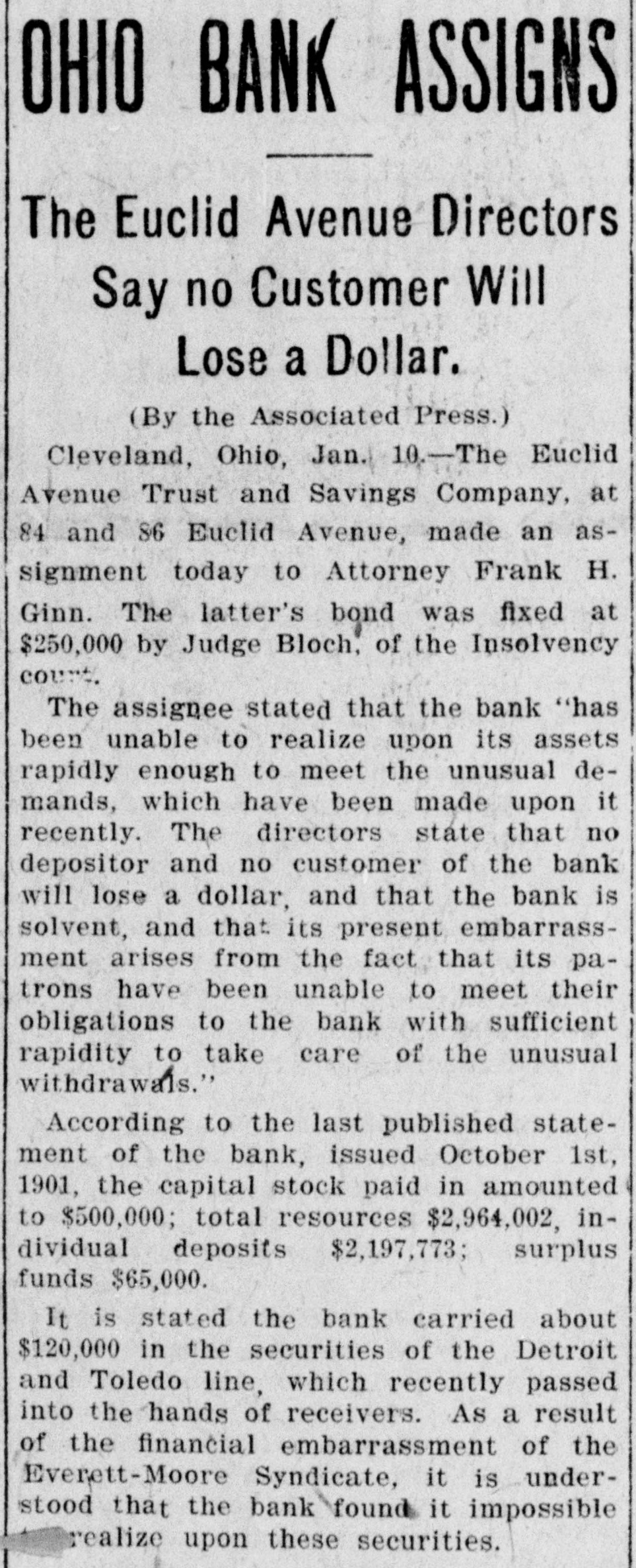
OHIO BANK ASSIGNS The Euclid Avenue Directors Say no Customer Will Lose a Dollar. (By the Associated Press.) Cleveland, Ohio, Jan. 10. .-The Euclid Avenue Trust and Savings Company, at 84 and 86 Euclid Avenue, made an assignment today to Attorney Frank H. Ginn. The latter's bond was fixed at $250,000 by Judge Bloch, of the Insolvency court The assignee stated that the bank "has been unable to realize upon its assets rapidly enough to meet the unusual demands, which have been made upon it recently. The directors state that no depositor and no customer of the bank will lose a dollar, and that the bank is solvent, and that its present embarrassment arises from the fact that its patrons have been unable to meet their obligations to the bank with sufficient rapidity to take care of the unusual withdrawals.' According to the last published statement of the bank, issued October 1st, 1901, the capital stock paid in amounted to $500,000; total resources $2,964,002, individual deposits $2,197,773; surplus funds $65,000. It is stated the bank carried about $120,000 in the securities of the Detroit and Toledo line, which recently passed into the hands of receivers. As a result of the financial embarrassment of the Everett-Moore Syndicate, it is understood that the bank found it impossible realize upon these securities.
7.January 11, 1902Evening Times-RepublicanMarshalltown, IA
Click image to open full size in new tab
Article Text
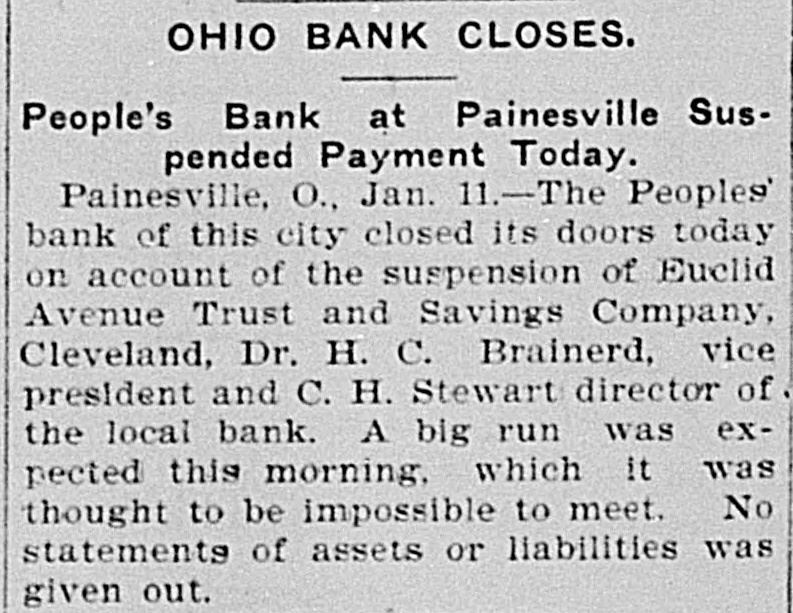
OHIO BANK CLOSES
People's Bank at Painesville Suspended Payment Today. Painesville, O., Jan. 11.-The Peoples' bank of this city closed its doors today on account of the suspension of Euclid Avenue Trust and Savings Company, Cleveland, Dr. H. C. Brainerd, vice president and C. H. Stewart director of the local bank. A big run was expected this morning, which it was thought to be impossible to meet. No statements of assets or liabilities was given out.
8.January 11, 1902Rock Island ArgusRock Island, IL
Click image to open full size in new tab
Article Text
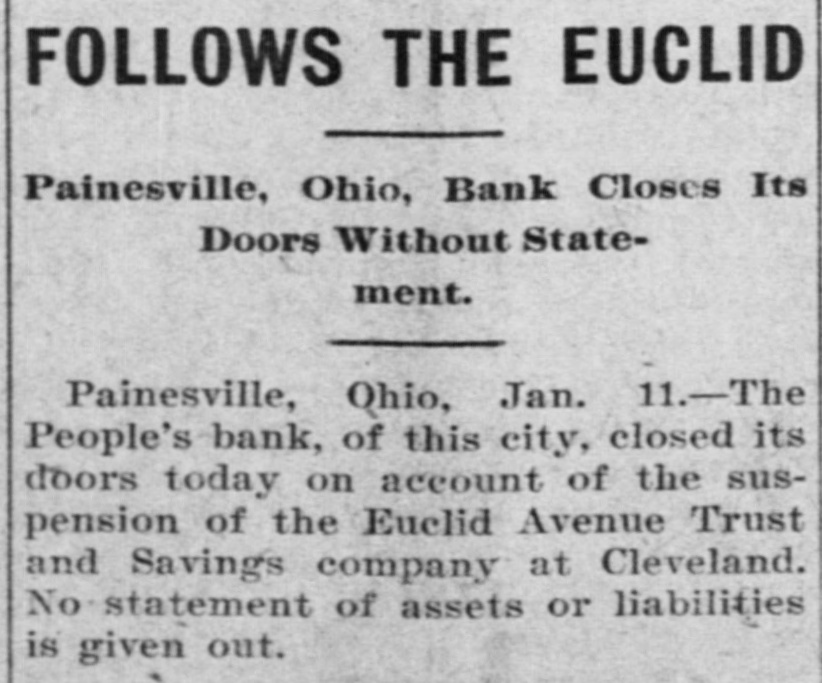
FOLLOWS THE EUCLID Painesville, Ohio, Bank Closes Its Doors Without Statement. Painesville, Qhio, Jan. 11.-The People's bank, of this city, closed its doors today on account of the suspension of the Euclid Avenue Trust and Savings company at Cleveland. No statement of assets or liabilities is given out.
9.January 11, 1902The Savannah Morning NewsSavannah, GA
Click image to open full size in new tab
Article Text
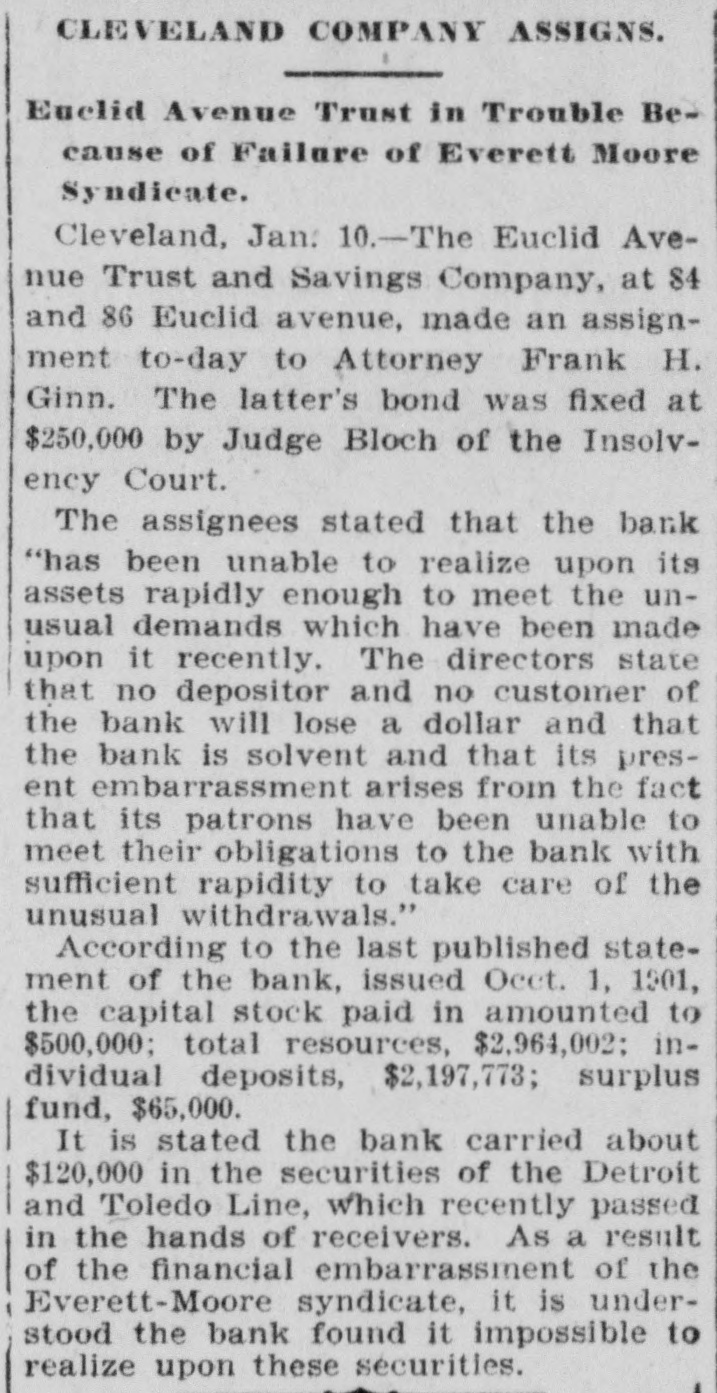
CLEVELAND COMPANY ASSIGNS
Euclid Avenue Trust in Trouble Because of Failure of Everett Moore Syndicate. Cleveland, Jan. 10.-The Euclid Avenue Trust and Savings Company, at 84 and 86 Euclid avenue, made an assignment to-day to Attorney Frank H. Ginn. The latter's bond was fixed at $250,000 by Judge Bloch of the Insolvency Court. The assignees stated that the bank "has been unable to realize upon its assets rapidly enough to meet the unusual demands which have been made upon it recently. The directors state that no depositor and no customer of the bank will lose a dollar and that the bank is solvent and that its present embarrassment arises from the fact that its patrons have been unable to meet their obligations to the bank with sufficient rapidity to take care of the unusual withdrawals." According to the last published statement of the bank, issued Occt. 1, 1901, the capital stock paid in amounted to $500,000; total resources, $2,964,002: individual deposits, $2,197,773; surplus fund, $65,000. It is stated the bank carried about $120,000 in the securities of the Detroit and Toledo Line, which recently passed in the hands of receivers. As a result of the financial embarrassment of the Everett-Moore syndicate, it is understood the bank found it impossible to realize upon these securities.
10.January 11, 1902The Saint Paul GlobeSaint Paul, MN
Click image to open full size in new tab
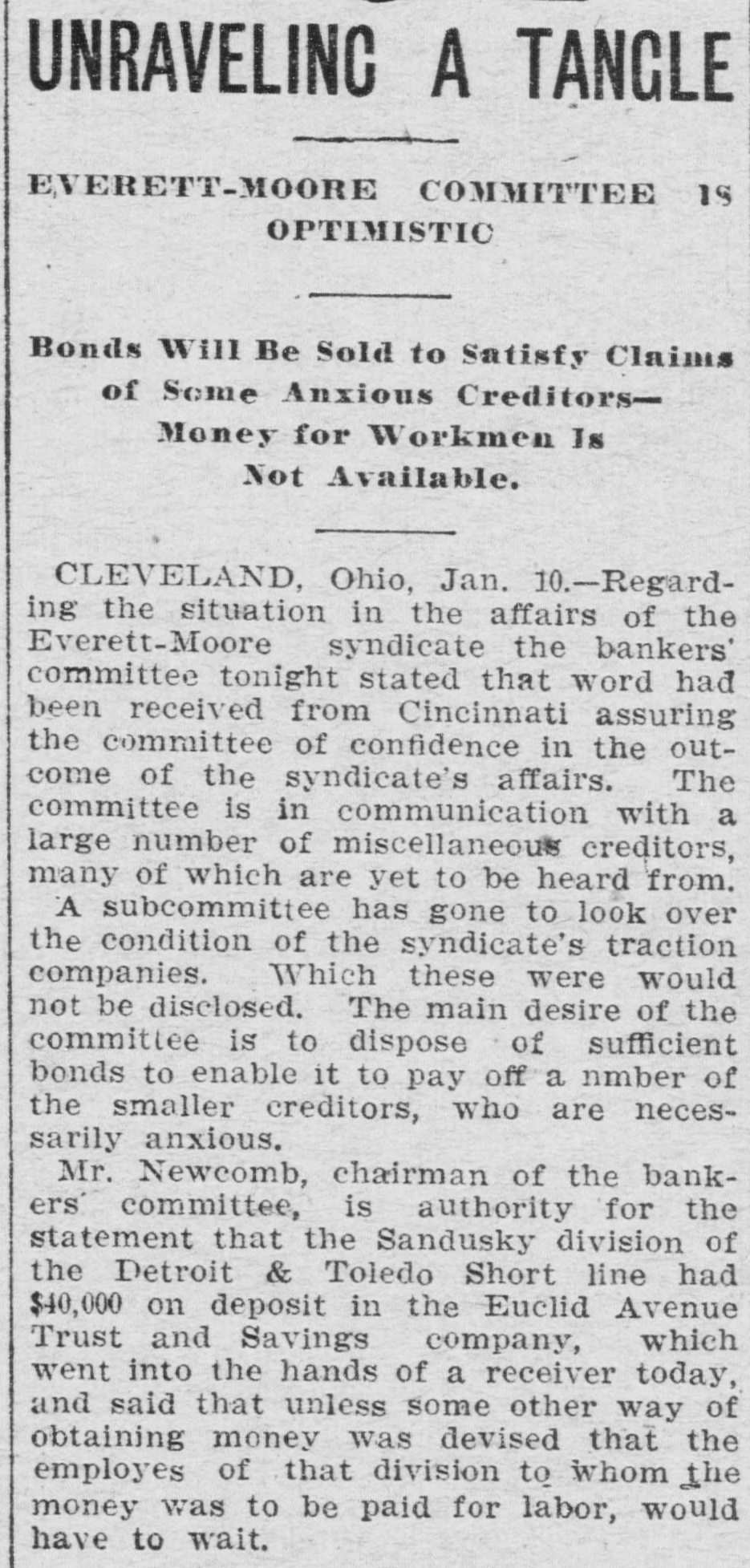
Article Text
UNRAVELING A TANCLE EVERETT-MOORE COMMITTEE 15 OPTIMISTIC Bonds Will Be Sold to Satisfy Claims of Some Anxious CreditorsMoney for Workmen Is Not Available. CLEVELAND, Ohio, Jan. 10.-Regarding the situation in the affairs of the Everett-Moore syndicate the bankers' committee tonight stated that word had been received from Cincinnati assuring the committee of confidence in the outcome of the syndicate's affairs. The committee is in communication with a large number of miscellaneous creditors, many of which are yet to be heard from. A subcommittee has gone to look over the condition of the syndicate's traction companies. Which these were would not be disclosed. The main desire of the committee is to dispose of sufficient bonds to enable it to pay off a nmber of the smaller creditors, who are necessarily anxious. Mr. Newcomb, chairman of the bankers' committee, is authority for the statement that the Sandusky division of the Detroit & Toledo Short line had $40,000 on deposit in the Euclid Avenue Trust and Savings company, which went into the hands of a receiver today, and said that unless some other way of obtaining money was devised that the employes of that division to whom the money was to be paid for labor, would have to wait.
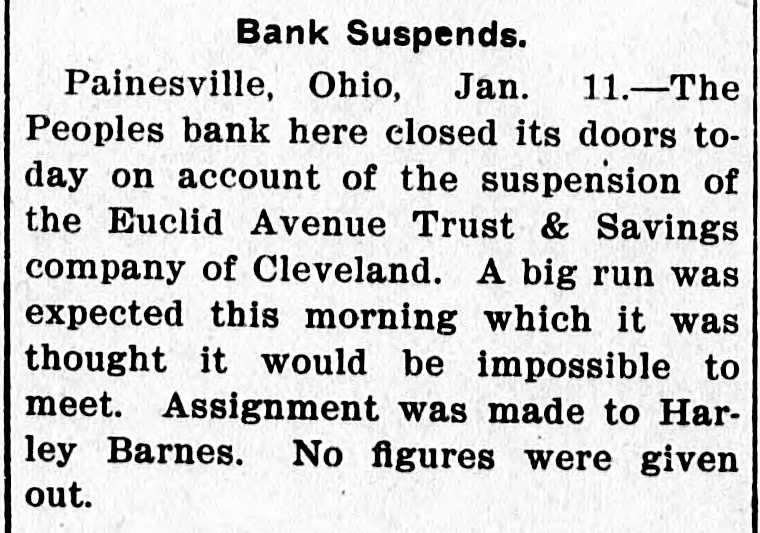
Painesville, Ohio, Jan. 11.-The Peoples bank here closed its doors today on account of the suspension of the Euclid Avenue Trust & Savings company of Cleveland. A big run was expected this morning which it was thought it would be impossible to meet. Assignment was made to Harley Barnes. No figures were given out.
12.January 14, 1902The Stark County DemocratCanton, OH
Click image to open full size in new tab
Article Text
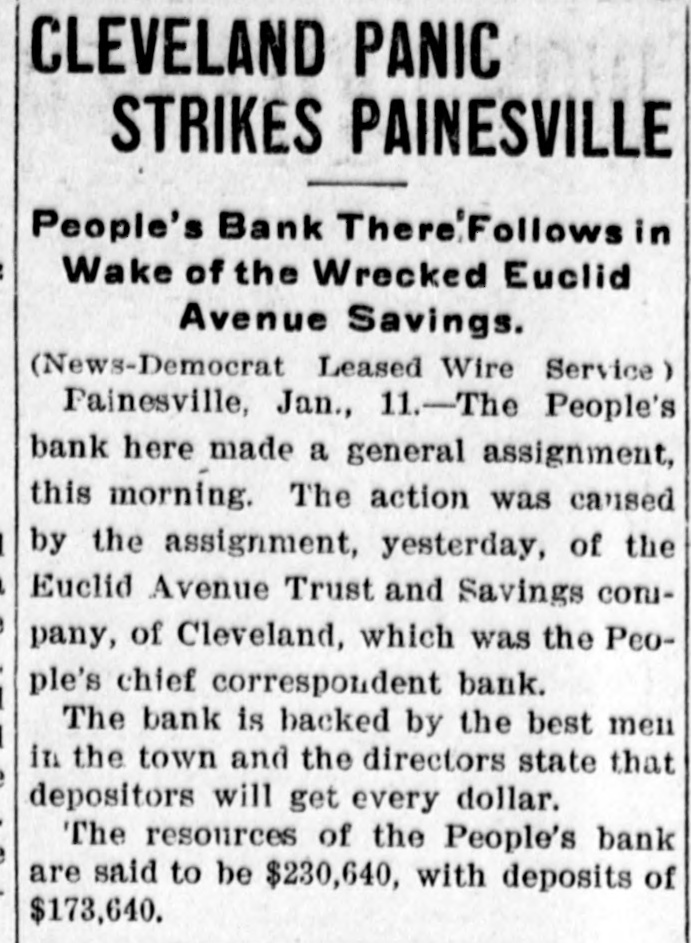
CLEVELAND PANIC STRIKES PAINESVILLE People's Bank There'Follows in Wake of the Wrecked Euclid Avenue Savings. (News-Democrat Leased Wire Service ) Fainesville, Jan., 11.-The People's bank here made a general assignment, this morning. The action was caused by the assignment, yesterday, of the Euclid Avenue Trust and Savings conipany, of Cleveland, which was the People's chief correspondent bank. The bank is backed by the best men in the town and the directors state that depositors will get every dollar. The resources of the People's bank are said to be $230,640, with deposits of $173,640.
13.January 15, 1902Adams County NewsRitzville, WA
Click image to open full size in new tab
Article Text
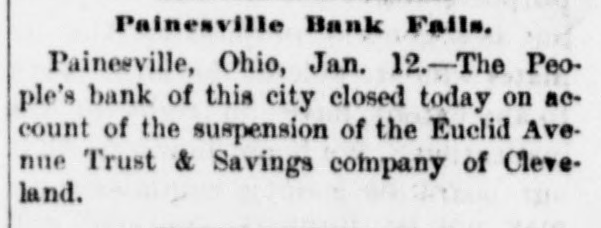
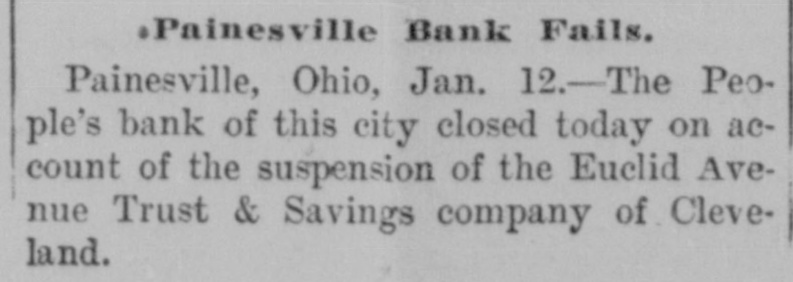
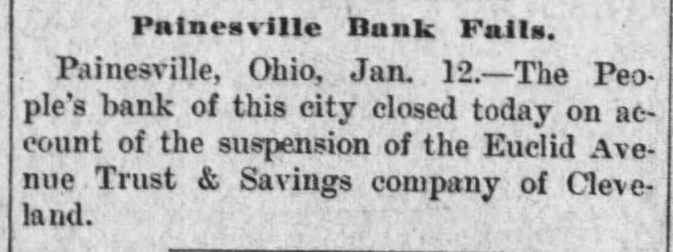
Painesville Bank Fails
Paineeville, Ohio, Jan. 12.-The People's bank of this city closed today on account of the suspension of the Euclid Avenue Trust & Savings company of Cleveland.
14.January 16, 1902The Oskaloosa HeraldOskaloosa, IA
Click image to open full size in new tab
Article Text
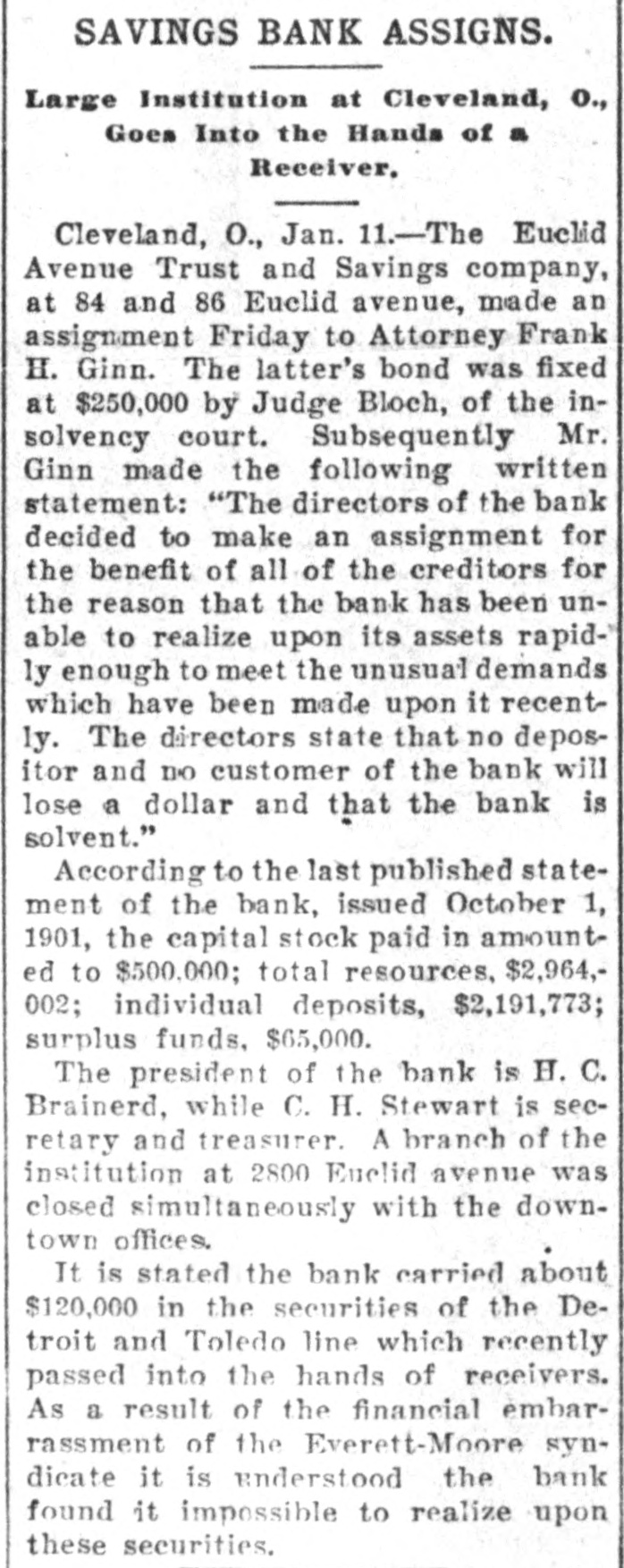
SAVINGS BANK ASSIGNS
Large Institution at Cleveland, o., Goes Into the Hands of a Receiver, Cleveland, 0., Jan. 11.-The Euclid Avenue Trust and Savings company, at 84 and 86 Euclid avenue, made an assignment Friday to Attorney Frank H. Ginn. The latter's bond was fixed at $250,000 by Judge Bloch, of the insolvency court. Subsequently Mr. Ginn made the following written statement: "The directors of the bank decided to make an assignment for the benefit of all of the creditors for the reason that the bank has been unable to realize upon its assets rapidly enough to meet the unusual demands which have been made upon it recently. The directors state that no depositor and no customer of the bank will lose a dollar and that the bank is solvent." According to the last published statement of the bank, issued October 1, 1901, the capital stock paid in amounted to $500,000; total resources, $2,964,002; individual deposits, $2,191,773; surplus funds, $65,000. The president of the bank is H. C. Brainerd, while C. H. Stewart is secretary and treasurer. A branch of the institution at 2800 Euclid avenue was closed simultaneously with the downtown offices. It is stated the bank carried about $120,000 in the securities of the Detroit and Toledo line which recently passed into the hands of receivers. As a result of the financial embarrassment of the Everett-Moore syndicate it is understood the bank found it impossible to realize upon these securities.
15.January 17, 1902The Kootenai HeraldBonners Ferry, Kootenai, ID
Click image to open full size in new tab
Article Text
Painesville Bank Fails
Painesville, Ohio, Jan. 12.-The People's bank of this city closed today on account of the suspension of the Euclid Avenue Trust & Savings company of Cleveland.
16.January 17, 1902Camas Prairie ChronicleCottonwood, ID
Click image to open full size in new tab
Article Text
Painesville Bank Fails
Painesville, Ohio, Jan. 12.-The People's bank of this city closed today on account of the suspension of the Euclid Avenue Trust & Savings company of Cleveland.
17.January 17, 1902The Nezperce HeraldNezperce, ID
Click image to open full size in new tab
Article Text
Painesville Bank Fails
Painesville, Ohio, Jan. 12.-The People's bank of this city closed today. on account of the suspension of the Euclid Avenue Trust & Savings company of Cleveland.
18.January 17, 1902Kootenai County RepublicanSandpoint, Rathdrum, ID
Click image to open full size in new tab
Article Text
Painesville Bank Fails
Painesville, Ohio, Jan. 12.-The People's bank of this city closed today on account of the suspension of the Euclid Avenue Trust & Savings company of Cleveland.
19.January 18, 1902The Coeur D'alene PressCoeur D'alene, ID
Click image to open full size in new tab
Article Text
Painesville Bank Falls
Painesville, Ohio, Jan. 12.-The People's bank of this city closed today on account of the suspension of the Euclid Ave. nue Trust & Savings company of Cleveland.
20.January 18, 1902Pullman HeraldPullman, WA
Click image to open full size in new tab
Article Text
Painesville Bank Fails
Painesville, Ohio, Jan. 12.-The People's bank of this city closed today on account of the suspension of the Euclid Avenue Trust & Savings company of Cleveland.
Bank runs are almost always and everywhere a deterioration of bank fundamentals.
But not for you.
You are the measure-zero exception: great fundamentals, solid bank, and yet the Diamond Dybvig fairy spread its rumor. Depositors woke up. Your collateral was not prepositioned. The Clearinghouse had it for you.
Do not pass Go. Do not collect $200. Go directly to jail… or worse.
Flag Article for Review
Flag Episode for Review
Euclid Avenue Trust & Savings Company · Episode ID 8622444391225