8615. Washington Bank (Minneapolis, MN)

Bank Information

Episode Type
Run β†’ Suspension β†’ Closure
Bank Type
state
Start Date
December 29, 1896
Location
Minneapolis, Minnesota (44.980, -93.264)

Metadata

Model
gpt-5-mini
Short Digest
a446ea97e2f6cad0

Response Measures

None

Description

Contemporary newspaper accounts report that the suspension (closing) of the Columbia National and Scandia banks produced a run on the Washington Bank on Dec 29, 1896. Management closed the bank that day, asked examiners to take charge, and a receiver (A. Ueland) was appointed shortly thereafter; the institution did not resume normal operations and later had assets liquidated and dividends paid to creditors. Multiple articles explicitly call it a 'State institution.'

Events (4)

1. December 29, 1896 Run
Cause
Local Banks
Cause Details
Runs at the Columbia National and Scandia banks alarmed Washington Bank depositors, who began drawing out deposits rapidly.
Measures
Officials had arranged to obtain $50,000 to meet demands but the funds were not forthcoming; cashier telephoned bank examiner and asked him to take charge.
Newspaper Excerpt
The suspension of the Scandia yesterday and the Columbia this morning created consternation among the patrons of the Washington Bank, and such a run ensued that the bank was compelled to close its doors about noon.
Source
newspapers
2. December 29, 1896 Suspension
Cause
Local Banks
Cause Details
Management suspended payments/closed to protect depositors after heavy simultaneous withdrawals triggered by other local bank failures.
Newspaper Excerpt
The Washington Bank, a State institution, closed its doors to-day... The suspension was due to the fact that its clientele, being the same as that of the suspended Columbia National and Scandia banks, became alarmed and began to draw out deposits this morning at such a rate that the management decided that the best interests of all would be served by closing the bank.
Source
newspapers
3. December 31, 1896 Receivership
Newspaper Excerpt
Judge Belden signed an order this morning appointing Judge A. Ueland receiver of the Washington Bank, under a bond of $200,000. The petition recites that the bank has $27,774 more liabilities than assets.
Source
newspapers
4. March 15, 1900 Other
Newspaper Excerpt
Andreas Ueland as the receiver of the defunct Washington bank, yesterday sold at public auction the remaining assets of the institution ... the sale being a sad reminder of the palmy days of the bank.
Source
newspapers

Newspaper Articles (24)

Article from Evening Star, December 29, 1896

Click image to open full size in new tab

Article Text

INABILITY TO REALIZE. Assets Were Slow and a Small Minneapolis Bank Closed. MINNEAPOLIS, Minn., December 20.The Columbia National Bank, a small institution of comparatively recent establishment and $200,000 capital, closed its doors this morning, and is now in the hands of the bank examiner. According to Its last statement, made December 17, it had loans and discounts of $348,145; United States bonds to secure circulation, $50,000; real estate and mortgages, $48,728; due from other banks, $42,807; cash reserve. $34,672; other cash items. $11,852; national bank notes outstanding, $45,000; due other banks. $136,579; deposits subject to check. $101,507; certificates of deposit, $63,594; certified and cashier's checks, $3.313; bills payable, $15,000. Cashier Jos. Bobleter said this morning: "We could have stood the pressure a little longer, but to protect the majority we closed this morning. We have $33,000 cash in the vault, and inside of sixty days expeet to have fully $100,000 more collected. Our total liabilities are only $247,000, and much of that, you understand, is not immediate. There is no doubt but what we will be able to make a full account with our depositors and a fair settlement with stockholders. "The recent withdrawals which caused the trouble were city and state funds, of which we had large deposits, and also by country correspondents. Of the city and state money. only about $11.200 remains in the bank. The majority of our individual depositors were business men." The officers are: Chas. Kittelson, president; H. Tuberson. vice president; Jos. Bobleter. cashier: J. C. Kittleson, assistant cashier. Among the directors are A. K. I. Teisberg and Charles Janson. The bank is in the immediate charge of George Coffin, deputy controller of the currency. He states that officers of the bank applied to the clearing house committee for assistance, but this body and the directors of the bank finally agreed that the best thing under the circumstances would be to close. "I believe." said Mr. Coffin. "that this action was anticipated by all parties interested, and the suspension will not cause any further trouble. All the national banks of this city are in a very strong condition financially, as we have satisfied ourselves by examination." Another Bank Closed. MINNEAPOLIS. Mirn., December 29.Washirgton bank, a state institution, closed its doors today. It had a capital of $100,000, and by its last statement at the close of business December 17, had $507,145 loans and discounts, $14,228 overdrafts secured. $20,165 in stocks and bonds, $14,475 in real estate, and $88,272 cash on hand. Its deposits were $346,153, its certified deposits $112,587. bank deposits $84,937. A. C. Haughan, city treasurer, was one of the founders of the bank and is one of its directors. O. E. Breecke is the cashier. Controller Eekels has received a dispatch announcing the failure of the Columbia National Bank of Minneapolis, Minn. Deputy Controller Coffin, who is next in rank to Mr. Eckels, happened to be passing through Minneapolis, and was directed to take temporary charge of the bank. Examiner Cook was ordered from Chicago to take permanent charge. The last report of the bank received by Mr. Eckels was that of October 6, the figures of December 17 not having reached here. At that time the assets were $641,000, but these probably have shrunk since then. The controller ascribed the failure to a lot of slow assets, on which ready money could not be realized, and he says this has been the cause of most of the recent bank failures.

Article from The Seattle Post-Intelligencer, December 30, 1896

Click image to open full size in new tab

Article Text

TWO FAILURES IN MINNEAPOLIS. Columbia National and the Washington Close Doors. MINNEAPOLIS Dec. 29.-The Columbia National bank. a small Institution of comparatively recent establishment and $200.000 capital, closed this morning and is in the hands of the bank examiner. According to the last statement. December 17. its affairs stood: Loans and discounts, $348.145: bonds to secure circulation, $50,000; real estate and mortgages, $48,728; due from other banks. $42,897; cash reserve, $34,872; other cash items. $11,852. Liabilities are: National bank notes outstanding. $45,000 due other banks. $136,579 deposits subject to check. $101.157; certificates of deposit, $63,594 certified and cashiers' checks, $3,313; bills payable, $15,000. Cashier Joseph Bobleter said: 'We could have stood the pressure a little longer, but to protect the majority we closed this morning. We have $33,000 cash. and inside of sixty days expect to have fully $100,000 more collected. Our total liabilities are only $247,000. There is no doubt that we will be able to pay depositors in full and to effect a fair settlement with the stockholders. Recent withdrawals of city and state funds, and by country correspondents, caused the trouble." The officers are: President. Charles Kittleson; vice president, H. Thorson; cashier, Joseph Bobieter. The bank is in charge of George H. Coffin, deputy comptroller. "I believe," said he. "that the suspension will not cause any further trouble. The national banks of this city are strong financially, as we have satisfied ourselves by examination. The Washington bank. a state Institution, closed its doors at noon. It had a capital of $100,000. and in its last statement at the close of business, December 17. had $706,104 in loans and discounts, $14,228 overdrafts secured, $20,165 in stocks and bonds, $14,475 real estate, and $88,272 cash on hand. Deposits were $363.132. certifled deposits, $112,587 bank deposits, $84,937 A C. Haugan, city treasurer, was one of the founders of the bank. and one of the directors. O. E. Breecke is cashier. The suspension of the Washington bank was due to the fact that its clientele, being the same as that of the suspended Columbian National bank and Scandia bank, became alarmed and began to draw out deposits this morning at such & rate that the management decided that the best interests of all would be served by closing the bank. Its condition is most excellent, the assets being $600,000. and the liabilities $500,000. There is little real estate among the former. and they can be quickly converted into money. The following anouncement was made by the clearing house committee this afternoon The clearing house committee deem it their duty to announce that their investigations warrant them in advancing whatever sum of money may be needed by the Scandia bank to meet promptly any calls upon them by the depositors. This bank has an unusually large available cash reserve, amounting to about 55 per cent. of its obligations, and its bills receivable are of such a class that we have no hesitation in saying we will make them the necessary advances to meet all demands, and that we do not Book for further trouble among the banks of this city." A Virginia Bank Succumbs. ROANOKE Va. Dec. 29. The Commercial National bank of this city closed Its dcors this morning by order of the board of directors On December 9. J.C. Davenport. the cashier, resigned, and his succersor was elected. The matter was kept quiet until Sunday night. when Davenport left the city for his home at Charleston. W Va. As soon as this became known a general run was made on the bank. and it ofwas compelled to go to the wall. The ficials say depositors will be paid in full. The liabilities are about $65,000. while the valuable assets are estimated to be worth double that amount The last report November 1 showed the assets of the bank to be $263,704. including bonds for circulation: stocks. $100,000; surplus, $25,000; undivided profits $6,000: owing depositors, $75,000: other liabilities $35,000. The failure is attributed by Mr. Eckeis in part to speculation. New Cashier Chosen. DENVER Col. Dec. 29 Dr. D. H. Dougan, president of the Carbonate National bank. of Leadville, has been chosen cashter of the Bank of Commerce in this city. He says the Carbonate bank will probabiy liquidate gradually during the next year. as Leadville in no longer a profitsbie field for so large an Institution. The Batavia Assignment. A. CHICAGO. Dec. -Attorney W. Green who drew up the assignment papers for the Batavia bank. disclosed the principal causes which led up to the assignment in an interview today. Aside from the Atlas bank liquidation, the most important factor that caused the Van Nortwick crash, he said, was the recent failure to dispose of $300,000 worth of bonds in the


Article from Richmond Dispatch, December 30, 1896

Click image to open full size in new tab

Article Text

MORE MINNEAPOLIS BANKS FAIL. The Columbia National and the Washington-Considerable Burry. MINNEAPOLIS, MINN.. December 29.The Columbia National Bank, whose president is Charles Kittleson, ex-State Treasurer, and whose cashier is Joseph Bobleter, also an ex-State Treasurer, failed to open its doors this morning, and George M. Coffin, Deputy Comptroller of the Currency, who happened to be in the city, took charge. Cashier Bobleter said that the liabilities, not including the capital stock, etc., and including principally deposits, amount to $247,000. while the assets, mostly notes, are $450,000. He said that he had no doubt the depositors would in time be paid in full. The State is creditor to the amount of $16,000. and the county to that of about $5,000. The city had $1,200 on deposit. At the present time, according to Cashier Bobleter, there Is $33,000 cash in he vault, and $100,000 will be collected within the next thirty days. The suspension was ordered for the purpose of protecting the majority of the creditors. The capital is $200,000. The suppension of the Scandia yesterday and the Columbia this morning created consternation among the patrons of the Washington Bank, and such a "run" ensued that the bank was compelled to close its doors about noon. Depositors drew their checks directly at the bank and through the Clearing-House at such a rate that it was evident that the interests of all the depositors demanded suspension. The bank knew that its strength would be sorely taxed to-day, and had made arrangements to get $50,000 in cash. which would have tided it over safely, but the money was not forthcoming this morning, and after a vain attempt to stand the demands, Cashier Brecke telephoned Bank-Examiner Kenyon that the officials had decided to close the bank, and asked him to take charge. Cashierd Brecke stated this afternoon that aside from the matter of cash on hand, the bank was in excellent shape. Exactly what will be done has not yet been determined. It is very likely that the suspension will be only temporary, as the resources of the bank are in such shape that its depositors can be paid in full in a comparatively short time, and 50 cents on the dollar within two months. In round numbers the liabilities are $500,000 and the assets $600,000. Of the latter, only $14,500 is real estate. The bank had some city deposits, $3,000 of State money, and $4,000 of the county's. The bank officials are: President, A. C. Haugan; Vice-President. J. S. Johnson: Cashier, O. E. Brecke. The bank's loans and discounts are $507,145. Its deposits are $458,000, and its capital stock $100,000. The announcement of the failure of the Columbia and Washington banks caused a considerable flurry at nearly all of the other banks of the city. The biggest run was on the Farmers' and Mechanics' Bank. the largest savings institution in the Northwest, with deposits amounting to over $6,000,000. This bank is said to be entirely safe. It stood a run of eight days during the panic of 1893.


Article from Birmingham State Herald, December 30, 1896

Click image to open full size in new tab

Article Text

TWO BANKS In Minneapolis Close Their Doors-Almost a Panic in the City. Minneapolis, Minn., Dec. 29.-The Columbia National bank, whose president is Charles Kittelson, ex-state treasurer, and whose cashier is Joseph Bobleter, also an ex-state treasurer, failed to open its doors this morning, and George M. Coffin, deputy comptroller of the currency, who happened to be in the. city, took charge. Cashier Bobleter said that the liabilities, not including the capital stock, etc., and including principally deposits, amounted in round numbers to $247,000, while the assets, mostly notes, amounted to $450,000. He said that he had no doubt but that the depositors would in time be paid in full. The state is creditor to the amount of $16,000, and the county to about $5,000. The city had $1,200 on deposit at the present time. According to Cashier Bobleter, there is $33,000 cash in the vault and $100,000 will be collected within the next thirty days. The suspension was ordered for the purpose of protecting the majority of the creditors. The bank's capital is $200,000. The suspension of the Scandia yesterday and the Columbia this morning created consternation among the patrons of the Washington bank and such a run ensued that the bank was compelled to close its doors shortly after noon. Depositors drew their checks directly at the bank and through the clearing house at such a rate that it was evident that the interests of all the depositors demanded suspension of business. The bank knew that its strength would be sorely taxed today and had made arrangements to get $50,000 in cash, which would have tided it over safely, but the money was not forthcoming this morning and after a vain at-


Article from Wheeling Register, December 30, 1896

Click image to open full size in new tab

Article Text

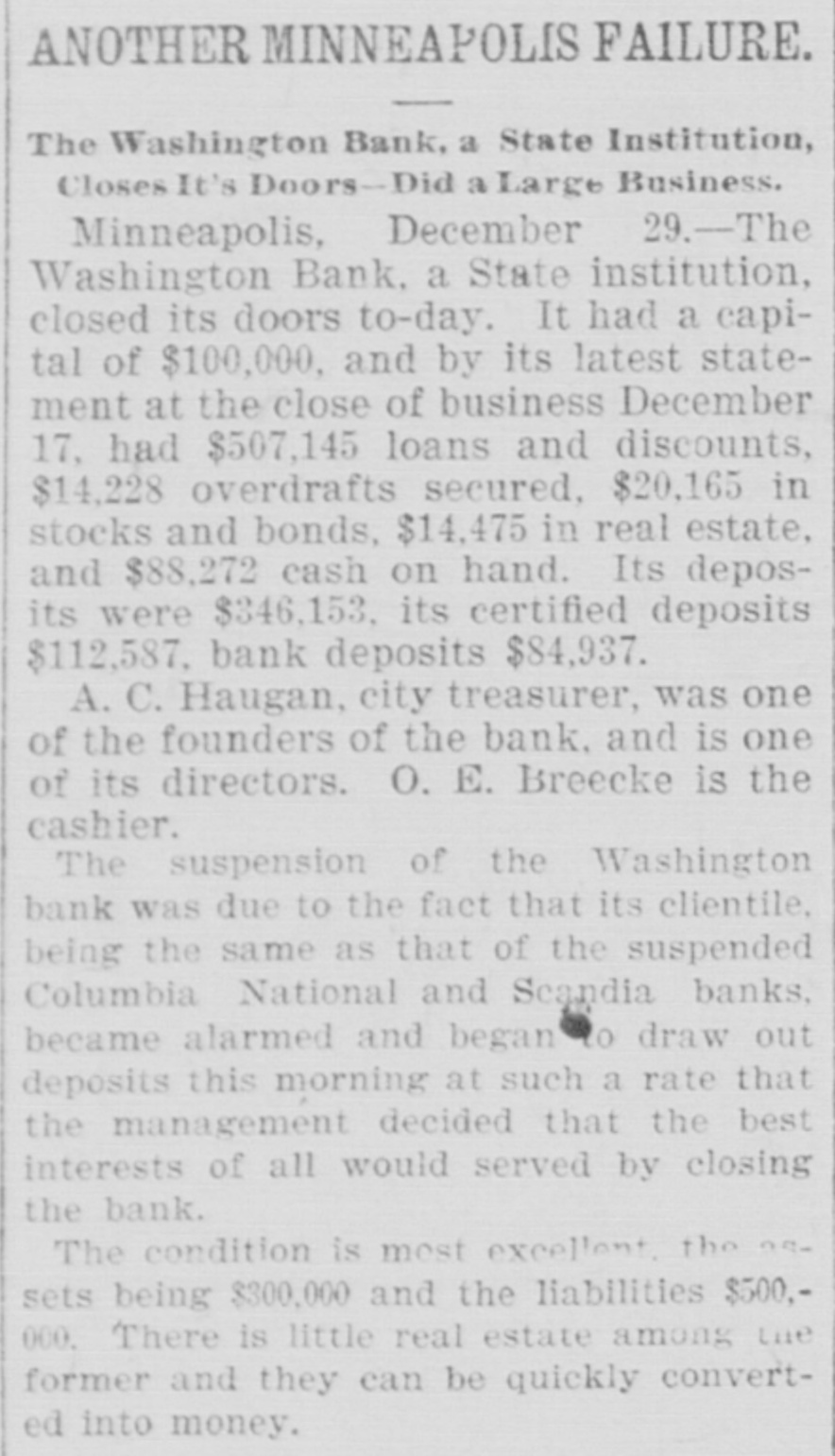
ANOTHER MINNEAPOLIS FAILURE. The Washington Bank, a State Institution, Closes It's Doors - Did a Large Business. Minneapolis, December 29.-The Washington Bank, a State institution, closed its doors to-day. It had a capital of $100,000. and by its latest statement at the close of business December 17. had $507,145 loans and discounts, $14,228 overdrafts secured, $20,165 in stocks and bonds, $14,475 in real estate, and $88,272 cash on hand. Its deposits were $346,153. its certified deposits $112,587. bank deposits $84,937. A. C. Haugan, city treasurer, was one of the founders of the bank. and is one of its directors. O. E. Breecke is the cashier. The suspension of the Washington bank was due to the fact that its clientile, being the same as that of the suspended Columbia National and Scandia banks, became alarmed and began to draw out deposits this morning at such a rate that the management decided that the best interests of all would served by closing the bank. The condition is most excellent the 95sets being $300,000 and the liabilities $500.000. There is little real estate among the former and they can be quickly converted into money.


Article from The Madison Daily Leader, December 30, 1896

Click image to open full size in new tab

Article Text

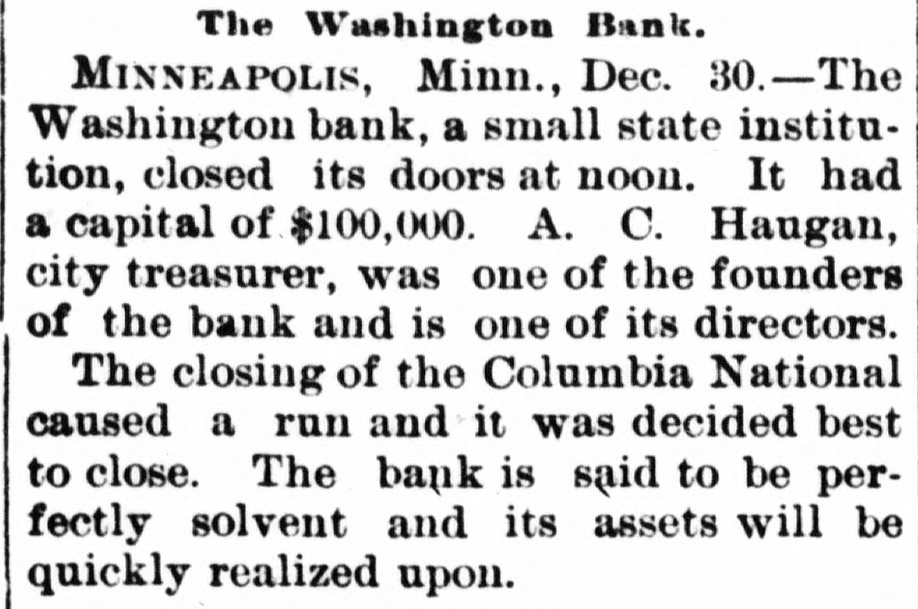
The Washington Bank. MINNEAPOLIS, Minn., Dec. 30.-The Washington bank, a small state institution, closed its doors at noon. It had a capital of $100,000. A. C. Haugan, city treasurer, was one of the founders of the bank and is one of its directors. The closing of the Columbia National caused a run and it was decided best to close. The bank is said to be perfectly solvent and its assets will be quickly realized upon.


Article from The Times, December 30, 1896

Click image to open full size in new tab

Article Text

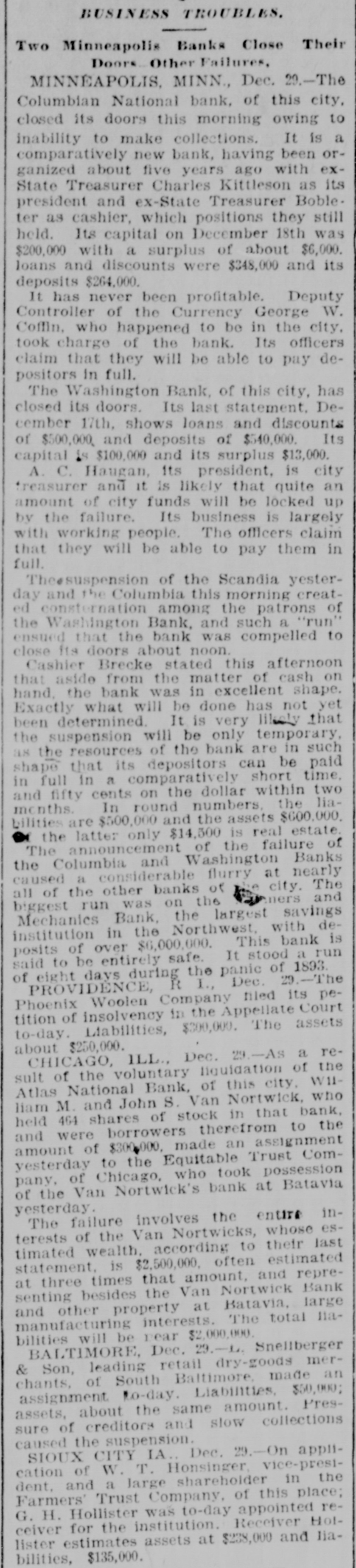
BUSINESS TROUBLES. Two Minneapolis Banks Close Their Doors Other Failures, MINNEAPOLIS, MINN., Dec. 29.-The Columbian National bank, of this city, closed its doors this morning owing to inability to make collections. It is a comparatively new bank, having been organized about five years ago with exState Treasurer Charles Kittleson as its president and ex-State Treasurer Bobleter as cashier, which positions they still held. Its capital on December 18th was $200,000 with a surplus of about $6,000. loans and discounts were $348,000 and its deposits $264,000. It has never been profitable. Deputy Controller of the Currency George W. Coffin, who happened to be in the city, took charge of the bank. Its officers claim that they will be able to pay depositors in full. The Washington Bank, of this city, has closed its doors. Its last statement, December 17th, shows loans and discounts of $500,000. and deposits of $540,000. Its capital is $100,000 and its surplus $13,000. A. C. Haugan, its president, is city treasurer and it is likely that quite an amount of city funds will be lΓΆcked up by the failure. Its business is largely with working people. The officers claim that they will be able to pay them in full. The#suspension of the Scandia yesterday and the Columbia this morning created consternation among the patrons of the Washington Bank, and such a "run" ensued that the bank was compelled to close its doors about noon. Cashier Brecke stated this afternoon that aside from the matter of cash on hand, the bank was in excellent shape. Exactly what will be done has not yet been determined. It is very likely that the suspension will be only temporary, as the resources of the bank are in such shape that its depositors can be paid in full in a comparatively short time. and fifty cents on the dollar within two months. In round numbers, the liabilities are $500,000 and the assets $600,000. the latter only $14,500 is real estate. The announcement of the failure of the Columbia and Washington Banks caused a considerable flurry at nearly all of the other banks of mers city. The and biggest run was on the Mechanics Bank, the largest savings institution in the Northwest, with deposits of over $6,000,000. This bank is said to be entirely safe. It stood a run of eight days during the panic of 1893. PROVIDENCE, R I., Dec. 29.-The Phoenix Woolen Company filed its petition of insolvency in the Appellate Court to-day. Liabilities, $300,000. The assets about $250,000. CHICAGO, ILL., Dec. 29.-As a result of the voluntary liquidation of the Atlas National Bank, of this city, W11liam M. and John S. Van Nortwick, who held 464 shares of stock in that bank, and were borrowers therefrom to the amount of $300,000, made an assignment yesterday to the Equitable Trust Company, of Chicago, who took possession of the Van Nortwick's bank at Batavia yesterday. The failure involves the entire interests of the Van Nortwicks, whose estimated wealth. according to their last statement, is $2,500,000, often estimated at three times that amount, and representing besides the Van Nortwick Bank and other property at Batavia, large manufacturing interests. The total nabilities will be near $2,000,000. BALTIMORE, Dec. 29.-L. Snellberger & Son, leading retail dry-goods merchants, of South Baltimore, made an assignment Mo-day. Liabilities, $50,000; assets, about the same amount. Pressure of creditors and slow collections caused the suspension. SIOUX CITY IA.. Dec. 29.-On application of W. T. Honsinger, vice-president, and a large shareholder in the Farmers' Trust Company, of this place; G. H. Hollister was to-day appointed receiver for the institution. Receiver Hollister estimates assets at $238,000 and lia-


Article from The Houston Daily Post, December 30, 1896

Click image to open full size in new tab

Article Text

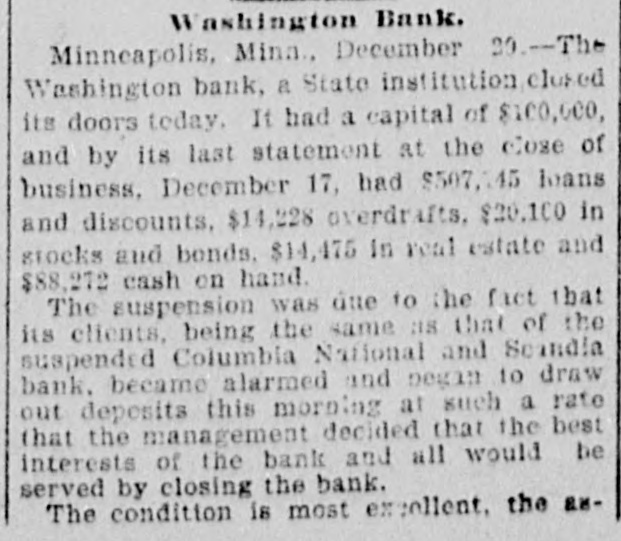
Washington Bank. Minneapolis, Minn., December 30.-The Washington bank, a State institution closed its doors today. It had a capital of $100,000, and by its last statement at the Close of business, December 17, had $507,145 loans and discounts, $14,228 overdrafts, $20.100 in stocks and bonds, $14,475 in real estate and $88,272 cash on hand. The suspension was due to the fact that its clients, being the same as that of the suspended Columbia National and Scandia bank. became alarmed and began to draw out deposits this morning at such a rate that the management decided that the best interests of the bank and all would be served by closing the bank. The condition is most excellent, the am-


Article from Omaha Daily Bee, December 30, 1896

Click image to open full size in new tab

Article Text

$1,000,000. Their liabilities cannot poss exceed $400,000 or $500,000 at the most firmly believe they will pay 100 cents on dollar and have $500,000 left. But they n have time. That is the whole reason the assignment. They have not the re money to meet certain pressing claims, these are times when hard cash talks. Attorney A. W. Green, who drew up assignment papers for the Batavia b: disclosed the principal causes which led to the assignment in an interview to Aside from Atlas bank liquidation the r important factor in the Van Norty crash, he said. was the recent failure dispose of $300,000 worth of bonds in Boston arket, secured by the great c bined lock mills, situated on Fox river Wisconsin, and valued at $700,000 in a c market. Negotiations for the conclus of this deal had nearly been contple when the National Bank of Illinois fai was announced. That immediately pu stop to the sale of the bonds and the Nortwicks were thrown upon their cash sources. Mr. Green said if this bond had been successful the Batavia bank we have been tided through the present ( culty. "There is no question that the cr tors' demands will be paid in full," Mr. Green. "The immediate cause of assignment was due to the Atlas b liquidation. The Van Nortwicks were debted to the Atlas for a consider: amount and were unable to pay any c. These loans are secured by the Apple Wis., paper mills, and there is no ques but that in time when all the assets car liquidated there will be money enough all creditors and some left for the Nortwicks." Lyman A. Walton, secretary of Equitable Trust company, who was trusted with the assignment papers of Van Nortwicks, has returned from Bata When seen he disclaimed all knowledge the -bank's affairs. "I spent only th minutes in Batavia." said Mr. Wal "and did nothave time to look over situation carefully. The cause of failure was the liquidation of the A bank. The Van Nortwick interests are large that it will take some time before exact figures can be given." TWO MINNEAPOLIS FAILURES. MINNEAPOLIS, Minn., Dec. 29 Columbia Nationalabank, a small Institu of comparatively recent establishment $200,000 capital, closed its doors this m ing. and is now in the hands of the b examiner. According to its last st ment. made December 17. it had loans discounts, $348,145; United States bonds secure circulation, $50,000; real estate mortgages, $48,728; due from other bar $42,897; cash reserve, $34,872; other ( items, $11,852: national bank notes standing, $45,000; due other banks, $136. deposits, subject to check, $101,507; cer cates of deposit, $68,594: certificates cashier's checks, $3,313; bills payable, $ 000. The Washington bank, a state in tution. closed its doors this noon. has a capital of $100,000 and by last statement, at the close of busin December 17, had $507,104 loans and counts, $142,228 overdrafts secured, $20 in stocks and bonds, $14,475 in real est and $88,272 cash on hand. Its depo were $363,132, its certified deposits, $112, bank deposits, $84037. /A. C. Haugan, treasurer. was on/ of the founders of bank and is one of its directors. O. Breecke is the cashier. The following announcement was made the clearing house committee this af noon: "The clearing house committee dee it its duty to announce that its investi tions warrant it in advancing whatever S of money may be needed by the Swedi American National bank to meet promp calls upon it by the depositors. This ba has an unusually large available cash serve, amounting to about 55 per cent of obligations, and its bills receivable are such account as we have no hesitation saying that we will make the necessary vances to meet all demands and that we not look for further trouble among the ba of this city." WASHINGTON, Dec. 29.-Comptro Eckels has received a dispatch announe the failure of the Columbia National ba of Minneapolis, Minn. Deputy Comptro Coffin, who is next in rank to Mr. Eck happened to be passing through Minnea lis and was directed to take tempor charge of the bank. Examiner Cook ordered from Chicago to take perman charge. The last report of the bank ceived by Mr. Eckels was that of Octo 6, the figures of December 17 not hav reached here. At that time the assets W $641,000, but these probably have shri since then. The comptroller ascribes failure to a lot of slow assets on which rea money could not be realized, and he S that this has been the cause of most of recent bank failures. The suspension of the Washington be was due to the fact that clientele being same as that of the suspended Colum National and Scandia bank, became alarn and began to draw out deposits this mo ing at such a rate that the managers cided that the best interests of all wo

Article from Birmingham State Herald, December 30, 1896

Click image to open full size in new tab

Article Text

FINANCIAL. Cincinnati, Dec. 29.-A petition was filed last evening by members of the wellknown firm of Duhme & Co., jewelers, for a dissolution and a receiver for the firm. They say the company is insolvent and unable to meet its maturing debts. Seattle Wash., Dec. 9.-The B. E. Stetson and Post Saw Mill company closed down its plant yesterday, throwing seventy men out of employment. The overproduction of lumber, together with the recent failures of eastern banks, affecting a number of western lumber firms, caused the suspension. Auburn, Me., Dec. 29.-A petition for a receiver for the American Trust and Banking company has been filed. A director says: "The .money is coming in such amounts that we are encouraged to think our doors can again be opened for business. The company has little borrowed money, and the directors believe that western investments will prove all right." Minneapolis, Minn., Dec. 29.-The Columbia National bank of this city closed its doors this morning, owing to inability to make collections. It is a comparatively new bank, having been organized about five years ago, with ex-State Treasurer Charles Kittelson as its president, and ex-State Treasuer Bobleter as its cashier, which positions they still hold. Its capital on December 18 was about $200,000, with a surplus of about $6,000. It has never been profitable. Deputy Comptroller of the Currency George W. Coffin, who happened to be in the city, took charge of the bank. Its officers claim that they will be able to pay depositors in full. Minneapolis, Minn., Dec. 29.-The Washington bank of this city has closed its doors. Its last statement, December 17, shows loans and discounts of $500,000 and deposits of $540,000. Its capital is $100,000, and its surplus $13,000. A. C. Haugan, its president, is city treasurer, and it is likely that quite an amount of city funds will be locked up by the failure. Its business is largely with working people. The officers claim that they will be able to pay them in full. Baltimore, Md., Dec. 29.-Berger & Co., leading retail dry goods merchants of South Baltimore, made an assignment today. Liabilities $50,000; assets about the same. Pressure of creditors and slow collections caused the suspension. Sioux City, Ia., Dec. 29.-On application of W. T. Honsinger, vice-president and a large shareholder in the Farmer's Trust company, of this place, G. H. Hollister was today appointed receiver for that institution. Tightness of the money market rendered it impossible for the company to meet its debentures when the makers of notes on which they were secured defaulted payments. Receiver Hollister estimates assets $238,000 and liabilities at $135,000.


Article from Richmond Dispatch, December 31, 1896

Click image to open full size in new tab

Article Text

der returnable at 10 o'clock to-morrow morning Judge Belden signed an order this morning appointing Judge A. Ueland receiver of the Washington Bank, under a bond of $200,000. The petition recites that the bank has $27,774 more liabilities than assets. Deputy-Collector Coffin is still in charge of the Columbia National Bank, awaiting the arrival of Bank-Examiner Cooke. The Farmers' and Mechanics' Bank issued a notice this morning, requiring all depositors to give sixty days' notice before being permitted to draw deposits. The bank issued a statement saying it had $800,000 in its vaults. The ClearingHouse Association held a meeting, and resolved to stand by all of the ten banks which are members of the organization. There was a heavy run on the St. Anthony Falls Bank, of this city, this forenoon. All demands were paid, and the excitement quieted down.


Article from Twice-A-Week Plain Dealer, January 1, 1897

Click image to open full size in new tab

Article Text

MORE TAILURES. Suspension of Two Banks in Minneapolis Announced. INABILITY TO REALIZE ON ASSETS. Many Interests Are Involved in the As signment of the Van Nortwick Brothers at Batavia, Ill-Other Business Troubles. 1 Minneapolis, Minn., Dec. 30.-The Columbia national bank, whose president is Charles Kittleson, ex-state treasurer, and whose cashier is Joseph Bobleter, also an ex-state treasurer, failed to open its doors Tuesday morning, and George M. Coffin, deputy controller of the currency, who happened to be in the city, took charge. Cashier Bobleter said that the liabilities, not including the capital stock, etc., and including principally deposits, amount in round numbers to $247,000, while the assets, mostly notes, amounted to $450,000. He said that he had no doubt but that the depositors would in time be paid in full. The state is a creditor to the amount of $16,000 and the county to about $5,000. The city had $1,200 on deposit. At the present time, according to Cashier Bobloter, there is $33,000 cash in the vault, and $100,000 will be collected within the next 30 days. The suspension was ordered for the purpose of protecting the majority of the creditors. The bank's capital is $200,000. Closed Its Doors. The suspension of the Scandia Monday and the Columbia Tuesday morning created consternation among the patrons of the Washington bank and such a run ensued that the bank was compelled to close its doors shortly after noon. Depositors drew their checks directly at the bank and through the clearing house at such a rate that it was evident that the interests of all the depositors demanded a suspension of business. The bank knew that its strength would be sorely taxed, and had made arrangements to get $50,000 in cash which would have tided it over safely, but the money was not forth coming Tuesday morning, and after a vain attempt to stand the demands, Cashier Brecke telephoned Bank Examiner Kenyon that the officials had decided to close the bank and asked him to take charge. Cashier Brecke stated that aside from the matter of cash on hand, the bank was in excellent shape. Exactly what will be done has not yet been deterunined. It is very likely that the suspension will be only temporary, as the resources of the bank are in such shape, according to Mr. Brecke, that its depositors can be paid in full in a comparatively short time. In round numbers the liabilities are $500,000 and the assets $600,000. Of the latter only $14,500 are real estate. The bank had some city deposits, $3,000 of state money and $4,000 of the county's. The bank's officials are President A. C. Haugan, who is at present city treasurer; vice president, K. S. E. Johnson; cashier, O. E. Brecke. The bank's loans and discounts are $507,145. Its deposits are $458,000 and its capital stock $100,000. Run on Savings Banks. The failure of two banksin this city in one day has caused a run on the Farmers' & Mechanics' savings bank, the largest savings bank in the northwest. It has over $7,000,000 on deposit, and does a strictly savings business. Quite an amount of money is being deposited there during the run. The of ficials say they can pay all demands and will not take advantage of the 60-day notice. Failure Involving Many Interests. Batavia, Ill., Dec. 30.-This city is in the throes of a financial disaster due to the failure of William M. & John S. Van Nortwick, bankers, of this place. The Van Nortwicks are not only leading commercial spirits of the Kane county town, but are heavily interested at other points. The assignment covers its interests in the following concerns: Bank of William J. and J. S. Van Nortwick, Batavia, Ill. Western Paper Bag company of Batavia. Appleton Manufacturing company, of Appleton, Wis. Memphis Woodenware company, of Memphis, Tenn. Cotton mills, at Aurora, Ill. Kaukauna Paper company, of Kaukauna, Wis. Combined Lock Paper company. Wisconsin Sulphite Fiber company. Union Pulp company. The assignment was made to the Equitable Trust company of Chicago. The cause of the failure was the liquidation of the Atlas national bank of Chicago, that institution having backed the Van Nortwicks to the extent of $300,000. W. M. Van Nortwick was a director in the Atlas. The father of the two men died in 1890. He left the sons $5,000,000. He had built paper mills and others, and his sons widely extended the business. It is thought the great fortune is dissipated. Attorney A. W. Green, of Green, Robbins & Honore, who drew up the assignment papers for the Batavia bank, disclosed the principal causes which led up to the assignment in an interview. Aside from the Atlas liquidation the most important factor in the Van Nortwick crash, he said, was the recent failare to dispose of $300,000 worth of bonds in the Boston market, secured on the great Combined Lock mills on Fox river and valued at $700,000 in a clear market. Negotiations for the conclusion of this deal had nearly been finIshed when the National Bank of Illinois' failure was announced. That put a stop to the sale of the bonds, and the


Article from The Columbia Herald, January 1, 1897

Click image to open full size in new tab

Article Text

Three Minneapolis Banks. MINNEAPOLIS, Dec. 29.-The Columbia National Bank of this city closed its doors this morning owing to inability to make collections. The bank's capital on December 18 was $200,000, with a surplus of about $6,000. Its loans and discounts were $348,000, and its deposits $264,000. The suspension of the Scandinavian yesterday and the Columbia this morning created consternation among the patrons of the Washington bank, and such a run ensued that the bank was compelled to close its door shortly after noon. In round numbers the liabilities are $500,000 and the assets $400,000. The Washington Bank of this city has closed its doors. Its last statement, December 17, shows loans and discounts of $500,000, and deposits of $540,000. Its capital is $100,000 and its surplus $13,000.


Article from The Diamond Drill, January 2, 1897

Click image to open full size in new tab

Article Text

which it could not realize. A Car Company Closes Shop. Laconia, N. H., Dec. 29.-The Laconia Car company was forced into insolvency Monday. The total liabilities are placed at $617,000 and assets at $407,000. Minneapolis Banks Suspend. Minneapolis, Minn., Dec. 30.-The Columbia national bank, whose president is Charles Kittleson, ex-state treasurer, and whose cashier is Joseph Bobleter, also an ex-state treasurer. failed to open its doors Tuesday morning, and George M. Coffin, deputy controller of the currency, who happened to be in the city, took charge. Cashier Bobleter said that the liabilities, not including the capital stock, etc., and including principally deposits, amount in round numbers to $247,000, while the assets, mostly notes, amounted to $450,000. He said that he had no doubt but that the depositors would in time be paid in full. The state is a creditor to the amount of $16,000 and the county to about $5,000. The city had $1,200 on deposit. At the present time, according to Cashier Bob. leter, there is $33,000 cash in the vault, and $100,000 will be collected within the next 30 days. The suspension was ordered for the purpose of protecting the majority of the creditors. The bank's capital is $200,000. Closed Its Doors. The suspension of the Seaudia Monday and the Columbia Tuesday morning created consternation among the patrons of the Washington bank and such a run ensued that the bank was compelled to close its doors shortly after noon. Depositors drew their checks directly at the bank and through the clearing house at such a rate that it was evident that the interests of all the depositors demanded a suspension of business. The bank knew that its strength would be sorely taxed, and had made arrangements to get $50,000 in cash which would have tided it over safely, but the money was not forthcoming Tuesday morning, and after a vain attempt to stand the demands, Cashier Brecke telephoned Bank Examiner Kenyon that the officials had decided to close the bank and asked him to take charge. A Kansas County Insolvent. Dighton, Kan., Dec. 30.-Lane county has formally. been declared insolvent by the county commissioners and the county treasurer has been ordered to stop further payment of interest on the county's bonded indebtedness, which amounts to $125,000. The securities are held by 40 corporations and individuals in New York and New England and have been quoted almost at par. Chairman Helmie, of the county board, declared the settlers were not repudiators and paid their taxes promptly, but the nonresident land-owners, such as the Jarvis-Conklin Mortgage company, had not paid any taxes for years, which prevented the county from raising enough money by taxation to meet its obligations. A Virginia National Bank Fails. Washington, Dec. 30.-The failure of the Commercial national bank of Roanoke, Va., was made known to the comptroller of the currency by telegraph and Comptroller Eckels immediately wired Bank Examiner Sands to take charge. The failure is attributed partly to speculation incident to the Roanoke boom. Mr. Eckels says the failure is not important. On November 21, the date of the last report of the condition of the bank, the assets were $263,704. including bonds to secure circulation: stock, $100,000: surplus, $25,000: undivided profits, $6,000; owing depositors, $75,000; other liabilities, $35,000 Receiver Named. Sioux City, Ia., Dec. 30.-On application of W. T. Honsinger, vice president and a large shareholder in the Farmers' Trust company of this place, G. H. Hollister was on Tuesday appointed re. ceiver for the institution. Tightness of the money market rendered it impossible for the company to meet its debentures when the makers of notes


Article from The Irish Standard, January 2, 1897

Click image to open full size in new tab

Article Text

WASHINGTON BANK. It Goes the Way of the Other Unfortunates. The Washington Bank, incorporated under the state laws, closed its doors yesterday at about noon. Its customers were largely of the same class that had patronized the Scandia and Columbia National banks, and the suspension of those two institutions caused a "run" on the Washington, which was located on the corner of Washington and Second avenues south. The bank officials had anticipated the run and had arranged for some $50,000 to carry them through the day, but at the last moment the amount was not forthcoming, and after making a vain endeavor to stem the tide and meet all demands as fast as presented, Cashier Brecke finally wired Public Examiner Kenyon that the directors had decided to close the bank; and requested him to take charge. This he did at once. The closing of these two banks, following so closely on the suspension of the Scandia on the day before, caused the wildest rumors to be circulated regarding a number of other banks. Happily there appears to be no foundation whatever for these rumors. At least, members of the clearing house association, who are certainly qualified to speak intelligently upon the subject, assert most emphatically that there will be no further suspensions among the banks. In reference to the affairs of the Washington bank, Cashier Brecke stated yesterday afternoon that aside from the matter of cash on hand, the bank was in excellent shape. Exactly what will be done has not yet been determined. It is very likely that the suspension will be only temporary, as the resources of the bank are in such a shape, according to Mr. Brecke, that its depositors can be paid in full in a comparatively short time, and 50 cents on the dollar within two months. In round numbers the liabilities are $500,000 and the assets $600,000. Of the latter only $14,500 are real estate. The bank had some city deposits, $3,000 of state money, and $4,000 of the county's. The bank's officials are as follows: President, A. C. Haugan; vice president, A. E. Johnson; cashier, O. E. Brecke; assistant cashier, August Breckman. Inquiry was made at the city hall in reference to the amount of funds on deposit by the city, not only in the suspended banks, but also in all the other banks in the city. Assistant City Treasurer Ankeny stated that he would prepare the information and present it to the mayor for communication to the city council at its next meeting. Until


Article from The Saint Paul Globe, January 7, 1897

Click image to open full size in new tab

Article Text

HAUGAN'S CHECK RETURNED. Court Decides the Washington Has No Claim on It. Andrew C. Haugan has secured $10,000 of money which has been tied up in the clearing house by an order of Judge Belden. Yesterday afternoon Mr. Haugan made an affidavit to the effect that on the day the Washington bank failed, he drew his check in favor of the Washington bank, against the funds in his name in the Flour City National bank. to meet clearances of the Washington bank. It happened that the amount needed was $27,000, and the Flour City did not honor the check. Then Haugan drew another check personally and collected the money for the clearing house, but as the Washington bank failed, none of the money was used. The city treasurer stated that he needed the money, but the clearing house would not release it until it was sure that the receiver of the Washington bank had no claim upon it. The court finds that he has not, and SO released the money by order.


Article from The Times, April 8, 1897

Click image to open full size in new tab

Article Text

SENSATIONAL DISCLOSURES MADE A Legislative Committee Investigating Bank Failures. St. Paul, Minn., April 7.-The jointlegislative committee investigating insolvent banks in this city and Minneapolis has made public the testimony secured during the past two months. Some of the disclosures are highly sensational. As to the Bank of Minnesota, of which William Dawson, Sr., was the president, and William Dawson, jr., cashier, W. H. Lightner, one of the receivers, stated that on October 7 $135,606 was due to the bank from the Fort Dearborn National Bank of Chicago. The balance, he said, was incorrect, accounts between these two banks being falsified to the extent of $100,000. At the time of the failure of the bank there was owing to it by the officials the following sums: William Dawson, sr., about $90,000; William Dawson, jr., $59,950: R. A. Smith, $50,000, of which he has since paid $35,000. In addition to that, William Dawson, jr., was guarantor of $53,000, of which $30,000 was overdrawa. As to thecause of the failure of the bank, it was testified that William Dawson, sr., owed it $281,000. The schedules of assets and liabilities of William Dawson, jr., have been filed in the district court. The assets are placed at $239,168.78, and the liabilities, $868,452.47. The face value of the assets is much higher. By far the largest portion of Mr. Daw. son's direct liabilities consists of in dividual notes. A few of these are secured, but most of them only by the indorsement of William Dawson, sr. As to the Scandia Bank, of Minneapolis, the committee states that its failure, according to the evidence, was honest, and it may yet pay in full. The committee says that the Washington Bank, of Minneapolis, went under for want of paid-up capital, direct and indirect loans to its officers, and from a lack of supervision. Dwelling upon the affairs of the Allemania Bank, of St. Paul, the report says that the assets, or a large portion of them, were worthless. The directors, it states, were heavy borrowers, and were guilty of misstatements. As to the affairs of the Minnesota Savings Bank, of St. Paul, the committee states the officers were borrowers. directly or indirectly. to an amount more than double the capital stock.


Article from The Irish Standard, November 6, 1897

Click image to open full size in new tab

Article Text

adjoining the church last Thursday evening. The proceeds will go to help the destitute of the parish. M. Hogan, a traveling man from Grand Rapids, Mich, arrived in the city Wednesday from Sioux City, and went to the Nicollet house. He had $95 in his pocketbook when he left Sioux City, but in some way the money had been ex- tracted. He cannot account for the theft. It is stated that A. C. Haugan, ex- city treasurer and banker, will enter the grocery store of C. S. Brackett as a clerk. Mr. Haugan several years ago was in the grocery business in South Minneapolis, and is, therefore, weli qualified to assume such a position. October was a busy month for the poor department, in view of the pleas- ant weather that prevailed. There were 450 applications for aid, and help was given to 344 families, numbering 1,465 individuals. There were 118 visits made by the assistant superintendent. Relier was extended in the following ways. Three hundred and six grocery orders, at an expense of $653; 153 wood orders, $422; 13 burials, $92; 28 transportations $219. The Bethany Home, which present contains nineteen city charges, cost the city $277, and the poor farm expense was $631. Dr. D. R. Butler has re- turned to the city after three years absence, and opened an office at 308 Twentieth avenue north, where he will be pleased to meet any of his old friends. Since leaving Minneapolis the doctor has spent two years in the pine woods of Eastern Minnesota, and a term at the Polyclinic at Chicago. Judge McGee has made an order, fix- ing the last day for filing claims against J. C. McCurry & Co., Nov. 25. Read the letter of Prof. Hosmer, the librarian of the public library, about the Irish and Catholic books on his shelves. Go to the library, take them home and read them during the winter months. One of the old settlers of Hennepin county, Cornelius Couillard, celebrated his 84th birthday Monday, at his home in the township of Richfield. There were present a large number of children, grandchildren and great-grandchildren. George Odell, another old settler, who numbers over 80 years, called during the day. Both men are still living on the farms on which they settled back in the fifties. Division No. 6, A. O. H., will give a benefit ball for the Hibernian Cade band at their hall, 2413 Bloomington avenue, next Thursday evening. The funeral of Mrs. Lillian Miller, who died of pneumonia after an illness of but two days, at her late home in Fargo, N. D., on Friday of last week, took place from the residence of her father, Frank Daily, 913 Third avenue south, this city, at 3 o'clock last Sunday af- ternoon. The remains were interred al St.. Anthony cemetery. The deceased was the wife of M. W. Miller, chief operator of the Western Union Tele- graph Co. at Fargo. She was 26 years of age, and leaves besides her husband, two children. Attorney John J. Kinnane, now of Chicago, but for several years a resi- dent of this city, was here during the week on business connected with the old Catholic Building and Loan associa- tion. Another dividend of 10 per cent is about to be paid to creditors of the Washington bank, the order directing Receiver Ueland to pay such a dividend having been signed by Judge McGee. This is the second payment to the cred- itors, the first dividend declared also being one of 10 per cent. The creditors are required to present the receiver's certificates at his office in the New York Life building in order to have the dividend credited before they can re- ceive any money. Capt. John H. Tapper is in the city for a two months' visit to his son, Frank, whe is on the police force. Capt. Tapper was a ferryman on the Missis- sippi in the days when there were no bridges across from Minneapolis to St. Anthony. The ladies of the church of St. Law- rence will hold their next social at the residence of Mr. James Cullen, 128 Pleas- ant avenue southeast, on Thursday evening, Nov. 11. The Misses Cullen extend an invitation to their friends in all parts of the city to be present on the merry occasion. Last Tuesday evening the St. An- thony Literary society held a meeting at which Rev. James O'Reilly presided.


Article from The Saint Paul Globe, January 30, 1898

Click image to open full size in new tab

Article Text

MINNEAPOLIS. OFFICE 65 SOUTH FOURTH STREET. # MINNEAPOLIS GLOBULES. Maud McBride has begun suit for divorce from Harry L. McBride on the grounds of desertion. Rika Peterson, who has been employed as domestic, was examined as to her sanity in the probate court and ordered committed to the asylum. Harriet Elizabeth Reeves has filed a petition for letters of administration in the estate of Delia R. Capron, who leaves $28,500 to six heirs. P. W. De Lancey, of Minneapolis, and Schmidt Brothers, of West Superior, Wis., were awarded the contract for the new flour warehouse at Superior for the Eastern Railway of Minnesota. It requires nearly 10,000 piles and 5,000,000 feet of lumber. That rollicking, roaring farcical review of R. F. Outcault's pen pictures, lately so popular in New York, will be the attraction at the Bijou for one week, beginning at today's matinee, and comes under the familiar title of "McFadden's Row of Flats." The board of sinking fund commissioners met yesterday morning in the office of Mayor Pratt, and agreed to accept the compromise of the bondsmen of A. C. Haugan, in so far as it related to the money of the sinking fund. The amount which the fund receives is $17,680. John Peterson, the new collector of customs for the district of Minnesota, made the rounds of the federal building yesterday morning. He stated that he would take up the office on Feb. 1, but gave no intimations of his intentions regarding the Minneapolis collectorship. "The Geisha, which had an unprecedented run at the Savoy theater in London, and at Daly's theater in New York, will be seen at the Metroplitan theater this week, commencing this evening, with the same elaborate scenery and costumes, several of the London and nearly all of the New oYrk favorites in the cast. The report of the receiver in the Washington bank shows receipts of $141,079.25 and disbursements of $123,789.11, with cash on hand of $14,039.12. There have been dividends declared of $99,551.77 and money returned depositors by order of court amounting to $11,961.17. The receiver leaves the value of his services to the court. The matter will be heard Feb. 26.


Article from The Redwood Gazette, May 10, 1899

Click image to open full size in new tab

Article Text

# BELVIEW AND ITS BORDER. Halger Hurtig of Carver is now clerking in the store of Otto Goetze. Wm. Ore and wife came down from Cottonwood and remained over Sunday. The Lutheran Ladies Aid society will meet with Mrs. C. C. Enestvedt afternoon. Work has commenced on the superstructure of the new Catholic church at this place. P. H. Jones is now engaged in putting a ten horse power gasoline engine in his elevator. Wm. O'Conner and wife of Renville visited with the family of J. M. Thompson over Sunday. Peter Hanson, residing six miles south of town, was made the father of a baby girl a week ago. The residence of Samuel Sampson in Southworth's addition, is rapidly approaching completion. Julius Halberg of Delhi, who is talking of becoming a cigar salesman, was in town the first of the week. B. Simpson and wife desire to return their thanks to the friends who assisted them in their recent bereavement. Halvor Helgeson has recently moved into the residence of J. M. Thompson, at one time occupied by F E. Harris. At the last meeting of the village council THE GAZETTE was made the official paper of the village of Belview. The band boys gave open air concerts on Thursday and Sunday evenings, rendering some very fine music. The time will soon be gone when you can get those 100 piece set dishes at mark down price at The Fair Store. A. Leonard is improving the appearance of his residence by adding a bay window and making other improvements. Wanted-Girl to do general house work. Work light, pay good. For particulars inquire of I. N. Tompkins, Redwood Falls. 38-t.f. Louis Leonard and wife left for Courtland, Nicollet county, last Thursday, to visit with Mrs. Leonard's relatives in that town. J. M. Thompson and A. O. Gimmestad were in Redwood Falls attending to court matters during the early portion of last week. T. W. Wallace and wife have stored their household goods for the summer and Mrs. Wallace will go to Cannon Falls to remain until fall. There will be services at the Lutheran church a week from next Sunday -the second day of Penticost, by Rev. Aasen of the Red Wing theological seminary. Goetze & Co. have issued some neat blotters setting forth the great May bargains of that cash store. Cheapness and quality are made a combination on the blotter. The first and second nines of Belview played a game of base ball Sunday afternoon, and at the end of seven innings time was called with an even score of 13 to 13. Mary Scanlan of Sheridan is visiting with her brother, Patrick in Rush City. Patrick is in the grocery business there with John O'Hara, formerly of Redwood Falls. L. P. Dolliff & Co. have sold the lumber to Jacob Jacobson for a $250 addition to his residence, to Helga Knudson for a $600 residence, and to Lars Tufto for an $800 residence. Mrs. H. A. Bakke came up from Rio, Wis., Isst Saturday, and is now busily engaged in arranging the home recently erected for herself and husband, and located in Southworth's addtion. John Gilbertson, residing in Swedes Forest, had a deep gash out of his cheek and a part of his ear torn open, by striking a nail while accidently falling into a barrel, on April 29th. A girl's "complexion" may be stamped on her lover's heart, but most of the "complexion" comes off unless put there by Rocky Mountain Tea. "Powder's a bad thing." Hitchcock & Co, A. O. Gimmestad received word recently that the creditors of the Washington Bank of Minneapolis, in which he had nearly $1500 on deposit at the time of its suspension, would receive another five per cent. dividend in a short time. Swan Peterson sold three steers to W. P. Weston of St. Paul for $190 during the past week. The purchaser was purchasing a car load of cattle in this


Article from Willmar Tribune, August 30, 1899

Click image to open full size in new tab

Article Text

i Land for Sale. The undersigned will until September 11th, 1899, receive sealed bids for the east half (E) of the southeast quarter (SEt) of section (21), township one hundred and twenty-one (121), range thirty-five (35), in Kandiyohi county, Minnesota, subject to a mortgage for $400, with interest thereon from July 14th, 1899. All bids must be accompanied by check for not less than 825 as guarantee of. good faith. All bids subject to approval of court. A. UELAND, Receiver of Washington Bank, No. 1019 New York Life Bldg. 1a Mianeapolis, Minn.


Article from Warren Sheaf, November 23, 1899

Click image to open full size in new tab

Article Text

NEWS IN BRIEF. Owatonna is putting in an electric fire alarm system. Samuel W. Ritchie, formerly a wealthy Minneapolis broker, was found dead on the floor of his room at the National hotel at Seattle. He had slashed a knife almost through his neck, severing the jugular vein. He was despondent over ill-fortune. Near Hastings the steamer Jessie B. and Flora Clark collided, the latter being badly damaged. Mrs. A. W. Clason died at Rochester from the effects of chioroform administered while having teeth extracted. Mrs. Daniel Smith, an aged lady living just outside of Wood Lake, was found dead in bed by neighbors. The cause was coal gas from the stove. The work of securing signatures to the monster petition to be presented to President McKinley, asking for the pardon of the six Minnesota soldiers sent to prison for the Augusta mutiny, is progressing in a highly satisfactory manner, and the originators of the project feel assured of success. Maple wood costs more per cord in Minneapolis than stove coal per ton. S. H. Hall was elected president of the Commercial Club of Minneapolis. Fifty loaves of bread were seized in Minneapolis on account of light weight and given to the needy. Judgments aggregating $42,400 were sold for $600 by the receiver of the defunct Washington bank of Minneapolis. Phil C. Justus, of St. Paul, was badly burned by an explosion of stove polish. The sawmill of the Charles Betcher Lumber Company at Winona burned to the ground. All the workmen escaped uninjured. The origin of the fire is unknown. Lumber piles in the vicinity were saved by hard work. The loss is probably $15,000; insured. Dr. Henry G. Filmore, 68 years old and a pioneer citizen, was found dead in bed at St. Cloud, having probably suffocated during the preceding night. He was sick of a cancer, but refused to permit an attendant. At Preston, Ole Aseln split Otto Nilson's nose open with a jack knife and was fined $30 therefor. Walter Krenzke, of Minnesota City, while laboring under the effect of liquor, became quite violent at his home and threatened to commit suicide. It was necessary to call in four strong men to handle him. Charles Clarkson, a colored waiter at the Ryan Hotel, St. Paul, fell dead in the pantry adjoining the dining room, just after he had finished serving one of the guests of the hostelry. The Eastern railway opened its new short line to Duluth, and established regular train service. Day trains will run via the new cut-off. Night trains will use the old Eastern Minnesota line. It is reported from a reliable source that the Minnesota Iron Company has purchased the Nelson Lumber Company's mineral lands on the range. The consideration is said to be $1,000,000. The postmaster general has issued an order changing the site of the postoffice at Oakdale, to three miles north of the presant location.


Article from The Ely Miner, November 24, 1899

Click image to open full size in new tab

Article Text

# NEWS IN BRIEF. Owatonna is putting in an electric fire alarm system. Samuel W. Ritchie, formerly a wealthy Minneapolis broker, was found dead on the floor of his room at the National hotel at Seattle. He had slashed a knife almost through his neck, severing the jugular vein. He was despondent over ill-fortune. Near Hastings the steamer Jessie B. and Flora Clark collided, the latter being badly damaged. Mrs. A. W. Clason died at Rochester from the effects of chloroform administered while having teeth extracted. Mrs. Daniel Smith, an aged lady living just outside of Wood Lake, was found dead in bed by neighbors. The cause was coal gas from the stove. The work of securing signatures to the monster petition to be presented to President McKinley, asking for the pardon of the six Minnesota soldiers sent to prison for the Augusta mutiny, is progressing in a highly satisfactory manner, and the originators of the project feel assured of success. Maple wood costs more per cord in Minneapolis than stove coal per ton. S. H. Hall was elected president of the Commercial Club of Minneapolis. Fifty loaves of bread were seized in Minneapolis on account of light weight and given to the needy. Judgments aggregating $42,400 were sold for $600 by the receiver of the defunct Washington bank of Minneapolis. Phil C. Justus, of St. Paul, was badly burned by an explosion of stove polish. The sawmill of the Charles Betcher Lumber Company at Winona burned to the ground. All the workmen escaped uninjured. The origin of the fire is unknown. Lumber piles in the vicinity were saved by hard work. The loss is probably $15,000; insured. Dr. Henry G. Filmore, 68 years old and a pioneer citizen, was found dead in bed at St. Cloud, having probably suffocated during the preceding night. He was sick of a cancer, but refused to permit an attendant. At Preston, Ole Aseln split Otto Nilson's nose open with a jack knife and was fined $30 therefor. Walter Krenzke, of Minnesota City, while laboring under the effect of liquor, became quite violent at his home and threatened to commit suicide. It was necessary to call in four strong men to handle him. Charles Clarkson, a colored waiter at the Ryan Hotel, St. Paul, fell dead in the pantry adjoining the dining room, just after he had finished serving one of the guests of the hostelry. The Eastern railway opened its new short line to Duluth, and established regular train service. Day trains will run via the new cut-off. Night trains will use the old Eastern Minnesota line. It is reported from a reliable source that the Minnesota Iron Company has purchased the Nelson Lumber Company's mineral lands on the range. The consideration is said to be $1,000,000. The postmaster general has issued an order changing the site of the postoffice at Oakdale, to three miles north of the present location.


Article from The Saint Paul Globe, March 15, 1900

Click image to open full size in new tab

Article Text

# BANK ASSETS AT AUCTION. Great Many of the Schedules Brought Ridiculously Low Prices. Andreas Ueland as the receiver of the defunct Washington bank, yesterday sold at public auction the remaining assets of the institution and about one-quarter of the institution and about $125,000 of property on its face value was knocked down for a total of $5,343. Many of the schedules brought ridiculously low prices, but it was the old story of nobody in particular wanting a dead horse, the sale being a sad reminder of the palmy days of the bank when a land office business was transacted in values with many of the well known men of Minneapolis.