Click image to open full size in new tab
Article Text
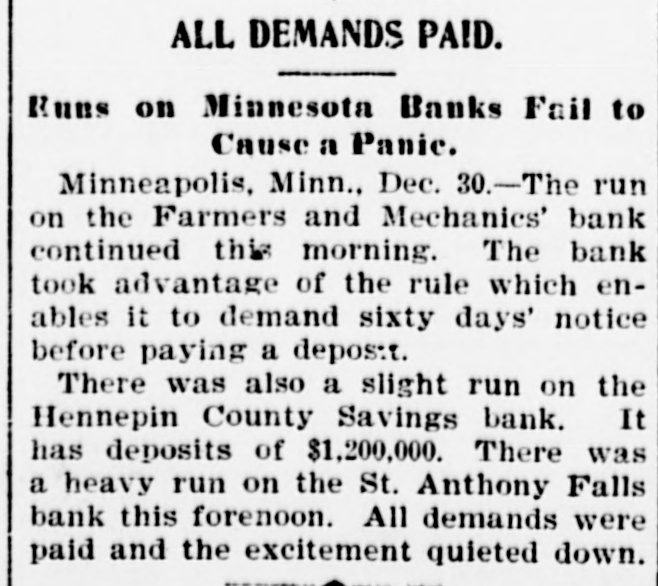
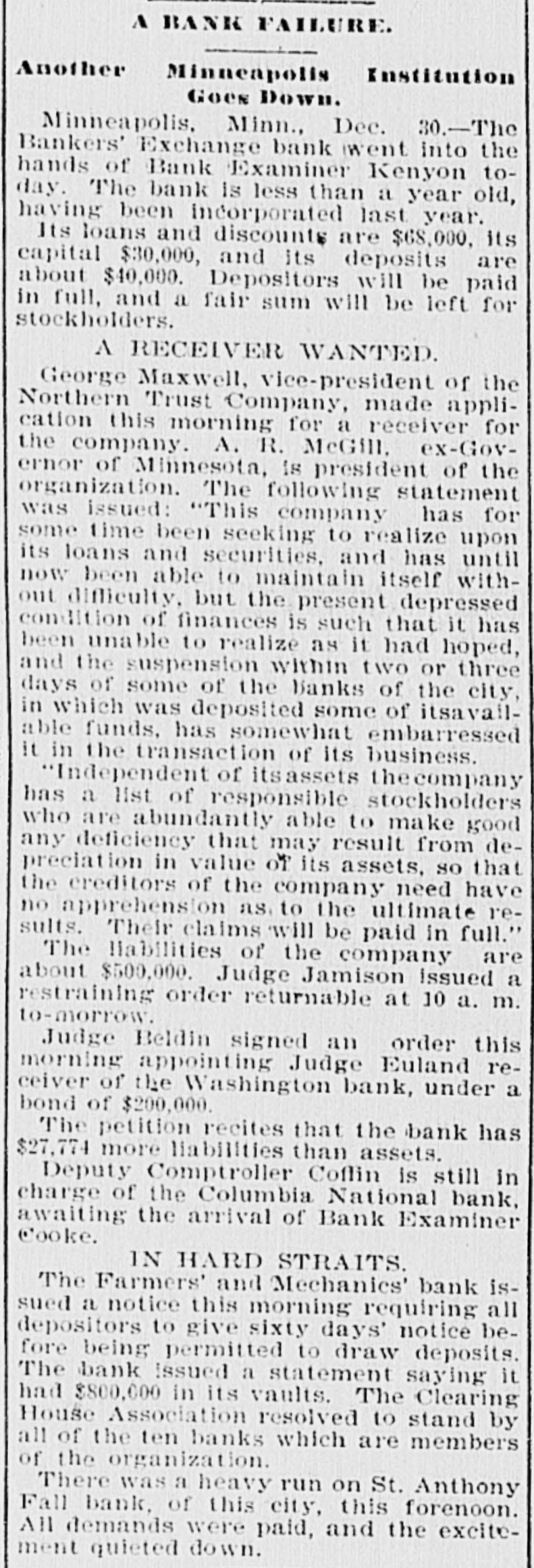
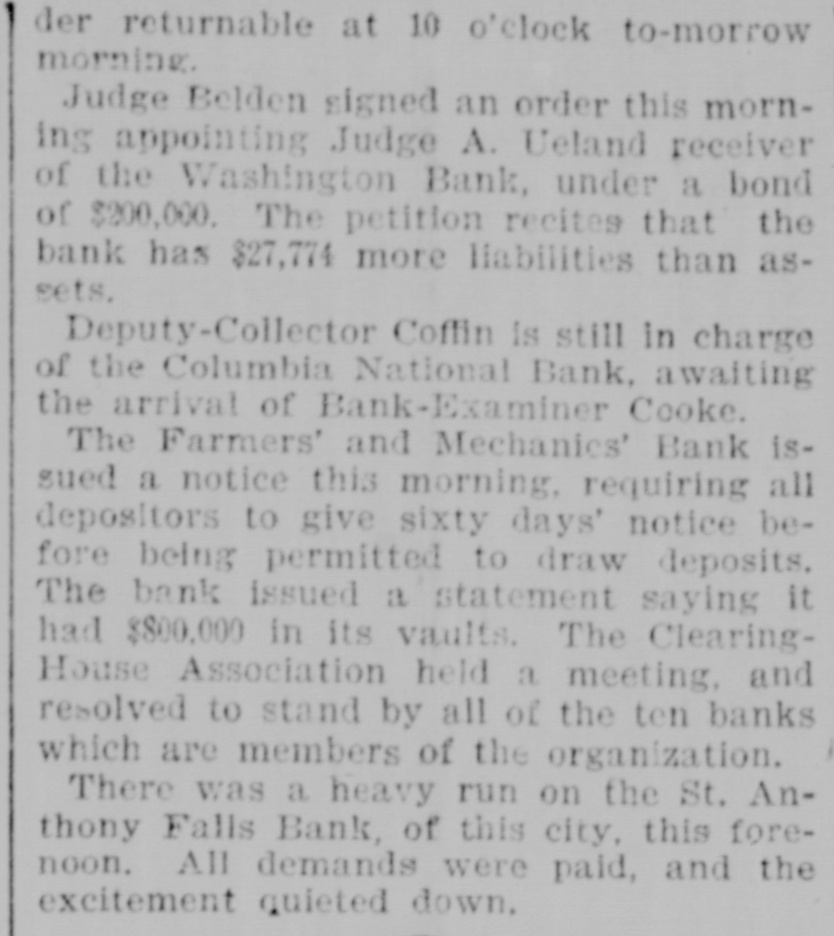
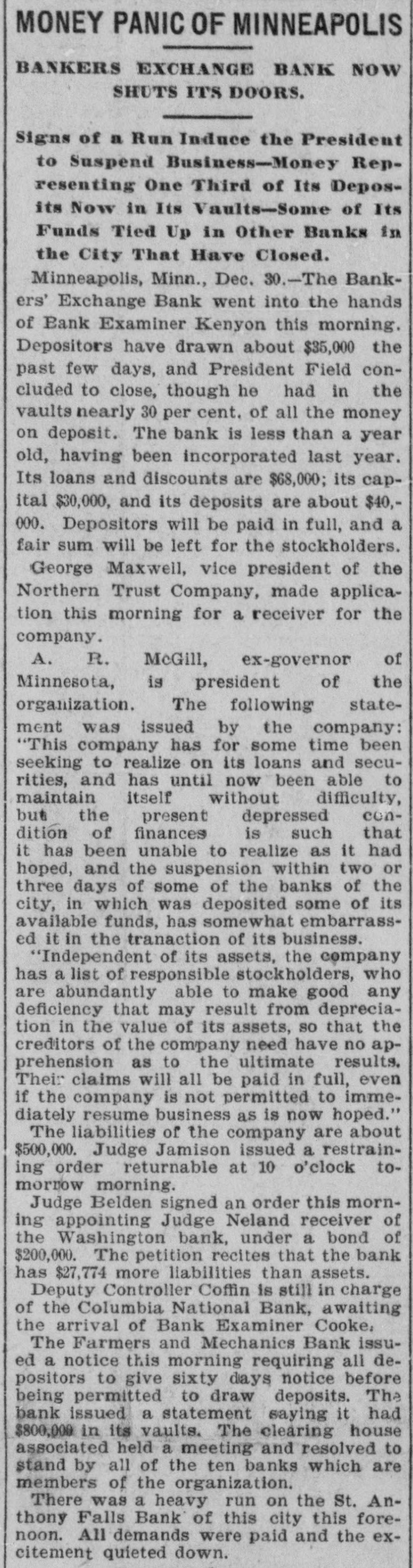
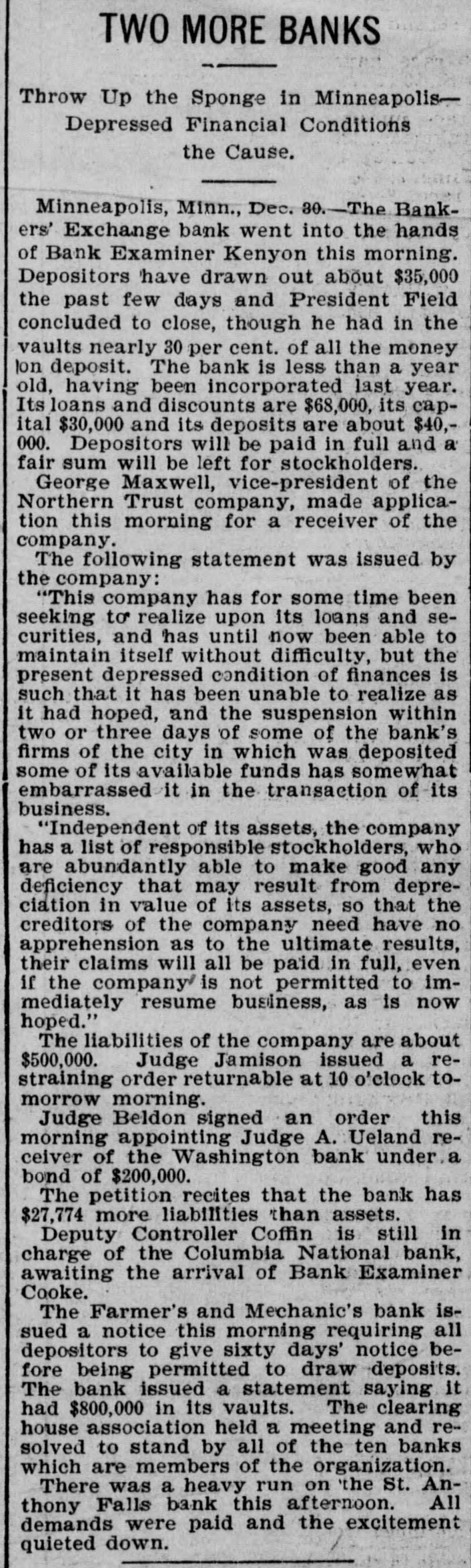
Another Minneapolis Bank Closes-Condition of Other Institutions. MINNEAPOLIS, MINN., Dec. 30.-The Bankers' Exchange Bank went into the hands of Bank Examiner Kenyon this morning. Depositors have drawn out about $35,000 the past few days, and President Field concluded to close, though he had in the vaults nearly 30 per cent. of all the money en deposit The bank is less than a year old, having been incorporated last year. Its loans and discounts are $68,000; its capital $30,000, and its deposits are about $40,000. Depositors will be paid in full, and a fair sum will be left for stockholders George Maxwell, vice president of the Northern Trust Company, made application this morning for a receiver of the company. A. R. McGill ex-Governor of Minnesota, is the president of the or ganization. The following statement was issued by the company "This company has for some time been seeking to realize upon its loans and securities, and has until now been able to maintain itself without difficulty, but the depressed condition of finances is such that it has been unable to realize as it had hoped, and the suspension within two or three days of some of the banks of the city, in which was deposited some of its available funds, has somewhat embarrassed it in the transaction of its business, Independent of its assets, the company has a list of responsible stock holders, who are abundantly able to make good any deficiency that may result from depreciation in value of its assets, so that the creditors of the company need have no apprehension as to the ultimate results, their claims will all be paid in full, even if the company is not permitted to immediately resume, as is now hoped. The liabilities of the company are about $500,000. Judge Jamison issued a restraining or der. returnable at 10 o'clock to-morrow morning. Judge Belden signed an order this morning appointing Judge A. Ueland receiver of the Washington Bank under a bond of $200,000 The petition recites that the bank has $27.77 more liabilities than assets. Deputy Comptroller Coffin is still in charge of the Columbia National Bank awaiting the arrival of Bank Examiner Cooke The Farmers and Mechanics Bank issued a notice this morning requiring all depositors to give sixty days notice before being permitted to draw deposits. The bank issued a statement saying it had $800,000 in its vaults. The ClearingHouse Association held a meeting and resolved to stand by all of the ten banks which are members of the organization. There was a heavy run on the St. Anthony Fall Bank of this city this forenoon. All demands were paid, and the excitement quieted down. CHICAGO Dec. A. Paulsen, who was the principal owner of the failed Central Trust and Savings Bank filed a bill in the Circuit Court to-day to restrain the Atlas National Bank from disposing of a note for $30,000 made by him to the bank and to restrain President Grannis and Charles B. Farwell, a director and x-United States senator, from disposing of their own property, so that Paulsen cannot collect any of the damages he may be awarded at the trial of his suit for $250,000 against the bank Grannis and Farwell in connection with the $30,000 note and the closing of Paulsen's bank by the failure of the Atlas to clear for it. In his bill Paulsen sets up the liquida. tion of the Atlas Bank now in progress and states his belief. that. notwithstanding all the depositors are being paid in full. it is hopelessly insolvent and will not pay its depositors from its own funds He also alleges that the Atlas Bank still holds him as endorser on the $30,000 note although the courts have held it to be fraudulent. and also unlawfully withholds $40,000 of collateral bonds belonging to him APPLETON WIS. Dec. 0.-John S Van Nortwick to-day made an individual assignment of his Fox river interests naming Postmester John M. Bear of this city, as receiver the latter giving bonds for $250,000. The principal property included in this assignment are the plants of the Combined Locks Paper Company, the Appleton Pulp and Paper Company, Union Paper Company at Kaukauna Wis.: Fibre Company at Monoca: 740 shares in the Green Bay and Mississippi Canal Company the face value of which is $740,000. and miner interests, including his residence in this city. DALLAS TEXAS. Dec. 30.-Telegrams to commercial agencies at Dallas announce the failure of A.A. Bahn feweler at Austin Texas Liabilities $30,000: assets. $10,000 Eastern creditors are caught for only $5,000. Three Austin banks are owed $10,000. PARKERSBURG W. VA., Dec. 30.-Isaac Prager & Sons, extensive retail dry-goods dealers, made an assignment yesterday. Assets and liabilities are estimated at $100,000. MONTGOMERY, ALA., Dec. -The Commercial Bank of Selma failed to open its doors for business to-day. instead a notice was posted stating that the Board of Directors had decided to make an assignment The cause of this action was the heavy run made on the bank in the last few days. The bank was a heavy debtor to New York banks, among them the Chemical, American Exchange Nattobal City, Third National of Montreal, and National Bank of the Republic, and they sent an attorney some days ago to investigate its condition. The knowledge of the attorney's presence had a great deal to do with the run. The Board of Directors arrived at the conclusion to assign after a long and continued session lasting until after midnight last night. The officers of the bank are. R. M. Nelson, president: Geo. A. Wilkins, vice-president; A. E. Baker, cashier. The patrons of the bank have cont. dence that it will soon resume business and are signing an agreement to withdraw their deposits. one-third in three months. one-third in six months, and one-third in nine months. There is no public statement as yet of assets and liabilities. The business men are hopeful that the failure will not be detrimental to their interests. HORRIBLE BRUTALITY