Real Estate Bank of the State of Arkansas (Little Rock, AR)

Episode Information

Episode UID
8586283190664
Episode Type
Suspension โ†’ Closure
Bank Type
state
Bank ID
858628319 hash
Start Date
April 20, 1855
Location
Little Rock, Arkansas (34.746, -92.290)

Metadata

Model
gpt-5-mini (chosen from majority vote of a three-model LLM ensemble)
Short Digest
78f79552a03bd037

Response Measures

None

Description

Chancery decree divested trustees and placed assets in receivership; no evidence bank reopened.

Events (4)

1. April 20, 1855 Receivership
Newspaper Excerpt
Col. C. F. M. Noland has been appointed Receiver, in the place of the trustees removed, and that his salary...Col. Noland has qualified, and will...take immediate charge of the affairs of the Bank.
Source
newspapers
2. April 20, 1855 Suspension
Cause
Government Action
Cause Details
Chancery court decree divesting trustees and officers of assets and appointing a receiver
Newspaper Excerpt
a decree was rendered by that court on the 20th day of April, 1855, divesting said Trustees and officers of the assets of that institution
Source
newspapers
3. November 10, 1855 Other
Newspaper Excerpt
instructions that the Receiver shall cause the abstracts named in the answers of the Trustees...to be made out as speedily as practicable; and the expense thereof to be paid out of the trust fund
Source
newspapers
4. November 10, 1855 Receivership
Newspaper Excerpt
Order...removing C. F. M. Noland and appointing Gordon N. Peay Receiver in Chancery of the assets of the Real Estate Bank.
Source
newspapers

Newspaper Articles (9)

Article from The True Democrat, April 24, 1855

Click image to open full size in new tab

Article Text

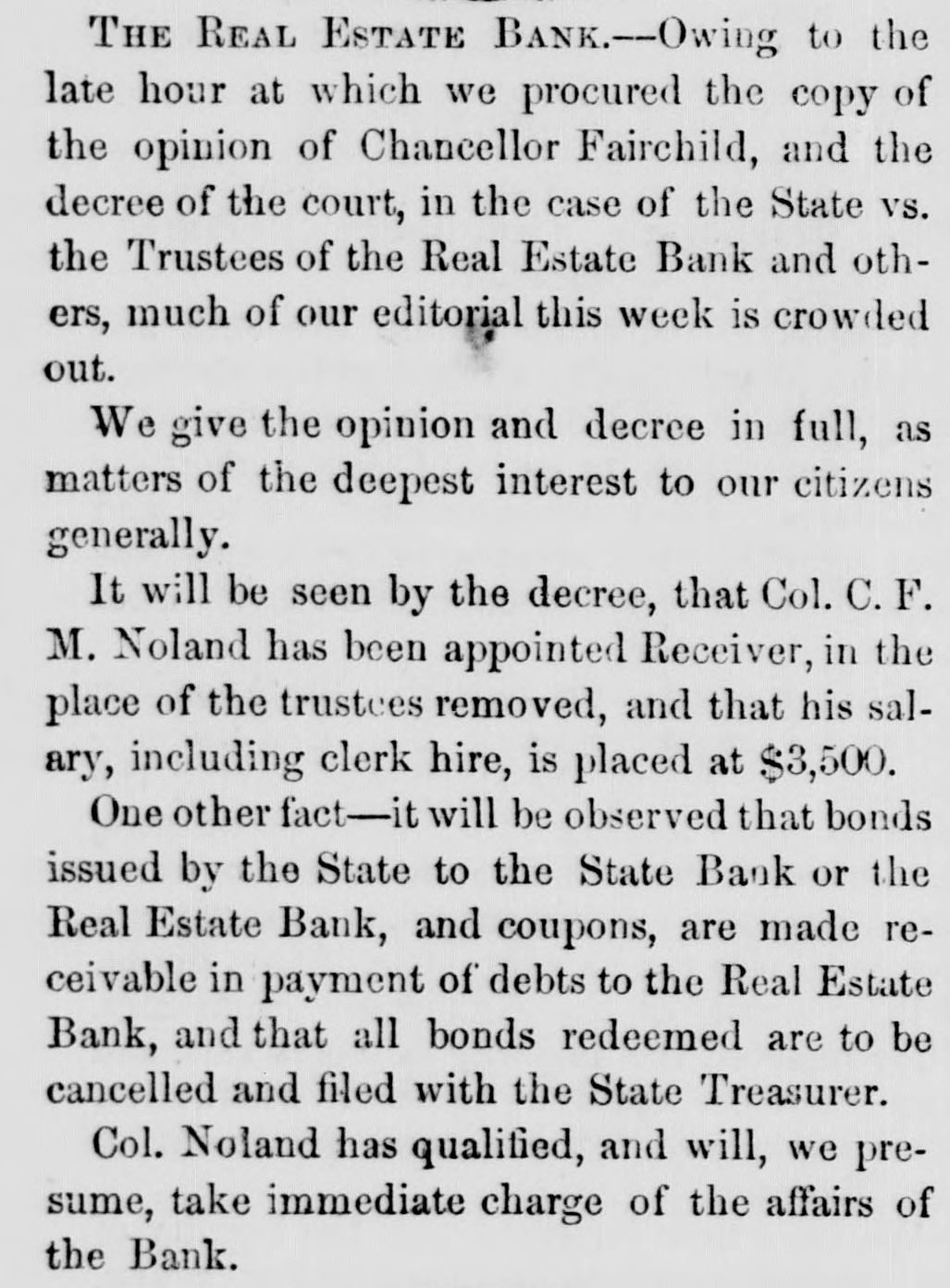
THE REAL ESTATE BANK.--Owing to the late hour at which we procured the copy of the opinion of Chancellor Fairchild, and the decree of the court, in the case of the State vs. the Trustees of the Real Estate Bank and others, much of our editorial this week is crowded out. We give the opinion and decree in full, as matters of the deepest interest to our citizens generally. It will be seen by the decree, that Col. C. F. M. Noland has been appointed Receiver, in the place of the trustees removed, and that his salary, including clerk hire, is placed at $3,500. One other fact-it will be observed that bonds issued by the State to the State Bank or the Real Estate Bank, and coupons, are made receivable in payment of debts to the Real Estate Bank, and that all bonds redeemed are to be cancelled and filed with the State Treasurer. Col. Noland has qualified, and will, we presume, take immediate charge of the affairs of the Bank.


Article from The True Democrat, July 10, 1855

Click image to open full size in new tab

Article Text

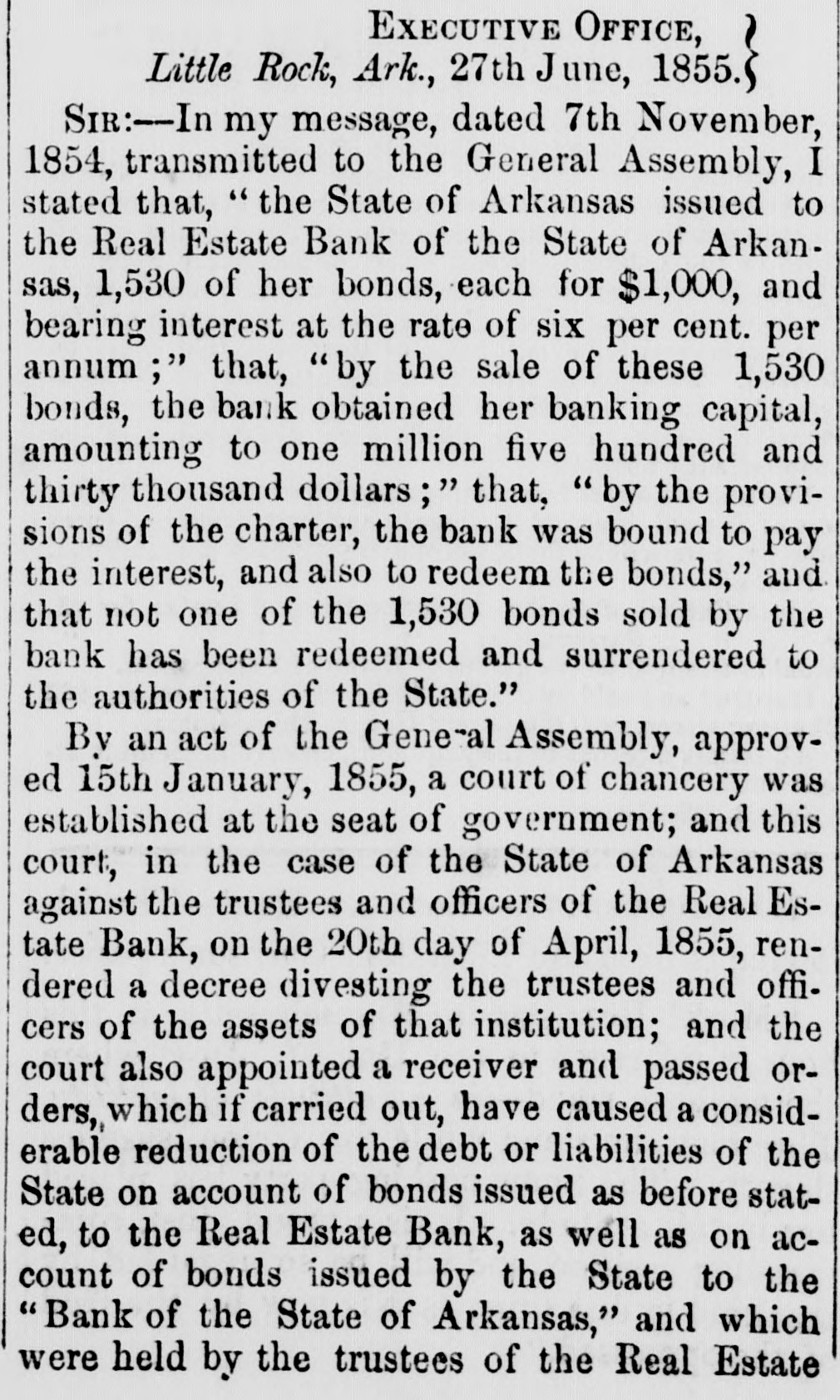
EXECUTIVE OFFICE, Little Rock, Ark., 27th June, 1855. SIR:-In my message, dated 7th November, 1854, transmitted to the General Assembly, I stated that, "the State of Arkansas issued to the Real Estate Bank of the State of Arkansas, 1,530 of her bonds, each for $1,000, and bearing interest at the rate of six per cent. per annum;" that, "by the sale of these 1,530 bonds, the bank obtained her banking capital, amounting to one million five hundred and thirty thousand dollars;" that, "by the provisions of the charter, the bank was bound to pay the interest, and also to redeem the bonds," and that not one of the 1,530 bonds sold by the bank has been redeemed and surrendered to the authorities of the State." Bv an act of the General Assembly, approved 15th January, 1855, a court of chancery was established at the seat of government; and this court, in the case of the State of Arkansas against the trustees and officers of the Real Estate Bank, on the 20th day of April, 1855, rendered a decree divesting the trustees and officers of the assets of that institution; and the court also appointed a receiver and passed orders, which if carried out, have caused a considerable reduction of the debt or liabilities of the State on account of bonds issued as before stated, to the Real Estate Bank, as well as on account of bonds issued by the State to the "Bank of the State of Arkansas," and which were held by the trustees of the Real Estate


Article from The True Democrat, November 20, 1855

Click image to open full size in new tab

Article Text

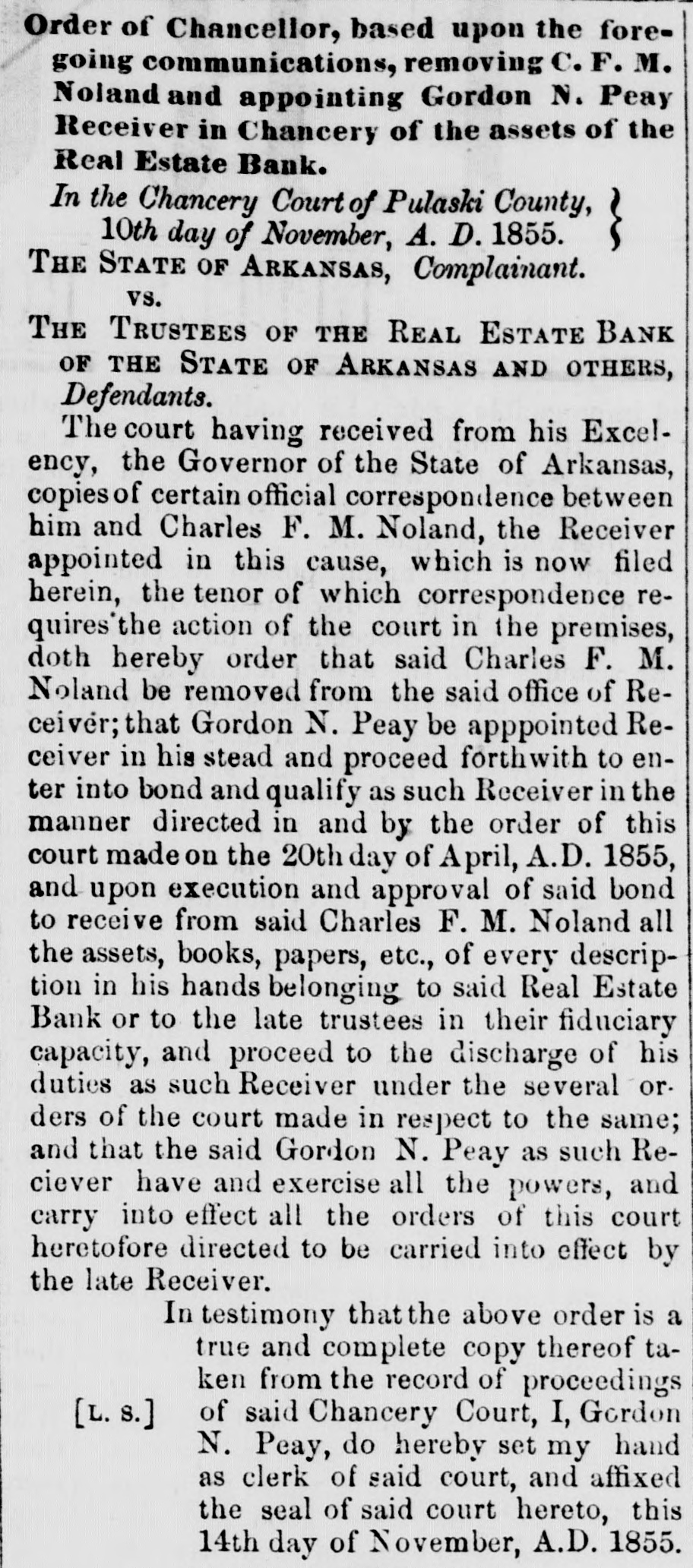
Order of Chancellor, based upon the foregoing communications, removing C. F. M. Noland and appointing Gordon N. Peay Receiver in Chancery of the assets of the Real Estate Bank. In the Chancery Court of Pulaski County, 10th day of November, A. D. 1855. THE STATE OF ARKANSAS, Complainant. vs. THE TRUSTEES OF THE REAL ESTATE BANK OF THE STATE OF ARKANSAS AND OTHERS, Defendants. The court having received from his Excelency, the Governor of the State of Arkansas, copies of certain official correspondence between him and Charles F. M. Noland, the Receiver appointed in this cause, which is now filed herein, the tenor of which correspondence requires) the action of the court in the premises, doth hereby order that said Charles F. M. Noland be removed from the said office of Receiver; that Gordon N. Peay be apppinted Receiver in his stead and proceed forthwith to enter into bond and qualify as such Receiver in the manner directed in and by the order of this court made on the 20th day of April, A.D. 1855, and upon execution and approval of said bond to receive from said Charles F. M. Noland all the assets, books, papers, etc., of every description in his hands belonging to said Real Estate Bank or to the late trustees in their fiduciary capacity, and proceed to the discharge of his duties as such Receiver under the several orders of the court made in respect to the same; and that the said Gordon N. Peay as such Reciever have and exercise all the powers, and carry into effect all the orders of this court heretofore directed to be carried into effect by the late Receiver. In testimony that the above order is a true and complete copy thereof taken from the record of proceedings of said Chancery Court, I, Gordon [L.s.] N. Peay, do hereby set my hand as clerk of said court, and affixed the seal of said court hereto, this 14th day of November, A.D. 1855.


Article from The True Democrat, November 20, 1855

Click image to open full size in new tab

Article Text

EXECUTIVE OFFICE, Little Rock, Ark., Oct., 23rd, 1855. SIR:-By the records of the Chancery Court of Pulaski county, it appears that in the case of the State of Arkansas against the Trustees and officers of the Real Estate Bank, a decree was rendered by that court on the 20th day of April, 1855, divesting said Trustees and officers of the assets of that institution; and that the Chancellor on that day, appointed you Receiver in the case, and for your services, including such clerk hire as may be necessary, decreed that to sum of dollars annum, use house three you and thousand should have of the be five entitled hundred of the receive banking the per and premises the Real Estate Bank, in the city of Little Rock. And on the 20th day of April, 1855, the following order was made by said court: is further ordered that the said Receiver shall cause the abstracts named in the answers of the Trustees not already completed, to be made out as speedily as practicable, and the expense thereof to be paid out of the trust fund, and the same to become a part of the answers of said trustees and other defendants to the bill of complaint." From the records it appears that the abstracts specified in the answers, and which by said order of the court, the Receiver was required to have made out, are as follows, to wit: 1. List of all bonds, bills and notes, turned over to Trustees under deed of assignment with columns to show how much paid on each, and when, how, and to whom; under each note all renewal notes should follow. 2. Abstract of all moneys received from debtors, by whom, and when. 3. Abstract of all moneys received by attorney, and how disposed of. 4. Abstract of all lands bought under decrees of foreclosure, and price bid in each case. 5. Abstract of all lands taken for debts and at how much. 6. Abstract of all lands bought under execution. 7. Abstract of suits brought on notes, etc., at law. 8. Abstract of judgments at law. 9. Abstract of suits for foreclosure, 10. Abstract of decrees for foreclosure. 11. Abstract of bad debts. 12. Abstract of debts lost by limitation. 13. Abstract of suits for money against the Trustees. 14. Abstract of land sold by Trustees. 15. Abstract of moneys received and paid out by cashier and secretary. 16. Abstract of debt of each trustee, and of attorney. 17. Abstract of moneys received of debtors, and for property, by each trustee, and how disposed of. 18. Abstract of cash and expense account. 19. Abstract of notes, bonds, bills, etc., now on hand. 20. List of all bonds and mortgages. 21. Abstract of bonds received, of whom, and how. 22. Abstract of bonds sold or disposed of. 23. Abstract of bonds exchanged with State Bank. 24. Abstract of all compensation paid to officers and agents." The foregoing are the twenty-four abstracts which, by the order of the court, you as Receiver were to have made out as speedily as practicable, and the expense thereof to be paid out of the trust fund, and the same to become a part of the answers of said trustees and other defendants to the bill of complaint." As these abstracts, when made out by you, are to become a part of the answers of the defendants in the suit, and as the accountants appointed by the Governor under the act of 15th January, 1855, are required by said law "to act under the direction of the the or the or the in lawyers judge prosecuting thereof in said vacation, suit, Governor. investiga- court, ting the books, accounts, and all other matters connected with the said suit, and the accounts and answers of all parties, who are or shall be made defendants in said suit,"-you will be pleased to advise me whether you have had all of the abstracts made out, and if you have not had all of them prepared, I would thank you to inform me which of them you have ready for the investigation of the accountants, and when you will have the whole of them completed, so that may know how to instruct the accountants in order that the objects of the law may be carried out. The law specially enjoins upon the Governor to have the suit against the trustees and officers of the Real Estate Bank prosecuted. The defendants have alledged that they cannot fully answer the bill of complaint without the abstracts referred to, and the suit has been delayfor the want of them. No one, except the Receiver of the bank, has authority to have these abstracts, which are to become a part of the answers of the defendants, made out. The Chancery Court gave that authority to the Receiver on the 20th day of April, 1855, and provided in the order, that the expense of having said abstracts made out, should be paid out of the trust fund, and also that they should be made out as speedily as
Article from The True Democrat, November 20, 1855

Click image to open full size in new tab

Article Text

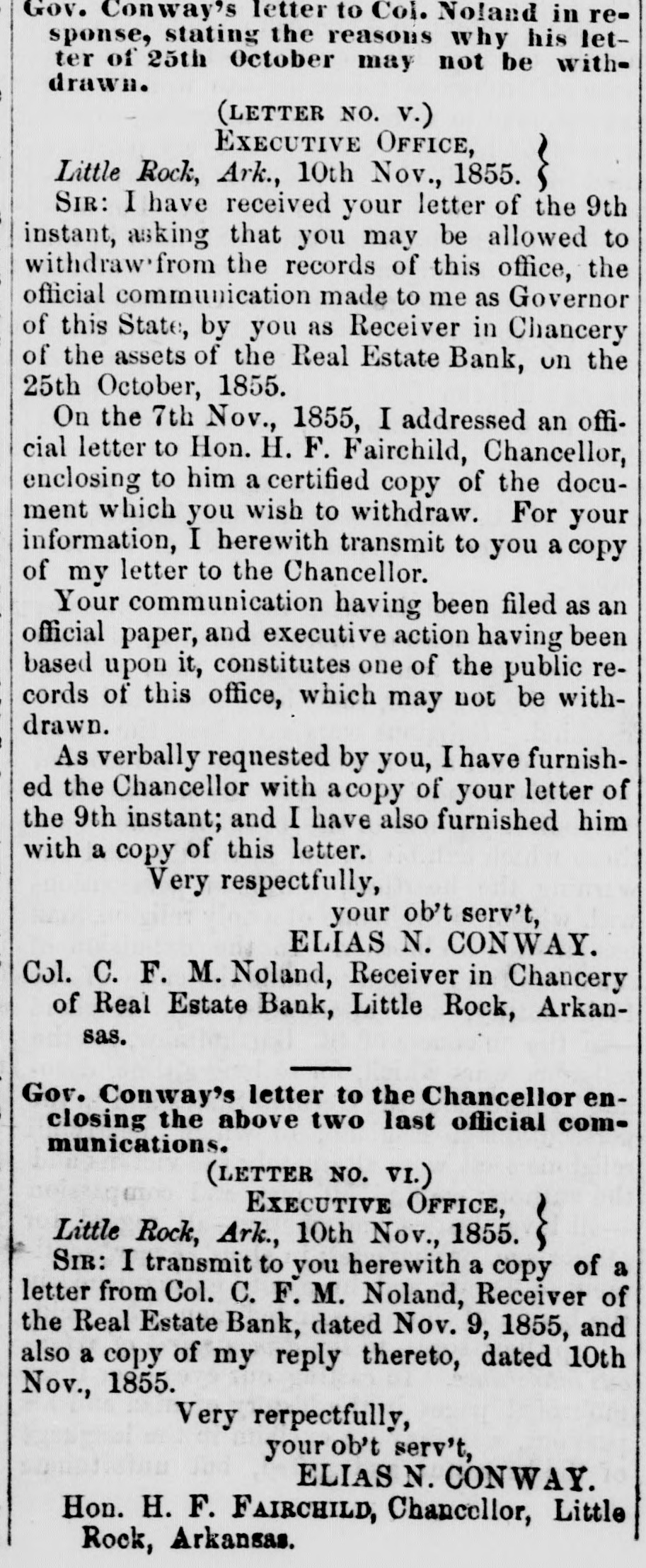
Gov. Conway's letter to Col. Noland in response, stating the reasons why his letter of 25th October may not be withdrawn. (LETTER NO. v.) EXECUTIVE OFFICE, Little Rock, Ark., 10th Nov., 1855. n SIR: I have received your letter of the 9th instant, asking that you may be allowed to withdraw' from the records of this office, the official communication made to me as Governor of this State, by you as Receiver in Chancery of the assets of the Real Estate Bank, on the 25th October, 1855. On the 7th Nov., 1855, I addressed an official letter to Hon. H. F. Fairchild, Chancellor, enclosing to him a certified copy of the document which you wish to withdraw. For your information, I herewith transmit to you a copy of my letter to the Chancellor. Your communication having been filed as an official paper, and executive action having been based upon it, constitutes one of the public records of this office, which may not be withdrawn. As verbally requested by you, Ihave furnished the Chancellor with acopy of your letter of the 9th instant; and I have also furnished him with a copy of this letter. Very respectfully, your ob't serv't, ELIAS N. CONWAY. Col. C. F. M. Noland, Receiver in Chancery of Real Estate Bank, Little Rock, Arkansas. Gov. Conway's letter to the Chancellor enclosing the above two last official communications. (LETTER NO. VI.) EXECUTIVE OFFICE, Little Rock, Ark., 10th Nov., 1855. } SIR: I transmit to you herewith a copy of a letter from Col. C. F. M. Noland, Receiver of the Real Estate Bank, dated Nov. 9, 1855, and also a copy of my reply thereto, dated 10th Nov., 1855. Very rerpectfully, your ob't serv't, ELIAS N. CONWAY. Hon. H. F. FAIRCHILD, Chancellor, Little Rock, Arkansas.


Article from The True Democrat, November 20, 1855

Click image to open full size in new tab

Article Text

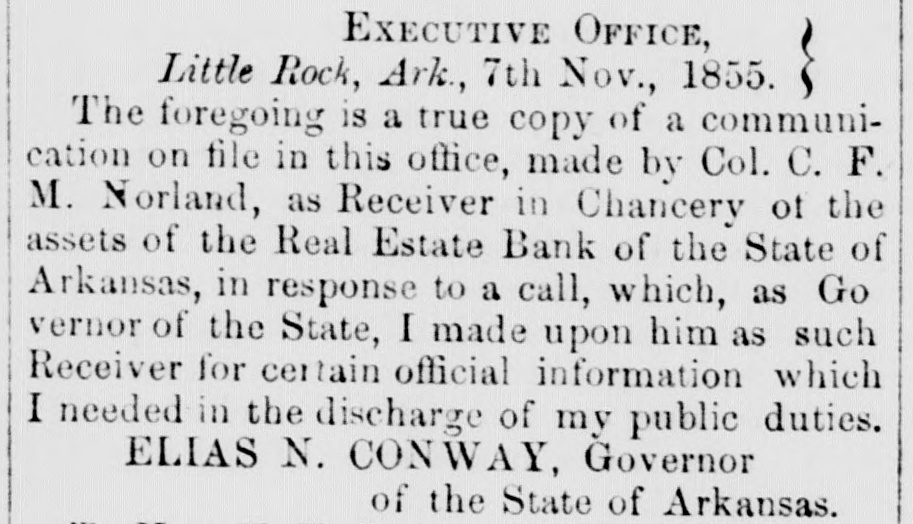
EXECUTIVE OFFICE, Little Rock, Ark., 7th Nov., 1855. } The foregoing is a true copy of a communication on file in this office, made by Col. C. F. M. Norland, as Receiver in Chancery of the assets of the Real Estate Bank of the State of Arkansas, in response to a call, which, as Go vernor of the State, I made upon him as such Receiver for certain official information which I needed in the discharge of my public duties. ELIAS N. CONWAY, Governor of the State of Arkansas.


Article from The True Democrat, November 20, 1855

Click image to open full size in new tab

Article Text

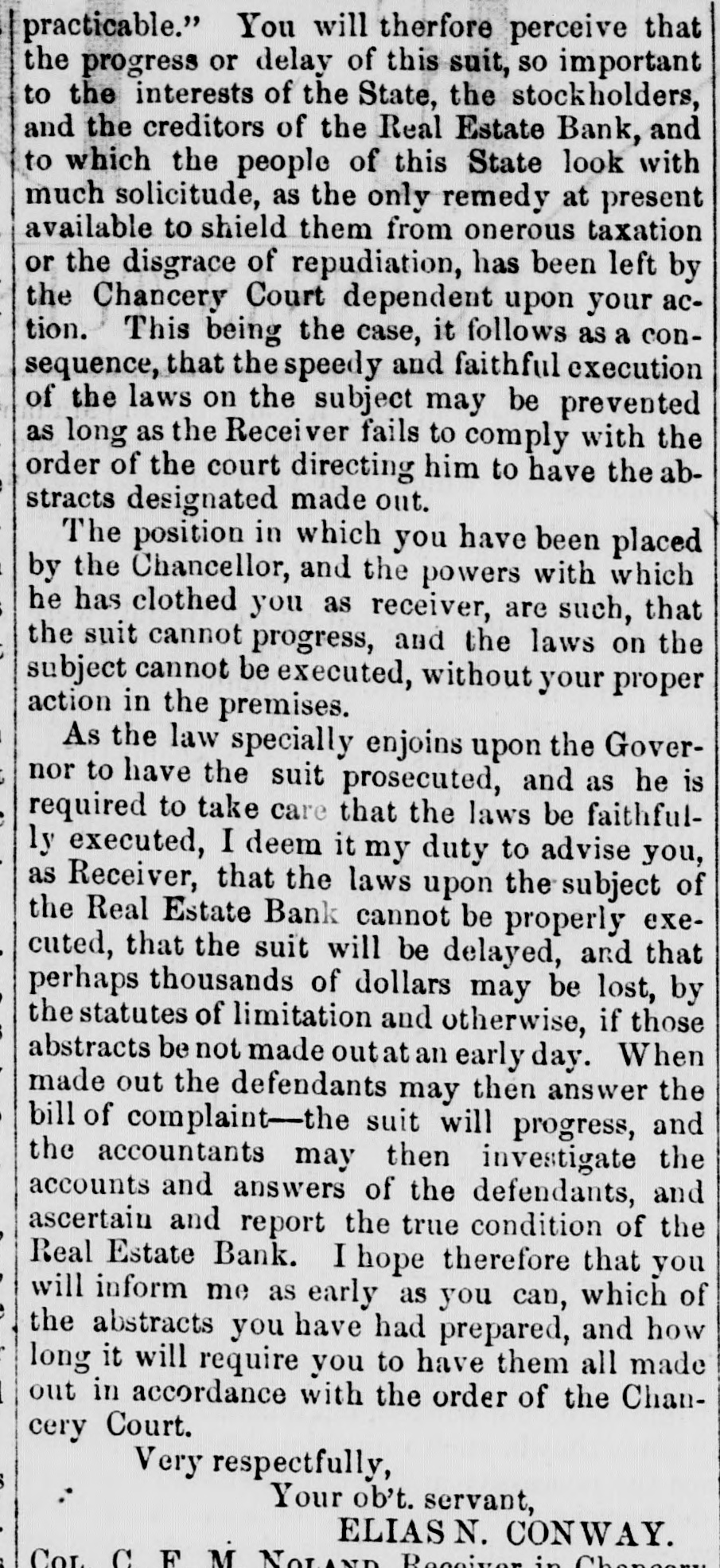
practicable." You will therfore perceive that the progress or delay of this suit, so important to the interests of the State, the tockholders, and the creditors of the Real Estate Bank, and to which the people of this State look with much solicitude, as the only remedy at present available to shield them from onerous taxation or the disgrace of repudiation, has been left by the Chancery Court dependent upon your action. This being the case, it follows as a consequence, that the speedy and faithful execution of the laws on the subject may be prevented as long as the Receiver fails to comply with the order of the court directing him to have the abstracts designated made out. The position in which you have been placed by the Chancellor, and the powers with which he has clothed you as receiver, are such, that the suit cannot progress, and the laws on the subject cannot be executed, without your proper action in the premises. As the law specially enjoins upon the Governor to have the suit prosecuted, and as he is required to take care that the laws be faithfully executed, I deem it my duty to advise you, as Receiver, that the laws upon the subject of the Real Estate Bank cannot be properly executed, that the suit will be delayed, and that perhaps thousands of dollars may be lost, by the statutes of limitation and otherwise, if those abstracts be not made out at an early day. When made out the defendants may then answer the bill of complaint-the suit will progress, and the accountants may then investigate the accounts and answers of the defendants, and ascertain and report the true condition of the Real Estate Bank. I hope therefore that you will inform me as early as you can, which of the abstracts you have had prepared, and how long it will require you to have them all made out in accordance with the order of the Chancery Court. Very respectfully, Your ob't. servant, ELIAS CONWAY. NOLAND


Article from Southern Shield, February 23, 1856

Click image to open full size in new tab

Article Text

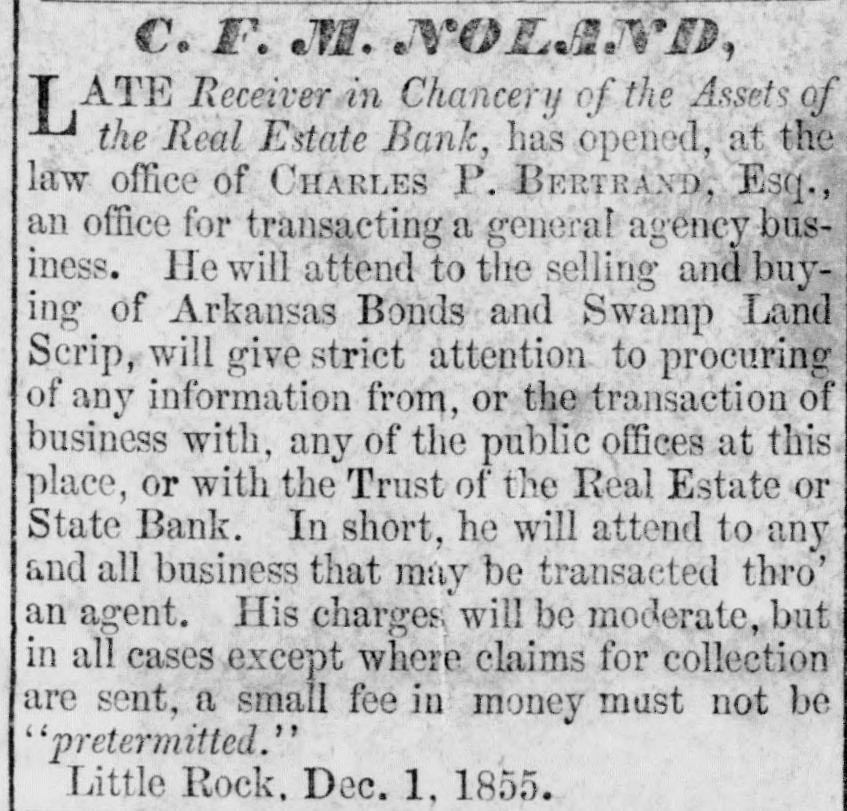
C.F.M. NOLAND, L ATE Receiver in Chancery of the Assets of the Real Estate Bank, has opened, at the law office of CHARLES P. Bertrand, Esq., an office for transacting a general agency business. He will attend to the selling and buying of Arkansas Bonds and Swamp Land Scrip, will give strict attention to procuring of any information from, or the transaction of business with, any of the public offices at this place, or with the Trust of the Real Estate or State Bank. In short, he will attend to any and all business that may be transacted thro' an agent. His charges will be moderate, but in all cases except where claims for collection are sent, a small fee in money must not be "pretermitted." Little Rock, Dec. 1, 1855.


Article from The True Democrat, May 12, 1857

Click image to open full size in new tab

Article Text

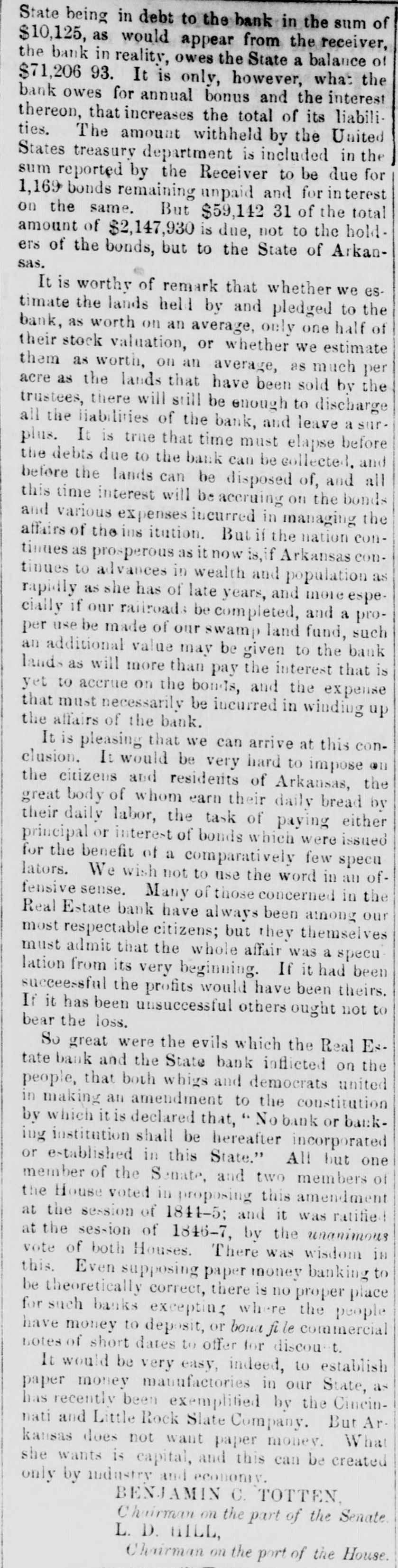
State being in debt to the bank in the sum of $10,125, as would appear from the receiver, the bank in reality, owes the State a balance of $71,206 93. It is only, however, wha: the bank owes for annual bonus and the interest amount withheld thereon, ties. The that increases the total by of the its United liabiliStates treasury department is included in the sum reported by the Receiver to be due for 1,169 bonds remaining unpaid and for interest on the same. But $59,142 31 of the total amount of $2,147,930 is due, not to the holders of the bonds, but to the State of Arkansas. It is worthy of remark that whether we estimate the lands held by and the as on an of bank, worth average, only pledged one half to their stock valuation, or whether we estimate them as worth, on an average, as much as that have been sold the acre the there lands will by per trustees, still be enough to discharge all the liabilities of the bank, and leave a sur. plus. It is true that time must elapse before debts due to the bank can be collected. and before the lands can be disposed of, and all will be on the bonds and this time various interest accruing expenses incurred in managing the affairs of the ins itution. But if the nation contimues as prosperous as it now is,if Arkansas to in wealth and as tinues rapidly advances she population conas has of late years, and more espe. ciaily if our railroad be completed, and a proper use be made of our swamp land fund, such an additional value may be given to the bank lands as will more than pay the interest that is yet to accrue on the bonds, and the expense that must necessarily be incurred in winding up the affairs of the bank. It is pleasing that we can arrive at this conclusion. It would be very hard to impose on the citizens and residents of Arkansas, the great body of whom earn their daily bread by their daily labor, the task of paying either principal or interest of bonds which were issued for the benefit of a comparatively few specu lators. We wish not to use the word in an of fensive sense. Many of those concerned in the Real Estate bank have always been among our most respectable citizens; but they themselves the whole affair was a must lation admit from that specu its very beginning. If it had been successful the profits would have been theirs. If it has been unsuccessful others ought not to bear the loss. So great were the evils which the Real ENtate bank and the State bank inflicted on the people, that both whigs and democrats united in making an amendment to the constitution by which it is declared that, No bank bankbe hereafter ing institution shall incorporated or or established in this State." All but one member of the Senate, and two members of the House voted in proposing this amendment at the session of 1841-5; and it was ratifie at the session of 1846-7, by the unanimous vote of both Houses. There was wisdom in this. Even supposing paper money banking to be theoretically correct, there is no proper place for such banks excepting where the people have money to deposit, or bowa file commercial notes of short dates to offer for discount. It would be very easy, indeed, to establish paper money manufactories in our State, as has recently been exemplified by the Cineinnati and Little Rock Slate Company. But Arkansas does not want paper money. What she wants is capital, and this can be created only by mudistry and economy. BENJAMIN C. TOTTEN Chairman on the part of the Senate D. HILL, Chairman on the port of the House.