8571. City Bank (Minneapolis, MN)

Bank Information

Episode Type
Run → Suspension → Closure
Bank Type
state
Start Date
January 15, 1896
Location
Minneapolis, Minnesota (44.980, -93.264)

Metadata

Model
gpt-5-mini
Short Digest
ece087fa1277a7b8

Response Measures

None

Description

Contemporary articles (Jan 15–16, 1896) report heavy withdrawals and inability to collect notes; the City Bank posted a notice and suspended pending state examiner investigation. A run (heavy withdrawals) precipitated the suspension; receivership proceedings follow (applications for receiver, receiver appointed later). The bank did not resume normal operations and entered receivership and liquidation/stockholder liability suits in subsequent years, consistent with permanent closure.

Events (4)

1. January 15, 1896 Run
Cause
Bank Specific Adverse Info
Cause Details
Heavy withdrawals of deposits combined with inability to collect on notes; withdrawal pressure left the bank powerless.
Measures
Bank closed doors and called in State Bank Examiner for an examination; posted notice of temporary closure.
Newspaper Excerpt
Owing to heavy withdrawals of deposits, ... this bank is temporarily closed
Source
newspapers
2. January 15, 1896 Suspension
Cause
Bank Specific Adverse Info
Cause Details
Suspension announced due to heavy withdrawals and inability to collect on notes; examiner placed in charge to investigate condition.
Newspaper Excerpt
Owing to heavy withdrawals of deposits, and inability to collect on notes, this bank is temporarily closed, to allow the Superintendent of Banks to examine into its condition.
Source
newspapers
3. January 17, 1896 Other
Newspaper Excerpt
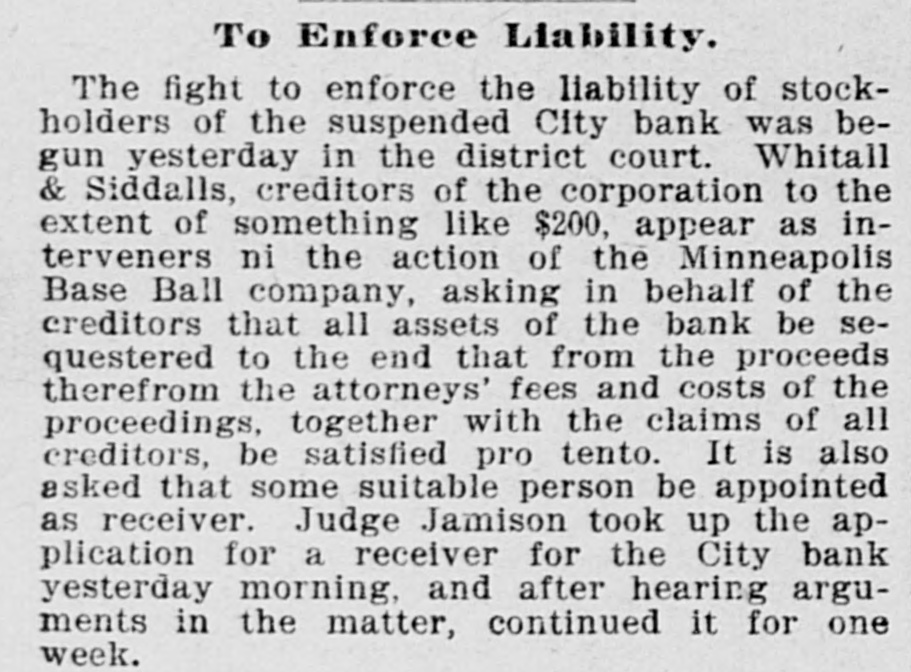
Judge Jamison took up the application for a receiver for the City bank ... continued it for one week. Receiver proceedings were later pursued and dividends paid by receiver in subsequent years (reports 1897–1899).
Source
newspapers
4. January 24, 1896 Receivership
Newspaper Excerpt
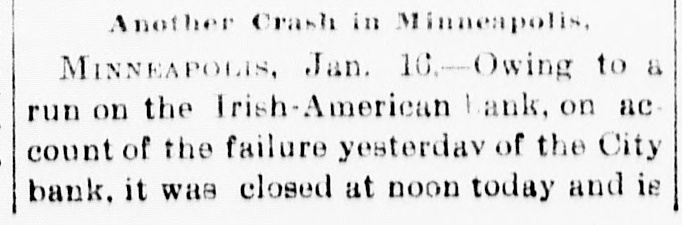
Owing to a run, precipitated by the Failure of the City Bank ... the Irish-American Bank closed its doors; receiver later appointed for City Bank (reports of receiver D.C. Bell and later proceedings).
Source
newspapers

Newspaper Articles (22)

Article from The Wichita Daily Eagle, January 16, 1896

Click image to open full size in new tab

Article Text

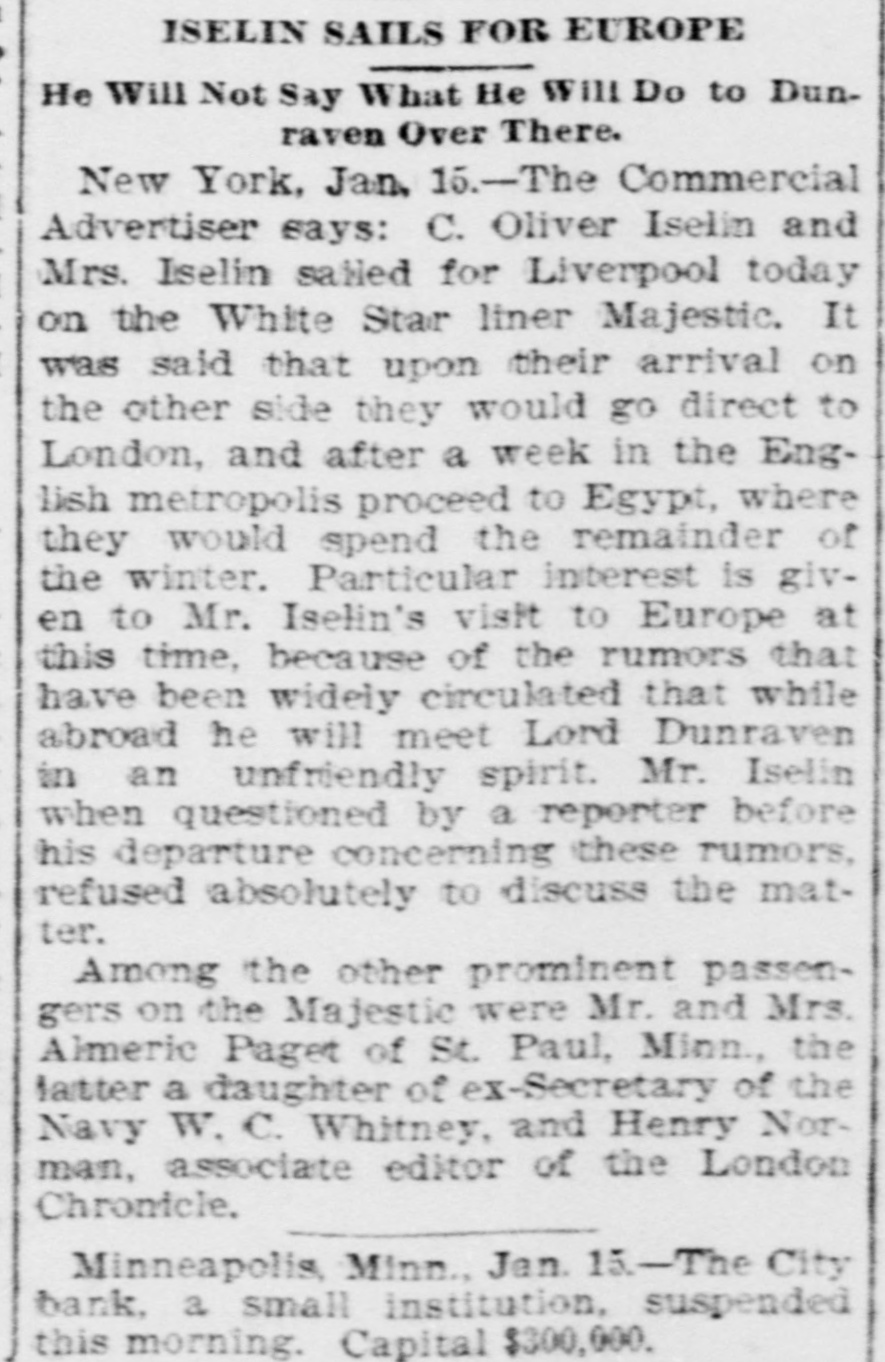
ISELIN SAILS FOR EUROPE He Will Not Say What He Will Do to Dunraven Over There. New York, Jan. 16.-The Commercial Advertiser says: C. Oliver Iselin and Mrs. Iselin salied for Liverpool today on the White Star liner Majestic. It was said that upon their arrival on the other side they would go direct to London, and after a week in the English metropolis proceed to Egypt, where they would spend the remainder of the winter. Particular interest is given to Mr. Iselin's visit to Europe at this time, because of the rumors that have been widely circulated that while abroad he will meet Lord Dunraven in an unfriendly spirit. Mr. Iselin when questioned by a reporter before his departure concerning these rumors, refused absolutely to discuss the matter. Among the other prominent passengers on the Majestic were Mr. and Mrs. Almeric Paget of St. Paul, Minn, the latter a daughter of ex-Secretary of the Navy W. C. Whitney, and Henry Norman, associate editor of the London Chronicle. Minneapolis, Minn., Jan. 15.-The City bank, a small institution, suspended this morning. Capital $300,000.


Article from Richmond Dispatch, January 16, 1896

Click image to open full size in new tab

Article Text

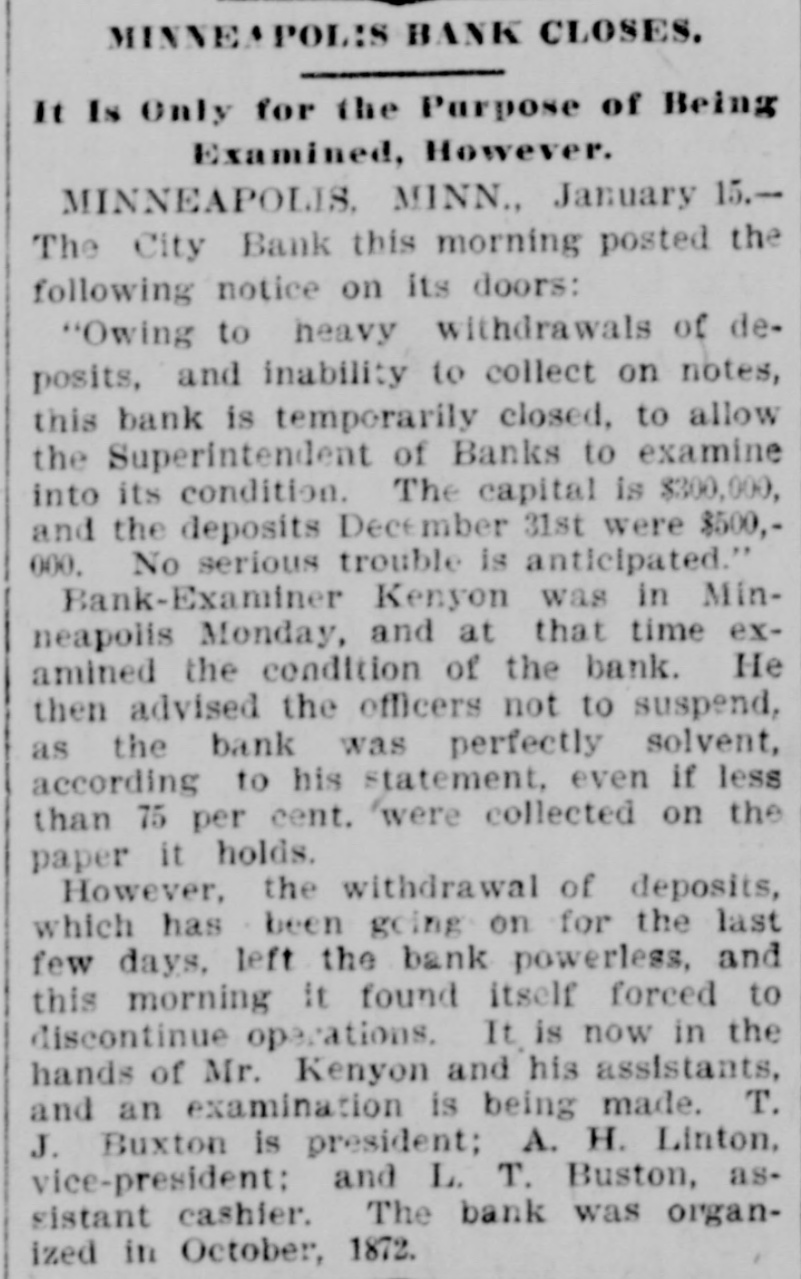
MINNEAPOLIS BANK CLOSES. It Is Only for the Purpose of Being Examined, However. MINNEAPOLIS. MINN., January 15.-The City Bank this morning posted the following notice on its doors: "Owing to heavy withdrawals of deposits, and inability to collect on notes, this bank is temporarily closed, to allow the Superintendent of Banks to examine into its condition. The capital is $300,000, and the deposits December 31st were $500,000. No serious trouble is anticipated." Bank-Examiner Kenyon was in Minneapolis Monday, and at that time examined the condition of the bank. He then advised the officers not to suspend, as the bank was perfectly solvent, according to his statement, even if less than 75 per cent. were collected on the paper it holds. However, the withdrawal of deposits, which has been going on for the last few days. left the bank powerless, and this morning it found itself forced to discontinue operations. It is now in the hands of Mr. Kenyon and his assistants, and an examination is being made. T. J. Buxton is president; A. H. Linton, vice-president: and L. T. Buston, assistant cashier. The bank was organized in October, 1872.


Article from The Morning News, January 16, 1896

Click image to open full size in new tab

Article Text

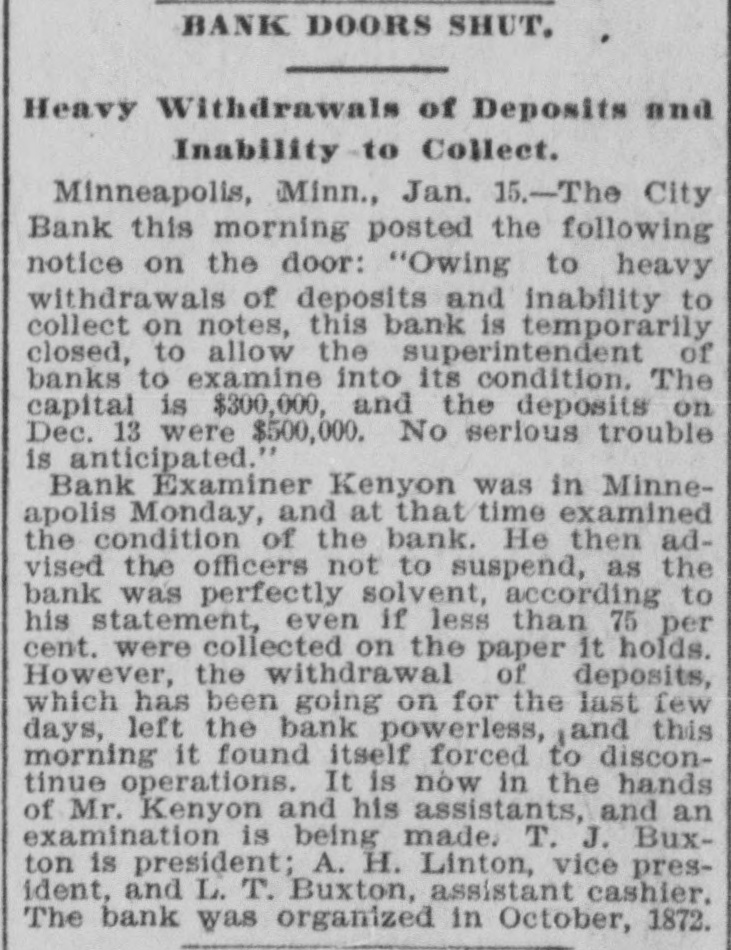
BANK DOORS SHUT. Heavy Withdrawals of Deposits and Inability-to Collect. Minneapolis, Minn., Jan. -The City Bank this morning posted the following notice on the door: "Owing to heavy withdrawals of deposits and inability to collect on notes, this bank is temporarily closed, to allow the superintendent of banks to examine into its condition. The capital is $300,000, and the deposits on Dec. 13 were $500,000. No serious trouble is anticipated." Bank Examiner Kenyon was in Minneapolis Monday, and at that time examined the condition of the bank. He then advised the officers not to suspend, as the bank was perfectly solvent, according to his statement, even if less than 75 per cent. were collected on the paper it holds. However, the withdrawal of deposits, which has been going on for the last few days, left the bank powerless, ,and this morning it found itself forced to discontinue operations. It is now in the hands of Mr. Kenyon and his assistants, and an examination is being made. T. J. Buxton is president; A. H. Linton, vice president, and L. T. Buxton, assistant cashier. The bank was organized in October, 1872.


Article from The Topeka State Journal, January 16, 1896

Click image to open full size in new tab

Article Text

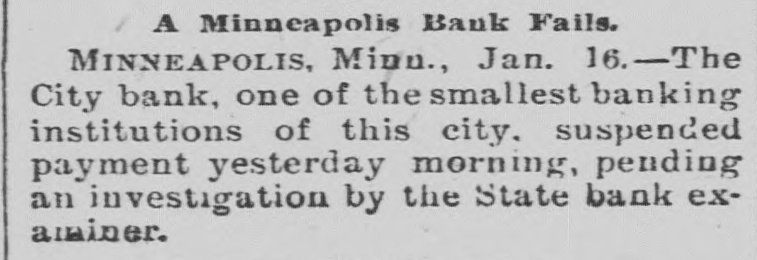
A Minneapolis Bank Fails. MINNEAPOLIS, Minn., Jan. 16.-The City bank, one of the smallest banking institutions of this city. suspended payment yesterday morning, pending an investigation by the State bank examiner.


Article from The Anaconda Standard, January 16, 1896

Click image to open full size in new tab

Article Text

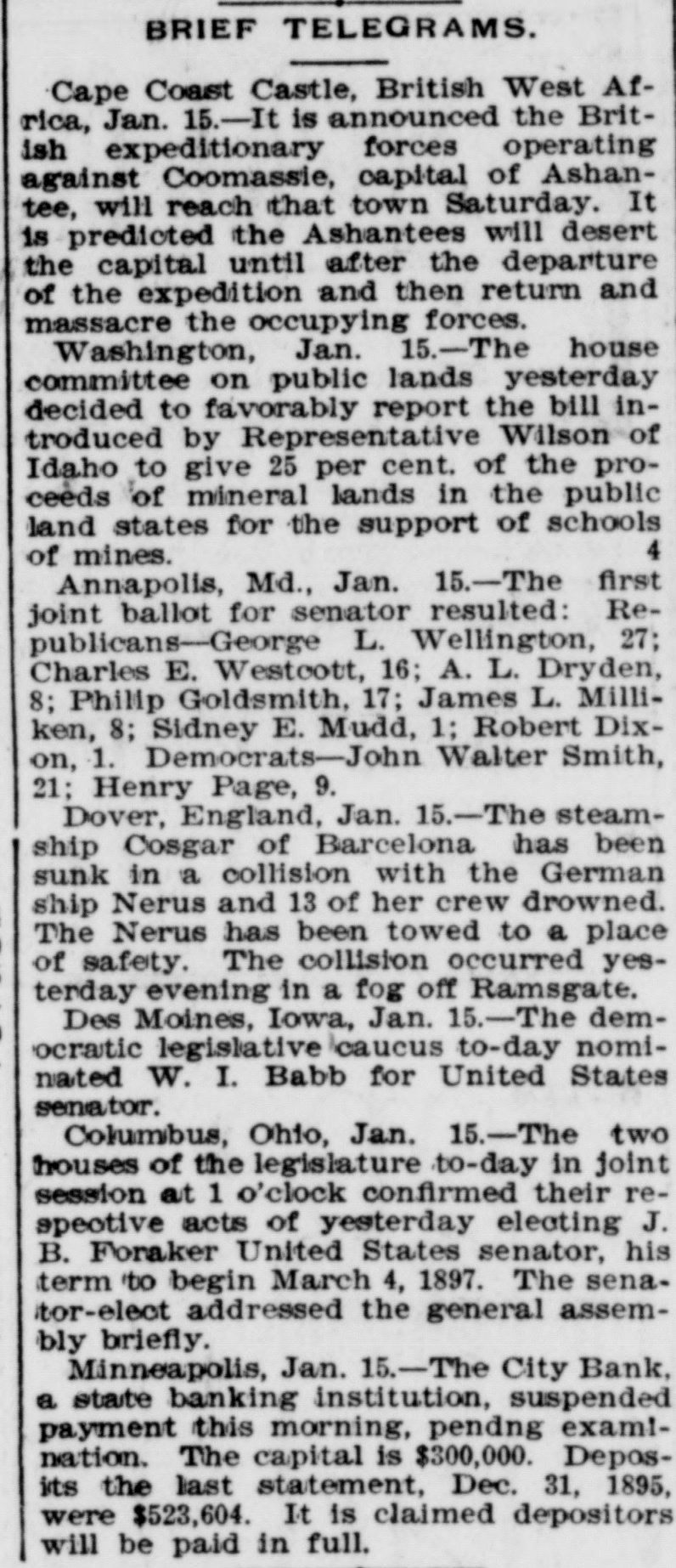
BRIEF TELEGRAMS. Cape Coast Castle, British West Africa, Jan. 15.-It is announced the British expeditionary forces operating against Coomassie, capital of Ashantee, will reach that town Saturday. It is predicted the Ashantees will desert the capital until after the departure of the expedition and then return and massacre the occupying forces. Washington, Jan. 15.-The house committee on public lands yesterday decided to favorably report the bill introduced by Representative Wilson of Idaho to give 25 per cent. of the proceeds of mineral lands in the public land states for the support of schools 4 of mines. Annapolis, Md., Jan. 15.-The first joint ballot for senator resulted: Republicans-George L. Wellington, 27; Charles E. Westcott, 16; A. L. Dryden, 8; Philip Goldsmith, 17; James L. Milliken, 8; Sidney E. Mudd, 1; Robert Dixon, 1. Democrats-John Walter Smith, 21; Henry Page, 9. Dover, England, Jan. 15.-The steamship Cosgar of Barcelona has been sunk in a collision with the German ship Nerus and 13 of her crew drowned. The Nerus has been towed to a place of safety. The collision occurred yesterday evening in a fog off Ramsgate. Des Moines, Iowa, Jan. 15.-The democratic legislative caucus to-day nominated W. I. Babb for United States senator. Columbus, Ohio, Jan. 15.-The two thouses of the legislature to-day in joint session at 1 o'clock confirmed their respective acts of yesterday electing J. B. Foraker United States senator, his term to begin March 4, 1897. The senator-elect addressed the general assembly briefly. Minneapolis, Jan. 15.-The City Bank, a state banking institution, suspended payment this morning, pendng examination. The capital is $300,000. Deposits the last statement, Dec. 31, 1895, were $523,604. It is claimed depositors will be paid in full.


Article from Great Falls Weekly Tribune, January 17, 1896

Click image to open full size in new tab

Article Text

Another Crash in Minneapolis, MINNEAPOLIS, Jan. 16.- Owing to 8 run on the Irish-American I ank, on account of the failure yesterdav of the City bank. it was closed at noon today and ie


Article from St. Paul Daily Globe, January 17, 1896

Click image to open full size in new tab

Article Text

To Enforce Liability. The fight to enforce the liability of stockholders of the suspended City bank was begun yesterday in the district court. Whitall & Siddalls, creditors of the corporation to the extent of something like $200, appear as interveners ni the action of the Minneapolis Base Ball company, asking in behalf of the creditors that all assets of the bank be sequestered to the end that from the proceeds therefrom the attorneys' fees and costs of the proceedings, together with the claims of all creditors, be satisfied pro tento. It is also asked that some suitable person be appointed as receiver. Judge Jamison took up the application for a receiver for the City bank yesterday morning, and after hearing arguments in the matter, continued it for one week.


Article from St. Paul Daily Globe, January 17, 1896

Click image to open full size in new tab

Article Text

MINNEAPOLIS. MINNEAPOLIS GLOBULES. The hearing for the application for the appointment of a receiver for the City bank has been postponed for one week. William Pierce, a small lad about eight years old, was sent to the reform school yesterday afternoon by Judge Kerr. He was booked for incorrigibility. Elizabeth Goodnow was married to W. C. Goodnow yesterday at her mother's residence, on Clinton avenue. After a short Eastern trip Mr. and Mrs. Goodnow will reside at the Berkeley hotel. Indicated by the exchange of seats for the Elks' intertainment this afternoon at the Lyceum, the occasion will be marked by the largest audience that has ever graced an occasion of this kind. A meeting was held in the state university chapel yesterday noon for the purpose of organizing a university carnival club, to act as an escort for "Fire King" W. H. Eustis, in the coming celebration in St. Paul. A meeting of the alumni of Middlebury college, of Middlebury, Vt., will be held next Monday evening in the parlors of the Nicollet at 8 o'clock, for the purpose of organizing an association of the alumni residing in the vicinity of the two cities. The committee in charge of the proposed Armenian mass meeting have decided on Sunday afternoon, Jan. 26, at 2 p. m., as the date of the meeting. The place has not yet been selected. The special committee will report to the general committee next Monday afternoon. One more complaint was sworn out in the municipal court this morning against Thomas Hughes, driver for the Underwriters' Salvage corps, charging him with fast driving. The defendant asked that the case be continued until next Tuesday, and he would enter his plea. The court granted the continuance.


Article from The Guthrie Daily Leader, January 18, 1896

Click image to open full size in new tab

Article Text

A Minneapolis Bank Fails. MINNEAPOLIS, Minn., Jan. 16.-The City bank. one of the smallest banking institutions of this city, suspended payment yesterday morning. pending an investigation by the State bank examiner.


Article from The Diamond Drill, January 18, 1896

Click image to open full size in new tab

Article Text

LATER. Hon. A. J. Balfour, first lord of the treasury, speaking at Manchester, England, said that nobody wanted to run contrary to the Monroe doctrine. In fact, he continued, if Venezuela had offered herself for annexation to Great Britain, any British statesman would decline such an honor. The business portion of Pleasant Green, Mo., was destroyed by fire. In a family quarrel at their home near Jonesboro, Tenn., Joseph P. Dove and one of his sons and a daughter were killed. W. L. Moody, brother of Dwight L. Moody, the evangelist, died in Kansas City, Mo., the result of injuries received in a railroad accident. He was a stockman and lived at Gardner, Kan. The government bond syndicate organized in New York by J. P. Morgan & Co., was dissolved. The failure of Keen, Sutteriee & Co., leather dealers in Philadelphia, for $4,000,000, carried down four other dealers, with aggregate liabilities of $400,000. The Bank of Wauneta, Neb., failed to open its doors. The two houses of the Ohio legislature in joint session confirmed their respective acts in electing J. B. Foraker United States senator, his term to begin March 4. 1897. The steamship Cesgar of Barcelona sunk in collision with the German ship Nereus off Ramsgate and 19 of its crew were drowned. Near Fort Holmes, O. T., four outlaws met death at the hands of a vigilance committee composed of ranchers. Premier Greenway's liberal government was returned to power in Manitoba by a large majority. The school issue was the only one of the fight and national schools have won the day. The City bank in Minneapolis, Minn., suspended payment with liabilities of $130,000. Washington, Jan. 16.-Senator Mills' speech on finance, with frequent direct criticisms of the president and secretary of the treasury, was the main feature of yesterday's session of the senate. Senator Peffer followed with a speech against bonds and in favor of silver coinage. Another day was consumed by the house in oratory upon the pension appropriation bill, in the course of which the policy of the present administration towards the veterans was scored by both republicans and democrats and defended by two or three democrats.


Article from The Pioneer Express, January 24, 1896

Click image to open full size in new tab

Article Text

OWING TO A RUN, Precipitated by the Failure of the City Bank in Minneapolis. Minneapolis, Jan. 18.-Owing to a heavy run precipitated by the City Bank failure of yesterday, the IrishAmerican Bank closed its doors at noon. The bank examiner is in charge, and as yet it is impossible to get any satisfactory statement of the bank's affairs. The officers of the bank are: President, J. S. Coughlin; vice president, J. E. Gould; cashier, J. C. Scallen. James H. Bishop, of the AmerIcan Savings and Loan, is one of the directors. The American carried a big deposit in the Irish-American, which may have been a factor in the bank's action. The paid capital of the IrishAmerican was $100,000, and in a statement of its condition at the end of business Dec. 13, 1893, the resources and liabilities balance at $554,684.26. The heaviest liabilities are demand certificates of deposit, 39,000.22; time certificates of deposit, $176,866.64; individual deposits subject to check, $109,919.38; total, $385,786.24. Amount due to other banks, rediscounts and bills payable, foot up at $50,000. The heaviest item among the assets is loans and discounts, $427,959.16. There is also about $33,000 worth of real es. tate.


Article from Perrysburg Journal, January 25, 1896

Click image to open full size in new tab

Article Text

DOMESTIC. The business portion of Pleasant Green, Mo., was destroyed by fire. In a family quarrel at their home near Jonesboro, Tenn., Joseph P. Dove and one of his sons and a daughter were killed. The government bond syndicate organized in New York by J. P. Morgan & Co., was dissolved. The Bank of Wauneta, Neb., failed to open its doors. After a cataleptic sleep of seven years, William Depue, a prominent citizen of Bushkill, Pa., suddenly returned to consciousness and good health. C. T. Eberts, a dentist at Holt, Mo., kissed the wife of a business man while filling her teeth, and was chased out of town by indignant citizens. W. L. Moody, brother of Dwight L. Moody, the evangelist, died in Kansas City, Mo., the result of injuries received in a railroad accident. He was a stockman and lived at Gardner, Kan. Near Fort Holmes, O. T., four outlaws met death at the hands of a vigilance committee composed of ranchers. The City bank in Minneapolis, Minn., suspended payment with liabilities of $150,000. Seidenberg, Stieffel & Co., cigar manufacturers in New York, failed for $275,000. At the meeting in Washington of the democratic national committee it was decided to hold the national convention, in Chicago on July 7. The Irish-American bank closed its doors at Minneapolis, Minn. Gen. Ballington Booth has purchased a farm in Bergen county, N. J., to be used as a home for worn-out Salvation Army officers. Gen. F. M. Drake was inaugurated governor of Iowa at the state house in Des Moines. Fire destroyed a large portion of the business interests of Nashville, Ind. Perkins & Welsh, sugar importers and exporters in New York, failed for $500,000. Kahn, Schoenbrun & Co., manufacturers and wholesale dealers in fine clothing in Chicago, failed for $300,000. Over 600 women employed by the Westinghouse Electric company in Pittsburgh struck because of reduction in their wages. The American Protective Tariff league in annual session at New York elected Cornelius N. Bliss president and Wilbur F. Wakeman secretary. The National Dairy union in session, in Chicago elected W. H. Hatch, of Miscouri, as president. White caps ordered W. M. Hertel to discharge a colored employe in his factory near Lima, O. He did not do so and all his property was burned. The next G. A. R. encampment of Indiana will be held in South Bend, May 13 and 14. Thomas Yost, aged 65, was divorced at Burlington, Ia., and within 30 minutes had secured a license to marry Mrs. William Frost, widow of a Methodist minister. Misses Minnie and Flora, aged 18 years, twin daughters of James Davenport, living at Fayette, Ind., died near the same hour of typhoid fever. During their lives they had never been separated from each other over night. Five masked men entered the house of Joseph Day, an old farmer at Flynn's Lick, Tenn., who was reputed to have money hidden away, ard killed Mr. Day and his wife, but faued to find the money. James Hansen and his wife and five children were buried in one grave in Oakwoods cemetery in Chicago. All were suffocated by gas turned on by Mr. Hansen, who had become despondent over money losses. The two children of Mrs. George Spraggins were burned to death in their home near Petersburg, Ind. The Farmers' national bank at Portsmouth, O., suspended payment. Every business house at Oakland City, Ind., was destroyed by fire. Seven negro laborera who were sleeping in an underground camp near Williams, S. C., were killed by the earth above falling on them.
Article from The Coeur D'alene Press, January 25, 1896

Click image to open full size in new tab

Article Text

Seven people are dead and two injured. The officers of the tug tell a harrowing story of the wreck and of the crew and its surroundings as found by them. The interest of American millers is centered in the next meeting of the executive committee of the National Millers' Trade Association, to be held January 27, in Chicago. Millers have recently practically decided upon a persistent agitation for reciprocity with South American countries, and will make a determined effort for the repeal of that portion of the tariff law which they think conflicts with the flour interests of the United States. B. A. Hart, a member of the association, says the prospect of the Cubans gaining their independence will have a tendency to promote commercial relations between the new republic and this country. Canada is to have a naval reserve. The Pawnee Indians in Oklahoma territory have all left their farms, and have gone to ghost dancing. Peter Hougaard, believed to have been insane, killed himself and his wife and five children in Chicago. Despite the order of the court, colored children were denied admission to the public schools in Perry, O. T. Vigorous search is being conducted for the hidden wealth of an old Spaniard, who died some years ago in Los Angeles. The matter of the Behring sea arbitration treaty is at last in a fair way to be settled, Canada having agreed to its terms. The Occidental college at Los Angeles, Cal., a Presbyterian institution, has been consumed by fire. The loss is $70,000, partly insured. The overtaxation of the public architect's office is given as the reason for the delay in the construction of the Portland, Or., public building. Colonel Ingersoll, the great infidel, has been extended an invitation to preach in a Chicago church, and to give his views of ideal Christianity. Through the cheapness of corn, American distillers, for the first time in ten years, can successfully compete in the French market with the Germans. It has been authoritatively announced that the Yale management has decided to abandon the project of a race with Oxford-Cambridge crews, of London. The candidacy of Senator Alliison is announced for nomination on the Re publican ticket for the presidency. Iowa's congressional delegation is solid for him. The second coming of the Redeemer has been prophesied again by the an evangelist of Baltimore, who thinks the present war talk is the beginning of the millenium. The sultan of Turkey has issued a decree prohibiting the distribution of funds collected in this country by the Red Cross Society for the relief of suffering Armenians. A dispatch from London says the statements made in the Italian newspapers that Great Britsin had ceded Zilah, on the Straits of Babel-Mandeb, to Italy, is officially denied. A dispatch from Vienna says Count Thun, governor of Bohemia, has resigned, and that his resignation is expected to lead to a healing of the breach between the young Czehs and the Germans. The Gloucester fishing schooner Fortuna sunk in a colision with the Boston Fruit Company's steamer Barnstable, off Highland light, Boston harbor. Nine of the Fortuna's crew were drowned and fourteen saved. The Prussian diet has been opened. The speech from the throne was devoted to domestic affairs. It is estimated the budget of 1896 will show a smaller deficit than that of 1895, owing to increased receipts due to improving trade. Mail advices from Hawaii state that friends of the ex-queen are anxious for war between England and the United States, believing that in the event of such hostilities England would seize the Hawaiian islands and restore Lihuokalani. A cablegram from Prague announces the death of "Charles Jonas, United States consul at Crefeld, Germany. Mr. Jonas was formerly consul at St. Petersburg, but exchanged positions with John Karel. He was at one time lieutenant-governor of Wisconsin. The certainty of the settlement of the Venezuela boundary dispute is still in doubt, since Venezuela repeatedly affirms that it is impossible for her to compromise the boundary claims by any treaty or convention, because of the terms of her national constitution. The City bank, of Minneapolis, a state banking institution, suspended payment this week, pending examination. The capital stock is $800,000. The deposits at the last statement, December 31, 1895, were $523,604. It is claimed the depositors will be paid in full. "There is a general opinion," says a letter to a Boston tobacco dealer, "both among insurgents and Spaniards, that General Campos has become demented. His actions, not only in the direction of the campaign, but his private and ordinary doings are such as to give good grounds for this belief."


Article from St. Paul Daily Globe, January 28, 1896

Click image to open full size in new tab

Article Text

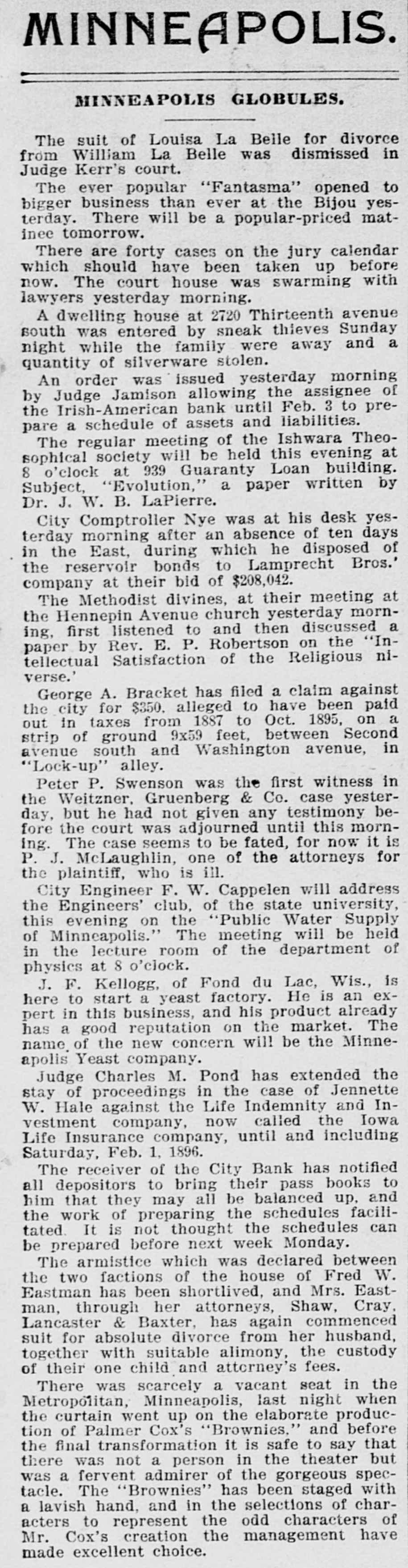
MINNEAPOLIS. MINNEAPOLIS GLOBULES. The suit of Louisa La Belle for divorce from William La Belle was dismissed in Judge Kerr's court. The ever popular "Fantasma" opened to bigger business than ever at the Bijou yesterday. There will be a popular-priced matinee tomorrow. There are forty cases on the jury calendar which should have been taken up before now. The court house was swarming with lawyers yesterday morning. A dwelling house at 2720 Thirteenth avenue south was entered by sneak thieves Sunday night while the family were away and a quantity of silverware stolen. An order was issued yesterday morning by Judge Jamison allowing the assignee of the Irish-American bank until Feb. 3 to prepare a schedule of assets and liabilities. The regular meeting of the Ishwara Theosophical society will be held this evening at 8 o'clock at 939 Guaranty Loan building. Subject, "Evolution," a paper written by Dr. J. W. B. LaPierre. City Comptroller Nye was at his desk yesterday morning after an absence of ten days in the East, during which he disposed of the reservoir bonds to Lamprecht Bros.' company at their bid of $208,042. The Methodist divines, at their meeting at the Hennepin Avenue church yesterday morning, first listened to and then discussed a paper by Rev. E. P. Robertson on the "Intellectual Satisfaction of the Religious niverse.' George A. Bracket has filed a claim against the city for $350, alleged to have been paid out in taxes from 1887 to Oct. 1895, on a strip of ground 9x59 feet, between Second avenue south and Washington avenue, in "Lock-up" alley. Peter P. Swenson was the first witness in the Weitzner, Gruenberg & Co. case yesterday, but he had not given any testimony before the court was adjourned until this morning. The case seems to be fated, for now it is P. J. McLaughlin, one of the attorneys for the plaintiff, who is ill. City Engineer F. W. Cappelen will address the Engineers' club, of the state university, this evening on the "Public Water Supply of Minneapolis." The meeting will be held in the lecture room of the department of physics at 8 o'clock. J. F. Kellogg, of Fond du Lac, Wis., is here to start a yeast factory. He is an expert in this business, and his product already has a good reputation on the market. The name of the new concern will be the Minneapolis Yeast company. Judge Charles M. Pond has extended the stay of proceedings in the case of Jennette W. Hale against the Life Indemnity and Investment company, now called the Iowa Life Insurance company, until and including Saturday, Feb. 1, 1896. The receiver of the City Bank has notified all depositors to bring their pass books to him that they may all be balanced up, and the work of preparing the schedules facilitated. It is not thought the schedules can be prepared before next week Monday. The armistice which was declared between the two factions of the house of Fred W. Eastman has been shortlived, and Mrs. Eastman, through her attorneys, Shaw, Cray, Lancaster & Baxter, has again commenced suit for absolute divorce from her husband, together with suitable alimony, the custody of their one child and attorney's fees. There was scarcely a vacant seat in the Metropolitan, Minneapolis, last night when the curtain went up on the elaborate production of Palmer Cox's "Brownies," and before the final transformation it is safe to say that there was not a person in the theater but was a fervent admirer of the gorgeous spectacle. The "Brownies" has been staged with a lavish hand, and in the selections of characters to represent the odd characters of Mr. Cox's creation the management have made excellent choice.


Article from St. Paul Daily Globe, February 11, 1896

Click image to open full size in new tab

Article Text

Papers Are Filed. Attorney General Childs yesterday filed in the Hennepin district court formal demands for the deposits of the state in the Irish-American and City banks, of Minneapolis, suspended.


Article from St. Paul Daily Globe, April 7, 1896

Click image to open full size in new tab

Article Text

SUPREME COURT RESUMES. April Term Calendar Will Be Called This Morning. The April term of the supreme court opens this morning at 11 o'clock, when cases will be set for trial, and some pending motions argued, possibly. The calendar this term is a comparatively small one, only 317 cases being of record. Among the interesting cases on the calendar are the receivership proceedings of the City Bank of Minneapolis, the old suits growing out of the sudden death of Cashier How, of the First National Bank of Shakopee; the Cass-Crow Wing county boundary dispute, a number of cases growing out of the failure of the N. P. Clarke Lumber company, the quarrel between the village of Wayzata and the Great Northern, Treasurer Koerner's United States Express company case, the American and Home Savings and Loan associations cases from Minneapolis. No. 1 on the calendar is, as it has been for several terms, the old suit of Russell Sage VS. The St. Paul, Stillwater & Taylor's Falls Railway Company.


Article from The Saint Paul Globe, June 12, 1897

Click image to open full size in new tab

Article Text

Sued Zenith City Men. Special to the Globe. DULUTH, Minn., June 11.-D. C. Bell as receiver of the city bank of Minneapolis, has sued A. F. and G. H. Dodge to recover on a promissory note for $22,500. The note is secured by a large number of lots in Kenwood Park.


Article from The Saint Paul Globe, August 18, 1898

Click image to open full size in new tab

Article Text

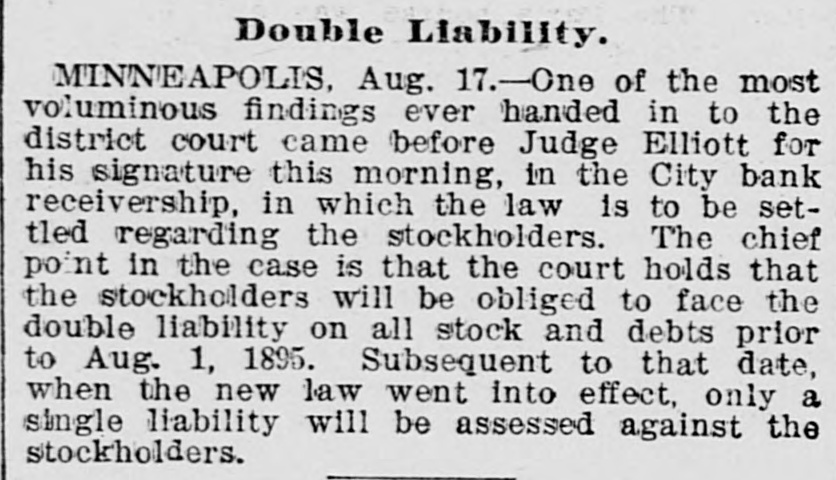
Double Liability. MINNEAPOLIS, Aug. 17.-One of the most voluminous findings ever handed in to the district court came before Judge Elliott for his signature this morning, in the City bank receivership, in which the law is to be settled regarding the stockholders. The chief point in the case is that the court holds that the stockholders will be obliged to face the double liability on all stock and debts prior to Aug. 1, 1895. Subsequent to that date, when the new law went into effect, only a single liability will be assessed against the stockholders.


Article from The Saint Paul Globe, November 12, 1898

Click image to open full size in new tab

Article Text

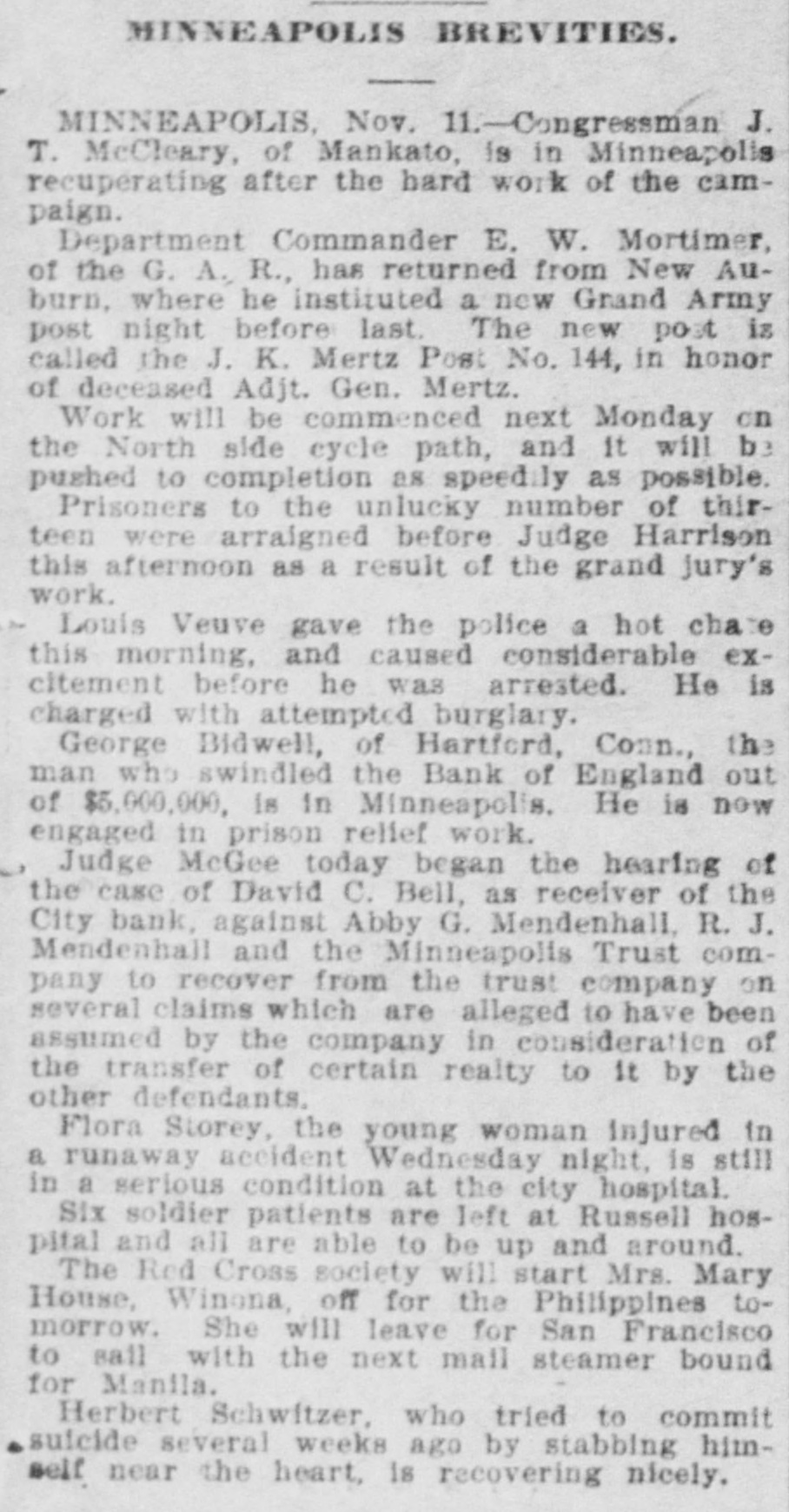
MINNEAPOLIS BREVITIES. MINNEAPOLIS Nov. 11.-Congressman J. T. McCleary, of Mankato, is in Minneapolis recuperating after the hard work of the campaign. Department Commander E. W. Mortimer, of the G. A. R., has returned from New Auburn, where he instituted a new Grand Army post night before last. The new post is called the J. K. Mertz Post No. 144, in honor of deceased Adjt. Gen. Mertz. Work will be commenced next Monday on the North side cycle path, and it will be pushed to completion as speedily as possible. Prisoners to the unlucky number of thirteen were arraigned before Judge Harrison this afternoon as a result of the grand jury's work. Louis Veuve gave the police a hot chare this morning, and caused considerable excitement before he was arrested. He is charged with attempted burglary. George Bidwell, of Hartford, Coan., the man who swindled the Bank of England out of $5,000,000, is in Minneapolis. He is now engaged in prison relief work. Judge McGee today began the hearing of the case of David C. Bell, as receiver of the City bank, against Abby G. Mendenhall, R. J. Mendenhall and the Minneapolis Trust company to recover from the trust company on several claims which are alleged to have been assumed by the company in consideration of the transfer of certain realty to it by the other defendants. Flora Storey, the young woman injured in a runaway accident Wednesday night. is still in a serious condition at the city hospital. Six soldier patients are left at Russell hospital and all are able to be up and around. The Red Cross society will start Mrs. Mary House, Winona, off for the Philippines tomorrow. She will leave for San Francisco to sail with the next mail steamer bound for Manila. Herbert Schwitzer, who tried to commit suicide several weeks ago by stabbing himself near the heart, is recovering nicely.


Article from The Saint Paul Globe, March 4, 1899

Click image to open full size in new tab

Article Text

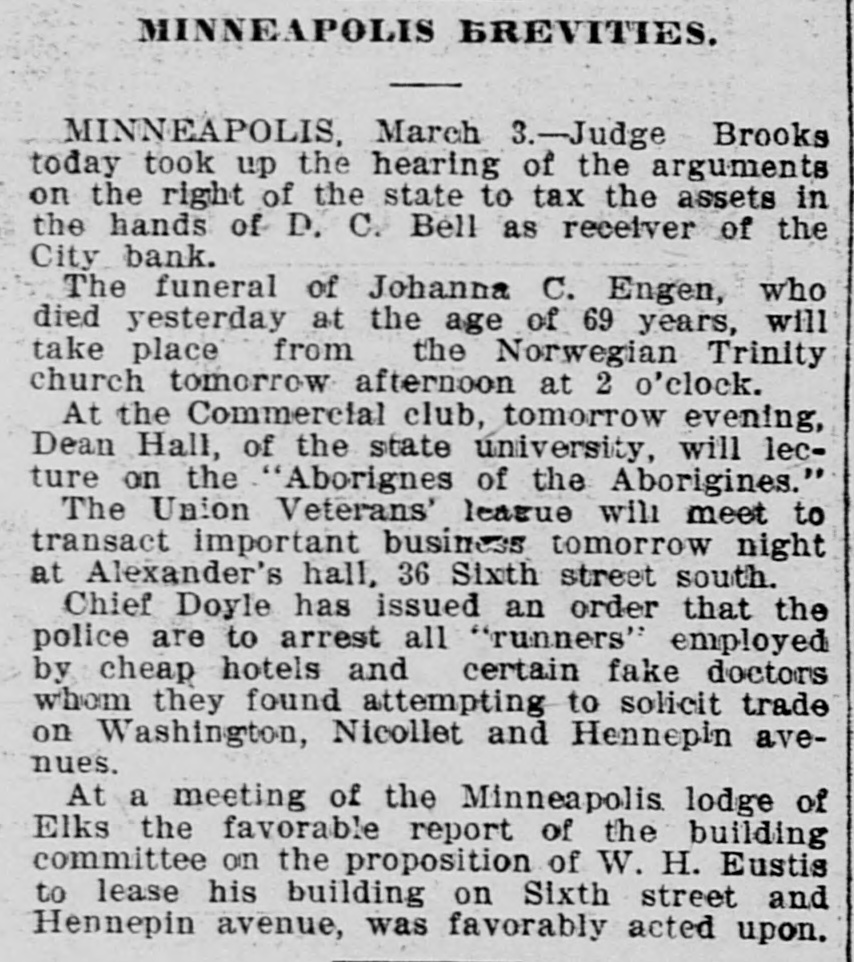
MINNEAPOLIS BREVITIES. MINNEAPOLIS, March 3.-Judge Brooks today took up the hearing of the arguments on the right of the state to tax the assets in the hands of D. C. Bell as receiver of the City bank. The funeral of Johanna C. Engen, who died yesterday at the age of 69 years, will take place from the Norwegian Trinity church tomorrow afternoon at 2 o'clock. At the Commercial club, tomorrow evening, Dean Hall, of the state university, will lecture on the "Aborignes of the Aborigines." The Union Veterans' league will meet to transact important business tomorrow night at Alexander's hall, 36 Sixth street south. Chief Doyle has issued an order that the police are to arrest all "runners" employed by cheap hotels and certain fake doctors whom they found attempting to solicit trade on Washington, Nicollet and Hennepin avenues. At a meeting of the Minneapolis lodge of Elks the favorable report of the building committee on the proposition of W. H. Eustis to lease his building on Sixth street and Hennepin avenue, was favorably acted upon.


Article from The Saint Paul Globe, March 19, 1899

Click image to open full size in new tab

Article Text

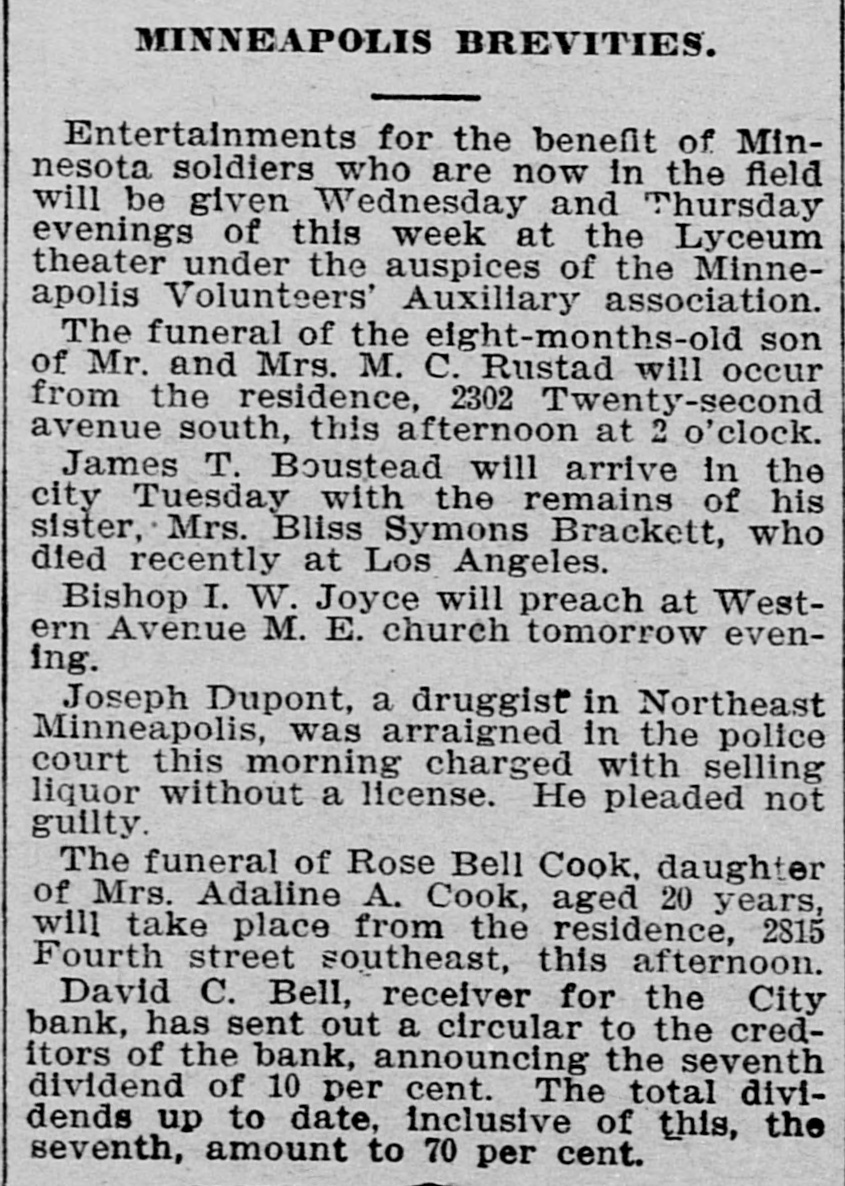
MINNEAPOLIS BREVITIES. Entertainments for the benefit of Minnesota soldiers who are now in the field will be given Wednesday and Thursday evenings of this week at the Lyceum theater under the auspices of the Minneapolis Volunteers' Auxillary association. The funeral of the eight-months-old son of Mr. and Mrs. M. C. Rustad will occur from the residence, 2302 Twenty-second avenue south, this afternoon at 2 o'clock. James T. Boustead will arrive in the city Tuesday with the remains of his sister, Mrs. Bliss Symons Brackett, who died recently at Los Angeles. Bishop I. W. Joyce will preach at Western Avenue M. E. church tomorrow evening. Joseph Dupont, a druggist in Northeast Minneapolis, was arraigned in the police court this morning charged with selling liquor without a license. He pleaded not guilty. The funeral of Rose Bell Cook, daughter of Mrs. Adaline A. Cook, aged 20 years, will take place from the residence, 2815 Fourth street southeast, this afternoon. David C. Bell, receiver for the City bank, has sent out a circular to the creditors of the bank, announcing the seventh dividend of 10 per cent. The total dividends up to date, inclusive of this, the seventh, amount to 70 per cent.


Article from The Saint Paul Globe, July 9, 1899

Click image to open full size in new tab

Article Text

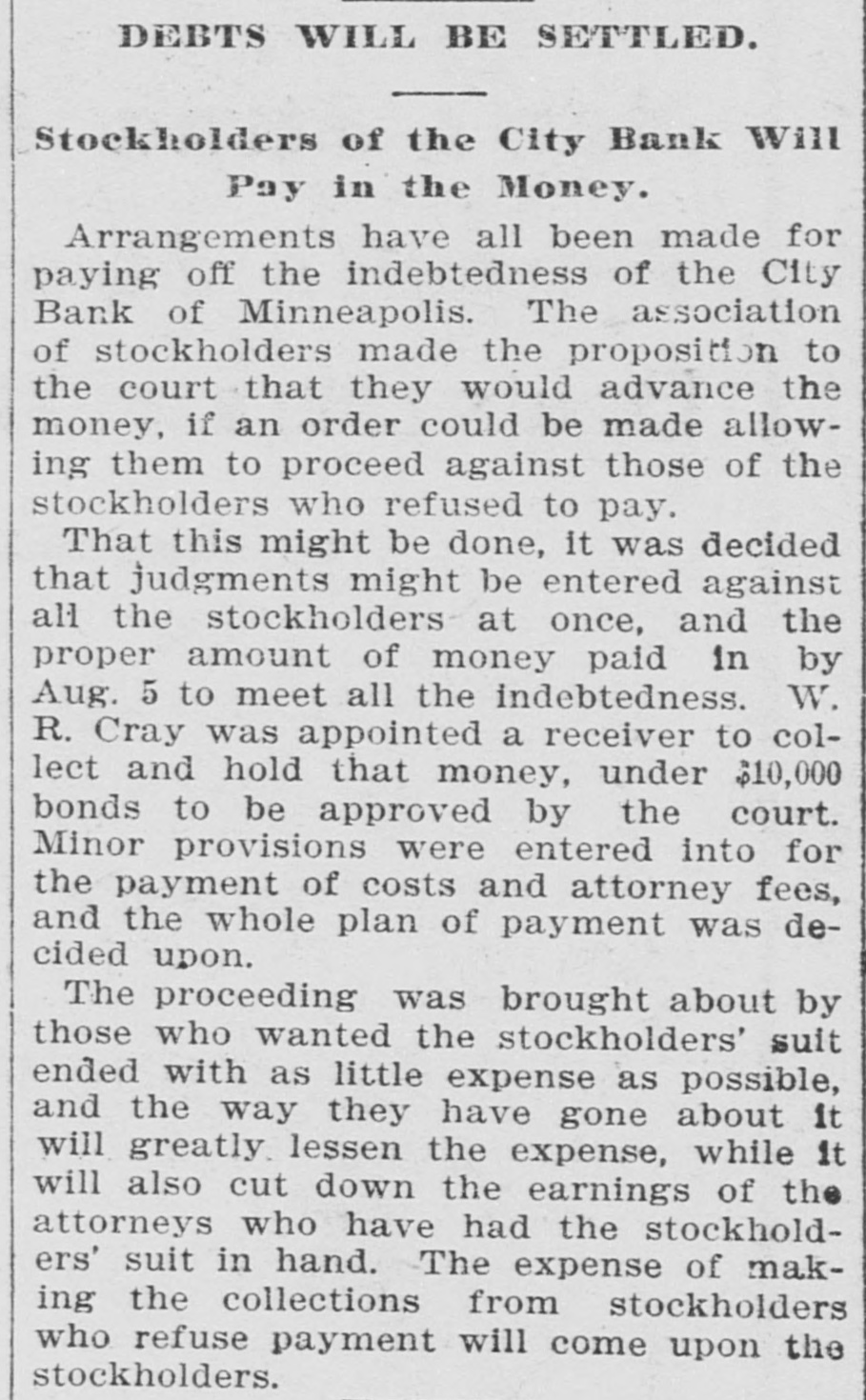
DEBTS WILL BE SETTLED. Stockholders of the City Bank Will Pay in the Money. Arrangements have all been made for paying off the indebtedness of the City Bank of Minneapolis. The association of stockholders made the proposition to the court that they would advance the money, if an order could be made allowing them to proceed against those of the stockholders who refused to pay. That this might be done, it was decided that judgments might be entered against all the stockholders at once, and the proper amount of money paid in by Aug. 5 to meet all the indebtedness. W. R. Cray was appointed a receiver to collect and hold that money, under $10,000 bonds to be approved by the court. Minor provisions were entered into for the payment of costs and attorney fees, and the whole plan of payment was decided upon. The proceeding was brought about by those who wanted the stockholders' suit ended with as little expense as possible, and the way they have gone about It will greatly. lessen the expense, while It will also cut down the earnings of the attorneys who have had the stockholders' suit in hand. The expense of making the collections from stockholders who refuse payment will come upon the stockholders.