Peoples Bank (Hattiesburg, MS)

Episode Information

Episode UID
8550835391293
Episode Type
Suspension β†’ Closure
Bank Type
state
Bank ID
855083539 hash
Start Date
September 4, 1907
Location
Hattiesburg, Mississippi (31.327, -89.290)

Metadata

Model
gpt-5-mini (chosen from majority vote of a three-model LLM ensemble)
Short Digest
4c44eb64a648cab6

Response Measures

None

Description

Sources describe voluntary liquidation and receiver payments after founder's assassination.

Events (2)

1. September 4, 1907 Receivership
Newspaper Excerpt
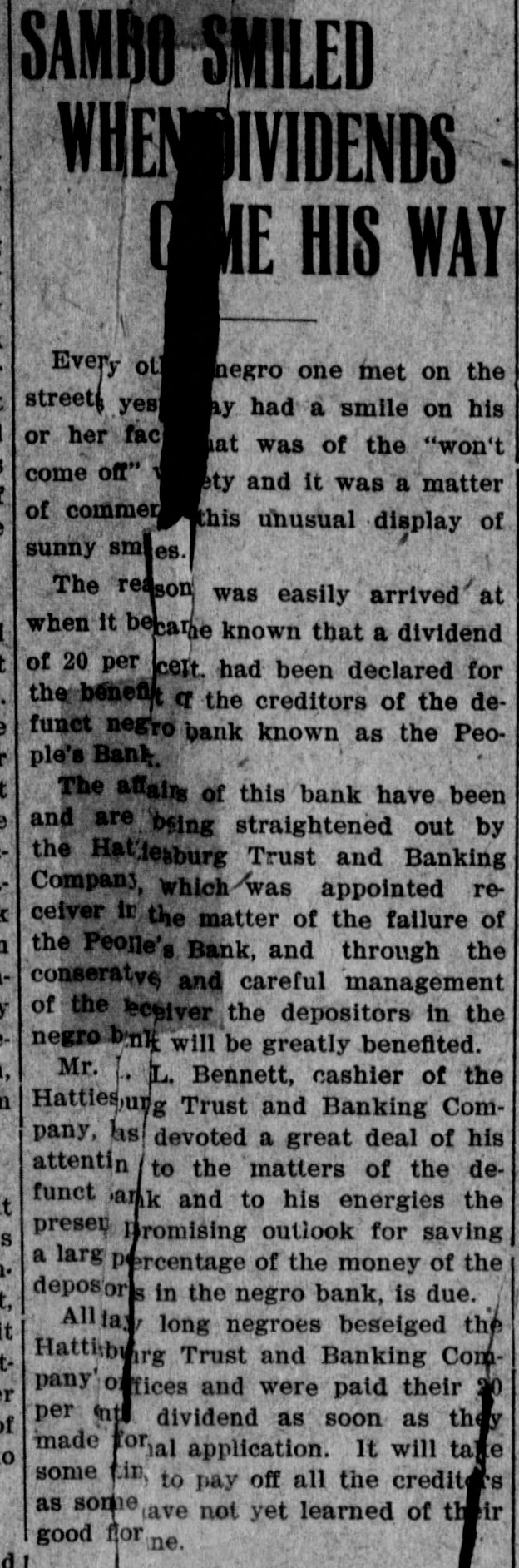
affairs of this bank ... are being straightened out by the Hattiesburg Trust and Banking Company, which was appointed receiver in the matter of the failure of the People's Bank
Source
newspapers
2. September 4, 1907 Suspension
Cause
Voluntary Liquidation
Cause Details
Went into voluntary liquidation after assassination of its founder; retiring bank paid depositors in full
Newspaper Excerpt
the defunct negro bank known as the People's Bank ... the Hattiesburg Trust and Banking Company, which was appointed receiver in the matter of the failure of the People's Bank
Source
newspapers

Newspaper Articles (2)

Article from Hattiesburg Daily News, September 4, 1907

Click image to open full size in new tab

Article Text

SAMBO SMILED WHEN IVIDENDS ME HIS WAY Every ot negro one met on the streets yes ay had a smile on his fac or her at was of the "won't come off" ty and it was a matter of commer this unusual display of sunny sm es. The reason was easily arrived at when it becare known that a dividend of 20 per celt. had been declared for the benefit q the creditors of the defunct negro bank known as the People's Bank. The affairs of this bank have been and are being straightened out by the Hatileşburg Trust and Banking Company, which was appointed receiver in the matter of the failure of the Peolle's Bank, and through the conseratve and careful management of the leceiver the depositors in the negro bnk will be greatly benefited. Mr. L. Bennett, cashier of the Hattiesung Trust and Banking Company, as devoted a great deal of his attentin to the matters of the defunct ank and to his energies the preser Promising outlook for saving S a larg Percentage of the money of the deposor's in the negro bank, is due. All iay long negroes beseiged the Hattisburg Trust and Banking Company offices and were paid their 20 r per nts dividend as soon as they made for al application. It will take some tin, to pay off all the credit S as some ave not yet learned of th ir good flor ne. di

Article from The Nashville Globe, March 12, 1909

Click image to open full size in new tab

Article Text

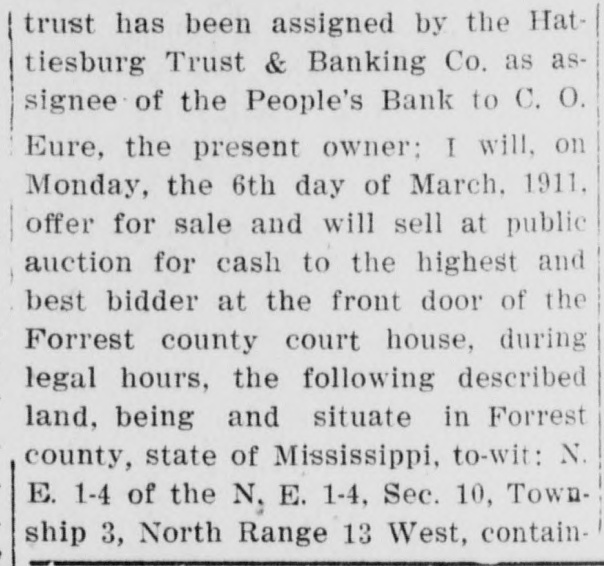
# MISSISSIPPI IN PROSPEROUS CONDITION. Mr. Chas Banks of Mound Bayou, Gives Good Account. Tells of their Rise of Progress-Eleven Active Institutions Now in Operation. In summarizing the economic progress of the Negro in Mississippi during the past ten years, that made in banking comes in for no inconsiderable part. Beginning with the Lincoln Savings Bank, which was formerly the Knights of Honor Bank, about eight years ago, Negro banks have steadily grown in number until, today, we have eleven live active, prosperous, progressive banking institutions dotted over the state. At Vicksburg we have the Lincoln Savings Bank, under the management of W. E. Mollison, with resources over $60,000.00, and the Union Savings Bank, managed by T. G. Ewing, resources over $60,000.00; at Indianola is the Delta Penny Savings Bank, directed by W. W. Cox, resources over $100,000.00; at Jackson is the American Savings Bank and Trust Company, managed by Dr. S. D. Redmond, resources over $60,000.00; and the Southern Bank, under the direction of L. K. Atwood, resources over $60,000.00; at Yazoo City is the People's Savings Bank, managed by H. H. King, resources over $40,000.00; at Columbus is the Penny Savings Bank, managed by W. I. Mitchell, resources $25,000.00; at Mound Bayou is the Bank of Mound Bayou, under the management of the writer, resources over $100,000.00; at Natchez is the Bluff City Savings Bank, under the direction of Dr. J. B. Banks, resources over $50,000.00; at Greenville is the Delta Savings Bank, under the management of John W. Strauther, resources over $25,000.00; at Hattiesburg is the Magic City Savings Bank, organized during the past year, under the management of Dr. J. H. Howard, resources over $15,000.00, this being, in fact, the recognized People's Bank of Hattiesburg, which went into voluntary liquidation after the assassination of its founder and cashier, the late E. D. Howell. It may be well here to state that the retiring bank paid all of its depositors in full; in fact, there has never been a real bank failure on the part of Negro banks in Mississippi since their existence. During the panic of 1907, so far as I have been able to learn, and I am stockholder in nearly all of them, only two banks suspended specie payment, and no one was seriously embarrassed, emerging from that trying period stronger and more trusted that before. While enjoying the confidence and patronage of their own people, it is a noteworthy fact that the Negro banks of this state have the confidence, respect and good will of the white bankers, especially their neighbors. In most cases the Negro bank clears thro' the white banks in the same town, using it largely as a correspondent. In this way it developes that the existence of the Negro banks in towns where there are also white banks, instead of being hurtful from any view point whatever, are mutually beneficial. Negroes, who otherwise would not be reached and induced to save, but for the existence influence, and education of Negro banks, are made depositors in Negro banks, who in turn, by using the local white banks as depositories and correspondents, bring into the channels of commerce funds that, but for them, would not be available. Of course the Negro banker does not pursue this policy for mere conciliation. The policy is in line with that of all small banks be they white or black, to use larger ones as correspondents and depositories, as well as to clear through them and because of the advantage and facilities always had by a larger institution, both as to safety and making par points; but in the operation of