Akron Savings Bank (Akron, OH)

Episode Information

Episode Type
Suspension โ†’ Reopening
Start Date
April 5, 1904
Location
Akron, Ohio (41.081, -81.519)
Bank Type
savings

Metadata

Events (2)

1. April 5, 1904 Suspension
Cause
Government Action
Cause Details
Akron Clearing House Association compelled the bank to make all clearings in cash, precipitating closure and appointment of receivers by the court.
Newspaper Excerpt
The doors of the Akron Savings Bank were closed today and receivers appointed. The action was precipitated as a result of the Akron Clearing House Association compelling the bank to make all its clearings in cash.
Source
newspapers
2. April 6, 1904 Reopening
Newspaper Excerpt
The Akron Savings bank ... reopened its doors to-day for business, with the receivers, William Buchtel and G. W. Sieber, in charge.
Source
newspapers

Newspaper Articles (16)

Article from Evening Times-Republican, April 5, 1904

Click image to open full size in new tab

Article Text

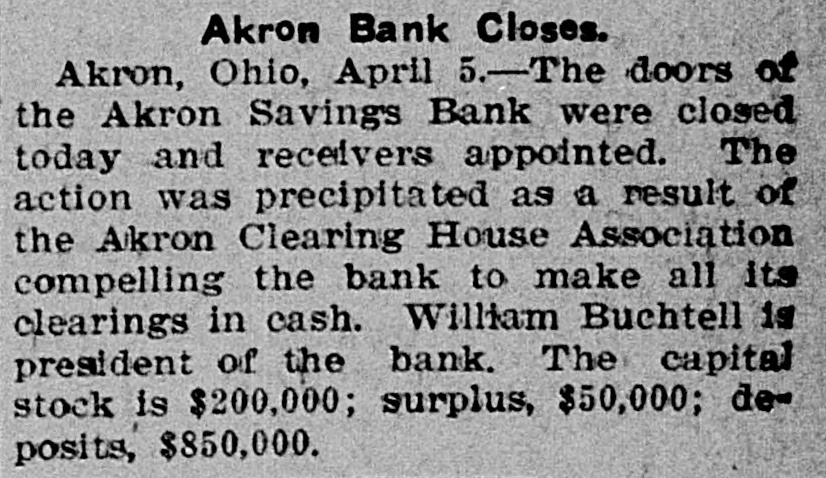
Akron Bank Closes

Akron, Ohio, April 5.-The doors of the Akron Savings Bank were closed today and receivers appointed. The action was precipitated as a result of the Akron Clearing House Association compelling the bank to make all its clearings in cash. William Buchtell is president of the bank. The capital stock is $200,000; surplus, $50,000; deposits, $850,000.


Article from The Daily Telegram, April 5, 1904

Click image to open full size in new tab

Article Text

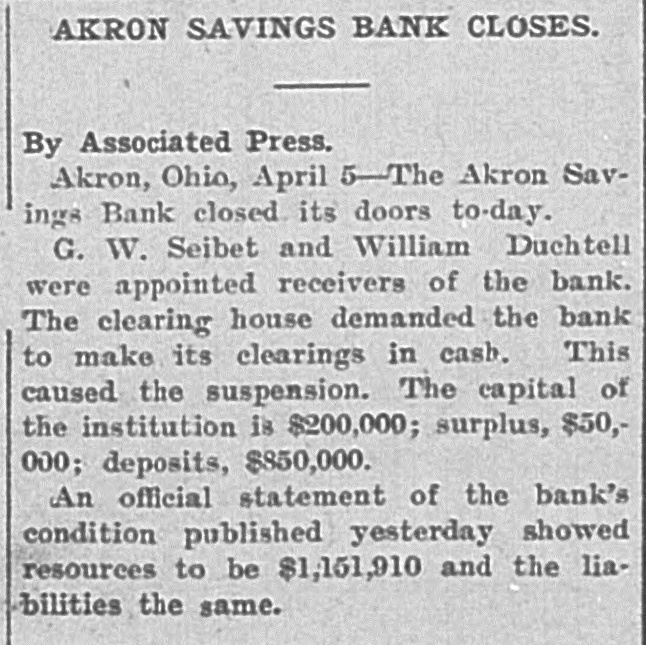
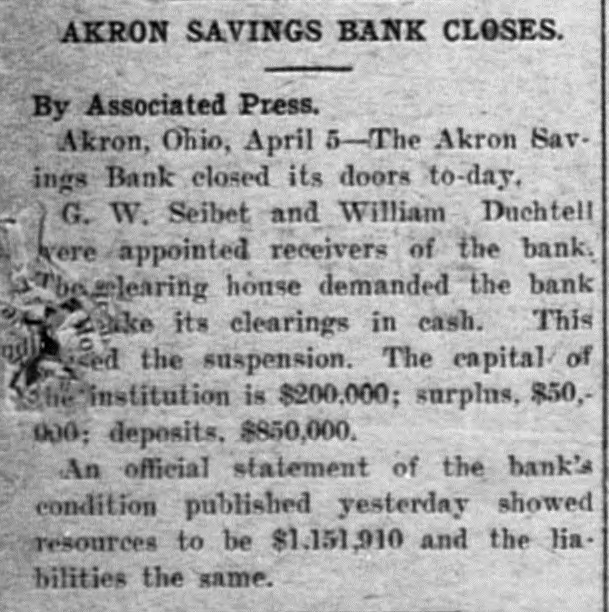
AKRON SAVINGS BANK CLOSES

By Associated Press. Akron, Ohio, April 5-The Akron Savings Bank closed its doors to-day. G. W. Seibet and William Duchtell were appointed receivers of the bank. be clearing house demanded the bank ke its clearings in cash. This ed the suspension. The capital of institution is $200,000; surplus, $50.000: deposits, $850,000. An official statement of the bank's condition published yesterday showed resources to be $1,151,910 and the lia. bilities the same.


Article from The Daily Tribune, April 5, 1904

Click image to open full size in new tab

Article Text

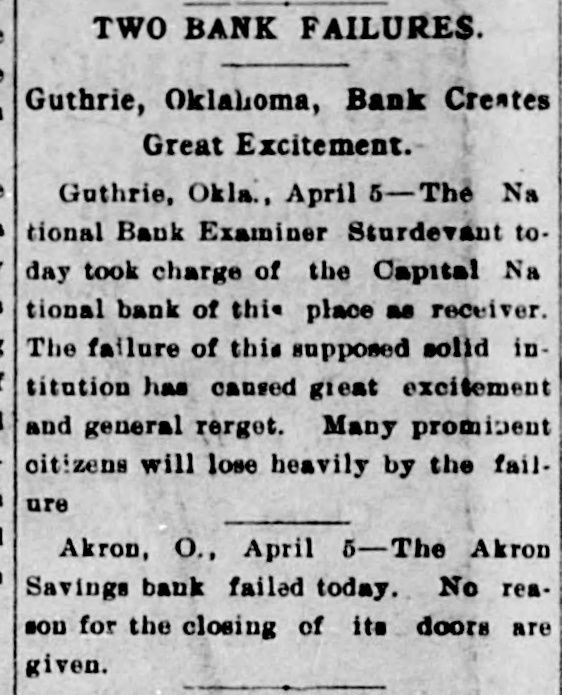
TWO BANK FAILURES

Guthrie, Oklahoma, Bank Creates Great Excitement. Guthrie, Okla., April 5-The Na tional Bank Examiner Sturdevant today took charge of the Capital Na tional bank of this place as receiver. The failure of this supposed solid intitution has caused gieat excitement and general rerget. Many prominent citizens will lose heavily by the fail. ure Akron, O., April 5-The Akron Savings bank failed today. No reasou for the closing of its doors are given.


Article from Rock Island Argus, April 5, 1904

Click image to open full size in new tab

Article Text

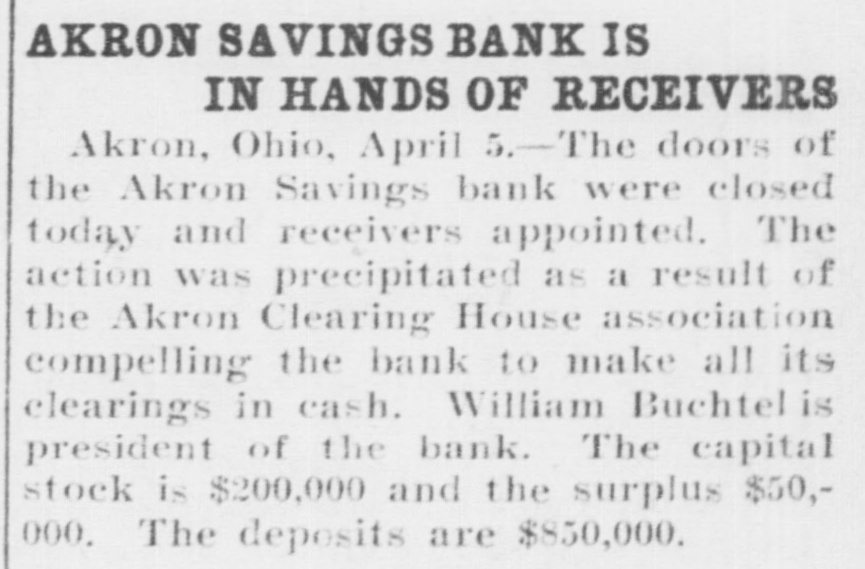
AKRON SAVINGS BANK IS IN HANDS OF RECEIVERS Akron, Ohio, April 5.-The doors of the Akron Savings bank were closed today and receivers appointed. The action was precipitated as a result of the Akron Clearing House association compelling the bank to make all its clearings in cash. William Buchtel is president of the bank. The capital stock is $200,000 and the surplus $50,000. The deposits are $850,000.


Article from Deseret Evening News, April 5, 1904

Click image to open full size in new tab

Article Text

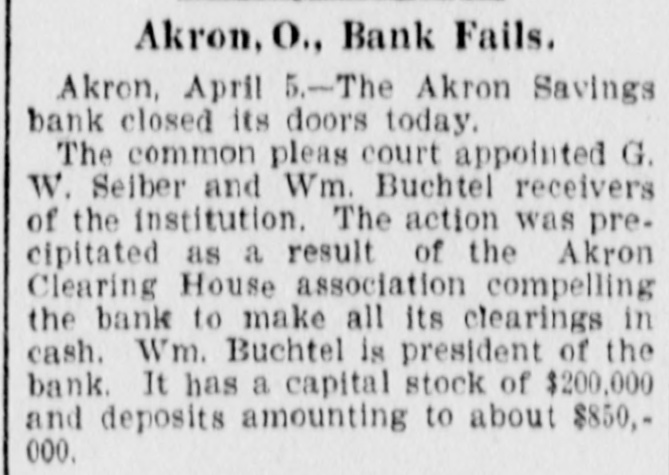
Akron, O., Bank Fails. Akron, April 5.-The Akron Savings bank closed its doors today. The common pleas court appointed G. W. Seiber and Wm. Buchtel receivers of the institution. The action was precipitated as a result of the Akron Clearing House association compelling the bank to make all its clearings in cash. Wm. Buchtel is president of the bank. It has a capital stock of $200,000 and deposits amounting to about $850,000.


Article from Evening Star, April 5, 1904

Click image to open full size in new tab

Article Text

Akron Savings Bank Closes Doors

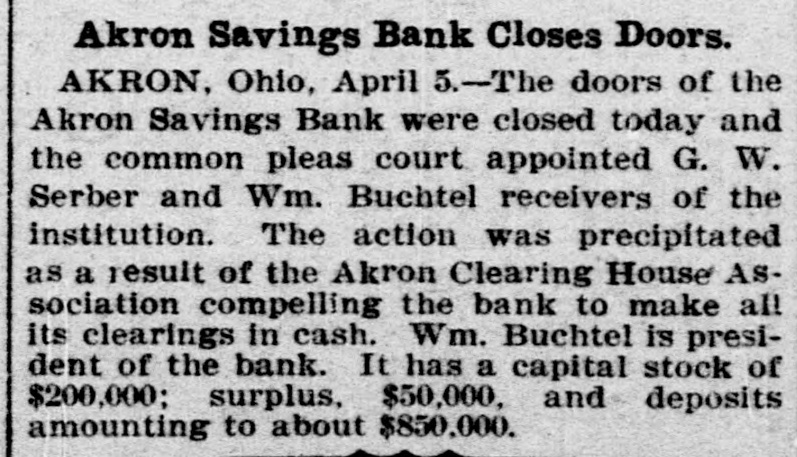
AKRON, Ohio, April 5.-The doors of the Akron Savings Bank were closed today and the common pleas court appointed G. W. Serber and Wm. Buchtel receivers of the institution. The action was precipitated as a result of the Akron Clearing House Association compelling the bank to make all its clearings in cash. Wm. Buchtel is president of the bank. It has a capital stock of $200,000; surplus, $50,000, and deposits amounting to about $850,000.


Article from Rock Island Argus, April 7, 1904

Click image to open full size in new tab

Article Text

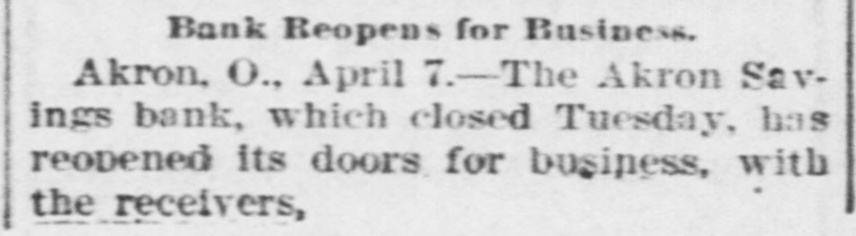
Bank Reopens for Business

Akron, O., April 7.-The Akron Savings bank, which closed Tuesday, has reopened its doors for business, with the receivers,


Article from The Waxahachie Daily Light, April 7, 1904

Click image to open full size in new tab

Article Text

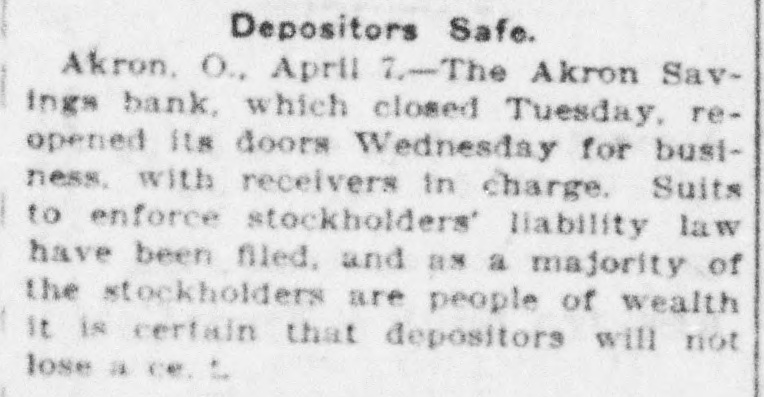
Depositors Safe

Akron, O., April .-The Akron Savings bank, which closed Tuesday, reopened its doors Wednesday for business, with receivers in charge. Suits to enforce stockholders' liability law have been filed, and as a majority of the stockholders are people of wealth It is certain that depositors will not lose a ce. L


Article from The Daily Morning Journal and Courier, April 7, 1904

Click image to open full size in new tab

Article Text

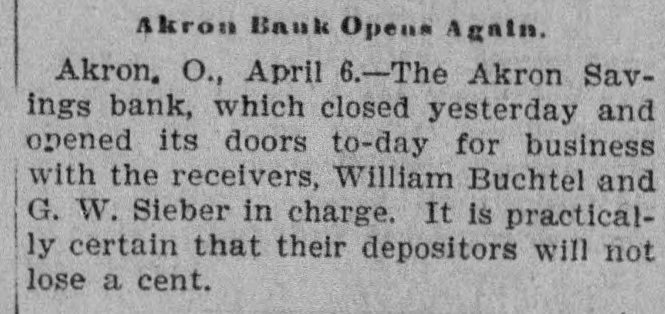
Akron Bank Opens Again

Akron. O., April 6.-The Akron Savings bank, which closed yesterday and opened its doors to-day for business with the receivers, William Buchtel and G. W. Sieber in charge. It is practically certain that their depositors will not lose a cent.


Article from The Indianapolis Journal, April 7, 1904

Click image to open full size in new tab

Article Text

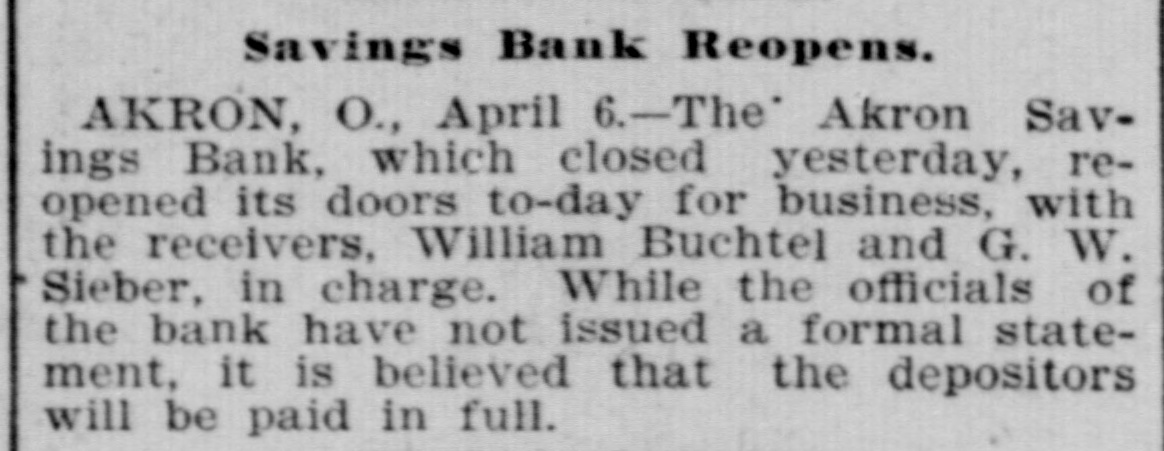
Savings Bank Reopens

AKRON, O., April 6.-The' Akron Savings Bank, which closed yesterday, reopened its doors to-day for business, with the receivers, William Buchtel and G. W. Sieber, in charge. While the officials of the bank have not issued a formal statement, it is believed that the depositors will be paid in full.


Article from The Clarksburg Telegram, April 8, 1904

Click image to open full size in new tab

Article Text

AKRON SAVINGS BANK CLOSES

By Associated Press. Akron, Ohio, April 5-The Akron Savings Bank closed its doors to-day. G. W. Seibet and William Duchtell were appointed receivers of the bank. The clearing house demanded the bank to make its clearings in cash. This caused the suspension. The capital of the institution is $200,000; surplus, $50,000; deposits, $850,000. An official statement of the bank's condition published yesterday showed resources to be $1,151,910 and the liabilities the same.


Article from The Stark County Democrat, April 8, 1904

Click image to open full size in new tab

Article Text

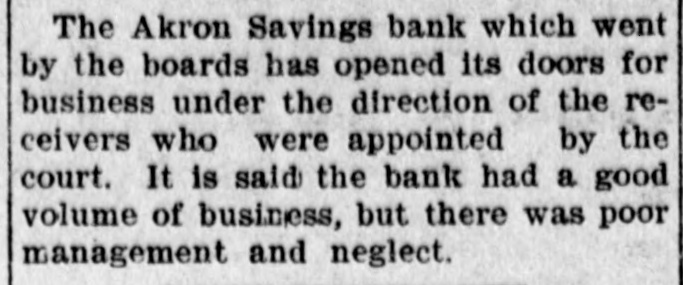
The Akron Savings bank which went by the boards has opened its doors for business under the direction of the receivers who were appointed by the court. It is said the bank had a good volume of business, but there was poor management and neglect.


Article from The Labor World, April 9, 1904

Click image to open full size in new tab

Article Text

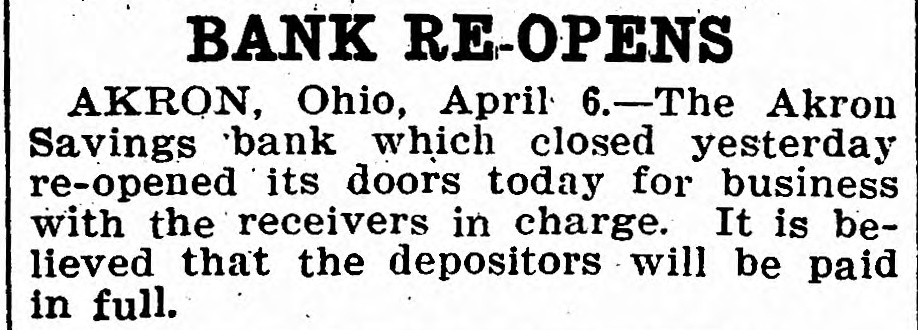
BANK RE-OPENS AKRON, Ohio, April 6.-The Akron Savings bank which closed yesterday re-opened its doors today for business with the receivers in charge. It is believed that the depositors will be paid in full.


Article from Wausau Pilot, April 12, 1904

Click image to open full size in new tab

Article Text

Akron Savings Bank Fails

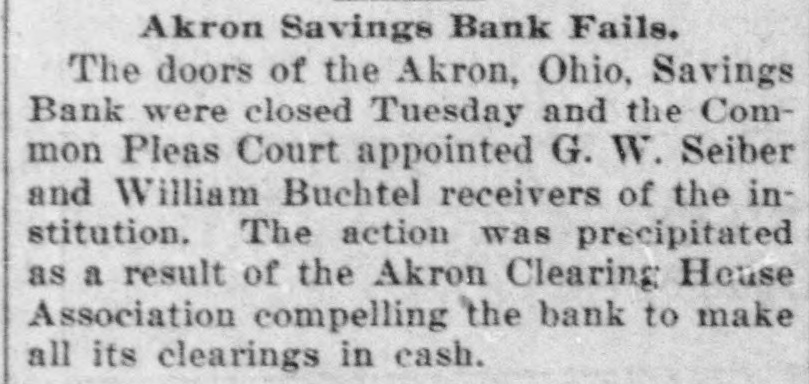
The doors of the Akron, Ohio, Savings Bank were closed Tuesday and the Common Pleas Court appointed G. W. Seiber and William Buchtel receivers of the institution. The action was precipitated as a result of the Akron Clearing House Association compelling the bank to make all its clearings in cash.


Article from New-York Tribune, July 5, 1907

Click image to open full size in new tab

Article Text

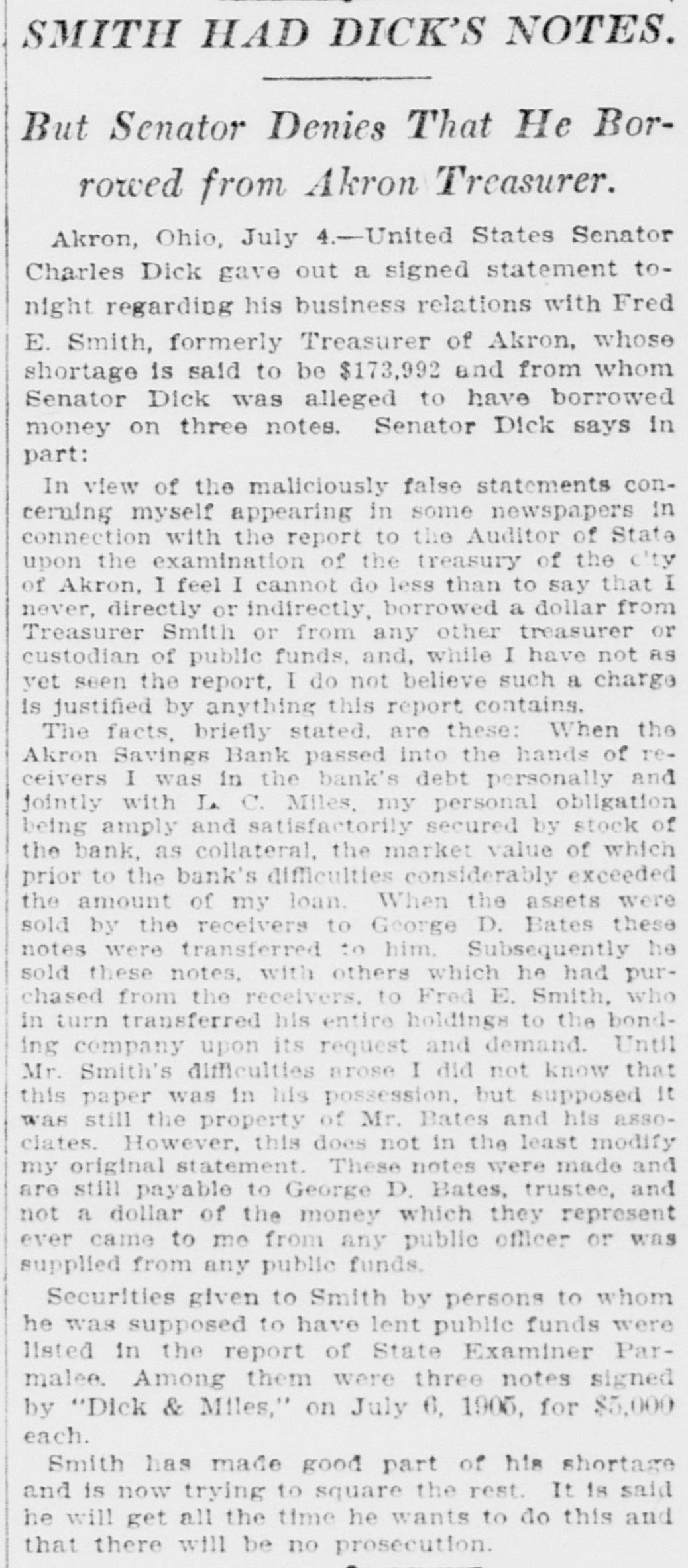
SMITH HAD DICK'S NOTES.

But Senator Denies That He Borrowed from Akron Treasurer.

Akron, Ohio, July 4.- United States Senator Charles Dick gave out a signed statement tonight regarding his business relations with Fred E. Smith, formerly Treasurer of Akron, whose shortage is said to be $173,992 and from whom Senator Dick was alleged to have borrowed money on three notes. Senator Dick says in part:

In view of the maliciously false statements concerning myself appearing in some newspapers in connection with the report to the Auditor of State upon the examination of the treasury of the city of Akron, I feel I cannot do less than to say that I never, directly or indirectly, borrowed a dollar from Treasurer Smith or from any other treasurer or custodian of public funds, and, while I have not as yet seen the report, I do not believe such a charge is justified by anything this report contains.

The facts, briefly stated, are these: When the Akron Savings Bank passed into the hands of receivers I was in the bank's debt personally and jointly with L. C. Miles, my personal obligation being amply and satisfactorily secured by stock of the bank, as collateral, the market value of which prior to the bank's difficulties considerably exceeded the amount of my loan. When the assets were sold by the receivers to George D. Bates these notes were transferred to him. Subsequently he sold these notes, with others which he had purchased from the receivers, to Fred E. Smith, who in turn transferred his entire holdings to the bonding company upon its request and demand. Until Mr. Smith's difficulties arose I did not know that this paper was in his possession, but supposed it was still the property of Mr. Bates and his associates. However, this does not in the least modify my original statement. These notes were made and are still payable to George D. Bates, trustee, and not a dollar of the money which they represent ever came to me from any public officer or was supplied from any public funds.

Securities given to Smith by persons to whom he was supposed to have lent public funds were listed in the report of State Examiner Parmalee. Among them were three notes signed by "Dick & Miles," on July 6, 1905, for $5,000 each.

Smith has made good part of his shortage and is now trying to square the rest. It is said he will get all the time he wants to do this and that there will be no prosecution.
Article from The Birmingham Age-Herald, July 5, 1907

Click image to open full size in new tab

Article Text

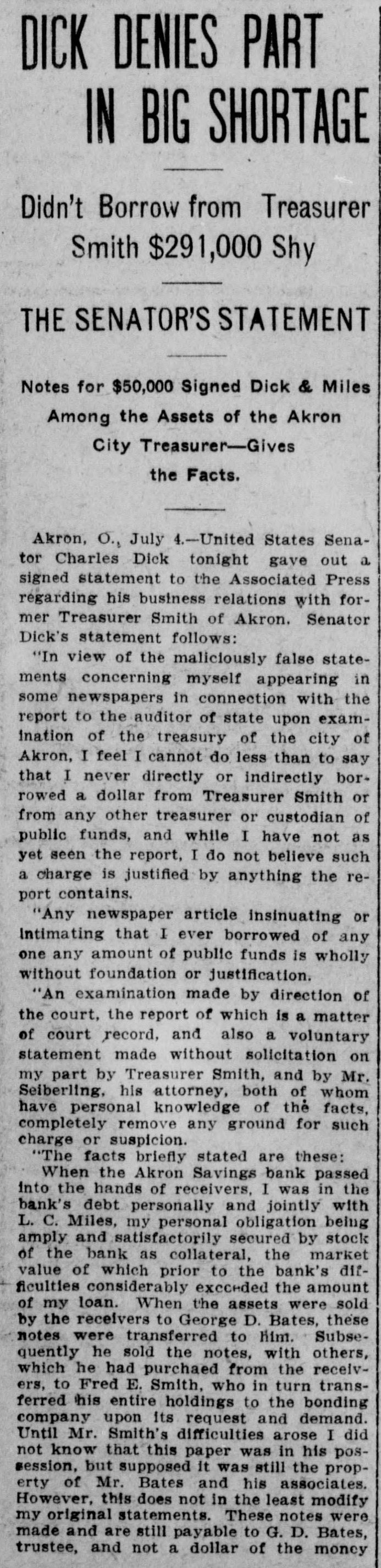
DICK DENIES PART IN BIG SHORTAGE Didn't Borrow from Treasurer Smith $291,000 Shy THE SENATOR'S STATEMENT Notes for $50,000 Signed Dick & Miles Among the Assets of the Akron City Treasurer-Gives the Facts. Akron, O., July 4.-United States Senator Charles Dick tonight gave out a signed statement to the Associated Press regarding his business relations with former Treasurer Smith of Akron. Senator Dick's statement follows: "In view of the maliciously false statements concerning myself appearing in some newspapers in connection with the report to the auditor of state upon examination of the treasury of the city of Akron, I feel I cannot do less than to say that I never directly or indirectly borrowed a dollar from Treasurer Smith or from any other treasurer or custodian of public funds, and while I have not as yet seen the report, I do not believe such a charge is justified by anything the report contains. "Any newspaper article insinuating or Intimating that I ever borrowed of any one any amount of public funds is wholly without foundation or justification. "An examination made by direction of the court, the report of which is a matter of court record, and also a voluntary statement made without solicitation on my part by Treasurer Smith, and by Mr. Seiberling, his attorney, both of whom have personal knowledge of the facts, completely remove any ground for such charge or suspicion. "The facts briefly stated are these: When the Akron Savings bank passed into the hands of receivers, I was in the bank's debt personally and jointly with L. C. Miles, my personal obligation being amply and satisfactorily secured by stock of the bank as collateral, the market value of which prior to the bank's difficulties considerably exceeded the amount of my loan. When the assets were sold by the receivers to George D. Bates, these notes were transferred to him. Subsequently he sold the notes, with others, which he had purchaed from the receivers, to Fred E. Smith, who in turn transferred this entire holdings to the bonding company upon its request and demand. Until Mr. Smith's difficulties arose I did not know that this paper was in his possession, but supposed it was still the property of Mr. Bates and his associates. However, this does not in the least modify my original statements. These notes were made and are still payable to G. D. Bates, trustee, and not a dollar of the money