Merchants National Bank (San Francisco, CA)

Episode Information

Episode UID
848701295
Episode Type
Run โ†’ Suspension โ†’ Reopening
Bank Type
national
Bank ID
84870 national
Charter Number
8487
Start Date
November 2, 1907
Location
San Francisco, California (37.780, -122.419)

Metadata

Model
gpt-5-mini (chosen from majority vote of a three-model LLM ensemble)
Short Digest
821ef8c29d74dcd1

Response Measures

Accommodated withdrawals, Clearinghouse loan, Full suspension, Books examined

Clearinghouse involved: Yes (loan, examination, or other measures)

Description

Sources state the bank suspended amid heavy withdrawals and rumors and express confidence of resumption, but explicit reopening date not shown.

Events (4)

1. December 31, 1906 Chartered
Source
historical_nic
2. November 2, 1907 Run
Cause
Rumor Or Misinformation
Cause Details
Sustained anonymous letters and telephone messages advised depositors to withdraw funds, generating heavy withdrawals.
Measures
Clearing House association loaned up to legal limit; sought advice of comptroller and expected special bank examiner; tried to liquidate assets.
Newspaper Excerpt
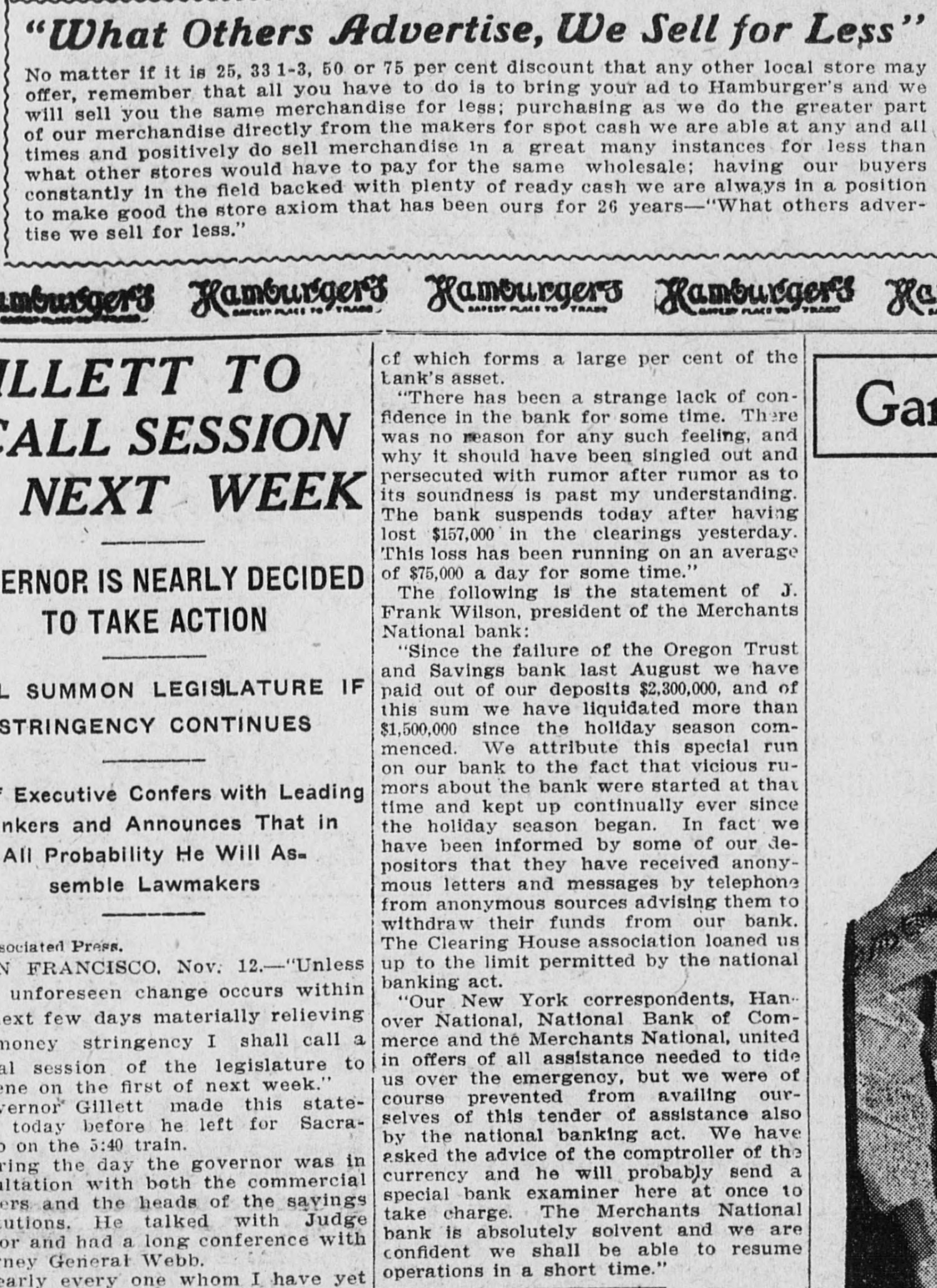
We have paid out of our deposits $2,300,000...we attribute this special run on our bank to the fact that vicious rumors about the bank were started
Source
newspapers
3. November 2, 1907 Suspension
Cause
Rumor Or Misinformation
Cause Details
Immediate heavy clearings losses and depositor withdrawals driven by persistent rumors forced suspension.
Newspaper Excerpt
The bank suspends today after having lost $157,000 in the clearings yesterday.
Source
newspapers
4. May 31, 1912 Voluntary Liquidation
Source
historical_nic

Newspaper Articles (6)

Article from Evening Star, November 3, 1907

Click image to open full size in new tab

Article Text

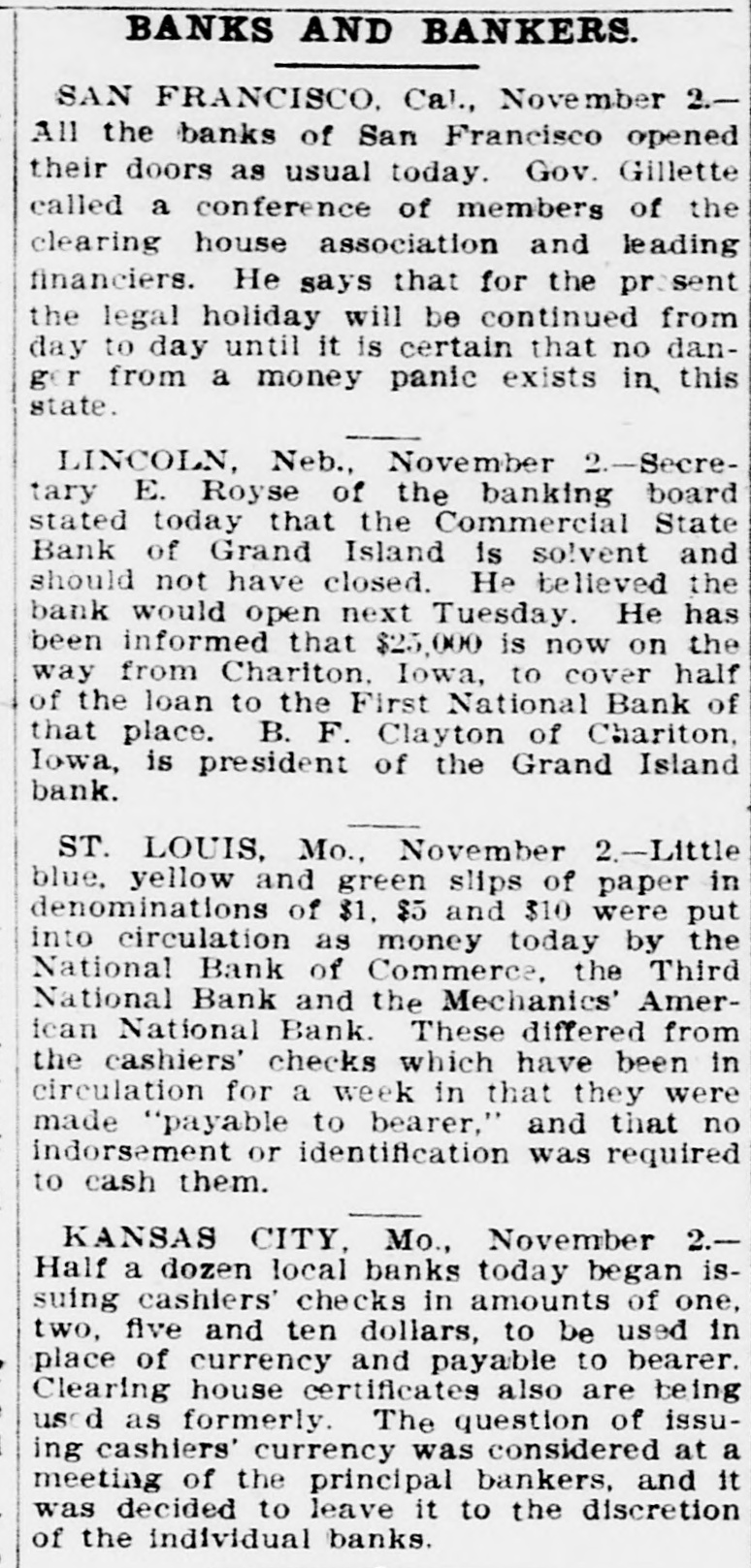
BANKS AND BANKERS. SAN FRANCISCO, Cal., November 2All the banks of San Francisco opened their doors as usual today. Gov. Gillette called a conference of members of the clearing house association and leading financiers. He says that for the present the legal holiday will be continued from day to day until it is certain that no danger from a money panic exists in, this state. LINCOLN, Neb., November 2.-Secretary E. Royse of the banking board stated today that the Commercial State Bank of Grand Island is solvent and should not have closed. He believed the bank would open next Tuesday. He has been informed that $25,000 is now on the way from Chariton, Iowa, to cover half of the loan to the First National Bank of that place. B. F. Clayton of Chariton, Iowa, is president of the Grand Island bank. ST. LOUIS, Mo., November -Little blue, yellow and green slips of paper in denominations of $1. $5 and $10 were put into circulation as money today by the National Bank of Commerce, the Third National Bank and the Mechanics' American National Bank. These differed from the cashiers' checks which have been in circulation for a week in that they were made "payable to bearer," and that no indorsement or identification was required to cash them. KANSAS CITY, Mo., November 2.Half a dozen local banks today began issuing cashiers' checks in amounts of one, two, five and ten dollars, to be used in place of currency and payable to bearer. Clearing house certificates also are being used as formerly. The question of issuing cashiers' currency was considered at a meeting of the principal bankers, and it was decided to leave it to the discretion of the individual banks.

Article from New-York Tribune, November 3, 1907

Click image to open full size in new tab

Article Text

HELPS PACIFIC COAST. Secretary Cortelyou Orders Transfer of $1,000,000. San Francisco, Nov. 2.-The United States government has come to the assistance of the San Francisco banks by taking steps to expedite the shipment of coin to the Pacific Coast. This action was the result of an appeal by local financiers to Secretary Cortelyou of the Treasury Department. A sum, said to be in the neighborhood of $1,000,000, will be transferred by the government for the use of the San Francisco savings banks. The government has coin in San Francisco to the amount of $343,000,000. Of this sum $303,000,000 is stored in the Mint and $40,000,000 in the Sub-Treasury. An effort was made to Induce the government to allow the local banks to deposit their federal bonds with the SubTreasury and obtain coin In return, but the authorities at Washington refused to consent to this plan. An arrangement was effected, however, by which similar results may be achieved by operating through the New York Sub-Treasury. The arrangement entered into between the San Francisco savings banks and the government provides that such federal bonds as the local banks have on deposit in New York may be turned in to the Sub-Treasury there. The New York Sub-Treasury will then instruct the San Francisco Sub-Treasury to pay out an equivalent in coin. All the banks of San Francisco opened their doors as usual to-day. Governor Gillette called a conference of members of the Clearing House Association and leading financiers, He says that for the present the legal holiday will be continued from day to day until it is certain that no danger from a money panic exists in this state.


Article from Los Angeles Herald, November 13, 1907

Click image to open full size in new tab

Article Text

"What Others Advertise, We Sell for Less" may No matter if it is 25, 33 1-3, 50 or 75 per cent discount that any other local store we offer, remember that all you have to do is to bring your ad to Hamburger's and part will sell you the same merchandise for less; purchasing as we do the greater of our merchandise directly from the makers for spot cash we are able at any and all times and positively do sell merchandise in a great many instances for less than what other stores would have to pay for the same wholesale; having our buyers constantly in the field backed with plenty of ready cash we are always in a position to make good the store axiom that has been ours for 26 years-"What others advertise we sell for less." Hamourgers BAPEST TRASS Hamburgers Hamburgers mass 80 SAFEST emburgers of which forms a large per cent of the tank's asset. ILLETT TO "There has been a strange lack of confdence in the bank for some time. There Ga: was no reason for any such feeling, and ALL SESSION why it should have been singled out and persecuted with rumor after rumor as to its soundness is past my understanding. NEXT WEEK The bank suspends today after having lost $157,000 in the clearings yesterday. This loss has been running on an average of $75,000 a day for some time." ERNOR IS NEARLY DECIDED The following is the statement of J. Frank Wilson, president of the Merchants TO TAKE ACTION National bank: "Since the failure of the Oregon Trust and Savings bank last August we have paid out of our deposits $2,300,000, and of SUMMON LEGISLATURE IF this sum we have liquidated more than STRINGENCY CONTINUES $1,500,000 since the holiday season commenced. We attribute this special run on our bank to the fact that vicious rumors about the bank were started at that : Executive Confers with Leading time and kept up continually ever since nkers and Announces That in the holiday season began. In fact we have been informed by some of our deAll Probability He Will Aspositors that they have received anonymous letters and messages by telephone semble Lawmakers from anonymous sources advising them to withdraw their funds from our bank. The Clearing House association loaned us sociated Press. up to the limit permitted by the national N FRANCISCO. Nov. 2.-"Unless banking act. unforeseen change occurs within "Our New York correspondents, Han.. ext few days materially relieving over National, National Bank of Commerce and the Merchants National, united money stringency I shall call a in offers of all assistance needed to tide al session of the legislature to us over the emergency, but we were of ene on the first of next week." course prevented from availing ourvernor Gillett made this stateselves of this tender of assistance also today before he left for Sacraby the national banking act. We have 5 on the 5:40 train. asked the advice of the comptroller of the ring the day the governor was in currency and he will probably send a altation with both the commercial special bank examiner here at once to ers and the heads of the sayings take charge. The Merchants National tutions. He talked with Judge bank is absolutely solvent and we are or and had a long conference with confident we shall be able to resume they General Webb. operations in a short time." early every one whom I have yet


Article from The Goldfield News, January 11, 1908

Click image to open full size in new tab

Article Text

Butte Gold of the Diamondfield Gold Mining com- pany and the Black Butte Gold Mining company was effected on August 1, 1905, and the first named company incorporated with a capital stock of 2,000,000 shares, par value $1 each. The stock is listed on the Gold- field exchange, and is selling around 20 cents, but has sold up to as high as 80 cents a share. A cash dividend of 2 cents a share on all stock that had been issued amounted to $14,650, was de- clared in the fall of 1905, and at the same time a stock dividend of the re- maining stock in the treasury which amounted to 267,500 shares was also distributed. The officers of the com- pany as announced after the last annual meeting, are: President, Frank Ish; vice president, L. L. Patrick; secretary, M. C. Howard. Other directors, Thos. D. Murphy, J. L. Harness. The prop- erty consists of about 70 acres in the Diamondfield district, northeast of the town of Goldfield, Nevada. Among the claims is the Quartzite Fraction, from which leasing operations have produced about $700,000 worth of ore. As the pay shoots in this claim indicate the same values along the strike of some of the other claims, a three-compartment shaft for working purposes, and more thor- ough development of the property is be- ing put down between two well defined ledges to reach a depth of 400 feet. At last accounts this shaft was down below the 300-foot level, and considerable crosscutting and drifting was going on. A large amount of ore running from $5 to $50 a ton is said to be already de- veloped on the company's estate. C. J. S., Wichita, Kas. When the strike came on the Florence Extension was in full operation. Two shafts are on the ground, each 300 feet deep. Only one shaft was working when the shut down came; this was shaft No. 2 at the 150-foot level; 300 feet of crosscutting has been done in which a ledge 9 feet wide was encountered running from $15 to $18. This shaft will be continued to the 350-foot point, when work resumes in the district. In crosscuting and drifting from that depth high grade ore is expected. Both shafts are equipped with heavy electric hoists and gallows frames. J. H., Jacksonville, Ill. The Rich Gulch Wonder property is not working at present. Some 45 Wonder properties were compelled to quit work either be- cause the Nye & Ormsby County bank at that place closed down or because out of town banks, like the John S. Cook & Co. bank at Goldfield and the San Fran- cisco banks went on a scrip or clearing house certificate basis. We do not know the status of the litigation. The Ne- vadan L. & M. Co. was working its lease on the Florence when the strike began and will resume when labor troubles are adjusted. Ely, Pittsburg. The Giroux Cons. at Ely is sending out $200,000 worth of ore monthly in addition to carrying on an immense amount of development. The Boston-Nevada has secured the 5-stamp mill at Osceola and will soon be treat- ing the ore from the Cumberland. The Rickard-Ely, near the 1,000-foot point in a drill hole has struck the sulphide zone, and has good copper assays from the drillings. The drill is still going down. E. J. M., Rox, Mass. Know nothing of the Howell and Little Exploration Co. The value of the Boston and Goldfield ground has not been determined as suf- ficient work has not been done. Have no late and exact data on the Quartette Extension Gold Mines Co. We presume you mean the Searchlight property. P. S., Boise. The Seven Troughs, op- erating in the district of that name, is said to have made a rich strike in the 400-foot level of the property. The re- port, which is well founded, comes from Salt Lake. ### Shareholders' Protective Association, Toronto, Canada. The "Mohawk John- nie Mine" is a new one to us. Give us the name of some of the officers or where the property is located, and we may be able to give you what you want. A. H. L., Portland. We have no in- formation on "Schwab's Gold Anchor." Don't know the property. Where is it located. Butte Boys was looking good at last reports. J. T. M., Wellsley, Mass. Neither of the stocks mentioned is listed and we have heard of no curb transactions. They are not working at present. Bull- frog district quiet. J. W. S., Chicago. Humphrey and Meyers are the largest owners of Man- hattan Cowboy. Address C. F. Hum- phrey, 1300 Golden Gate Avenue, San Francisco, Cal. J. W. L., Portland. See item about Schwab's Golden Anchor in our Tonopah news letter of today.


Article from The San Francisco Call, April 12, 1908

Click image to open full size in new tab

Article Text

No More Yellow Gold But when the New York banks went on a clearing house basis and declared that no shipments of coin or currency would be made to interior correspondents, the San Francisco clearing house association deemed it time to act. After much discussion and with great reluctance-for such a step had never before been found necessary-it was decided to follow the lead of New York, Chicage and practically every other large city in the country. On October 28 the announcement was made that no payments in coin would be made "except for the reasonable and clearly legitimate demands of business." At the same time customers were requested to use checks wherever possible in making payments, stamping such checks "Payable Through the San Francisco Clearing House." The announcement appeared in the newspapers of October 29 and aroused instant though not acute apprehension in the public mind. It was the first general realization that the financial trouble was to have any local bearing. Not until the afternoon of the 30th. when the California safe deposit and trust company closed its doors, was there anything like real alarm, and even then there was no, demonstration or manifestation of excitement. The small crowds that gathered around the doors of the closed bank and its branches were quiet and orderly, accepting the situation with the same incredible good nature that carried them through earthquake and fire and a thousand resultant discomforts. The following day, however, sus 1 picion and dread were in the atmosphere, and the banks had to meet unusually heavy demands for cash. It was probably the most anxious day for bankers that has occurred in San Francisco since that time in 1875 when the Bank of California suspended, and Rale ston's dead body was taken from the 1 bay at North beach. The intervention t of legal holidays, which the governor s called from day to day, had a salutary


Article from The San Diego Sun, March 27, 1928

Click image to open full size in new tab

Article Text

MONEY PANIC, OF 1907 OFFERS SECOND TEST FOR BANK WIZARD Shrewd Planning Saves Famous San Francisco Financial Institution From Collapse In Face of Situation Note: This is the teath (Editor's the cent series California tax survey of articles Taxpayers' made of this Assn. county Others will follow from day day.) CHAPTER 10 But just a year later another test was to come. Almost as severe. It was worse for many banks and business concerns. This was the "money panic" of 1907, which spread devastation far and wide, but in a manner different from the fire. This panic brought business to a standstill, particularly big business. It was in many ways the most spectacular panic the United States ever has known. Giannini made trip east early in 1907 He visited New York and the other centers. He sensed "something coming. On' his return to San Francisco he convinced his associates of the serlous financial trouble that was brewing. He issued orders that the bank husband its gold. San Francisco in those days was a town that liked "hard" -gold and silver. Currency was not a common medium of exchange. GOLD STORED But Giannini started giving out currency at every opportunity, quietly and without comment All the gold that came into the bank and all that could be obtained was stored for the coming emergency Loans were cut down as much as possible where injury would not be done business and the bank Itself. Preparation was the watchword. No business calls for greater foresight and for the ability to analyze economic trends. Giannini proved he could do that. He had gold in tremendous amount. So great did the hoard become the bank could not hold it all in its own vaults. The Bank of Italy literally overflowed with gold, and space had to be hired in another The panic came like a whirl- NEW YORK, CENTER New York was the center of the disturbance because interior banks had placed on deposit there more than 300 millions of dollars. They could not get this money back. The big Knickerbocker Trust Co. of New York failed. Others followed. Throughout the country banks intimately connected with the closed institutions were in turn involved There was no money, no gold and no currency to meet day to day needs of customers in many places, San Francisco among them. In many cities no cash or currency whatsoever was available. Clearing house certificates became a medium of exchange. In San Francisco the customers withdrawals to $100 in gold or currency and the balance in these clearing house certificates. But not the Bank of Italy The Giannini bank had all the yellow metal It. needed for its customers. It paid gold throughout the entire period of depression. GOLD TO SPARE Not only that, the Bank of Italy had gold to spare and instead of holding more than was needed Giannini turned his reserve above his own needs to the bank which had stored his wealth. The fire had made timid bankers run to cover. They tightened up on loans. Money was hard to get from everyone except Giannini. He loaned right and left. The panic of 1907 brought about change in our money BYStem. It finally brought about the Federal Reserve Act designed to prevent just such panics. INFLATION Speculation and wide-spread inflation caused it. Railways and great industrial concerns had absorbed vast amounts of capital during the boom days of 1906 and early 1907. It was estimated that $500 000 had been but recently borrowed from Europe in addition to the $300 000 000 from country banks, which were in the habit of sending their surplus funds to the big banks of New York where much was put "on call' for speculative stock market loans It is no secret now that the 1907 panic showed a weakness in the banking system of the United States. The national banks had been weakened by the growth of trust companies which extended their business into commercial banking These trust companies then were comparatively unrestricted by law. Their operations went far beyond conservative practice and in particular they did not protect their deposits with adequate reserves. Giannini had foreseen the panis of 1907 and had hoarded gold. He likewise east about for the reasons of the panic and the results. Studying the situation, he noticed that our neighbors in Canada had avoided the cataclysm. Conditions in trade there were akin to our own, even worse in fact. In this country we had general bank suspension lasting two months. Canada escaped that Here banks added to the panic. Country banks, which must keep their reserves at work in the large centers, and particularly New York, clamored most vehemently and urgently for the return of their funds from the reserve centers. It proved bankers are human, after all, but It likewise