Article Text
Suspended Payment
CINCINNATI, Feb. 6.-Metropolitan Bank suspended payment for a short time this morning, but resumed in a few minutes.
Click image to open full size in new tab
CINCINNATI, Feb. 6.-Metropolitan Bank suspended payment for a short time this morning, but resumed in a few minutes.
Click image to open full size in new tab
CINCINNATI. o., Feb. 7.-Another sensational feature has been added to the Metropolitan bank suspension, which is the arrest of Hon. Wm. Means, president of the bank.
Click image to open full size in new tab
CINCINNATI, O., Feb. 6.-When the Metropolitan bank opened Monday morning there was quite a crowd on hand waiting to draw out deposits, but they were disappointed. The bank people claimed to have securities, but not cash, on hand. They said the latter would be forthcoming. The paying teller of the bank asserts that they have not suspended. The reason for temporary suspension of the Metropolitan bank was to organize, which has just been done by electing Louis Krohn vice president, vice J. R. Decamp, resigned. The bank is now paying out on demand, and doing business as usual.
Click image to open full size in new tab
CINCINNATI, O., 4 February 6.-The Metropolitan Bank directors held a session this morning at I0 o'clock. Pending the meeting, the payment of checks was suspended and a long line of depos itors gathered. In a very few minutes, however, the payment of checks began, and at 11.10 the line was much decreased. Directors are still in session, and what was transacted is not yet known, except that President DeCamps' resignation was accepted and Louis Krohn chosen in his place. Bank Examiner Sanders is at the bank, but says he is too busy to say anything for the benefit of the public. The directors took no other action than to elect Krohn vice-president in place of De Camp. President Means, referring to the stoppage of payment, says he supposed the story must have arisen from some accidental delay at the payer's desk, 88 no order for the suspension was given. Everything is quiet at the bank.
Click image to open full size in new tab
(By telegraph to the Dispatch.] CINCINNATI, O., February 6.-The Metropolitan Bank suspended payment for a short time this morning, but resumed in a few minutes.
Click image to open full size in new tab
The Vice President Speculated too Freely in Real Estate. CINCINNATI, Feb. 6.-There was more than the usual demand upon the Metropolitan bank all day but at the clearing house it was only $10,000 behind. While bankers agree that the bank is solvent, they recognized the fact that it could not meet every possible demand in a dav, so eight of the banks loaned it $25,000 apiece and other offers were declined. The objection made to Decamp the retiring vice president was, that he had been speculating too much in real estate. The directors of the bank held a meeting this morning during which payment of checks was suspended, but business was soon re sumed. The president says there was no order for suspension. A bank examiner was at the bank but would divulge nothing.
Click image to open full size in new tab
CINCINNATI, Feb. 6-The Metropolitan Bank su-pended payment for a short time this morning, but resumed in a few minutes. The directors held a meeting at ten o'clock, pending which the payment of checks was suspended, and a lonz line of depositors gathered, reaching from the payer's desk to the street. In a very few miautes, however, the payment of checks began and at noon the line was much decrease ! The directors took 2. oth r action than to elect Mr. Kroha vice-pre-ident, in place of Mr. DeCano. Presid nt Means, referring to the stoppage of payments, said there was no order for it and ne reason for it, and that he did not know there was any suspension.
Click image to open full size in new tab
lay gas land, Toledo natural gas stock, Roane Mountain, Tenn., iron and coal land, and stock in the Athens, Ga., Improvement company was purchased. Most of the land and stock was bought on time, notes being given. When the boom ended and these notes matured it is charged that the bank's money was used to pay them.
This, it is alleged, was accomplished by one director loaning the bank's money to the other on notes. These amounted to over $600,000. National bank examiners went through the bank numerous times, and always reported it solvent. When the Fidelity bank failed it was discovered that there was something wrong with the Metropolitan. It seems that on March 17, Bank Examiner Powell arrived in this city for the purpose of examining the Fidelity National bank. It was at the time Harper and Hopkins were in the wheat deal. When Powell began his examination, the reserve fund, which the law requires to be 25 per cent. of the deposits, was away below that amount. To dupe the examiner, Harper borrowed $150,000 from the Metropolitan bank. This was enough to balance the reserve fund, and Examiner Powell reported that the Fidelity was solvent. This money was returned to the Metropolitan the next day. This peculiar transaction was not known, however, when the Fidelity failed. Examiner Powell appointed John R. De Camp, vice president of the Metropolitan, temporary receiver of the Fidelity. The Fidelity failure caused a run on all the banks.
Vice President De Camp knew that his own bank, the Metropolitan, was hard pushed. To save his institution it is charged that he took all the bills receivable of the Fidelity bank and collected from the New York banks $175,000. This amount he turned over to the Metropolitan to meet the demands for money from the depositors. When Receiver Armstrong took charge of the Fidelity's affairs he demanded the money, and the Metropolitan paid over $115,000 to the receiver, which in turn was sent to Comptroller of the Currency Trenholm. During the trial the peculiar transaction of transferring the funds of the Metropolitan to the Fidelity came out. This caused Comptroller Trenholm to look upon the Metropolitan with suspicion. He examined old statements of the bank, and saw upon the face of them that there was something wrong.
A new bank examiner, Mr. Sanders, was then sent to Cincinnati. The very first day he was in the bank he found that it was not solvent. The last statement showed the reserve fund to be 25 per cent. of the deposits. Instead of this amount he found there was not 10 per cent. on hand. He next discovered the fact that there was a syndicate among the directors for speculating in real estate. He demanded that the directors, whose unsecured notes were in the bank, replace them with solid cash. This was done by some of the directors, while others turned in real estate stock, etc.
Mr. Sanders looked upon the stock with suspicion. He remained in the bank over a week. This caused suspicion. Metropolitan stock dropped from 145 to seventy-nine cents. This caused a run on the bank Saturday.
Then came the resignation of the vice president John R. De Camp, which was demanded by the examiner. This caused the run on the bank Monday.
Mr. De Camp's arrest convinced the directors that further efforts to sustain the bank would prove futile.
City Treasurer Bohrer had $100,000 in the bank.
It is said depositors will lose nothing. Stockholders will realize 86 on their stock. Examiner Sanders and his aid, Mr. William Moffett, at once took charge of the bank. They will continue in charge until a receiver is appointed.
A rumor is current on Third street to the effect that the Metropolitan will reorganize in a few days, reduce the capital stock, pay all the claims and continue business.
Click image to open full size in new tab
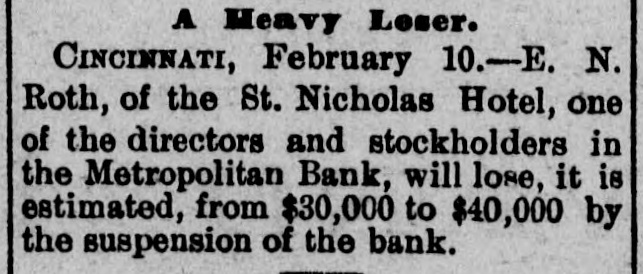
CINCINNATI, February 10.-E. N. Roth, of the St. Nicholas Hotel, one of the directors and stockholders in the Metropolitan Bank, will lose, it is estimated, from $30,000 to $40,000 by the suspension of the bank.
Click image to open full size in new tab
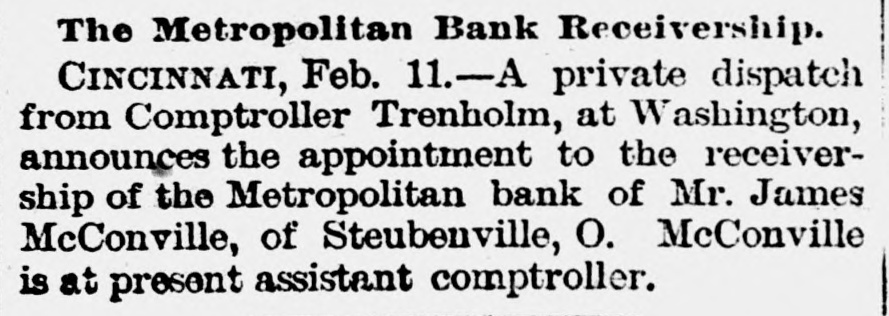
CINCINNATI, Feb. 11.-A private dispatch from Comptroller Trenholm, at Washington, announces the appointment to the receivership of the Metropolitan bank of Mr. James McConville, of Steubenville, O. McConville is at present assistant comptroller.
Click image to open full size in new tab
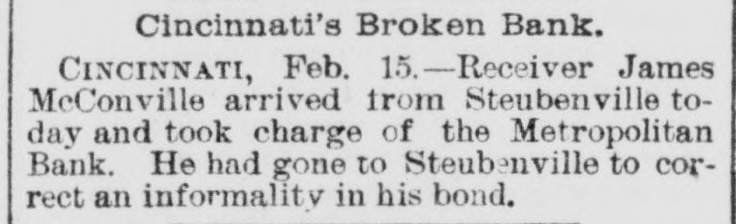
CINCINNATI, Feb. 15.-Receiver James McConville arrived from Steubenville today and took charge of the Metropolitan Bank. He had gone to Steubenville to correct an informality in his bond.
Click image to open full size in new tab
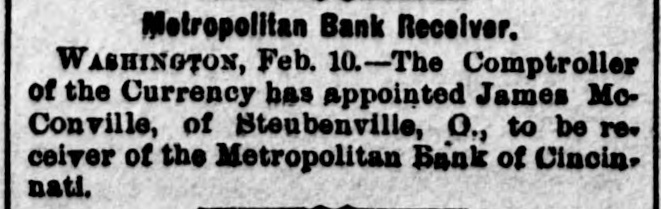
WASHINGTON, Feb. 10.-The Comptroller of the Currency has appointed James McConville, of Steubenville, O., to be re. ceiver of the Metropolitan Bank of Cincinnati.
Click image to open full size in new tab
Receiver McConville's First Work, CINOINNATI, O., Feb. 16.-The first work of Receiver McConville, of the Metropolitan Bank, is the collection of the money

Click image to open full size in new tab
pieces and forty other persons injured, fourteen seriously. Immense damage was done, several tons of powder being exploded. EIGHT hundred marble workers of Boston have struck for nine hours' work at ten hours' pay. THE WEST. THE Methodist Church at Fremont, O., was destroyed by fire recently and two persons in the parsonage adjoining were injured by falling walls. Loss, $35,000. Br the explosion of a burr stone of a corn mill at Broadhead, Champaign County, IIL, recently, two men were killed and two fatally hurt. A SENSATIONAL feature of the failure of the Metropolitan Bank, of Cincinnati, was the arrest on the 7th of Hon. William Means. its president. Other arrests were expected. THE North Chicago rolling mill at South Chicago resumed work on the 6th after two months' idleness. THE lockout of the Cincinnati shoemakers has practically been settled by the giving way of the employes under the persuasion of the district master workman. A RECEIVER has been appointed for the firm of E. A. Spyer & Co., wholesale teas and coffees, of Chicago. The principal cause of their embarrassment is said to be the recent decline in the coffee market. The liabilities have not been made known. TWENTY-FIVE prominent persons of Chicago have taken steps to erect a crematory. OIL was struck at Lehigh, I. T., recently at a depth of 917 feet and is flowing at the rate of a barrel an hour. By the derailing of an accommodation train near Athens, III., the other night, eight passengers were injured and six freight cars ditched. THE people of Albuquerque have subscribed $40,000 in cash to the Rio Grande & Utah railroad. THE striking Cincinnati shoemakers have been ordered to return to work. THE Territorial miners' convention at Helena denounced the Northern Pacific. McCLELLAN & Co., insolvent Minneapolis stove dealers, schedule shows assets, $3,262, and liabilities, $5,296. THE Springfield, O., Manufacturing Company has been placed in the hands of a receiver. THE National Convention was in session in Cincinnati on the Sth. AGENT KINNEY'S Dakota blizzard stories have been again contradicted. THE Manitoba railroad bridge across the Missouri river at Great Falls, Dak., has been completed. It is 900 feet long. D. R. LOCKE, "Petroleum V. Nasby," of the Toledo (0.) Blade, was reported on the 8th to be dying of consumption. A DISASTROUS cable accident occurred at Kansas City, Mo., on the night of the Sth, on the incline at the Union Depot, caused by the grip breaking. Two persons were fatally injured and seven others were hurt, one quite seriously. The incline had been noted for several bad accidents previously to the late disaster. A PHASE in the railroad war on the Sth was a cut of $3.00 in the passenger rate from Chicago to Kansas City. THE American Newspaper Publishers' Union held its annual meeting in Indianapolis, Ind., on the Sth. AMOS S. SNELL, a capitalist worth $3,000,000, was murdered by burglars in his residence, 425 Washington boulevard, Chicago, on the morning of the Sth. One arrest was made. What the robbers succeeded in taking away was not known, excepting that with the property was a check for $5,000 made by A. J. Stone, Sne:l's son-inlaw. THE Oklahoma convention met in Kansas City, Mo., on the Sih at the Board of Trade Hall with a large attendance, Governor Morehouse, of Missouri, occupying the chair. A memorial to Congress was adopted as well as resolutions looking to the opening of the Indian Territory and favoring the Springer bill for the creation of the Territory of Oklahoma. FIRE in Cleveland, 0., the other day, caused $65,000 damage to J. L. Hudson's clothing store. Cause, electric light wires. BENJAMIN EGGLESTON, ex-member of Congress and one of the most prominent of Ohio political leaders, died recently in Cincinnati, aged seventy-two. J. C. EVANS, of Harlem, Mo., has been elected treasurer and Parker Earl, of Cobden, III., president of the American Horticultural Society. THE Andrew Jackson Club, of Chicago, has taken steps to call a meeting of Democratic Clubs of America in Chicago June 1. FIVE cases of trichincsis have occurred in the family of William Man, a resident of Toledo, 0. All five were in a dangerous condition. BENSLEY BROS., of the Chicago Board of Trade, failed ou the 9th. Liabilities were not definitely known, but were thought to amount to $300,000. THE Columbia Theater, of Chicago, IS reported in financial difficulties. GEORGE W. CLARK. a real estate dealer of Duluth, Minn., formerly a newspaper writer under the late Daniel Manning on the Albany Argus, died recently. WOLVES have become dangerously numerous in the vicinity of St. Cloud, Minn. The other night several made a raid on a pig pen, almost within the city limits, and destroyed nearly 2,000 pounds of live hogs. IN Liberty township. Wabash Coun y, Ind., recently J. I. Smith and Joel Hale were killed by the explosion of the boiler of a portable engine. The explosion was caused by pumping cold water into the superheated boiler. Two men were recently digzing up some dynamite which had been buried to protect it until wanted to use in a gas well near Bellevue, O., when one of them struck the explosive material with his pick. The explosion instantly killed the two men. WILLIAM DONALDSON & Co.. dealers in pictures and frames, Cincinnati, have failed with $75,000 liabilities and $40,000 assets. THE SOUTH THE people of Arkansas are preparing remonstrances against the Dawes bill to levy a tax on lard manufactured by the aid of cotton seed oil. THE Commercial Printing Company. of
Click image to open full size in new tab
A CHECK FOR $125,000. Presid snt Means Settles His Indebtedness to the Metropolitan. CINCINNATI, Feb. 17.-Receiver McConville took hold at the Metropolitan bank yes-
Click image to open full size in new tab
General News. THE City of Providence passed up from Natchez to St. Louis last evening with a fine trip.
THE palatial steamer Coahoma is receiving to leave this evening at 5 o'clock for Helena and Friars Point.
THE elegant passenger steamer Rosa Lee will back out this day at 5 o'clock p.m. for Osceola and all way landings on the upper coast.
THE Gayoso clears this evening for Tiptonville and way points on the upper const. Capt. W. P. Hall commands, with Mr. W. Mitchell in the office.
The large side-wheel Centennial is offered for sale at St. Louis. She is 318 feet long, with forty-two feet beam, and is the longest boat in the western waters.
THE Belle Memphis, from St. Louis, passed down to Natchez yesterday, loaded flat. She put off sixty tons of merchandise and twenty-five tons of freight for way points.
THE Kate Adams leaves this afternoon at 5 o'clock for Helena, Friars Point, Concordia, Terrene and Arkansas City. Messrs. Mark R. Cheek and William Blanker are her chief officers.
It is said that 1,300 Hungarians have signed articles with John A. Wood to go to work at his Fremont mine, at Allenport, Pa., at a reduction of 25 per cent. The miners of the Connecticut mine, same place, have also accepted the reduction.
Capt. Hegler says the sale to him and associates of Coney Island, which has been in the hands of a receiver since the failure of the Metropolitan bank, of Cincinnati, has been confirmed, and the Guiding Star will hold up her end in the excursion business this season. Last season his boat handled 198,000 excursionists.—New Orleans Picayune.
Click image to open full size in new tab
Saved by a Bluff, General Mike Ryan, in talking of the Metropolitan Bank failure, recently told a Cincinnati Telegram reporter a good story ilustrating the power of bluff. It was in connection with his assertion that with little further aid from the other banks in the city the Metropolitan might have been saved. He said: "I have a brother connected with a bank in Leavenworth, Kan. There are two banks there, and the rival to that of my brother was in a shaky condition. The president came to Matt and told him the circumstances, and that if there was a run the bank would be unable to stand it. Matt told him to keep a stiff upper lip, for he knew that the failure of the other bank meant the failure of his own. He jumped on the train, went to Kansas City, got $40,000 in coingold and silver-in barrels, ran back to Leavenworth with the specie, and got half я dozen drays to the depot to take the barrels to the bank. Meantime the the crowd of depositors had begun to gether at the bank, demanding their money, and the old man was talking to them to gain time. All at once they saw the drays coming up, loaded down with these barrels. Matt was with the treasure, and shouted to the crowd to wait about five minutes and they'd get their money, as it was there in the barrels. "In unloading the barrels, one of them dropped and broke, so that, through a crack, the anxious depositors could see the shining gold, and, as it rolled up the steps of the bank, $5gold pieces kept dropping out, and were picked up by the janitor. When the coin was all rolled in, Matt came out and told us all who had money there to go in and get it, as the bank proposed to pay them all off andstart fresh, and didn't want such acowardly lot of depositors any way. All the time he was niling on the indignation he didn't want to be taken at his word, as the bank had only $10,000 cash on hand, against $90,000 of deposits made. He had brought $40,000, but there was still a shortage of $40,000. However, the game worked. The people were reassured by the sight of the barrels of coin and went away satisfied. The run was averted and the bank pulled through all right."
Click image to open full size in new tab
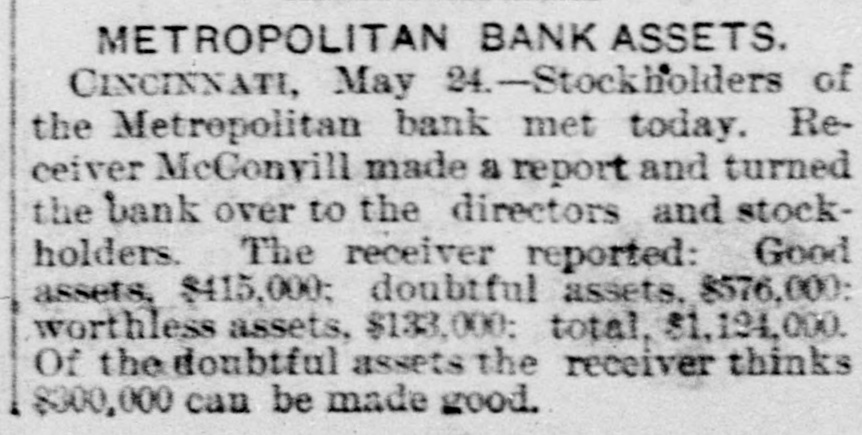
CINCINNATI, May 24.-Stockholders of the Metrepolitan bank met today. Receiver McConvill made a report and turned the bank over to the directors and stockholders. The receiver reported: Good assets, $415,000; doubtful assets, $576,000: worthless assets, $133,000; total, $1,194,000. Of the doubtful assets the receiver thinks $300,000 can be made good.
Click image to open full size in new tab
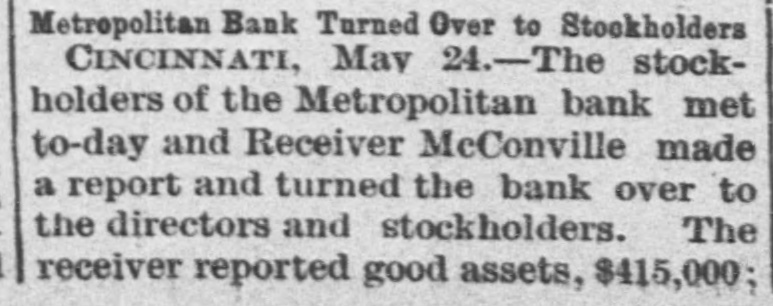
Metropolitan Bank Turned Over to Stockholders CINCINNATI, May 24.-The stockholders of the Metropolitan bank met to-day and Receiver McConville made a report and turned the bank over to the directors and stockholders. The receiver reported good assets, $415,000;
Click image to open full size in new tab
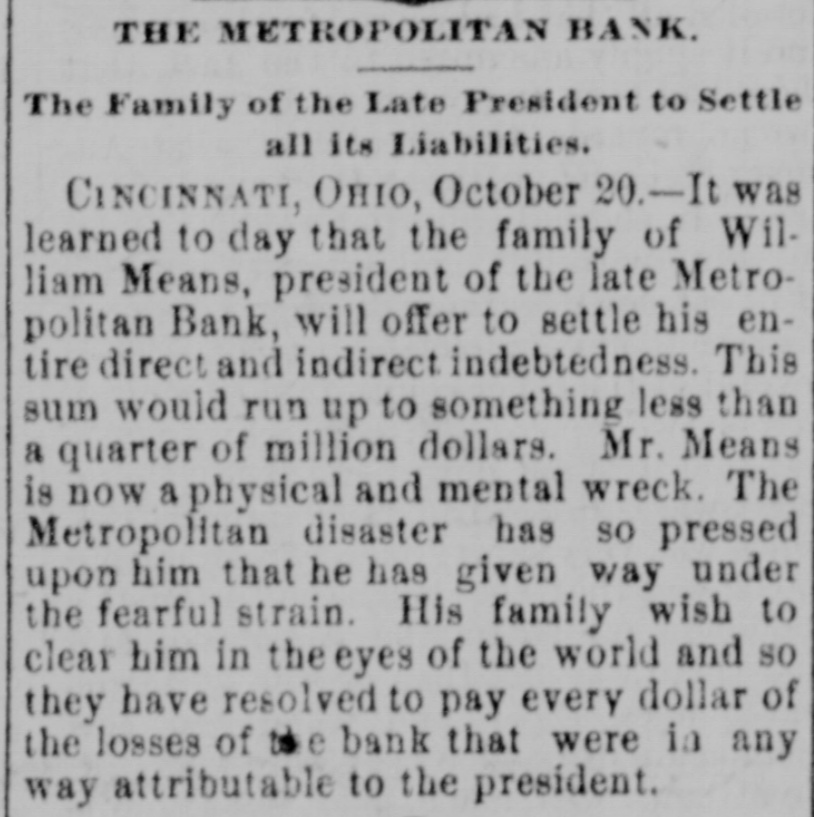
The Family of the Late President to Settle all its Liabilities. CINCINNATI, OHIO, October 20.-It was learned to day that the family of William Means, president of the late Metropolitan Bank, will offer to settle his entire direct and indirect indebtedness. This sum would run up to something less than a quarter of million dollars. Mr. Means is now a physical and mental wreck. The Metropolitan disaster has so pressed upon him that he has given way under the fearful strain. His family wish to clear him in the eyes of the world and SO they have resolved to pay every dollar of the losses of the bank that were in any way attributable to the president.
Click image to open full size in new tab
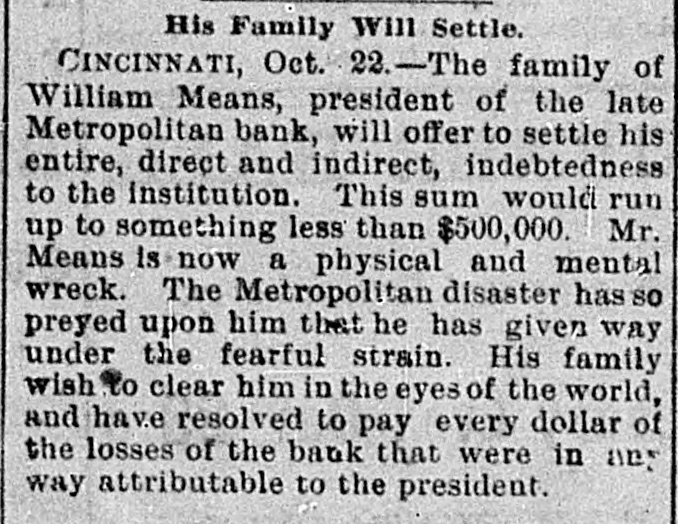
CINCINNATI, Oct. 22.-The family of William Means, president of the late Metropolitan bank, will offer to settle his entire, direct and indirect, indebtedness to the institution. This sum would run up to something less than $500,000. Mr. Means is now a physical and mental wreck. The Metropolitan disaster has so preyed upon him that he has given way under the fearful strain. His family wish to clear him in the eyes of the world, and have resolved to pay every dollar of the losses of the bank that were in any way attributable to the president.