Mechanics Bank (Newark, NJ)

Episode Information

Episode Type
Suspension β†’ Reopening
Start Date
November 1, 1881
Location
Newark, New Jersey (40.736, -74.172)
Bank Type
state

Metadata

Notes

Bank suspended after large embezzlement; directors later proposed a scheme to revive/resume the bank, but final reopening outcome is not fully documented here.

Events (4)

1. November 1, 1881 Suspension
Cause
Bank Specific Adverse Info
Cause Details
Embezzlement and massive misapplication of funds by cashier Oscar L. Baldwin and implicated clerks leading to suspension and closure of bank operations
Newspaper Excerpt
the failure of the Mechanics bank of Newark
Source
newspapers
2. November 7, 1881 Other
Newspaper Excerpt
a receiver has been appointed of the factory and property of C. Nugent & Co.; provisional receiver to take charge of affairs (and injunctions sought against Nugent & Co.)
Source
newspapers
3. December 3, 1881 Other
Newspaper Excerpt
directors agreed upon a scheme for the re-establishment of the bank and to raise a fund with a view to an honorable adjustment of the claims of stockholders, depositors and other creditors
Source
newspapers
4. May 3, 1882 Other
Newspaper Excerpt
conferences and suits to recover losses from directors and bondsmen continue; receivers' legal actions ongoing
Source
newspapers

Newspaper Articles (24)

Article from The Cheyenne Daily Leader, November 1, 1881

Click image to open full size in new tab

Article Text

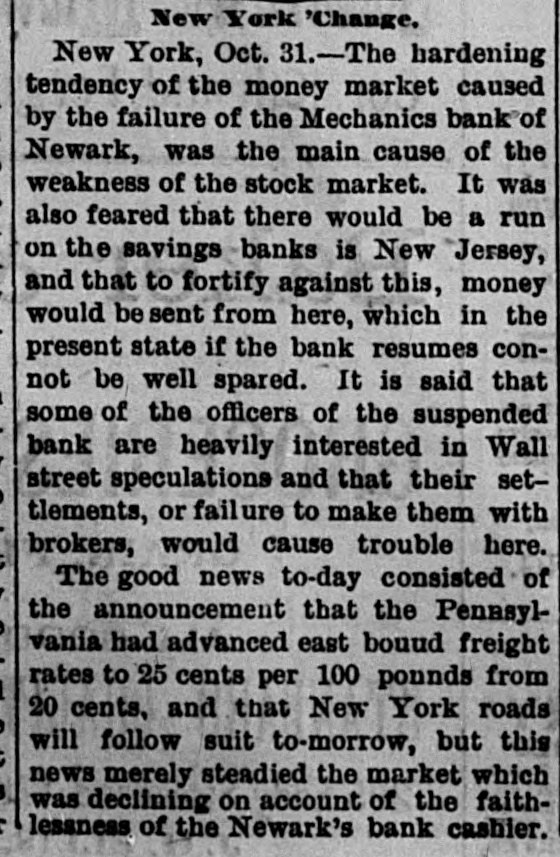
New York 'Change

New York, Oct. 31. -The - bardening tendency of the money market caused by the failure of the Mechanics bank of Newark, was the main cause of the weakness of the stock market. It was also feared that there would be a run on the savings banks is New Jersey, and that to fortify against this, money would be sent from here, which in the present state if the bank resumes connot be well spared. It is said that some of the officers of the suspended bank are heavily interested in Wall street speculations and that their settlements, or failure to make them with brokers, would cause trouble here. The good news to-day consisted of the announcement that the Pennsylvania had advanced east bouud freight rates to 25 cents per 100 pounds from 20 cents, and that New York roads will follow suit to-morrow, but this news merely steadied the market which was declining on account of the faithlessness of the Newark's bank cashier.


Article from Wheeling Register, November 1, 1881

Click image to open full size in new tab

Article Text

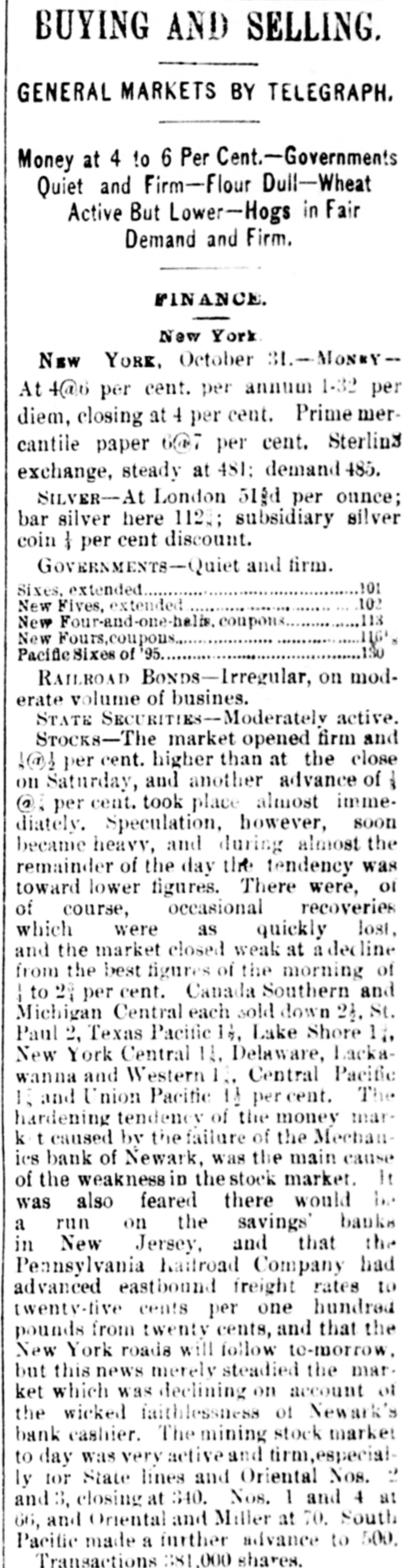
BUYING AND SELLING

GENERAL MARKETS BY TELEGRAPH. Money at 4 to 6 Per Cent.-Governments Quiet and Firm-Flour Dull-Wheat Active But Lower-Hogs in Fair Demand and Firm. FINANCE. New York NEW YORK, October 31.-MONEY-At 4@6 per cent. per annum 1.32 per diem, closing at 4 per cent. Prime mercantile paper 6@7 per cent. Sterling exchange, steady at 481: demand 485. SILVER-At London 518d per ounce; bar silver here 112. subsidiary silver coin 1 per cent discount. GOVERNMENTS-Quiet and firm. 101 Sixes, extended 102 New Fives, extended 113 New Four-and-one-halts.coupons 116' New Fours,coupons 130 PacificSixes of '95 RAILROAD Boxos-Irregular, on moderate volume of busines. STATE SECURITIES-Moderately active. STOCKS-The market opened firm and 1@1 per cent. higher than at the close on Saturday, and another advance of 1 @. per cent. took place almost immediately. Speculation, however, soon became heavy, and during almost the remainder of the day the tendency was toward lower figures. There were, of of course, occasional recoveries which were as quickly lost, and the market closed weak at a decline from the best figures of the morning of : to 21 per cent. Canada Southern and Michigan Central each sold down 2). St. Paul 2, Texas Pacific 14, Lake Shore 1., New York Central 11. Delaware, Lackawanna and Western 1., Central Pacific 1, and Union Pacific 11 percent. The hardening tendency of the money mark t caused by the failure of the Mechanies bank of Newark, was the main cause of the weakness in the stock market. It was also feared there would be a run on the savings' banks in New Jersey, and that the Pennsylvania Railroad Company had advanced eastbound freight rates to twenty-tive cents per one hundred pounds from twenty cents, and that the New York roads will follow to-morrow. but this news merely steadied the mar. ket which was declining on account of the wicked faithlessness of Newark's bank cashier. The mining stock market to day was very active and firm, especially for State lines and Oriental Nos. 2 and 3, closing at 340. Nos. 1 and 4 at 66, and Oriental and Miller at 70. South Pacitic made a further advance to 500. Transactions 381,000 shares.


Article from Daily Globe, November 1, 1881

Click image to open full size in new tab

Article Text

Financial and Stock Markets

NEW YORK, Oct. 1.-Money 4@6 per cent. per annum and 1-32 per cent. per diem, closing at 4 per cert. Prime mercantile paper 6@7 per cent. Sterling exchange, bankers' bills steady at $4.81. Sight exchange on New York, $4.85. Governments quiet and firm. Bonds-Railroad bonds irregular on a moderate volume of business. State Securities-Moderately active. Stocks-The stock market opened firm and 1/2 to 1/2 per cent. higher than it closed on SatSurday, and another advance of 1/8 to 3/2 per cent. took place almost immediately. Speculation, however, became hea vy and during almost the remainder of the day the tendency was toward lower figures. There were, of course, occasional recoveries, but they were as quickly lost and the market closed weak at a decline from the best figures of the morning of 1/4 to 314 per cent. Canada Southern and Michigan Central each sold down 21/2 per cent., Texas Pacific 1 1/2 per cent, Lake Shore 18/4 per cent., New York Central 11/6 per cent., Delaware, Lackawanna & Western 1% per cent., Central Pacific 1% per cent. and Union Pacific 1 1/2 per cent. The hardening tendency of the money market was caused by the failure of the Mechanics' bank, Newark, which was the main cause of weakness in the stock market. It was also feared there would be a run on the savings' banks in New Jersey and that to fortify against this money would be sent from here, which, in the present state of bank reserves, cannot be well spared. It is said that some of the officers of the suspended bank were heavily interested in Wall street speculation and that their settlements or failure made with brokers would cause trouble here. The good news consisted of an announcement that the Pennsylvania railway company had advanced east bound freight


Article from Chicago Daily Tribune, November 2, 1881

Click image to open full size in new tab

Article Text

NUMENT

BALDWIN'S COMPLOT. United NEWARK, N. J., Nov. 1.-It Kensby seeing became sathasty examination the of papers relistied. Mechanics' Bank and States after District-At ttorney surrendered the books by Ualdwith III his he made brtho lating Cashier to Nugente & Co., voluntary Hence statement, the substantially true. Nugent's on Judge the hands of the be immediately of demand were gent that & Co. property now Teese, In restitution surrendered counsel, C. to Nii- the 11 Receiver, In partial by Nugent In complicity examounts abstracted The District-Attorney Haldwin. some papers on the hibited to and insisted that by factory were the claim with is based, Teese produced which the app goods bank, the plication and now were in the of in moneys fact be allowed the drawn property to have from of all the himself expert bank. Teese asked to matter, and pledged the property should was completed and that until examine the examination the be left undisturbed he could give answer. NUMBER'S REPLY he for c. Nugent. said he would false C. show Baldwin's drawn any to & Co. and not of able Counsel confession their credits such Nugent $2,000,000 in excess would be amount he doubted as even If the excess The firm was one-tenth and of that amount. own books n statement of making up from its and drawn out bank of the for a number of offset years the banks moneys would paid In past, and figures. nssign this. the he thought, & Co. had not made do so. an Thustory C. Nugent nor do they in be end a to preferred creditor ment, the bank was to At present, it was the also au & Co. to would abide and intention that was of Nugent error. events, when remain It still been mlsled as to informed the that hebank and be found the people way tho money near claimed ly S500, had grone. When & Co. haddrawn counsel said that C. past three months, hands day 000 In the Nugent employed 700 and Then that and the firm, which have n large DAY-roll; month. night, would was over $50,000 to be per purchased, that and other expenses. would alone there was material But was it not likely THIS SOME there RECEIPTS be TO ESPENDITURE COUNTERINAI- ANCE MeAll the money LARGE received was went what into the the state- to Bank, and this by the firm is now of the the show. ment chanies' The being fact financial made manager out whole affair of Neither Is firm that Bakdwin was for about eight years. were and nor James and Baldwin nor claimed fill up Christopher had been to be, Nugent signed than- notes had it power of How easy it among the upsuch depositing and eters to fill checks. attorney notes and instead to of place would their be pass-book receipts for him bank's papers credit! The firm of the firm to notes their as deposits, and of the Cashier show about it. A friend him on the said he was and heard the he Garfield was money. made know would Haldwin nothing buried, with Nugent Hald former day up, and a large quantity enabled to pay evidence had ask C. would Nugeut soon for be of thought material was in about been know Baldwin $500,000. overdrawn that Nugent when This. to n no large he Cashier spoke'to great his amount. account anxiety. of Nugeut, the had Germanin ns with If was he n the E. M. Douglass Bank, sald In conversation talk of the city had been National reporter: four or five It years has been past that Nugent & Co. Cashier of UPHELD the Mechanics' BY in BALDWIN, the Bank y bank. Baldwin He Secre- was spoken was practically of Tellers, by everybody. raised as Oscar. President, 1 and do everything not think tary, referred and to him. inconvenience No, to other inwas will cause any only firm seriously suid this think the Co. It is convenienced Is they have creditors If this is cents on the this banks. morning true, 1 that I doubt Nugent If their & dollar." belloved suspended, Cashi and. get statement been moro than 25 When nsked whether that he all the loaned amount to Haldwin's from the bank Douglass sald: & Co. was made than probable Nugent withdrawn not. Baldwin It true, Is more some-weekly the visits sum "I to do Wall street, and nino-tenths of wassunk that fully he abstracted eight or from the bank in which stock speculation." GEORGE WILKINSON, National of the Manufacturers' President of the President Bank, and John 11. Bank, Kase, corroborated course what Second National said. Mr. Kase said, "I do In the not think Douglass averation: involved as of & Co. are so people Nugent further would like to have henvily that he was believe. noti than Baldwin morning for more to the and he elid the debted Nugent said $220,000, this Mechanics Bank assets not to proposo Me $200,000 or his entire compelled to chanies' Bank: he creditors, make an with all resume business to turn over terms assignment, that. If lie was his would do 80 but on equitable hoped to be able to that he two. in a week or ATTORNEY REASDY, Nugent & Co. DISTRICT the account of discovered that Investigating bank, up to noon the bank. on checks, he is with firm the had drawn from since Jan. 1; and of demore the than $1,500,000 find what amounts these drafts. found and endeavoring pasils have been to deposits made amounting to meet to $150,000 In 110 September had the October. reporter, and had he a svoke rope Kenshy to Nugent has now I have around around very earnestly: the Cashier's his, and neck 1 intend but to draw It was tight." one counsel for Nugout blank said his drafts client them at the up The habit of leaving Cashier filled them in bank. the and that to the sult himself, and used to In with Wall amounts NUGENT'S street speculations. DRAPTY you 19881. Kensby of drafts States following bank during 1881: Drafts. night United makes and deposits the by Nugent in the Deposits Octobur. $255,100


Article from New-York Tribune, November 3, 1881

Click image to open full size in new tab

Article Text

THE EXCITEMENT DIMINISHING

MUCH DOURT STILL FELT AS TO WHAT BALDWIN DID WITH THE MONEY-THE SUSPENSION FOLTOWED BY THE FAILURE OF A NEWARK MERCHANT-ACTION OF THE DIRECTORS OF THE BANK. signs of excitement fall National The of outward the Mechanies' Bank over of the Newark downhave almost disappeared. Occasionally two or three would form a front of the building walk group of in on and yesterday the stare sideanxiously at the modest little piece of white paper pasted on the closed iron doors, on which was written the first thrilling announcement of wreck and ruin, or look up at the stone arm and hammer thrust from the wall, which, in the light of the recent disclosures, seem a satire on honest toil, It's the poor people who make the money," said one workingwoman to another as she eyed this symbol of industry, an' it's the big bags who git it." The other nodded assent. Then a who was passing was asked if he thought man it was safe let money remain on deposit in certain other bank which she named. She said that by hard work in twenty years she had saved $500. On being advised to divide her account between two or more banks she started off, saying that she would act at once on the advice. At another time an old colored woman waved her umbrella at the bank and said that she was going home to advise her to put his money in an iron box and bury it under son rocks, where it would be safe from dishonest cashiers. DID BALDWIN USE THE MONEY IN SPECULATION Within the bank the examiner and his assistants were still busily engaged in turning over books a papers, but on inquiry little could be ascertained of the probable results of the investigations. Various rumors of the amount of the embezzlement were afloat through the day. One of them was in effect that the amount would reach three and a half millions, but this report was not generally credited. Some, however, shrugged their shoulders and said that they would be surprised at anything. The statement by the cashier that the whole amount of the deficit was absorbed in the morocco business C. Nugent & Co. still continues to be the subject of of much discussion in business circles, and the opinion seems to be growing that some of the money was lost inspeculation. Itis well known that Baldwin intimately associated with a young broker in New. ark no had a business connection with a inent stock firm in this city. He was in the prom- habit of frequenting the young broker's office, and on his own admission he had engaged with him in some transactions in Newark stocks. What is hard to believe is that so large an amount was absorbed by the Nugent firm. It was learned, however, on good authority yesterday that the bezzling cashier was the financial agent of the mo- emrocco house, was 80 regarded by the clerks employed by the firm, and made a practice of going to Nugent's office nearly every morning. That these facts never reached the ears of the directors, and that no suspicion was aroused by them is one of the mysteries of the case, especially as many have long been unable to understand C. Nugent Co.'s method of doing business. There & has yet been no denial of story that the two men frequently met in a Market- the st. beer shop to discuss their business affairs. This place, which is within a stone's throw of the rocco factory, is said to have had an increase mo- of patronage since it has become known as the rendezvous of the conspirators, many asking the barkeeper to point out the particular table at which they sat. HOW THE TRANSACTIONS WERE particulars were learned of Additional CARRIED yesterday ON. the manner in which the fraudulent transactions were carried on. Checks were drawn up by the cashier and signed by Nugent for the amount necessary to make up the difference between notes falling due and moneys received. These checks weredrawn on certain firms in this city-most frequently and the leather & Anderson. Then the Pickard come Martin & Runyon, cashier house would on of to New-York and inform these firms that drafts for so much had been drawn on them, and that as no such amounts in their hands to Nugent's credit he would were them checks on the Mechanics' Bank of New-York give or upon the Mechanics' National Bank of Newark. This, it is said, has been systematic method of procedure for years. "The fact of the cashier of the largest banking institution in New-Jersey." said one yesterday, "packing to New-York every day or two to make deposits to meet drafts should have excited the BUSpicion of the most credulous. The spectacle is almost ridiculous." A MEETING OF THE BANK DIRECTORS. A meeting of the directors was held at O o'clock yesterday morning, at the house of President Halsey. There was much speculation as to what the object of the meeting was, as the directors when approached on the subject refused to divalge the nature of their proceedings. All the directors were present except Lewis Grover and Colonel Wright. One of the directors, when questioned. said that he had made a calculation of the assets and liabilities the bank and that he had been led to the conclusion of that the depositors would ultimately meet with loss. Other directors say that they cannot express no any opinion until the exact condition of the bank has been made known by the examiner. So far as could be ascertained yesterday the majority of the directors is still disposed fully to credit the statements made by Cashier Baldwin. They are also hopeful that a large proportion of the deficiency may be made up by gaining possession.of the Nugent property. G. A. Halsey spent the greater part of the day in this city yesterday, but he did not say that his visit was in the interest of the bank James F. Bond, another director, when asked if he credited the report that Benjamin Stites, the the accounts with other implicated in the tions, thought clerk who said to kept that be dishonest banks, transac- was he had no reason, to believe that was true. He did not believe the assertion that the clerk was missing; it was understood that he was confined to his room with rheumatism. which frequently incapacitated him for business for weeks at a time. Later in the day it was learned that the meeting of the directors was for the purpose of person name to the Controiler of the at Washington to for deciding Currency on receiver. The name decided on. it


Article from The Daily Gazette, November 5, 1881

Click image to open full size in new tab

Article Text

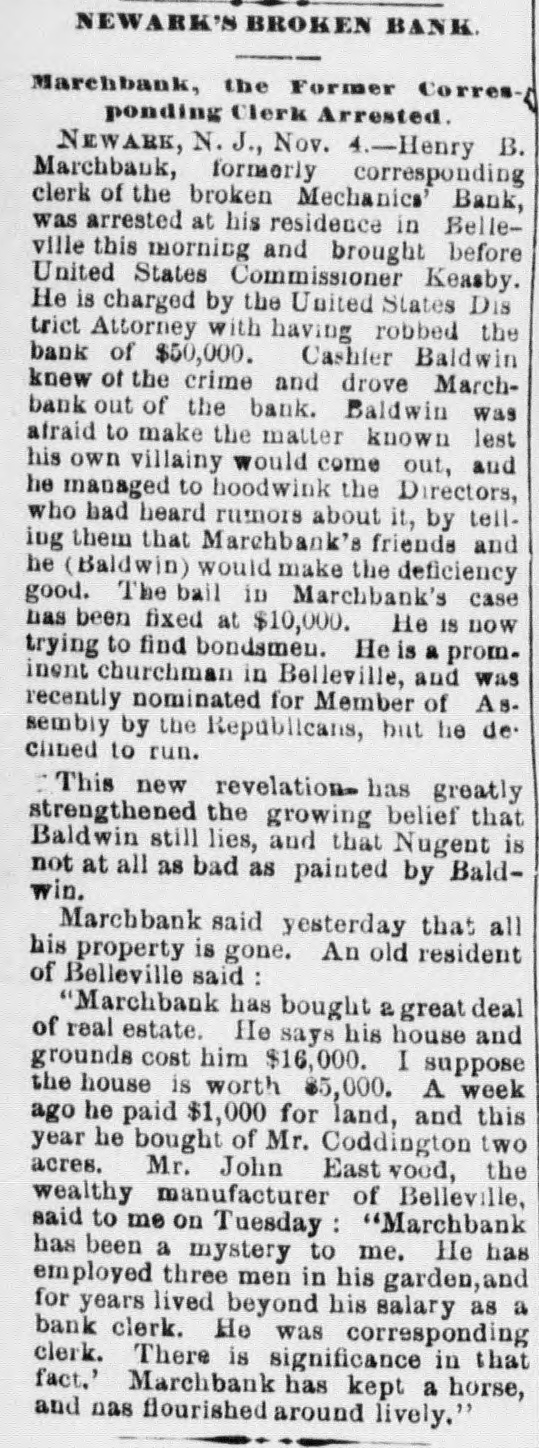
NEWARK'S BROKEN BANK Marchbank, the Former Corresponding Clerk Arrested. NEWARK, N. J., Nov. 4.-Henry B. Marchbank, formarly corresponding clerk of the broken Mechanics' Bank, was arrested at his residence in Belleville this morning and brought before United States Commissioner Keasby. He is charged by the United States Dis trict Attorney with having robbed the bank of $50,000. Cashier Baldwin knew of the crime and drove Marchbank out of the bank. Baldwin was afraid to make the matter known lest his own villainy would come out, and he managed to hoodwink the Directors, who had heard rumors about it, by telling them that Marchbank's friends and he (Baldwin) would make the deficiency good. The bail in Marchbank's case has been fixed at $10,000. He IS now trying to find bondsmen. He is a prom. inent churchman in Belleville, and was recently nominated for Member of As. sembly by the Republicans, but he de. clined to run. This new revelation. has greatly strengthened the growing belief that Baldwin still lies, and that Nugent is not at all as bad as painted by Baldwin. Marchbank said yesterday that all his property is gone. An old resident of Belleville said : "Marchbank has bought a great deal of real estate. He says his house and grounds cost him $16,000. I suppose the house is worth $5,000. A week ago he paid $1,000 for land, and this year he bought of Mr. Coddington two acres. Mr. John East vood, the wealthy manufacturer of Belleville, said to me on Tuesday : "Marchbank has been a mystery to me. He has employed three men in his garden, and for years lived beyond his salary as a bank clerk. He was corresponding clerk. There is significance in that fact,' Marchbank has kept a horse, and nas flourished around lively."


Article from New-York Tribune, November 7, 1881

Click image to open full size in new tab

Article Text

THE NEWARK BANK TROUBLES

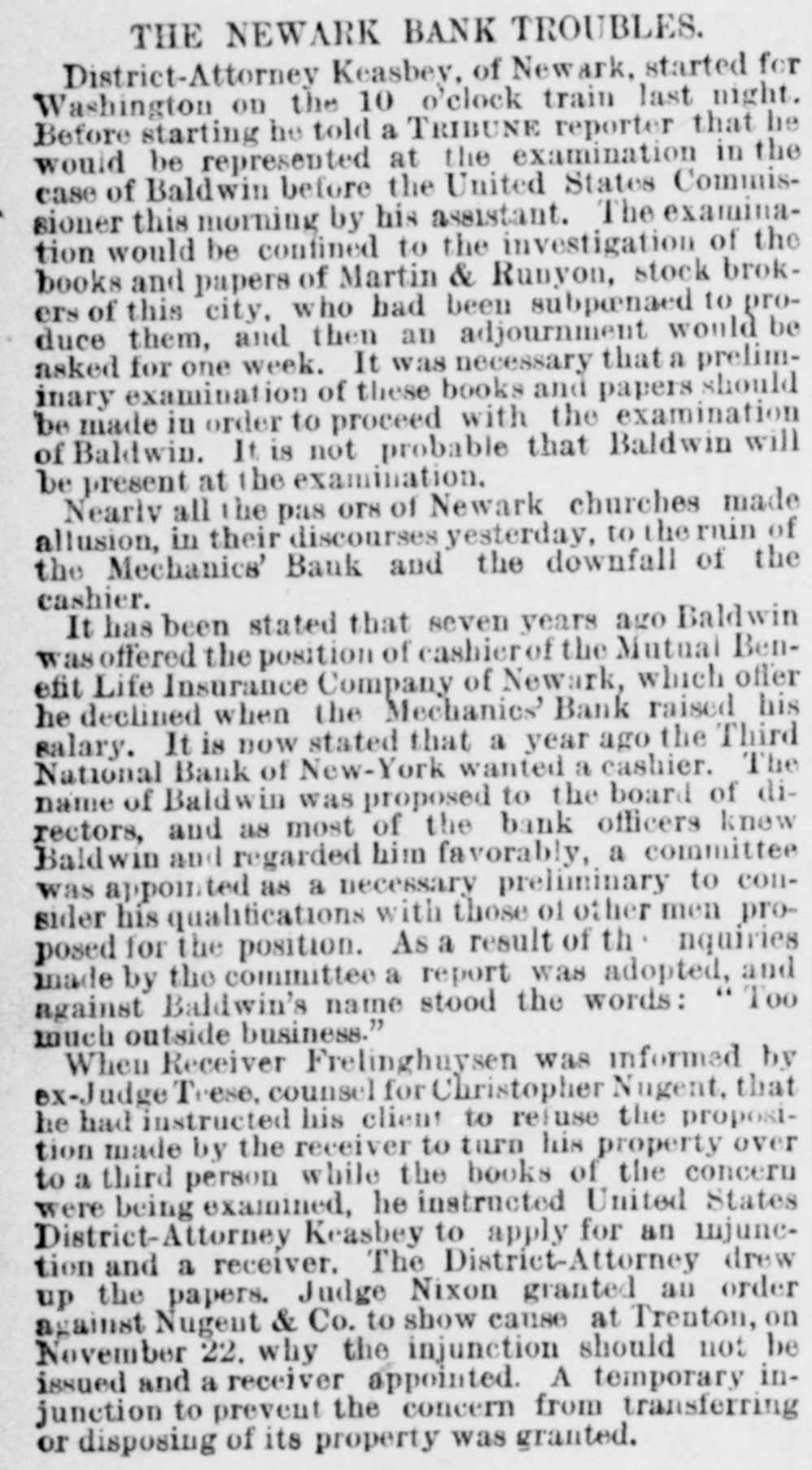
District-Attorney Keasbey, of Newark, started for Washington on the 10 o'clock train last night. Before starting he told a TRIBUNE reporter that he would be represented at the examination in the case of Baldwin before the United States Commissioner this morning by his assistant. The examination would be confined to the investigation of the books and papers of Martin & Runyon, stock brokers of this city, who had been subprenaed to produce them, and then an adjournment would be asked for one week. It was necessary that a preliminary examination of these books and papers should be made in order to proceed with the examination of Baldwin. It is not probable that Baldwin will be present at the examination. Nearly all the pas or8 of Newark churches made allusion, in their discourses yesterday, to the rnin of the Mechanics' Bank and the downfall of the cashier. It has been stated that seven years ago Baldwin was offered the position of cashier of the Mutual Benefit Life Insurance Company of Newark, which offer he declined when the Mechanics' Bank raised his salary. It is now stated that a year ago the Third National Bank of New-York wanted a cashier. The name of Baldwin was proposed to the board of directors, and as most of the bank officers knew Bald win and regarded him favorably, a committee was appointed as a necessary preliminary to consider his qualitications with those 01 other men proposed for the position. As a result of th inquiries made by the committee a report was adopted, and against Baldwin's name stood the words: Too much outside business." When Receiver Frelinghuysen was informed by ex-Judge Teese, counsel for Christopher Nugent, that he had instructed his client to refuse the proposition made by the receiver to turn his property over to a third person while the books of the concern were being examined, he instructed United States District-Attorney Keasbey to apply for an injunetion and a receiver. The District-Attorney drew up the papers. Judge Nixon granted au order against Nugent & Co. to show cause at Trenton, on November 22. why the injunction should not be issued and a receiver appointed. A temporary injunction to prevent the concern from transferring or disposing of its property was granted.


Article from The Wheeling Daily Intelligencer, November 8, 1881

Click image to open full size in new tab

Article Text

Busted by the Mechanics' Bank

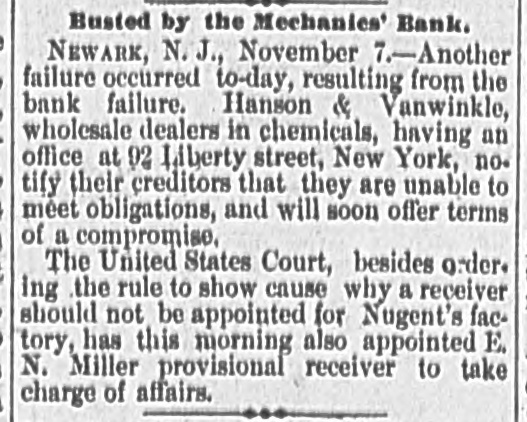
NEWARK, N. J., November 7.-Another failure occurred to-day, resulting from the bank failure. Hanson & Vanwinkle, wholesale dealers in chemicals, having an office at 92 Liberty street, New York, no. tify their creditors that they are unable to meet obligations, and will soon offer terms of a compromise, The United States Court, besides order. ing the rule to show cause why a receiver should not be appointed for Nugent's factory, has this morning also appointed E. N. Miller provisional receiver to take charge of affairs.


Article from The Daily Dispatch, November 18, 1881

Click image to open full size in new tab

Article Text

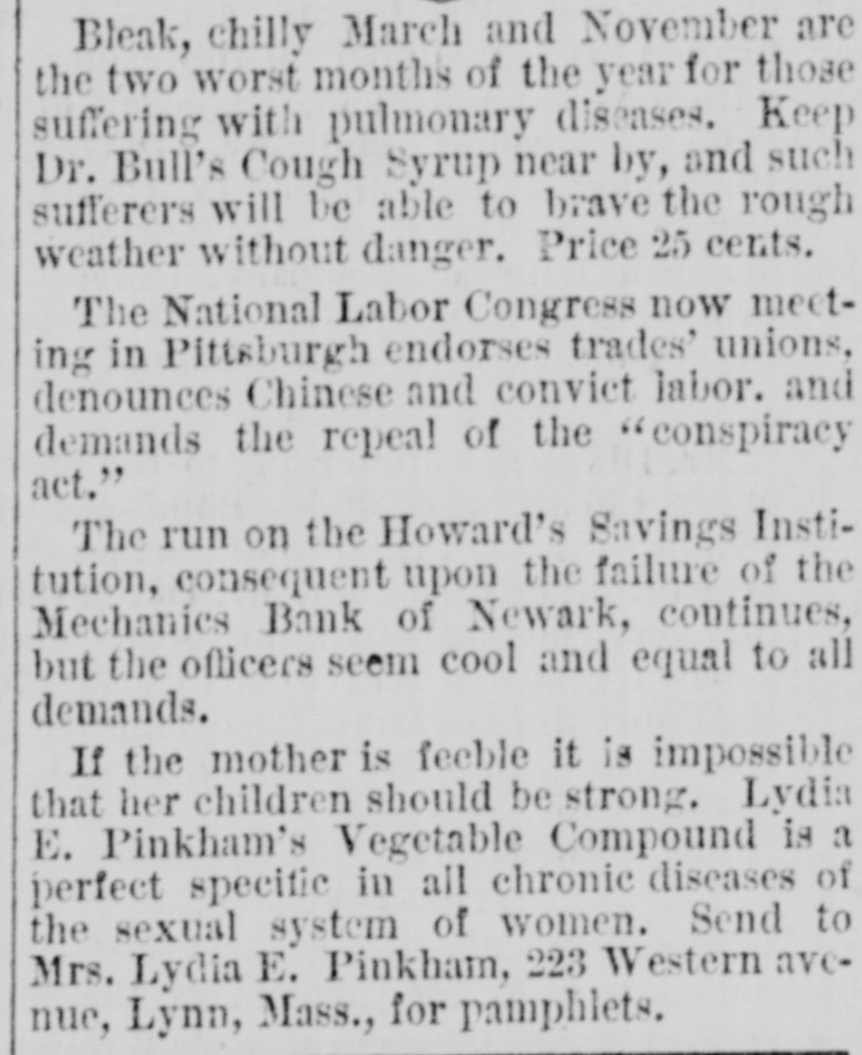
Bleak, chilly March and November are the two worst months of the year for those suffering with pulmonary diseases. Keep Dr. Bull's Cough Syrup near by, and such sufferers will be able to brave the rough weather without danger. Price 25 cents. The National Labor Congress now meeting in Pittsburgh endorses trades' unions, denounces Chinese and convict labor. and demands the repeal of the "conspiracy act." The run on the Howard's Savings Institution, consequent upon the failure of the Mechanics Bank of Newark, continues, but the officers seem cool and equal to all demands. If the mother is feeble it is impossible that her children should be strong. Lydia E. Pinkham's Vegetable Compound is a perfect specific in all chronic diseases of the sexual system of women. Send to Mrs. Lydia E. Pinkham, 223 Western avenue, Lynn, Mass., for pamphlets.


Article from Arizona Weekly Citizen, November 20, 1881

Click image to open full size in new tab

Article Text

the removal because their not being Grant Renubi that such not trol His him. Grant duty the whole party A Heavy WASHINGTON, Comp. troller Knox of 100 of the Mechanics National Bank of The Body Victim Roct 17. body of the third vietim of the disaster to-day. that Henry of ing What ter General will report commend service and San York Francisco be larged shorten time the Pennsylvania Central already done. More Star Route Frauds CHICAGO 18. The Times Bannock City Montana, that the Gov paying S1 4,643 for the star routesir M ontana, on no service is performed. Tu:f Callenge 18 Charles H. New YORK, Ray match Phil. Thomp against son for $10,000. winner stakes gate money Guiteau's Trial W WASHINGTON, November 18 Long be the fore the hour nal court, ladies gentlemen ridors and admis At 9 o'clock drove Guiteau, clutching large brndi of pers his in hurriedly into the building There marked a tions the team violence the four-fifths ladies. Seoville take some prisoner prevent prisoner the and thing public the ed and represent turning their there such forty-three Know. NEW Chaffee knows plans He has Secretary Report. W Secre 18 tary the savs Gover has ment tial creasing W private ASHINGTON dispatch states Bank has closed Central Bank National Boston but continued Bank NEWARK, Depo itors in the Mechanics Bank, it under stood, have unter the directors and F Butler and Roger NEW The B ton bank the Pacific of eight paid small then through The trouble. by the which it was member. COLUMBUS terday caught voting ings. ment heating all from the perint the fire could have originated, and firmly ting the strange men bilfered the rooms, taking could lay loss amount W ley Brown Mrs. Garfield, Arthur, has papers of Garfield Making Penal Colony 19. The United State named Dunko and will atten tion of the LITTLE Rock, uber 19. Boge Jackso Hamburg Ashley murthe der of Ben Jordan noted desperado, two three or to the for one which he was executed. Dr. Hamilton Testify NEW YORK, November 19. Dr. Hamilton, Garfield surgeon. has been summoned as witness in the Guiteau trial. Official Count HARRISBURG 19. Official vote for State Baile 265,295; Noble 258,431 49,994 14,976; Wilson, 4,507 Plurality for Bailey, 6,864 The Memorial Hospital Fund. W ASHINGTON, N. vember 19 The Garfield Memorial Hospital Fund now lighty


Article from New-York Tribune, November 23, 1881

Click image to open full size in new tab

Article Text

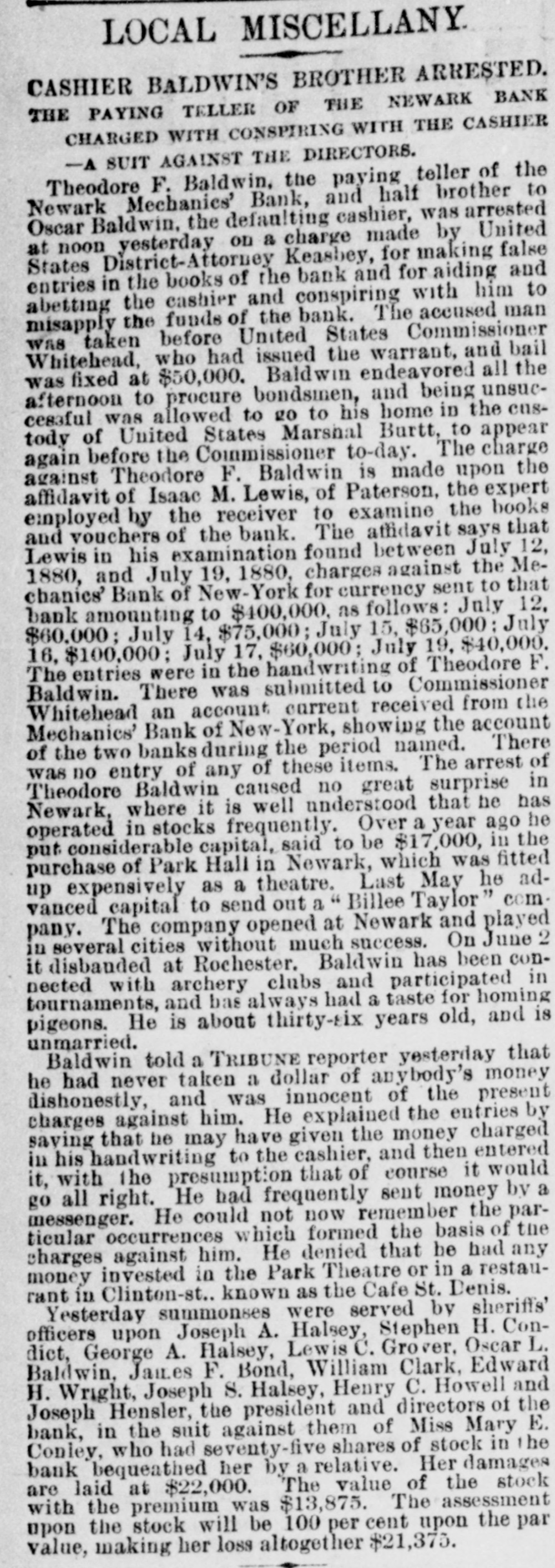
LOCAL MISCELLANY.
CASHIER BALDWIN'S BROTHER ARRESTED.

THE PAYING TELLER OF THE NEWARK BANK CHARGED WITH CONSPIRING WITH THE CASHIER -A SUIT AGAINST THE DIRECTORS.

Theodore F. Baldwin, the paying teller of the Newark Mechanics' Bank, and half brother to Oscar Baldwin, the defaulting cashier, was arrested at noon yesterday on a charge made by United States District-Attorney Keasbey, for making false entries in the books of the bank and for aiding and abetting the cashier and conspiring with him to misapply the funds of the bank. The accused man was taken before United States Commissioner Whitehead, who had issued the warrant, and bail was fixed at $50,000. Baldwin endeavored all the afternoon to procure bondsmen, and being unsuccessful was allowed to go to his home in the custody of United States Marshal Burtt, to appear again before the Commissioner to-day. The charge against Theodore F. Baldwin is made upon the affidavit of Isaac M. Lewis, of Paterson, the expert employed by the receiver to examine the books and vouchers of the bank. The affidavit says that Lewis in his examination found between July 12, 1880, and July 19, 1880, charges against the Mechanics' Bank of New-York for currency sent to that bank amounting to $400,000, as follows: July 12, $60,000; July 14, $75,000; July 15, $65,000; July 16, $100,000; July 17, $60,000; July 19, $40,000. The entries were in the handwriting of Theodore F. Baldwin. There was submitted to Commissioner Whitehead an account current received from the Mechanics' Bank of New-York, showing the account of the two banks during the period named. There was no entry of any of these items. The arrest of Theodore Baldwin caused no great surprise in Newark, where it is well understood that he has operated in stocks frequently. Over a year ago he put considerable capital, said to be $17,000, in the purchase of Park Hall in Newark, which was fitted up expensively as a theatre. Last May he advanced capital to send out a "Billee Taylor" company. The company opened at Newark and played in several cities without much success. On June 2 it disbanded at Rochester. Baldwin has been connected with archery clubs and participated in tournaments, and has always had a taste for homing pigeons. He is about thirty-six years old, and is unmarried.

Baldwin told a TRIBUNE reporter yesterday that he had never taken a dollar of anybody's money dishonestly, and was innocent of the present charges against him. He explained the entries by saving that he may have given the money charged in his handwriting to the cashier, and then entered it, with the presumption that of course it would go all right. He had frequently sent money by a messenger. He could not now remember the particular occurrences which formed the basis of the charges against him. He denied that he had any money invested in the Park Theatre or in a restaurant in Clinton-st., known as the Cafe St. Denis.

Yesterday summonses were served by sheriffs' officers upon Joseph A. Halsey, Stephen H. Condict, George A. Halsey, Lewis C. Grover, Oscar L. Baldwin, James F. Bond, William Clark, Edward H. Wright, Joseph S. Halsey, Henry C. Howell and Joseph Hensler, the president and directors of the bank, in the suit against them of Miss Mary E. Conley, who had seventy-five shares of stock in the bank bequeathed her by a relative. Her damages are laid at $22,000. The value of the stock with the premium was $13,875. The assessment upon the stock will be 100 per cent upon the par value, making her loss altogether $21,375.
Article from Daily Kennebec Journal, November 28, 1881

Click image to open full size in new tab

Article Text

CONDENSED DISPATCHES

James Doran was found frozen to death at South Groverland, Mass., Saturday, A. M. He was 40 years of age, a wool sorter in Wales factory. It is stated he was stupefied with liquor. Saturday afternoon David R. Belton of Watertown, N, Y., attempted to escape from the penitentiary and was shot. A receiver has been appointed of the factory and property of C. Nugent & Co., of Newark, N. J. The works will continue operations. The directors of the Mechanics' Bank of Newark, N. J., hope to revive the bank. A receiver will probably be appointed for the Pacific National Bank of Boston. Secretary Folger has not vet decided what action he will take relative to the outstanding bonds. The Secretary is still engaged in considering the bond question, consequently he cannot indicate when he will issue circulars bearing on the subject. At all events he will do so today. Postmaster Pearson is notified from San Francisco that mails from Shanghai, Oct. 26, Hong Kong, Oct. 29, and Yokahama, Nov. 9, are due in New York for early morning delivery, Dec. 2. At St. Albans, Vt., Saturday, Chancellor Rice, in the case of Langdon vs. Vermont & Canada Railroad and others entered a pro forma decree of foreclosure against the Vermont Central Railroad Co. first and second mortgage bondholders, and Vermont & Canada Railroad Co. in favor of the trust bondholders. Fire, Saturday morning, at Farmington, N. H., damaged the frame building occupied as a store and hall for lodges. Loss $3,000; insured. Mrs. Small's millinery stock was damaced by smoke and water; insured for $1,200. which, it is thought, will cover the loss. The lodge property was damaged considerably, although the books were saved; insured. John Pedrick who was run over by a freight train on the Eastern railroad a week ago died at Salem Hospital Sunday morning. The Central National Bank of Boston have received an official order from Comptroller Knox to increase its capital stock by addition of half a million. The commission as Rear Admiral to Com modore Beaumont, commandant at the Portsmouth Navy Yard, has been received by him and the flag of Rear Admiral is hoisted at the yard. The tops of the cars which arrived in Washington, D. C., from the West Saturday morning, were covered with snow from the Alleghanies. Ice has already formed in Washington, and a despatch from Norfolk, Va., says that there was ice an inch thick there on Friday, which is somewhat unusual for this portion of the year. Some 50 members of the House of Representatives have reached Washington since Thanksgiving. The contest for the Clerkship has not fairly opened. Mr. Rainey (the colored ex-Congressman from South Carolina) think the republicans should give it to him, as he was their last caucus nominee. The codfish receips at Gloucester. Mass., last week were 61,000 pounds of Georges, 20,060 pounds Bay of Fundy, 20,000 pounds off-shore. The receipts of fresh halibut were 60.600 pounds. The shore fleet landed some 100,000 pounds of hake, 20,000 pounds of cusk. The other fish receipts were 67 barrels of mackerel (the last catch of the season). 53 barrels of spurling. 800 quintals of cured shore fish, about half haddock and the rest hake and small codfish. The market is moderately active for the season and prices unchanged.


Article from New-York Tribune, December 2, 1881

Click image to open full size in new tab

Article Text

MORE OF BALDWIN'S RASCALITIES

The investigation of the affairs of the Mechanics' Bank of Newark is constantly bringing to light new facts connected with Bildwin's management. Several months ago the Essex County authorities were compelled to raise a temporary loan. A note $50,000 was made and was discounted at the Mechanics' Bank at 4 per cent. When the bank became ruined the county authorities supposed that the note was still in possession of the bank, and expected to use their deposits in the bank as a set off against it. It has now been ascertained that Baldwin, being in need of money, took the note to New-York some time previous to the bank failure, and had it rediscounted at the Mechanic's Bank of New-York at the rate of 5 per cent. Another transaction is even worse. At the October meeting of the Board of Freeholders of Essex County it was announced that $15,000 in United States bonds, held by the county, must be sold to meet the payment of the Free Bridge bonds due on November 1 at the Mechanics' Bank. The director was authorized to sell the bonds and deposit the proceeds in the bank to the account of the Free Bridge bonds. The director of the Board gave Cashier Baldwin power of attorney to self the bonds, and they were sold for $17,400. Some time after the sale Bald win gave the county credit for the amount on its pass-book, and it has since been supposed tha the same formed part of the coun y's claim against the bank. It is now learned that, while crediting the amount in the county's pass-book, Baldwin did not give credit for it on the books of the bank. and that instead he had credited it to the account of Christopher N agent & Co. Receiver Frelinghuysen has decli ed o transfer the credit. The counsel of the county, John W. Taylor, having examined the matter stated that he would prepare the necessary atti davits to prove that the money belonged o the county, and an arragement will be made by the receivers of the bank and Nugent & Co. by which the county will receive he amount wrongly credited. The county has $88 890 on deposit, xclusive of the $17,400 received from the sale of the bonds, The examina ion of Ryerson and Boule, stock brokers of this city, in the matter of the stock transactions of the Baldwins, which was postponed on Wednesday. was again postponed yesterday IIItil next week by Commissioner Whitehead, of Newark. District-Attorney Keas ey, when quest oned by a reporter, said the prosecution was endeavoring to get at the truth about the Baldwins' stock speculations in New-York. The City of Newark holds two shares of Mechanics' Bank stock, bequeathed to the city by a W man late ly deceased, to 00 held in trust for educational purposes. Receiver Frelinghuysen has notified to the city to pay 100 per cent assessment upon these two shares of stock. The Finance Committee has referred the matter to the City Council.


Article from The Dallas Daily Herald, December 4, 1881

Click image to open full size in new tab

Article Text

Affairs of the Newark Bank

NEWARK, N. J., December 3.-Counsel for the directors of the Mechanics' bank announces that the directory yesterday agreed upon an agreement of re-establishment of the bank, and to raise funds with a view to an honorable adjustment of all claims of stockholders, depositors and other creditors. Partieulars will shortly be made known. The receiver of the bank says that if the arrangement would into efgo fect it would cost the directors more than one million dollars, and would result in saving the bank. From several sources it is learned that the stockholders will probably lose the value of stock, and that depositors will receive a small per cent. except those amounts that are under twenty dollars.


Article from Knoxville Daily Chronicle, December 4, 1881

Click image to open full size in new tab

Article Text

NEW JERSEY

NEWARK, N. J., December 3.Chancellor Rumzon has refused to grant a writ of error in the case of Kenkowski, the Hudson county murderer. The counsel for the directors of the Mechanics' Bank announces that the directors yesterday agreed upon a scheme for the re-establishment of the bank and to raise funds with a view to an honorable adjustment. of the claims of stockholders, depositors and other creditors. The part culars will shortly be made known. The receiver of the bank says that if the arrangements would go into effect it would cost the directors more than one million dollars, and would result in reviving the bank. From several sources it is learned that the stockholders will probably lose the value of the stock, and that the depositors will lose a small per centage, except those to whom amounts under $200 are due.


Article from The Daily Dispatch, December 4, 1881

Click image to open full size in new tab

Article Text

Writ of Error Refused The Mechanics Bank of Newark. NEWARK, N. J., December 3.-Chancellor Runyon this morning refused to grant a writ of error in the case of Kinkowski, the Henderson-county murderer. The counsel for the Mechanics Bank announces that the directors vesterday agreed upon a scheme for the reΓ©stablishment of the bank and to raise a fund with the view to an honorable adjustment of the claims of stockholders, depositors, and other creditors. The particulars will shortly be made known.


Article from New-York Tribune, December 4, 1881

Click image to open full size in new tab

Article Text

- OF are depositors and other reditors. John W. Tavlor, counsel for the diectors, was authorized to take the necessary steps , bring about the revival of the bank and the setlettent of its debts. Yesterday the directors were eticent in regard to the matter and referred all inuirers to their counsel. I: was learned that George . Halsey, a director. had gone to Washington, and t was presumed that his mission was to see Conroller Knox, although a director stated that there as no need for such a visit just now. he propos tion of the directors contemplates the avinent in full of all the small deposits-sav $200 nd less amounts-and payment of 75 per cent to 11 other depositors. The calculation has been that etween 50 and 60 per cent would be recovered to he depositors by the receiver's proceedings, and the proposition 18 in lieu of this. The condition is that he depositors and other creditors discontinue all egal proceedings, that all must agree to the proposion. and that it shall receive the approval of the on roller. The stockholders will be relieved simly of the assessment upon their stock, but will lose 8 value. A paper was drawn up by the counsel of he directors embodying the terms of the been to the directon, and this has agreed by all proposirs, five of whom have already signed it. By this greement, also, the direct pledge themselves to abscribe certain stipulated amounts (said to be 750,000 In all) to meet the required payments. Of this sum, Stephen H. Con1ct and Joseph A. Halsey have put their names own or $250 000 each. The next highest for Circulars be to igned is $70,000. will issued amount tockholders and depositors, giving them sixty days' time to make their responses. If the proposition is ccup e.l. it will be then submitted to the Conroller. The idea entertained in reviving the ank is to extinguish the present stock and open subscriptions for new stock. As the matter stands I present, the depositors are assured of getting 50 or cent if the Nugent property can be secured by he receiver: and they are not estopped from civil uits to recover the remainder of their deposits. DIVIDED ON THE QUESTION OF PAYMENT. The township of Kearny, N. J., is hopelessly ivided over the question of paying about $150,000 I bo ids which were issued by the township in 1868 , aid in the construction of the Montelair Railway. 'he village of Arlingt 11 was laid our at that time y a company of speculators, and it was through ein influence that the township, in which the vilwe lies, was persuaded to issue the bonds, The otal issue was $100,000, and the bonds were payble in yearly instalments of $5,000, the last instalent to fail due in 1890 The principal and iterest now amount to $140,000. but as the olders were obliged to sue for their payment he expenses of litigation amount to about $10.000 lore. The suit developed the fact that the bonds ere issued without due authority, but it was held hat as they had passed into the hands of ipnocent ersons they must be paid. The residents of the ower part of the township and their representative 1 the council oppose the payment for the reason hat the railroad has been of no benefit to them. 11 the other hand. the residents of the upper part re willing, but not able to pay, and they favor a compromise; but their opponents will consent to othing short of repudiation. The holders of the ouds, the Bond Street Savings Bank and McCnibugh, Wats 11 & Co., of New-York, threaten to pply 10 he courts for a mandamus to compe the ouncil to levy a special tax on the township to ay the judgments. They offered to accept new onds at 6 per cent interest, but the council reseted the offer. When the resignation of Lewis C. Grover as presdent of the Mutual Benefit Life Insuran ce Comany of Newark, was aunounced, some time after is failure of the Mechanics' Bank, of which he was , director, a good deal of surprise was occasioned. t was stated at the time that Mr. Grover N resigna1011 was entirely voluntary, and had been caused y ill health. It is now stated upon good authority hat Mr. Grover's resignation was not entirely volintary. The day following the suspension of the Mechanics" Bank a reporter of THE TRIBUNE had an interview with Mr. Grover, who expressed very reely his opinion of Baldwin. The latter read Mr. Grover's expressions in TRIBUNE, and, becomng incensed, it is stated. sent a threatening quest o Mr. Grover to resign the presidency of the Muual Benefit. The request, it is averred, was backed p by Baldwin's knowledge of loans to the Mebanies' Bank of which Mr. Grover knew.


Article from Savannah Morning News, December 5, 1881

Click image to open full size in new tab

Article Text

A SCHEME TO REFUND

Proposed Restoration of Newark's Broken Bank. NEWARK, N. J., December 3.-Counsel for the Mechanics' Bank announce that the directors yesterday agreed upon a scheme for the reestablishment of the bank to raise a fund with the view to an honorable adjustment of the claims of the stockholders, depositors and other creditors. The particu'ars will shortly be made known. The receiver of the bank said that if the arrangement would go into effect it would cost the directors more than one million dollars, and would result in reviving the bank. From several sources it is learned that the stockholders will probably lose the value of their stock, and that the depositors will lose a small percentage, except those to whom amounts under $200 are due.


Article from The Rock Island Argus, December 5, 1881

Click image to open full size in new tab

Article Text

BUSTED BANKNEWARK, N. J., Dec. 3. The directors of the Mechanics' bank have agreed to contribute $1,000,000 toward paying the creditors and reviving the bank. The directors will publicly announce their willingness to pay the creditors a percentage on their dues larger than any that could be hoped from a receiver. If the creditors accept the amount offered, the sums will be paid in immediately and a full receipt ta ken. The bank will then resume under the old name.


Article from Chicago Daily Tribune, December 6, 1881

Click image to open full size in new tab

Article Text

The Mechanics' Bank of Newark

PHILADRLPHIA, Dec. 5.-On motion of counsel for the Receiver of the suspended Mechanics' Bank of Newark, the Court of Common Please today dissolved the attachment issued by the Farmera' & Mechanics' Bunk of this city against the monoy and securities deposited in the Phil. adelphia National Bank belloved to belong to the Newark bank. The attachment was dissolved on the principle of law that the funds of the Institutionlin the bands of the Receiver are not liable to attachment, and that although the Receiver's appointment may not have been made at the time of the susponsion of the Institution, It dates back to the time of the suspenaion.


Article from The Pickens Sentinel, January 19, 1882

Click image to open full size in new tab

Article Text

OSCAR L

BALDWIN, late cashier of the wrecked Mechanics' Bank, of Newark, N. J., has filed his answer to the application of the Receiver for a permanent injunction restraining him from disposing of his property on the ground that he had- applied the bank funds to his own use, in which he denies that any part of the banks money was ever improperly diverted to his own use, and explains in detail how the several funds with which he is charged with transferring to his own use came into his possession. He tells, in a long narrative, the true story of his life, how he began- work in the bank as messenger, rose to be cashier, and finally, in 1872, was induced by the representations of Christopher Nugent, of Nugent & Co., morocco manufacturers, to extend his line of credit to the amount of $147,000. He says he concealed this fact from the Directors, and that Nugent, on learning this, used it to force him to continue the loans until the time of the failure, when they amounted to $2,400,000.


Article from New-York Tribune, March 5, 1882

Click image to open full size in new tab

Article Text

TWELVE PAGES.

THE NEWS THIS MORNING.

FOREIGN. - The London cable dispatch to THE TRIBUNE says that Bradlaugh's reelection is likely to impose fresh trouble upon the Government. Counsel was employed yesterday to defend MacLean, who shot at the Queen. Two balloonists were picked up in the British Channel by the Calais mail steamer. English correspondents have been ordered to leave Austria.

CONGRESS. - The Senate was not in session. The House agreed to the report of the Conference Committee on the Immediate Deficiency Appropriation bill; the contested election case from the Ild District of Louisiana was dismissed; there was an extended debate on the Consular and Diplomatic Appropriation bill.

DOMESTIC. - The Grand Jury at Washington presented indictments against twelve persons for conspiracy in connection with the Star Route mail service. Much distress is caused by the spring freshets. Justice Miller, of the United States Supreme Court, has rendered an opinion on the rights of express companies. An anti-Chinese meeting was held in San Francisco yesterday. Alice Wright, an actress, committed suicide.

CITY AND SUBURBAN. - The walking match closed last night, Hazael having completed 600 miles; Fitzgerald was second with a score of 577 miles. Francis S. Lathrop died at his home in Madison, N. J., yesterday. The Senate Committee on Insurance held its first meeting. George Hendrix was discharged, but was rearrested on civil proceedings brought by Mr. Field. Charles F. Jube, the son of a wealthy merchant, committed suicide. The receiver of the Mechanics' Bank in Newark will sue S. H. Condict for $700,000. The Railway Advisory Commission will meet to-morrow. Gold value of the legal-tender silver dollar (412Β½ grains), 87.44 cents. Stocks were generally dull, but active in spots and lower, and closed weak and unsettled.

THE WEATHER. - TRIBUNE local observations indicate clear and fair weather, with higher temperatures, followed by increasing cloudiness and chances of light rain late in the day. Thermometer yesterday: Highest, 52Β°; lowest, 32Β°; average, 41ΒΎΒ°.


Article from New-York Tribune, March 10, 1882

Click image to open full size in new tab

Article Text

LOCAL MISCELLANY

STEPHEN H. CONDICT REARRESTED. Stephen H. Condict, a director of the Mechanics' week Bank of Newark, who was arrested a National on a charge of aiding and abetting Cashier Baldwin ago in his embezzlements and held in $50,000 civil was rearrested yesterday morning on a bail suit bail, brought by Receiver Frelinghuysen, and fixed at $250,000. The suit is for the recovery bank of was $700,000 alleged to have been lost by the after Condict became aware of its condition. For a week since Condict was held to bail on the criminal charge, his house in Park-place, Newark, It has been watched day and night by a detective. was apprehended that Condict would seek to leave the city and forfeit the bail given. It was deemed prudent to secure him by a larger amount of bail in of the civil proceedings be un last Satur- laws day view by the receiver. Under the of the United States, it was not possible to secure a writ of ne-exeat except on positive proof that he was about to depart suddenly from the country. It was, therefore, determined to discontinue the receiver's suit in equity, and to begin a suit at common law for damages, which would allow the judge to hold the defendent to bail in such sum as he might deem advisable. On Wednesday District-Attorney A. Q. Keasbey and John R. Emery, counsel for the receiver. procured the necessary affidavits and submitted them to Judge Nixon, who granted an order holding Condict to bail in the sun of $250,000. The writ was given to United States Marshal Hutchinson, who'placed it in the hands of a deputy who made the arrest vesterday morning. The affidavits are by the receiver and Director James F. Bond. The receiver's affidavit sets forth a history of the case substantially as given in his statement contained in the bill of equity and already published in THE TRIBUNE. The receiver also asserts that Condict has disposed of part of his property with intent to escape his liability. James F. Bond deposes that Condict had for a long time been very attentive to the affairs of the bank and knew more of its business than any other director, and that he had given no information whatever that he had received any information as to anything wrong in its affairs. Mr. Bond's affidavit states that when the plan of compromise with the depositors was being matured, Condict came to his house and requested him to put down his contribution ($250,000), remarking that it was one-half of all he was worth. Mr. Bond adds that he has ample means of knowing Condict's financial condition, and believes that he was worth much over one-half a million. Condict was given until this morning to produce his bail, and in the meantime was permitted to remain in his house in the custody of a United States Marshal. His counsel are Cortlandt Parker and Leonard Joseph Bedle. In the United States Court at Trenton on Wednesday a bill was filed by Cortlandt Parker, counsel for Edward Balbach & Son, against the receiver of the Mechanics' Bank in a suit to have the plaintiffs' notes, which the bank had hypotheeated in New-York and which the plaintiffs have already paid. set off against their deposit. and to have a check, which had already gone to plaintiffs' credit when the bank tailed, returned to the firm. Yesterday a declaration was filed in the Court in the suit of the receiver against Daniel Dodd, Phineas Jones and Matthias M. Dodd, bondsmen of Cashier Baldwin, to recover the amount of their bond, $20,000.


Article from New-York Tribune, May 3, 1882

Click image to open full size in new tab

Article Text

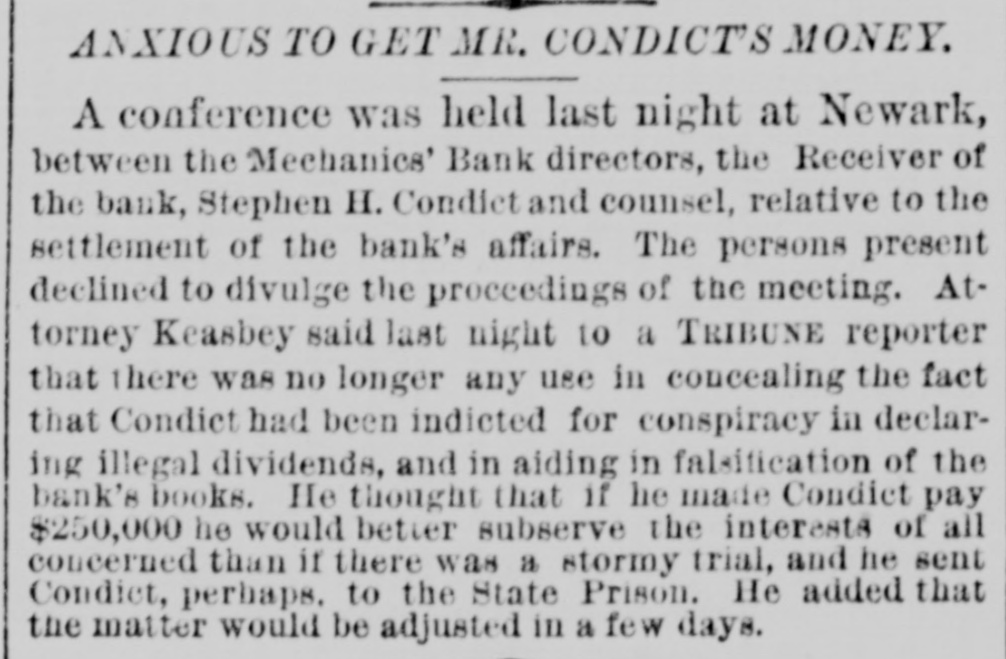
ANXIOUS TO GET MR

CONDICTS MONEY. A conference was held last night at Newark, between the Mechanics' Bank directors, the Receiver of the bank, Stephen H. Condict and counsel, relative to the settlement of the bank's affairs. The persons present declined to divulge the proceedings of the meeting. Attorney Keasbey said last night to a TRIBUNE reporter that there was no longer any use in concealing the fact that Condict had been indicted for conspiracy in declaring illegal dividends, and in aiding in falsification of the bank's books. He thought that if he made Condict pay $250,000 he would better subserve the interests of all concerned than if there was a stormy trial, and he sent Condict, perhaps. to the State Prison. He added that the matter would be adjusted in a few days.