8325. Banks of Baltimore (Baltimore, MD)

Bank Information

Episode Type
Suspension → Reopening
Bank Type
state
Start Date
May 11, 1837
Location
Baltimore, Maryland (39.290, -76.612)

Metadata

Model
gpt-5-mini
Short Digest
dab421b7

Response Measures

None

Description

Articles (May 1837) report the banks of Baltimore suspending specie payments along with New York and Philadelphia as part of the nationwide 1837 crisis. No article describes a depositor run on the Banks of Baltimore specifically; the action is a coordinated suspension tied to systemic pressures (Jackson-era policy, failures elsewhere). Historically these suspensions were temporary and full resumption was attempted years later, so classified as suspension_reopening.

Events (1)

1. May 11, 1837 Suspension
Cause
Macro News
Cause Details
Coordinated suspension following suspensions in New York and Philadelphia amid the nationwide 1837 financial crisis and specie drain tied to federal policy and commercial failures.
Newspaper Excerpt
Resolved, That in consequence of the information received this day, that Banks of New York and Philadelphia have suspended specie payments, it is expedient and necessary for the Banks in this city ... to pursue, for a limited period, the same course.
Source
newspapers

Newspaper Articles (5)

Article from Staunton Spectator, and General Advertiser, May 18, 1837

Click image to open full size in new tab

Article Text

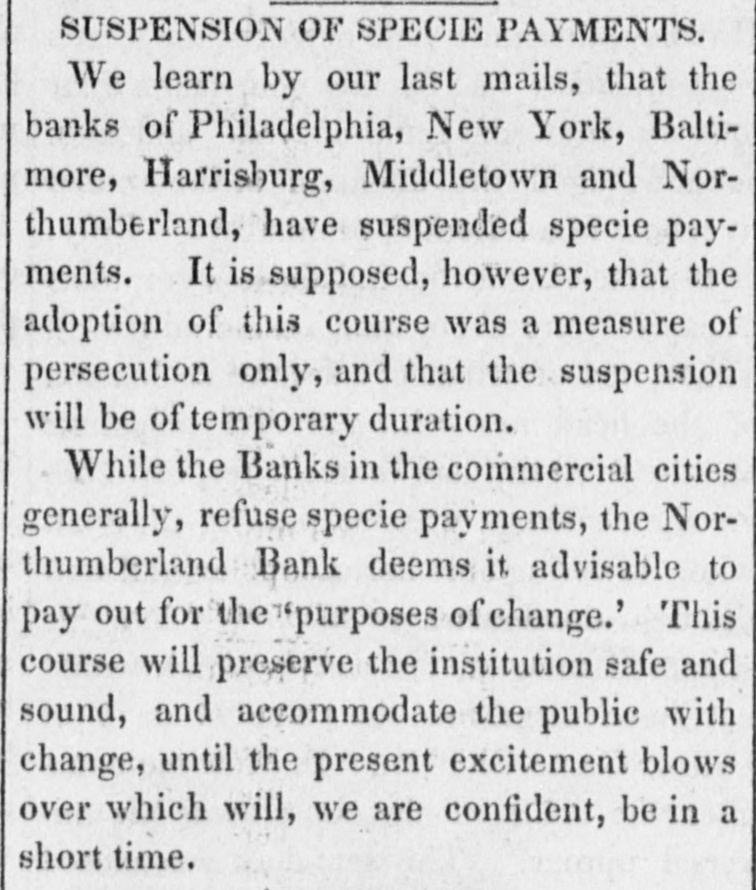
SPECTATOR. STAUNTON THURSDAY, MAY 18, 1837. THE PUBLIC CALAMITY! is -The grand "Experiment" is fairly out !-The State Banks, by means of which Gen. Jackson promised to give the country "a better currency" than was afforded by the United States' Bank, are at length yielding to the general pressure and embarrassment, produced by his most lawless and outrageous acts! The Banks of New-York, Philadelphia, Baltimore, and Richmond, have suspended specie payments !-and there is no question that the same measure will be adopted, if not from necessity, at least in self-delence, by the banks generally throughout the Union. None of them could withstand a general run upon them for specie, cut off from the ordinary sources of supply-and if they foresee that they shall be compelled ultimately to stop, they will consider it less injurious to their credit and future solvency to do so before they are drained of their specie. This, we doubt not, has been the consideration which governed the Richmond Banks-though the necessity must have been most stern and unrelenting, since it involves a forfeiture of the charter of one of them; a consequence which would certainly not have been incurred but to avoid a greater evil. We allude to the Farmers' Bank, which we believe is the best of the two. The same provision is contained in the charters of one or two other of our banks. What, then, is to be done in this emergency To compel the Banks to wind up their business, as is required on a forfeiture of charter, would greatly aggravate the public distress. And yet nothing else remains for them should they stop specie payments. without an immediate act of the Legislature to relieve them from their disabilities. Under these circumstances, we shall not be surprized to hear that the Governor has called an extra. session of the Legislature. In our opinion, the crisis imperiously demands it. So much for the Golden humbug, and the silly and wicked "Experiment" OD the currency, the bitter fruits of which were so early foretold So much for the servile submission of the People and their Representatives to the insurpations of the Executive !-Wide spread bank ruptcy and a ruined Currency, are DOW to be superadded to the abiding curse of violated Law, and a broken Constitution!

Article from South Branch Intelligencer, May 20, 1837

Click image to open full size in new tab

Article Text

much more danger is to be feared from the disrepute and alarm of this event, than from the event itself, bad as it is. THE PHILADELPHIA BANKS. 11 o'clock A. M. of the Officers and of the several banks of the city of At a meeting THURSDAY, and county Directors WedPhiladelphia, held at the Exchange on nesday evening, May 10, 1837, THOMAS SPARKS, Esq., was called to Sec- the Chair, and JACOB FRITH was appointed retary: The proceedings of the meeting of the Merchants and Citizens, held at the in to the suspension of specie relation Exchange, committee payments, been presented and read, a of officer from each bank was ed to a preamble and folhaving ONE prepare resolutions,wl appoint- the retired, and after some time reported lowing, which was under the peculiar circumstances Whereas, adopted itself this community finds placed the of specie payments our sister of New York; and by in which city suspension between whereas, by the in the state of the balances which would cause a chief part of our specie ties, existing the certain basis, and abstraction much wherewhich could never be reclaimed; measure has been as, of citizens, to the large the meetings recommended proceedings the morn- by of which publicity will be given in ing: RESOLVED, therefore That this meeting recomsuspension of specie payments as a measure which, less disastrous to the and menda be temporary however community painful, of this city and county, to continue its payment in attempt will institutions than the avain present state of things. RESOLVED, That, in the mean time, the the of all the banks will be received at different notes banks as usual, in payment of debts and On on motion, deposite. RESOLVED, That the proceedings be published andsigned.-Inquirer. BALTIMOBE, May 11, 1837. a meeting of the officers of the several Banks of the City of and of Directors At Delegations Baltimore, appointed from for that purpose; representatives all these institutions appeared. Robert Smith was called to the chair, & Robert Mickle appointed Secretary. Mr. Speed after briefly explaining the objects of the meeting, submitted the following resolutions, which were unanimously adopted Resolved, That in consequence of the the information received this day, that Banks of New York and Philadelphia have suspended specie payments, it is expedient and necessary for the Banks & in this city, for their own protection the interests of the whole community, to pursue, for a limited period, the same course. Resolved, That while the measure is recommended from a belief in its im- is perative necessity, every assurance felt in the stability of the moneyed institutions of this city. From the Baltimore Chronicle, May 8. The notes of the Farmers' Bank of Virginia, a depository of the public funds, have been, for the last week,utterly worthless in the Baltimore market. By this we mean to say that they could not, for several days, be turned into such funds as would answer to debts due at bank, at any price pay whatsoever; and we may add that they have, for three months, been only available at a sacrifice of from two to four per cent. The notes of the deposite banks in all the Western and Southern States are now and have been at a discount in this market of from three to ten per cent. and are scarcely available, even at those rates. The notes of other Western & Southern banks are, in many instances, altogether unsaleable, and answer the usual purposes of money scarcely better of than the products of the lead mines Galena. There is at this hour, in the United States NO bank, except the Bank the of the United States, chartered by State of Pennsylvania, whose notes are at in all parts of the Union, or constitute par a "general circulating medium." There is, in fact and in truth, in the United States no currency at all which answers the purposes of business, and that it is in consequence of the want of this currency; rather than from any absolute insolvency, that merchants are failing,banks are obliged to curtail their discounts, and ruin and desolation and are usurping the places of prosperity improvement. The Hagers-town Torch Light says have just been shown a letter from a in -We gentleman Baltimore which dated Monday the 8th inst., says-- here. "Last Saturday was an awful day We had three large failures, and to-day two more.


Article from The Columbia Democrat, May 20, 1837

Click image to open full size in new tab

Article Text

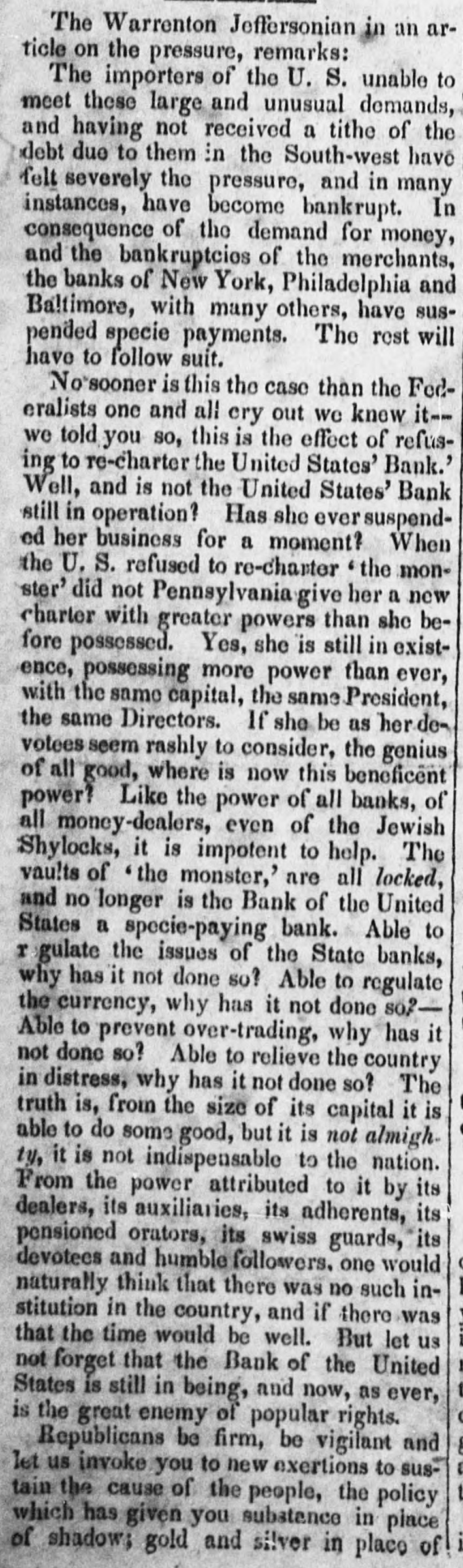
SUSPENSION OF SPECIE PAYMENTS. We learn by our last mails, that the banks of Philadelphia, New York, Baltimore, Harrisburg, Middletown and Northumberland, have suspended specie payments. It is supposed, however, that the adoption of this course was a measure of persecution only, and that the suspension will be of temporary duration. While the Banks in the commercial cities generally, refuse specie payments, the Northumberland Bank deems it advisable to pay out for the If purposes of change.' This course will preserve the institution safe and sound, and accommodate the public with change, until the present excitement blows over which will, we are confident, be in a short time.


Article from Western Courier, June 8, 1837

Click image to open full size in new tab

Article Text

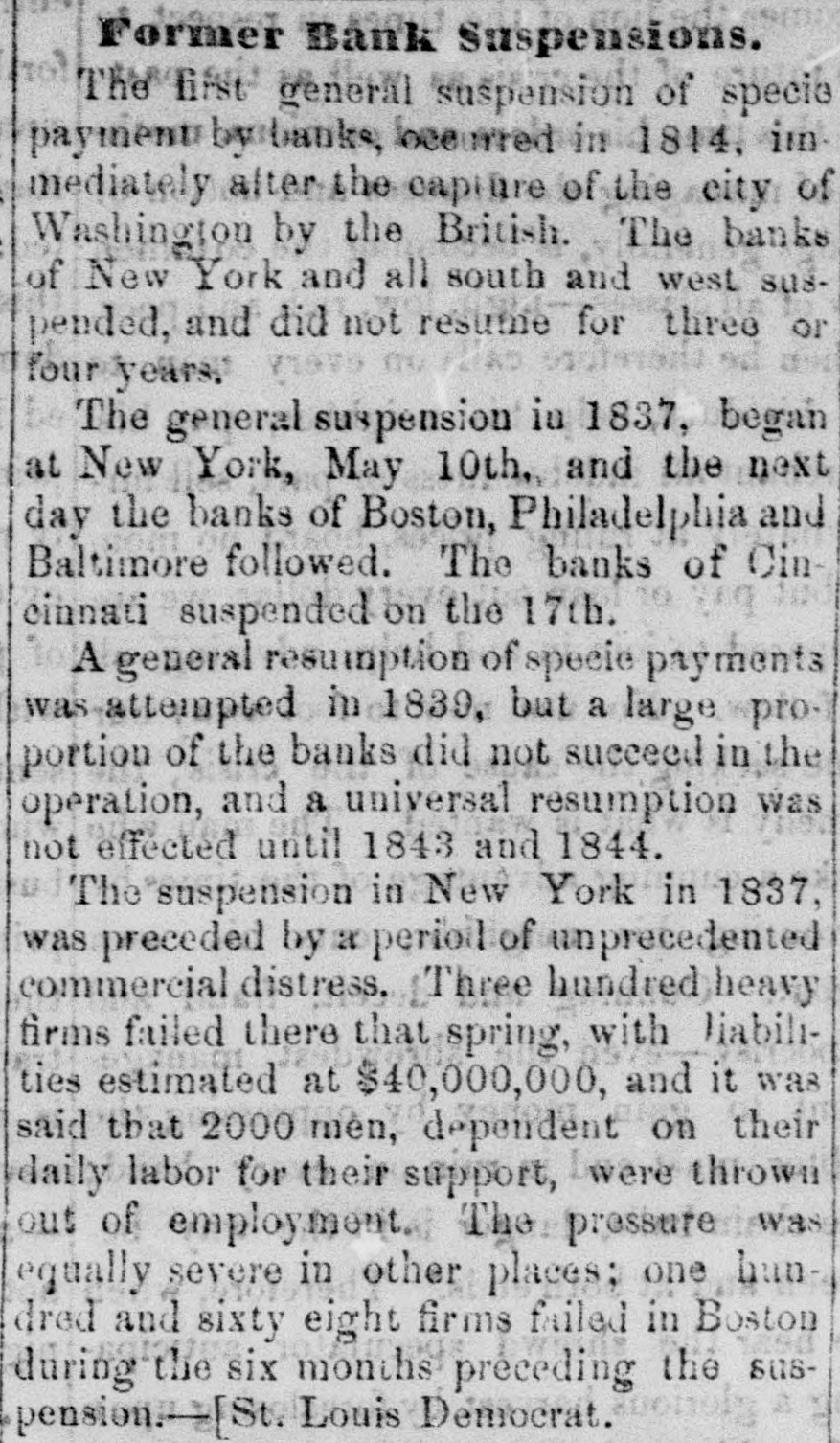
The Warrenton Jeffersonian in an article on the pressure, remarks: The importers of the U. S. unable to meet these large and unusual demands, and having not received a tithe of the debt due to them in the South-west have felt severely the pressure, and in many instances, have become bankrupt. In consequence of the demand for money, and the bankruptcios of the merchants, the banks of New York, Philadelphia and Baltimore, with many others, have suspended specie payments. The rest will have to follow suit. No sooner is this the case than the Federalists one and all cry out we knew it--we told you so, this is the effect of refusing to re-charter the United States' Bank.' Well, and is not the United States' Bank still in operation? Has she ever suspended her business for a moment? When the U. S. refused to re-charter the monster' did not Pennsylvania give her a new charter with greater powers than she before possessed. Yes, she is still in existence, possessing more power than ever, with the same capital, the same President, the same Directors. If she be as her devotees seem rashly to consider, the genius of all good, where is now this beneficent power? Like the power of all banks, of all money-dealers, even of the Jewish Shylocks, it is impotent to help. The vaults of the monster,' are all locked, and no longer is the Bank of the United States a specie-paying bank. Able to regulate the issues of the State banks, why has it not done so? Able to regulate the currency, why has it not done so? Able to prevent over-trading, why has it not done so? Able to relieve the country in distress, why has it not done so? The truth is, from the size of its capital it is able to do some good, but it is not almighty, it is not indispensable to the nation. From the power attributed to it by its dealers, its auxiliaries, its adherents, its pensioned orators, its swiss guards, its devotees and humble followers, one would naturally think that there was no such institution in the country, and if there was that the time would be well. But let us not forget that the Bank of the United States is still in being, and now, as ever, is the great enemy of popular rights. Republicans be firm, be vigilant and let us invoke you to new exertions to sustain the cause of the people, the policy which has given you substance in place of shadow; gold and silver in place of


Article from Grant County Herald, October 17, 1857

Click image to open full size in new tab

Article Text

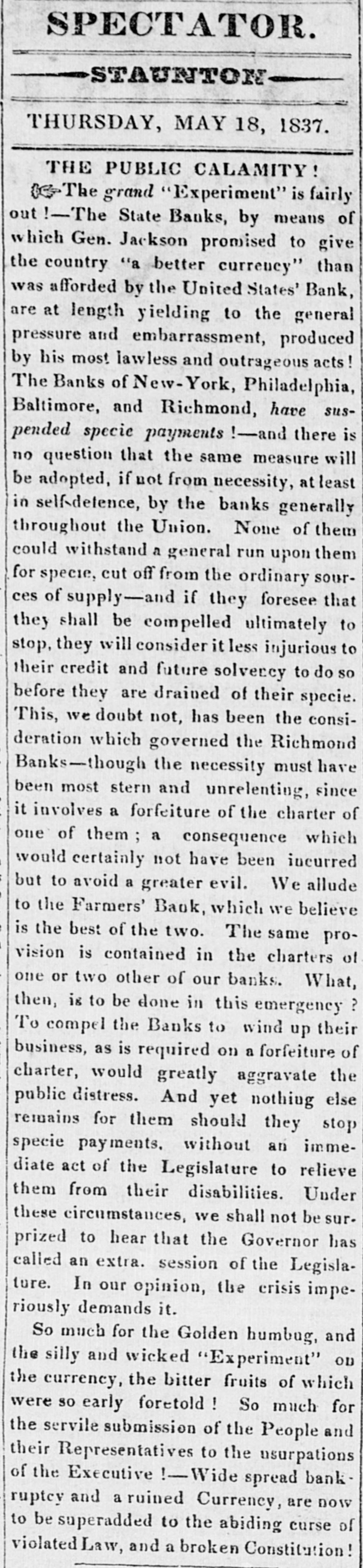
# Former Bank Suspensions. The first general suspension of specie payment by banks, occurred in 1814, immediately after the capture of the city of Washington by the British. The banks of New York and all south and west suspended, and did not resume for three or four years. The general suspension in 1837, began at New York, May 10th, and the next day the banks of Boston, Philadelphia and Baltimore followed. The banks of Cincinnati suspended on the 17th. A general resumption of specie payments was attempted in 1839, but a large proportion of the banks did not succeed in the operation, and a universal resumption was not effected until 1843 and 1844. The suspension in New York in 1837, was preceded by a period of unprecedented commercial distress. Three hundred heavy firms failed there that spring, with liabilities estimated at $40,000,000, and it was said that 2000 men, dependent on their daily labor for their support, were thrown out of employment. The pressure was equally severe in other places; one hundred and sixty eight firms failed in Boston during the six months preceding the suspension. [St. Louis Democrat.