8320. Banks in Baltimore (Baltimore, MD)

Bank Information

Episode Type
Run → Suspension → Reopening
Bank Type
state
Start Date
September 26, 1857
Location
Baltimore, Maryland (39.290, -76.612)

Metadata

Model
gpt-5-mini
Short Digest
38aac309

Response Measures

Partial suspension

Description

Newspapers report a wave of runs and the suspension of specie payments by banks in Baltimore around Sept. 26, 1857 as part of the wider Panic of 1857. Suspensions are described as prudential/temporary (partial payments for small denominations) and newspapers expect resumption; no explicit formal reopening date is given in these articles. Multiple banks are involved rather than a single named institution.

Events (3)

1. September 26, 1857 Run
Cause
Macro News
Cause Details
Widespread financial crisis/Panic of 1857 and contagion from suspensions in Philadelphia and other cities produced runs on Baltimore banks
Measures
Banks limited specie payments (paid only $5 notes and small checks in some cases); issued circulars and assurances of ability to meet obligations
Newspaper Excerpt
morning information was telegraphed to this city that all the banks in Baltimore had suspended specie payment, creating a run upon those in this city
Source
newspapers
2. September 26, 1857 Suspension
Cause
Macro News
Cause Details
Banks suspended specie payments in response to the national money pressure and runs following failures/suspensions in other cities (Philadelphia, New York), described as a prudential/necessary measure
Newspaper Excerpt
all the banks in Baltimore had suspended specie payment
Source
newspapers
3. October 1, 1857* Other
Newspaper Excerpt
The suspension is not, however, total, for the Banks, most of them, continue to pay specie for tens and fives, and to pay checks in their own and the notes of other banks. ... That it will be temporary, there can be no question, especially if the banks north and east of Pennsylvania, are not affected.
Source
newspapers

Newspaper Articles (9)

Article from Evening Star, September 26, 1857

Click image to open full size in new tab

Article Text

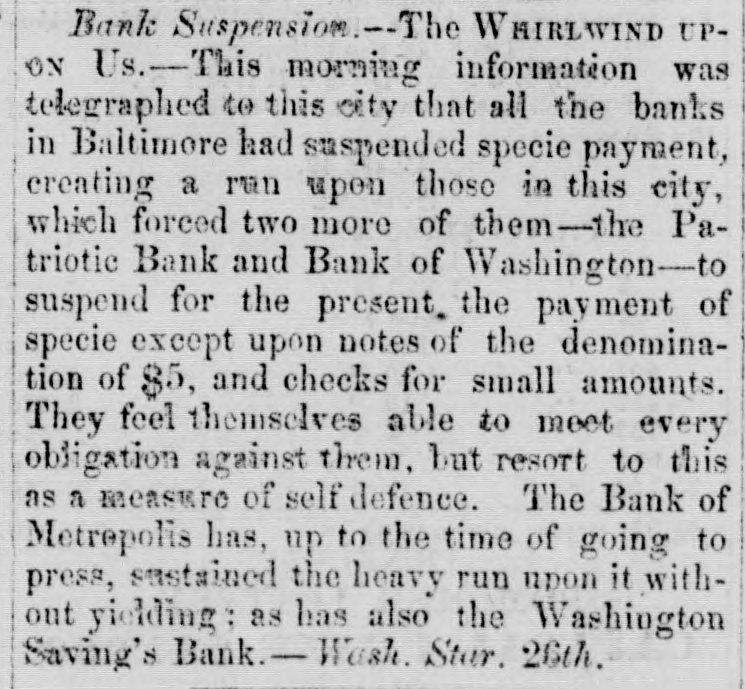
WASHINGTON NEWS AND GOSSIP. BANK SUSPENTION-THE WHIRL UPON morning information was telegraphed to this city that all the banks in Baltimore had suspended specie payment, creating a run upon those in this city, which forced two of them-the Patriotic Bank and Bank of Washington-to suspend for the present the payment of specie except upon notes of the denomination of $5, and checks for small amounts. They feel themselves able to meet every obligation against them, but resort to this as a measure of self-defence. The Bank of Metropolis has, up to the time of going to press, sustained the heavy run upon it without yielding; as has also the Washington Saving's Bank. The run upon Sweeny, Rittenhouse & Co., has also been promptly met. With regard to the Bank of Washington and the Patriotic Bank no fears are entertained of ultimate loss to any one through their suspension as they are known to be abundantly able to liquidate every demand against them. BE or GOOD CHEER.-There is truth in the following reflections on the business condition of the country, for which we are indebted to the New York Evening Post. Though speculation may cramp New York city and the far West for a year to come, the general condition of business people North, East and South is sound; more especially in the South There, people of all classes owe less and work harder than ever before. But for the business system of the country, which compels the South to pay a tribute on all things to the North, the current monetary troubles in the non-slaveholding States would be unfelt everywhere south of Mason and Dixon's line. As it is, it affects no one in the South not tied up in speculations in the Northwest. The fact that such troubles, trials, difficulties and embarrassments have taken place at the North with slight effect on the South should be sufficient to make it plain to politicians of the Evening Post school that their stereotyped stories concerning the comparative industrial condition of the South are roorbacks, and nothing else. We are, however, glad to have it in our power to lay before the Star's readers the following facts from the paper mentioned above, showing that the present pressure in the North is likely to be but ephemeral In 1837, we importing from Europe large quantities of grain to supply our necessities, in addition to our usual importations of merchandise We bad experienced a loss of over twenty millions of dollars by the most disastrous fire this country ever experienced The winter of 1833 was one of the very coldest ever known in this climate, and was followed by a backward spring a short summer and a general failure of the crops. Added to this, the country was possessed with an insane passion for speculations in wild and unproductive lands With nothing to pay with, without crops to live upon, with wealth all invested in lands of no current value, with destructive fires and inclement skies, began the revulsion which over trading and mad speculation rapidly ripened into general ruptey But how different is our present condition There has been. without question. much overtrading, much bad management and extravagance and yet the recent report of the Secretary of the Treasurys that we have exported, inclusive of specie, during the fiscal year ending 1st July last, some millions more than we have imported The crops of the country the largest ever known; almost every section of our land reports bounteous harvests, and there is every prospect of a good foreign demand, at fair prices, for all the grain and flour we can supply. Through the troubles in India, and the general increasing foreign demand, our pork and beef, which have become important articles of export, will command probably double their average value, and we shall have a greatly increased supply The prospects for a fuliy fair crop of cotton are prom. ising, and prices are nearly or quite double those of average years Throughout the length and breadth of the land there is an unusual prospect of late fall pasture, and roots for the sustenance of cattle, which is a matter of more importance than is generolly considered. California is sending us regularly more than forty millions of gold per annum, a considerable portion of which remains in circulation in the interior of our country Emigration to our shores of a more thrifty class of people steadily onward. and through the money they bring, together with their industrious habits. our estern States are reaping a rich harvest These are facts plain to every observer. and present a state of things as different from what prevailed here in 1837 as it is easy to conceive occuring in any country in 80 short a period as twenty years. We are all great deal wiser for what has occurred. Several enormous bubbles have been exploded; credit will hereafter rest on a sounder and therefore more profitable basis, and. unless something happens not lying within the range of probabilities, our next New Year's Day will be one of the happiest and most prosperous that has ever dawned upon this country." COMPENSATION OF CONSULS.-The Attorney General has given an opinion relative to the pay of consuls, in which, after reviewing the various acts of Congress regulating such pay, he decides that the compensation of consuls is to be regulated by the law which was in force when the services were rendered and not by that which prevailed at the date of the commission. A doubt has arisen about the construction of the last clause in the 8th section of the act of 1856. A consul shall not be allowed compensation for the time occupied in coming home "if he shall have resigned, or been recalled therefrom for any malfeasance of his office." The Attorney General decides that the words underscored qualify the word "resigned" as well as "recalled." Under the rule laid down in the opinion of the Attorney General, the claim of Mr. McCrea. late consul at Paris, and Mr. Murphy, do., at Shanghae for time spent in returning home is allowed, as their return home was long after the act of 1856 went into effect, and their resignations were not for malfeasance in office. The claim of Mr. Epping, Consul at Oldenburg, for salary while waiting instructions and going out is disallowed, as is that of Mr. Blythe, Consul General for Cuba; of Mr. Andrews, late Consul General for the British American Provinces; and of Mr. Huffnagle, Consul General to British India, as the time at which the services were performed does not bring them within the provisions of the acts allowing such pay. WALKER'S PROPOSED new raid on Nicaragua is eleciting appropriate comments from the
Article from New-York Daily Tribune, September 28, 1857

Click image to open full size in new tab

Article Text

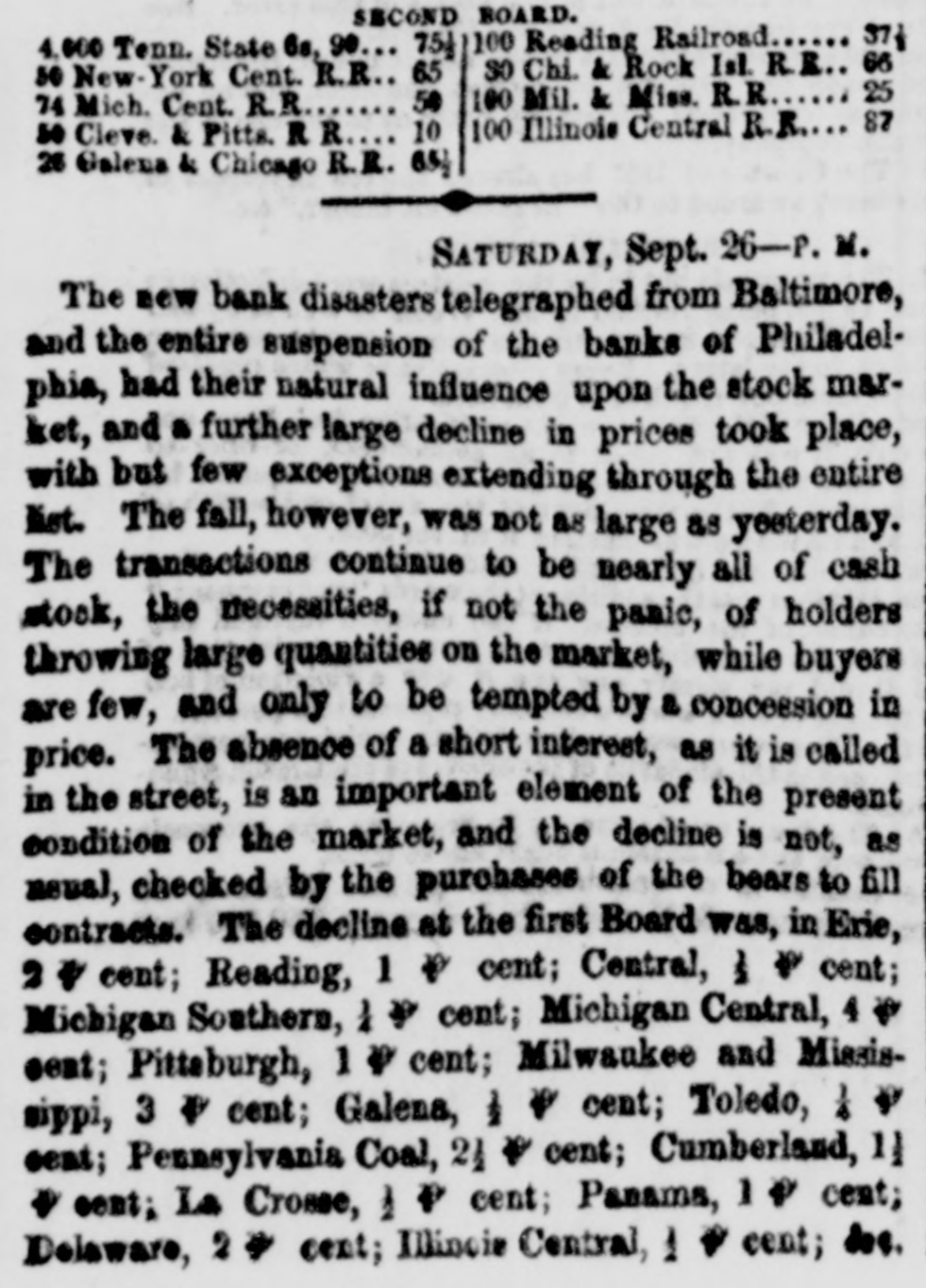
SECOND BOARD. 371 4.000 Tenn. State 6s, 90 75 100 Reading Railroad 66 30 Chi. & Rock Isl. R.R 65 50 New-York Cent. R.R 25 100 Mil. & Miss. R. R 50 74 Mich. Cent. R.R 87 100 Illinois Central R.R. 10 so Cleve. & Pitts. R R 26 Galena & Chicago R.R. as SATURDAY, Sept. 26-P. M. The new bank disasters telegraphed from Baltimore, and the entire suspension of the banks of Philadelphia, had their natural influence upon the stock market, and a further large decline in prices took place, with but few exceptions extending through the entire list. The fall, however, was not as large as yesterday. The transactions continue to be nearly all of cash stock, the necessities, if not the panic, of holders throwing large quantities on the market, while buyers are few, and only to be tempted by a concession in price. The absence of a short interest, as it is called in the street, is an important element of the present condition of the market, and the decline is not, as asual, checked by the purchases of the bears to fill contracts. The decline at the first Board was, in Erie, 2 F cent; Reading, 1 P cent; Central, 1 P cent; P Michigan Southern, 1 P cent; Michigan Central, 4 eent; Pittaburgh, 1 & cent; Milwaukee and Mississippi, 3 P cent; Galena, I v cent; Toledo, 1 cent; Pennsylvania Coal, 21 cent; Cumberland, 11 s cent, La Crosse, 1 P cent; Panama, 1 P cent; Delaware, 2 # cent; Illinois Central, 1 cent; dec.


Article from The Daily Gate City, September 30, 1857

Click image to open full size in new tab

Article Text

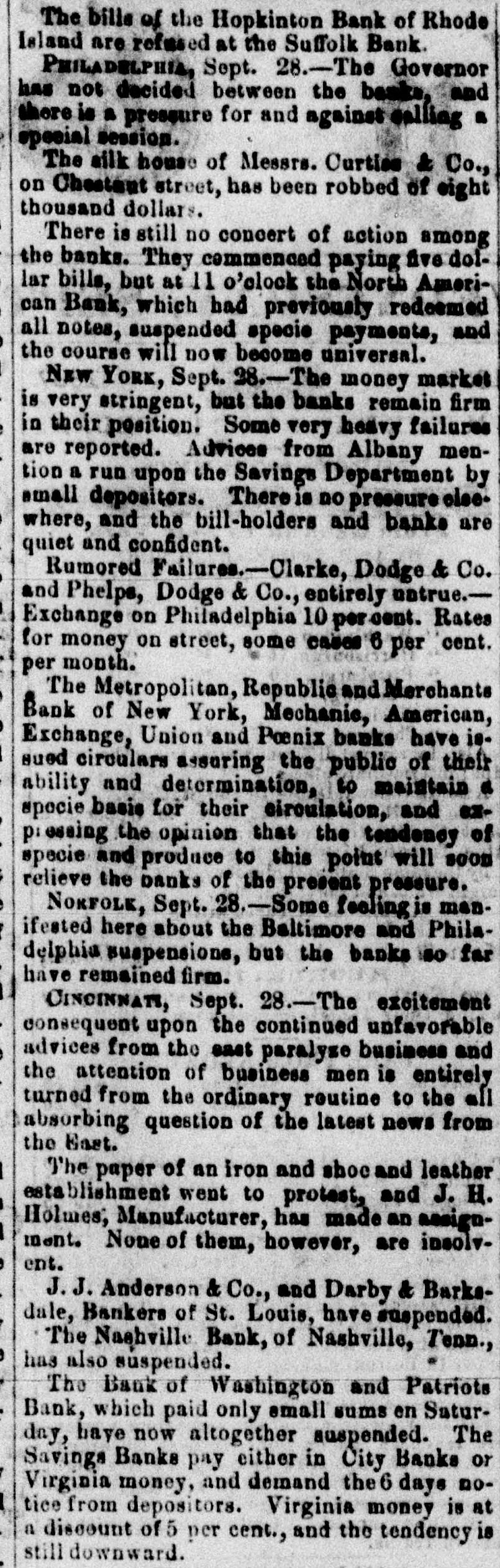
The bills of the Hopkinton Bank of Rhode Island are refused at the Suffolk Bank. Philadelphia, Sept. 28.-The Governor has not decided between the banks, and there is a pressure for and against calling a special session. The silk house of Messrs. Curtise & Co., on Chestaut street, has been robbed of eight thousand dollars. There is still no concert of action among the banks. They commenced paying five dollar bills, but at 11 o'clock the North American Bank, which had previously redeemed all notes, suspended specie payments, and the course will now become universal. NEW YORK, Sept. 28.-The money market is very stringent, but the banks remain firm in their position. Some very heavy failures are reported. Advices from Albany mention a run upon the Savings Department by small depositors. There is no pressure clsewhere, and the bill-holders and banks are quiet and confident. Rumored Failures.-Clarke, Dodge & Co. and Phelps, Dodge & Co., entirely untrue.Exchange on Philadelphia 10 per cent. Rates for money on street, some cases 6 per cent. per month. The Metropolitan, Republic and Merchants Bank of New York, Mechanic, American, Exchange, Union and Poenix banks have issued circulars assuring the public of their ability and determination, to maintain a specie basis for their circulation, and exp: essing the opinion that the tendency of specie and produce to this point will soon relieve the banks of the present pressure. NORFOLK, Sept. 28.-Some feeling is manifested here about the Baltimore and Philadelphia suspensions, but the banks so far have remained firm. CINCINNATE, Sept. 28.-The excitement consequent upon the continued unfavorable advices from the east paralyze business and the attention of business men is entirely turned from the ordinary routine to the all absorbing question of the latest news from the East. The paper of an iron and shoe and leather establishment went to protest, and J. H. Holmes, Manufacturer, has made an assignment. None of them, however, are insolvent. J. J. Anderson & Co., and Darby & Barksdale, Bankers of St. Louis, have suspended. The Nashville Bank, of Nashville, Tenn., has also suspended. The Bank of Washington and Patriots Bank, which paid only small sums en Saturday, have now altogether suspended. The Savings Banks pay either in City Banks or Virginia money, and demand the6 days notice from depositors. Virginia money is at a discount of 5 per cent., and the tendency is still downward.


Article from Bradford Reporter, October 1, 1857

Click image to open full size in new tab

Article Text

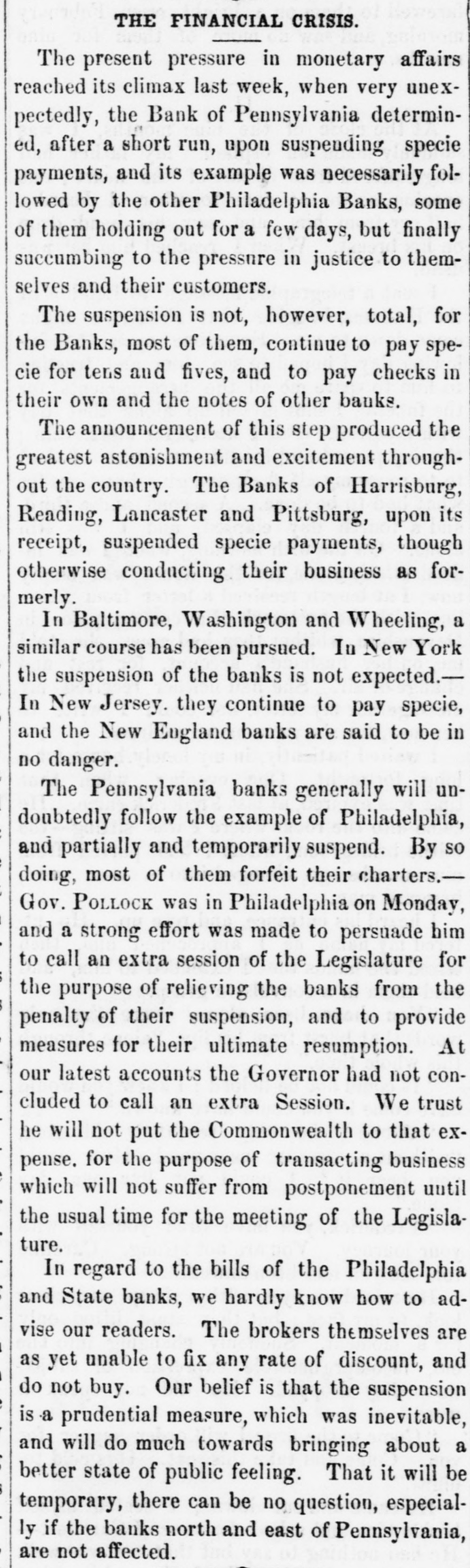
THE FINANCIAL CRISIS. The present pressure in monetary affairs reached its climax last week, when very unexpectedly, the Bank of Pennsylvania determined, after a short run, upon suspending specie payments, and its example was necessarily followed by the other Philadelphia Banks, some of them holding out for a few days, but finally succumbing to the pressure in justice to themselves and their customers. The suspension is not, however, total, for the Banks, most of them, continue to pay specie for tens and fives, and to pay checks in their own and the notes of other banks. The announcement of this step produced the greatest astonishment and excitement throughout the country. The Banks of Harrisburg, Reading, Lancaster and Pittsburg, upon its receipt, suspended specie payments, though otherwise conducting their business as formerly. In Baltimore, Washington and Wheeling, a similar course has been pursued. In New York the suspension of the banks is not expected.In New Jersey. they continue to pay specie, and the New England banks are said to be in no danger. The Pennsylvania banks generally will undoubtedly follow the example of Philadelphia, and partially and temporarily suspend. By so doing, most of them forfeit their charters.— Gov. POLLOCK was in Philadelphia on Monday, and a strong effort was made to persuade him to call an extra session of the Legislature for the purpose of relieving the banks from the penalty of their suspension, and to provide measures for their ultimate resumption. At our latest accounts the Governor had not concluded to call an extra Session. We trust he will not put the Commonwealth to that expense. for the purpose of transacting business which will not suffer from postponement until the usual time for the meeting of the Legislature. In regard to the bills of the Philadelphia and State banks, we hardly know how to advise our readers. The brokers themselves are as yet unable to fix any rate of discount, and do not buy. Our belief is that the suspension is a prudential measure, which was inevitable, and will do much towards bringing about a better state of public feeling. That it will be temporary, there can be no question, especially if the banks north and east of Pennsylvania, are not affected.


Article from Fremont Journal, October 2, 1857

Click image to open full size in new tab

Article Text

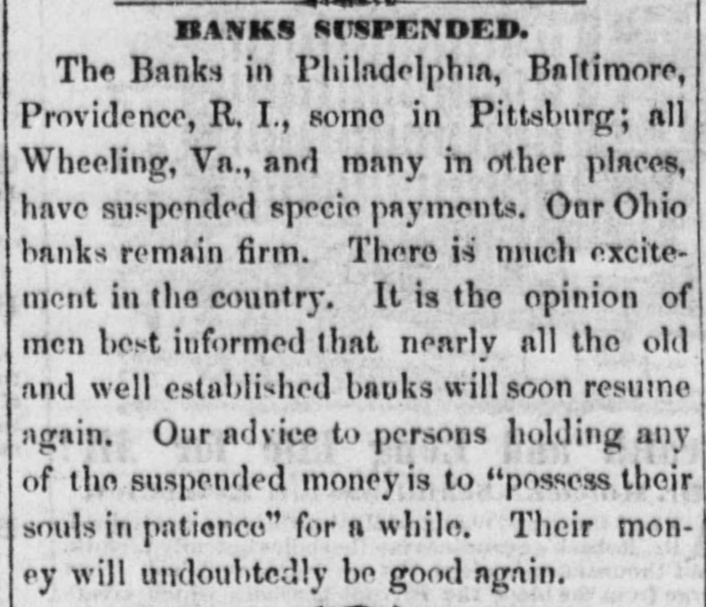
BANKS SUSPENDED. The Banks in Philadelphia, Baltimore, Providence, R. I., some in Pittsburg; all Wheeling, Va., and many in other places, have suspended specie payments. Our Ohio banks remain firm. There is much excitement in the country. It is the opinion of men best informed that nearly all the old and well established banks will soon resume again. Our advice to persons holding any of the suspended money is to "possess their souls in patience" for a while. Their money will undoubtedly be good again.


Article from Republican Vindicator, October 3, 1857

Click image to open full size in new tab

Article Text

Bank Suspension.-The WHIRLWIND UPON Us.-This morning information was telegraphed to this city that all the banks in Baltimore had suspended specie payment, creating a run upon those in this city, which forced two more of them-the Patriotic Bank and Bank of Washington-to suspend for the present. the payment of specie except upon notes of the denomination of $5, and checks for small amounts. They feel themselves able to meet every obligation against them, but resort to this as a measure of self defence. The Bank of Metropolis has, up to the time of going to press, sustained the heavy run upon it without yielding: as has also the Washington Saving's Bank.- Wash. Star. 26th.


Article from Evening Star, October 16, 1857

Click image to open full size in new tab

Article Text

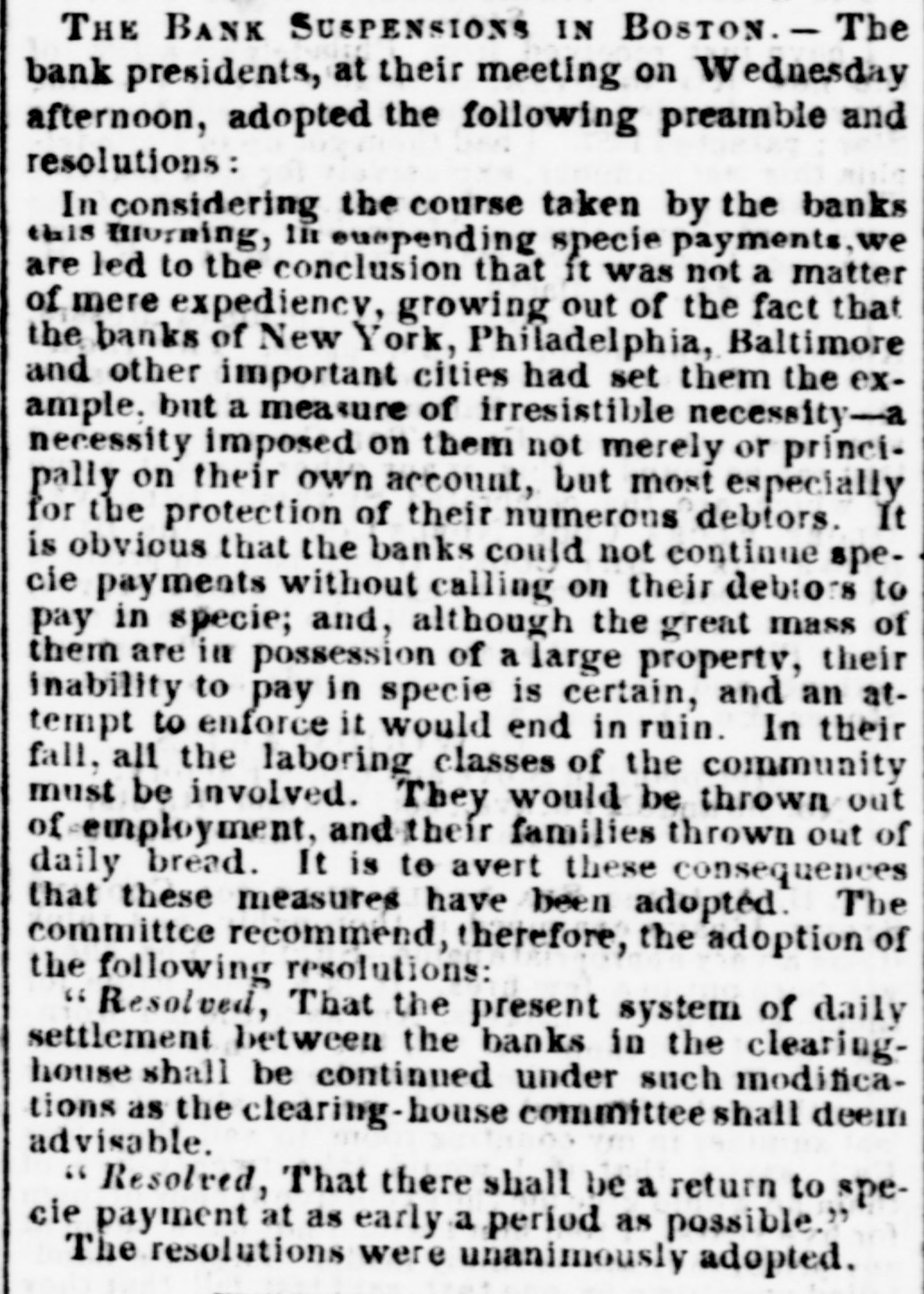
# THE BANK SUSPENSIONS IN BOSTON. The bank presidents, at their meeting on Wednesday afternoon, adopted the following preamble and resolutions: In considering the course taken by the banks this morning, in suspending specie payments, we are led to the conclusion that it was not a matter of mere expediency, growing out of the fact that the banks of New York, Philadelphia, Baltimore and other important cities had set them the example, but a measure of irresistible necessity—a necessity imposed on them not merely or principally on their own account, but most especially for the protection of their numerous debtors. It is obvious that the banks could not continue specie payments without calling on their debtors to pay in specie; and, although the great mass of them are in possession of a large property, their inability to pay in specie is certain, and an attempt to enforce it would end in ruin. In their fall, all the laboring classes of the community must be involved. They would be thrown out of-employment, and their families thrown out of daily bread. It is to avert these consequences that these measures have been adopted. The committee recommend, therefore, the adoption of the following resolutions: "Resolved, That the present system of daily settlement between the banks in the clearing-house shall be continued under such modifications as the clearing-house committee shall deem advisable. "Resolved, That there shall be a return to specie payment at as early a period as possible." The resolutions were unanimously adopted.


Article from The Cecil Whig, October 17, 1857

Click image to open full size in new tab

Article Text

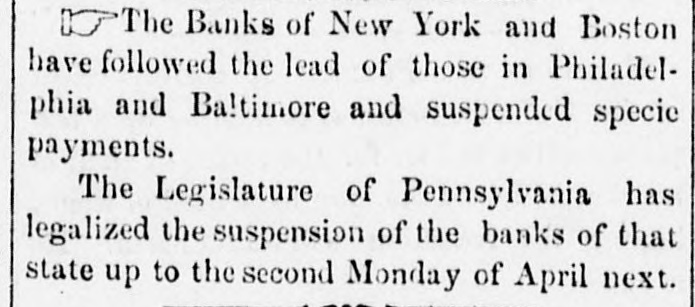
The Banks of New York and Boston have followed the lead of those in Philadelphia and Baltimore and suspended specie payments. The Legislature of Pennsylvania has legalized the suspension of the banks of that state up to the second Monday of April next.


Article from Richmond Enquirer, April 6, 1858

Click image to open full size in new tab

Article Text

crisis. The suspension of specie payments in Baitimore, Philadelphia and New York, has just shut out Virginia capitaliste from their own specie, and, in the teeth of this recent experience, a large additional Amo nt is to be sent, by legislative authority, the vaulte of Baltimore, there to await another drop of e dead-fall. Again. If there be any advantage to be gained for Virginia, by thus stocking Baltimore with our specie, why does the General Assembly discriminate between the two sorts of Banks? Why are the independent Banks alone permitted to enjoy this pre cious immunity of choice between Richmond and Baltimore? Is it intended by this means to enable them to supplant their competitors? Or, is this scheme nothing more than a decoy duck, employe, to Jure the independent Banks to certain bankruptcy, by breaking down their credit at home, while it of fers the promise of enhancing their credit abroad? Another question. Is the State of Virginia to take the notes of these independent banks n payment of taxes? Is the State Treasury, as well as the citizen, obliged to send drafts to Baltimore, there to collect specie for public diabusements? So we interpret the late act of the Legislature. A previous Legislature degraded State credit by establishing a Virginia State Treasury brokerage at New York. The present act establishes another at Baltimore. We beg leave to explain to our readers, that we were not advised of the obnoxious features of this act, previous to its passage. Had we been so advised, we would not have failed to warn the public of the impending stroke. The bill was hurried through without mature consideration-scarcely - with an attempt at debate. In the House of Delegates, it pass. ed without 8 division, and many members of the House were ignorant of its provisions. The evil is now past present remedy. We have nothing left us but to regret an act of unwise legisla tion, and endure the consequences of another effort to provincialize Virginia. This is all. But this all is more than enough. It is noxious to State enterprise. It is degrading to State credit. It is bitter 88 gall to State pride.