Fourth State Bank (Hutchinson, KS)

Episode Information

Episode UID
83135471483
Episode Type
Run → Suspension → Closure
Bank Type
state
Bank ID
8313547 routing
Routing Number
83-1354
Start Date
July 3, 1923
Location
Hutchinson, Kansas (38.061, -97.930)

Metadata

Model
gpt-5-mini (chosen from majority vote of a three-model LLM ensemble)
Short Digest
d5bfc471ddc34465

Response Measures

None

Description

Closure was by the state banking department after discovery of large shortages; later reorganization efforts mentioned but final status ambiguous in these articles.

Events (2)

1. July 3, 1923 Run
Cause
Bank Specific Adverse Info
Cause Details
Depositors withdrew funds after news of the president's disappearance and discovery of embezzlement/large shortages tied to his oil speculations.
Measures
Depositors withdrew approximately $50,000 in cash during the run.
Newspaper Excerpt
During a run on the bank July 3rd, $50,000.00 was withdrawn.
Source
newspapers
2. July 4, 1923 Suspension
Cause
Government Action
Cause Details
State banking department closed the bank after discovery of large shortages and alleged defalcation by the president.
Newspaper Excerpt
The Fourth State Bank at Hutchinson did not open for business Thursday morning, after a shortage of around $175,000.00 was discovered by the state banking department.
Source
newspapers

Newspaper Articles (16)

Article from The Kansas City Star, July 5, 1923

Click image to open full size in new tab

Article Text

And, in Desire to Become Wealthy While Still a Young Man, He Sacrificed Funds in Questionable Loans. HUTCHINSON, KAS., July 5.—The wrecking of the Fourth State Bank of Hutchinson is the story of a man who made a small amount of money in an oil deal, entered the banking business, in which he had had no previous experience, and in his desire to reach his ambition of making a million dollars, sacrificed the bank funds in questionable loans.


Article from The Kansas City Star, July 5, 1923

Click image to open full size in new tab

Article Text

HUTCHINSON, KAS., July 5.—The wrecking of the Fourth State Bank of Hutchinson is the story of a man who made a small amount of money in an oil deal, entered the banking business, in which he had had no previous experience, and in his desire to reach his ambition of making a million dollars, sacrificed the bank funds in questionable loans. The bank was organized in 1920, did a thriving business and had a large number of depositors. Everything was left to the judgment of the president, Walter L. Grundy, in making loans. The board of directors include Dr. H. G. Welch, prominent physician and capitalist; E. E. Bloom, president of the Bloom Drug Company; Arthur Dade, capitalist and a heavy owner of business real estate; Lacy Rosier, president of the Hutchinson Oil Company; Henry Shears, paving contractor; Guy Glascock, insurance man, and Walter Grundy.


Article from The Kansas City Star, July 5, 1923

Click image to open full size in new tab

Article Text

PLUNGED IN OIL AGAIN? Some Believe Grundy's Fall Was Due to Private Speculations. TOPEKA BUREAU THE KANSAS CITY STAR (By a Staff Correspondent.) TOPEKA, July 5.—The failure of the Fourth State Bank at Hutchinson and the disappearance of Walter Grundy, its president and manager, is another case of crooked banking methods being "pulled" under the very nose of the Kansas banking department. Fortunately the Fourth State Bank was not under the guaranty law—that is, fortunate for the guaranty fund, which has been hit hard in the last two years by bank failures and the majority


Article from The Kansas City Star, July 5, 1923

Click image to open full size in new tab

Article Text

Fortunately the Fourth State Bank was not under the guaranty law—that is, fortunate for the guaranty fund, which has been hit hard in the last two years by bank failures, and the majority of the bank failures in Kansas have been caused by crooked banking. The depositors of the failed bank will be forced to stand the loss, which probably will amount to about $200,000, minus whatever may be collected from the stockholders under the double liability law. Grundy had lived in Hutchinson about ten years. After the war he invested a small amount of money in oil ventures and made some money, then organized the bank. He associated with him in the venture some of the most prominent men of Hutchinson. Grundy was not what is known as a "high flier," although he lived well. For a year or two Grundy and his wife lived at the Bisonte hotel, the Harvey house of Hutchinson, which was the only evidence of "high living" that was noticeable. Then they moved into an apartment, where they have since lived. But Grundy could not keep out of the oil business. Having made some money before going into the bank he is believed to have kept up his pursuit of the gamble of oil with the bank funds, unknown to the directors of the bank. He wasn't so "lucky" in his later ventures. Three weeks ago an examination of the bank was made by the state department and a shortage of $60,000 was discovered. The case was laid before the directors and they promised to make good the shortage. But further investigation revealed more. It is another case of what occurred at Salina a few years ago when H. J. Lefferdink, cashier of the Salina State Bank, which crashed there because of Lefferdink's speculations, was allowed to escape after the state bank commissioner knew Lefferdink had plundered the bank.


Article from The Partridge Bulletin, July 6, 1923

Click image to open full size in new tab

Article Text

News of Reno County People Hutchinson, Kansas—According to reports for the month of June in the Farm Bureau work, 543 people attended meetings or demonstrations held in connection with the Bureau. The work accomplished includes four stock judging demonstrations, one club picnic and two club meetings. Three hundred thirty-six women attended 15 meetings on judging fruits, vegetables, breads and cakes for the fair. “Much interest was shown”, said Miss S. Schnemayer, “in the canning and preserving of fruits. I believe there will be a lot less spoiled fruits and meats next year in Reno county.” Here is what the Farm Bureau office did during the month of June. Personal calls, 160; Telephone calls, 67; Personal letters, 377; Bulletins, 572; Labor placed, 17; Demostration meetings, 15; Attendance, 336; Club meetings, 4; Attendance, 217; Miles traveled, 1166. The Fourth State Bank at Hutchinson did not open for business Thursday morning, after a shortage of around $175,000.00 was discovered by the state banking department. A run on the bank Tuesday afternoon withdrew $50,000.00 in cash. The president, Walter Grundy is missing and his whereabouts are unknown. The state banking department expects that the bank will be able to pay out. This bank was not operating under the guarantee fund of the State of Kansas as does the bank in this city. Banks operating under this feature are absolutely safe as every deposit is guaranteed by the State of Kansas. The office of county treasurer and Levi Adkinson is being given a very thorough examination by the county commissioners after the finding of a check for $24,171.81, drawn on the Fourth State bank and signed by the United Water, Gas & Electric Co. for their taxes, which the county treasurer had not presented for payment and had held 7 months. Mr. Adkinson says he was holding the check on request of an official of the Fourth State Bank. Mr. Adkinson is under a bond of $100,000.00, so the county does not stand to loose anything. Daniel Walborn who has lived south of Arlington for a quarter of a century died Wednesday after a long illness. No reports of accidents on the Fourth have been reported in Reno county.


Article from The Langdon Leader, July 6, 1923

Click image to open full size in new tab

Article Text

News of Reno County People Hutchinson, Kansas-According to reports for the month of June in the Farm Bureau work, 543 people attended meetings or demonstrations held in connection with the Bureau. The work accomplished includes four stock judging demonstrations, one club picnic and two club meetings. Three hundred thirty-six women attended 15 meetings on judging fruits, vegetables, breads and cakes for the fair. "Much interest was shown", said Miss S. Schnemayer, "in the canning and preserving of fruits. I believe there will be a lot less spoiled fruits and meats next year in Reno county." Here is what the Farm Bureau office did during the month of June. Personal calls, 160; Telephone calls, 67; Personal letters, 377; Bulletins, 572; Labor placed, 17; Demonstration meetings, 15; Attendance, 336; Club meetings, 4; Attendance, 217; Miles traveled, 1166. ——— The Fourth State Bank at Hutchinson did not open for business Thursday morning, after a shortage of around $175,000.00 was discovered by the state banking department. A run on the bank Tuesday afternoon withdrew $50,000.00 in cash. The president, Walter Grundy is missing and his where abouts are unknown. The state banking department expects that the bank will be able to pay out. This bank was not operating under the guarantee fund of the State of Kansas as does the bank in this city. Banks operating under this feature are absolutely safe as every deposit is guaranteed by the State of Kansas. ——— The office of county treasurer and Levi Adkinson is being given a very thorough examination by the county commissioners after the finding of a check for $24,171.81, drawn on the Fourth State bank and signed by the United Water, Gas & Electric Co. for their taxes, which the county treasurer had not presented for payment and had held 7 months. Mr. Adkinson says he was holding the check on request of an official of the Fourth State Bank. Mr. Adkinson is under a bond of $100,000.00, so the county does not stand to loose anything. ——— Daniel Walborn who has lived south of Arlington for a quarter of a century died Wednesday after a long illness. No reports of accidents on the Fourth have been reported in Reno county.


Article from Kirksville Daily Express and Kirksville Daily News, July 6, 1923

Click image to open full size in new tab

Article Text

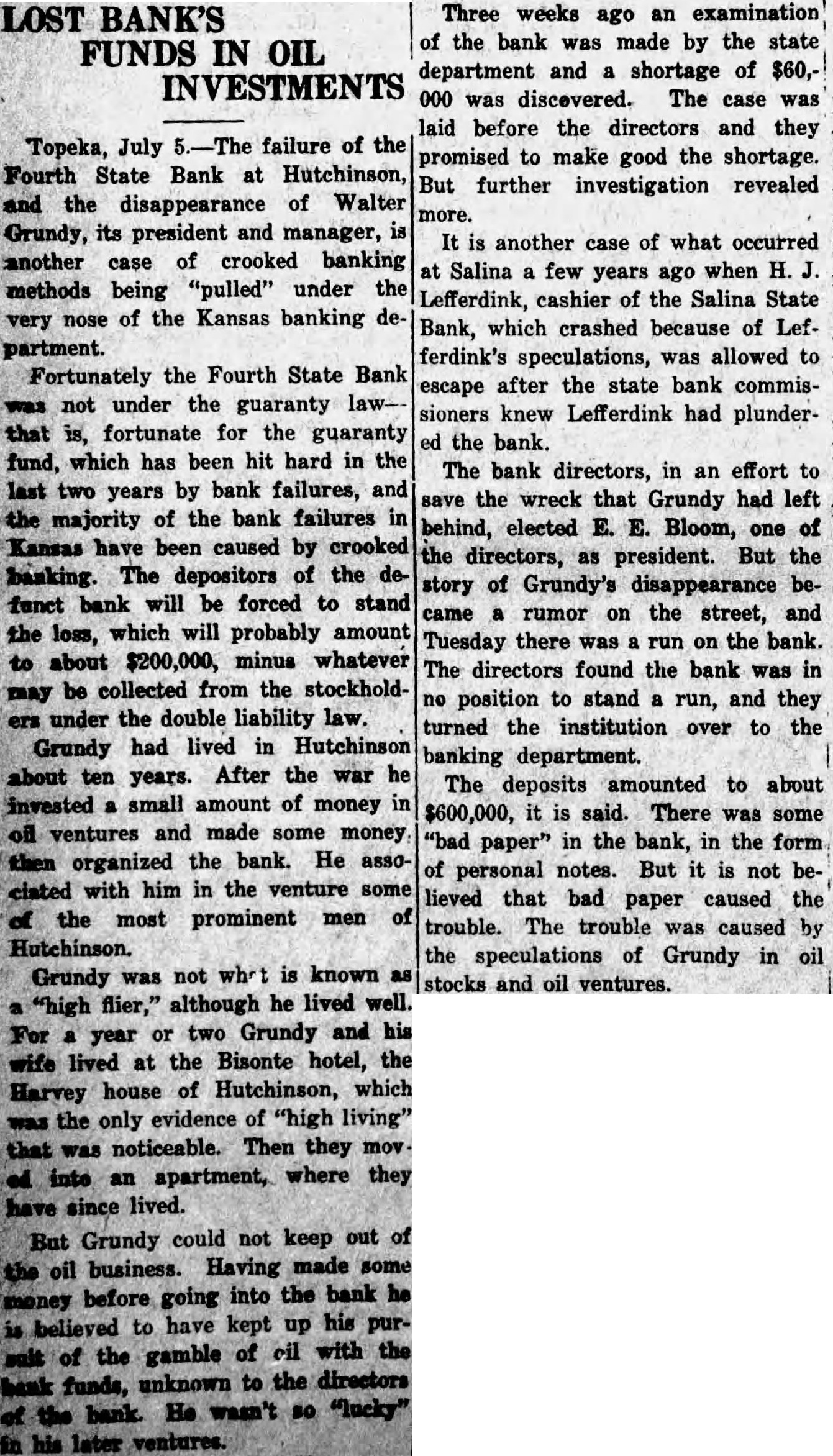
LOST BANK'S FUNDS IN OIL INVESTMENTS Topeka, July 5.—The failure of the Fourth State Bank at Hutchinson, and the disappearance of Walter Grundy, its president and manager, is another case of crooked banking methods being "pulled" under the very nose of the Kansas banking department. Fortunately the Fourth State Bank was not under the guaranty law—that is, fortunate for the guaranty fund, which has been hit hard in the last two years by bank failures, and the majority of the bank failures in Kansas have been caused by crooked banking. The depositors of the defunct bank will be forced to stand the loss, which will probably amount to about $200,000, minus whatever may be collected from the stockholders under the double liability law. Grundy had lived in Hutchinson about ten years. After the war he invested a small amount of money in


Article from The American Guardian, July 9, 1923

Click image to open full size in new tab

Article Text

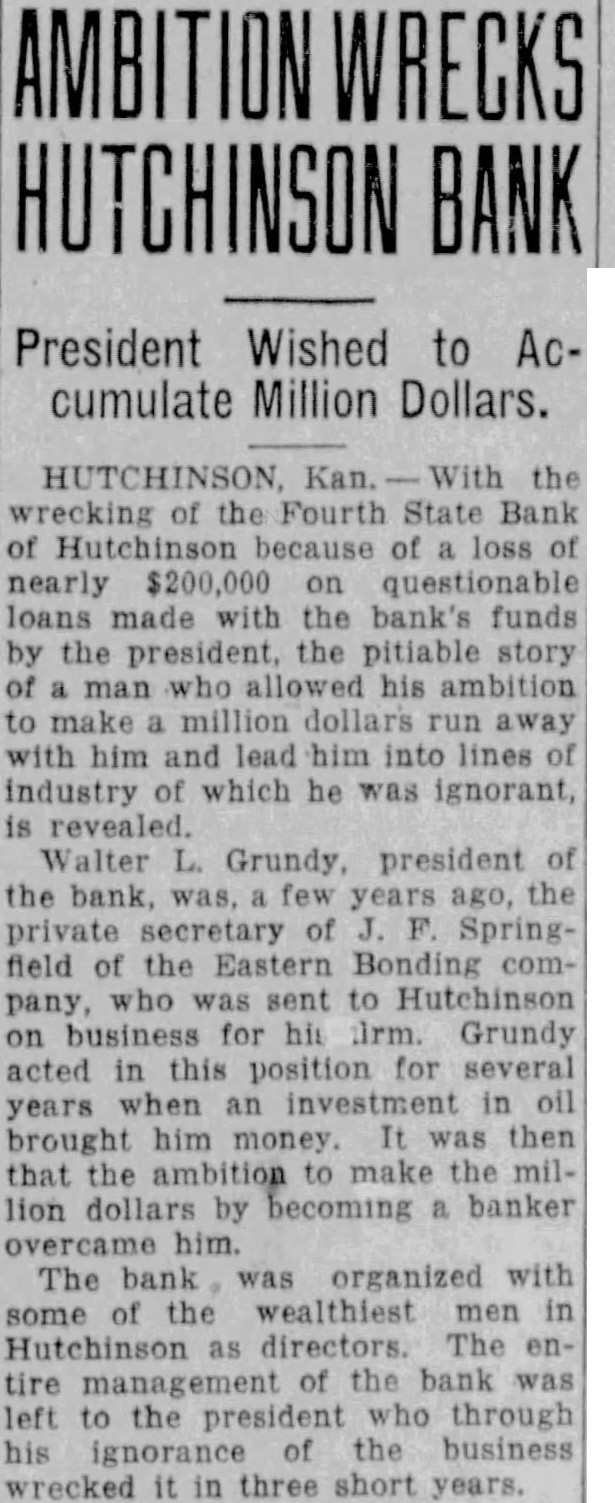
AMBITION WRECKS HUTCHINSON BANK President Wished to Accumulate Million Dollars. HUTCHINSON, Kan. — With the wrecking of the Fourth State Bank of Hutchinson because of a loss of nearly $200,000 on questionable loans made with the bank's funds by the president, the pitiable story of a man who allowed his ambition to make a million dollars run away with him and lead him into lines of industry of which he was ignorant, is revealed. Walter L. Grundy, president of the bank, was, a few years ago, the private secretary of J. F. Springfield of the Eastern Bonding company, who was sent to Hutchinson on business for his firm. Grundy acted in this position for several years when an investment in oil brought him money. It was then that the ambition to make the million dollars by becoming a banker overcame him. The bank was organized with some of the wealthiest men in Hutchinson as directors. The entire management of the bank was left to the president who through his ignorance of the business wrecked it in three short years.


Article from The Turon Weekly Press, July 12, 1923

Click image to open full size in new tab

Article Text

Georgia Co. Success Credited to Live Stock The dairy cow, the hog, and the hen have won for themselves a high place in the regard of Turner county, Ga. farmers. This county grew but one crop—cotton—until about two years ago. Finding the boll weevil and general economic conditions made this crop a continued financial loss, a "permanent prosperity" program, substituting dairy cattle, hogs and poultry, with pasture and feed crops for their maintenance, was adopted and approved methods of management introduced by the county agricultural agent. Within two years, a profitable dairy, poultry and meat industry has been developed. The total amount realized by Turner county farmers in 1922, through the sale of their diversified farming products, reached $1,000,000, an average of about $600 per farm. In addition, they have enjoyed a comfortable living produced on their own farms, their soil is increasing in fertility, and their live stock holdings are growing. The creamery which opened in October, 1921, with 100 patrons, now has over 800. Checks for cream have more than doubled in amount in the last 7 months. There are now 40 purebred bulls in the county. Co-operative shipments of hogs from the county will reach probably 15 cars per month this year. More than 45,000 pure-bred chicks have been hatched in the county since November, 1922. This striking success in a county having no marked physical or economic advantages to start with has been accomplished, according to reports to the United States Department of Agriculture, through the complete co-operation of practically every farmer and business man in the county with the agricultural extension workers in carrying out the program. The Fourth State Bank of Hutchinson went on the rocks Thursday of last week. The state bank commissioner estimates a shortage of $175,000.00. During a run on the bank July 3rd, $50,000.00 was withdrawn. The president, Walter Grundy, is missing. The last official statement of the bank showed deposits of $737,000. The bank's deposits are not protected by the State Guarantee Fund. A strong effort is being made to re-organize the bank. In this event it is hoped that the loss to the depositors will be comparatively small.


Article from The Milan Standard, July 12, 1923

Click image to open full size in new tab

Article Text

LOST BANK'S FUNDS IN OIL INVESTMENTS Topeka, July 5.—The failure of the Fourth State Bank at Hutchinson, and the disappearance of Walter Grundy, its president and manager, is another case of crooked banking methods being "pulled" under the very nose of the Kansas banking department. Fortunately the Fourth State Bank was not under the guaranty law—that is, fortunate for the guaranty fund, which has been hit hard in the last two years by bank failures, and the majority of the bank failures in Kansas have been caused by crooked banking. The depositors of the defunct bank will be forced to stand the loss, which will probably amount to about $200,000, minus whatever may be collected from the stockholders under the double liability law. Grundy had lived in Hutchinson about ten years. After the war he invested a small amount of money in oil ventures and made some money, then organized the bank. He associated with him in the venture some of the most prominent men of Hutchinson. Grundy was not what is known as a "high flier," although he lived well. For a year or two Grundy and his wife lived at the Bisonte hotel, the Harvey house of Hutchinson, which was the only evidence of "high living" that was noticeable. Then they moved into an apartment, where they have since lived. But Grundy could not keep out of the oil business. Having made some money before going into the bank he is believed to have kept up his pursuit of the gamble of oil with the bank funds, unknown to the directors of the bank. He wasn't so "lucky" in his later ventures. Three weeks ago an examination of the bank was made by the state department and a shortage of $60,000 was discovered. The case was laid before the directors and they promised to make good the shortage. But further investigation revealed more. It is another case of what occurred at Salina a few years ago when H. J. Lefferdink, cashier of the Salina State Bank, which crashed because of Lefferdink's speculations, was allowed to escape after the state bank commissioners knew Lefferdink had plundered the bank. The bank directors, in an effort to save the wreck that Grundy had left behind, elected E. E. Bloom, one of the directors, as president. But the story of Grundy's disappearance became a rumor on the street, and Tuesday there was a run on the bank. The directors found the bank was in no position to stand a run, and they turned the institution over to the banking department. The deposits amounted to about $600,000, it is said. There was some "bad paper" in the bank, in the form of personal notes. But it is not believed that bad paper caused the trouble. The trouble was caused by the speculations of Grundy in oil stocks and oil ventures.


Article from The Hutchinson News, July 17, 1923

Click image to open full size in new tab

Article Text

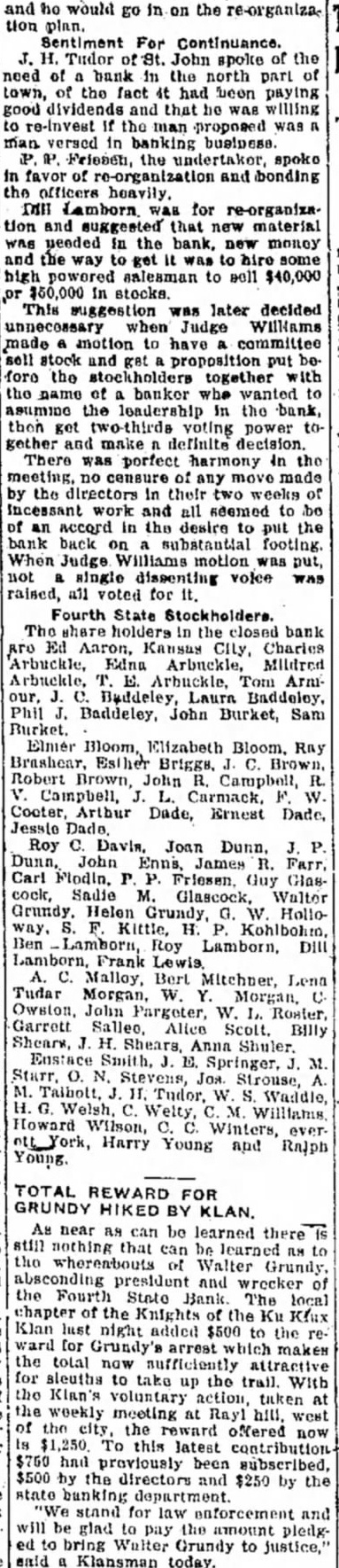
and he would go in on the re-organization plan. Sentiment For Continuance. J. H. Tudor of St. John spoke of the need of a bank in the north part of town, of the fact it had been paying good dividends and that he was willing to re-invest if the man proposed was a man versed in banking business. P. P. Friesen, the undertaker, spoke in favor of re-organization and bonding the officers heavily. Dill Lamborn was for re-organization and suggested that new material was needed in the bank, new money and the way to get it was to hire some high powered salesman to sell $40,000 or $50,000 in stocks. This suggestion was later decided unnecessary when Judge Williams made a motion to have a committee sell stock and get a proposition put before the stockholders together with the name of a banker who wanted to assume the leadership in the bank, then get two-thirds voting power together and make a definite decision. There was perfect harmony in the meeting, no censure of any move made by the directors in their two weeks of incessant work and all seemed to be of an accord in the desire to put the bank back on a substantial footing. When Judge Williams motion was put, not a single dissenting voice was raised, all voted for it. Fourth State Stockholders. The share holders in the closed bank are Ed Aaron, Kansas City, Charles Arbuckle, Edna Arbuckle, Mildred Arbuckle, T. E. Arbuckle, Tom Armour, J. C. Baddeley, Laura Baddeley, Phil J. Baddeley, John Burket, Sam Burket. Elmer Bloom, Elizabeth Bloom, Ray Brashear, Esther Briggs, J. C. Brown, Robert Brown, John R. Campbell, R. V. Campbell, J. L. Carmack, F. W. Coeter, Arthur Dade, Ernest Dade, Jessie Dade. Roy C. Davis, Joan Dunn, J. P. Dunn, John Enns, James R. Farr, Carl Flodin, P. P. Friesen, Guy Glascock, Sadie M. Glascock, Walter Grundy, Helen Grundy, G. W. Holloway, S. F. Kittle, H. P. Kohlbohm, Ben Lamborn, Roy Lamborn, Dill Lamborn, Frank Lewis. A. C. Malloy, Bert Mitchner, Lena Tudor Morgan, W. Y. Morgan, C. Owston, John Pargeter, W. L. Rosier, Garrett Sallee, Alice Scott, Billy Shears, J. H. Shears, Anna Shuler. Eustace Smith, J. E. Springer, J. M. Starr, O. N. Stevens, Jos. Strouse, A. M. Talbott, J. H. Tudor, W. S. Waddle, H. G. Welsh, C. Welty, C. M. Williams, Howard Wilson, C. C. Winters, Everett York, Harry Young and Ralph Young. TOTAL REWARD FOR GRUNDY HIKED BY KLAN. As near as can be learned there is still nothing that can be learned as to the whereabouts of Walter Grundy, absconding president and wrecker of the Fourth State Bank. The local chapter of the Knights of the Ku Klux Klan last night added $500 to the reward for Grundy's arrest which makes the total now sufficiently attractive for sleuths to take up the trail. With the Klan's voluntary action, taken at the weekly meeting at Rayl hill, west of the city, the reward offered now is $1,250. To this latest contribution $750 had previously been subscribed, $500 by the directors and $250 by the state banking department. "We stand for law enforcement and will be glad to pay the amount pledged to bring Walter Grundy to justice," said a Klansman today.
Article from The Weekly Kansas City Star, July 18, 1923

Click image to open full size in new tab

Article Text

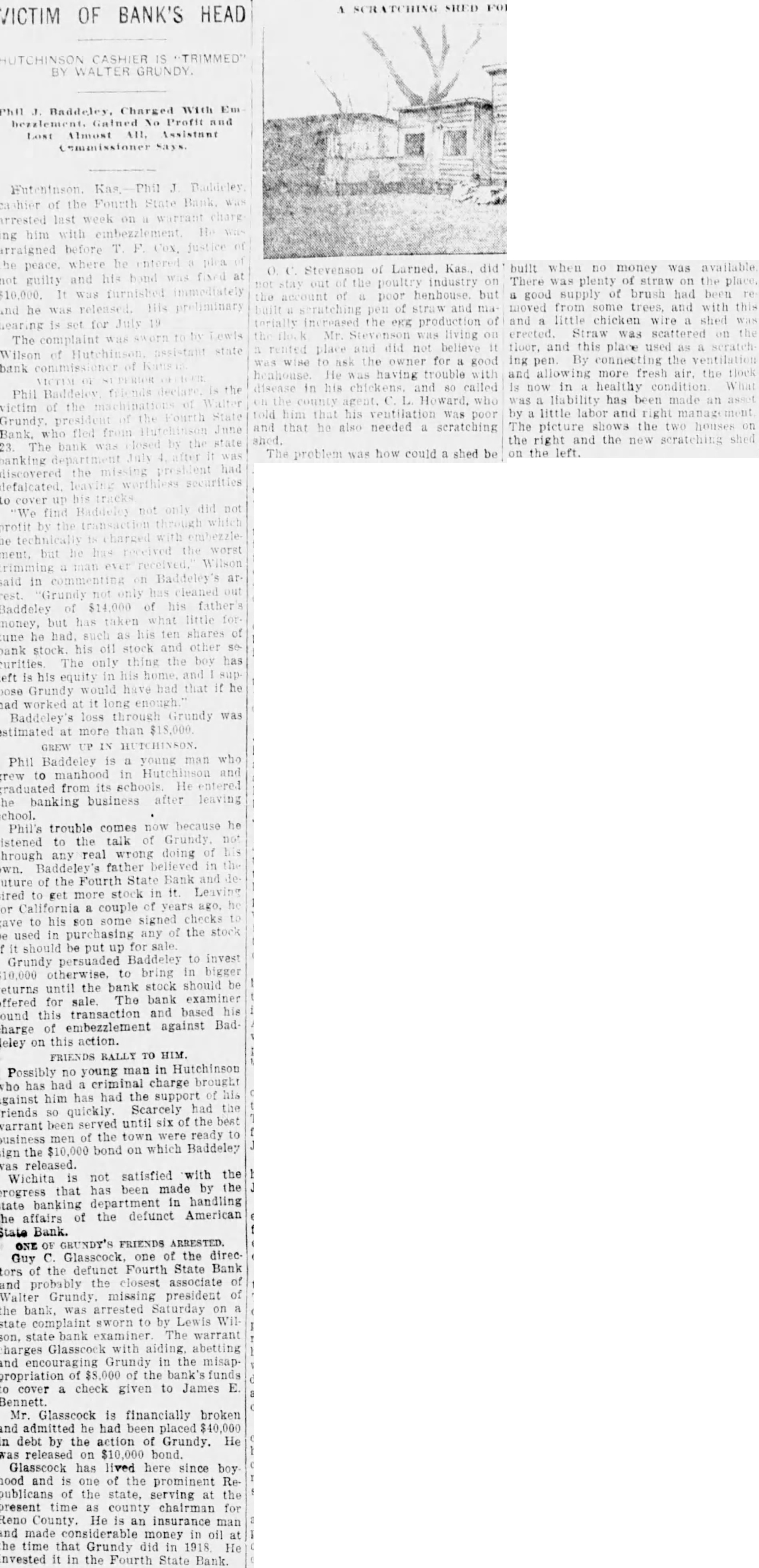
VICTIM OF BANK'S HEAD HUTCHINSON CASHIER IS "TRIMMED" BY WALTER GRUNDY. Phil J. Baddeley, Charged With Embezzlement, Gained No Profit and Lost Almost All, Assistant Commissioner Says. Hutchinson, Kas.—Phil J. Baddeley, cashier of the Fourth State Bank, was arrested last week on a warrant charging him with embezzlement. He was arraigned before T. F. Cox, justice of the peace, where he entered a plea of not guilty and his bond was fixed at $10,000. It was furnished immediately and he was released. His preliminary hearing is set for July 19. The complaint was sworn to by Lewis Wilson of Hutchinson, assistant state bank commissioner of Kansas. VICTIM OF SUPERIOR OFFICER. Phil Baddeley, friends declare, is the victim of the machinations of Walter Grundy, president of the Fourth State Bank, who fled from Hutchinson June 23. The bank was closed by the state banking department July 4, after it was discovered the missing president had defalcated, leaving worthless securities to cover up his tracks. "We find Baddeley not only did not profit by the transaction through which he technically is charged with embezzlement, but he has received the worst trimming a man ever received," Wilson said in commenting on Baddeley's arrest. "Grundy not only has cleaned out Baddeley of $14,000 of his father's money, but has taken what little fortune he had, such as his ten shares of bank stock, his oil stock and other securities. The only thing the boy has left is his equity in his home, and I suppose Grundy would have had that if he had worked at it long enough." Baddeley's loss through Grundy was estimated at more than $18,000. GREW UP IN HUTCHINSON. Phil Baddeley is a young man who grew to manhood in Hutchinson and graduated from its schools. He entered the banking business after leaving school. Phil's trouble comes now because he listened to the talk of Grundy, not through any real wrong doing of his own. Baddeley's father believed in the future of the Fourth State Bank and desired to get more stock in it. Leaving for California a couple of years ago, he gave to his son some signed checks to be used in purchasing any of the stock if it should be put up for sale. Grundy persuaded Baddeley to invest $10,000 otherwise, to bring in bigger returns until the bank stock should be offered for sale. The bank examiner found this transaction and based his charge of embezzlement against Baddeley on this action. FRIENDS RALLY TO HIM. Possibly no young man in Hutchinson who has had a criminal charge brought against him has had the support of his friends so quickly. Scarcely had the warrant been served until six of the best business men of the town were ready to sign the $10,000 bond on which Baddeley was released. Wichita is not satisfied with the progress that has been made by the state banking department in handling the affairs of the defunct American State Bank. ONE OF GRUNDY'S FRIENDS ARRESTED. Guy C. Glasscock, one of the directors of the defunct Fourth State Bank and probably the closest associate of Walter Grundy, missing president of the bank, was arrested Saturday on a state complaint sworn to by Lewis Wilson, state bank examiner. The warrant charges Glasscock with aiding, abetting and encouraging Grundy in the misappropriation of $8,000 of the bank's funds to cover a check given to James E. Bennett. Mr. Glasscock is financially broken and admitted he had been placed $40,000 in debt by the action of Grundy. He was released on $10,000 bond. Glasscock has lived here since boyhood and is one of the prominent Republicans of the state, serving at the present time as county chairman for Reno County. He is an insurance man and made considerable money in oil at the time that Grundy did in 1918. He invested it in the Fourth State Bank.


Article from The Chase Register, July 26, 1923

Click image to open full size in new tab

Article Text

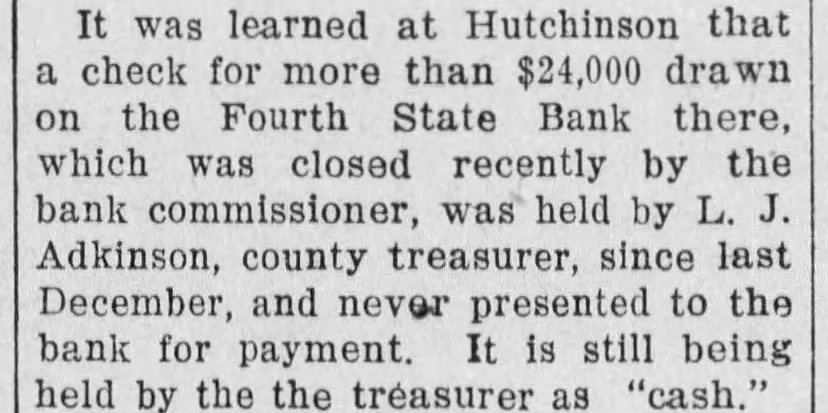
It was learned at Hutchinson that a check for more than $24,000 drawn on the Fourth State Bank there, which was closed recently by the bank commissioner, was held by L. J. Adkinson, county treasurer, since last December, and never presented to the bank for payment. It is still being held by the the treasurer as "cash."


Article from Lexington Herald-Leader, September 14, 1923

Click image to open full size in new tab

Article Text

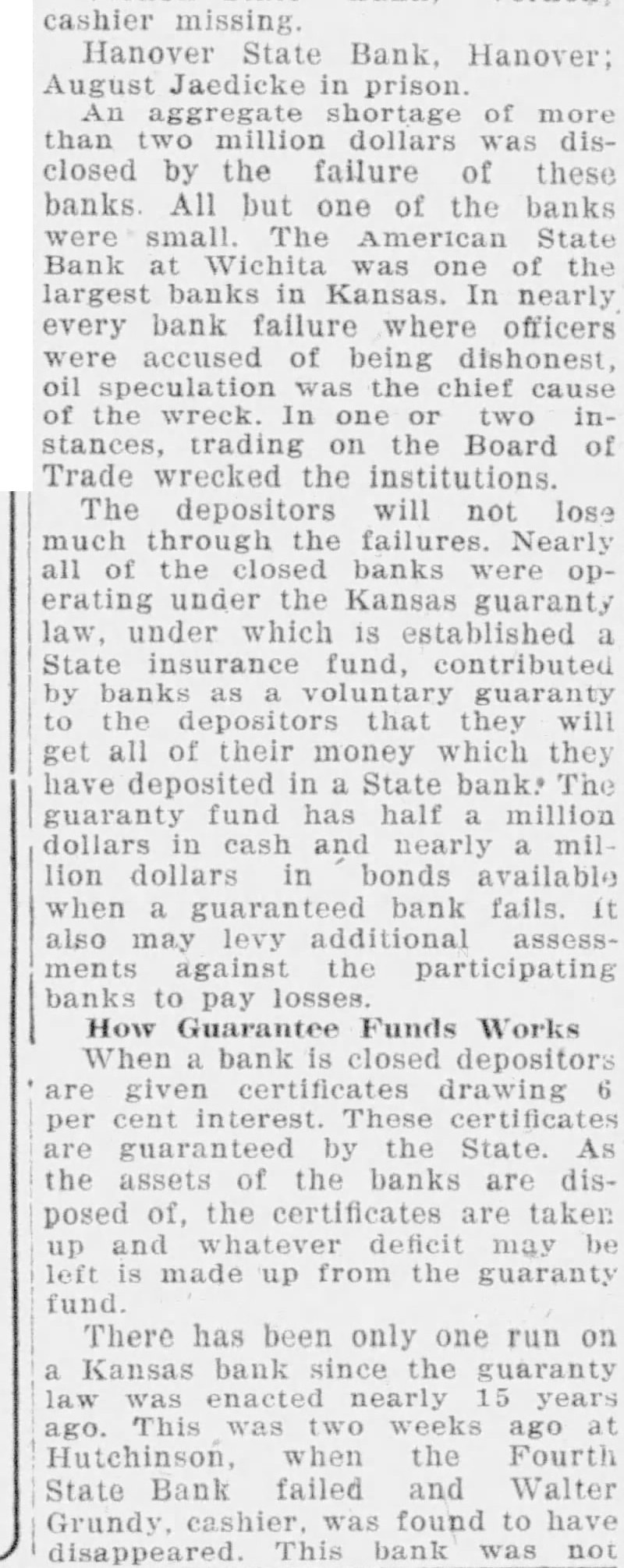
cashier missing. Hanover State Bank, Hanover; August Jaedicke in prison. An aggregate shortage of more than two million dollars was disclosed by the failure of these banks. All but one of the banks were small. The American State Bank at Wichita was one of the largest banks in Kansas. In nearly every bank failure where officers were accused of being dishonest, oil speculation was the chief cause of the wreck. In one or two instances, trading on the Board of Trade wrecked the institutions. The depositors will not lose much through the failures. Nearly all of the closed banks were operating under the Kansas guaranty law, under which is established a State insurance fund, contributed by banks as a voluntary guaranty to the depositors that they will get all of their money which they have deposited in a State bank. The guaranty fund has half a million dollars in cash and nearly a million dollars in bonds available when a guaranteed bank fails. It also may levy additional assessments against the participating banks to pay losses. How Guarantee Funds Works When a bank is closed depositors are given certificates drawing 6 per cent interest. These certificates are guaranteed by the State. As the assets of the banks are disposed of, the certificates are taken up and whatever deficit may be left is made up from the guaranty fund. There has been only one run on a Kansas bank since the guaranty law was enacted nearly 15 years ago. This was two weeks ago at Hutchinson, when the Fourth State Bank failed and Walter Grundy, cashier, was found to have disappeared. This bank was not


Article from The Hutchinson News, October 1, 1923

Click image to open full size in new tab

Article Text

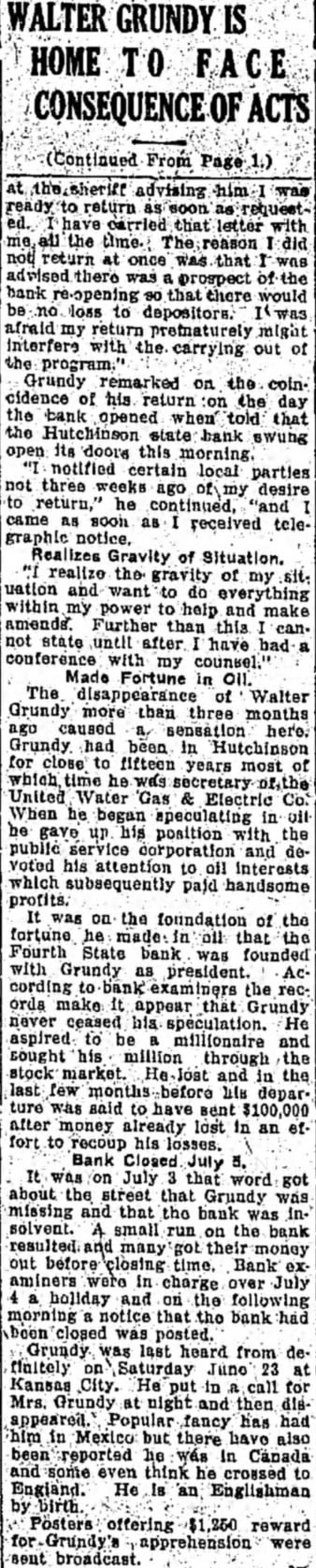
WALTER GRUNDY IS HOME TO FACE CONSEQUENCE OF ACTS (Continued From Page 1.) at the sheriff advising him I was ready to return as soon as requested. I have carried that letter with me all the time. The reason I did not return at once was that I was advised there was a prospect of the bank re-opening so that there would be no loss to depositors. I was afraid my return prematurely might interfere with the carrying out of the program." Grundy remarked on the coincidence of his return on the day the bank opened when told that the Hutchinson state bank swung open its doors this morning. "I notified certain local parties not three weeks ago of my desire to return," he continued, "and I came as soon as I received telegraphic notice." Realizes Gravity of Situation. "I realize the gravity of my situation and want to do everything within my power to help and make amends. Further than this I cannot state until after I have had a conference with my counsel." Made Fortune in Oil. The disappearance of Walter Grundy more than three months ago caused a sensation here. Grundy had been in Hutchinson for close to fifteen years most of which time he was secretary of the United Water Gas & Electric Co. When he began speculating in oil he gave up his position with the public service corporation and devoted his attention to oil interests which subsequently paid handsome profits. It was on the foundation of the fortune he made in oil that the Fourth State bank was founded with Grundy as president. According to bank examiners the records make it appear that Grundy never ceased his speculation. He aspired to be a millionaire and sought his million through the stock market. He lost and in the last few months before his departure was said to have sent $100,000 after money already lost in an effort to recoup his losses. Bank Closed July 5. It was on July 3 that word got about the street that Grundy was missing and that the bank was insolvent. A small run on the bank resulted and many got their money out before closing time. Bank examiners were in charge over July 4 a holiday and on the following morning a notice that the bank had been closed was posted. Grundy was last heard from definitely on Saturday June 23 at Kansas City. He put in a call for Mrs. Grundy at night and then disappeared. Popular fancy has had him in Mexico but there have also been reported he was in Canada and some even think he crossed to England. He is an Englishman by birth. Posters offering $1,250 reward for Grundy's apprehension were sent broadcast.


Article from Shawnee News-Star, November 3, 1923

Click image to open full size in new tab

Article Text

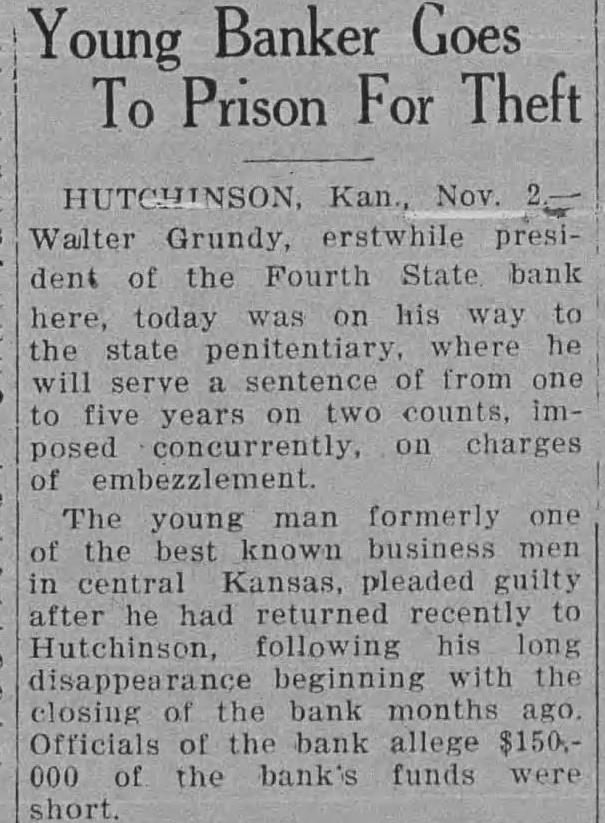
Young Banker Goes To Prison For Theft HUTCHINSON, Kan., Nov. 2.—Walter Grundy, erstwhile president of the Fourth State bank here, today was on his way to the state penitentiary, where he will serve a sentence of from one to five years on two counts, imposed concurrently, on charges of embezzlement. The young man formerly one of the best known business men in central Kansas, pleaded guilty after he had returned recently to Hutchinson, following his long disappearance beginning with the closing of the bank months ago. Officials of the bank allege $150,000 of the bank's funds were short.