Article Text
WAYS OF KANSAS BANK WRECKERS HARD TO TRAVEL
Neither the Teeming Millions of New York, Nor the Farther Corners of the Country, Conceal Them.
By The Journal-Post Topeka Bureau.
TOPEKA, April 14.—New York city with its millions of people is not a good place for absconding Kansas bankers to seek to hide.
This was proved a number of years ago, when John A. Flack, who wrecked the Abilene State bank, was captured in New York after having been a fugitive for two years; and it was proved again last week when Edward J. Conklin, absconding Emporia banker, was caught in the net of the law under Gotham's white lights.
The records of the state banking department show that bankers, who go wrong, come out best when they "face the music" rather than try to skip the country and escape punishment. Sooner or later those, who skip the country, are caught and brought back and they find that their only gain through running away has been that they have postponed the serving of their sentences and thus have made themselves older men when they have paid their penalties.
Recognized by Fellow Townsman.
Mr. Conklin, whose blow up at Emporia was one of the most sensational financial crashes in recent years, fled on January 7, 1920, when it was discovered that he had wrecked a mortgage company and a building and loan association and caused considerable losses to a bank. No trace could be found of him, and it is said that he spent much time and money trying to keep out of the clutches of the law. Finally he wound up in New York city where he thought he would be safe. But last Sunday he was recognized by a former Emporian and was promptly arrested and held for the Kansas authorities.
August Jaedicke, whose operations wrecked a bank at Hanover, in Washington county, is another Kansas banker who found it unprofitable to try to escape punishment. After Jaedicke had run his bank on the rocks, on May 15, 1920, he got in his automobile and fled the country. For something like two months he managed to escape the detectives who were on his trail, but finally he was run down and captured in Louisiana, where he was living under an assumed name. Jaedicke came back to Kansas without a fuss when he was located, but he was tried and convicted and is now serving a term in the state penitentiary at Lansing.
Lefferdink Still at Large.
So far as the state records show, only four absconding Kansas bankers have been able to get away from the law within the last ten years. The most prominent of these is H. J. Lefferdink, who was charged with violating the law when the Broeker-Lefferdink financial smash at Salina startled the state in May, 1919. Lefferdink fled the country at once, and he has never been heard from since. Reports have come to state officials that he was in hiding in various parts of the country, but always he managed to get away. It is now generally believed that he is in hiding in Mexico. Felix Broeker, who was connected with him in the operations that broke the Kansas State bank in 1919, did not attempt to run away. He stayed and "faced the music," and was tried on criminal charges, but was not convicted.
Another Kansas banker who has succeeded in eluding pursuit for eighteen months is O. O. Spitter of Viola. Spitter's bank was reported in trouble in October, 1921, and a deputy state bank commissioner was sent to Viola to make an examination. While the deputy was working on the books, Spitter gathered up a bundle of the bank's bonds and made his getaway and has never since been heard from.
Mysterious Case, This.
On September 22, 1921, E. D. Dolson, cashier of the Farmers' State bank at McCune, mysteriously left the country and has not been heard from since.
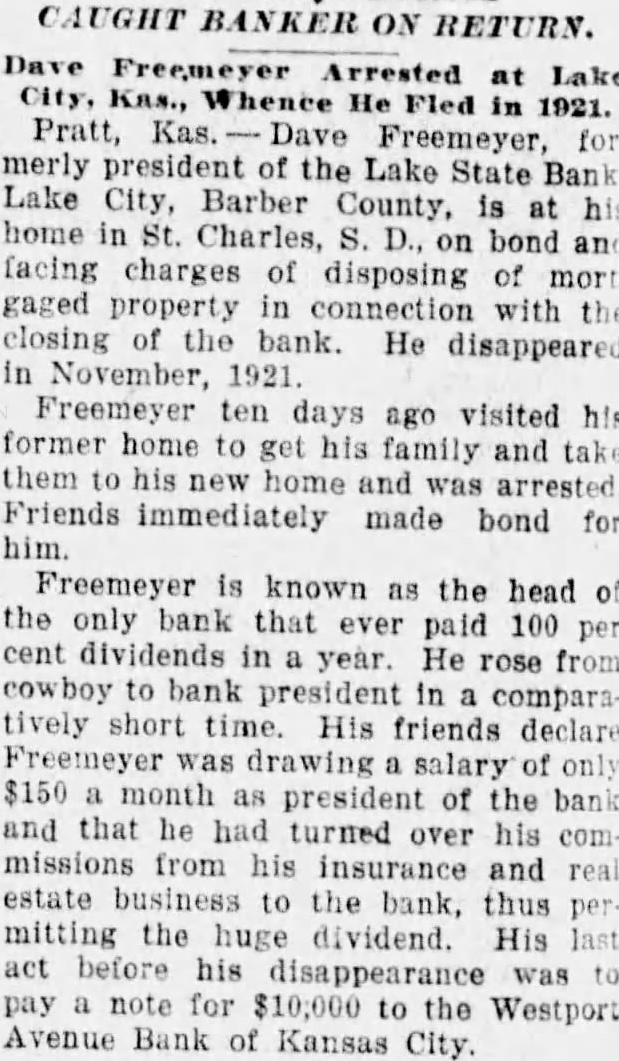
One of the most baffling of absconding banker cases that the state department has had in recent years was that in which Dave Freemyer, president of the Lake State bank, at Lake City, disappeared a little less than a year ago. Freemyer took a load of cattle to Kansas City and disposed of them. He got a draft for the money and mailed it back to his bank, and that was the last that was ever heard of him in a direct way. His bank was involved, but the state department got enough money out of his property to make up all losses in which the state was interested.
Conklin's Career Spectacular.
Recently it was reported that he was living in North Dakota, but no one in Topeka seems to know for certain whatever became of him.
Of all the absconding Kansas bankers of recent years, it is said that Edward J. Conklin's operations were the most spectacular. A short time before he ran away he made a trip to Europe, and all during the time that he was looting the institutions with which he was connected he was one of the "best livers" in Emporia, a leader in business and social circles and a man who was held in high esteem by all of his associates.