Americus National Bank (Americus, GA)

Episode Information

Episode Type
Suspension β†’ Closure
Start Date
February 3, 1914
Location
Americus, Georgia (32.072, -84.233)
Bank Type
national
Charter Number
8305

Metadata

Receivership Details

Depositor recovery rate
45.5%
Date receivership started
1914-02-03
Date receivership terminated
1918-10-31
OCC cause of failure
Fraud
Share of assets assessed as good
44.3%
Share of assets assessed as doubtful
46.7%
Share of assets assessed as worthless
9.0%

Notes

Suspension followed discovery of large unauthorized overdrafts and disappearance of an assistant cashier; receiver appointed and bank liquidated.

Events (5)

1. July 14, 1906 Chartered
Source
historical_nic
2. February 3, 1914 Suspension
Cause
Bank Specific Adverse Info
Cause Details
Large unauthorized overdrafts discovered, alleged disappearance of $2,500 in cash and missing assistant cashier G. D. Wheatley Jr.
Newspaper Excerpt
The Americus National Bank, which suspended Tuesday, may reach $100,000 ...
Source
newspapers
3. February 3, 1914 Receivership
Source
historical_nic
4. February 5, 1914 Receivership
Newspaper Excerpt
The comptroller of the currency today named T. C. Dunlap of Atlanta, receiver for the Americus National bank.
Source
newspapers
5. November 16, 1914 Other
Newspaper Excerpt
The first dividend payment made to creditors and depositors, of the defunct Americus National bank, was paid this morning ... the first ten per cent dividend.
Source
newspapers

Newspaper Articles (24)

Article from Atlanta Georgian, February 4, 1914

Click image to open full size in new tab

Article Text

BANK DEFICIT MAY REACH $100,000 Unauthorized Overdrafts Assigned as Cause of Suspension of Americus institution. AMERICUS, Feb. 4.-The deficit of the Americus National Bank, which suspended Tuesday, may reach $100,000, Assistant Bank Examiner T. C. Dunlap has arrived and taken charge. He will make a report as soon as the tangled affairs can be straightened out. The assets of the bank are said to be $350,000 and liabilities more than $400,000. M. M. Lowry, the cashier, states that most of the deficit is due to unauthorized overdrafts. He states that one overdraft of $12,000 has already been discovered, but that it is perfectly safe. Much mystery surrounds the entire affair, and the 800 Americus depositors are at a loss as to exactly what to do. It is claimed the depositors will eventually get every cent and that the stockholders will be the only losers. The alleged mysterious disappearance of $2,500 in cash from the bank on Saturday is still unexplained. The whereabouts of G. D. Wheatley, Jr., the missing assistant cashier, has not yet been discovered. His father is still anxious for him to be located and return to Americus. He fears that he will be made the scapegoat of the bank tangle.


Article from Americus Times-Recorder, February 5, 1914

Click image to open full size in new tab

Article Text

ANXIETY OF LITTLE ONES REGARDING THEIR MONEY Baby Bankers Want to Know A Few Things Thrifty Americus kiddies-the finan ciers of the future-and there are many of them here, are not a little worked up over the suspension of the Americus National, which carries a savings department. in which scores of Americus children have Inog deposited their pennies, nickels and dimes. These embryo Carnegies and Hetty Greens want to know if their claims will have preference over those of the "grown-ups" of money-saving proclivities, and have been assured that they will get their precious pennies, darling dimes and nity nickels in due timemaybe. Many of these baby bankers have accounts ranging from a dollar to $100 and even $200 each in the savings bank, while the young sons of Mr. C. J. Clarke, thrifty young "newsies, have nearly $600 thus laid away. This division of the bank is capitalized at $15,000, but the "baby banks" have emptied probably twice that amount into the strong box. One fine young fellow, a manly school boy who earns a dollar every Saturday, has two years' wages thus deposited, and is spending some sleepless night just now.


Article from Atlanta Georgian, February 5, 1914

Click image to open full size in new tab

Article Text

BANK DEFICIT MAY REACH $100,000 Unauthorized Overdrafts Assigned as Cause of Suspension of Americus Institution. AMERICUS, Feb. 4.-The deficit of the Americus National Bank, which suspended Tuesday, may reach $100.0.00. Assistant Bank Examiner T.C. Dunlap has arrived and taken charge, He will make a report as soon as the tangled affairs can be straightened out. The assets of the bank are said to be $350,000 and liabilities more than $400,000. M. M. Lowry, the cashier, states that most of the deficit is due to unauthorized overdrafts. He states that one overdraft of $12,000 has already been discovered, but that it is perfectly safe. Much mystery surrounds the entire affair, and the 800 Americus depositors are at a loss as to exactly what to do. It is claimed the depositors will eventually get every cent and that the stockholders will be the only losers. The alleged mysterious disappearance of $2,500 in cash from the bank on Saturday is still unexplained. The whereabouts of G. D. Wheatley, Jr., the missing assistant cashier, has not yet been discovered. His father is still anxious for him to be located and return to Americus. He fears that he will be made the scapegoat of the bank tangle.


Article from The Pensacola Journal, February 6, 1914

Click image to open full size in new tab

Article Text

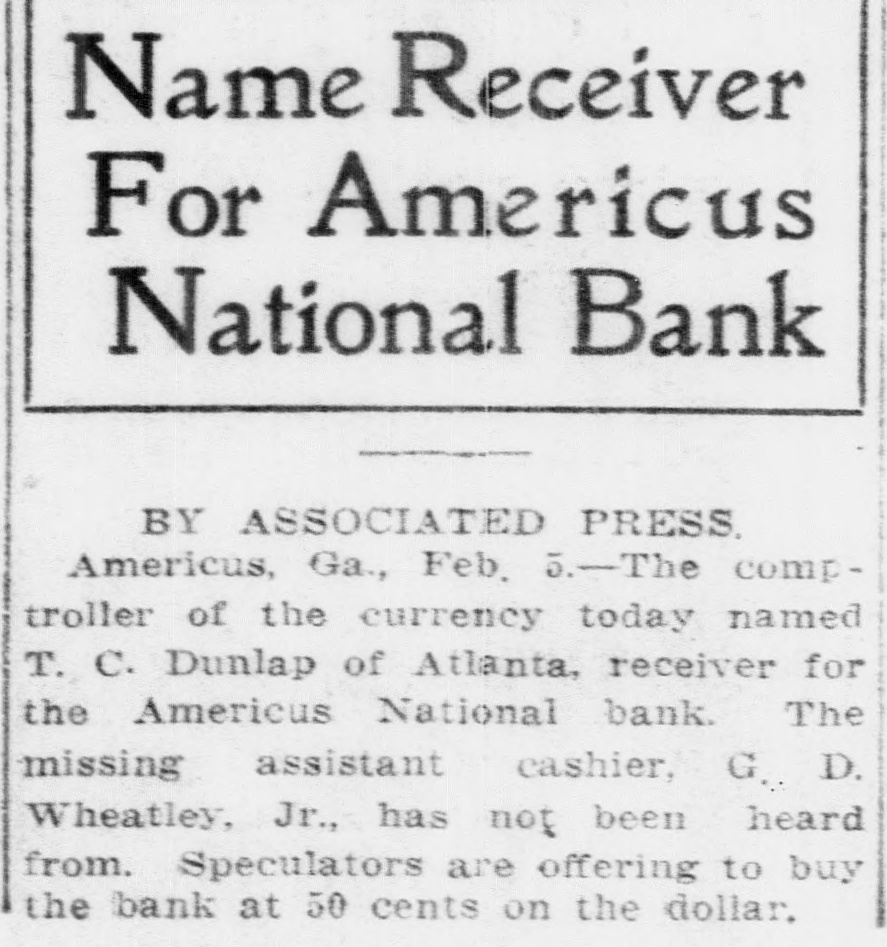
Name Receiver For Americus National Bank BY ASSOCIATED PRESS Americus, Ga., Feb. 5.-The comptroller of the currency today named T. C. Dunlap of Atlanta, receiver for the Americus National bank. The missing assistant cashier, G. D. Wheatley, Jr., has not been heard from. Speculators are offering to buy the bank at 50 cents on the dollar.


Article from The Odanah Star, February 6, 1914

Click image to open full size in new tab

Article Text

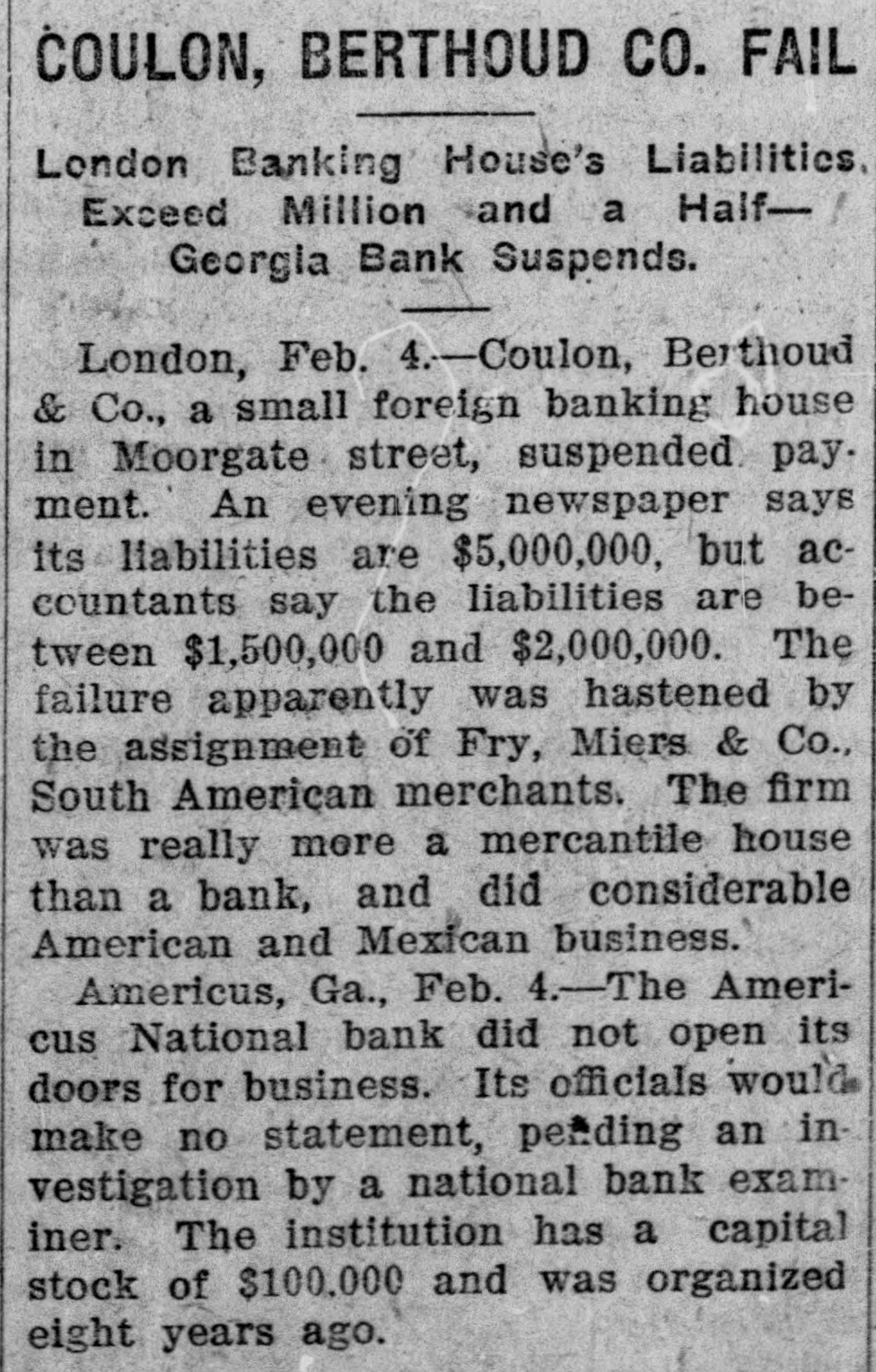
COULON, BERTHOUD CO. FAIL London Banking House's Liabilities. Exceed Million and a HalfGeorgia Bank Suspends. London, Feb. 4.-Coulon, Berthoud & Co., a small foreign banking house in Moorgate street, suspended pay. ment. An evening newspaper says its liabilities are $5,000,000, but accountants say the liabilities are between $1,500,000 and $2,000,000. The failure apparently was hastened by the assignment of Fry, Miers & Co., South American merchants. The firm was really more a mercantile house than a bank, and did considerable American and Mexican business. Americus, Ga., Feb. 4.-The Americus National bank did not open its doors for business. Its officials would make no statement, pending an investigation by a national bank examiner. The institution has a capital stock of $100,000 and was organized eight years ago.


Article from Americus Times-Recorder, February 7, 1914

Click image to open full size in new tab

Article Text

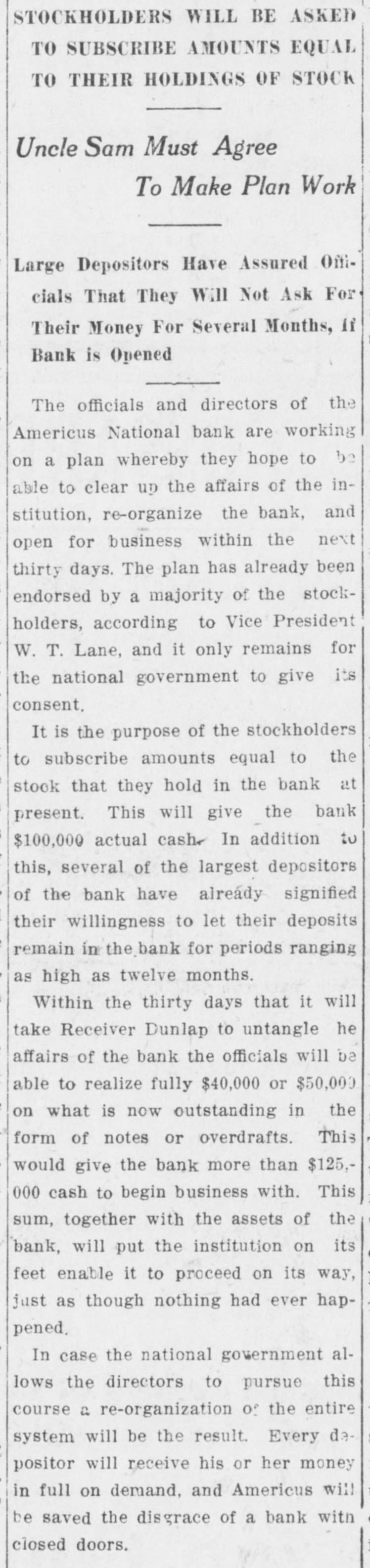
STOCKHOLDERS WILL BE ASKED TO SUBSCRIBE AMOUNTS EQUAL TO THEIR HOLDINGS OF STOCK Uncle Sam Must Agree To Make Plan Work Large Depositors Have Assured Officials That They Will Not Ask For Their Money For Several Months, If Bank is Opened The officials and directors of the Americus National bank are working on a plan whereby they hope to be able to clear up the affairs of the institution, re-organize the bank, and open for business within the next thirty days. The plan has already been endorsed by a majority of the stockholders, according to Vice President W. T. Lane, and it only remains for the national government to give its consent. It is the purpose of the stockholders to subscribe amounts equal to the stook that they hold in the bank at present. This will give the bank $100,000 actual cash. In addition to this, several of the largest depositors of the bank have alreΓ‘dy signified their willingness to let their deposits remain in the bank for periods ranging as high as twelve months. Within the thirty days that it will take Receiver Dunlap to untangle he affairs of the bank the officials will be able to realize fully $40,000 or $50,000 on what is now outstanding in the form of notes or overdrafts. This would give the bank more than $125,000 cash to begin business with. This sum, together with the assets of the bank, will put the institution on its feet enable it to proceed on its way, just as though nothing had ever happened. In case the national government allows the directors to pursue this course a re-organization of the entire system will be the result. Every depositor will receive his or her money in full on demand, and Americus will be saved the disgrace of a bank with closed doors.


Article from Atlanta Georgian, February 8, 1914

Click image to open full size in new tab

Article Text

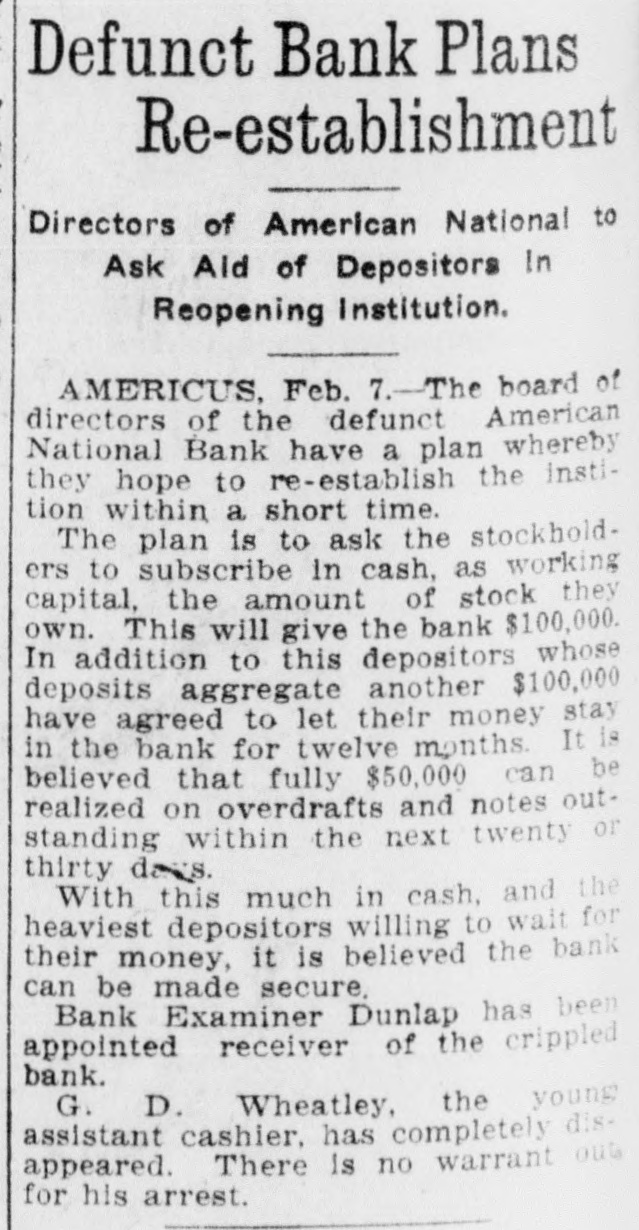
Defunct Bank Plans Re-establishment Directors of American National to Ask Ald of Depositors In Reopening Institution. AMERICUS, Feb. 7.-The board of directors of the defunct American National Bank have a plan whereby they hope to re-establish the instition within a short time. The plan is to ask the stockholders to subscribe in cash, as working capital, the amount of stock they own. This will give the bank $100,000. In addition to this depositors whose deposits aggregate another $100,000 have agreed to let their money stay in the bank for twelve months. It is believed that fully $50,000 can be realized on overdrafts and notes outstanding within the next twenty or thirty days. With this much in cash, and the heaviest depositors willing to wait for their money, it is believed the bank can be made secure. Bank Examiner Dunlap has been appointed receiver of the crippled bank. G. D. Wheatley, the young assistant cashier, has completely disappeared. There is no warrant out for his arrest.


Article from Americus Times-Recorder, February 11, 1914

Click image to open full size in new tab

Article Text

DEVISING PLANS FOR RESUMPTION BANK'S BUSINESS OFFICERS ARE THUS ENGAGED Prospect Seems to Brighten Somew While depositors of the suspended bank here do not doubt that they will, eventually, get back all of their money, the fact that considerable delay may necessarily ensue before the final installment is paid, as usually is the case in bank settlements, disturbs them no little. They would prefer to have it paid back to them as it was deposited in many instances-in a lump sum. But circumstances alter cases and they will be glad now to get it back at all-lump sum or in lumps of any size. Progress is being made in the examination of the bank's books and records but it may yet require several weeks to complete this herculean task, owing to the condition in which many of the books were found. ,In the meantime Receiver Dunlap has no information for the public. It is said, however, that a well-devised plan is now under consideration and which, if adopted, may mean the early restoration of the Americus National and a resumption of business. This statement is made upon authority of a gentleman allied with the bank, and who is in position to know. The proposition, he said, was fully discussed yesterday. Details were not given, but two plans, he stated, were being considered. One plan has in view the early opening of the bank and immediate payment of depositors. The other plan contemplates the organization of another bank, that will take over in its entirety the crippled Americus National, pay off its obligations and continue business under a new name and charter. The Americus National has valuable assets, and this latter proposition, it is asserted, will not be a bad venture. At all events the officers and friends of the institution are hard at work in an attempt to formulate some plan that will relieve as soon as possible the tense situation and, more especially to pay back to the 800 depositors the amounts due them. Friends of Assistant Cashier G. D. Wheatley, Jr., express the belief that he will return to Americus in a few days-perhaps this week-though this is but a surmise. They do not think he has gone beyond Atlanta, where friends saw him only a few days ago. That he will soon return home no one seems to doubt.


Article from Americus Times-Recorder, February 24, 1914

Click image to open full size in new tab

Article Text

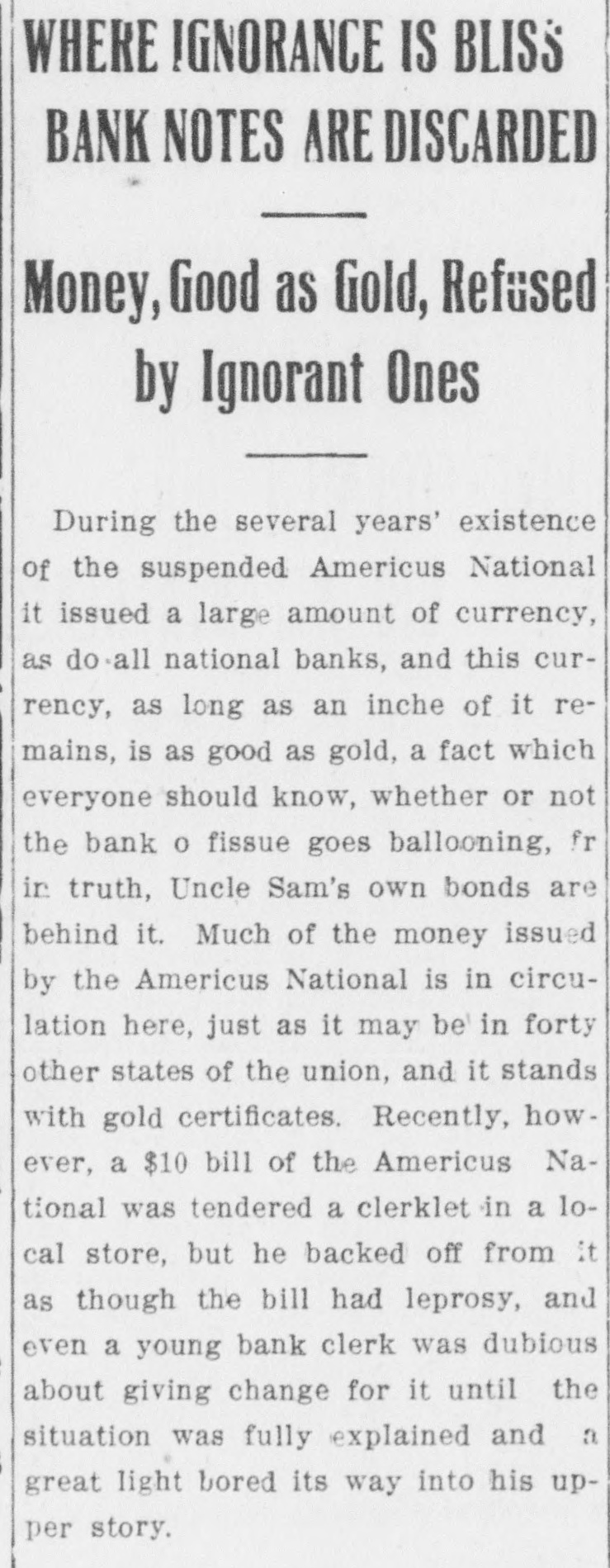
WHERE IGNORANCE IS BLISS
BANK NOTES ARE DISCARDED
Money, Good as Gold, Refused by Ignorant Ones

During the several years' existence of the suspended Americus National it issued a large amount of currency, as do all national banks, and this currency, as long as an inche of it remains, is as good as gold, a fact which everyone should know, whether or not the bank o fissue goes ballooning, fr in truth, Uncle Sam's own bonds are behind it. Much of the money issued by the Americus National is in circulation here, just as it may be in forty other states of the union, and it stands with gold certificates. Recently, however, a $10 bill of the Americus National was tendered a clerklet in a local store, but he backed off from it as though the bill had leprosy, and even a young bank clerk was dubious about giving change for it until the situation was fully explained and a great light bored its way into his upper story.


Article from Americus Times-Recorder, February 25, 1914

Click image to open full size in new tab

Article Text

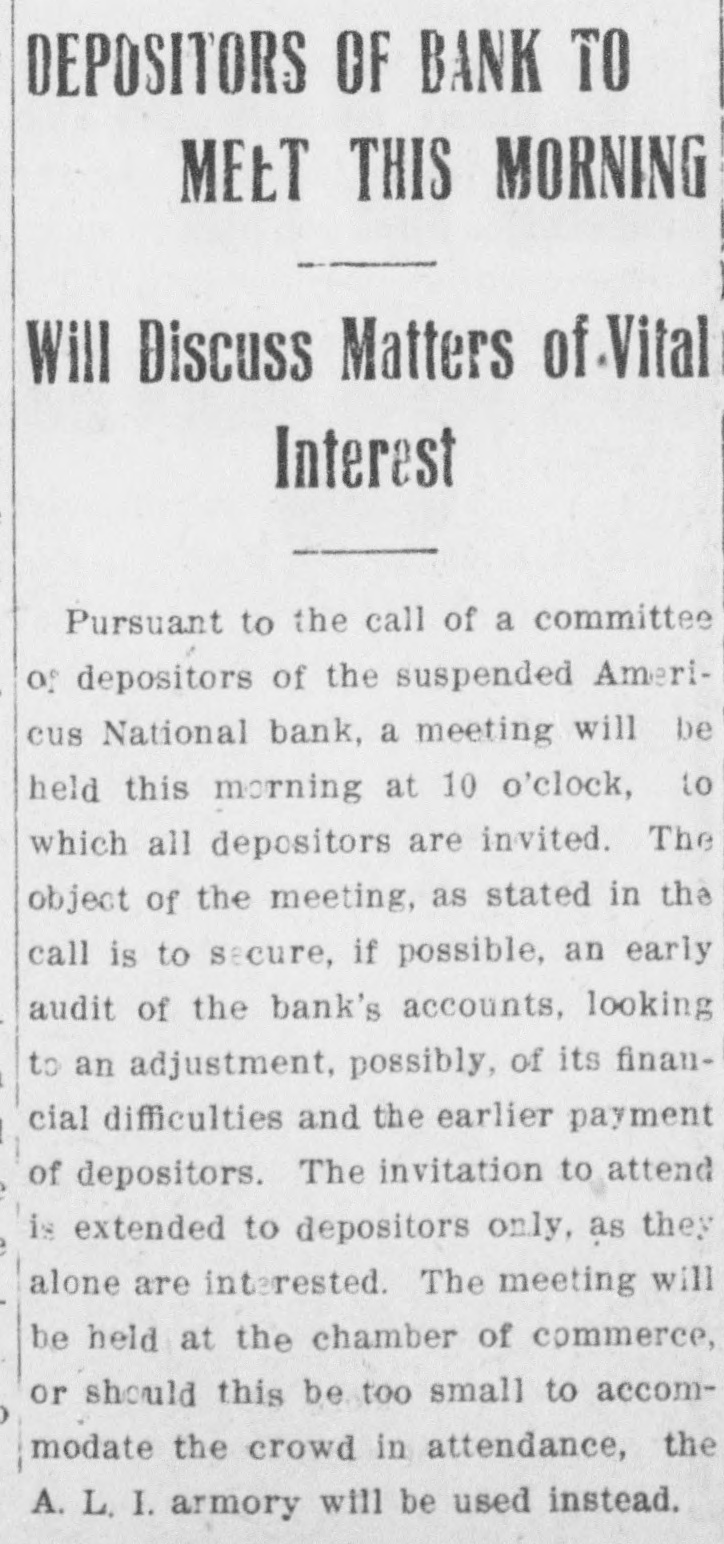
DEPOSITORS OF BANK TO MEET THIS MORNING Will Discuss Matters of-Vital Interest Pursuant to the call of a committee of depositors of the suspended Americus National bank, a meeting will be held this morning at 10 o'clock, to which all depositors are invited. The object of the meeting, as stated in the call is to secure, if possible, an early audit of the bank's accounts, looking to an adjustment, possibly, of its financial difficulties and the earlier payment of depositors. The invitation to attend is extended to depositors only, as they alone are interested. The meeting will be held at the chamber of commerce, or should this be too small to accommodate the crowd in attendance, the A. L. I. armory will be used instead.


Article from Americus Times-Recorder, March 29, 1914

Click image to open full size in new tab

Article Text

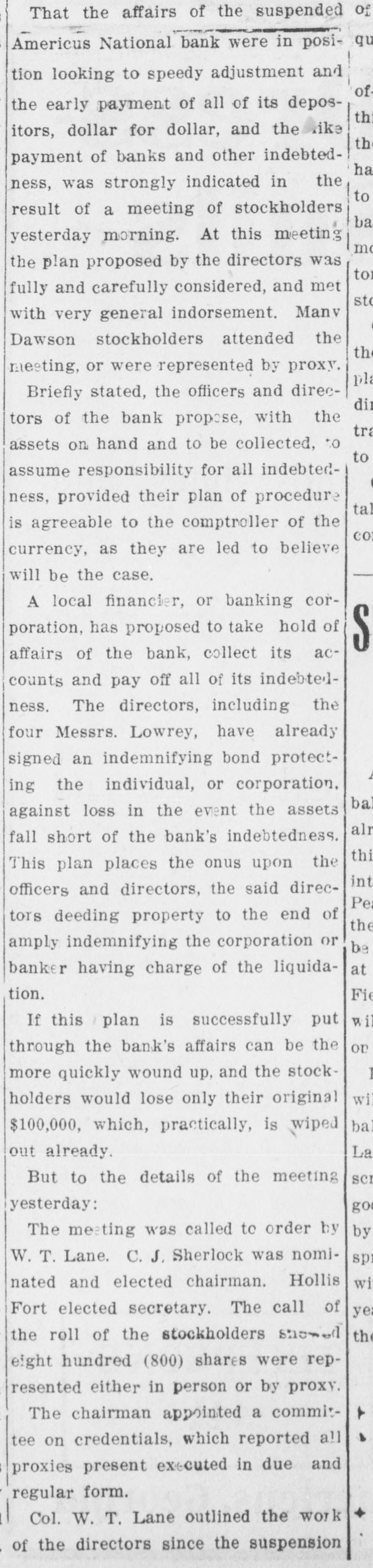
That the affairs of the suspended qu Americus National bank were in position looking to speedy adjustment and of the early payment of all of its deposth itors, dollar for dollar, and the like th payment of banks and other indebtedha ness, was strongly indicated in the to result of a meeting of stockholders ba yesterday morning. At this meeting m the plan proposed by the directors was to fully and carefully considered, and met st with very general indorsement. Manv Dawson stockholders attended the th meeting, or were represented by proxy. pla Briefly stated, the officers and direcdi tors of the bank propose, with the tra assets on hand and to be collected, to to assume responsibility for all indebtedness, provided their plan of procedure tal is agreeable to the comptroller of the CO currency, as they are led to believe will be the case. A local financier, or banking corporation, has proposed to take hold of affairs of the bank, collect its accounts and pay off all of its indebtedness. The directors, including the four Messrs. Lowrey, have already signed an indemnifying bond protecting the individual, or corporation. bai against loss in the event the assets alr fall short of the bank's indebtedness. thi This plan places the onus upon the int officers and directors, the said direcPea tors deeding property to the end of the amply indemnifying the corporation or be at banker having charge of the liquidation. Fie If this plan is successfully put through the bank's affairs can be the more quickly wound up, and the stockwi holders would lose only their original ba $100,000, which, practically, is wiped La out already. SCI But to the details of the meeting yesterday: go by The meeting was called to order by sp: W. T. Lane. C. S. Sherlock was nomiwi nated and elected chairman. Hollis Fort elected secretary. The call of year the the roll of the stockholders shored eight hundred (800) shares were represented either in person or by proxy. The chairman appointed a committee on credentials, which reported all proxies present executed in due and regular form. Col. W. T. Lane outlined the work of the directors since the suspension


Article from The Dawson News, March 31, 1914

Click image to open full size in new tab

Article Text

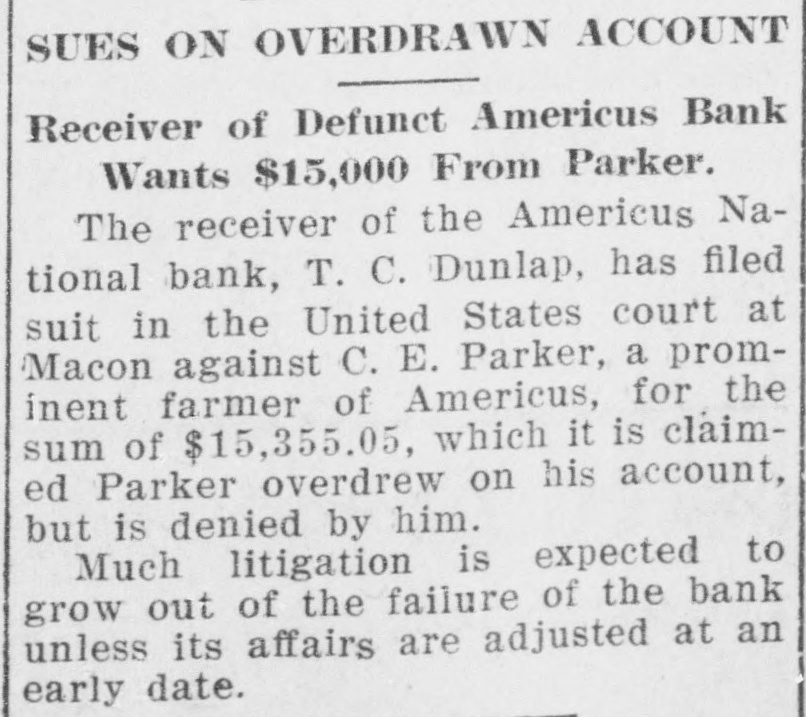
SUES ON OVERDRAWN ACCOUNT Receiver of Defunct Americus Bank Wants $15,000 From Parker. The receiver of the Americus National bank, T. C. Dunlap, has filed suit in the United States court at Macon against C. E. Parker, a prominent farmer of Americus, for the sum of $15,355.05, which it is claimed Parker overdrew on his account, but is denied by him. Much litigation is expected to grow out of the failure of the bank unless its affairs are adjusted at an early date.


Article from The Dawson News, April 21, 1914

Click image to open full size in new tab

Article Text

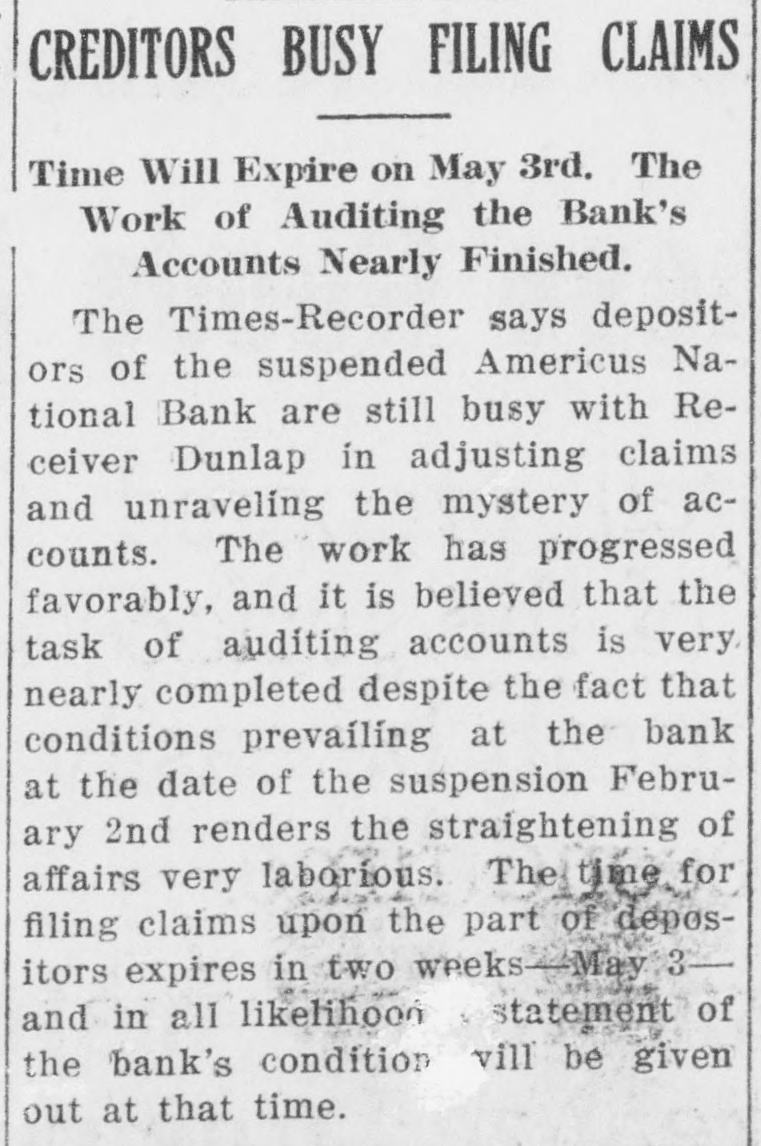
CREDITORS BUSY FILING CLAIMS Time Will Expire on May 3rd. The Work of Auditing the Bank's Accounts Nearly Finished. The Times-Recorder says depositors of the suspended Americus National Bank are still busy with Receiver Dunlap in adjusting claims and unraveling the mystery of accounts. The work has progressed favorably, and it is believed that the task of auditing accounts is very nearly completed despite the fact that conditions prevailing at the bank at the date of the suspension February 2nd renders the straightening of affairs very laborious. The time for filing claims upon the part of depositors expires in two weeks May 3 and in all likelihoon statement of the bank's condition vill be given out at that time.


Article from Americus Times-Recorder, May 31, 1914

Click image to open full size in new tab

Article Text

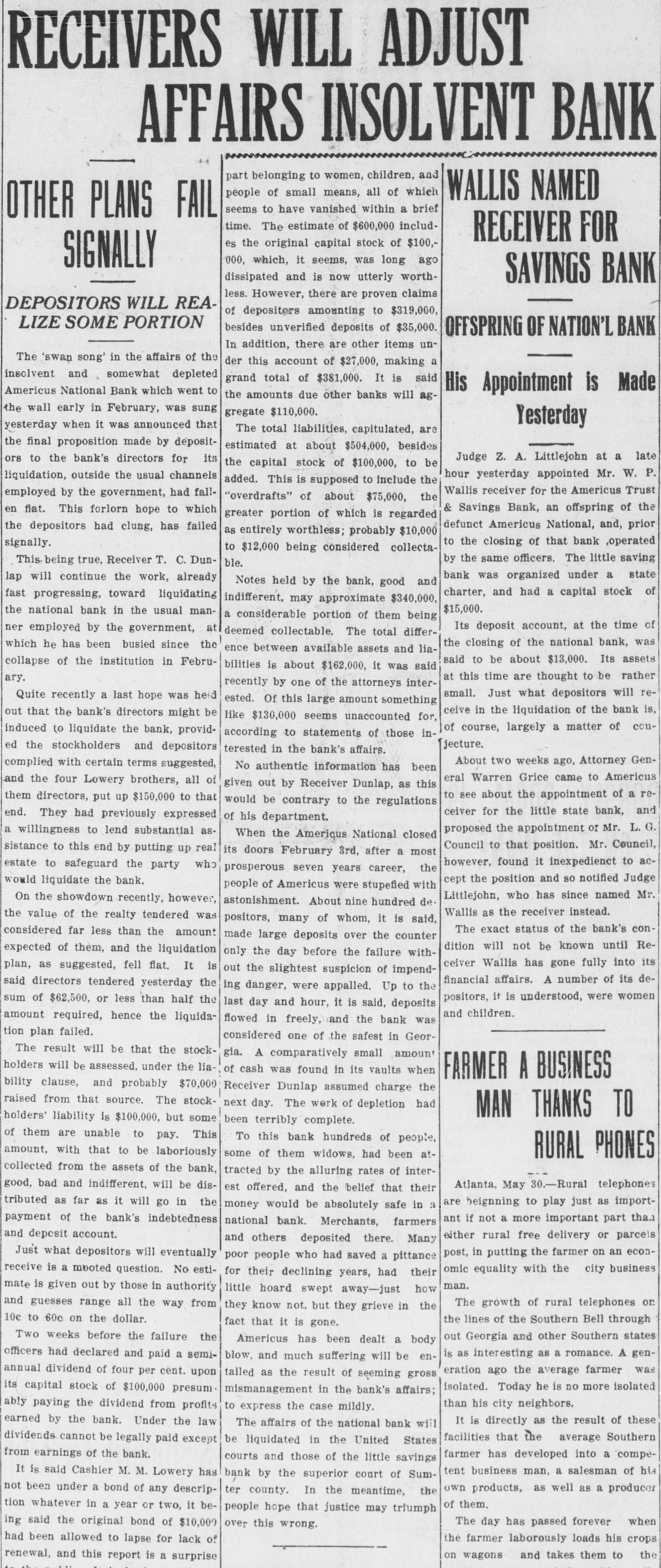
RECEIVERS WILL ADJUST AFFAIRS INSOLVENT BANK 48 part belonging to women, children, and people of small means, all of which WALLIS NAMED seems to have vanished within a brief FAIL OTHER PLANS time. The estimate of $600,000 includRECEIVER FOR es the original capital stock of $100,000, which, it seems, was long ago SIGNALLY dissipated and is now utterly worthSAVINGS BANK less. However, there are proven claims DEPOSITORS WILL REAof depositors amounting to $319,000, LIZE SOME PORTION besides unverified deposits of $35,000. OFFSPRING OF NATION'L BANK In addition, there are other items unThe 'swap song' in the affairs of the der this account of $27,000, making a insolvent and somewhat depleted grand total of $381,000. It is said Americus National Bank which went to His Appointment is Made the amounts due other banks will agthe wall early in February, was sung gregate $110,000. Yesterday yesterday when it was announced that The total liabilities, capitulated, are the final proposition made by depositestimated at about $504,000, besides Judge Z. A. Littlejohn at a late ors to the bank's directors for its the capital stock of $100,000, to be hour yesterday appointed Mr. W. P. liquidation, outside the usual channels added. This is supposed to include the Wallis receiver for the Americus Trust employed by the government, had fall"overdrafts" of about $75,000, the & Savings Bank, an offspring of the en flat. This forlorn hope to which greater portion of which is regarded defunct Americus National, and, prior the depositors had clung, has failed as entirely worthless; probably $10,000 to the closing of that bank ,operated signally. to $12,000 being considered collectaby the same officers. The little saving This being true, Receiver T. C. Dunble. bank was organized under a state lap will continue the work, already Notes held by the bank, good and charter, and had a capital stock of fast progressing, toward liquidating indifferent, may approximate $340,000, $15,000. the national bank in the usual mana considerable portion of them being Its deposit account, at the time of ner employed by the government, at deemed collectable. The total differthe closing of the national bank, was which he has been busied since the ence between available assets and liasaid to be about $13,000. Its assets collapse of the institution in Februbilities is about $162,000, it was said at this time are thought to be rather ary. recently by one of the attorneys intersmall. Just what depositors will reQuite recently a last hope was held ested. Of this large amount something ceive in the liquidation of the bank is, out that the bank's directors might be like $130,000 seems unaccounted for, of course, largely a matter of couinduced to liquidate the bank, providaccording to statements of those injecture. ed the stockholders and depositors terested in the bank's affairs. About two weeks ago, Attorney Gencomplied with certain terms suggested, No authentic information has been eral Warren Grice came to Americus and the four Lowery brothers, all of given out by Receiver Dunlap, as this to see about the appointment of a rethem directors, put up $150,000 to that would be contrary to the regulations ceiver for the little state bank, and end. They had previously expressed of his department. proposed the appointment of Mr. L. G. a willingness to lend substantial asWhen the Americus National closed Council to that position. Mr. Council, sistance to this end by putting up real its doors February 3rd, after a most however, found it inexpedienct to acestate to safeguard the party who prosperous seven years career, the cept the position and so notified Judge would liquidate the bank. people of Americus were stupefied with Littlejohn, who has since named Mr. On the showdown recently, however, astonishment. About nine hundred deWallis as the receiver instead. the value of the realty tendered was positors, many of whom, it is said, The exact status of the bank's conconsidered far less than the amount made large deposits over the counter dition will not be known until Reexpected of them, and the liquidation only the day before the failure withceiver Wallis has gone fully into its plan, as suggested, fell flat, It is out the slightest suspicion of impendfinancial affairs. A number of its desaid directors tendered yesterday the ing danger, were appalled. Up to the positors, it is understood, were women sum of $62,500, or less than half the last day and hour, it is said, deposits and children. amount required, hence the liquidaflowed in freely, and the bank was tion plan failed. considered one of the safest in GeorThe result will be that the stockgia. A comparatively small amount holders will be assessed, under the liaof cash was found in its vaults when FARMER A BUSINESS bility clause, and probably $70,000 Receiver Dunlap assumed charge the raised from that source. The stocknext day. The work of depletion had MAN THANKS TO holders' liability is $100,000, but some been terribly complete. of them are unable to pay. This To this bank hundreds of people, amount, with that to be laboriously RURAL PHONES some of them widows, had been atcollected from the assets of the bank, tracted by the alluring rates of intergood, bad and indifferent, will be disAtlanta, May 30.-Rural telephones est offered, and the belief that their are beignning to play just as importtributed as far as it will go in the money would be absolutely safe in a payment of the bank's indebtedness ant if not a more important part than national bank. Merchants, farmers and deposit account. either rural free delivery or parcels and others deposited there. Many post, in putting the farmer on an econJust what depositors will eventually poor people who had saved a pittance omic equality with the city business receive is a mooted question. No estifor their declining years, had their man. mate is given out by those in authority little hoard swept away-just how The growth of rural telephones or and guesses range all the way from they know not, but they grieve in the 10c to 60c on the dollar. the lines of the Southern Bell through fact that it is gone. out Georgia and other Southern states Two weeks before the failure the Americus has been dealt a body is as interesting as a romance. A genofficers had declared and paid a semiblow, and much suffering will be eneration ago the average farmer was annual dividend of four per cent. upon tailed as the result of seeming gross isolated. Today he is no more isolated its capital stock of $100,000 presum. mismanagement in the bank's affairs; than his city neighbors. ably paying the dividend from profits to express the case mildly. earned by the bank. Under the law It is directly as the result of these The affairs of the national bank will facilities that the average Southern dividends cannot be legally paid except be liquidated in the United States from earnings of the bank. farmer has developed into a compecourts and those of the little savings tent business man, a salesman of his It is said Cashier M. M. Lowery has bank by the superior court of Sumown products, as well as a producer not been under a bond of any descripter county. In the meantime, the of them. tion whatever in a year or two, it bepeople hope that justice may triumph The day has passed forever when ing said the original bond of $10,000 over this wrong. had been allowed to lapse for lack of the farmer laborously loads his crops on wagons and takes them to the renewal, and this report is a surprise
Article from Americus Times-Recorder, September 30, 1914

Click image to open full size in new tab

Article Text

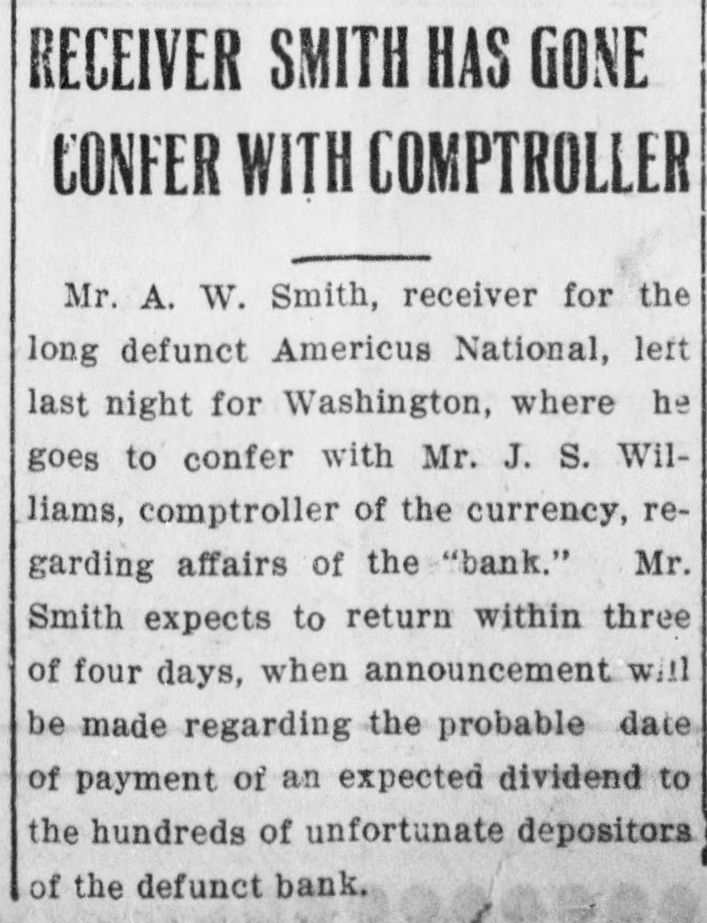
RECEIVER SMITH HAS GONE CONFER WITH COMPTROLLER Mr. A. W. Smith, receiver for the long defunct Americus National, left last night for Washington, where he goes to confer with Mr. J. S. Williams, comptroller of the currency, reMr. garding affairs of the "bank." Smith expects to return within three of four days, when announcement will be made regarding the probable date of payment of an expected dividend to the hundreds of unfortunate depositors of the defunct bank.


Article from Americus Times-Recorder, November 10, 1914

Click image to open full size in new tab

Article Text

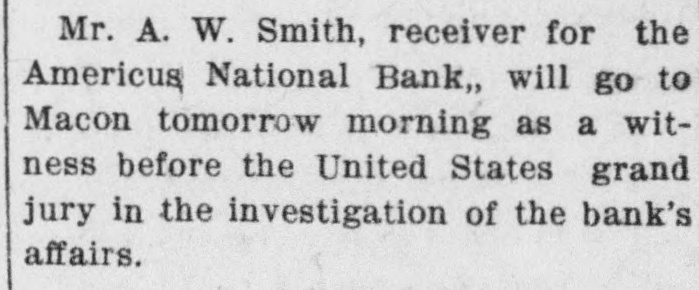
Mr. A. W. Smith, receiver for the Americus National Bank,, will go to Macon tomorrow morning as a witness before the United States grand jury in the investigation of the bank's affairs.


Article from Americus Times-Recorder, November 12, 1914

Click image to open full size in new tab

Article Text

WITNESSES DISAPPOINTED

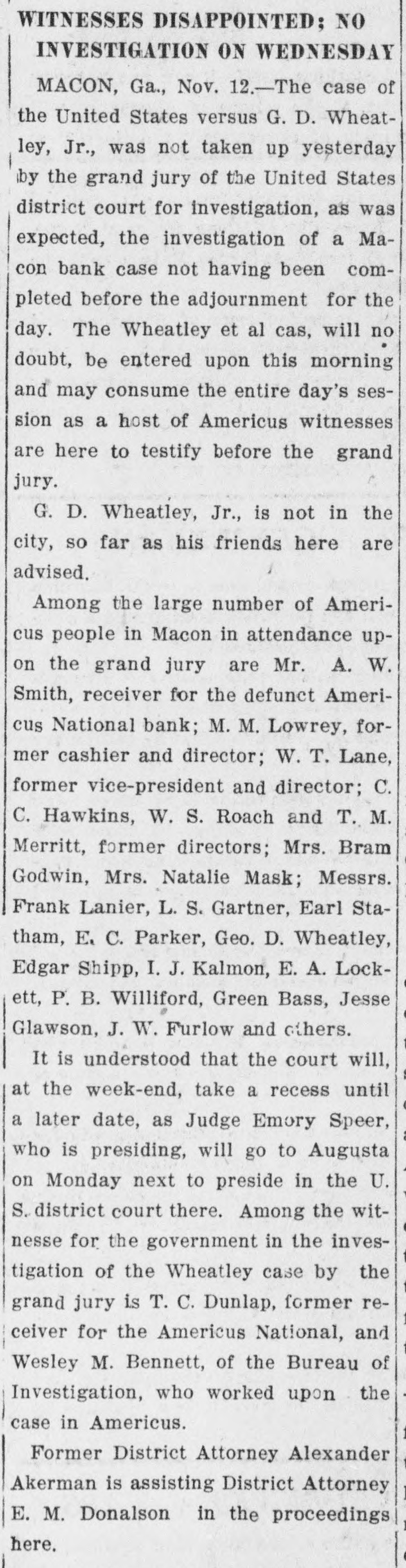
NO INVESTIGATION ON WEDNESDAY MACON, Ga., Nov. 12.-The case of the United States versus G. D. Wheatley, Jr., was not taken up yesterday by the grand jury of the United States district court for investigation, as was expected, the investigation of a Macon bank case not having been completed before the adjournment for the day. The Wheatley et al cas, will no doubt, be entered upon this morning and may consume the entire day's session as a host of Americus witnesses are here to testify before the grand jury. G. D. Wheatley, Jr., is not in the city, so far as his friends here are advised. Among the large number of Americus people in Macon in attendance upon the grand jury are Mr. A. W. Smith, receiver for the defunct Americus National bank; M. M. Lowrey, former cashier and director; W. T. Lane, former vice-president and director; C. C. Hawkins, W. S. Roach and T. M. Merritt, former directors; Mrs. Bram Godwin, Mrs. Natalie Mask; Messrs. Frank Lanier, L. S. Gartner, Earl Statham, E. C. Parker, Geo. D. Wheatley, Edgar Shipp, I. J. Kalmon, E. A. Lockett, P. B. Williford, Green Bass, Jesse Glawson, J. W. Furlow and others. It is understood that the court will, at the week-end, take a recess until a later date, as Judge Emory Speer, who is presiding, will go to Augusta on Monday next to preside in the U. S. district court there. Among the witnesse for the government in the investigation of the Wheatley case by the grand jury is T. C. Dunlap, former receiver for the Americus National, and Wesley M. Bennett, of the Bureau of Investigation, who worked upon the case in Americus. Former District Attorney Alexander Akerman is assisting District Attorney E. M. Donalson in the proceedings here.


Article from Americus Times-Recorder, November 14, 1914

Click image to open full size in new tab

Article Text

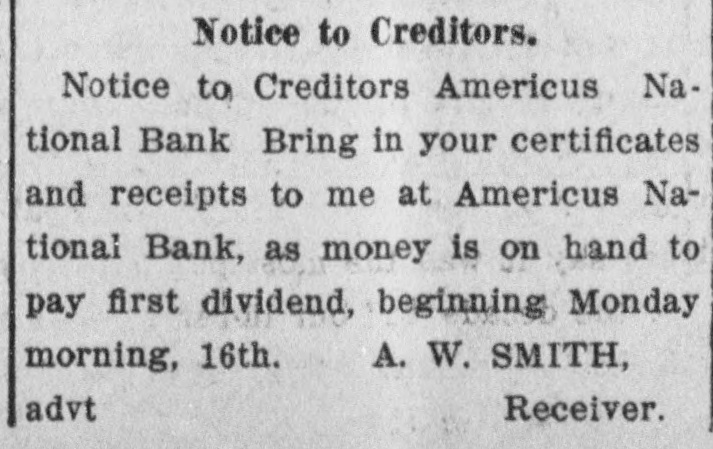
Notice to Creditors

Notice to Creditors Americus National Bank Bring in your certificates and receipts to me at Americus National Bank, as money is on hand to pay first dividend, beginning Monday A. W. SMITH, morning, 16th. advt Receiver.


Article from Americus Times-Recorder, November 16, 1914

Click image to open full size in new tab

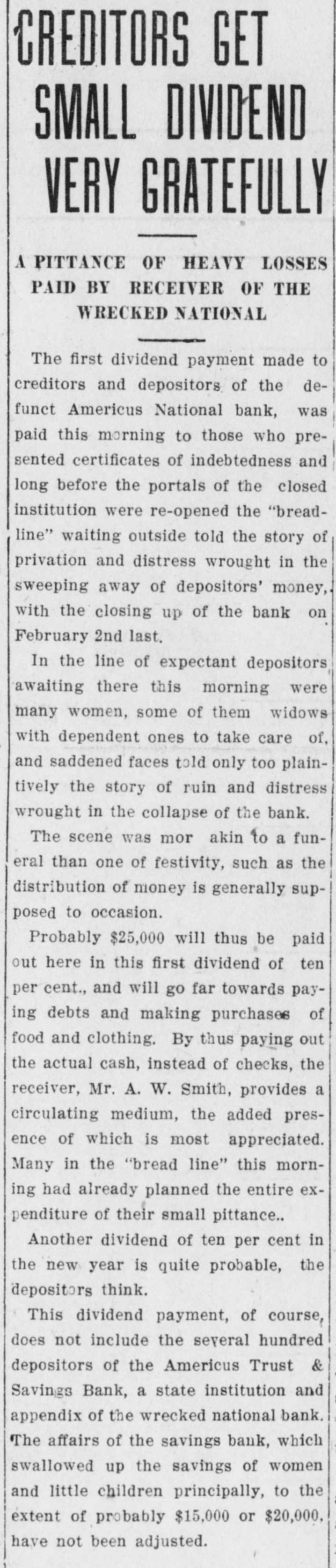
Article Text

CREDITORS GET SMALL DIVIDEND VERY GRATEFULLY A PITTANCE OF HEAVY LOSSES PAID BY RECEIVER OF THE WRECKED NATIONAL The first dividend payment made to creditors and depositors, of the defunct Americus National bank, was paid this morning to those who presented certificates of indebtedness and long before the portals of the closed institution were re-opened the "breadline" waiting outside told the story of privation and distress wrought in the sweeping away of depositors' money, with the closing up of the bank on February 2nd last. In the line of expectant depositors awaiting there this morning were many women, some of them widows with dependent ones to take care of, and saddened faces told only too plaintively the story of ruin and distress wrought in the collapse of the bank. The scene was mor akin to a funeral than one of festivity, such as the distribution of money is generally supposed to occasion. Probably $25,000 will thus be paid out here in this first dividend of ten per cent., and will go far towards paying debts and making purchases of food and clothing. By thus paying out the actual cash, instead of checks, the receiver, Mr. A. W. Smith, provides a circulating medium, the added presence of which is most appreciated. Many in the "bread line" this morning had already planned the entire expenditure of their small pittance.. Another dividend of ten per cent in the new year is quite probable, the depositors think. This dividend payment, of course, does not include the several hundred & depositors of the Americus Trust Savings Bank, a state institution and appendix of the wrecked national bank. The affairs of the savings bank, which swallowed up the savings of women and little children principally, to the extent of probably $15,000 or $20,000, have not been adjusted.


Article from Americus Times-Recorder, November 16, 1914

Click image to open full size in new tab

Article Text

Notice to Creditors

Notice to Creditors Americus National Bank Bring in your certificates and receipts to me at Americus National Bank, as money is on hand to pay first dividend, beginning Monday A. W. SMITH, morning, 16th. Receiver. advt


Article from Americus Times-Recorder, November 20, 1914

Click image to open full size in new tab

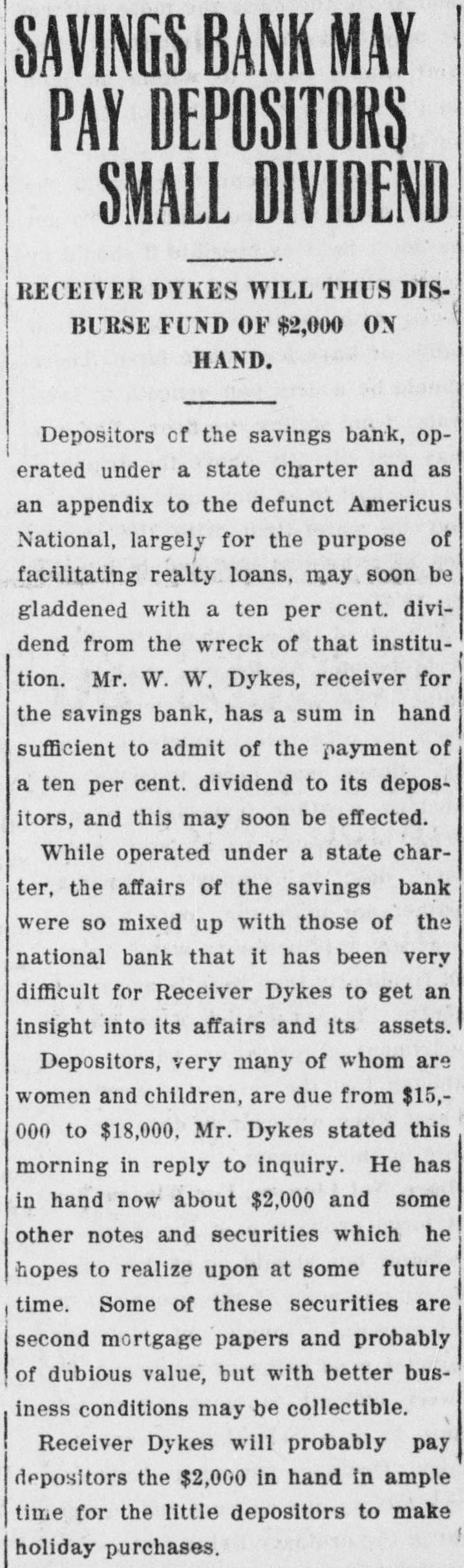
Article Text

SAVINGS BANK MAY PAY DEPOSITORS SMALL DIVIDEND RECEIVER DYKES WILL THUS DISBURSE FUND OF $2,000 ON HAND. Depositors of the savings bank, operated under a state charter and as an appendix to the defunct Americus National, largely for the purpose of facilitating realty loans, may soon be gladdened with a ten per cent. dividend from the wreck of that institution. Mr. W. W. Dykes, receiver for the savings bank, has a sum in hand sufficient to admit of the payment of a ten per cent. dividend to its depositors, and this may soon be effected. While operated under a state charter, the affairs of the savings bank were so mixed up with those of the national bank that it has been very difficult for Receiver Dykes to get an insight into its affairs and its assets. Depositors, very many of whom are women and children, are due from $15,000 to $18,000, Mr. Dykes stated this morning in reply to inquiry. He has in hand now about $2,000 and some other notes and securities which he hopes to realize upon at some future time. Some of these securities are second mortgage papers and probably of dubious value, but with better business conditions may be collectible. Receiver Dykes will probably pay depositors the $2,000 in hand in ample time for the little depositors to make holiday purchases.


Article from The Dawson News, November 24, 1914

Click image to open full size in new tab

Article Text

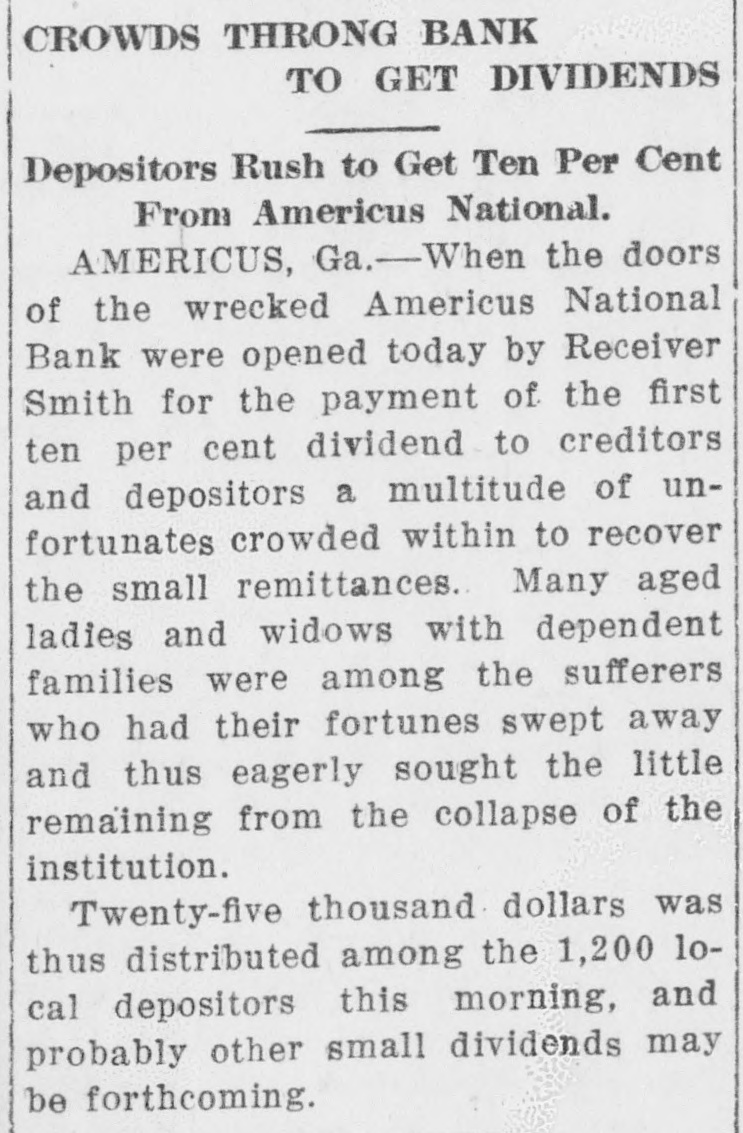
CROWDS THRONG BANK TO GET DIVIDENDS Depositors Rush to Get Ten Per Cent From Americus National. AMERICUS, Ga.-When the doors of the wrecked Americus National Bank were opened today by Receiver Smith for the payment of the first ten per cent dividend to creditors and depositors a multitude of unfortunates crowded within to recover the small remittances. Many aged ladies and widows with dependent families were among the sufferers who had their fortunes swept away and thus eagerly sought the little remaining from the collapse of the institution. Twenty-five thousand dollars was thus distributed among the 1,200 local depositors this morning, and probably other small dividends may be forthcoming.


Article from The Dawson News, December 1, 1914

Click image to open full size in new tab

Article Text

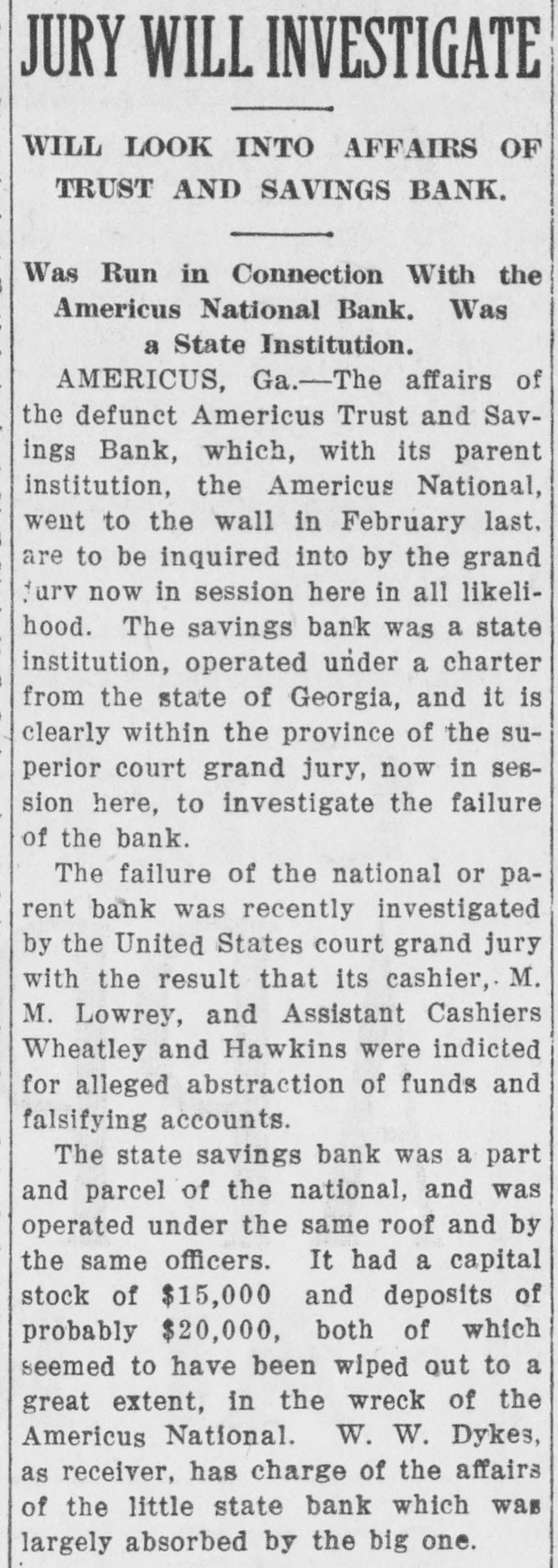
JURY WILL INVESTIGATE WILL LOOK INTO AFFAIRS OF TRUST AND SAVINGS BANK. Was Run in Connection With the Americus National Bank. Was a State Institution. AMERICUS, Ga.-The affairs of the defunct Americus Trust and Savings Bank, which, with its parent institution, the Americus National, went to the wall in February last. are to be inquired into by the grand jurv now in session here in all likelihood. The savings bank was a state institution, operated under a charter from the state of Georgia, and it is clearly within the province of the superior court grand jury, now in session here, to investigate the failure of the bank. The failure of the national or parent bank was recently investigated by the United States court grand jury with the result that its cashier, M. M. Lowrey, and Assistant Cashiers Wheatley and Hawkins were indicted for alleged abstraction of funds and falsifying accounts. The state savings bank was a part and parcel of the national, and was operated under the same roof and by the same officers. It had a capital stock of $15,000 and deposits of probably $20,000, both of which seemed to have been wiped out to a great extent, in the wreck of the Americus National. W. W. Dykes, as receiver, has charge of the affairs of the little state bank which was largely absorbed by the big one.


Article from The Dawson News, October 26, 1915

Click image to open full size in new tab

Article Text

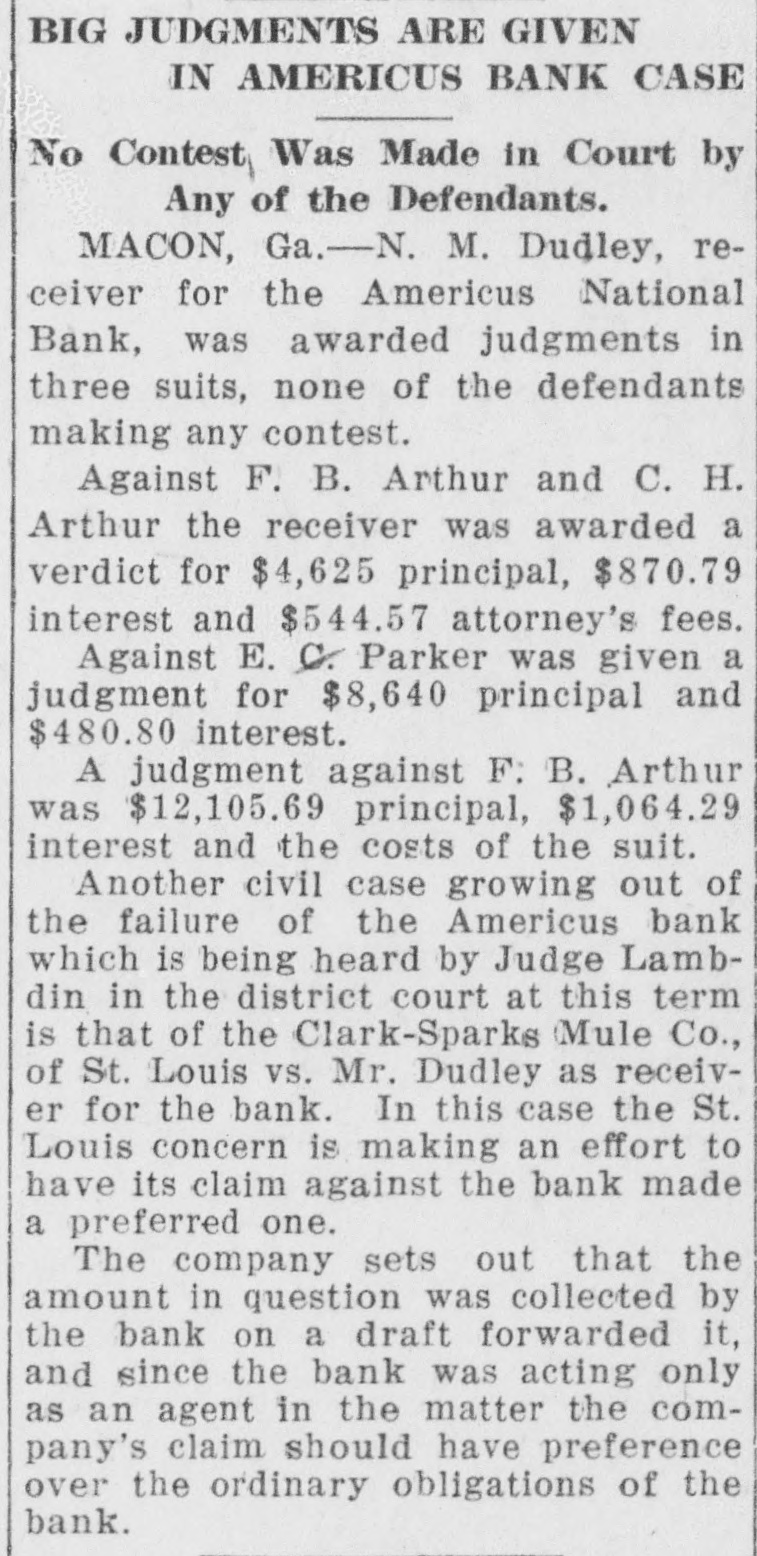
BIG JUDGMENTS ARE GIVEN
IN AMERICUS BANK CASE

No Contest Was Made in Court by Any of the Defendants.

MACON, Ga. -N. M. Dudley, receiver for the Americus National Bank, was awarded judgments in three suits, none of the defendants making any contest.

Against F. B. Arthur and C. H. Arthur the receiver was awarded a verdict for $4,625 principal, $870.79 interest and $544.57 attorney's fees. Against E. C. Parker was given a judgment for $8,640 principal and $480.80 interest.

A judgment against F. B. Arthur was $12,105.69 principal, $1,064.29 interest and the costs of the suit.

Another civil case growing out of the failure of the Americus bank which is being heard by Judge Lambdin in the district court at this term is that of the Clark-Sparks Mule Co., of St. Louis vs. Mr. Dudley as receiver for the bank. In this case the St. Louis concern is making an effort to have its claim against the bank made a preferred one.

The company sets out that the amount in question was collected by the bank on a draft forwarded it, and since the bank was acting only as an agent in the matter the company's claim should have preference over the ordinary obligations of the bank.