Article Text
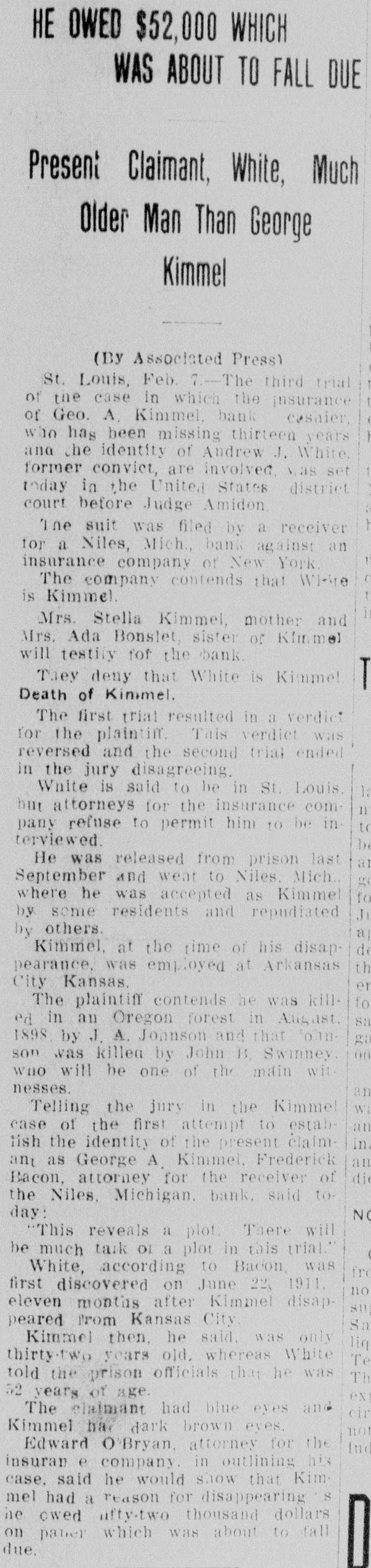
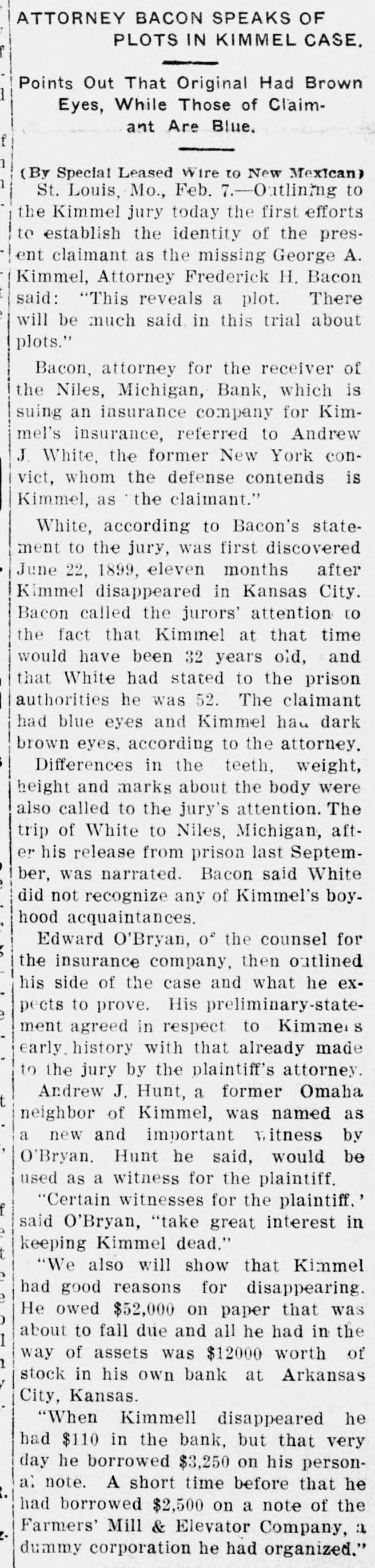
ATTORNEY BACON SPEAKS OF PLOTS IN KIMMEL CASE. Points Out That Original Had Brown Eyes, While Those of Claimant Are Blue. (By Special Leased Wire to New Mexican) St. Louis, Mo., Feb. 7.-Ontlining to the Kimmel jury today the first efforts to establish the identity of the present claimant as the missing George A. Kimmel, Attorney Frederick H. Bacon said: "This reveals a plot. There will be much said in this trial about plots." Bacon, attorney for the receiver of the Niles, Michigan, Bank, which is suing an insurance company for Kimmel's insurance, referred to Andrew J. White, the former New York convict, whom the defense contends is Kimmel, as the claimant." White, according to Bacon's statement to the jury, was first discovered June 22, 1899, eleven months after Kimmel disappeared in Kansas City. Bacon called the jurors' attention to the fact that Kimmel at that time would have been 32 years old, and that White had stated to the prison authorities he was 52. The claimant had blue eyes and Kimmel hau dark brown eyes, according to the attorney. Differences in the teeth, weight, height and marks about the body were also called to the jury's attention. The trip of White to Niles, Michigan, after his release from prison last September, was narrated. Bacon said White did not recognize any of Kimmel's boyhood acquaintances. Edward O'Bryan, 0 ° the counsel for the insurance company, then outlined his side of the case and what he expects to prove. His preliminary-statement agreed in respect to Kimmers early history with that already made to the jury by the plaintiff's attorney. Andrew J. Hunt, a former Omaha neighbor of Kimmel, was named as a new and important witness by O'Bryan. Hunt he said, would be used as a witness for the plaintiff. "Certain witnesses for the plaintiff,' said O'Bryan, "take great interest in keeping Kimmel dead." "We also will show that Kimmel had good reasons for disappearing. He owed $52,000 on paper that was about to fall due and all he had in the way of assets was $12000 worth of stock in his own bank at Arkansas City, Kansas. "When Kimmell disappeared he had $110 in the bank, but that very day he borrowed $3,250 on his personal note. A short time before that he had borrowed $2,500 on a note of the Farmers' Mill & Elevator Company, a dummy corporation he had organized."