National Savings Bank (Concord, NH)

Episode Information

Episode UID
8156968690888
Episode Type
Run โ†’ Suspension โ†’ Reopening
Bank Type
savings
Bank ID
815696869 hash
Start Date
December 1, 1873*
Location
Concord, New Hampshire (43.208, -71.538)

Metadata

Model
gpt-5-mini (chosen from majority vote of a three-model LLM ensemble)
Short Digest
e7b65feb6fb2166f

Response Measures

None

Description

Treasurer W. W. Storrs confessed a large defalcation; legislative committee later found bank solvent and recommended resumption of full payments.

Events (4)

1. December 1, 1873* Run
Cause
Macro News
Cause Details
Withdrawals began amid the wider money panic/nervousness affecting banks; timid depositors initiated a run and heavy withdrawals.
Measures
Paid out small sums (about $25,000) and then suspended most payments to stop the run.
Newspaper Excerpt
during the panic Mr. Storrs's bank shutdown to stop a run of the depositors
Source
newspapers
2. December 1, 1873* Suspension
Cause
Macro News
Cause Details
Bank suspended most payments to stop withdrawals during the panic and later because of discovery of a large defalcation by the treasurer.
Newspaper Excerpt
after paying out some $25,000, the bank shut down, except for small sums in extreme cases
Source
newspapers
3. December 26, 1873 Other
Newspaper Excerpt
Gentlemen, there is a deficiency in my account with the bank. I think it will reach from $50,000 to $75,000. (confession of Treasurer W. W. Storrs).
Source
newspapers
4. August 16, 1874 Reopening
Newspaper Excerpt
After expressing their opinion that, notwithstanding the defalcation ... the bank is to-day solvent. The report closes with a recommendation ... and payment in full should then be resumed. (legislative committee report Aug.16,1874).
Source
newspapers

Newspaper Articles (13)

Article from New-York Tribune, January 3, 1874

Click image to open full size in new tab

Article Text

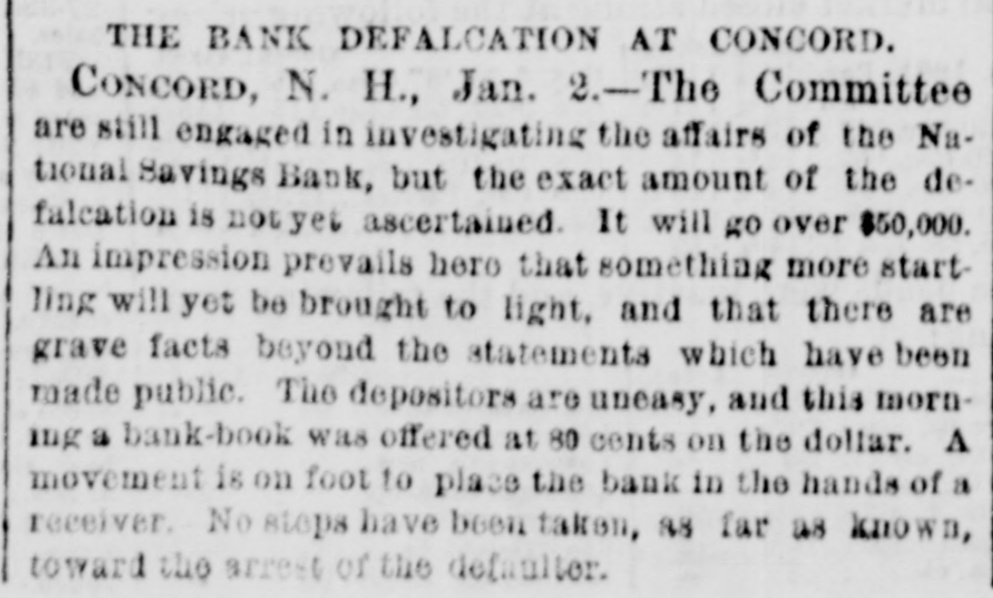
THE BANK DEFALCATION AT CONCORD. CONCORD, N. H., Jan. 2.-The Committee are still engaged in investigating the affairs of the National Savings Bank, but the exact amount of the defalcation is notyet ascertained It will go over $50,000. An impression prevails hero that somethiag more startling will yet be brought to light, and that there are grave facts beyond the statements which have been made public. The depositors are uneasy, and this morning a bank-book was offered at 80 cents on the dollar. A movement is on foot to place the bank in the hands of a receiver No steps have been taken, 88 far as known, toward the arrest of the defaulter.


Article from The New York Herald, January 3, 1874

Click image to open full size in new tab

Article Text

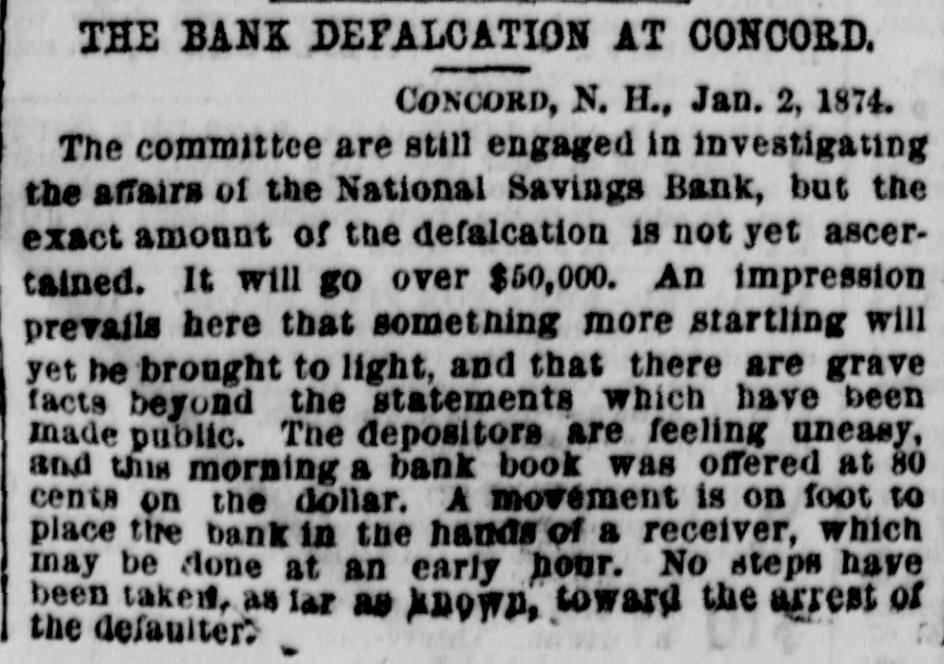
THE BANK DEFALCATION AT CONCORD. CONCORD, N. H., Jan. 2, 1874. The committee are still engaged in investigating the affairs of the National Savings Bank, but the exact amount of the defalcation is not yet ascertained. It will go over $50,000. An impression prevails here that something more startling will yet he brought to light, and that there are grave facts beyond the statements which have been made public. The depositors are feeling uneasy, and this morning a bank book was offered at 80 cents on the dollar. A movement is on foot to place the bank in the hands of a receiver, which may be done at an early hour. No steps have been taken, as lar as known, toward the arrest of the defaulter.


Article from Chicago Daily Tribune, January 5, 1874

Click image to open full size in new tab

Article Text

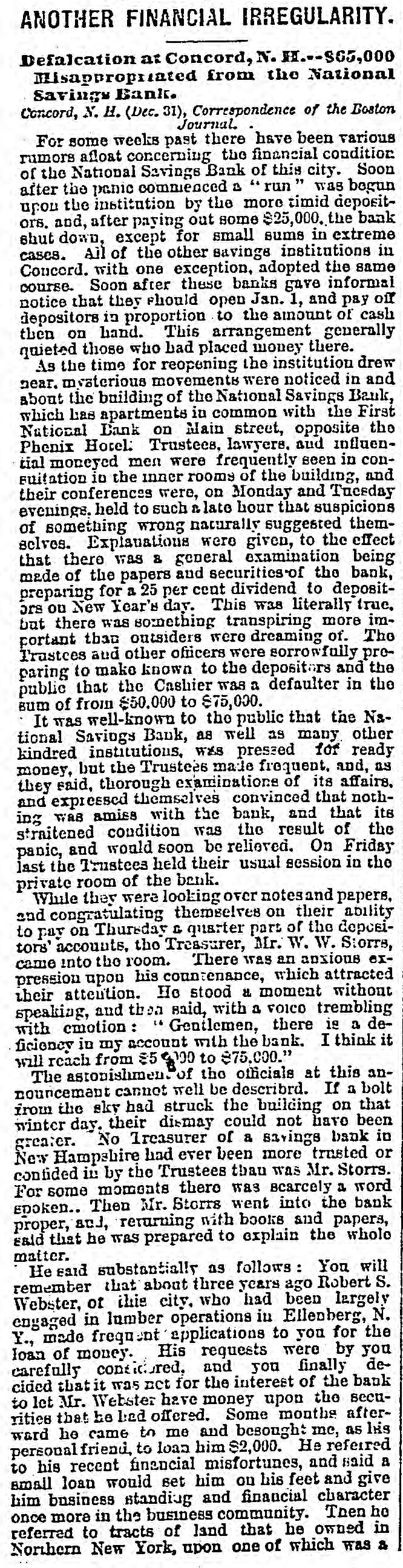
ANOTHER FINANCIAL IRREGULARITY. Defalcation at Concord, N. H.--$65,000 Misapproprinted from the National Savings Bank. Concord, N. H. (Dec. 31), Correspondence of the Boston Journal. For some weeks past there have been various rumors afloat concerning the financial condition of the National Savings Bank of this city. Soon after the panic commenced a run was begun upon the institution by the more timid depositors. and, after paying out some $25,000. the bank shut down, except for small sums in extreme cases. All of the other savings institutions in Concord. with one exception, adopted the same course. Soon after these banks gave informal notice that they should open Jan. 1, and pay off depositors in proportion to the amount of cash then on hand. This arrangement generally quieted those who bad placed money there. As the time for reopening the institution drew near. mesterious movements were noticed in and about the building of the National Savings Bank, which has apartments in common with the First National Bank on Main street, opposite the Phenix Hotel: Trustees, lawyers. and influential moneyed men were frequently seen in consuitation in the inner rooms of the building, and their conferences were, on Monday and Tuesday evenings. held to such C. late hour that suspicions of something wrong naturally suggested themselves. Explanations were given, to the effect that there was a general examination being made of the papers and securities-of the bank, preparing for a 25 per cent dividend to depositors ou New Year's day. This was literally true, but there was something transpiring more important than outsiders were dreaming of. The Trustees and other officers were sorrowfully preparing to make known to the depositors and the public that the Cashier was a defaulter in the sum of from $50,000 to $75,000. It was well-known to the public that the National Savings Bank, as well as many other kindred institutions, was pressed for ready money, but the Trustees made frequent. and, as they said, thorough examinations of its affairs. and expressed themselves convinced that nothing was amiss with the bank, and that its straitened condition was the result of the panic, and would soon be relieved. On Friday last the Trustees held their usual session in the private room of the bank. While they were looking over notesand papers, and congratulating themselves on their ability to pay on Thursday G quarter part of the depositors' accounts, the Treasurer, Mr. W. W. Storrs, came into the room. There was an apxious expression upon his countenance, which attracted their attention. He stood a moment without speaking, and then said, with a voice trembling with emotion : 16 Gentlemen, there is a deficiency in my account with the bank. I think it will reach from 85 100 to $75.000." The astonishment of the officials at this announcement cannot well be describrd. If a bolt from the skv had struck the building on that winter day. their dismay could not have been greater. No Treasurer of a savings bank in New Hampshire had ever been more trusted or confided in by the Trustees than was Mr. Storrs. For some moments there was scarcely a word spoken. Then Mr. Storrs went into the bank proper, and, returning with books and papers, said that he was prepared to explain the whole matter. He said substantially as follows You will remember that about three years ago Robert S. Webster, of this city, who had been largely engaged in lumber operations in Ellenberg, N. Y., made frequent applications to you for the loan of money. His requests were by you carefully considered. and you finally decided that it was net for the interest of the bank to let Mr. Webster have money upon the securities that he had offered. Some months afterward he came to me and besought me, as his personal friend, to loan him $2,000. He refeired to his recent financial misfortunes, and said a small loan would set him on his feet and give him business standing and financial character once more in the business community. Then he referred to tracts of land that he owned in Northern New York, upon one of which was &


Article from The Cairo Bulletin, January 7, 1874

Click image to open full size in new tab

Article Text

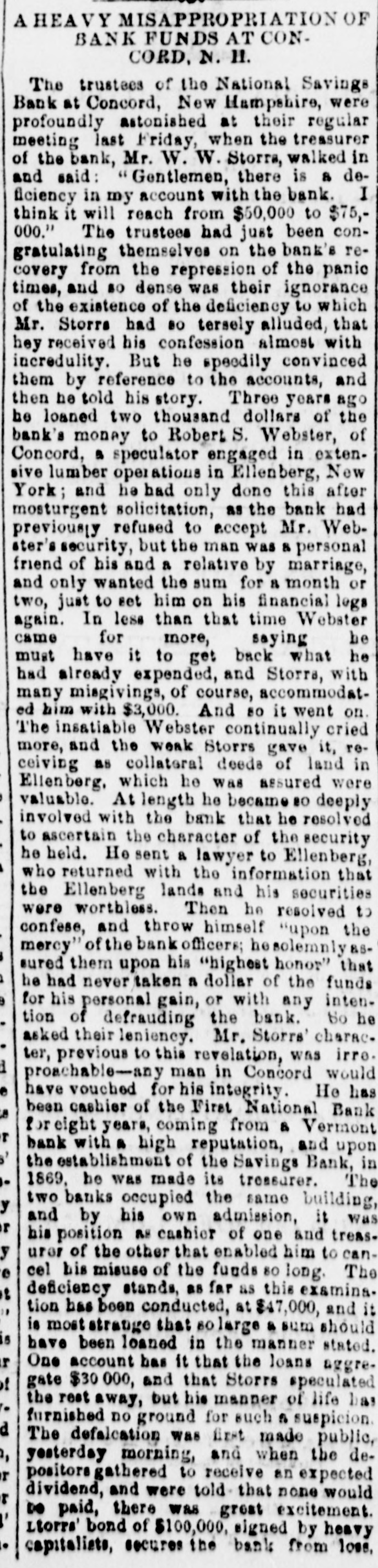
AHEAVY MISAPPROPRIATION OF BANK FUNDS AT CONCORD, N. 11. The trustees of the National Savings Bank at Concord, New Hampshire, were profoundly astonished at their regular meeting last Friday, when the treasurer of the bank, Mr. W. W. Storrs, walked in and said: "Gentlemen, there is a deficiency in my account with the bank. I think it will reach from $50,000 to $75,000." The trustees had just been congratulating themselves on the bank's recovery from the repression of the panic times, and so dense was their ignorance of the existence of the deficiency to which Mr. Storrs had BO tersely alluded, that hey received his confession almost with incredulity. But he speedily convinced them by reference to the accounts, and then he told his story. Three years ago he loaned two thousand dollars of the bank's money to Robert S. Webster, of Concord, a speculator engaged in extensive lumber operations in Ellenberg, New York; and he had only done this after mosturgent solicitation, as the bank had previously refused to accept Mr. Webster's security, but the man was & personal friend of his and a relative by marriage, and only wanted the sum for a month or two, just to set him on his financial legs again. In less than that time Webster came for more, saying he must have it to get back what he had already expended, and Storrs, with many misgivings, of course, accommodated him with $3,000. And 80 it went on. The insatiable Webster continually cried more, and the weak Storrs gave it, receiving as collateral deeds of land in Ellenberg, which he was assured were valuable. At length he became 80 deeply involved with the bank that he resolved to ascertain the character of the security he held. He sent a lawyer to Ellenberg, who returned with the information that the Ellenberg lands and his securities were worthless. Then he resolved to confese, and throw himself "upon the mercy" of the bank officers; he solemnly assured them upon his "highest honor" that he had never taken a dollar of the funds for his personal gain, or with any intention of defrauding the bank. So he asked their leniency. Mr. Storrs' character, previous to this revelation, was irro. proachable-any man in Concord would have vouched for his integrity. He has been cashier of the First National Bank for eight years, coming from & Vermont T bank with a high reputation, and upon the establishment of the Savings Bank, in 1869, he was made its treasurer. The two banks occupied the same building, y and by his own admission, it was r his position as cashier of one and treasurer of the other that enabled him to cane cel bis misuse of the funds 80 long. The deficiency stands, as far as this examina: tion has been conducted, at $47,000, and it is most strange that solarge a sum should is have been leaned in the manner stated. r One account has it that the loans aggregate $30 000, and that Storrs speculated the rest away, but his manner of life has furnished no ground for such & suspicion. a The defalcation was first made public, yesterday morning, and when the der positors gathered to receive an expected dividend, and were told that none would r be paid, there was great excitement. Ltorrs' bond of $100,000, signed by heavy capitalists, secures the bank from loss,


Article from Green-Mountain Freeman, January 8, 1874

Click image to open full size in new tab

Article Text

Defalcation of W. W. Storrs. The latest important revelation of financial irregularities" is from Concord, New Hampshire, and the chief actor a young man brought up in this village, and well known to all who have resided here for any considerable length of time. Mr. W. W. Storrs, a son of Deacon C. W, Storrs, was a Montpelier boy, and was for a time after leaving here, cashier of the Orange County Bank at Chelsea. About eight years ago he went to Concord to accept the position of cashier of the First National Bank of that city. He soon made many friends there and strengthened the confidence his employers had in him, year by year. Going there with good recommendations, his course as cashier was such that he was soon enabled to build on that as well as on the good words of his friends. In 1869 the National Savings Bank was established in Concord and Mr. Storrs was made its treasurer. This bank did a large business, and its deposits have reached the sum of a millionand three quarters. During the panic, it, like other banks, was somewhat short and stopped payment except in small sums, after enduring a run." It had, however, determined to resume business on the first of January, as near as might be according to its former custom. Friday, the 26th ult., the trustees were in the bank making arrangements for the payment of their depositors, when Mr. Storrs appeared before them, and his appearance was such as to attract attention. Standing silent a moment he said with emotion, Gentlemen, there is a deficiency in my account with the bank. I think it will reach from $50,000 to $75,000." The trustees were of course amazed, as their confidence in Mr. Storrs had been the greatest possible. The story of Mr. Storrs as told to the trustees, is reported to have been substantially this: You will remember that about three years ago Robert S. Webster of this city, who had been largeIv engaged in lumber operations in Ellenberg. N.


Article from Burlington Weekly Free Press, January 9, 1874

Click image to open full size in new tab

Article Text

THE CONCORD DEFALCATION.- FRESH ExCITEMENT-Theexeitementover - the National Savings Bank defalcation was renewed SatSurday forenoon by the reports that the bondsmen of Mr. Storrs, the treasurer. by some technicality are not holden for the loss, and that the President of the Savings Bank and also of the First National Bank, Mr. George A. Pillsbury, was seriously involved financially. When the bank was opened at 10 o'clock the depositors and others had gathered in front of the building, filling up the sidewalk and a portion of the -treet. They manifested great anxiety and said they wanted to know if the worst had been told them. The officials of the bank and other friends of the institation besought the crowd to refrain from increasing the anxiety and exeitement that already prevailed. They said that nothing had thus far transpired in the examination that gives any reason for believing that the bank was involved to any greater extent than was at first announced. Indeed they had strong hopes that the deficit would not rise above $50,000. Cantain Wm. Walker, an associate official with the president, said there was not a shadow of any foundation for the absurd rumors concerning the financial standing of Mr. Pillsbury He said that the account of Mr. Pillsbury with the banks was small and that the balance was in his favor. The statements calmed the crowd, but it was even then evident that the depositors were fearful that from some source something worse was coming. It is a singular circumstance that the bank building was erected upon the foundation of the old Concord Bank edifice. an institution which went to smash years ago. The delay in paying the expected dividend from the Savings Bank is causing great inconvenience to many of the depositors. If the bank proves insolvent the commissioners will at once put it into the hands of receivers. Well informed men say that the bondsmen are holden for the loss.


Article from St. Johnsbury Caledonian, January 9, 1874

Click image to open full size in new tab

Article Text

Defalcation of a Former Vermonter. For some time past there have been rumors afloat, in Concord. N. H.. concerning the financial condition of the National Savings Bank of that city, which gave rise to many conjectures, and not a little uneasiness. Some time ago the Concord bank informally gave notice that they should open and pay off depositors in proportion to the amount of cash on hand. having shut down to stop a "run" occasioned by the panie. As the time for reopening drew near. mysterious movements were noticed in the National Savings Bank. which has apartments in common with the First National Bank. on Main street. There were frequent consultations of lawyers, trustees and business men. the object of which gave rise TO much conjecture. At last it transpired that the trustees and officials of the National Savings Bank had discovered that the treasurer was a detaulter in the sum of from $50.000 to $75,000. It appears that on Friday last, while the trustees were holding their session in their private room. Mr. W. W. Storts. treasurer of the bank. entered and confessed. with much emotion. that there was a deficiency of from $50.000 to $75,000 in his accounts with the bank. It appeared, from Mr. Storr's confession. that he had commeneed the defalcation three years age. by lending a comparatively small sum of the bank's money to a friend. Mr. Webster. of Ellenburg. N.Y.. in the faith that the representations the latter made to him of his property. were correct. Subsequently he continued his course. be lieving that the business operations in which Webster was engaged, would enable him to repay him. The latter gave him deeds of a very extensive tract of land in Ellenburg. as security. At last the loan and interest having increased to a large amount. Mr. Storrs determined to probe the matter to the bottom. and the investigations made showed him that Webster's land was comparatively worthless. and would realize little. Mr. Storrs then determined to confess his guilt. and throw himself upon the merey of the trustees. An examination shows the defalcation to be about $67.000. which may be reduced to $65,000. Storrs. who is cash161 of the First National Bank. as well as treasurer of the Savings Bank. is a son of the late Deacon C. W. Storrs of Montpelier. from which he went to Concord about eight years ago. highly entizen and


Article from Vermont Phล“nix, January 9, 1874

Click image to open full size in new tab

Article Text

SAVINGS BANK DEFALCATION IN CONCORD, N. H.-The announcement of the fact that Mr. W. W. Storrs, treasurer of the Nati nal Savings Bank of Concord, N. H., is a defaulter in the sum of $50,000 to 875,000 was made last week, and, from the peculiarities of the case, has created great local excitement, and is the subject of widespread comment. During the panic Mr. Storrs's bank shutdown to stop a "run" of the depositors, and some time since it WIS announced that the bank would re-open to pay off depositors in proportion to the cash on hand. But just before the day of the re-opening Storrs appeared at a meeting of the directors and confessed that there was deficiency of from $50,000 to $75,000 in the accounts-at the same time affirming that none of the money had been used for his personal advantage. As a natural consequence, when the depositors appeared to claim their money they were informed that there was none to pay theur with, and great excitement ensued. It appeared, from Mr. Stores's e infession, that be had conumenced the defalcation three years ago, by lending a comparatively small sum of the bank's money to a friend, Mr. Webster of Ellenburg, N. Y., upon his urgent solicitation, and in the faith that the representations the latter made to him of his property, were correct. Finding himself "stuck," he continued his course in the hope that Webster's business operations wouldeventually enable him to retrieve himself. Last fall, the loan and interest having increased to a large amount, Storrs investigated the security which Webster bad given him on Ellenburg real estate, found the tract of land worthless, and determined to confess bis guilt, and to throw himself upon the mercy of the trustees. The fact that he was Cashier of the First National Bank, as well as Treasurer of the Savings Bank, enabled him to cover up his transact ons for 80 long time, but it is believed that the funds of the National Bank are untouched. There is less sympathy for Mr. Storrs than there was when the defalcation was first announced, and it is state that Webster to whom the money was loaned, had near ly ruined several prominent men in Con cord and had caused heavy loss to a bank in neighboring city before be applied to Storrs for loans. An examina ion of the bank by the State Bank Commissioners shows the defaleation to amount to $62,954, which sum is secured by the Treasurer's bondsmen. To fore immediate liquidation would bankrupt the institution, but with proper management solveney can be regained.


Article from Wilmington Daily Gazette, January 23, 1874

Click image to open full size in new tab

Article Text

The Philadelphia Ledger says: "Both the message of the Governor of this State and that of the Governor of the State of New York call attention 10 the loose manner in which saving funds and other trust companies are managed, and advise that they be looked after. The defaults and losses through these are frequent and heavy. Recently We noticed in our news column the default of W. W. Storrs, the treasurer of the National Savings Bank at Concord, N. II. An examination has been made and a deficiency discovered above the amount first given-say some $63,000. Two-thirds of the assets are in non-productive Western securities." it is worthy of remark that the recent panic has not demonstrated the insecurity of any of the numerous life insurance companies. They have always been regarded with suspicion by the mass of the people. In many of the States thev have been "looked after" by the legislatures; but not more closely than have the national banks, and yet many of these have failed from being robbed or the misuse of capital The extent to which the people are interested in life insurance is enormous. Nearly every State has been thoroughly ennassed to secure policy buyers, and the amount of money drawn from business pursuits for this purpose has been perceptibly felt. In order to push their business some of the companies have secured the services of preachers to go among those of their denominations, and thus many have been induced to take policies who were not even able to pay their rent. And many times this money has gone to save policies that have finally been forfeited. In our owu State, eo generally have the farmers became involved In these ventures, that one of our most intelligent and extensive peach growers and land owners lately referred to the matter iu an article to the press, and assigned life insurance as one of the causes of the want of success by many farmers. His idea being that *hey were not able to spare from their business 11 times of short crops and low prices, the money annually required to keep their policies renewed. This be ng the case it certainly becomes the duty of each State to look closely after the interests of institutions in which the people are 60 deeply intereated. Statements should be made at least semi-annually, and published under affidavit.-This is the practice with the National Banks, and why not apply it 10 life insurance companies?


Article from New-York Tribune, August 17, 1874

Click image to open full size in new tab

Article Text

CONDITION OF THE NATIONAL SAVINGS BANK OF CONCORD, N. H. BOSTON, Aug. 16.-The committee appointed by the Legislature at Concord, N. H., to investigate the affairs of the National Savings Bank at Concord has made its report. It will be remembered that this is the bank from which W. W. Storrs, the Treasurer, abstracted over $50,000, the defalcation becoming known in December last. The Committee express their opinion that the most casual examination of the books at any time during the past five years would have detected fraud, yet, notwithstanding the bank trustees pretended to make examinations four times a year, the evidence tended strongly to show that no examination whatever was at any time made of Storrs's books by the President. Trustees, or any of the Committee of the bank until after the defalcation was made public. The Committee charge the trustees with gross negligence, which does not admit of an apology. and strongly condemn the action of the trustees in neglecting to institute criminal proceedings against Storrs, and allowing him to escape. After expressing their opinion that, notwithstanding the defalcation, and shrinkage of values from the money panie, the bank is to-day solvent. The report closes with a recommendation that a meeting of the grantees should be called at once. The present managers of the bank should receive the unamimous approval of the meeting, or a change should be made and payment in full should then be resumed. No other course suggests itself to them as practicable or likely to restore public confidence.


Article from The Portland Daily Press, August 17, 1874

Click image to open full size in new tab

Article Text

BY TELEGRAPH. NEW HAMPSHIRE. A Drunken Afair. KEENE, Aug. 16.-Allen Craig was found at about half past 11 o'clock last night on the sidewalk near the Eagle Hotel, lying in a pool of blood with his throat cnt. He was removed to the barn and died in about twenty minutes, without being able to give any account of the affair. Soon after he was removed, another man, who proved to be Wm. A. McLaughlin, was found lying in the ditch near by, apparently insensible, and under him lay his hat and a butcher knife. He was also taken to the barn and in a short time came to, not appearing to be hurt but very drunk. He was placed under arrest and taken to jail, making drunken in. quiries what he had done and if it was he that killed Craig. Craig has been for many years foreman in Foster's tannery, and McLaughlin was also employed there. Craig, McLaughlin, Daniel O'Keefe, and one Conway, had been together visiting saloons and drinking during the evening. There was no previous quarrel between the men. The knife was identified as belonging to McLaughlin. It had been ground very sharp for him last Thursday by a fellow workman. The evidence is very strong that McLaughlin is the murderer. He admits the ownership of the knife and a piece of cloth which he had wound around it some time before was found near the murdered man. All of the party were very drnnk when last seen, and somewhat quarrelsome. Sudden Death. PORTSMOUTH, Aug. 16.-Mr. Frank Bush, of the firm of Bent & Bush, well known Boston hatters, died very suddenly at the Oceanic House, Isle of Shoals, Saturday at midnight. Mr. Bush had joined in a dance at the hotel during the evening and is supposed to have died of heart disease. The National Savings Bank. The committee appointed by the legislature to investigate the affairs of the National Savings' Bank, Concord, have made a report. It will be remembered that this is the bank from which W. W. Storrs, treasurer. abstracted $50,000, the defalcarion becoming known in December last, The committee express the opinion that the most casual examination of the books at any time during five years would have detected fraud, yet notwithstanding the bank trustees pretended to make examinations four times a year, the evidence tended strongly to show that no examination whatever was, at any time, made of Storrs' books by the trustees or other committee of the bank until after the defalcation was made public. The committee charge the trustees with gross negligence which does not admit of apology and strongly condemn the action of the trustees in neglecting to institute criminal proceedings against Storrs and allow him to escape. After expressing the opinion that notwithstanding the defalcation and shrinkage of values from the money panic, the bank is to-day solvent. The report eloses with a recommendation that the meeting of grantees should be called at once, the present managers of the bank should receive the uanimous endorsement of the meeting. or a change should be made and payment in full should then be resumed. No oth er course suggests itself to them as practicable or likely to restore public confidence.


Article from The New York Herald, August 17, 1874

Click image to open full size in new tab

Article Text

THE CONCORD SAVINGS BANK. Report of the Legislative Examining Committee-Culpability of the Board of Trustees. BOSTON, August 16, 1874. The committee appointed by the Legislature at Concord, N. H., to investigate the affairs of the National Savings Bank at Concord, has made its report. It will be remembered that this 18 the bank from which W. W. Storrs, the treasurer, abstracted over $50,000, the defalcation becoming known in December last. The committee express their opinion that the most casual examination of the books at any time during five years would have detected fraud: yet, notwithstanding the bank trustees pretended to make examinations four times a year, the evidence tended strongly to show that no examination whatever was at any time made of Storrs' books by the President, trustees, or any of the committee of the bank until after the defalcation was made public. The committee charge the trustees with gross negligence, which does not admit of an apology, and strongly condemn the action of the trustees in neglecting to institute criminal proceedings against Storrs and allowing him to escape. After expressing their opinion that notwithstanding the defalcation and shrinkage of values from the money panic the bank is to-day solvent, the report closes with a recommendation that a meeting of the grantees should be called at once. The present managers of the bank should receive the unanimous indorsement of the meeting, or a change should be made, and payment in full should then be resumed. No other course suggests itself to them as practicable or likely to restore public confidence.


Article from Green-Mountain Freeman, August 19, 1874

Click image to open full size in new tab

Article Text

bers of granges and their friends are cordially invited to attend. The Third District Democratic Convention assembled at Academy Hall, St. Albans, on Friday, the 14th. and organized by the choice of N. H. Armington as president, and E. M. Sutton, of Burlington, as secretary. Hon. John L. Edwards. of Newport, was nominated for Representative in Congress, and Messrs. Morillo Noyes, of Burlington, F. M. McIntyre, of St. Albans, and G. W. Beardsley, of Alburgh, were appointed district committee. The resolutions adopted approve the platform adopted at the State convention: compliment the candidate for Congress. and hail with delight the prospect of the speedy construction of the Caughnawaga Ship Canal, and the extension of our trade and commerce by means of a judicious reciprocity treaty." A VERMONT SINGER.-Mr. J. E. Perkins, of Woodstock, prima basso at Her Majesty's theatre, was married in London, July 23d, to Miss Marie Roye, a prominent soprano of the same company. They arrived in New York on the 7th. Mr. Perkins will sing but once publicly in this country during his present visit. He appears at a musical convention at St. Johnsbury this week. VERMONT STATE FAIR. 1874.-The Annual Fair of the Vermont State Agrienltural Society and Wool Growers' Association will be held at Rutland, September 8 9. 10 and 11. The Society have made arrangements with the Rathand County Ag. ricultural Society to hold the Fair upon their convenient and extensive grounds There are upon the premises a large number of permanent and conveniently ar ranged buildings, SO that exhibitors will have ample space to show their goods in 1 machin S. Several new features will be intro Inced for the convenience and benefi of exhibitors. All man facturers of machinery and thor saving implements an I ar icl useful and ornamental that they wishto bring to the notice of the people of Vermont are cordially invited to come, and every effort will be make to accommodat them. The awards to the successful exhibitors will be made by Diplom, Medals and Money. R thand being one of the great railroa I centers of Vermont, itean be reached with little effort. The Superintendent of the Meel anies' Hall will consider it a great favor if exhibitors in his department will maketheir en ries at an early day previous to the week of Fair. Heretofore many exhibit irs have neglected to make their entries until a late day of the Fair, causing inconvenience to hemselves and extra trouble to the Su perintendent. Exhibitors' tickets are $1.00, entitling them to admittance to the grounds during the Fair. Entries can be made at any time prev ous. by ad tressing the subscriber at Corn wall. and on Mon lay, September 7, at the Bardwell House, Ratland. SAMUEL EVERTS, Sup't Mechanics' Hall. Cornwall, Vt., May, 1874. THE STORRS' DEFALCATION.-The committee appointed by the New Hampshire legislature to investigate the affairs of the National Savings Bank of Concord has made its report. This is the bank from which W. W. Storrs. treasurer, abstracte over $50,000, the defalcation becoming known in December last. The committee express the opinion that the most casual examination of the books at any time. during five years, would have detected frand, yet, notwithstanding the bank trustees pretended to ike aminations four times a year, the evidence tended strongly to show that no examination whatever was d it any time made of Storrs' books by the president, trustees, or other committee until after the defalcation was made public. The committee charge the trustees with gross negligence, which does not admit of apology, and strongly condemn the action of the trustees in ne lecting to in stitute criminal proceedings against Storrs and allowing him to escape. After ex pressing the opinion that. notwithstanding the defalcation and shrinkage of value d from the money panic, the bank is. to-day solvent, the report closes with the recommendation that a meeting of the trustees should be called at once the present managers of the bank should receive the unanimous endorsement of the meeting or a change should be made and a pay ment in full should then be resumed. No other course suggests itself to them as practicable, or likely to restore public con fidence. n The Perkins family will have a reunion this week, at the old homestead, in Wood stock, honor of the The father, Col. Orson Perkins, taught singing school for 45 years, and his wife d was a prominent singer in her young ys They are both hale and hearty at 72 and 66 st Their six children, five sons and adaughter are all living: W. O., the well known con vention conductor an composer,of Boston H. S., also conductor and composer o