Canal Bank (Cleveland, OH)

Episode Information

Episode Type
Run → Suspension → Closure
Start Date
November 9, 1854
Location
Cleveland, Ohio (41.499, -81.695)
Bank Type
state

Metadata

Notes

Affairs were assigned to receivers (W. J. Gordon and J. S. Hewitt) and the bank remained in receivership in later records.

Events (3)

1. November 9, 1854 Run
Cause
Macro News
Cause Details
Widespread November 1854 financial panic/pressure led to heavy withdrawals and duress on the bank.
Measures
Paid bill-holders/specie at the counter while refusing depositor withdrawals; other local banks accepted its bills at par.
Newspaper Excerpt
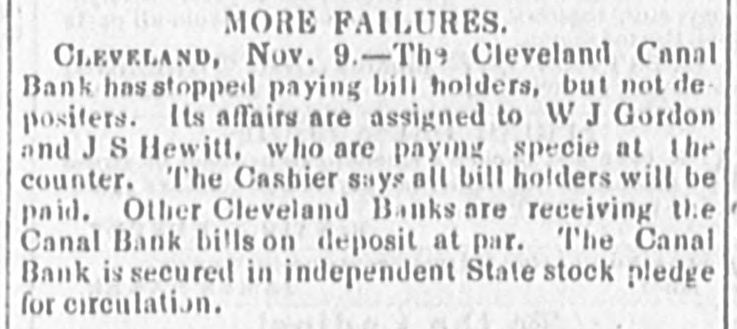
The Canal Bank of this city has stopped paying bill holders, but not depositors.
Source
newspapers
2. November 9, 1854 Suspension
Cause
Macro News
Cause Details
Bank suspended operations/ceased ordinary payments amid the wider banking crisis and assignment to receivers.
Newspaper Excerpt
The affairs of the Bank have been assigned to W J Gordon and JS Hewitt, who are paying specie at the counter.
Source
newspapers
3. November 9, 1854 Receivership
Newspaper Excerpt
Its affairs are assigned to W J Gordon and JS Hewitt, who are paying specie at the counter.
Source
newspapers

Newspaper Articles (23)

Article from Wheeling Daily Intelligencer, November 10, 1854

Click image to open full size in new tab

Article Text

MORE FAILURES

CLEVELAND, Nov. 9.-The Cleveland Canal Bank has stopped paying bill holders, but not de positers. Its affairs are assigned to W J Gordon and JS Hewitt, who are paying specie at the counter. The Cashier says all bill holders will be paid. Other Cleveland Banks are receiving the Canal Bank bills on deposit at par. The Canal Bank is secured in independent State stock pledge for circulation.


Article from The New York Herald, November 15, 1854

Click image to open full size in new tab

Article Text

The Financial Crisis

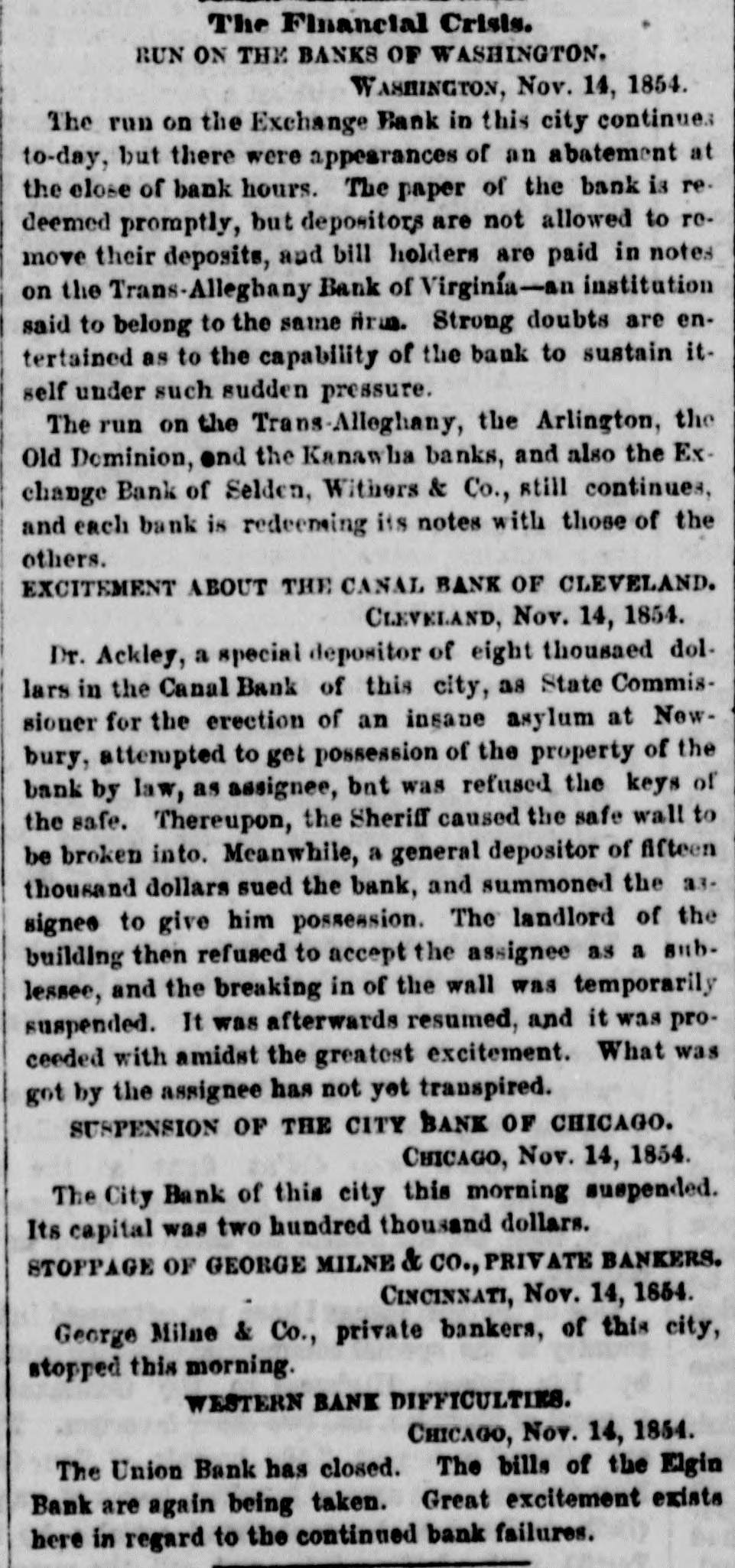
RUN ON THE BANKS OF WASHINGTON. WASHINGTON, Nov. 14, 1854. The run on the Exchange Bank in this city continue. to-day, but there were appearances of an abatement at the close of bank hours. The paper of the bank is re. deemed promptly, but depositors are not allowed to remove their deposits, and bill holders are paid in notes on the Trans-Alleghany Bank of Virginía-an institution said to belong to the same firm. Strong doubts are entertained as to the capability of the bank to sustain itself under such sudden pressure. The run on the Trans-Alleghany, the Arlington, the Old Deminion, and the Kanawha banks, and also the Exchange Bank of Selden, Withers & Co., still continues, and each bank is redeeming its notes with those of the others. EXCITEMENT ABOUT THE CANAL BANK OF CLEVELAND. CLEVELAND, Nov. 14, 1854. Dr. Ackley, a special depositor of eight thousaed dollars in the Canal Bank of this city, as State Commissioner for the erection of an insane asylum at Newbury, attempted to get possession of the property of the bank by law, as assignee, bnt was refused the keys of the safe. Thereupon, the Sheriff caused the safe wall to be broken into. Meanwhile, a general depositor of fifteen thousand dollars sued the bank, and summoned the 33signee to give him possession. The landlord of the building then refused to accept the assignee as a sublessee, and the breaking in of the wall was temporarily suspended. It was afterwards resumed, and it was proceeded with amidst the greatest excitement. What was got by the assignee has not yet transpired. SUSPENSION OF THE CITY BANK OF CHICAGO. CHICAGO, Nov. 14, 1854. The City Bank of this city this morning suspended. Its capital was two hundred thousand dollars. STOPPAGE OF GEORGE MILNE & co., PRIVATE BANKERS. CINCINNATI, Nov. 14, 1654. George Milne & Co., private bankers, of this city, stopped this morning. WESTERN BANK DIFFICULTIES. CHICAGO, Nov. 14, 1854. The Union Bank has closed. The bills of the Elgin Bank are again being taken. Great excitement exists here in regard to the continued bank failures.


Article from The Weekly Portage Sentinel, November 15, 1854

Click image to open full size in new tab

Article Text

The Bank Failures

Failures are the order of the day. A commercial crisis has come, which threatens to overthrow the would be "money Kings" of the country, and exhibit their affairs in a true but not very enviable light. Storms are said to purify the atmosphere, and it is to be hoped that the financiel storm now upon us will clear away the rubbish and show business men where and how they stand. The heavy failures which have recently occurred, have caused a feeling of insecurity throughout the whole country, and the people very justly begin to make an examination of their financial concerns. A month or two ago every day brought us news of Bank failures from New York, Michigan, Indiana, Kentucky and other States around us, 80 that some began to congratulate themselves, that our home institutions were better than foreign, (this may be the case; they are all bad enough;) but the recent news from Cincinnati, Dayton, Circleville, Columbus and Cleveland, is beginning to shake the confidence of the people in every thing, like banking institutions anywhere. First came the failure of Ellis & Sturges; about the same time, word was received that the Circleville Bank had 'gone by the board.' The next day the Miami Valley Bank "suspended payment." The day after, the Clin. ton bank of Columbus was said to be in a fainting condition, and last, but not least the Canal Bank at Cleveland has "given up the ghost" and robbed its depositors and time draft holders of one hundred and eighty thousand dollars! Beautiful institutions truly. If a poor man were to steal $35 to get food for his family, he would be deemed a felon and sent to the Penitentiary; but a Bank may receive thousands on deposite just on the eve of failure, suspend payment, defraud its credit. ors, out of their money and its directors and officers go unpunished! These are the same privileged institutions which are exempted from the payment of taxes, and as a consequenee are licensed to defraud and wrong the laboring classes without hinderance or restraint. The circulation of some of these Banks however, is secured by State or United States Stocks. Where this is the case the bill holders are secure. But the depositors of money with them, are without security and as a consequence lose the whole amount of their deposites. Below, we append a list of the only Banks in Ohio whose circulation is secured by State or United Statas Stocks deposited with the officers of State: Bank of Geauga; Canal Bank of Cleveland; City Bank of Cleveland; City Bank of Columbus; City Bank of Cincinnati; Commercial Bank of Cincinnati; Franklin Bank of Zanesville; Mahoning County Bank, Youngstown; Sandusky City Bank; Seneca County Bank, Tiffin; Western Reserve Bank, Warren; Bank of Commerce, Cleveland; Bank of Marion; Champaign County Bank, Urbana; Franklin Bank of Portage Co., Franklin; Forest City Bank, Cleveland; Iron Bank of Ironton; Merchants' Bank of Massillon; Miami Valley Bank of Dayton; Pickaway County Bank, Circleville; Springfield Bank; Stark County Bank, Canton; Union Bank, Sandusky City. 05 P. S. Since writing the above, news has reached us of the failure of the City Bank of Columbus, Farmers Joint Stock Bank, Buffalo; Wondbury Bank, Connecticut and Exchange Bank, Buffalo. So they go. We are a fast people.


Article from Staunton Spectator, November 15, 1854

Click image to open full size in new tab

Article Text

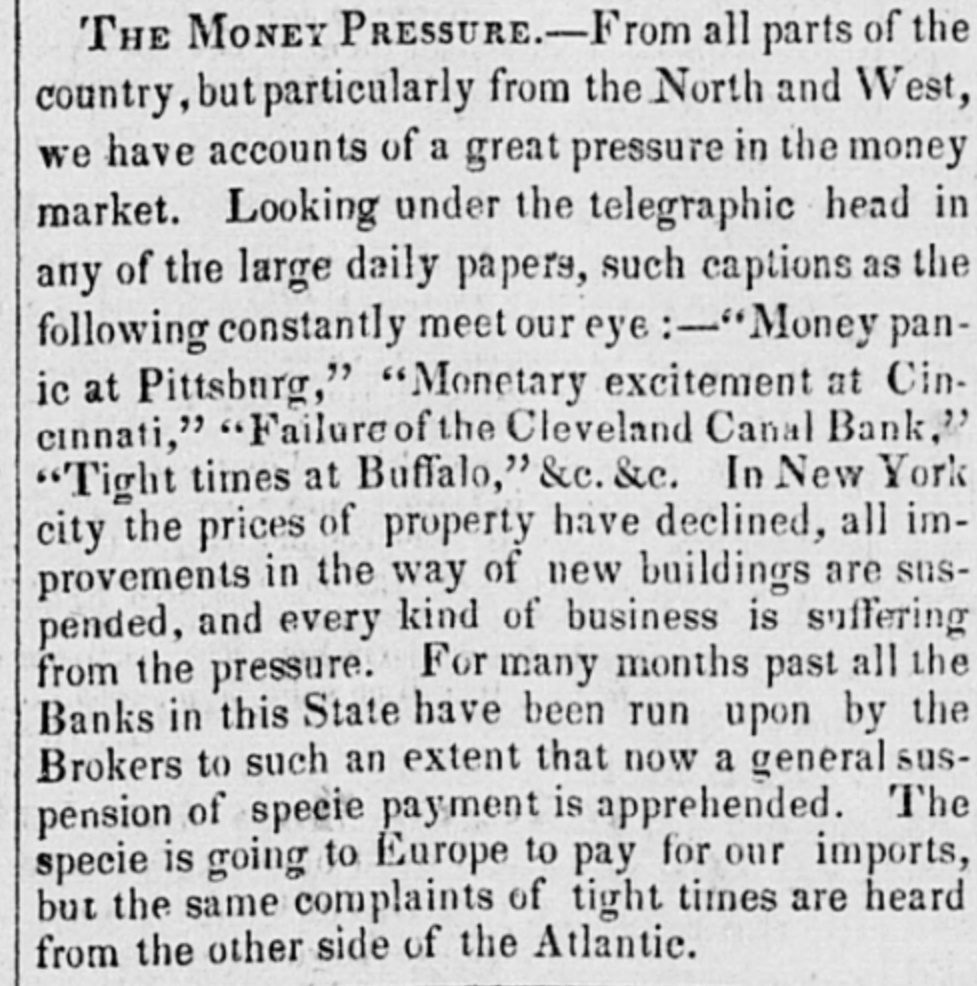
THE MONEY PRESSURE

-From all parts of the country, but particularly from the North and West, we have accounts of a great pressure in the money market. Looking under the telegraphic head in any of the large daily papers, such captions as the following constantly meet our eye :-"Money panic at Pittsburg," "Monetary excitement at Cineinnati," 'Failure of the Cleveland Canal Bank," "Tight times at Buffalo," &c. &c. In New York city the prices of property have declined, all improvements in the way of new buildings are suspended, and every kind of business is suffering from the pressure. For many months past all the Banks in this State have been run upon by the Brokers to such an extent that now a general suspension of specie payment is apprehended. The specie is going to Europe to pay for our imports, but the same complaints of tight times are heard from the other side of the Atlantic.


Article from Burlington Tri-Weekly Hawk-Eye, November 16, 1854

Click image to open full size in new tab

Article Text

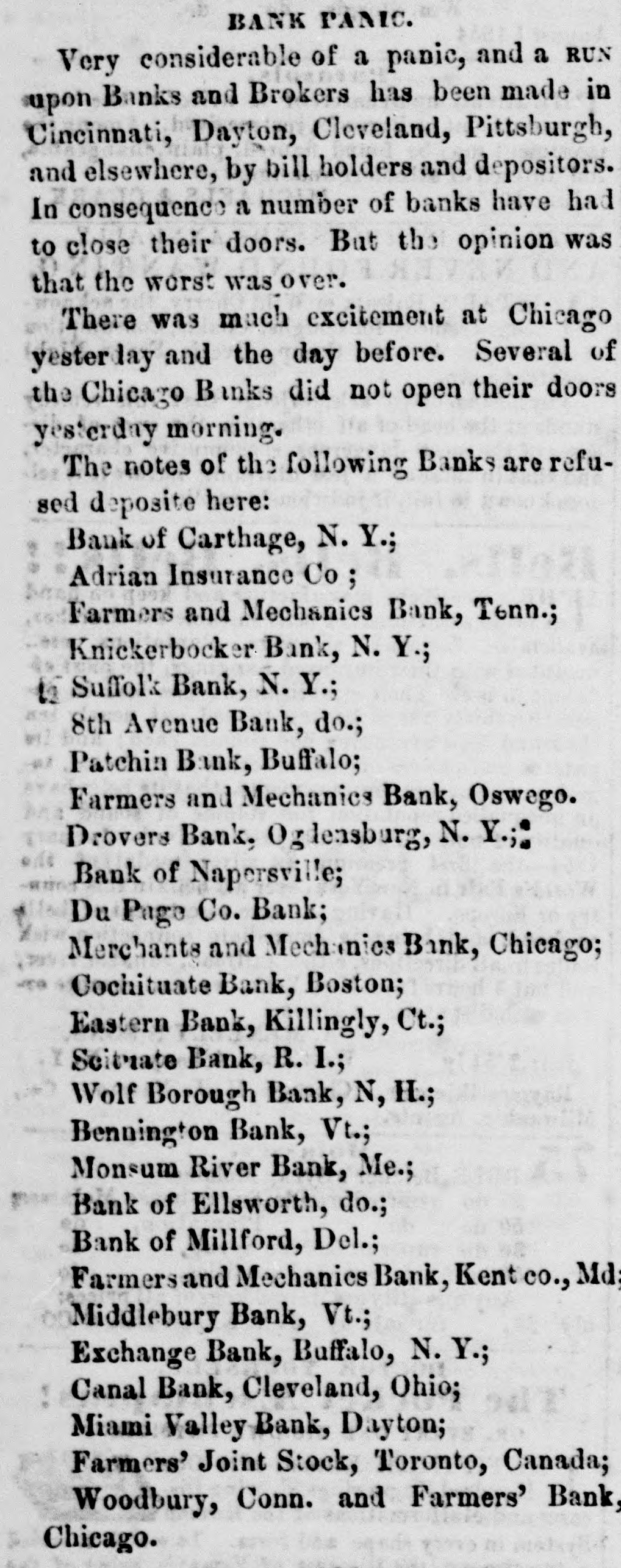
BANK PAMC

Very considerable of a panic, and a RUN upon Banks and Brokers has been made in Cincinnati, Dayton, Cleveland, Pittsburgh, and elsewhere, by bill holders and depositors. In consequence a number of banks have ha 1 to close their doors. But the opinion was that the worst was over. There was much excitement at Chicago yester day and the day before. Several of the Chicago B unks did not open their doors yesterday morning. The notes of the following Banks are refused deposite here: Bank of Carthage, N. Y.; Adrian Insurance Co ; Farmers and Mechanics Bank, Tenn.; Knickerbocker Bank, N. Y.; to Suffolk Bank, N. Y.; 8th Avenue Bank, do.; Patchin Bank, Buffalo; Farmers and Mechanics Bank, Oswego. Drovers Bank, Og lensburg, N. Y.;: Bank of Napersville; Du Page Co. Bank; Merchants and Mechanics Bank, Chicago; Cochituate Bank, Boston; Eastern Bank, Killingly, Ct.; Scituate Bank, R. I.; Wolf Borough Bank, N, H.; Bennington Bank, Vt.; Monsum River Bank, Me.; Bank of Ellsworth, do.; Bank of Millford, Del.; Farmersand Mechanics Bank, Kent co., Md; Middlebury Bank, Vt.; Exchange Bank, Buffalo, N. Y.; Canal Bank, Cleveland, Ohio; Miami Valley Bank, Dayton; Farmers' Joint Stock, Toronto, Canada; Woodbury, Conn. and Farmers' Bank, Chicago.


Article from The National Era, November 16, 1854

Click image to open full size in new tab

Article Text

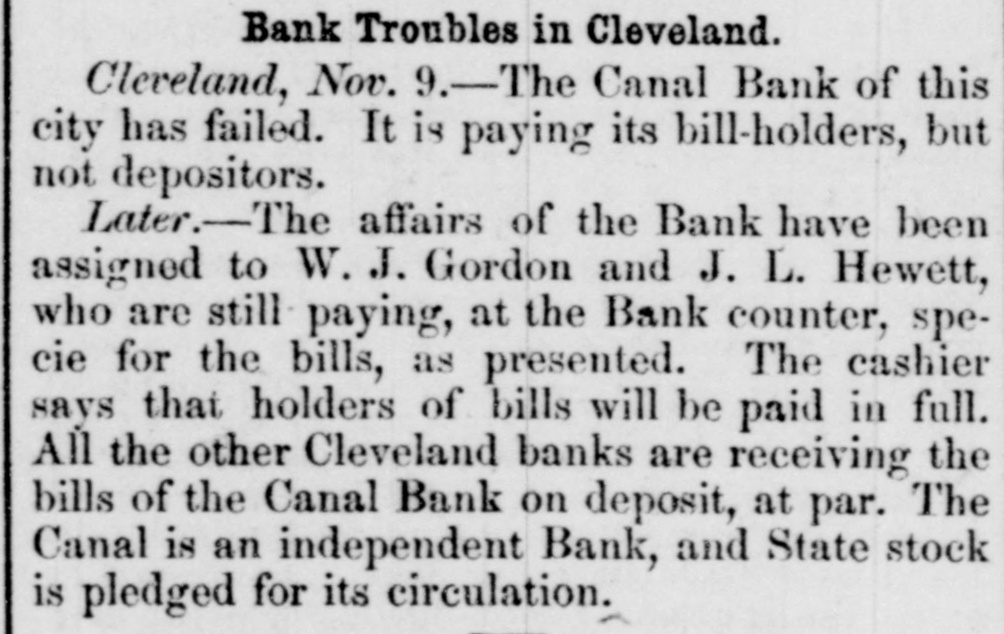
Bank Troubles in Cleveland

Clereland, Nov. 9.-The Canal Bank of this city has failed. It is paying its bill-holders, but not depositors. Later.-The affairs of the Bank have been assigned to W. J. Gordon and J. L. Hewett, who are still paying, at the Bank counter, specie for the bills, as presented. The cashier says that holders of bills will be paid in full. All the other Cleveland banks are receiving the bills of the Canal Bank on deposit, at par. The Canal is an independent Bank, and State stock is pledged for its circulation.


Article from Daily Davenport Gazette, November 17, 1854

Click image to open full size in new tab

Article Text

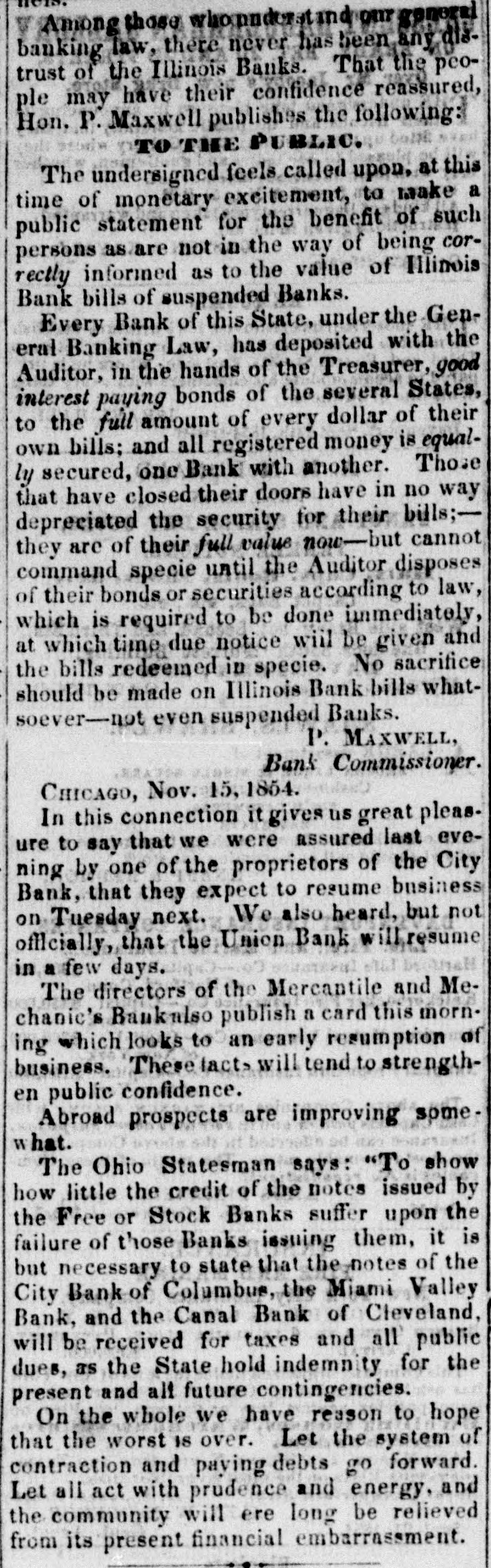
Among those whounderst and our general banking law, there never has been any distrust of the Illinois Banks. That the people may have their confidence reassured, Hon. P. Maxwell publishes the following: TO THE PUBLIC. The undersigned feels called upon, at this time of monetary excitement, to make a public statement for the benefit of such persons as are not in the way of being correctly informed as to the value of Illinois Bank bills of suspended Banks. Every Bank of this State, under the General Banking Law, has deposited with the Auditor, in the hands of the Treasurer, good interest paying bonds of the several States, to the full amount of every dollar of their own bills; and all registered money is equally secured, one Bank with another. Those that have closed their doors have in no way depreciated the security for their bills:they are of their full value now-but cannot command specie until the Auditor disposes of their bonds or securities according to law, which is required to be done immediately, at which time due notice will be given and the bills redeemed in specie. No sacrifice should be made on Illinois Bank bills whatsoever-not even suspended Banks. P. MAXWELL, Bank Commissioner. CHICAGO, Nov. 15, 1854. In this connection it gives us great pleasure to say that we were assured last evening by one of the proprietors of the City Bank, that they expect to resume business on Tuesday next. We also heard, but not officially, that the Union Bank will resume in a few days. The directors of the Mercantile and Mechanic's Bank also publish a card this morning which looks to an early resumption of business. These facts will tend to strengthen public confidence. Abroad prospects are improving somewhat. The Ohio Statesman says: "To show how little the credit of the notes issued by the Free or Stock Banks suffer upon the failure of those Banks issuing them, it is but necessary to state that the notes of the City Bank of Columbus, the Miami Valley Bank, and the Canal Bank of Cleveland, will be received for taxes and all public dues, as the State hold indemnity for the present and all future contingencies. On the whole we have reason to hope that the worst is over. Let the system of contraction and paying debts go forward. Let all act with prudence and energy, and the community will ere long be relieved from its present financial embarrassment.


Article from The Cadiz Democratic Sentinel, November 22, 1854

Click image to open full size in new tab

Article Text

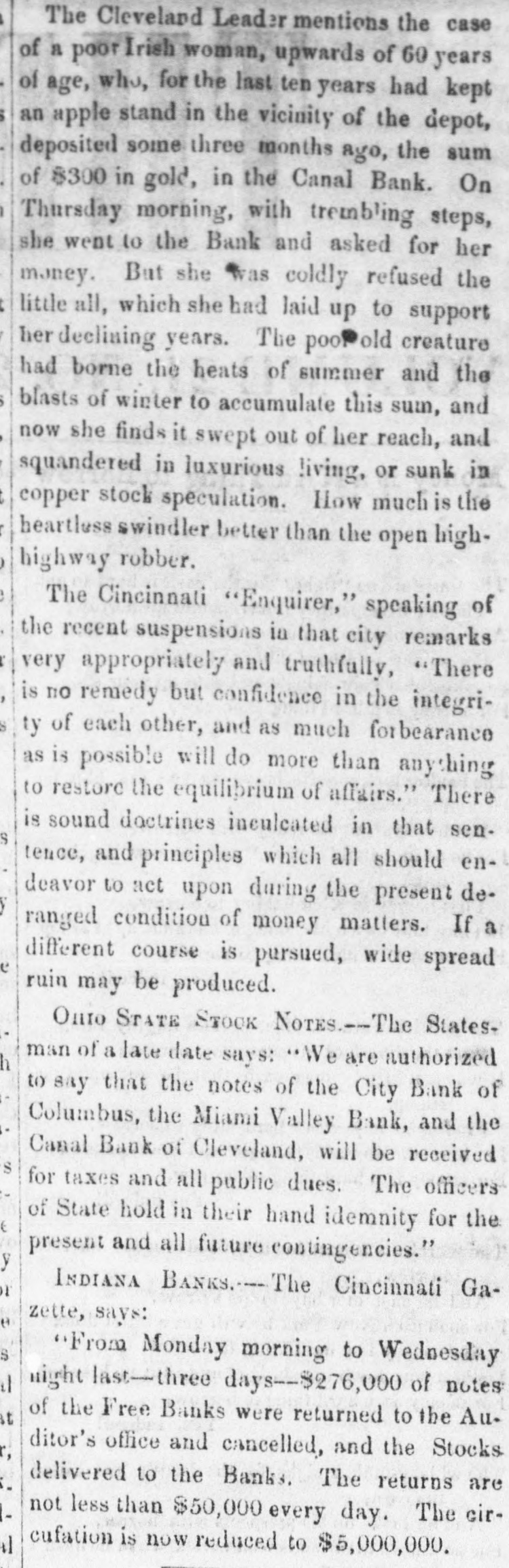
The Cleveland Leader mentions the case of a poor Irish woman, upwards of 60 years of age, who, for the last ten years had kept an apple stand in the vicinity of the depot, deposited some three months ago, the sum of $300 in gold, in the Canal Bank. On Thursday morning, with trembling steps, she went to the Bank and asked for her money. But she was coldly refused the little all, which she had laid up to support her declining years. The poor old creature had borne the heats of summer and the blasts of winter to accumulate this sum, and now she finds it swept out of her reach, and squandered in luxurious living, or sunk in copper stock speculation. How much is the heartless swindler better than the open high-highway robber.

The Cincinnati "Enquirer," speaking of the recent suspensions in that city remarks very appropriately and truthfully, "There is no remedy but confidence in the integrity of each other, and as much forbearance as is possible will do more than anything to restore the equilibrium of affairs." There is sound doctrines inculcated in that sentence, and principles which all should endeavor to act upon during the present deranged condition of money matters. If a different course is pursued, wide spread ruin may be produced.

OHIO STATE STOCK NOTES.--The Statesman of a late date says: "We are authorized to say that the notes of the City Bank of Columbus, the Miami Valley Bank, and the Canal Bank of Cleveland, will be received for taxes and all public dues. The officers of State hold in their hand idemnity for the present and all future contingencies."

INDIANA BANKS.--The Cincinnati Gazette, says:

"From Monday morning to Wednesday night last-three days--$276,000 of notes of the Free Banks were returned to the Auditor's office and cancelled, and the Stocks delivered to the Banks. The returns are not less than $50,000 every day. The circulation is now reduced to $5,000,000.


Article from The Kalida Venture, November 24, 1854

Click image to open full size in new tab

Article Text

bas Latest Banks Failed

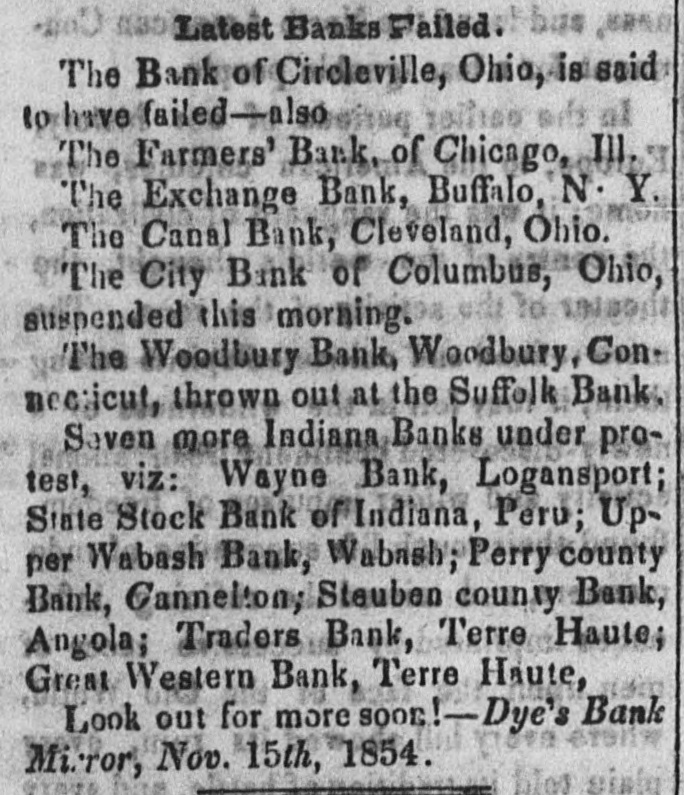
The Bank of Circleville, Ohio, is said to have failed-also The Farmers' Bank, of Chicago, Ill. The Exchange Bank, Buffalo, N. Y. The Canal Bank, Cleveland, Ohio. The City Bank of Columbus, Ohio, suspended this morning. The Woodbury Bank, Woodbury, Con nec:icut, thrown out at the Suffolk Bank Seven more Indiana Banks under protest, viz: Wayne Bank, Logansport; State Stock Bank of Indiana, Peru; Upper Wabash Bank, Wabash; Perry county Bank, Cannelton; Steuben county Bank, Angola; Traders Bank, Terre Haute; Great Western Bank, Terre Haute, Look out for more soor!-Dye's Bank Mirror, Nov. 15th, 1854.


Article from Evening Star, December 1, 1854

Click image to open full size in new tab

Article Text

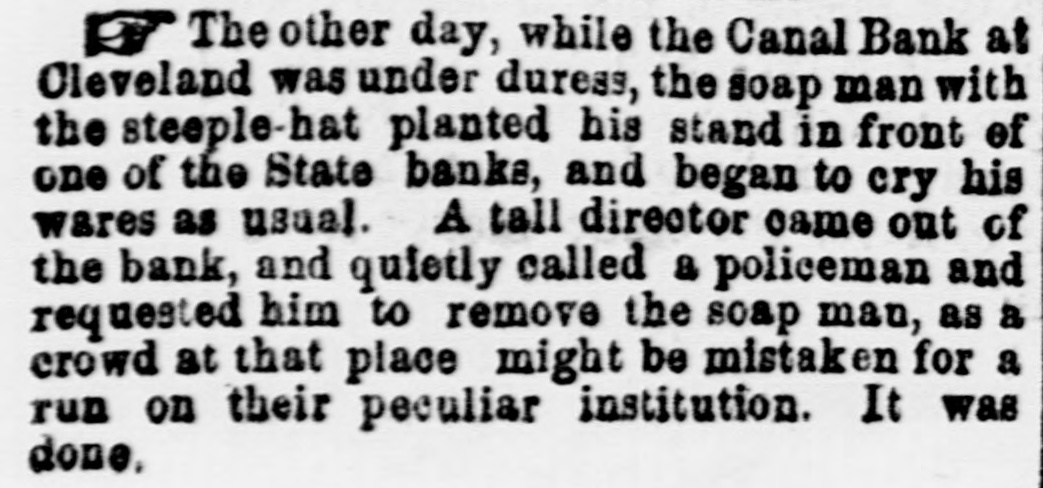
The other day, while the Canal Bank at Cleveland was under duress, the soap man with the steeple-hat planted his stand in front of one of the State banks, and began to cry his wares as usual. A tall director came out of the bank, and quietly called a policeman and requested him to remove the soap man, as a crowd at that place might be mistaken for a run on their peculiar institution. It was done.


Article from Virginia Free Press, December 14, 1854

Click image to open full size in new tab

Article Text

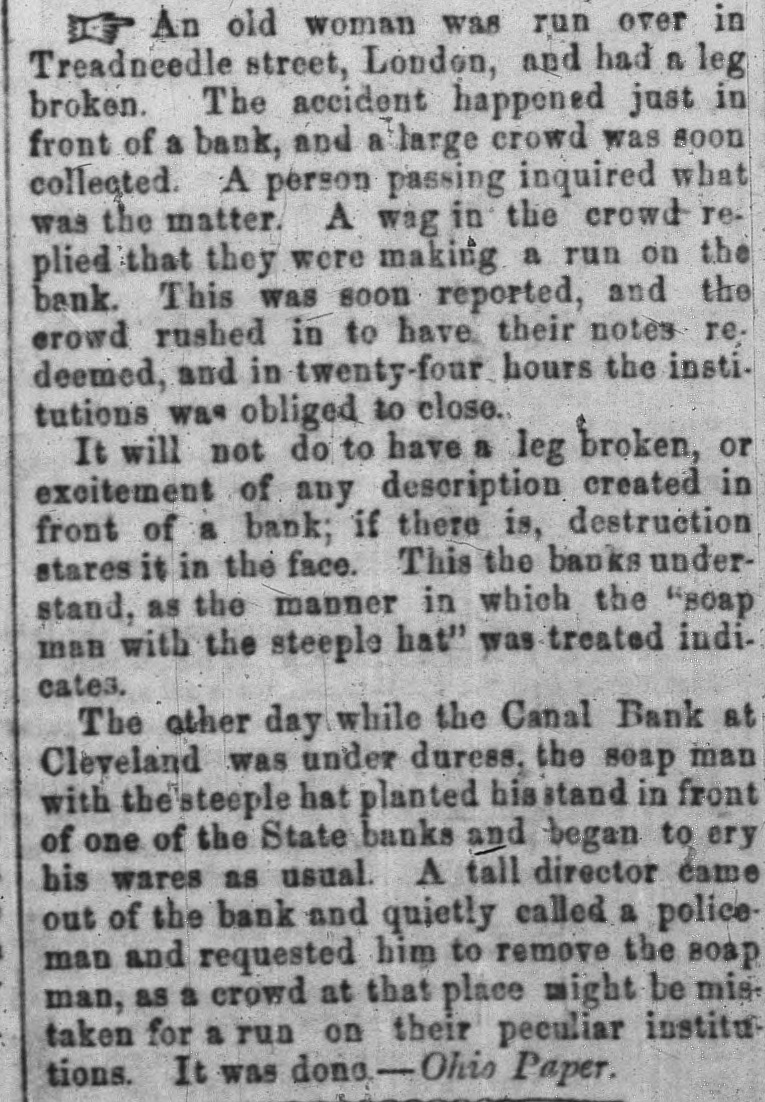
An old woman was run over in Treadneedle street, London, and had a leg broken. The accident happened just in front of a bank, and a large crowd was soon collected. A person passing inquired what was the matter. A wag in the crowd replied that they were making a run on the bank. This was soon reported, and the erowd rushed in to have their notes redeemed, and in twenty-four hours the institutions was obliged to close.

It will not do to have a leg broken, or excitement of any description created in front of a bank; if there is, destruction stares it in the face. This the banks understand, as the manner in which the "soap man with the steeple hat" was treated indicates.

The other day while the Canal Bank at Cleveland was under duress, the soap man with the steeple hat planted his stand in front of one of the State banks and began to ery his wares as usual. A tall director came out of the bank and quietly called a policeman and requested him to remove the soap man, as a crowd at that place might be mistaken for a run on their peculiar institutions. It was done.—Ohio Paper.


Article from Fayetteville Observer, January 18, 1855

Click image to open full size in new tab

Article Text

NICE SENSE OF DANGER.--A Cleve-land

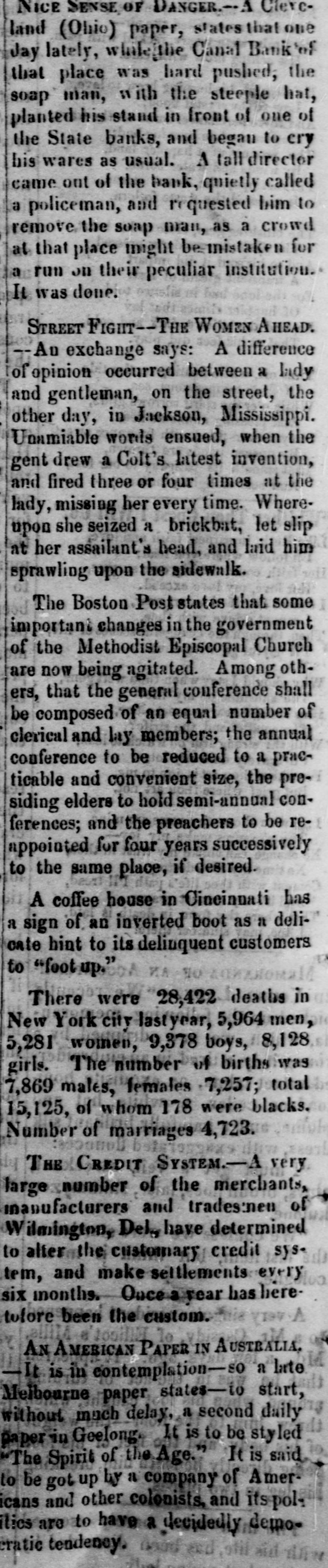
land (Ohio) paper, states that one day lately, while the Canal Bank of that place was hard pushed, the soap man, with the steeple hat, planted his stand in front of one of the State banks, and began to cry his wares as usual. A tall director came out of the bank, quietly called a policeman, and requested him to remove the soap man, as a crowd at that place might be mistaken for a run on their peculiar institution. It was done.

STREET FIGHT--THE WOMEN A HEAD.

--An exchange says: A difference of opinion occurred between a lady and gentleman, on the street, the other day, in Jackson, Mississippi. Unamiable words ensued, when the gent drew a Colt's latest invention, and fired three or four times at the lady, missing her every time. Where- upon she seized a brickbat, let slip at her assailant's head, and laid him sprawling upon the sidewalk.

The Boston Post states that some important changes in the government of the Methodist Episcopal Church are now being agitated. Among oth- ers, that the general conference shall be composed of an equal number of clerical and lay members; the annual conference to be reduced to a prac- ticable and convenient size, the pre- siding elders to hold semi-annual con- ferences; and the preachers to be re- appointed for four years successively to the same place, if desired.

A coffee house in Cincinnati has a sign of an inverted boot as a deli- cate hint to its delinquent customers to "foot up."

There were 28,422 deaths in New York city last year, 5,964 men, 5,281 women, 9,378 boys, 8,128 girls. The number of births was 7,869 males, females 7,257; total 15,125, of whom 178 were blacks. Number of marriages 4,723.

THE CREDIT SYSTEM.

-A very large number of the merchants, manufacturers and tradesmen of Wilmington, Del, have determined to alter the customary credit sys- tem, and make settlements every six months. Once a year has here- tofore been the custom.

AN AMERICAN PAPER IN AUSTRALIA.

It is in contemplation-so a late Melbourne paper states-to start, without much delay, a second daily paper in Geelong. It is to be styled "The Spirit of the Age." It is said to be got up by a company of Amer- icans and other colonists, and its pol- itics are to have a decidedly demo- cratic tendency.

Article from Minnesota Weekly Times, March 13, 1855

Click image to open full size in new tab

Article Text

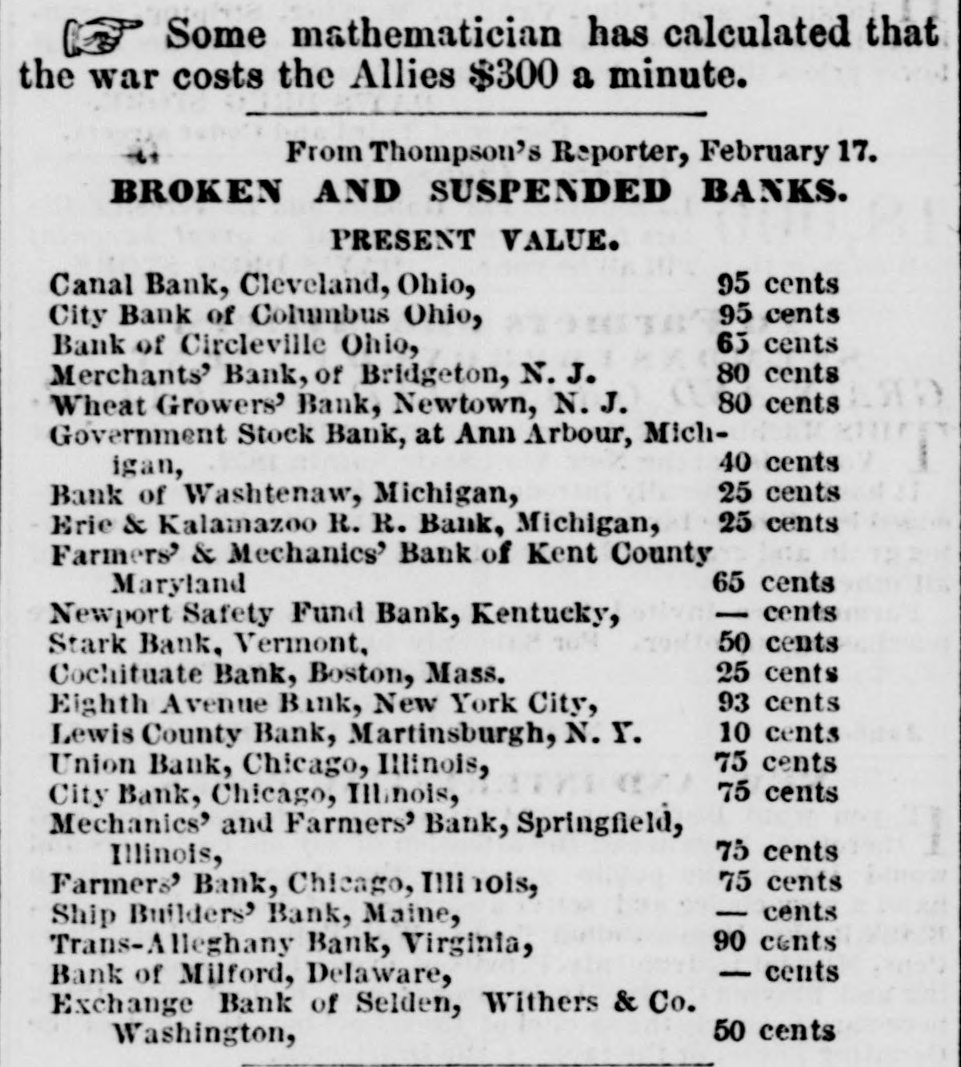
Some mathematician has calculated that the war costs the Allies $300 a minute.

BROKEN AND SUSPENDED BANKS.

PRESENT VALUE. Canal Bank, Cleveland, Ohio, 95 cents City Bank of Columbus Ohio, 95 cents Bank of Circleville Ohio, 65 cents Merchants' Bank, of Bridgeton, N. J. 80 cents Wheat Growers' Bank, Newtown, N. J. 80 cents Government Stock Bank, at Ann Arbour, Mich-igan, 40 cents Bank of Washtenaw, Michigan, 25 cents Erie & Kalamazoo R. R. Bank, Michigan, 25 cents Farmers & Mechanics' Bank of Kent County Maryland 65 cents Newport Safety Fund Bank, Kentucky, — cents Stark Bank, Vernont, 50 cents Cochituate Bank, Boston, Mass. 25 cents Eighth Avenue Bank, New York City, 93 cents Lewis County Bank, Martinsburgh, N. Y. 10 cents Union Bank, Chicago, Illinois, 75 cents City Bank, Chicago, Illinois, 75 cents Mechanics' and Farmers' Bank, Springfield, Illinois, 75 cents Farmers' Bank, Chicago, Illinois, 75 cents Ship Builders' Bank, Maine, — cents Trans-Alleghany Bank, Virginia, 90 cents Bank of Milford, Delaware, — cents Exchange Bank of Selden, Withers & Co. Washington, 50 cents


Article from The Ashland Union, January 28, 1857

Click image to open full size in new tab

Article Text

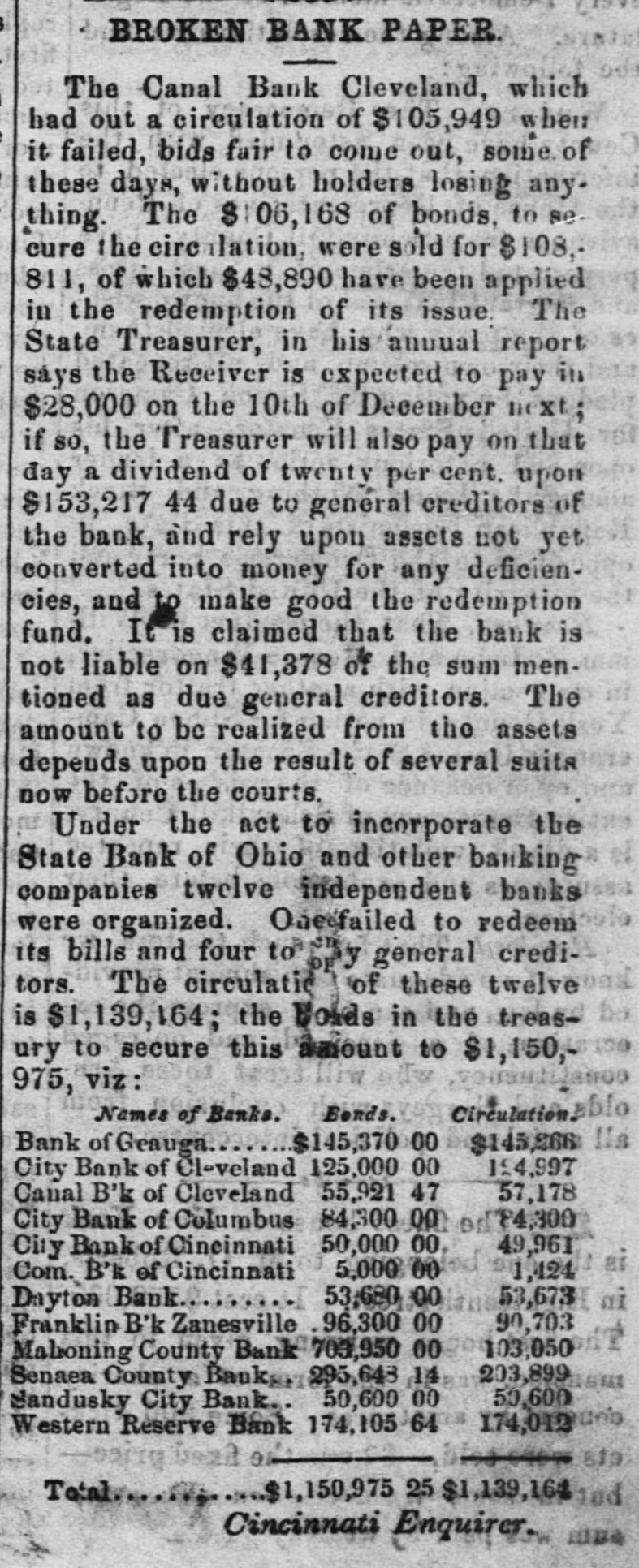
BROKEN BANK PAPER / The Canal Bank Cleveland, which had out a circulation of $105,949 when it failed, bids fair to come out, some. of these days, without holders losing any. thing. The $ 06,168 of bonds, to se cure the circ lation, were sold for $108, 811, of which $43,890 have been applied in the redemption of its issue. The State Treasurer, in his annual report says the Receiver is expected to pay in $28,000 on the 10th of December next; if so, the Treasurer will also pay on that day a dividend of twenty per cent. upon $153,217 44 due to general creditors of the bank, and rely upon assets not yet converted into money for any deficiencies, and to make good the redemption fund. It is claimed that the bank is not liable on $41,378 of the sum mentioned as due general creditors. The amount to be realized from the assets depends upon the result of several suits now before the courts. Under the act to incorporate the State Bank of Ohio and other banking companies twelve independent banks were organized. Onedfailed to redeem its bills and four to opy general creditors. The circulatic of these twelve is $1,139,164; the Folds in the treasury to secure this amount to $1,150, 975, viz: Circulation. Names of Banks. Bonds. $145,370.00 Bank of Geauga $145,866 154,997 City Bank of Cl-veland 125,000 00 47 55,921 Canal B'k of Cleveland 57,178 00 84,300 14,300 or City Bank of Columbus 00, 49,961 City Bank of Cincinnati 50,000 00 5,000 Com. B'k of Cincinnati 1,124 53,680.00 53,673 Dayton Bank 00 90,703 Franklin B'k Zanesville 96,300 00 103,050 703,950 Mahoning County Bank 203,899 14 295,643 Senaea County Bauk 00 50,600 50,600 Sandusky City Bank 174,012 Western Reserve Bank 174,105 64 Total $1,150,975 $1,139,164 Cincinnati Enquirer.


Article from Western Reserve Chronicle, September 9, 1857

Click image to open full size in new tab

Article Text

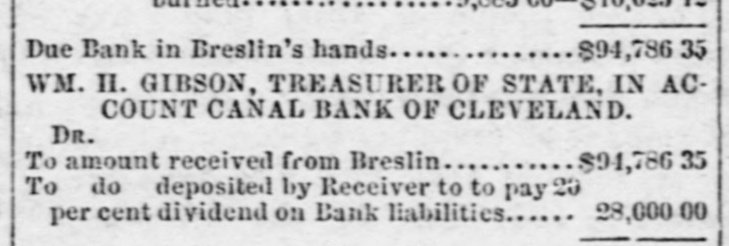
EE 2,000 our Due Bank in Breslin's hands $94,786.35 WM. II. GIBSON, TREASURER OF STATE, IN ACCOUNT CANAL BANK OF CLEVELAND. DR. To amount received from Breslin $94,786.35 To do deposited by Receiver to to pay 20 28,000.00 per cent dividend on Bank liabilities


Article from The Ashland Union, February 17, 1858

Click image to open full size in new tab

Article Text

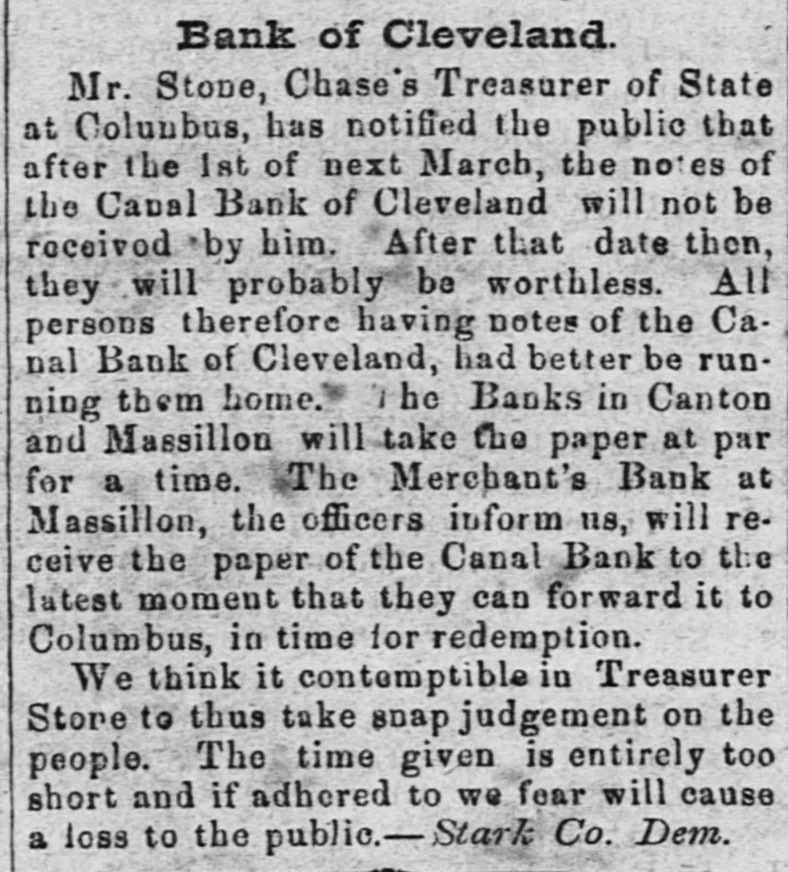
Bank of Cleveland

Mr. Stone, Chase's Treasurer of State at Colunbus, has notified the public that after the 1st of next March, the notes of the Capal Bank of Cleveland will not be received by him. After that date then, they will probably be worthless. All persons therefore having notes of the Canal Bank of Cleveland, had better be running them home. 7 he Banks in Canton and Massillon will take the paper at par for a time. The Merchant's Bank at Massillon, the officers inform us, will receive the paper of the Canal Bank to the latest moment that they can forward it to Columbus, in time for redemption. We think it contemptible in Treasurer Store to thus take snap judgement on the people. The time given is entirely too short and if adhered to we fear will cause a loss to the public.- Stark Co. Dem.


Article from The Daily Dispatch, February 19, 1858

Click image to open full size in new tab

Article Text

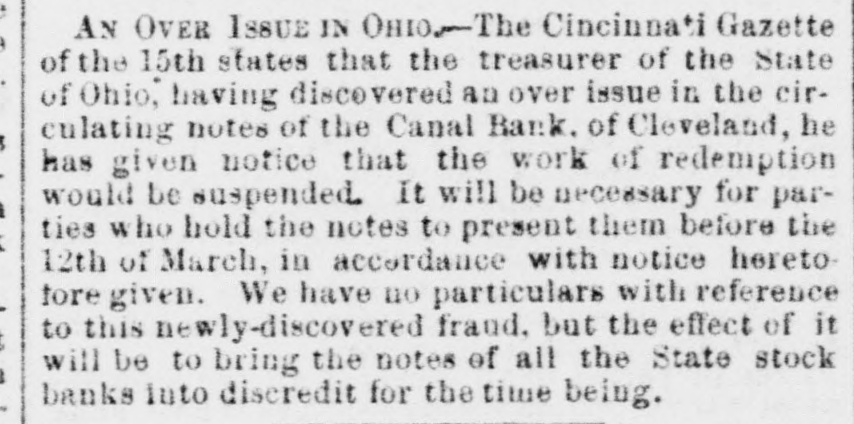
AN OVER ISSUE IN OHIO-The Cincinnati Gazette of the 15th states that the treasurer of the State of Ohio, having discovered an over issue in the circulating notes of the Canal Bank. of Cleveland, he has given notice that the work of redemption would be suspended. It will be necessary for parties who hold the notes to present them before the 12th of March, in accordance with notice hereto fore given. We have no particulars with reference to this newly-discovered fraud, but the effect of it will be to bring the notes of all the State stock banks into discredit for the time being.


Article from Delaware Gazette, February 26, 1858

Click image to open full size in new tab

Article Text

THE CANAL BANK OF CLEVELAND

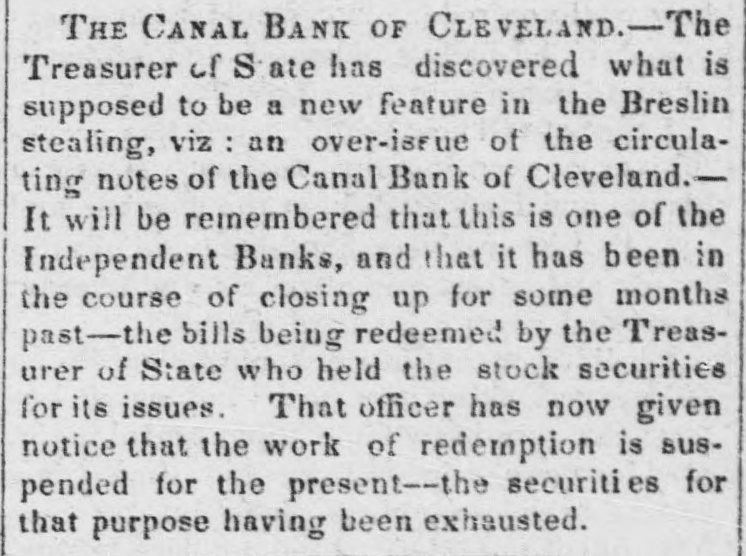
-The Treasurer of S ate has discovered what is supposed to be a new feature in the Breslin stealing, viz : an over-issue of the circulating notes of the Canal Bank of Cleveland.It will be remembered that this is one of the Independent Banks, and that it has been in the course of closing up for some months past-the bills being redeemed by the Treasurer of State who held the stock securities for its issues. That officer has now given notice that the work of redemption is suspended for the present--the securities for that purpose having been exhausted.


Article from Cleveland Morning Leader, December 8, 1858

Click image to open full size in new tab

Article Text

SUSPENDED BANKS

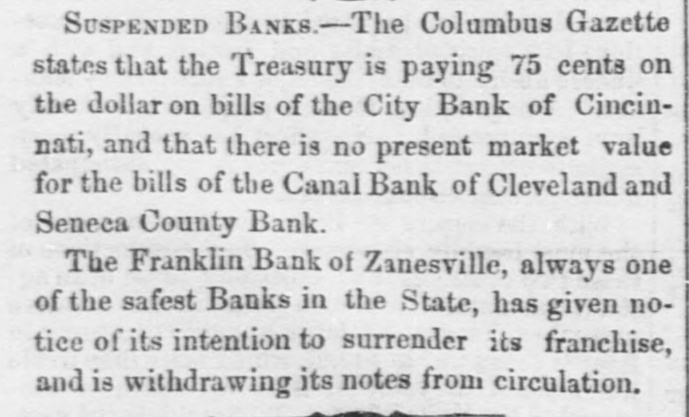
-The Columbus Gazette states that the Treasury is paying 75 cents on the dollar on bills of the City Bank of Cincinnati, and that there is no present market value for the bills of the Canal Bank of Cleveland and Seneca County Bank. The Franklin Bank of Zanesville, always one of the safest Banks in the State, has given notice of its intention to surrender its franchise, and is withdrawing its notes from circulation.


Article from Cleveland Morning Leader, November 12, 1860

Click image to open full size in new tab

Article Text

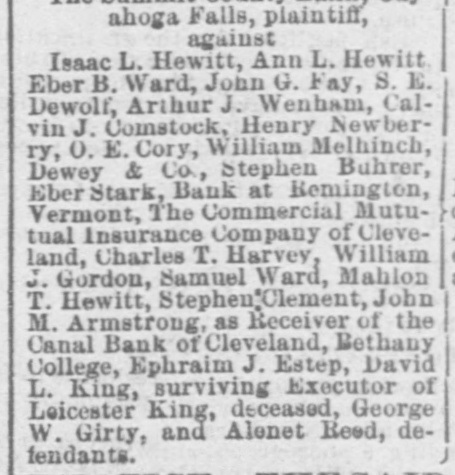
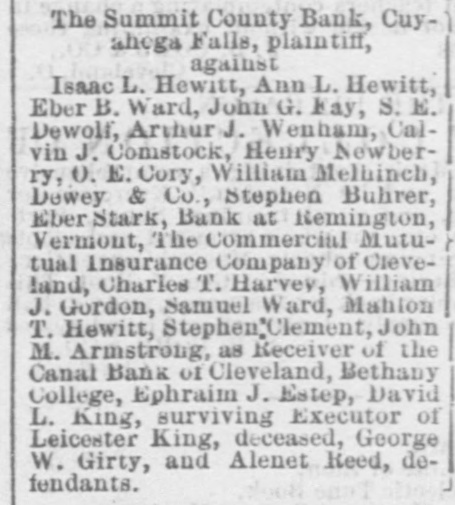
ahoga Falls, plaintiff, against Isaac L. Hewitt, Ann L. Hewitt. Eber B. Ward, John G. Fay, S. E. Dewolf, Arthur J. Wenham, Calvin J. Comstock, Henry Newberry, O. E. Cory, William Melhinch, Dewey & Co., Stephen Buhrer, Eber Stark, Bank at Remington, Vermont, The Commercial Mutual Insurance Company of Cleveland, Charles T. Harvey, William J. Gordon, Samuel Ward, Mahlon T. Hewitt, Stephen Clement, John M. Armstrong, as Receiver of the Canal Bank of Cleveland, Bethany College, Ephraim J. Estep, David L. King, surviving Executor of Leicester King, deceased, George W. Girty, and Alenet Reed, defendants.


Article from Cleveland Morning Leader, November 16, 1860

Click image to open full size in new tab

Article Text

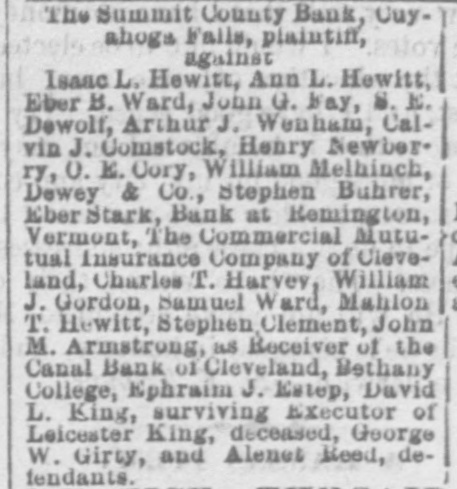
The Summit County Bank, Cuyahoga Falls, plaintiff, against Isaac L. Hewitt, Ann L. Hewitt, Eber B. Ward, John G. Fay, S. E. Dewolf, Arthur J. Wenham, Calvin J. Comstock, Henry Newberry, O. E. Cory, William Melhinch, Dewey & Co., Stephen Buhrer, Eber Stark, Bank at Remington, Vermont, The Commercial Mutual Insurance Company of Cleveland, Charles T. Harvey, William J. Gordon, Samuel Ward, Mahlon T. Hewitt, Stephen Clement, John M. Armstrong, as Receiver of the Canal Bank of Cleveland, Bethany College, Ephraim J. Estep, David L. King, surviving Executor of Leicester King, deceased, George W. Girty, and Alenet Reed, de- fendants.


Article from Cleveland Morning Leader, December 1, 1860

Click image to open full size in new tab

Article Text

The Summit County Bank, Cuyahoga Falls, plaintiff, against

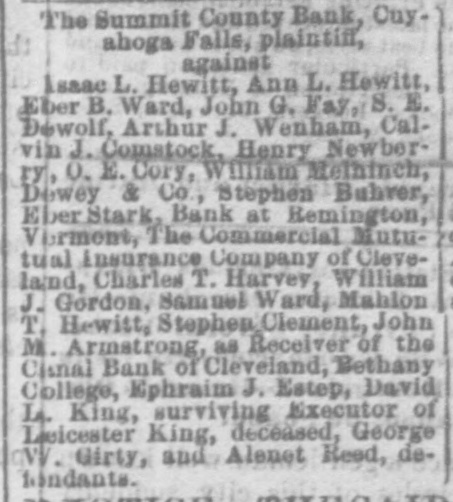
Isaac L. Hewitt, Ann L. Hewitt, Eber B. Ward, John G. Fay, S. E. Dewolf, Arthur J. Wenham, Calvin J. Comstock, Henry Newberry, O. K. Cory, William Melhinch, Dewey & Co., Stephen Buhrer, Eber Stark, Bank at Remington, Vermont, The Commercial Mutual Insurance Company of Cleveland, Charles T. Harvey, William J. Gordon, Samuel Ward, Mahlon T. Hewitt, Stephen Clement, John M. Armstrong, as Receiver of the Canal Bank of Cleveland, Bethany College, Ephraim J. Estep, David L. King, surviving Executor of Leicester King, deceased, George W. Girty, and Alenet Reed, defendants.


Article from Cleveland Morning Leader, December 14, 1860

Click image to open full size in new tab

Article Text

The Summit County Bank, Cuyahoga Falls, plaintiff, against Isaac L. Hewitt, Ann L. Hewitt, Eber B. Ward, John G. Fay, S. E. Dewolf, Arthur J. Wenham, Calvin J. Comstock, Henry Newberry, O. E. Cory, William Melninch, Dewey & Co., Stephen Buhver, Eber Stark, Bank at Remington, Vermont, The Commercial Mutual insurance Company of Cleveland, Charles T. Harvey, William J. Gordon, Samuel Ward, Mahlon T. Hewitt, Stephen Clement, John M. Armstrong, as Receiver of the Canal Bank of Cleveland, Bethany College, Ephraim J. Estep, David L. King, surviving Executor of Leicester King, deceased, George W. Girty, and Alenet Reed, de- fendants.