Newspapers use the spelling 'Pittsburg' (common historical variant) for Pittsburgh.
Events (2)
1.July 8, 1913Suspension
Cause
Bank Specific Adverse Info
Cause Details
Financial difficulties of the Kuhn interests, heavy speculative investments and alleged reserve deficiency led to receivership.
Newspaper Excerpt
the banking house of J. S. & W. S. Kuhn, Inc. were forced into the hands of receivers
Source
newspapers
same day
2.July 8, 1913Receivership
Newspaper Excerpt
the appointment of receivers for the banking house of J. S. and W. S. Kuhn, Inc.
Source
newspapers
Newspaper Articles (11)
1.July 8, 1913The Brunswick NewsBrunswick, GA
Click image to open full size in new tab
Article Text
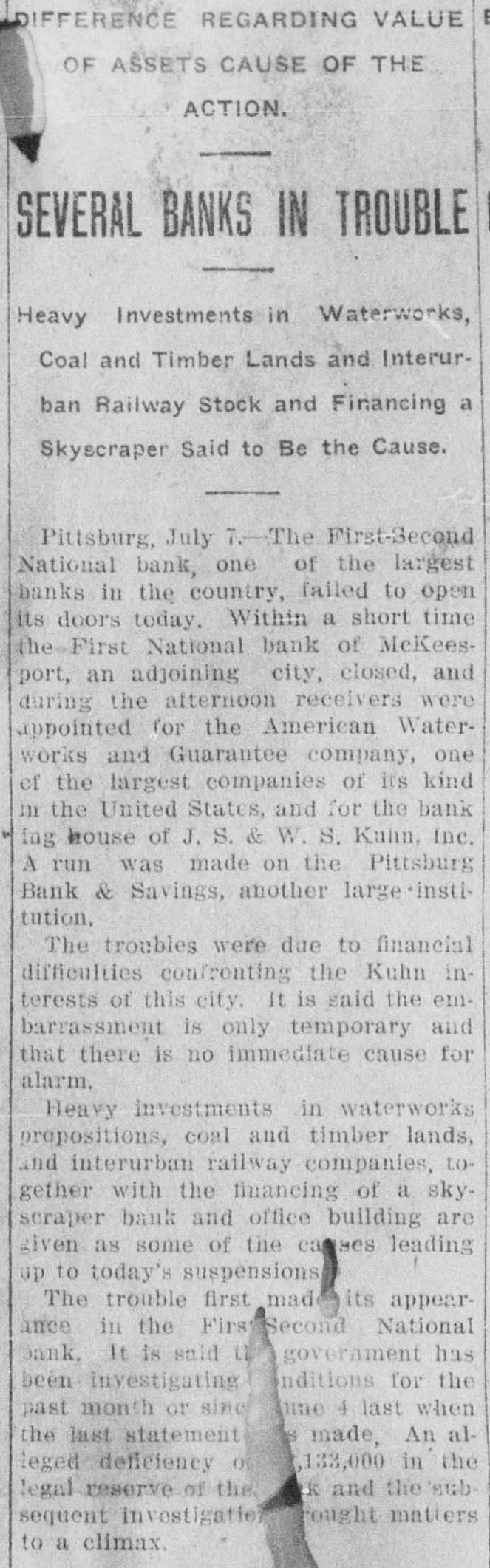
DIFFERENCE REGARDING VALUE OF ASSETS CAUSE OF THE ACTION. SEVERAL BANKS IN TROUBLE Heavy Investments in Waterworks, Coal and Timber Lands and Interurban Railway Stock and Financing a Skyscraper Said to Be the Cause. Pittsburg, July T.The First-Second National bank, one of the largest banks in the country, failed to open its doors today. Within a short time the First National bank of McKeesport, an adjoining city, closed, and during the afternoon receivers were appointed for the American Waterworks and Guarantee company, one of the largest companies of its kind in the United States, and for the bank ing house of J. S. & W. S. Kuhn, Inc. A run was made on the Pittsburg Bank & Savings, another large'institution. The troubles were due to financial difficulties confronting the Kuhn interests of this city. It is said the embarrassment is only temporary and that there is no immediate cause for alarm. Heavy investments in waterworks propositions, coal and timber lands, and interurban railway companies, together with the financing of a skyscraper bank and office building are given as some of the causes leading up to today's suspensions The trouble first mad its appearare in the First Second National bank. It is said il government has been investigating nditions for the past month or sinc une 4 last when the last statement S made, An al1,133,000 in the leged deficiency O k and the sublegal reserve of the rought matters sequent invostigatie) to a climax.
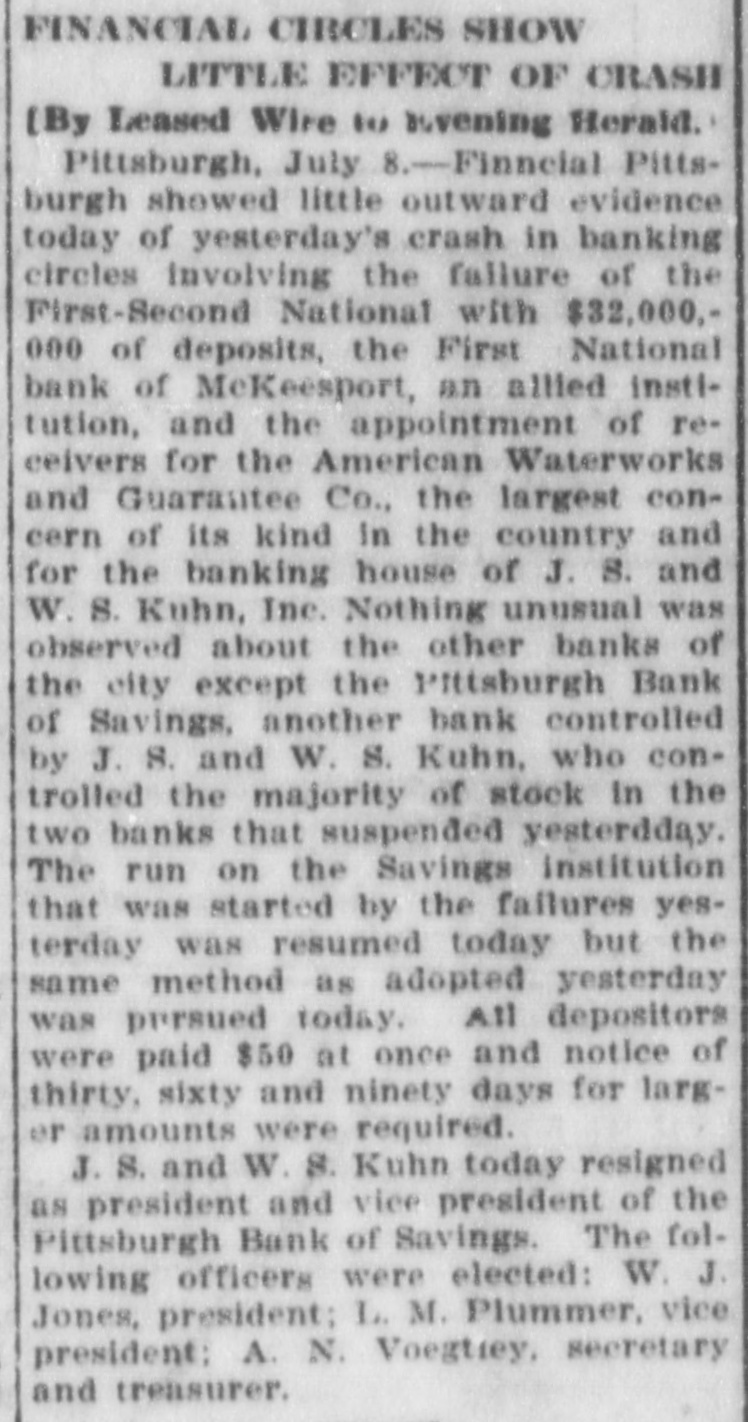
FINANCIAL CIRCLES SHOW LITTLE EFFECT OF CRASH (By Leased Wire to awaring Herald. Pittsburgh, July 8.-Finnelal Pittsburgh showed little outward evidence today of yesterday's crash in banking circles involving the failure of the First-Second National with $32,000,000 of deposits, the First National bank of McKeesport, an allied institution, and the appointment of receivers for the American Waterworks and Guarantee Co., the largest concern of its kind in the country and for the banking house of J. S. and W. S. Kuhn, Inc. Nothing unusual was observed about the other banks of the city except the Pittsburgh Bank of Savings, another bank controlled by J. S. and W. S. Kuhn, who controlled the majority of stock In the wo banks that suspended yesterdday. The run on the Savings institution that was started by the failures yesterday was resumed today but the same method as adopted yesterday was persued today. All depositors were paid $50 at once and notice of thirty, sixty and ninety days for largor amounts were required. J. S. and W. 8. Kuhn today resigned as president and vice president of the Pittsburgh Bank of Savings. The following officers were elected: W. J. Jones, president: L. M. Plummer, vice president: A. N. Voegtiey, secretary and treasurer.
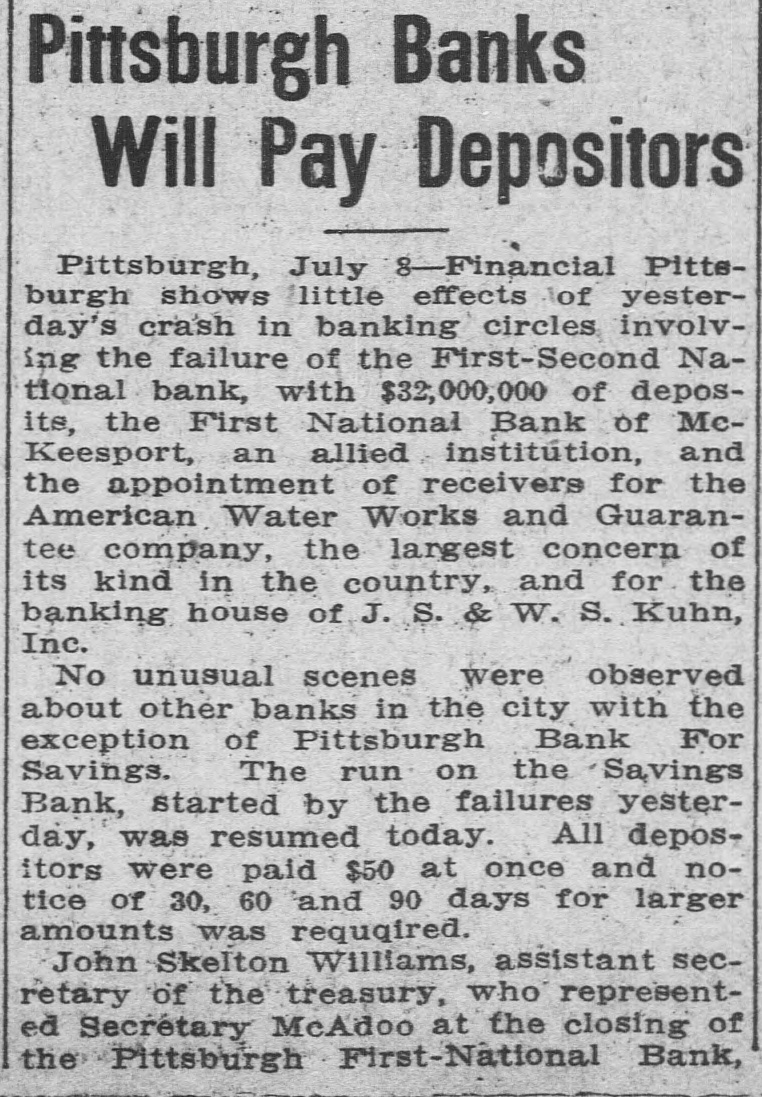
Pittsburgh Banks Will Pay Depositors Pittsburgh, July 8-Financial Pitteburgh shows little effects of yesterday's crash in banking circles involving the failure of the First-Second National bank, with $32,000,000 of deposits, the First National Bank of McKeesport, an allied institution, and the appointment of receivers for the American Water Works and Guarantee company, the largest concern of its kind in the country, and for the banking house of J. S. & W. S. Kuhn, Inc. No unusual scenes were observed about other banks in the city with the exception of Pittsburgh Bank For Savings. The run on the Savings Bank, started by the failures yesterday, was resumed today. All depositors were paid $50 at once and notice of 30, 60 and 90 days for larger amounts was required. John Skelton Williams, assistant secretary of the treasury, who represented Secretary McAdoo at the closing of the Pittsburgh First-National Bank,
4.July 8, 1913The Times DispatchRichmond, VA
Click image to open full size in new tab
Article Text
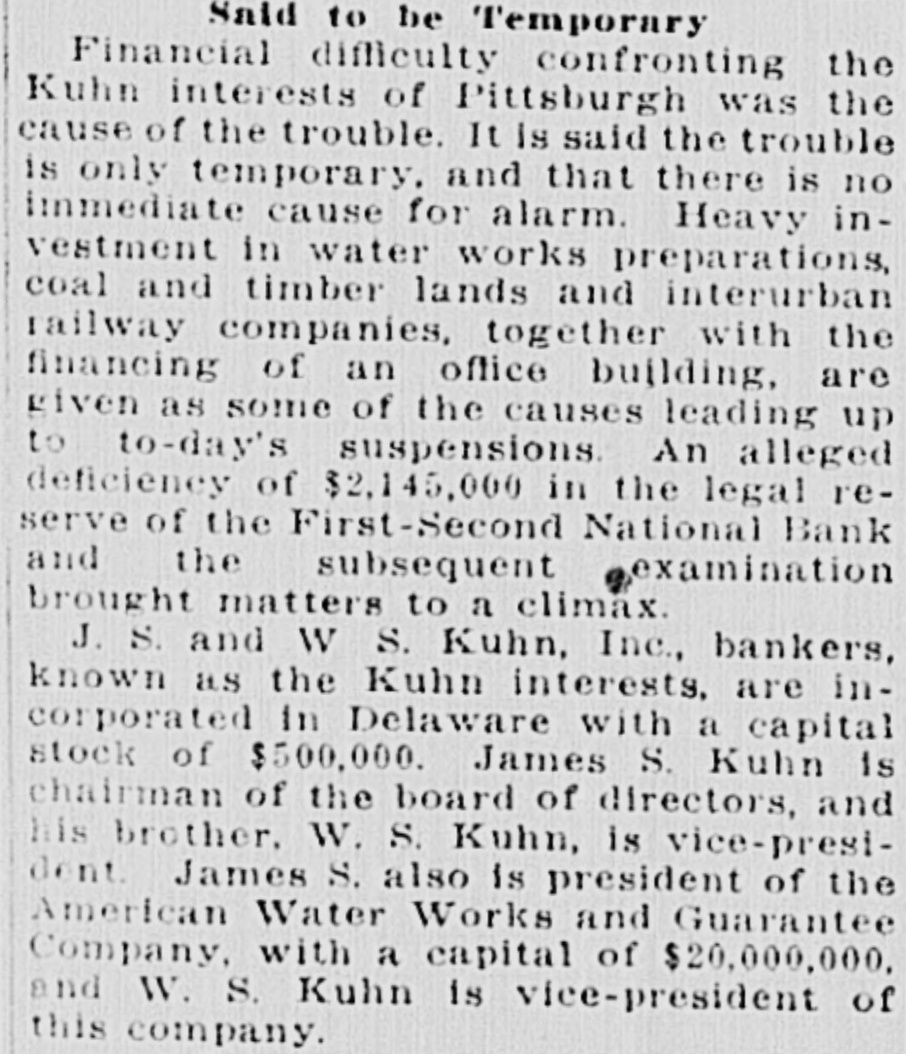
Said to be Temporary Financial difficulty confronting the Kuhn interests of Pittsburgh was the cause of the trouble. It is said the trouble is only temporary. and that there is no immediate cause for alarm. Heavy investment in water works preparations, coal and timber lands and interurban railway companies, together with the financing of an office building, are given as some of the causes leading up to to-day's suspensions. An alleged deficiency of $2,145,000 in the legal reserve of the First-Second National Bank and the subsequent examination brought matters to a climax. J. S. and W S. Kuhn, Inc., bankers, known as the Kuhn interests, are incorporated in Delaware with a capital stock of $500,000. James S. Kuhn Is chairman of the board of directors, and his brother. W. S. Kuhn, is vice-president. James S. also is president of the American Water Works and Guarantee Company, with a capital of $20,000,000. and W. S. Kuhn is vice-president of this company.
5.July 8, 1913Evening StarWashington, DC
Click image to open full size in new tab
Article Text
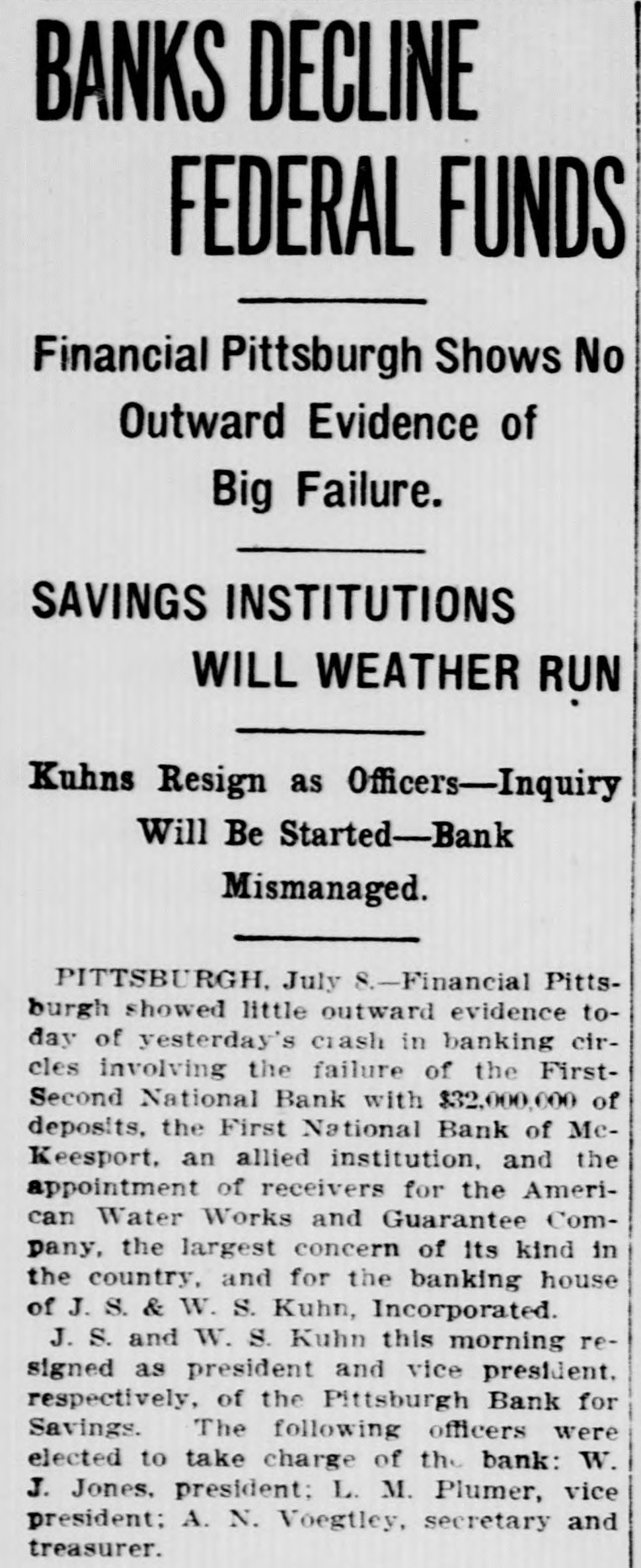
BANKS DECLINE FEDERAL FUNDS Financial Pittsburgh Shows No Outward Evidence of Big Failure. SAVINGS INSTITUTIONS WILL WEATHER RUN Kuhns Resign as Officers-Inquiry Will Be Started-Bank Mismanaged. PITTSBURGH, July 8.-Financial Pittsburgh showed little outward evidence today of yesterday's crash in banking circles involving the failure of the FirstSecond National Bank with $32,000,000 of deposits, the First National Bank of McKeesport, an allied institution, and the appointment of receivers for the American Water Works and Guarantee Company, the largest concern of Its kind in the country, and for the banking house of J. S. & W. S. Kuhn, Incorporated. J. S. and W. S. Kuhn this morning resigned as president and vice president. respectively, of the Pittsburgh Bank for Savings. The following officers were elected to take charge of the bank: W. J. Jones. president: L. M. Plumer, vice president: A. N. Voegtley, secretary and treasurer.
6.July 9, 1913The Salt Lake TribuneSalt Lake City, UT
Click image to open full size in new tab
Article Text
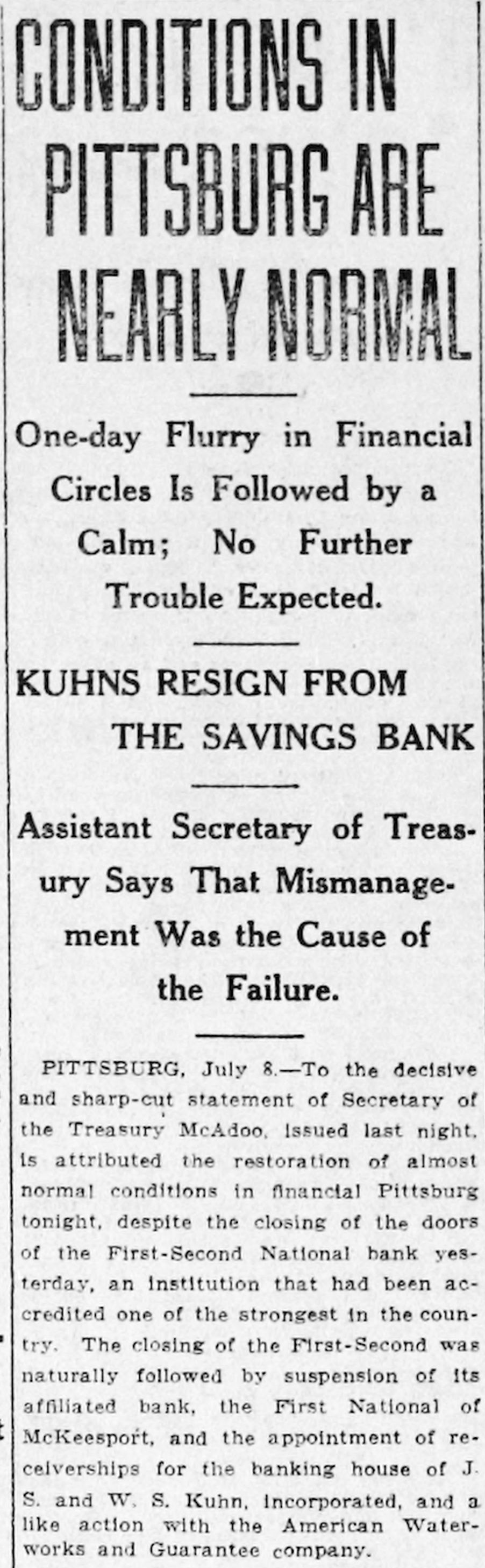
CONDITIONS IN PITTSBURG ARE , One-day Flurry in Financial Circles Is Followed by a Calm; No Further Trouble Expected. KUHNS RESIGN FROM THE SAVINGS BANK Assistant Secretary of Treasury Says That Mismanagement Was the Cause of the Failure. PITTSBURG, July 8.-To the decisive and sharp-cut statement of Secretary of the Treasury McAdoo. issued last night. is attributed the restoration of almost normal conditions in financial Pittsburg tonight, despite the closing of the doors of the First-Second National bank yesterday, an institution that had been accredited one of the strongest in the country. The closing of the First-Second was naturally followed by suspension of its affiliated bank, the First National of McKeesport, and the appointment of receiverships for the banking house of J. S. and W. S. Kuhn, Incorporated, and a like action with the American Waterworks and Guarantee company.
7.July 9, 1913Arizona RepublicanPhoenix, AZ
Click image to open full size in new tab
Article Text
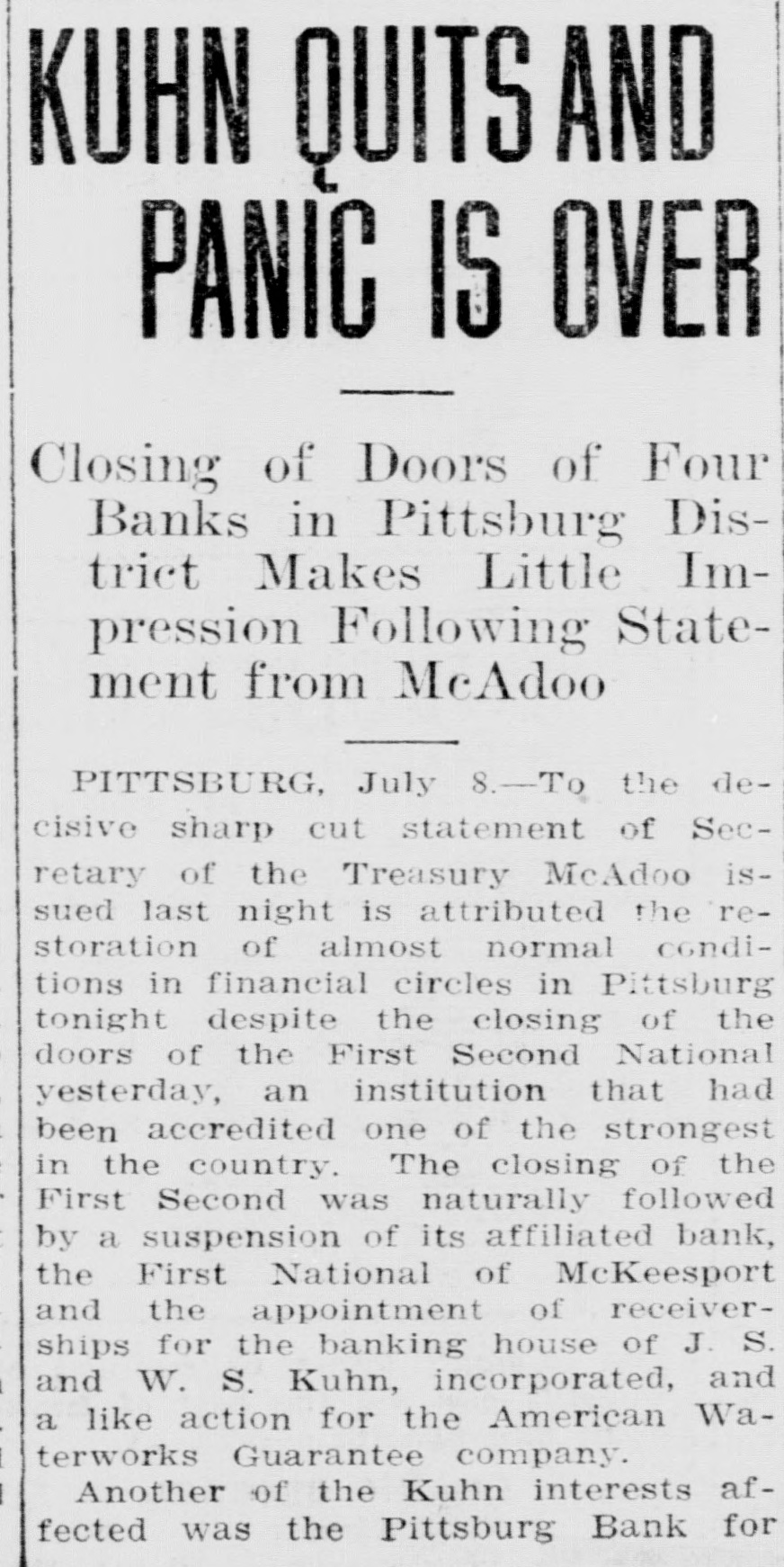
KUHN QUITS AND PANIC IS OVER Closing of Doors of Four Banks in Pittsburg District Makes Little Impression Following Statement from McAdoo PITTSBURG, July -To the decisive sharp cut statement of Secretary of the Treasury McAdoo issued last night is attributed the restoration of almost normal conditions in financial circles in Pittsburg tonight despite the closing of the doors of the First Second National yesterday, an institution that had been accredited one of the strongest in the country. The closing of the First Second was naturally followed by a suspension of its affiliated bank, the First National of McKeesport and the appointment of receiverships for the banking house of J. S. and W. S. Kuhn, incorporated, and a like action for the American Waterworks Guarantee company. Another of the Kuhn interests affected was the Pittsburg Bank for
8.July 9, 1913The Laurens AdvertiserLaurens, SC
Click image to open full size in new tab
Article Text
BIG BANK FAILURE IN PITTSBURGI One Bank Falls Causing Receivership for Others. LEADING BANK OF THE COUNTRY Bank had been in Shaky Condition to Some Time and the Failure was n° Unexpected to the Clearing Hous Association. Depositors Probabl Lose Little. Pittsburg, July 7.-The First-Sec ond National Bank of Pittsburg, th First National Bank of McKeesport. neighboring city; the American Wa terworks & Guarantee Company an the banking house of J. S. & W. S Kuhn, Inc., of this city, were force into the hands of receivers toda through the failure of the first-name institution to open its doors thi morning. The closing of the First Second National Bank was ordered b the deputy comptroller of the cui rency, T. P. Kane, after every egor had been made to meet the govern ment requirements as to the legal re serve. The Kuhn Banking House has ey
9.July 11, 1913The Holly ChieftainHolly, CO
Click image to open full size in new tab
Article Text
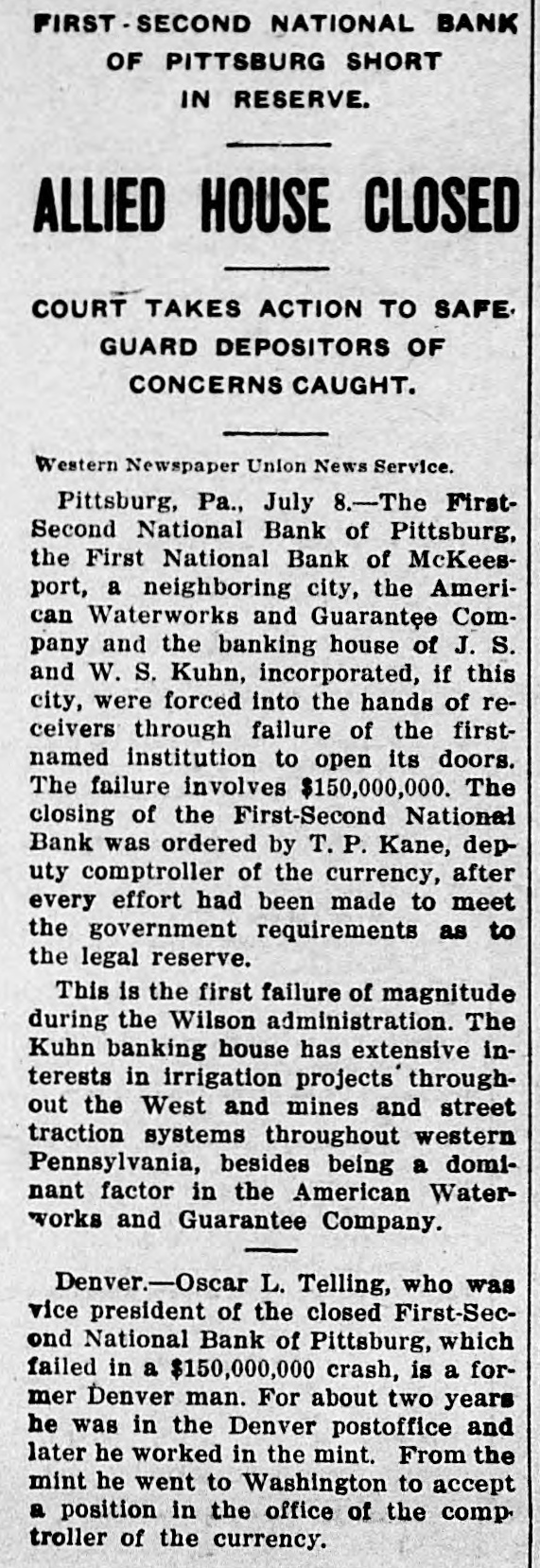
FIRST - SECOND NATIONAL BANK OF PITTSBURG SHORT IN RESERVE. ALLIED HOUSE CLOSED COURT TAKES ACTION TO SAFE. GUARD DEPOSITORS OF CONCERNS CAUGHT. Western Newspaper Union News Service. Pittsburg, Pa., July 8.-The FirstSecond National Bank of Pittsburg, the First National Bank of McKeesport, a neighboring city, the American Waterworks and Guarantee Company and the banking house of J. S. and W. S. Kuhn, incorporated, if this city, were forced into the hands of receivers through failure of the firstnamed institution to open its doors. The failure involves $150,000,000. The closing of the First-Second National Bank was ordered by T.P. Kane, deputy comptroller of the currency, after every effort had been made to meet the government requirements as to the legal reserve. This is the first failure of magnitude during the Wilson administration. The Kuhn banking house has extensive interests in irrigation projects throughout the West and mines and street traction systems throughout western Pennsylvania, besides being a dominant factor in the American Waterworks and Guarantee Company. Denver.-Oscar L. Telling, who was vice president of the closed First-Second National Bank of Pittsburg, which failed in a $150,000,000 crash, is a former Denver man. For about two years he was in the Denver postoffice and later he worked in the mint. From the mint he went to Washington to accept a position in the office of the comp. troller of the currency.
10.July 11, 1913The United OpinionBradford, VT
Click image to open full size in new tab
Article Text
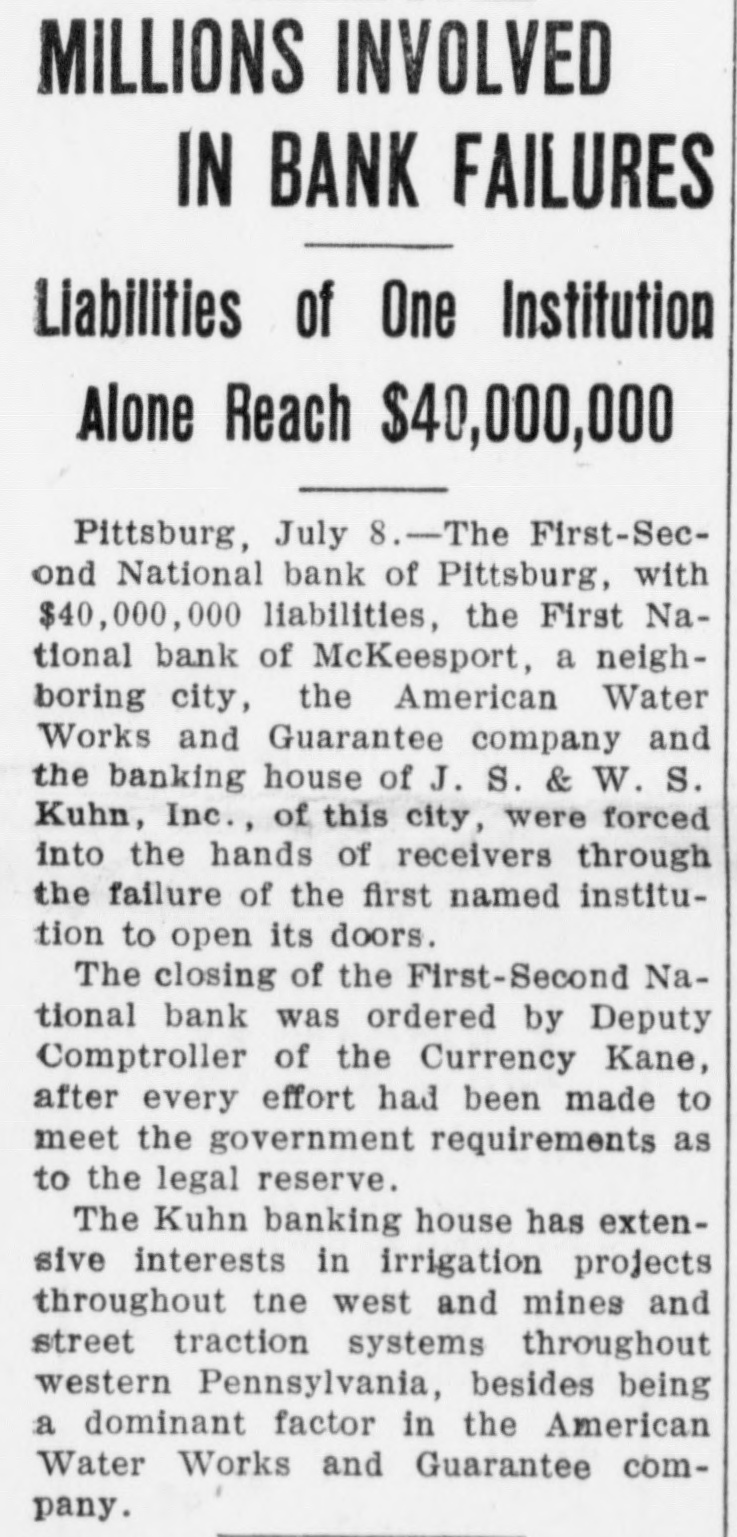
MILLIONS INVOLVED IN BANK FAILURES Liabilities of One Institution Alone Reach $40,000,000 Pittsburg, July 8.-The First-Second National bank of Pittsburg, with $40,000,000 liabilities, the First National bank of McKeesport, a neighboring city, the American Water Works and Guarantee company and the banking house of J. S. & W. S. Kuhn, Inc., of this city, were forced into the hands of receivers through the failure of the first named institution to open its doors. The closing of the First-Second National bank was ordered by Deputy Comptroller of the Currency Kane, after every effort had been made to meet the government requirements as to the legal reserve. The Kuhn banking house has extensive interests in irrigation projects throughout the west and mines and street traction systems throughout western Pennsylvania, besides being a dominant factor in the American Water Works and Guarantee company.
11.July 12, 1913Abbeville ProgressAbbeville, LA
Click image to open full size in new tab
Article Text
Two Banks Forced Into Receivership
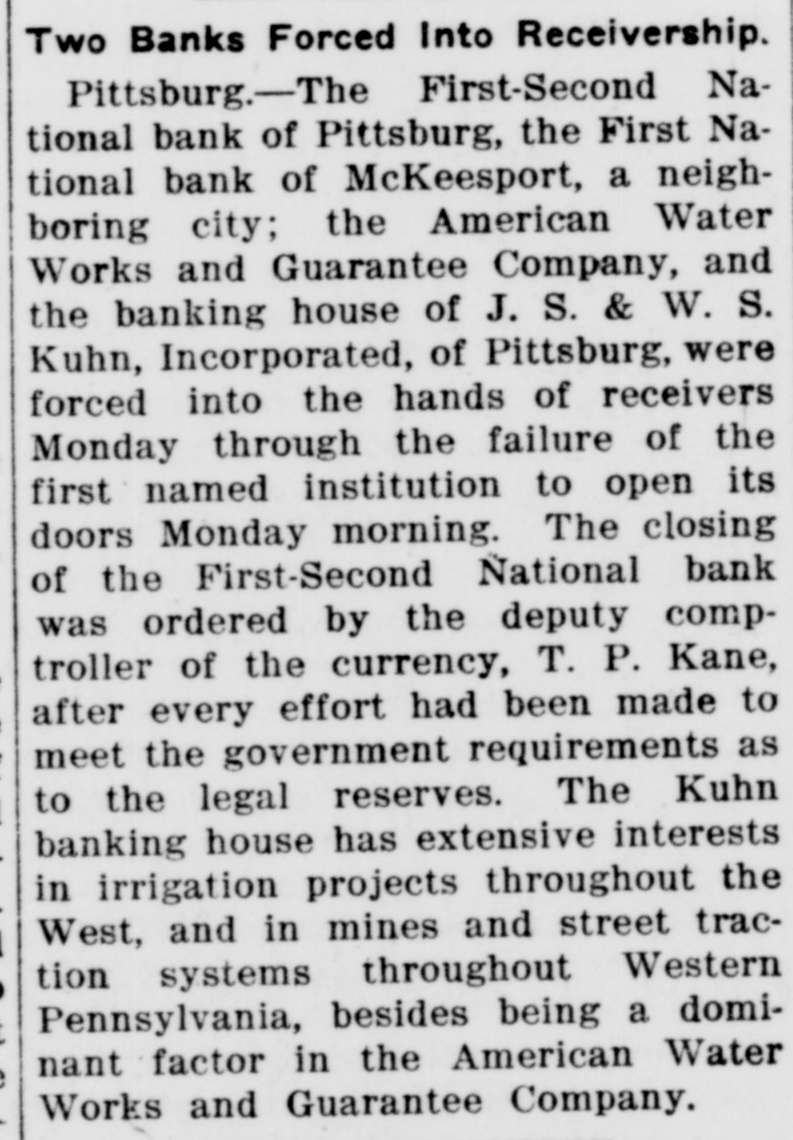
Pittsburg.-The First-Second National bank of Pittsburg, the First National bank of McKeesport, a neighboring city; the American Water Works and Guarantee Company, and the banking house of J. S. & W. S. Kuhn, Incorporated, of Pittsburg, were forced into the hands of receivers Monday through the failure of the first named institution to open its doors Monday morning. The closing of the First-Second National bank was ordered by the deputy comptroller of the currency, T. P. Kane, after every effort had been made to meet the government requirements as to the legal reserves. The Kuhn banking house has extensive interests in irrigation projects throughout the West, and in mines and street traction systems throughout Western Pennsylvania, besides being a dominant factor in the American Water Works and Guarantee Company.
Bank runs are almost always and everywhere a deterioration of bank fundamentals.
But not for you.
You are the measure-zero exception: great fundamentals, solid bank, and yet the Diamond Dybvig fairy spread its rumor. Depositors woke up. Your collateral was not prepositioned. The Clearinghouse had it for you.
Do not pass Go. Do not collect $200. Go directly to jail… or worse.