Article Text
WALZ WAS NOT A DIRECTOR IN DEFUNCT BANK
NASHVILLE BANKER NOT INVOLVED IN FAILURE OF BANK OF GILLETT, AS CHARGED.
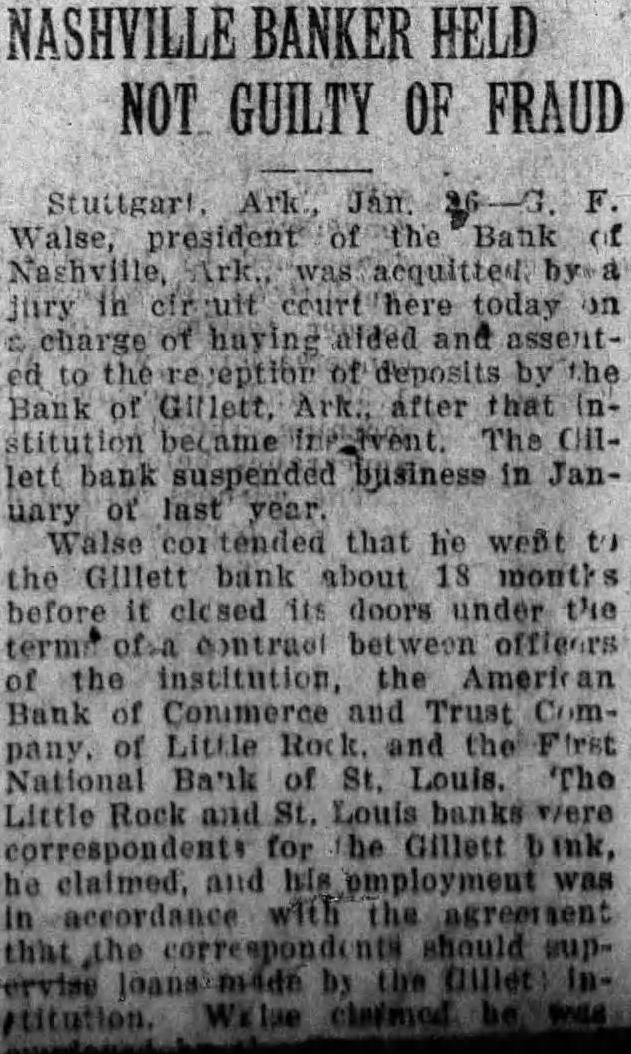
Press dispatches last week told of the indictment at DeWitt of six officers and directors of the Bank of Gillett, which failed last January, and stated that it was probable that a seventh indictment had been returned by the jury, this one against Geo. F. Walz, president of the Bank of Nashville, who the dispatches said was a director in the defunct bank. While Mr. Walz was connected with the bank as a trustee, he was never connected in an official capacity, and the dispatches published in state papers, were misleading and harmful to Mr. Walz. Because of the misleading character of the dispatches, The News requested Mr. Walz to make a statement of the affair for publication in order that the people here may have the full truth of the matter. Mr. Walz' statement follows:
"Referring to an article in the Arkansas Gazette of August 17th, which was erroneous as to the facts as well as misleading to the average reader, and because of the fact that I am fulfilling a position of trust and responsibility in this community, I am prompted to make this statement publicly:
"Some time in May, 1921, while I was cashier of the Arkansas County Bank of Stuttgart, Ark., I was confronted with a proposition to act in the capacity of liquidation agent (collector) and as custodian of collateral, in the manner of accepting a trustee-ship for the First National Bank of St. Louis, Mo., the American Bank of Commerce and Trust Co., of Little Rock and the Bank of Gillett, the latter bank at that time being heavily involved with the two former banks. Upon and by the approval of the then bank commissioner an agreement was entered into between the above mentioned banks and myself as trustee; my duties being plainly outlined in this agreement and specifically stated that I would have no voice in the management of the bank, however, that I should act in harmony with and at the suggestions of the Board of Directors in the collection of their notes, and advise and consult with them in the granting of additional credit to their customers, the agreement further designated that this trust should exist only at will of the three contracting banks and that my services could be dispensed with by them at any time they saw fit.
"In no way or form did this agreement endow me with any authority to do anything or perform the duties of any officer or director. The agreement stipulated that I should be custodian of the notes that were pledged to the correspondent banks as collateral, to make collections wherever possible and apply the proceeds according to the terms of the agreement. The agreement further stated that the Bank of Gillett was to turn over to me all notes received for new loans made, and to be held by me as collateral for additional moneys furnished by the two correspondent banks.
"The extended condition of the Bank of Gillett was the cause of large commodity loans during the high prices of 1918, 1919 and early part of 1920, and only by the most favorable market and crop conditions was it possible to liquidate sufficient to meet the demands of the bank and pay its bills. This favorable condition failed to materialize and the bank realizing that it would not be in position to finance its customers for another crop, and otherwise properly function as a bank, suspended business about the middle of January, 1923.
"It is natural that bank failures cause ill feelings and since the Bank of Gillett has considerable public money at the time it closed, feeling ran very high, and sentiment grew very fast against the First National Bank of St. Louis and the American Bank of Commerce of Little Rock, the public feeling that the contract which had been entered into eighteen months prior was unfair to the depositors, and that they had been taken advantage of—the public generally feeling that my mission was only to assist these two out of town banks in getting their money. They"