Article Text
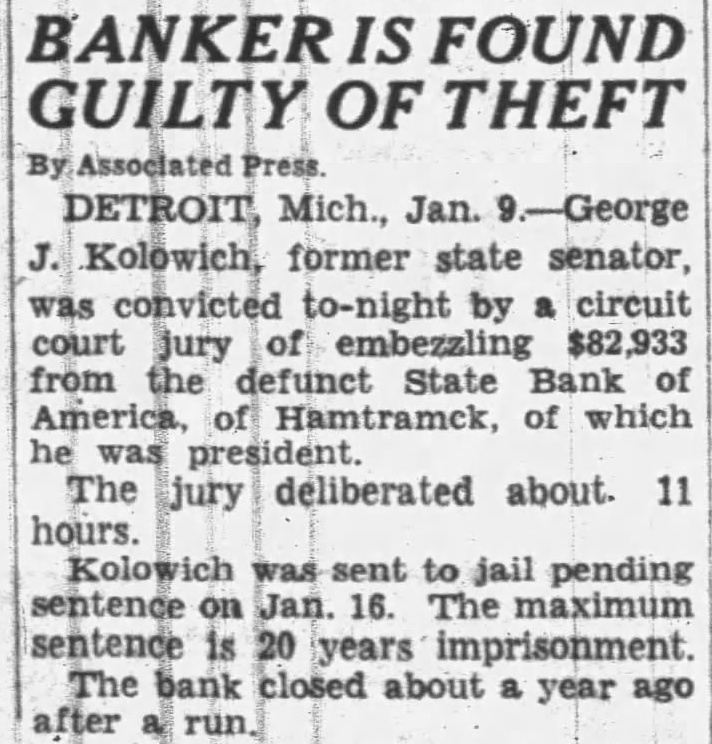
AIR KOLOWICH BANK ACCOUNT Witnesses Testify to Big Overdrafts An effort by defense counsel to show that Rudolph E. Reichert, State banking commissioner, and the board of directors of the defunct State Bank of America made last minute attempt to bolster up the Hamtramck institution the day before it failed was ruled out Wednesday as the second embezzlement trial of George J. Kolowich, bank president, entered its second day. Reichert's part in the events leading up to the closing of the bank drew the fire of Duncan C. McCrea, assistant prosecutor, during the argument over the admission of testimony which the defense claims would show that the commissioner and directors treated the shortages as overdrafts. Anthony Maiullo, defense attorney, told the court the officials passed a resolution taking over the Merchants and Mechanics Banking Building as part payments of its $82,933 overdraft in the State Bank. This was done to give Kolowich, who owned the bank, more time in which make up the balance, Maiullo claimed. Rules Out Testimony "I don't care how many banking commissioners treated the overdrafts shortages,' Mr. McCrea said, "The only difference would be that the commissioner might in that case be guilty of compounding felony.' Judge Homer Ferguson ruled out the testimony, but said that the defense might show what action had been taken to cover the shortages. Willard Babcock, cashier of the State Bank of America on direct examination by Mr. McCrea, described the series of overdrafts on the Merchants and Mechanics Bank's account. Babcock testified that drafts were honored but not charged against the account until June 16. At one time they totaled $84 489.86, more than was on deposit. Babcock said. Admits Other Overdrafts Babcock admitted. under crossexamination, that overdrafts had existed early in 1930, and had been covered by Kolowich within a short period. Michael A. Goszycki, a teller in the defunct State Bank of America, testified that he had made false entries in the cash books under orders from Babcock. John W. Kempisty, cashier at the Merchants and Mechanics Bank, said on the stand that from Jan. 10, 1930, to June 18, 1930, the Merchants and Mechanics Bank was constantly overdrawn on the State Bank of America for sums varying up to $135,000. Tells of Securing Loan Kempisty testified that on Oct. 29, 1929, under orders from Kolowich, he negotiated a loan from the State Bank of America for $12,580. In January, 1930, when bank ex aminers investigated the condition of the State Bank of America, Kolowich paid $2,000 on this loan Another note was then made out for the remaining $10,580 and Kempisty signed it. Later, according to Kempisty, Kolowich also signed it. The receivers for the defunct bank are now suing Kempisty in an attempt to regain the $10,580. Says Bank Had Cash On cross-examination by Anthony Maiullo, defense counsel, Kempisty testified that every statement he saw from the State Bank of America showed that the Merchants and Mechanics Bank had plenty of money on deposit. On further questioning by McCrea, Kempisty said that bonds belonging to Kolowich were sold and the proceeds put into the bank and that on June 18, 1930, total of 1,142 pieces of property owned by Kolowich were turned over to the bank's receivers to help straighten out the bank's Kolowich's bond was raised from $10,000 to $20,000 because of irregularities in connection with his other trial.