8059. Chelsea Bank (Chelsea, MA)

Bank Information

Episode Type
Suspension → Closure
Bank Type
state
Start Date
January 1, 1837*
Location
Chelsea, Massachusetts (42.392, -71.033)

Metadata

Model
gpt-5-mini
Short Digest
a06a934c

Response Measures

None

Description

Contemporary newspapers (1857) list Chelsea Bank, Chelsea among the banks that failed in the financial crisis of 1837. The articles state it 'failed' or 'suspended' in 1837 as part of the wider panic; no run is described in the excerpts. Year of failure given as 1837; exact day/month not provided.

Events (1)

1. January 1, 1837* Suspension
Cause
Macro News
Cause Details
Part of the widespread bank failures during the financial crisis of 1837; listed among banks that 'failed' that year in contemporary reports.
Newspaper Excerpt
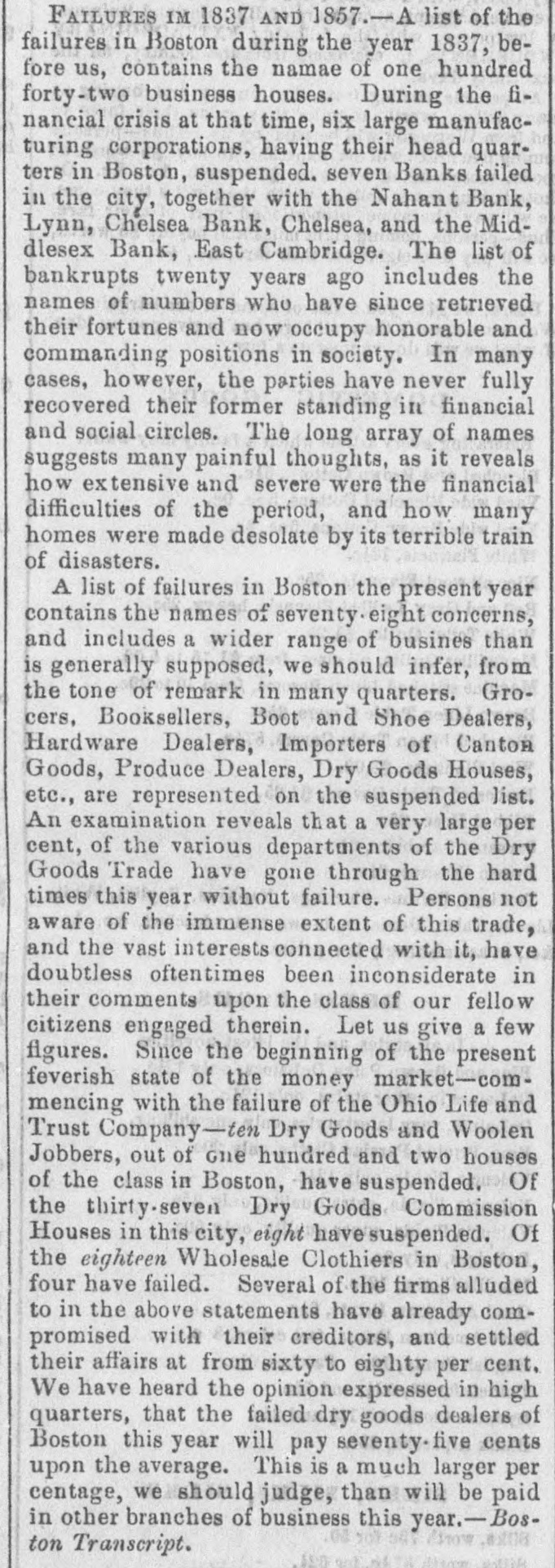
seven Banks failed in the city, together with the Nahant Bank, Lynn, Chelsea Bank, Chelsea, and the Middlesex Bank, East Cambridge.
Source
newspapers

Newspaper Articles (2)

Article from Worcester Daily Spy, November 24, 1857

Click image to open full size in new tab

Article Text

FAILURES IM 1837 AND 1857.-A list of the failures in Boston during the year 1837, before us, contains the namae of one hundred forty-two business houses. During the financial crisis at that time, six large manufacturing corporations, having their head quarters in Boston, suspended. seven Banks failed in the city, together with the Nahant Bank, Lynn, Chelsea Bank, Chelsea, and the Middlesex Bank, East Cambridge. The list of bankrupts twenty years ago includes the names of numbers who have since retrieved their fortunes and now occupy honorable and commanding positions in society. In many cases, however, the parties have never fully recovered their former standing in financial and social circles. The long array of names suggests many painful thoughts, as it reveals how extensive and severe were the financial difficulties of the period, and how many homes were made desolate by its terrible train of disasters. A list of failures in Boston the present year contains the names of seventy. eight concerns, and includes a wider range of busines than is generally supposed, we should infer, from the tone of remark in many quarters. Grocers, Booksellers, Boot and Shoe Dealers, Hardware Dealers, Importers of Canton Goods, Produce Dealers, Dry Goods Houses, etc., are represented on the suspended list. An examination reveals that a very large per cent, of the various departments of the Dry Goods Trade have gone through the hard times this year without failure. Persons not aware of the immense extent of this trade, and the vast interests connected with it, have doubtless oftentimes been inconsiderate in their comments upon the class of our fellow citizens engaged therein. Let us give a few figures. Since the beginning of the present feverish state of the money market-commencing with the failure of the Ohio Life and Trust Company-ten Dry Goods and Woolen Jobbers, out of one hundred and two houses of the class in Boston, have suspended. Of the thirty-seven Dry Goods Commission Houses in this city, eight have suspended. Of the eighteen Wholesale Clothiers in Boston, four have failed. Several of the firms alluded to in the above statements have already compromised with their creditors, and settled their affairs at from sixty to eighty per cent, We have heard the opinion expressed in high quarters, that the failed dry goods dealers of Boston this year will pay seventy. five cents upon the average. This is a much larger per centage, we should judge, than will be paid in other branches of business this year.-BosNow ton Transcript. with

Article from The New York Herald, November 26, 1857

Click image to open full size in new tab

Article Text

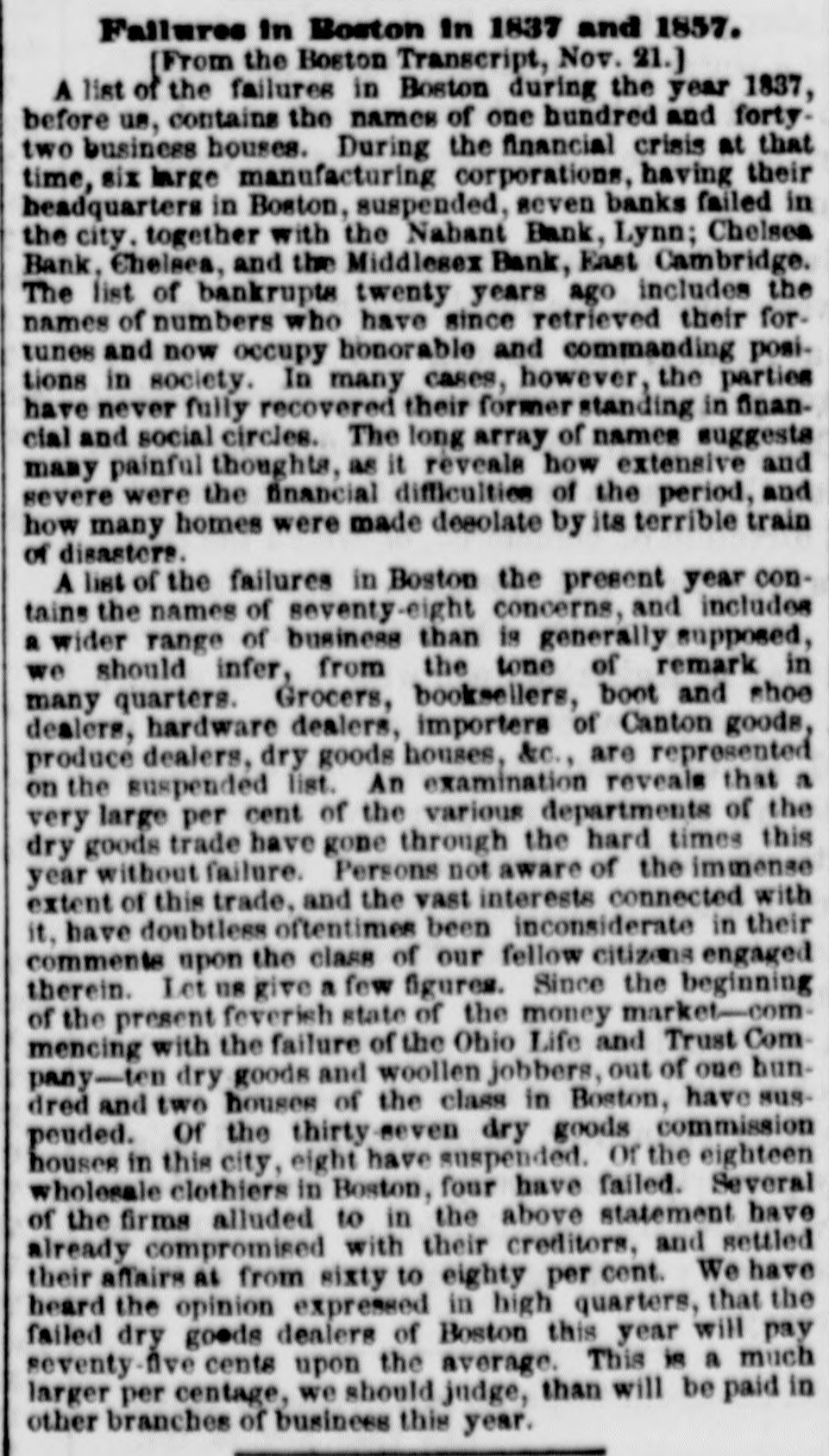
Failures In Boston In 1837 and 1857. [From the Boston Transcript, Nov. 21.] A list of the failures in Boston during the year 1837, before us, contains the names of one hundred and fortytwo business houses. During the financial crisis at that time, six large manufacturing corporations, having their headquarters in Boston, suspended, seven banks failed in the city, together with the Nabant Bank, Lynn; Chelsea Bank, Chelsea, and the Middlesex Bank, East Cambridge. The list of bankrupts twenty years ago includes the names of numbers who have since retrieved their fortunes and now occupy honorable and commanding positions in society. In many cases, however, the parties have never fully recovered their former standing in financial and social circles. The long array of names suggests many painful thoughts, as it reveals how extensive and severe were the financial difficulties of the period, and how many homes were made desolate by its terrible train of disasters. A list of the failures in Boston the present year contains the names of seventy-eight concerns, and includes a wider range of business than is generally supposed, we should infer, from the tone of remark in many quarters. Grocers, booksellers, boot and shoe dealers, hardware dealers, importers of Canton goods, produce dealers, dry goods houses, &c., are represented on the suspended list. An examination reveals that a very large per cent of the various departments of the dry goods trade have gone through the hard times this year without failure. Persons not aware of the immense extent of this trade, and the vast interests connected with it, have doubtless oftentimes been inconsiderate in their comments upon the class of our fellow citizens engaged therein. Let us give a few figures. Since the beginning of the present feverish state of the money market-commencing with the failure of the Ohio Life and Trust Company-ten dry goods and woollen jobbers, out of one hundred and two houses of the class in Boston, have suspeuded. Of the thirty-seven dry goods commission houses in this city, eight have suspended. Of the eighteen wholesale clothiers in Boston, four have failed. Several of the firms alluded to in the above statement have already compromised with their creditors, and settled their affairs at from sixty to eighty per cent. We have heard the opinion expressed in high quarters, that the failed dry goods dealers of Boston this year will pay seventy-five cents upon the average. This is a much larger per centage, we should judge, than will be paid in other branches of business this year.