Commercial Bank (St Paul, MN)

Episode Information

Episode UID
8050292491108
Episode Type
Run โ†’ Suspension โ†’ Reopening
Bank Type
state
Bank ID
805029249 hash
Start Date
April 27, 1892
Location
St Paul, Minnesota (44.944, -93.093)

Metadata

Model
gpt-5-mini (chosen from majority vote of a three-model LLM ensemble)
Short Digest
abbdcbe09f0f8567

Response Measures

None

Description

Assigned to a receiver after suspension but later reorganized and reopened under arrangements with depositors/creditors.

Events (4)

1. April 27, 1892 Run
Cause
Rumor Or Misinformation
Cause Details
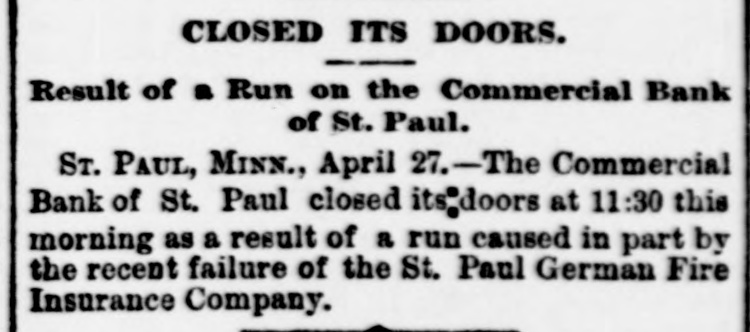
Run triggered by scare/rumors linking the bank with the failure of the St. Paul German Fire Insurance Company, prompting heavy withdrawals.
Measures
Bank suspended payments; card placed in window announcing temporary suspension and promise to pay depositors in full.
Newspaper Excerpt
The Commercial Bank ... action was taken after a heavy run, continuing during the entire forenoon.
Source
newspapers
2. April 28, 1892 Suspension
Cause
Rumor Or Misinformation
Cause Details
Suspension followed the run caused by rumors/scare from the failure of the St. Paul German Fire Insurance Company.
Newspaper Excerpt
The Commercial bank has suspended payment. The officers say depositors will be paid in full.
Source
newspapers
3. April 29, 1892 Receivership
Newspaper Excerpt
The Commercial bank yesterday afternoon made an assignment to Frank A. Seymour, cashier of the Merchants' National bank.
Source
newspapers
4. September 22, 1892 Reopening
Newspaper Excerpt
The Commercial bank of St. Paul ... has reopened for business under the same management; depositors and creditors made an agreement with the stockholders.
Source
newspapers

Newspaper Articles (21)

Article from The Wilmington Daily Republican, April 28, 1892

Click image to open full size in new tab

Article Text

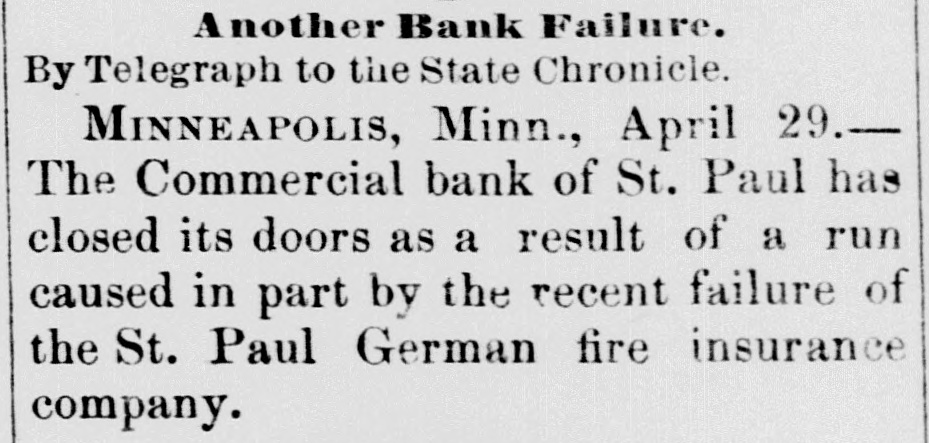
ST. PAUL'S BANK FAILURE. The Commercial Closes Its Doors During a Run. MINNEAPOLIS, April 28.-The Commercial bank, of St. Paul, has closed its doors, as a result of a run caused in part by the recent failure of the St. Paul German Fire Insurance company. The leading man in the insurance company is Albert Scheffer, who is also president of the Commercial bank. Scheffer is confined to his home by illness and Wilham Hamm, vice president, and Herman Scheffer, cashier, have not yet been found. Insurance Commissioner McBride, of Kansas, is in the city, and in company with Insurance Commissioner Smith, of Minnesota, called on the St. Paul German Accident Insurance company with a view to further inquiring into the affairs of that concern. It is now reported that the affairs of the accident insurance company, which are under the same management as the German Fire Insurance company, are in bad shape. Mr. Middleton, one of the bank directors, stated to the United Press reporter that all depositors of the bank would be paid in full, and none except the stockholders would lose a cent. He said that the suspension was caused by a rumor set in circulation in the country to the effect that the failure of the German Fire Insurance company would have a serious effect upon the Commercial bank. This rumor reached the city and caused a run which necessitated the suspension. State Bank Examiner Kenyon states that the bank was found to be in good condition when he last examined into its affairs.


Article from The Morning Call, April 28, 1892

Click image to open full size in new tab

Article Text

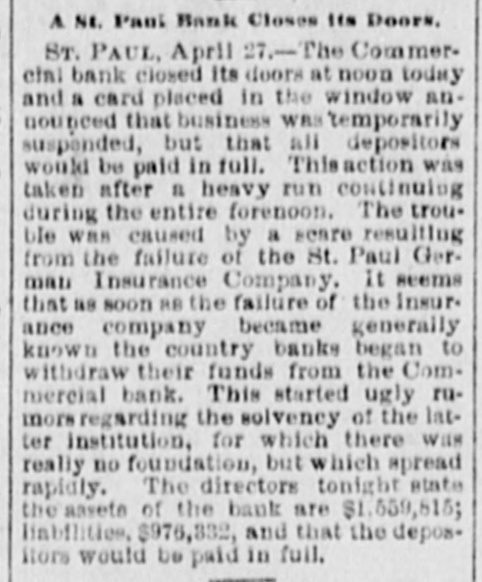
FORCED TO SUSPEND. The Commercial Bank of St. Pani Closes Its Doors. Sr. PAUL, Minn., April 27.-The Commercial Bank closed its doors at noon to-day, and a card was placed in the window announcing that business was temporarily suspended but all the depositors would be paid in full. This action was taken after a heavy run, continuing during the entire forenoon. The trouble was caused by a scare resulting from the failure of the St. Paul German Insurance Company. It seem's that as soon as the failure of the Insurance company became generally known the country banks began to withdraw their funds from the Commercial Bank. This started ugly rumors regarding the solvency of the latter institution, for which there was really no foundation, but which spread ranidly. The directors to- night stated; that the assets of the bank are $1,559,815 and the liabilities $976,332, and that the depositors would be paid in full.


Article from Los Angeles Herald, April 28, 1892

Click image to open full size in new tab

Article Text

WIRE WAIFS. It is announced that the pope will appoint a commission to prepare a plan for the official representation of the vatican at the world's fair. A landslide at the Des Moines, Iowa, brick yard buried twenty-seven men. Two were killed and several severely injured. The St. Paul, Minn., Commercial bank has suspended payment. The officera say the depositors will be paid in full. The suspension is the result of the failure of the St. Paul German Fire Insurance company. Shepherd Busby was hanged in the United States jail at Fort Smith, Ark., Wednesday morning, for the murder of Deputy United States Marshal Barney Connelley, in Indian Territory, last year. The Texas railroad commission has decided to bring suit for the state against the Southern Pacific railway for the recovery of the penalties prescribed for the violation of the commission's law for charging greater rates on wool shipments than those charged by the commission. Suit will also be brought to compel the Missouri, Kansas and Texas railroad to establish its main office in the state, the office at Denison not being regarded as its principal office, according to the requirements of the law.


Article from St. Paul Daily Globe, April 28, 1892

Click image to open full size in new tab

Article Text

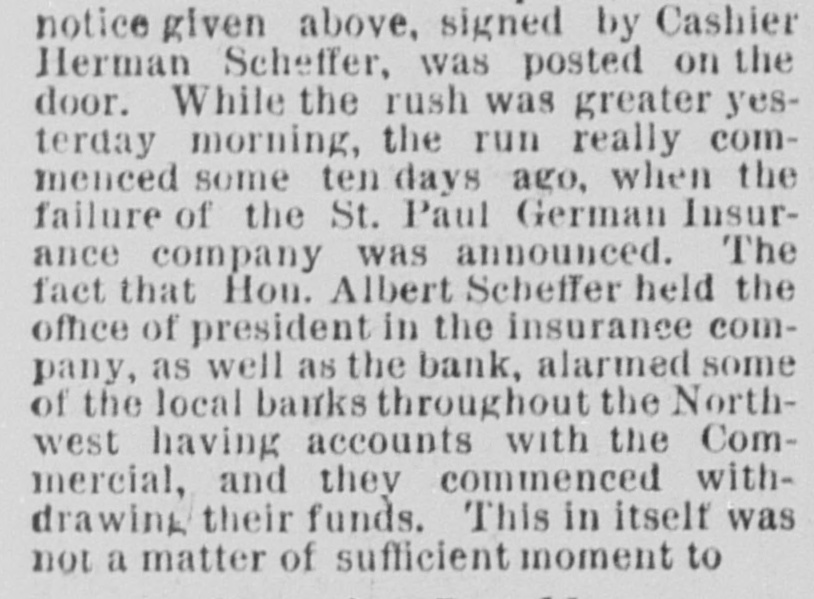
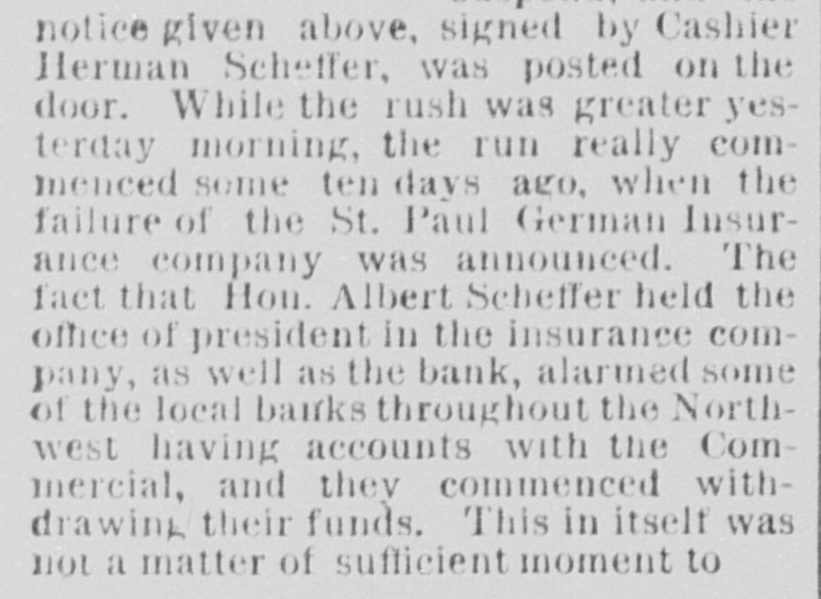
office of president in the insurance company, as well as the bank, alarmed some of the local banks throughout the Northwest having accounts with the Commercial, and they commenced withdrawing their funds. This in itself was not a matter of sufficient moment to Cause Any Trouble, but it speedily became known in the city and was whispered around among the many depositors, and the run was started. The Commercial bank on March 1 last had nearly $1,000,000 of deposits, belonging to over 1,400 different people. It has been a popular bank and an especial favorite with the smaller merchants, as will be seen from the number of the depositors, which is nearly twice as great as most banks with double the amount of deposits. On account of the great number of depositors the run was perhaps made a great deal worse than it would have been otherwise. The report furnished the papers last evening by the cashier, Herman Scheffer, shows that since the run commenced over $300,000 have been drawn out, the amount due depositors at the present time being $699,419.44, against which the bank shows assets in notes, real estate, bonds, etc., of $1,559,815.35. This apparent surplus is reduced, however, by rediscounts amounting to $276,912.60. The full statement of Herman Scheffer, the cashier of the suspended bank, follows: "It IS well known that banking business is largely founded on confidence. The fact that the German Insurance company, which lately closed its doors, has been generally supposed to be closely allied to the Commercial bank, Albert Scheffer being president of both Institutions, has, without reason, caused the opinion to become prevalent among the depositors that the future of the one Involved the Other. "This has caused a feeling of uncertainty among depositors, which has resulted in their withdrawing from the deposits over $300,000 in cash within the last few days. Today the run became so strong that the officers considered that justice to all depositors required them to suspend payment temporarily. The assets are ample for the protection of all depositors, and an effort is bring made to effect an arrangement by which the bank will be enabled to pay off its depositors speedily. Mr. Scheifer furnished the following statement of assets and liabilities: Liabilities $699,419 4 Due depositors Rediscounts 276,912 60 Total $976,352 Assets $1,559,815 Notes, real estate, etc At the commencement of business yesterday morning the bank officials had no idea that they would be obliged to close up. Aid from other banks had been promised and a considerable amount advanced. The clearing house association met yesterday morning, and after looking over the situation suspended the bank before the clearing hour. This was with the assent of Cashier Herman Scheffer, and was made necessary by the fact that the bank did not have the funds with which to meet the heavy drafts. When this news reached the bank the payment of all demands was continued for a time, several of the other banks having volunteered the funds. Some of this money was furnished, but several of the volunteers desired time to consult with their fellow officers, and this delay was fatal to the success of the plan. At 2 o'clock the members of the clearing house committee, which is made up of President W. B. Merriam, of the Merchants' National: E. H. Bailey, cashier of the First National, and WillJam Dawson Jr., cashier of the Bank of Minnesota, met in Gov. Merriam's private office and made an examination of the assets of the suspended bank. A good part of the afternoon was spent at this task, and when it was completed it was agreed that the board of directors of the Commercial bank should be advised that, under the circumstances, the clearing house committee is under the Impression that it will be best to allow the courts to Appoint a Receiver to wind up the business of the bank. The committee estimated that it would require $500,000 to help the bank through as the opening would precipitate another rush. The clearing house was willing to furnish $200,000, but not $500,000. While this decision of the clearing house does not settle the fate of the bank, it means that if it IS reopened the aid will have to be furnished from outside the members of the association. According to the vice president of the Commercial bank, E. A. Hendrickson, this adverse report of the clearing house is largely due to the idea given by the

Article from Deseret Evening News, April 28, 1892

Click image to open full size in new tab

Article Text

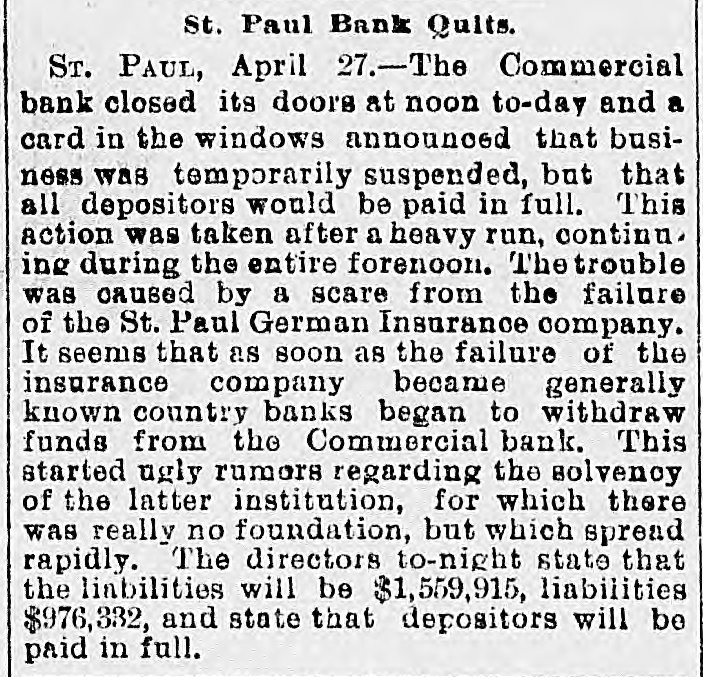
A Nt. Pani Bank Closes Its Doors. ST. PAUL, April 27.-The Commercial bank closed its doors at noon today and a card placed in the window announced that business was temporarily suspended, but that all depositors would be paid in full. Thisaction was taken after n heavy run continuing during the entire forenoon. The trouble was caused by a scare resulting from the failure of the St. Paul German Insurance Company. It seems that as soon RB the failure of the Insurance company became generally known the country banks began to withdraw their funds from the Commercial bank. This started ugly rumorsregarding the solvency of the latter institution, for which there WITH really no foundation, but which spread rapidly. The directors tonight state the assets of the bank are $1,559,815; liabilities. $976,332, and that the deposltors would be paid in full.

Article from The Salt Lake Herald, April 28, 1892

Click image to open full size in new tab

Article Text

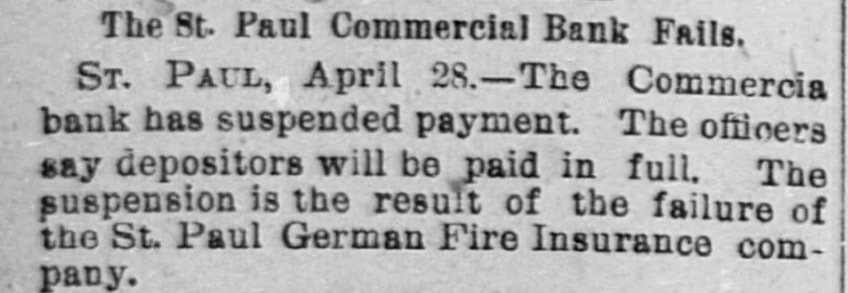
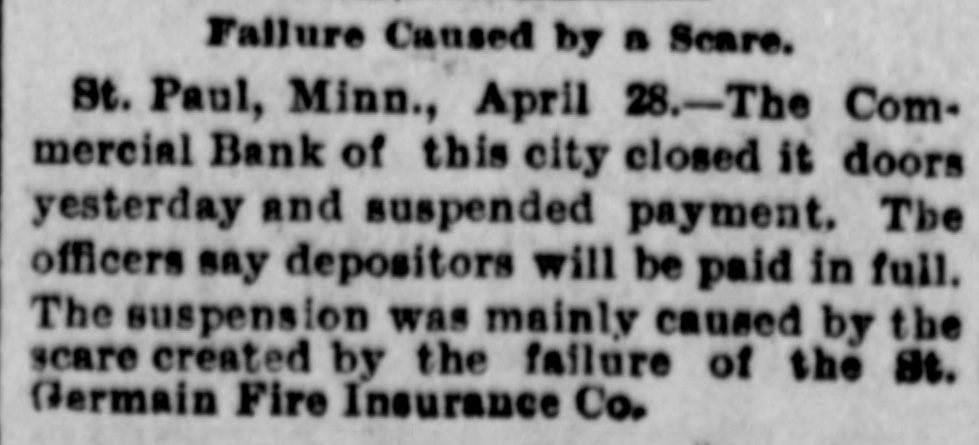
The St. Paul Commercial Bank Fails. ST. PAUL, April 28.-The Commercia bank has suspended payment. The officers say depositors will be paid in full, The suspension is the result of the failure of the St. Paul German Fire Insurance company.

Article from St. Paul Daily Globe, April 29, 1892

Click image to open full size in new tab

Article Text

A RECEIVER NAMED. F. A. Seymour Made Assignee of the Commercial Bank. The Commercial bank yesterday afternoon made an assignment to Frank A. Seymour, cashier of the Merchants' National bank. Efforts were made yesterday forenoon to place the bank on its feet again, and a meeting of the representatives of the other city banks was held at the Merchants' National to consider the matter and decide what action it was best to take in the matter. What occurred at this meeting. is largely a matter of conjecture, but from the fact that the board of directors of the Commercial held a meeting later in the afternoon and decided to make an assignment, the bankers' meeting evidently took the same view of the situation as the clearing house committee which met a few hours after the suspension of the bank. That decision was that the clearing house committee was of the opinion that the officials of the Commercial should be informed that under all the circumstances it would be best to allow the courts to appoint a receiver and the business of the bank be wound up. Upon the receipt of this information the directors of the Commercial at once signed the papers making an assignment to Mr. Seymour, who will immediately proceed to wind up the business of the bank. This action it is understood is final and no more efforts will be made to reorganize and continue the bank.


Article from The World, April 29, 1892

Click image to open full size in new tab

Article Text

ST. PAUL'S BANK FAILURE. the Commercial Closes Its Doors During a ReD. MINNEAPOLIS, April 28-The Commercial bank, of St. Paul, has closed its doors, as a result of a run caused in part by the recent failure of the St. Paul German Fire Insurance company. The leading man in the insurance company is Albert Scheffer, who is also president of the Commercial bank. Scheffer is confined to his home by illness and William Hamm, vice president, and Herman Scheffer, cashier, have not yet been found. Insurance Commissioner McBride, of Kansas, is in the city, and in company with Insurance Commissioner Smith, of Minnesota, called on the St. Paul German Accident Insurance company with a view to further inquiring into the affairs of that soncern. It is now reported that the affairs of the accident insurance company, which are under the same management, as the German Fire Insurance company, are in bad shape. Mr. Middleton, one of the bank directors, stated to the United Press reporter that all depositors of the bank would be paid in full, and none except the stockholders would lose a cent. He said that the suspension was caused by a rumor set in circulation in the country to the effect that the failure of the German Fire Insurance company would have a serious effect upon the Commercial bank. This rumor reached the city and caused a run which necessitated the suspension. State Bank Examiner Kenyon states that the bank was found to be in good condition when he last examined into its affairs.


Article from The Salt Lake Herald, April 30, 1892

Click image to open full size in new tab

Article Text

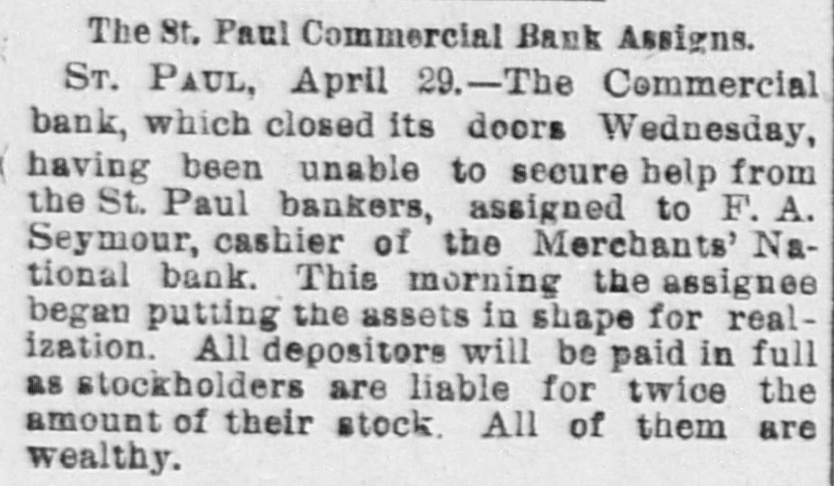
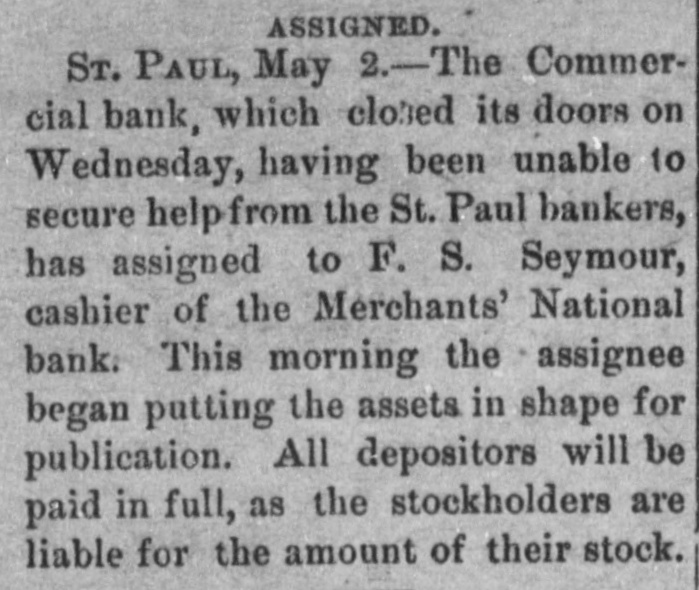
The St. Paul Commercial Bank Assigns. ST. PAUL, April 29.-The Commercial bank, which closed its doors Wednesday, having been unable to secure help from the St. Paul bankers, assigned to F. A. Seymour, cashier of the Merchants' National bank. This morning the assignee began putting the assets in shape for realization. All depositors will be paid in full as stockholders are liable for twice the amount of their stock. All of them are wealthy.

Article from Hot Springs Weekly Star, May 6, 1892

Click image to open full size in new tab

Article Text

the Alliance and People's party over the call for a secret conference of representatives of Southern States at Birmingham, Ala. This call does not include Kansas and the Northwestern States, and for this reason there is trouble ahead. The leaders here be lieve it is a scheme to turn the Alliance over to the Democratic party in the Southern States and some of them don't hesitate to say so. Chairman Chase of the People's Executive Committee. called on Secretary French of the State Alliance to see if that official could throw any light on the matter, French said that no such call had been received at Alliance headquarters. Chairman Chase of the Kansas Central Committee, said: "My attention had not been called to this new conference. I do not understand what it means or why the call should be issued." Secretary French was sarcastic in speaking of Polk's attempt to keep the conference secret. is just about as farcical,' he said, "as the attempt of the Senate to keep their executive session proceedings from the public." 11. E. Taubeneck. Chairman of the National Peoples party, has fired a bombshell into the camp of Alliance leaders, who have been courting a fusion with the Democrats in Kansas. He has written a letter which reads: Fusion means confusion anl will lead to nothing else. We want all the votes we can get. We want every Democrat and Republican to come with us, and we would like to have every office within the gift of the People's party. but we can't afford to secure either votes or offices by bartering away our principles. The very moment we use them as trading stock and peddle them around to the highest bidder to secure an office we will sink into oblivion. and we ought to. There is but one thing for us to do. "keep in the middle of the road, hoist the black flag and neither give nor accept any quarter. Any man who expects any of the old parties to give us any financial support by fusion in my opinion is a mental deformity. The rank and file of the new party is with Taubeneck, and it is believed his letter will knock out the fusion of any kind in the Northwestern States. Sr. PAUL, Minn., special: The Commercial Bank has closed its doors, and a card placed in the window announeing that business was temporarily suspended, but that all depositors would be paid in full. The action was taken after a heavy run on the bank, caused by the scare resulting from the failure of the St. Paul German Insurance Company. It seems that as soon as the failure of the insurance company be came generally known, the country banks began to withdraw their funds from the Commercial Bank. This started ugiy rumors concerning venev of the latter institution, for which there was no foundation but which spread rapidiy. The directors state that the assets of the bank are $1,559,815. liabilities $970,332. and that the depositors would be paid in full. SAN FRANCISCO special: Twenty members of Teed's flock here will leave for Chicago. They are the best of his community here. Among them is Mrs. Knight, who is a cousin of Col Fred Crocker, the railway millionaire. She has turned over $10.000 to Teed. Her brothers tried to prevent her wasting this fortune, but she appealed to the law and defeated them. Others in the party are Victor Schiefferstein. once champion amateur sprinter of the const, and Mr. and Mrs. Mrs. Marsden, who are worth $30,000. CHICAGO special: An attempt on the life of Election Commissioner Michael Schweisthal of this city, was made by a man named Thomas Keenan. who lost his savings by a recent failure of Schweisthal's bank. He called at his house and threatened vengeance. An officer seized him as he was flourishing a revolver. When seen in his cell he was still defiant and said that he was not going to see weisthal living in splendor while his wife and children starved. CHICAGO special: What is said to be the first suit for damages ever begun against the United States Government, was entered in the Federal Circuit Court. It is brought under the law enacted in 1887. permitting suits to be entered against the general government, which, prior to that time could not be done. The plaintiff is the John Wilkinson Company, which sues to recover $2,000 alleged excessive duty imposed on a consignmen of bicycles from England. SAN FRANCISCO special: A warrant was sworn out by State Controller Dunn for the arrest of ex-Assemblyman EIwood Bruner of Sacramento. Bruner is charged with having offered to accept a bribe of $1,000 to prevent the passage by the last Legislature of a bill affecting ticket scalpers. A warrant was also sworn out by Controller Dunn for the arrest of ex-Assemblyman J. G. McCall of San Francisco on the same charge. CHICAGO special: The local coal exchange was given notice by the coal


Article from The Worthington Advance, May 12, 1892

Click image to open full size in new tab

Article Text

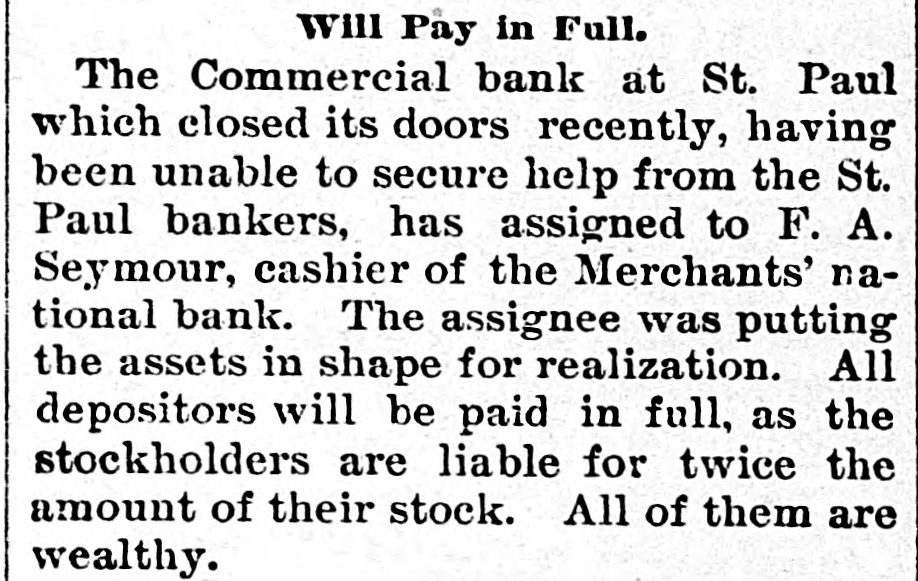
Will Pay in Full. The Commercial bank at St. Paul which closed its doors recently, having been unable to secure help from the St. Paul bankers, has assigned to F. A. Seymour, cashier of the Merchants' national bank. The assignee was putting the assets in shape for realization. All depositors will be paid in full, as the stockholders are liable for twice the amount of their stock. All of them are wealthy.

Article from Warren Sheaf, May 12, 1892

Click image to open full size in new tab

Article Text

Will Pay in Full. The Commercial bank at St. Paul which closed its doors recently, having been unable to secure help from the St. Paul bankers, has assigned to F. A. Seymour, cashier of the Merchants' national bank. The assignee was putting the assets in shape for realization. All depositors will be paid in full, as the stockholders are liable for twice the amount of their stock. All of them are wealthy.

Article from The Irish Standard, May 14, 1892

Click image to open full size in new tab

Article Text

NOTES. Our best bow is due to Judge Conroy, the newly-elected justice of the peace for the east Tom, beg pardon, Judge Conroy, is entitled and fully merits the honors bestowed upon him. James Burns, Tim Kelliher and Chas. McDermott, of this city, in company with John McCarthy and John O'Shaughnessy, of Stillwater, left for New Orleans last Friday to attend the national convention of the A. O. H. St. Lnke's Literary society held their second post lenten social at the residence of Hon. Judge McDonald last Thursday evening. Despite the inclemency of the weather the gathering was of large proportions and the entertainment par +xcellent. Among those who took part in the same were the Misses Egan, Miss Franklyn, Miss Campbell and Messrs. Donnelly, Cole and McCarthy. Bishop McGolrick, of Duluth, was in the city last Sunday, the occasion being the blessing of St. Vincent's church, of which Rev. Father Cosgrove is the esteemed and beloved pastor. Bishop McGolrick preached an eloquent and instructive sermon relative to the occasion at High Mass, and in the afternoon confered confirmation on about one hundred children. At 7:80 in the evening vespers were sung, after which a sermon on Total Abstinence Was delivered by the Rt. Rev. Bishop. This prodigions success, "Spider and Fly," will be presented at the Grand Opera House week commencing May 15, with manifold novelties and a company numbering forty-six who were mostry recruited abroad. The play has been entirely rewritten and reconstructed. The costumes which are said to be very handsome were made especially for this production by Chas. Alias, Costumer for the Drury Lane Theatre, London. The "Spider and Fly" in its new dress has proved one of the strongest novelties and most successful production of the present season. The failure of the Commercial Bank of this city, in some measure, created a panic here last Monday. It was given out that a run would be made on the Seven-corners Bank, of which Billy Banholzer is the esteemed president. The run started, but the complacent air with which Billy sat in the front office of the bank smoking a cigar and paying all who demanded their money, the amount due them had a tendency to quiet the nerves of the depositors. All who want their money can have it, said Mr. Banholzer. we are prepared to meet any kind of a run. But it did not come and Tuesday found everything all serene at the Seven Corners Bank. Not the least of the regrets to be offered by Democrats and Republicans alike is the loss of the present head of the city detective force, John J. O'Connor. To attempt to eulogize him for a past record that is without a stain during his nine years as chief of that department would be superfluous. John O'Connor leaves that office with a consciouspess of having well and truly performed his duties. He has instilled into the minds of the thieving fraternity the one lesson, that St. Paul is a good place for them to keep away from. Socially Mr. O'Connor is one man in a thousand. To see him is to know him, to know him is to respect him and not soon forget him; but to be missed he always will be. The election is over and the question which is now agitating the mind of spoil hunters is the filling of the office of the Chief of Police. Had the late Capt. John Bresette lived to see the result of this late election the question of the selection of chief of police would soon be settled. Bat aspirants for the office are besinging Mayor-elect Wright and a Kilkenny cat fight is now going on among the Republican office seekers. Prominent among them is the present Sheriff, Ed. S. Bean, and the mantle could not fall on better or worthier shoulders. He is eminently qualified to fill the porition and would hold it with the same becoming grace and dignity with which he fills the present office. But his chief opponent is one of his deputies, John Harris. and Harris has a "pull" of no small quantity. The friends of Harris are not few nor isolated, but Bean has a monopoly in that direction and if he really desires the plum will undoubtedly be wearing the star of Chief of Police soon after making his

Article from St. Paul Daily Globe, May 27, 1892

Click image to open full size in new tab

Article Text

Commercial Bank to Resume Business With the Aid of Depositors. One-Third of Their Deposits to Be Converted Into New Stock. The Balance to Be Withdrawn or Run From Six Months to One Year. Corporation Attorney Lawler Will Appeal From the Auditorium Decision. The Commercial bank will resume business in about six weeks. The matter was definitely settled at a meeting of the depositors held in the old store of Schuneman & Evans last evening. Albert Scheffer explained the condition of the bank from a stockholder's point of view. fle stated that there is a concerted and well organized effort under way to reorganize the institution, and to once more throw open the doors for financial business. Some $200,000 is now in sight, and as soon as the amount of stock subscribed shall have reached $250,000 the bank will resume. The obJeet is to issue paid up stock to the amount of $500,000, and Mr. Scheffer felt that there would be little doubt about eneumpas-ing this end after half the amount is paid in. The of cers and the stockholders had a proposition to make to the depositors, and, should the plan be adopted, the problem will have been solved. He explained that it was to have the deposilors subscribe 30 per cent of the money they have on deposit to stock; draw out 30 per cent if they wish, and to leave 20 per cent six months and 20 per cent one year. If this is done the necessary stock will have been disposed of. This proposition met with hearty applause, and William Hamm was asked to speak. He said that the bank had been placed in a false light before the public. It had been claimed that the cause of the failure of the bank was directly owing to the insolvency of the Germama Insurance company. This was an: error, for the insurance compariy was only indirectly responsible. The bank is amply secured for every doller loaned that company. but it was the feeling of fear that pervaded the depositors that precipitated the failure. He said that $350,000 was drawn out of the bank in two days, and that accounts for the failure. A vote was taken after the subject was generally discussed and it was the unanimous wish of the depositors to enter into the arrangement suggested by the officers of the bank. Some agreed to subscribe at least one-half of their deposits for stock. explaining that as soon as the bank resumes the stock will be worth 100 cents on the dollar and those who cannot afford to carry so much will find a ready market for it. Blanks had been prepared. and a great many of the de positors affixed their signatures to them and stated the amounts of stock the will accept in part settlement of theif claims, and Herman Scheffer will open up the old bank's office each day to receive other signatures of depositors until the requisite amount is in sight Then the affairs of the Commercial will be taken out of the courts and business esumed.


Article from St. Paul Daily Globe, August 3, 1892

Click image to open full size in new tab

Article Text

IF CREDITORS AGREE, Judge Kelly Will Dismiss the Commercial Bank Insolvency, Discharge the Assignee and Permit the Doors to Be Reopened. Weihe Accepts, and Erwin May Defend Homestead Strikers. Sixth Annual Convention of Brotherhood of Machine Moulders. An application was made to Judge William Louis Kelly in chambers yesterday which has for its object the rehabilitating of the Commercial bank with the necessary rights to again open its doors for the purpose of carrying on a general banking business. The application is in the nature of a petition, signed by Albert Scheffer as president of the bank. The legal papers were drawn up by the law firm of C. D. and Thomas D. O'Brien. The petition makes a gratifying showing of the financial condition of the institution which closed its doors a few months ago. After reading the petition and hearing the statements made by interested parties, Judge Kelly issued an order as a preliminary step to reinstating the bank. This order, among other things, recites the following facts: Whereas, It appears, upon examination of the affairs of the bank and on consideration of them by the directors, the stockholders and a large majority of the creditors in both number and amount, it was discovered that it was for the benefit of all parties that the insolvency proceedings should be dismissed and the assets returned to the Commercial bank, and that it should resume the business of banking; it also appearing that the liabilities at the time of the assignment were about $945,514, consisting of sums due depositors on open account of cerificates on deposits, moneys due other banks, cashier's checks and rediscounts. The value of the assets of the bank then amounted to about $1,235,815. An agreement was reached. which has been carried out. by which there has been $250,000 subscribed to the stock It has been agreed by about 700 of the creditors owning $380,000 in claims to allow the bank to carry this indebtedness. Under the arrangements mentioned above' the indebtedness has been reduced from $949,514 to $460,574, the assignee now having about $170,000 in money, making $420,000 in the hands of the bank. In addition to the above funds, the assets are about $830,000, making a total capital of $1,220,000, leaving the total indebtedness about $630,000 and the assets over the liabilities amount to $590,000. It also appearing that the bank can manage the affairs to a better advantage than the assignee, and thus avoid loss to the bank, the stockhoiders and creditors: it is therefore ordered that FrankiA. Seymour, the assignee, and all the creditors of the Commercial bank who have filed the claims and all other parties in interest, appear before Judge illiam Louis Kelly, judge of the district court,at his chambers in the court house, Aug. 23, at 10 a. m., and show cause why the petition of the bank to be allowed to resume should not be granted and the insolvency proceedings dismissed. and the accounts of the receiver settled and allowed, and his compensation and expenses


Article from The Sauk Centre Herald, August 11, 1892

Click image to open full size in new tab

Article Text

The coroner's jury has returned a verdict holding City Engineer Rundlett and assistants responsible for the West Side disaster. The Bankers' National bank of Chicago, capital $1,000,000, ex-Comptroller Lacy, president, has been authorized by Comptroller Hepburn to be in business. The directors of the Commercial bank, St. Paul, have applied to the courts for permission to re-open, and Judge Kelly has set the date for the hearing on Aug. 23. Rev. Dr. Frank T. Ingalls, of Springfield, Mo., a Congregational clergyman of wide reputation, president of Drury college, and a brother of ex-Senator Ingalls, is dead. Captain William C. Spencer, U.S. A., by the direction of the president, is placed upon the retired list to date from July 30, 1892, the date of his appointment of captain. The Minnesota world's fair commissioners has made appropriations for the horticultural and educational exhibits. All but $7,000 of the additional $100,000 has been collected. The efforts to compromise the Iron Hall litigation have proven fruitless and negotiations have been broken off. The case will come up for trial at Indianapolis next Thursday. A sloop from Victoria landed a dozen Chinese near Point Wilson, Or., and then hastily sailed away. The customs officers arrested four of the Chinese and are now on the trail of the others. At a picnic at Ball Hollow, Ky., a regular mountain battle took place between two Ferrill brothers and three or four Daniels. One of the Ferrills was terribly butchered, while two of the Daniels received dangerous wounds. Daniel W. Shea, son of a wealthy Boston family, and Henry Smith, of Saratoga, worth a million in his own name, fought two rounds to a draw at Saratoga Monday, before a select few. The fight was the result of a quarrel. John C. Bundy, for many years editor and publisher of The Religio-Philosophical Journal, and a man of international reputation among spiritualists and occultists, died in Chicago Saturday after a brief illness. He was 51 years old. The forty-two invader stockmen and Texans have been arraigned in court in Cheyenne charged with murder in the first degree. They were indicted in a body and in groups of four. It required all day to read the indictments. The trial is set for Aug. 23. The Milwaukee's statement for the year ended June 30 shows gross earnings of $32,283,508, an increase as compared with the preceding fiscal year of $4,779,383; expenses and taxes, $20,815,004; an increase of $2,448,504; net earnings, $11,468,508; an increase of $2,330,779. Harry Deakin has arrived in San Francisco from Japan direct, bringing with him the manuscript of a new play written by Sir Edwin Arnold and christened "Adsuma, or the Japanese Wife." The play is to be produced with Oriental splendor at Chicago during the world's fair. The Minnesota state railroad and warehouse commissioners have decided to hold an open meeting at the capitol on Sept. 1. They will then consider the matter of establishing a uniform grade for all kinds of grain handled in Minnesota. All persons interested in the subject are invited to attend and express their views to the commissioners.


Article from The Madison Daily Leader, September 5, 1892

Click image to open full size in new tab

Article Text

ELECTRICAL ECHOES. Matters of More or Less Moment Briefly Mentioned. Judge Kelly has decided that the Commercial bank, of St. Paul, may resume business. The custom collections at St. Paul for August amounted to $20,000 and the revenue to $224,000. The President has appointed as postmasters Gus A. Schultz at Two Harbors, Minn., and Mrs. Nettie J. Van Inwegen at Ortonville, Minn. Twenty-one of the Jersey City, N. J. ballot box stuffers have been sentenced. Their sentences ranged from six to fifteen months. The prisoners were at once sent to jail. Up to and including the 31st of August the treasury department has shipped to various points in the United States $7,000,000 in small notes to facilitate the moving of the crops. The survivors of the battle of Birch Coolie, fought against the Indians i 1862, held a reunion at the Merchants hotel, St. Paul, to celebrate its thirtieth anniversary of that event. The London and General bank (limited) has suspended payment. The bank was founded in 1882 with a capitial of 1,000,000 pounds. To Sept. 10, 1891, 417,770 pounds had been subscribed to the capital. The Kent and Surrey Building society of Woolwich, England, has collapsed. It has been discovered that the secretary, George B. Bryceson, has been falsifying the books for years and has embezzed at least 50,000 pounds. There may shortly be another cabinet crisis in Germany in which Baron von Schelling, minister of justice, will chiefly be concerned. This minister has identified himself so closely with the Progressist party that his position is not considered tenable. The Spanish government now seems disposed to satisfy the demands recently made by the United States for the revision of the new Cuba tariff on the ground that it does not contain those concessions for American imports which were agreed on in the convention of 1891.


Article from The Worthington Advance, September 22, 1892

Click image to open full size in new tab

Article Text

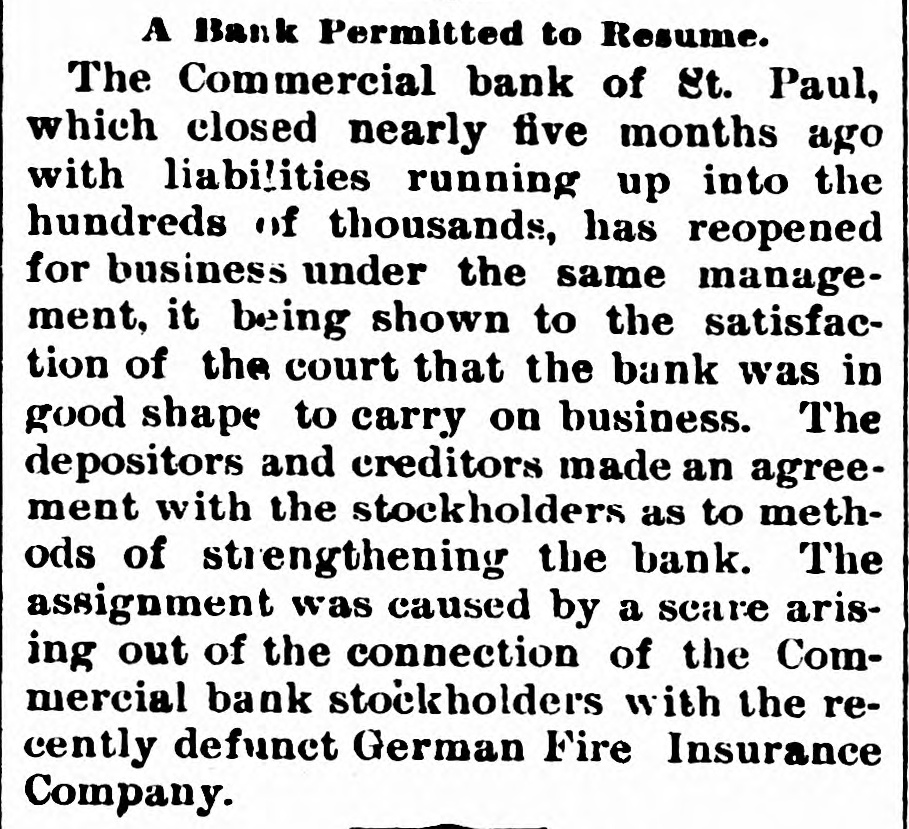
A Bank Permitted to Resume. The Commercial bank of St. Paul, which closed nearly five months ago with liabilities running up into the hundreds of thousands, has reopened for business under the same management, it being shown to the satisfaction of the court that the bank was in good shape to carry on business. The depositors and creditors made an agreement with the stockholders as to methods of strengthening the bank. The assignment was caused by a scare arising out of the connection of the Commercial bank stockholders with the recently defunct German Fire Insurance Company.

Article from People's Voice, January 6, 1893

Click image to open full size in new tab

Article Text

BUSINESS FAILURES. THE MORE DISASTROUS ONES NOTED-BANKS GENERALLY. Jan. 11-First national bank, of Muncie, Pa. Jan. 23-First national bank of Downs, Kan.; $100,000. Jan. 25-Bank of Jefferson at Shepherdstown, W. Va. Jan. 29-Fall River county bank at Oelricks, S. D.: $30,000 Butler county bank at Chicora, Pa.: $60,000. Feb. 2-Commercial loan and savings bank at Kearney, Neb.: $150,000. Feb. 3-National bank of Silver City, and Feb. 4-Marcy, Geer & McCann's back at Raton, N. .M.; $800,000 First national bank of Deming, N. M. Feb. 6-Western Farm Mortgage Company at Denver; $1,000,000. Feb. 8 - Merchants' bank of Moorehead, Minn.: $175,000. Feb. 26-Newmarket (N. H.) savings bank suspended; $191,000. Mar. 1-Lima (0.) national bank. Mar. 21-Painesville (O.) Savings and Loan Association bank. Mar. 24 -American national bank of Birmingham, Ala. Apr. 15-Interstate national bank of New York. Apr. 27-Commercial bank of St. Paul, Minn.: ; $1,000,000. May 25-People's bank of Sea Isle City, N. J. June 4-Platte Valley bank at Central City, Neb. June 25-First national bank at Erie, Kan, Nesha county; losses, $30,000. Sep. 2-Nebraska State bank. at Crete. Sep. 23-Richmond (Me.) savings bank. Sep. 24-People's bank at Hope, Ark Oct. 17-Two Nebraska state banks, one at Ainsworth, the other at Springview. Oct. 27-Hot Springs (Ark.) Valley bank (private); $80,000. Nov. 5-Continental bank at Kansas City, Mo. Nov. 30-Stone City bank, of Joliet, 111., and Joliet Enterprise Co. (barb wire manufacturers); $1,000,000. Dec. 6-Wholesale mercantile firm of Wilczinski & Nelson at Greenville, Miss.: $100,000. Dec. 13-Black Hilis national bank at Rapid City, S. D. Dec. 13-Lipman & Co., jute merchants at Dundee. Scotland, failed for $1,250,000. Dec. 15-National bank of Newton, Kan. Dec. 18-Wholesale grocery in Brooklyn, N. Y.; $400,000. Dec. 26-E.S.Corser Minneapolis, real eastate dealer: $1,000,000.


Article from Baxter Springs News, January 7, 1893

Click image to open full size in new tab

Article Text

BUSINESS FAILURES. THE MORE DISASTROUS ONES NOTED-BANKS GENERALLY. Jan. 11-First national bank. of Muncie. Pa. Jan. 23-First national bank of Downs, Kan.: $100,000. Jan. 25-Bank of Jefferson at Shepherdstown, W. Va. Jan. 29-Fall River county bank at Oelricks, S. .D.: $30,000 Butler county bank at Chicora, Pa.: $69.000. Feb. 2-Commercial loan and savings bank at Kearney. Neb.: $150,000. Feb. 3-National bank of Silver City, and Feb. 4--Marcy. Geer & McCann's bank at Raton, N. M.: $800,000 First national bank of Deming. N. M. Feb. 6-Western Farm Mortgage Company at Denver: $1,000,000. Feb. 8 - Merchants' bank of Moorehead. Minn.: โ‚ฌ175.000. Feb. 2--Newmarket (N. H.) savings bank suspended: $191,000. Mar. 1--Lima (0.) national bank. Mar. 21-Painesville (O.) Savings and Loan As: sociation bank. Mar. 24-American national bank of Birmingham. Ala. Apr. 15-Interstate national bank of New York. Apr. 27-Commercial bank of St. Paul, Minn.; $1,000,000. May 35-People's bank of Sea Isle City, N.J. June 4-Platte Valley bank at Central City, Neb. June 25-First national bank at Erie, Kan., Nesha county: losses, $30,000. Sep. 2-Nebraska State bank. at Crete. Sep. 23-Richmond (Me.) savings bank. Sep 24-People's bank at Hope, Ark. Oct. 17-Two Nebraska state banks, one at Ainsworth. the other at Springview. Oct. 27-Hot Springs (Ark.) Valley bank (private): 880,000. Nov. 5--Continental bank at Kansas City, Mo. Nov 30-Stone City bank. of Joliet, 111., and Joliet Enterprise Co. (barb wire manufacturers); $1,000,000. Dec. 6--Wholesale mercantile firm of Wilczinski & Nelson at Greenville, Miss.: $100,000. Dec. 13-Black Hills national bank at Rapid City, S. D. Dec. 15-National bank of Newton. Kan. Dec. 18-W holesale grocery in Brooklyn, N. Y.: $400,000. Dec. 26-E. S. Corser, Minneapolis, real estate dealer: $1,000,000.


Article from The Irish Standard, January 7, 1893

Click image to open full size in new tab

Article Text

GLANCE BACKWARD. Review of the Many Important Happenings of 1892. Heavy Business Failures, Startling Casualties and Horrible Crines-Industrial, Political and Sporting Events, Disastrous Fires of the Year, Etc. BUSINESS FAILURES. MORE DISASTROUS ONES NOTED-BANKS GENERALLY. Jan. 11-First national bank. of Muncie, Pa. Jan. 23-First national bank of Downs, Kan; $100,000. Jan 85-Bank of Jefferson at Shepherdstown, W. Va Jan. 29-Fall River county bank at Oelricks, S. D.; $30,000 Butler county bank at Chicora, Pa.; $60,000. Feb. 2-Commercial loan and savings bank at Kearney, Neb.: $150,000. Feb. 3-National bank of Silver City, and Feb. 4-Marcy, Geer & McCann's bank at Raton, N. M.; $800,000 First national bank of Deming, N. M. Feb. 6-Western Farm Mortgage Company at Denver; $1,000,000. Feb. 8 - Merchants' bank of Moorehead, Minn.: $175,000. Feb. 26-Newmarket (N. H.) savings bank suspended; $191.000. Mar 1-Lima (O.) national bank. Mar. 21-Painesville (O.) Savings and Loan Association bank. Mar. 24-American national bank of Birmingham, Ala. Apr. 15--Interstate national bank of New York. Apr. 27-Commercial bank of St. Paul, Minn.; $1,000,000. May 25-People's bank of Sea Isle City, N. J. June 4-Platte Valley bank at Central City, Neb. June 25-First national bank at Erie, Kan, Nesha county: losses, $30,000. Sep. 2--Nebraska State bank. at Crete. Sep. 23-Richmond (Me.) savings bank. Seu 21-People's bank at Hope, Ark Oct. 17-Two Nebraska state banks, one at Ainsworth, the other at Springview. Oct. 27-Hot Springs (Ark.) Valley bank (pri-, vate); $80,000. Nov. 5-Continental bankat Kansas City, Mo. Nov 30-Stone City bank, of Joliet, 111., and Jollet Enterprise Co. (barb wire manufacturers); $1,000,000. Dec. 6-Wholesale mercantile firm of Wilozinski & Nelson at Greenville, Miss.; $400,000. Dec. .11-Black Hills national bank at Rapid City, S. D. Dec. 13-Lipman & Co., jute merchants at Dundee, Scotland, failed for $1,250,000. Dec. 15-National bank of Newton, Kan. Dec. 18-Wholesale grocery in Brooklyn, N. Y.; $400,000.