First National Bank (Chicago, IL)

Episode Information

Episode UID
800885
Episode Type
Run β†’ Suspension β†’ Reopening
Bank Type
national
Bank ID
80 national
Charter Number
8
Start Date
September 22, 1873
Location
Chicago, Illinois (41.850, -87.650)

Metadata

Model
gpt-5-mini (chosen from majority vote of a three-model LLM ensemble)
Short Digest
a817fac286bfa33f

Response Measures

Accommodated withdrawals, Borrowed from banks or large institutions, Clearinghouse loan, Public signal of financial health, Partial suspension, Books examined

Clearinghouse involved: Yes (loan, examination, or other measures)

Description

Reports conflict on whether First National paid throughout the panic; later (1878) receivership/dividend is reported.

Events (6)

1. June 22, 1863 Chartered
Source
historical_nic
2. September 22, 1873 Run
Cause
Macro News
Cause Details
Panic of 1873 and adverse financial news from New York produced runs on Chicago banks
Measures
Banks invoked thirty- and sixty-day rule; paying only small sums and falling back on Clearing House arrangement
Newspaper Excerpt
There is considerable of a run upon some of the banks here to-day
Source
newspapers
3. September 25, 1873 Suspension
Cause
Macro News
Cause Details
Coordinated suspension by Chicago banks/Clearing House in response to nationwide panic and currency shortages
Newspaper Excerpt
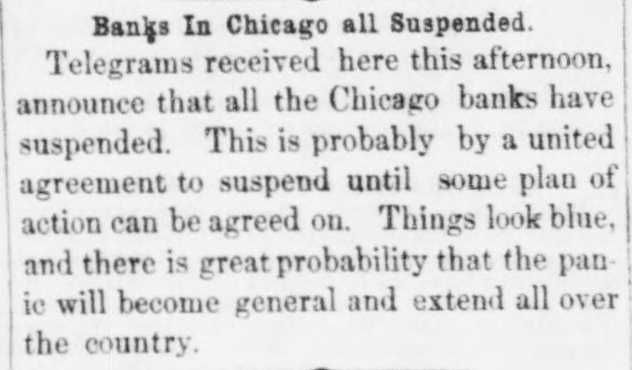
Telegrams ... announce that all the Chicago banks have suspended.
Source
newspapers
4. September 30, 1873 Reopening
Newspaper Excerpt
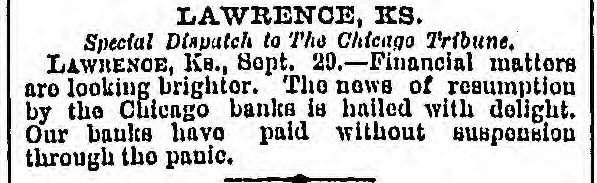
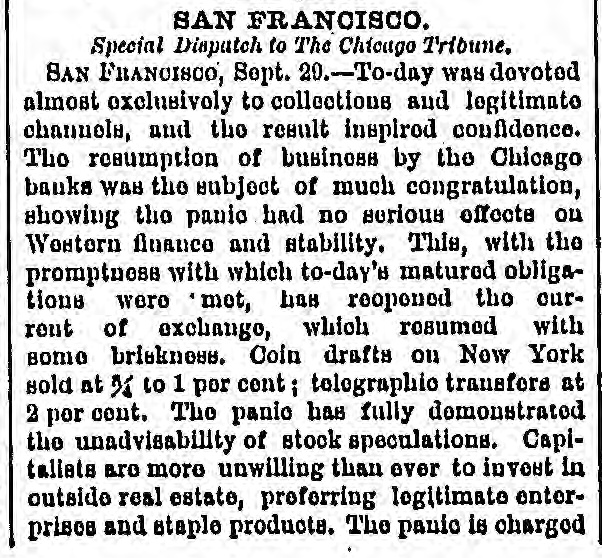
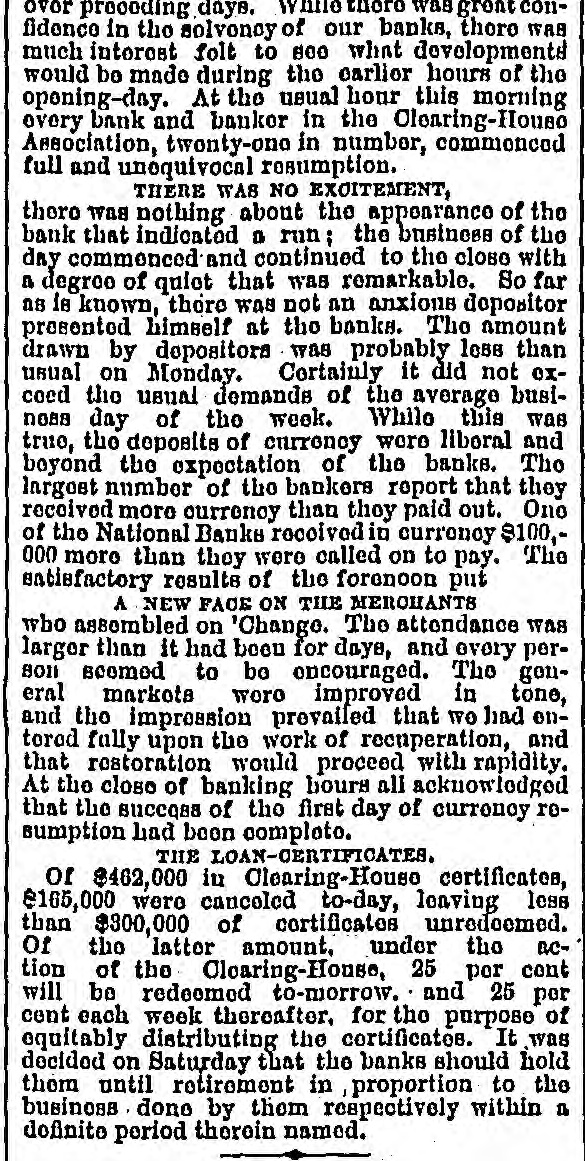
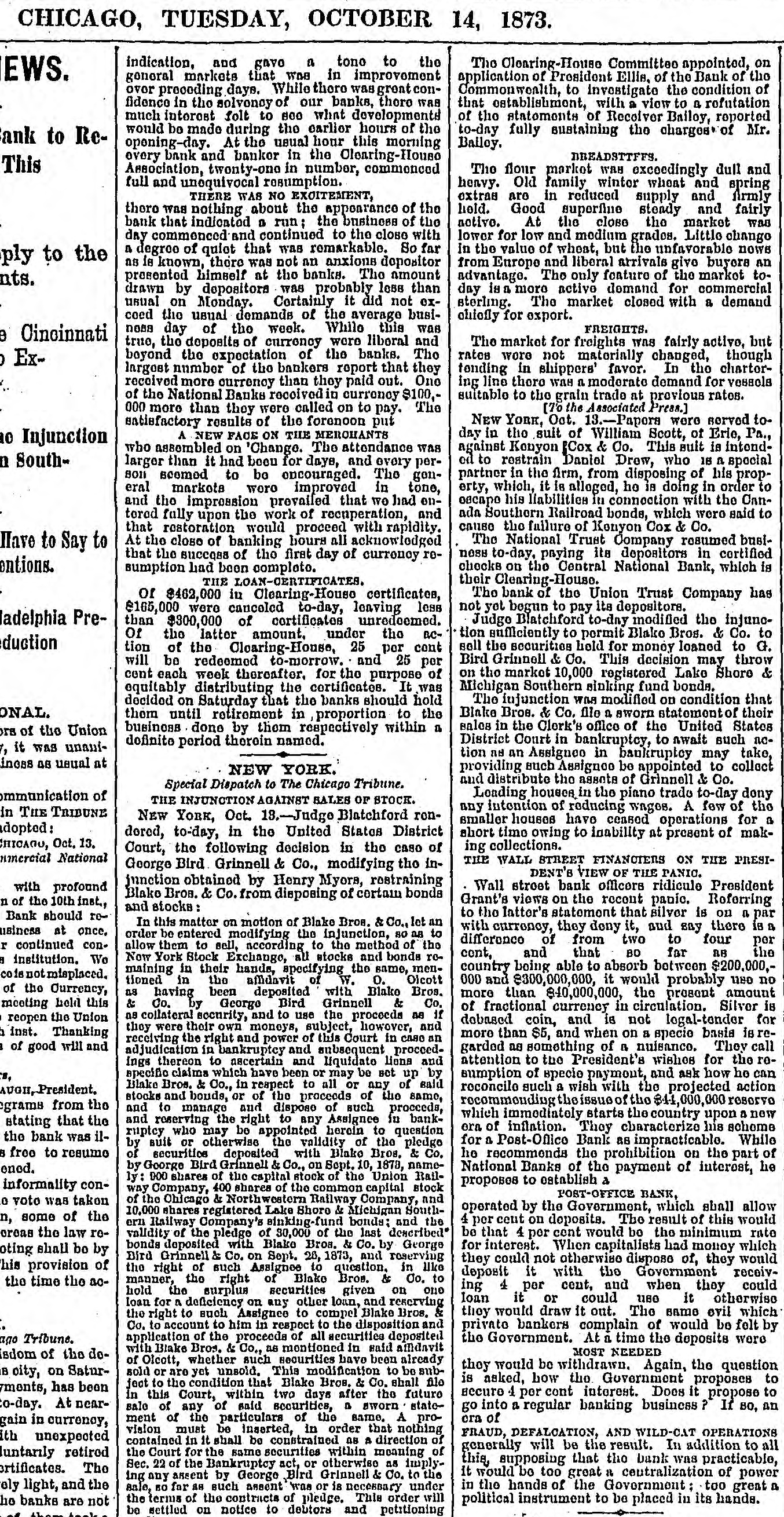
The news of resumption by the Chicago banks is hailed with delight. The resumption of business by the Chicago banks was the subject of much congratulation, showing the panic had no serious effects on Western finance and stability.
Source
newspapers
5. January 31, 1878 Receivership
Newspaper Excerpt
The Comptroller of the Currency has declared a dividend in favor of the creditors of the First National bank of Chicago of 45 per cent.
Source
newspapers
6. May 1, 1882 Chartered
Source
historical_nic

Newspaper Articles (23)

Article from The Daily State Journal, October 18, 1871

Click image to open full size in new tab

Article Text

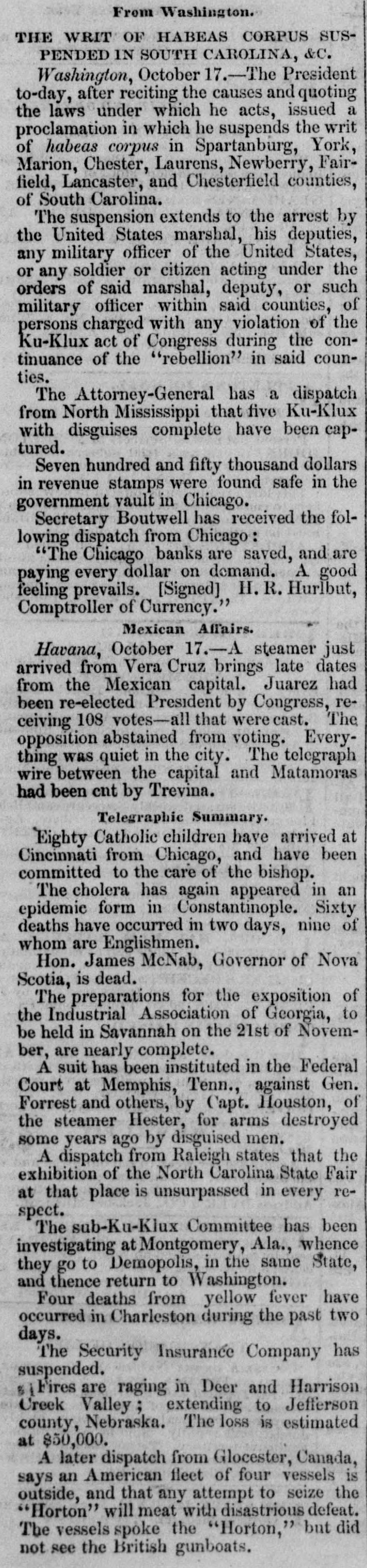
# THE WRIT OF HABEAS CORPUS SUSPENDED IN SOUTH CAROLINA, &C. Washington, October 17.--The President to-day, after reciting the causes and quoting the laws under which he acts, issued a proclamation in which he suspends the writ of habeas corpus in Spartanburg, York, Marion, Chester, Laurens, Newberry, Fairfield, Lancaster, and Chesterfield counties, of South Carolina. The suspension extends to the arrest by the United States marshal, his deputies, any military officer of the United States, or any soldier or citizen acting under the orders of said marshal, deputy, or such military officer within said counties, of persons charged with any violation of the Ku-Klux act of Congress during the continuance of the "rebellion" in said counties. The Attorney-General has a dispatch from North Mississippi that five Ku-Klux with disguises complete have been captured. Seven hundred and fifty thousand dollars in revenue stamps were found safe in the government vault in Chicago. Secretary Boutwell has received the following dispatch from Chicago: "The Chicago banks are saved, and are paying every dollar on demand. A good feeling prevails. [Signed] H. R. Hurlbut, Comptroller of Currency." Mexican Affairs. Havana, October 17.-A steamer just arrived from Vera Cruz brings late dates from the Mexican capital. Juarez had been re-elected President by Congress, receiving 108 votes-all that were cast. The opposition abstained from voting. Everything was quiet in the city. The telegraph wire between the capital and Matamoras had been cut by Trevina. Telegraphic Summary. Eighty Catholic children have arrived at Cincinnati from Chicago, and have been committed to the care of the bishop. The cholera has again appeared in an epidemie form in Constantinople. Sixty deaths have occurred in two days, nine of whom are Englishmen. Hon. James McNab, Governor of Nova Scotia, is dead. The preparations for the exposition of the Industrial Association of Georgia, to be held in Savannah on the 21st of November, are nearly complete. A suit has been instituted in the Federal Court at Memphis, Tenn., against Gen. Forrest and others, by Capt. Houston, of the steamer Hester, for arms destroyed some years ago by disguised men. A dispatch from Raleigh states that the exhibition of the North Carolina State Fair at that place is unsurpassed in every respect. The sub-Ku-Klux Committee has been investigating at Montgomery, Ala., whence they go to Demopolis, in the same State, and thence return to Washington. Four deaths from yellow fever have occurred in Charleston during the past two days. The Security Insurance Company has suspended. Fires are raging in Deer and Harrison Creek Valley; extending to Jefferson county, Nebraska. The loss is estimated at $50,000. A later dispatch from Glocester, Canada, says an American fleet of four vessels is outside, and that any attempt to seize the "Horton" will meat with disastrious defeat. The vessels spoke the "Horton," but did not see the British gunboats.


Article from The Tipton Advertiser, October 19, 1871

Click image to open full size in new tab

Article Text

# THE CHICAGO FIRE considered a sufficiently large figure to cover all the losses. The number of acres actually burned over is about 2,500-comprising the most compact and thickly inhabited part of the city, and the great bulk of its business and substance. About 20,000 buildings were burned, one-fourth of which were of stone or brick. The actual loss of life was undoubtedly over 300. Concerning the situation and prospects, on Friday, the Journal said: "Chicago is not hopelessly down. Her capitalists and merchants are 'up and doing'-preparing for reorganization and reconstruction upon the old foundations -and it is very apparent to all intelligent observers, that all will soon be well, and that Chicago will, before long, be in rapid process of rebuilding, and that before many years she will in all respects be herself again. The fact, now positively stated, that the heaviest insurance companies at the East will promptly adjust and pay in full their losses by our Great Conflagration, is the most cheering news we have yet received since the Calamity. This will go far towards helping many of our people out of their troubles and setting them on their feet again." On Monday, it speaks yet more cheerfully, speaking of the announcement that the banks would resume business on the 17th, which is strengthened by a certificate from the United States Comptroller of Currency that the National banks of Chicago are solvent institutions, as follows: "The decision of the banks to abandon their fifteen per cent. installment policy, and resume business as usual to-morrow, has restored confidence in Chicago. The universal opinion now is that the grain business will soon be running as usual. At present the derangement in insurance is a hindrance to shipments. There is no speculative business attempted. It is believed that the permanent increase in the price of grain will be slight. We hear of scores of cases where merchants or capitalists are already fully determined to rebuild in the most substantial style on the old sites, and it is already very evident that the South Side will before many months be 'reconstructed' even more substantially than is was built originally." The peace of the city has been restored and is maintained. The papers deprecate the statements which are finding place in newspapers signifying a different state of things, and say that General Sheridan and the city authorities report no cases of outrage or serious disturbance.


Article from New-York Tribune, December 2, 1872

Click image to open full size in new tab

Article Text

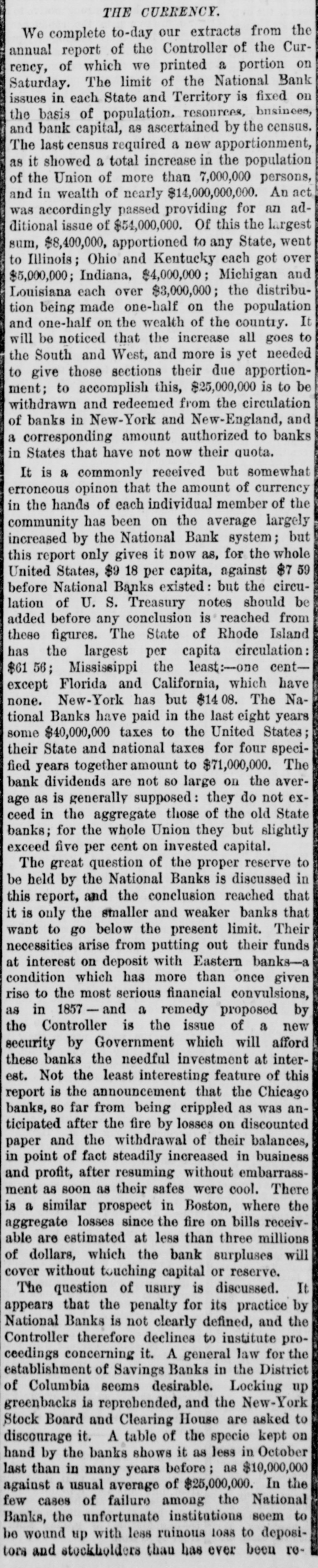
THE CURRENCY. We complete to-day our extracts from the annual report of the Controller of the Currency, of which we printed a portion on Saturday. The limit of the National Bank issues in each State and Territory is fixed on the basis of population. resources, businees, and bank capital, as ascertained by the census. The last census required a new apportionment, as it showed a total increase in the population of the Union of more than 7,000,000 persons, and in wealth of nearly $14,000,000,000. An act was accordingly passed providing for an additional issue of $54,000,000. Of this the largest sum, $8,400,000, apportioned to any State, went to Illinois; Ohio and Kentucky each got over $5,000,000; Indiana, $4,000,000; Michigan and Louisiana each over $3,000,000; the distribution being made one-half on the population and one-half on the wealth of the country. It will be noticed that the increase all goes to the South and West, and more is yet needed to give those sections their due apportionment; to accomplish this, $25,000,000 is to be withdrawn and redeemed from the circulation of banks in New-York and New-England, and a corresponding amount authorized to banks in States that have not now their quota. It is a commonly received but somewhat erroneous opinon that the amount of currency in the hands of each individual member of the community has been on the average largely increased by the National Bank system; but this report only gives it now as, for the whole United States, $9 18 per capita, against $7 59 before National Banks existed: but the circulation of U. S. Treasury notes should be added before any conclusion is reached from these figures. The State of Rhode Island has the largest per capita circulation: $61 56; Mississippi the least:-one centexcept Florida and California, which have none. New-York has but $14 08. The National Banks have paid in the last eight years some $40,000,000 taxes to the United States; their State and national taxes for four specified years together amount to $71,000,000. The bank dividends are not so large on the average as is generally supposed: they do not exceed in the aggregate those of the old State banks; for the whole Union they but slightly exceed five per cent on invested capital. The great question of the proper reserve to be held by the National Banks is discussed in this report, and the conclusion reached that it is only the smaller and weaker banks that want to go below the present limit. Their necessities arise from putting out their funds at interest on deposit with Eastern banks-a condition which has more than once given riso to the most serious financial convulsions, as in 1857 - and a remedy proposed by the Controller is the issue of a new security by Government which will afford these banks the needful investment at interest. Not the least interesting feature of this report is the announcement that the Chicago banks, 80 far from being crippled as was anticipated after the fire by losses on discounted paper and the withdrawal of their balances, in point of fact steadily increased in business and profit, after resuming without embarrassment as soon as their safes were cool. There is a similar prospect in Boston, where the aggregate losses since the fire on bills receivable are estimated at less than three millions of dollars, which the bank surpluses will cover without touching capital or reserve. The question of usury is discussed. It appears that the penalty for its practice by National Banks is not clearly defined, and the Controller therefore declines to institute proceedings concerning it. A general law for the establishment of Savings Banks in the District of Columbia seems desirable. Locking up greenbacks is reprehended, and the New-York Stock Board and Clearing House are asked to discourage it. A table of the specie kept on hand by the banks shows it as less in October last than in many years before; as $10,000,000 against a usual average of $25,000,000. In the few cases of failure among the National Banks, the unfortunate institutions seem to be wound up with less ruinous loss to depositors and stockholders than has ever been re-


Article from Daily Kennebec Journal, December 4, 1872

Click image to open full size in new tab

Article Text

# THE CURRENCY. The Report of the Comptroller of the Currency is an elaborate document. The topic of most interest referred to is that of a proposed increase of the national bank notes. The Comptroller recommends the repeal of the act of Congress which calls for the redistribution of twenty-five millions of national bank currency, by withdrawing that amount from the Middle and Eastern States and giving it to the South and West, and in lieu thereof to issue five millions a year additional circulation for the next five years, to meet the wants of those States which have not had their full proportion. It is a commonly received but somewhat erroneous opinion that the amount of currency in the hands of each individual member of the community has been on the average largely increased by the National Bank system; but this report only gives it now as, for the whole United States, $9,18 per capita, against $7,59 before National Banks existed; but the circulation of United States Treasury notes should be added before any conclusion is reached from these figures. The State of Rhode Island has the largest per capita circulation: $61,56; Missippi the least: one centβ€”except Florida and California, which have none. New York has but $14,08. The National banks have paid in the last eight years some $40,000,000 taxes to the United States; their State and national taxes for four specified years together amount to $71,000,000. The bank dividends are not so large on the average as is generally supposed; they do not exceed in the aggregate those of the old State banks; for the whole Union they but slightly exceed five per cent on invested capital. The great question of the proper reserve to be held by the National Banks is discussed in this report, and the conclusion reached that it is only the smaller and weaker banks that want to go below the present limit. Their necessities arise from putting out their funds at interest on deposit with Eastern banksβ€”a condition which has more than once given rise to the most serious financial convulsions, as in 1857β€”and a remedy proposed by the Controller is the issue of a new security by a Government which will afford these banks the needful investment at interest. Not the least interesting feature of this report is the announcement that the Chicago banks, so far from being crippled as was anticipated after the fire by losses on discounted paper and the withdrawal of their balances, in point of fact steadily increased in business and profit, after resuming without embarrassment as soon as their safes were cool. There is a similar prospect in Boston, where the aggregate losses since the fire on bills receivable are estimated at less than three millions of dollars, which the bank surpluses will cover without touching capital or reserve. The question of usury is discussed. It appears that the penalty for its practice by National Banks is not clearly defined, and the


Article from Chicago Daily Tribune, September 16, 1873

Click image to open full size in new tab

Article Text

MONETARY. MONDAY EVENING, Sept. 15. Local finances word n little more quiet to-day than during last week. The country orders for burrency were considerably lighter, but the supply of currency in this markot in BO extremely scanty that the banks find it very difficult to moot oven the diminished domanda of their country customors. No considerable amounts of currency coino back from the country yet, and though the Chicago banks keep bringing currenby hore from Now York, all thoy get la in $100, 0500, and $1,000 bills, which are of but little uso In the country. Money is evidently becoming scarcer in this market AB the grain accumulates horo. It le estimated that the aggregate deposits of the Chicago banks havo fallen off between $2,000,000 and $3,000,000 in the last ten days. Now York exchange was much depressed again 10-day, owing to the pressure for currency, and was freely offored at $1.25 por $1,000 discount, with no buyers at that. EMBABRABSMENTS OF THE CANADA SOUTHERN. It is surmised in some quarters that the financial difficultion of the Canada Southorn Railroad, which were the cause of the susponsion of Kenyon, Cox & Co., of Now York, will intorforo with the construction of the Chicago oxtonlon of the road called the Chicago & Canada Bouthern." boing the line from Amherstburg, Canada (Detroit Rivor) to Chicago, in which case the main line and branches of the Canada Southorn already completed would have to dopend on the Michigan Southern and Tolodo, Wabash & Wostern for any connection with the great grain region of the West, instead of connecting at Chicago with the Rook Island and the Northwestern, as was intended by the projectors of the Canada Southern. It is oven not impossiblo that the confliot of intercete between the Michigan Southern and the Tolodo & Wabash on the one hand, and of the Rock Island and the Northwestern on the other, may have exercised wome influence to bring about the present financial difficulties. By Oct. 1 it is expected that the Canada Sonthorn will be operating 405 milos of road, viz. : The main lino and St. Thomas Branch in Canada, 292 miles; the Toledo, Canada Southorn & Detroit, which makes the connection with the Michigan Southorn, and also with the Tolodo, Wabash & Westorn, the Dayton & Michigan, the Pennsylvania Railroad branch leading to Pittsburgh, as well as with roads centering at Detroit, 58 miles; the Erie & Niagara, 31 miles: and the Michigan Midland and Canada, 14 miles. The Chicago & Canada Southern is finished 70 milos of the distance from opposite Amboratburg (Dotroit Rivor) toward this city. The noncompletion of this latter road would leave the main lino, Canada Southorn, with us principal Western connections at Tolodo instead of Chlcago. The opening of the Canada Southorn was delayed for some time by the non-completion of the International Bridgo over the Niagara River, a work over which tho Canada Southern had no control. In the menutime, arrangements have been made for the use of the Suspension Bridge, 15 miles bolow the International, and reached by the Erio & Niagara Railway, which is owned by the Canada Southorn. This routo has been, and will bo, used for freight business, but no through passenger trains will be put on until tho International Bridge is done. THE GAUGE OF THE GRAND TRUNK Railway will be changed to 4 foot 81/4 inches botween Toronto and Montreal, on Saturday, 4th of October next. IMPORTS AT NEW YORK AND BOSTON continuo light compared to previous years. At New York the imports for the wook ending Sept. 12 were: For the week. 1871. 1872. 1873, Entered at port $ 3,467,827 $ 3,492,058 $ 2,503,718 Thrown on market. 3,670,665 3,814,767 2,853,374 Since Jan. 1. 1871. 1873. 1873. Entered At port $101,134,535 $110,425,322 $90,487,529 Thrownon market. 99,070,410 104,345,101 92,910,729 At Boston, for the week ending Sept. 5, they were: 1873, 1872. $ 1,617,897 For the week ending Sept. 5 $ 1,288,197 Previously reported 43,867,776 50,456,133 845 156 079 Total


Article from Memphis Daily Appeal, September 22, 1873

Click image to open full size in new tab

Article Text

NEWS OF THE DAY. The Wisconsin State fair begins at Milwaukee to-day. The Texas editorial excursionists left Cincinnati last night for Louisville. The financial panic is reported to have seriously affected the narrow-gauge interests in Utah. The Chicago banks have taken advantage of the sixty-day privilege on their depositors. McClure's military academy, at Oakland, California, was entirely destroyed by fire Saturday night. Immediately after the cortes adjourns the Spanish government at Madrid will declare Spain in a state of seige. Thomas Tarwater, a brakeman, was run over and killed by a freight-train at Columbia, Tennessee, on the nineteenth instant. Pat Garnley, an insane man, set fire to a building in Jeffersonville, Indiana, yesterday, remained in it and was burned to death. Business generally will be suspended in Cincinnati to-day. it being proclaimed by the mayor. a holiday in the interest of the exposition. A strange and fatal disease at Kelter, in Utah, is very prevalent, producing great consternation. The patients die in a few hours. It resembles fever. Satisfactory arrangements have bee n perfected with the Ute and other tribes of Indians, hitherto in discontent, so that they will be settled upon their reservations. A Milwaukee dispatch says the financial panic of New York produces no disturbance there as yet, but the banks are preparing for any emergency that may occur the coming week. At Carbondale, Illinois, yesterday two negroes, Bill Smith and Frank Collins, remembered the Sabbath by playing cards, "fell out," resulting in the latter shooting the former through the heart. He's dead.


Article from The New York Herald, September 23, 1873

Click image to open full size in new tab

Article Text

Run on the Chicago Banks. CHICAGO, Sept. 22, 1873. There is considerable of a run upon some of the banks here to-day, but they are adhering to the resolution adopted yesterday to fall back upon the thirty and sixty day rule, and are only paying on sums of less than $100. The largest assemblage appears to be gathered at the States Savings Institution, but so far the crowd has been very quiet and orderly. The latest reports, public and private, from New York, appear to have had the effect to lessen the anxiety which was manifested this morning among many bankers and business men.


Article from The Rock Island Daily Argus, September 25, 1873

Click image to open full size in new tab

Article Text

# Banks In Chicago all Suspended. Telegrams received here this afternoon, announce that all the Chicago banks have suspended. This is probably by a united agreement to suspend until some plan of action can be agreed on. Things look blue, and there is great probability that the panic will become general and extend all over the country.


Article from New-York Tribune, September 26, 1873

Click image to open full size in new tab

Article Text

New-York Daily Tribune. FOUNDED BY HORACE GREELEY. FRIDAY, SEPTEMBER 26, 1873. At a stormy Erie meeting in London, President Watson received a unanimous resolution of thanks, and announced that his road wanted $30,000,000 at once. The French Conservatives claim a majority of 20 in the Assembly in favor of a monarchical restoration; the Republican members threaten to resign in a body. The Spanish Government has demanded of England the release of the Vitoria and Almanza. = The U. steamer Tigress is still searching for the Polaris crew. Secretary Richardson, Attorney-General Williams, and other officials determined, it is said, after long consultation, that the Government should not use any portion of the legal-tender reserve for the purchase of additional bonds. The banks of Chicago, Cincinnati, Baitimore, Nashville, and New-Orleans have suspended the currency payment of large demands. In St. Louis the bank suspension appears to be total. Failures are reported in New-Brunswick, N.J., Selma, Ala., Indianapolis, MemThe schooner Whiting phis, Atlanta, and Augusta. was wrecked at Grand Haven, Mich., all the crew but one being Descued after a thrilling fight with the waves. = An Anti-Kellogg Convention has been called, to meet at New-Orleans Nov. 24. There were no further suspensions in Wall-st., although aid from the Government in the purchase of bonds was entirely withdrawn. The difficulty in getting foreign exchange has affected the export trade somewhat disastrously. The Stock Exchange endeavored, by the appointment of a Committee, to force settlements upon last week's transactions. The Bank Presidents did not favor the theory of the Stock Exchange 10 regard to the resumption of business. ==== Sprague's attorneys endeavored to show that the money for his investments was borrowed from the Brooklyn Trust Company. The Grand Jury issued a public call for testimony. The District-Attorney refused to announce his intentions concerning the jail frauds. The Committee on investigating department affairs or- The Liberal Republican General Commitganized. tees made arrangements for holding primaries, and listened to Gen. Coctrane's remarks on the issues of the campaign. The Kings County Democratic primaries were held. The Newark Democratic Convention made municipal nominations. = An effort to act on the Police Justice nominations falled in the Board of Aldermen. - The Protestant Episcopal Diocesan Convention was addressed by Bishop Potter. - Prominent delegates to the Conference of the Evangelical Alliance, and Wilkie Collins, arrived. Damaging testimony was adduced in the baby-farming examination. The Harlem Rowing Club's Fall races were pulled, and entries for the National Amateur Regatta were announced. = The New-Jersey section of the NewYork and Oswego Midland Railroad is to return to its


Article from The True Northerner, September 26, 1873

Click image to open full size in new tab

Article Text

# True Northerner. PAW PAW, MICHIGAN, Sept. 26, 1873. # Local Department. Hon. Wilder D. Foster, Representative in Congress from the Fifth District of Michigan, died in Grand Rapids Sept. 20. H. P. McFarlin will hold an Auction Sale at the residence of Fdward Stowman, two miles north-west of Glendale P. O., Oct. 11. We advise every young man or lady who wish to qualify for business to attend the Kalamazoo Business College. The Ann Arbor Courier says the seating capactity of the new University Hall is 3,000, and by the use of temporary seats 4,000 can be accommodated. Charles Smolk has removed his Sewing Machine Depot to the new building on the corner of Main and Niles streets, adjoining the residence of T. A. Granger. The Fair of the Paw Paw Valley Agricultural Society commenced last Wednesday and closed to-day. We will give a more extended notice of it in our next issue. REV. R. C. WELCH, who has been assigned by the Michigan Conference to the charge of the M. E. Church in this place for the ensuing year. preached his first sermon on Sunday morning last. All the Banks of Chicago entered into an arrangement by which they closed their doors yesterday morning, and take thirty days in which to pay depositors. A genral derangement of business must be the result. The South Haven Sentinel says: "The condition of religion is good." That is just as we had supposed, and we are right glad to see that fact verified in so public a manner, for the past season has been unusually sickly. The Government Printing office in the City of Washington, in the Territory of Columbia, is one of the largest printing offices in the world. Six colored compositors are employed at the case in that concern. The Lapeer Clarion wants the fat men to stand back in future and give the lean men of the State a chance to hold a convention and get a good, square meal out of East Saginaw or some other philanthropic city. At a public gathering lately one of the gentlemen present was called upon for a speech, and this is how he responded: "Gentlemen and women, I ain't no speecher. More'n 20 years ago I came here a poor idiot boy, and now what are I?" On Saturday last, Miss Emma Pugsley left for Ann Arbor to enter the State University. She is a graduate of the school here, and is an excellent scholar. There are now two young ladies attending the University from this village, the other being Mies Emma Andrews. who has been there for the past two years. The Circuit Court has been in session during the past week. On Monday the Matteson case came up on a motion for change of venue, which motion, after a hearing and the reading of affidavits in support of the motion and counter affidavits opposed to it, was denied. The time for the trial will probably be set down for the next term of the Court. The most important other matter before the Court was a case between A. M. Merrifield and Philo Reed. LAWRENCE, Sept. 16, 1873. TRUE NORTHERNER: DEAR. SIR, I have been away all summer, and have but just returned. The first newspaper I saw after getting home was yourself going "Up in a Balloon." If a little money will save you, the enclosed Two Dollars will help. Keep the thing flying till they all respond, and keep the paper coming. Can't keep house without it. Yours Truly, The State Fair, held at Grand Rapids last week, was a success as regards the magnitude of the exhibition in all its departmentst-he Lumber of people who attended and financially. We learn that the receipts exceeded thirty thousand dollars. Our own Van Buren County maintained the ascendency she had heretofore attained. She bore off the highest prize for her County Collection of Fruit; the township of South Haven took the first prize for her Township collection of Fruit; and the Williams' process for evaporating fruit was pronounced superior to the Alden process. Mr. Williams. the inventor, is a resident and fruit grower of South Haven, in this countv. Our worthy and honored friend. Judge Monroe. met with a very serious mishap on Saturday night last, by which he is now lying in a critical condition. He had arrived here on the nine o'clock train on his way home from Grand Rapids, where he had been attending the State Fair. He started for his home, aboat eight miles from town, on foot and leading a ball by a cord attached to a ring in his nose. When about one-half mile from town the bull became somewhat refractory and refused to go. the Judge meanwhile pulling him along by the cord, when the animal suddenly attacked nim, throwing him to the ground and trampling him under his feet, bruising and lacerating him very seriously about the chest, side and bowels. fter becoming released the Judge crawled to the house of Mr. Clancy and aroused the inmates. who took him in and cared for him until he was taken home, Sunday morning. Ir not unfrequently happens that a party political convention is moved to deliberately falsify history in their platforms, declarations and resolves, as was the case of the Ohio in ther recant numatform adopted by


Article from Chicago Daily Tribune, September 28, 1873

Click image to open full size in new tab

Article Text

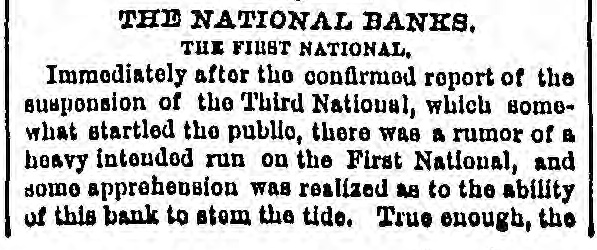
THE NATIONAL BANKS. THE FIRST NATIONAL, Immediately after the confirmed report of the susponsion of the Third National, which somewhat startled the public, there was a rumor of a heavy intended run on the First National, and some apprehension was realized As to the ability of this bank to stom the tide. True enough, the


Article from The Rock Island Daily Argus, September 29, 1873

Click image to open full size in new tab

Article Text

: port. Appeal for Help for Shreve Accidents, etc., etc. y f Sep. 27 The Third payments National of CHICAGO, has suspended large somewhat of currency The Cook by the I run Bank on the First. There has into been suspension County Na- re- a Bank, led on Monday action of the invites the active corresponsume tional payment. of Union, its and northwestern will coI operation dents. There appears financial to and be a commercial slightly a improved marked circles feeling in but business exhibits cash property currency falling Some was more to-day, off. urgent, The investment inquiry indicating for in that grain. cur is arriving for obtained considerable a deof the banks express to-day and in evince spite of the action termination rency by of banks to work in other through sections of the I a After protracted night country CHICAGO Sept. 27 House Association to the improvit is ing prospects, debate, resolved the Clearing that, in inexpedient view of to issue the Maufac Banks t loan The certificate Second declare National their and intention to go into turers involuntary liquidation. deposits in our banks t tion of for The the decrease past 40 per week cent of is $11,000,000, The outlook a to-night diminu- of the is very reassuring Sept. 27.-A meeting was held last CHICAGO House Association adjourn until half by past all Clearing night and did not It was attended of the one this members morning including yesterday the officers clearing A propthe suspended to issue a of the osition banks that purposes loan received on majority account of votes renewed, but house was not adopted The discussion necessary was united late hour strong opposition and, it being action, declared the following to committee to take some was appointed for adoption at a the plan Mr S Mr consider and report the clearing house for settlements in Corn Exchange Mr. RutRumsey; of the Fifth National Mr S of the Traders and Mr It ter, Lombard, Hibernian of the National: National; National Green Clark, was baum. of to adjourn until meeting of the then At a that they of the voted the German subsequent resolved 8 'clock this will to evening. they plan similar in report their system, the Clearing committee the New York adoption only through of a and that checks will House. ST. be LOUIS, paid Sept this 27. morning. Quiet has All reigned every are among the banks under the rule and in the checks cheerfully acquiesce Change is paying body seems to The feeling on articles are better arrangement and prices for The some volume in of some busstiffened materially somewhat, obtained. and, Mer iness increased figures were be more hopeapprehension cases, chants, ful,but higher there generally, is still and seem but strong to little under disposition current entirely to of The do very day much has passed circles trading. quietly The almost in excitement financial subsided, and commercial day has positively an im feeling among and of the previous and there was all classes. Prices some materially, on proved Change stiffened higher figures panic. than A num- since articles brought mencement of the this afternoon against that they currency will pay deposits. ber the of comme banks announced all currency checks are Matters curquiet on the only trouble. have, with new PHILADELPHISTREET Third Sept the scarcity Many of great large raised exertions, full wages. e rency manufacturing being concerns sufficient amounts of curJo Sam rency PHILADELPHIA applicant to pay for Sept. Cooke proceedings & Co., of the has in bank state- with ment n the drawn made of the assets sephs, ruptcy the against suit in Jay consequence and liabilities of out cur paid are discounting circles. in banking 27. rency City firm. when banks freely, needed have giving generally to pay an wages, easier and feeling of the close manifest. they Some of the paid out. f business an banks Sept. as was much curThe Secretary rency WASHINGTON as is Sept. no longer 27 financial troubled sour with in of the Treasury of inquiry from whatever exists De is telegrams No excitement and the Executive An ar made ces. that department, equally free from by it. which the e McCullough rangement partment has of been Jay Government Cooke, drafts & Co. the agency. is a There Sept.27. & London the Co. London Beyond will house honor house this all there of Clews, has been Habrecht no change sit the in AUGUSTA here to-day Ga, but There is no otherwing dostateuation feeling is unchanged. want of currency. bank cotton for The to n ing NEW in YORK. be Sept. ready for committee publication has resolved to ited amounts. is day ments The will not issue clearing loan house certificates the to opinion unlim NEW YORK, Sept. 27. with steadily financial bright , of persons that conversant the prospect Savings is institutions meet are la ments ening. Banksand more freely to it is stated, of offers bor to prepay millions. the paying pay out rolls, money and government, November interest last met , fourteen Libraover Some prominent rooms of the Mercantile rela ing Association, in the and after condition of financial follownow tive commercial to the present affairs, adopted the should commer and ing That all our efforts of trade greatest and efficiency Resolved directed to the promoting support their the vast be and to in carrying incidental on to exchanges possible of harvest. recommend to happily banks the and our bountifu That we their union, that so it be Resolintenance of request resolution to dised count begun, freely, ented commercial which by joint on a paper like of occasion in character,


Article from Chicago Daily Tribune, September 30, 1873

Click image to open full size in new tab

Article Text

LAWRENCE, KS. Special Dispatch to The Chicago Tribune. LAWRENCE, Ks., Sept. 20.-Financial matters are looking brighter. The news of resumption by the Chicago banks is hailed with delight. Our banks have paid without suspension through the panic.


Article from Chicago Daily Tribune, September 30, 1873

Click image to open full size in new tab

Article Text

SAN FRANCISCO. Special Dispatch to The Chicago Tribune. SAN FRANCISCO, Sept. 20.-To-day was devoted almost exclusively to collections and legitimate channels, and the result inspirod confidence. Tho resumption of business by the Chicago banks was the subject of much congratulation, showing the panic had no serious effects on Western finance and stability. This, with the promptness with which to-day's matured obliga- tions were mot, has reopened the current of exchange, which resumed with some briskness. Coin drafts on New York sold at ΒΎ to 1 por cent; telegraphic transfers at 2 por cent. The panic has fully demonstrated the unadvisability of stock speculations. Capitalists are more unwilling than ever to invest in outside real estate, preferring legitimate enter- prises and staple products. The panic is charged


Article from Ottumwa Weekly Courier, October 2, 1873

Click image to open full size in new tab

Article Text

On Monday evening last the following action was had by Chicago bankers : The Chicago Clearing House association of banks and bankers resolve that until further action, and in view of the disturbed condition of affairs in New York and other cities, and the difficulty of converting balances into currency, its members be recommended and authorized to suspend currency payments on any large demands made upon them, either from country banks or over their counters. Dispatches of last night show that this action of the Chicago bankers is commended in Keokuk and Des Moines, Iowa,"also by those of Quincy and Peoria, III. The excitement throughout the whole country is great, and yet everybody expresses the utmost confidence in the banks, except such as have been dealing in railroad stock. The opinion prevails that banks generally must suspend until the people settle quietly down. Our produce which had commenced moving, is about totally checked. Eastern banks refuse to send currency west, and as a consequence no produce can be bought. This certainly cannot last long, for the starving must have bread and the currency depot must be unlocked in the East.


Article from Eureka Daily Sentinel, October 3, 1873

Click image to open full size in new tab

Article Text

(SPECIAL TO THE DAILY SENTINEL.] NEW YORK. NEW YORK, Oct.2 The Court of Appeals reversed the judement of the lower Court. and dismissed with costs the complaint against the Staten Island Railroa Company. There were the famous Westfield explosion cases, A denial is given to the statement published to the effect that the mis. sion of Cardinal Bonnechaz to Rome was for the purpose of inviting the Pope in France. to consecrate Henry as King. It is stated that the mis sion of the Cardinal has no reference to the monarchical question. The Danforth Locomotive Works. New Jersey, will place the employes at their founday on half time, or work two gangs on alternate days. Forty employes of the Morris & Essex Railro d. at Hoboken. were discharged vesterd IV. and about 150 at other points. because of the inability of the company to obtain the necessarv currency for disbursements. A dispatch from Fort Klamath, dated vesterday. says: Captain Jack and his five associates will be hanged Friday morning at 10 o'clock sharp. and to-day the carpenters will drive the first nail in the structures which are being erected to meet the requirement of the sentence. They will be suspended from one beam. and at a given signal will swing into eternity together. The execution will be public. to allow the Klamaths and neighboring Indians full view of the manner in which the law ef the United States is meted out to transgressors.' ILLINOIS. CHICAGO, Oct. 2. A Washington special says, in reply to inquiries, this evening. that Secre tarv Richardson reiterated his former statement that he believes the Government will not lose a dollar in consequence of the failure of Clews & Co., or Clews. Hobacht & Co.: that a few thousand dollars may possibly be st thereby. He thinks the indica. DS are that the company will pay all its debts. and furthermore, that if Jay Cooke & Co. pav even 33 per cent. he believes the Government, which stands in the position of a preferred creditor. will not lose anything by the failure of the First National Bank of this city. No proposition of compromise has vet been made by Jay Cooke & Co. through the receivers of the First National Bank to the Treasury Department. As to the affairs of the syndicate. Mr. Richardson savs they will not be directly disturbed by the failure of Jay Cooke & Co., though it is possible that the result of the financial panic in this country may retard or injuriously affect the sales of our new bonds in foreign countries. DISTRICT OF COLUMBIA. WASHINGTON Oct. 2. The public debt statement shows the total debt $221 496.164. and the total interest. $32.083.523. Cash in the treasury (coin). $80.246.757; cash in the treasury (currency), $3.289.032. Special deposits held for the redemption of certificates of deposit. as provided by law. $11,250.000. Total in the treasury, $94,785,789. Debt. less cash in the treasury. $2.218.703.898 decrease during the month. $1 1.901.467 Bonds issued to Pacific RR. compan'es, interest payable in lawful money, principal vet outstanding. $64 4 623,512. Interest account, and not vet paid, $969.352. Interest paid by the United States, $20,447,986. Interest repaid by the of the maila


Article from Burlington Weekly Free Press, October 3, 1873

Click image to open full size in new tab

Article Text

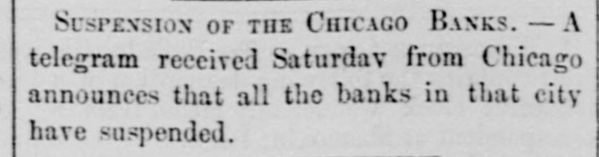
SUSPENSION OF THE CHICAGO BANKS. - A A telegram received Saturday from Chicago announces that all the banks in that city have suspended.


Article from Burlington Weekly Free Press, October 3, 1873

Click image to open full size in new tab

Article Text

The Action of the Banks. The New York banks, in order to prevent further drain of greenbacks, and new lock-ups of currency, already in too scanty supply, found it necessary to refuse payments of large checks and drafts, while still holding themselves prepared to cash small checks, drawn in the ordinary course of business. Similar action at once became necessary in other monetary centres. Thus the Boston banks found that New Yorkers were picking up Boston checks, and that large sums of greenbacks, were being sent from Boston to New York. They at once held a meeting for concerted action and adopted the same measure of partial saspension. The same causes led to the same precautionary measure] on the part of the banks in Philadelphia, Baltimore, Chicago, Cineinnati, Indianapolis, and other large cities. Probably a majority of the banks of the principal cities of the Union have by this time followed the example of New York. The country banks are not in equal danger of drains of currency, and probably do not in many cases find it necessary to give formalinotice of similar precautions. Yet their attitude, in the nature of things, must be substantially the same. While all goes on quietly and on the usual course of business, they will make no difference in their mode of doing business; but they would unquestionably meet any concerted or unusual demand for currency, by a refusal to pay greenbacks and a tender of some other form of payment, as certified checks, or drafts. Our Burlington banks are sound and strong ; and as long as our business men and community generally keep their heads, and make no unnecessary or unusual demands. they will unquestionably keep right on in the ever. tenor of their way, responding as usual to all ordinary demands. While the banks tbus do their duty, it is for the community to remember that a duty also rests with them. No one should hoard greenbacks, or needlessly withdraw them from circulation. Let every one that has cash use what he needs, and thus keep it moving; and deposit what he does not need in the banks, to help keep up their supply of currency. With such wise action, there need not be, and we suppose there will not be, any disturbance of the usual course of business among us.


Article from Chicago Daily Tribune, February 13, 1874

Click image to open full size in new tab

Article Text

MONEY AND COMMERCE. MONETARY. THURSDAY EVENING, Feb. 12. Notwithstanding the large amount of money absorbed in carrying grain and provisions in this market, the supply of loanable funds in the market is greater than finds employment. It is frooly offered on domand lonns nt 8 por cont, and on time loans at 10 ; but there seems scarcoly any inducement to put the rates of money lower than these figures. In this market, when a borrower wants money at all, he wants it bad enough to pay 10 or 8 per cent for it, and the difference of 1, or oven 2, por cont on short time loans would not be sufficient to induco him to embark in any onterpriso which be otherwise would not. In the Eastern markets it is different. Speculators BOOKER up 1001x0 ] U 01 [vop which fluctuato less in price than Western prodnote, and when the rate of interest ou money gets below the average rato of dividends on cortain stocks it is borrowed to carry the stocks or speculate in them. In this market, however, the supply of money, be it over 60 abundant, soldom puts the rate of money below 8 per cent on domand and 10 per cont on sixty or ninety days. What is not used at these ratos either lies idlo or Is sent East, where the Now York banks pay 4 per cent on current balances. Now York exchange continues weak at 75c por $1,000 discount. Currency shipments to the country are still pretty large. CHICAGO BANKS DISCUSSED IN LONDON. It scems that the Chicago banks are doomed to be belied in regard to the position they took during the panio last fall. Hero in the West, even our rivals, Cincinnati and St. Louis, were honorable enough to acknowledge that, while the banks in every other large city in the United States stopped currency payments, the Chicago banks continued to pay currency on demand of their depositors throughout the panic. The New York papers, however, with the exception of the Now York Journal of Commerce, ignored the fact, and said that all the banks in the United States suspended currency payments. An article on " The Panio," in Harper's Monthly Magazine, boldly asserted the falsehood that the Chicago banks suspended, as well as all others in the West. But now comes the most unconscionable misrepresentation of all, from the mouth of Mr. R. Potter, the President of the Grand Trunk RailGrand only JO " 1V 10 AUM Trunk Railway Company in London, reported in the Times of that city, Jan. 23, Mr. Potter dolivered bis report of the working and financial condition of the road. In this he took occasion to Bay that he sailed for America in September, and whon he arrived found that a great commercial storm had commenced, which swept over the whole country, reducing the value of almost overything. He then," BAYS the Times' report, described the state of things during the whole panic, both in New York and Chicago. For a whole mouth,' said Mr. Pottor, 'there 1008 only one bank that continued business in Chicago, and that was their Canadian bank, to which the American people brought their capital. If Mr. Potter is interested in the Canadian bank which has a branch in this city, he would this Sumplin Sujop 10 Suides 10J oppronold en was honorable to bring it into notice, But to tell in London a wholesale falsehood for the sake of giving his bank a prestige to which it was not entitled by any of the circumstances of the case, and in SO doing to misrepresent rival bank in the city, was not only dishonorable every in Mr. Potter, but doubly 80 from the prominent position ho occupies as President of a trunk line of railroad. If Mr. Pot- great tor had not been in Chicago during his visit to America, there might be some excuse for his statemoute, on the ground that he had heard such reports. But Mr. Potter was in Chicago, and must have known, if he know anything about Chicago during the pauic, that the First National, the Commercial National, the Morchants' National, the Corn Exchange National, the Fifth National, the Northwestern National, the Merchants' Savinga, Loan & Trust Company and several others, continued to pay currency on the demand-checks of their depositors throughout the whole panie, or and that, in order to do this, they brought


Article from New-York Tribune, August 30, 1877

Click image to open full size in new tab

Article Text

EFFECT UPON BUSINESS IN THIS CITY. The failure of the State Savings Bank of Chicago had no perceptible effect here, and bankers generally regarded it as a temporary matter, not likely to create a panic or disturb the standing of other Chicago banking institutions. A private dispatch received yesterday afternoon stated that the run on the banks was not heavy, that the larger institutions were promptly meeting all demands, and that savings banks were insisting on the rule that for the withdrawal of larger amounts than $10, thirty days notice must be given. It is not believed by the officers of the leading banks in this city that there is any immediate danger of a serious time with the Chicago Banks, and in no case could it much affect banks 111 this city. The State Savings Bank of Chicago is reported to have total resources of $2,724,000, with liabilities of $2,988,339. This is believed to be a low estimate of the deficiency, which, it is thought, will be increased somewhat on account of the shrinkage in values of real estate, of which the bank holds $1,435,315. A Wall-st. banker stated that the financial embarrassment of the State Savings Bank has been a matter of discussion for a long time, and gross mismanagement has been charged against its executive officers. He stated further that D. D. Spencer, the president, was reported to have been a heavy operator in grain, and had by the decline lost the money of the depositors with which he had been operating. Mr. Spencer 18 reported as having left Chicagoon Saturday for this city, but up to last night he had not been seen or heard of, and the presumption among bankers is that he laid over in Canada, or went in a westerly direction. The members of the Produce Exchange were somewhat anxious yesterday morning to obtain full intelligence. Advices were received throughout the day, and they all tended to show that the market, as yet, had not been affected to any extent in Chicago, and there were, therefore, no fears to be entertained of trouble here. A prominent member of the Exchange stated to a TRIBUNE reporter that unless there was a very heavy run on the Chicago banks, causing a money panic, there would be no trouble 111 the produce market here. The Exchange in this city was governed almost entirely by the news from London, and not by the Chicago market, which was too speculative. If, he said, there were any heavy failures there, it would then probably have a disastrous effect on New-York merchants.


Article from The Princeton Union, January 30, 1878

Click image to open full size in new tab

Article Text

Dividends Declared. The Comptroller of the Currency has declared a dividend in favor of the creditors of the First National bank of Chicago of 45 per cent., and to the creditors of the Central National bank of 25 per cent., payable as soon as schedules received from receivers are examined. He has also declared a dividend in favor of the creditors of the following banks: First National bank of Delphi, Ind., 25 per cent., making in all 50 per cent,; First National bank of Duluth, Minn., 20 per cent., making 65 per cent. in all.


Article from The Worthington Advance, January 31, 1878

Click image to open full size in new tab

Article Text

Dividends Declared. The Comptroller of the Currency has declared a dividend in favor of the creditors of the First National bank of Chicago of 45 per cent., and to the creditors of the Central National bank of 25 per ccnt., payable as soon as schedules received from receivers are examined. He has also declared a dividend in favor of the creditors of the following banks: First National bank of Delphi, Ind., 25 per cent., making in all 50 per cent,; First National bank of Duluth, Minn., 20 percent., making 65 per cent. in all. French Protectorate for San Domingo. Late Havana advices give out the rumor that Spain will sign a treaty with San Domingo at the end of this month, assuring a protectorate over that island, causes great excitement in San Domingo and Hayti, and serves to increase the unpopularity of President Bolz. The-rumor is somewhat strengthened by the appointment of New Spanish Consuls at several parts of the Domingan Republic.


Article from River Falls Journal, January 31, 1878

Click image to open full size in new tab

Article Text

Dividends Declared. The Comptroller of the Currency has declared a dividend in favor of the creditors of the First National bank of Chicago of 45 per cent., and to the creditors of the Central National bank of 25 per cent., payable as soon as schedules received from receivers are examined. He has also declared a dividend in favor of the creditors of the following banks: First National bank of Delphi, Ind., 25 per cent., making in all 50 per cent,; First National bank of Duluth, Minn., 20 per cent., making 65 per cent. in all.