Holland Banking Company (Springfield, MO)

Episode Information

Episode Type
Run → Suspension → Closure
Start Date
January 15, 1924
Location
Springfield, Missouri (37.215, -93.298)
Bank Type
state
Routing Number
80-0004

Metadata

Notes

Grand-jury indictments later revealed serious loan problems and possible insolvency despite the run being triggered by a false rumor.

Events (4)

1. January 15, 1924 Run
Cause
Rumor Or Misinformation
Cause Details
A false rumor spread by an irresponsible girl employe who misreported seeing a run when she saw long lines cashing paychecks, triggering steady withdrawals.
Random Run
Yes
Random Run Snippet
Irresponsible girl employee started false rumor of a run
Measures
Leading citizens and merchants agreed to honor checks; bank sought reorganization and funds; later placed affairs with State Finance Commissioner.
Newspaper Excerpt
failed to open its doors today, following two runs last week.
Source
newspapers
2. January 15, 1924 Suspension
Cause
Government Action
Cause Details
Bank closed and placed in hands of state bank examiner/State Finance Commissioner after runs and concern about maintaining legal reserve.
Newspaper Excerpt
failed to open its doors today ... the institution was placed in the hands of the state bank examiner / State Finance Commissioner
Source
newspapers
3. May 14, 1924 Other
Newspaper Excerpt
Officials of Holland Bank Are Named In 23 Indictments. ... returned 23 indictments against five officers of the bank ... indicating prior examiner found questionable/forged notes and weak condition last July, 1923. (grand jury report).
Source
newspapers
4. October 4, 1924 Other
Newspaper Excerpt
E. L. Sanford convicted of accepting deposits when he knew bank was in failing condition; sentenced to four years; resulted from closing Jan. 15 and subsequent grand jury action.
Source
newspapers

Newspaper Articles (22)

Article from The Oregon Daily Journal, January 15, 1924

Click image to open full size in new tab

Article Text

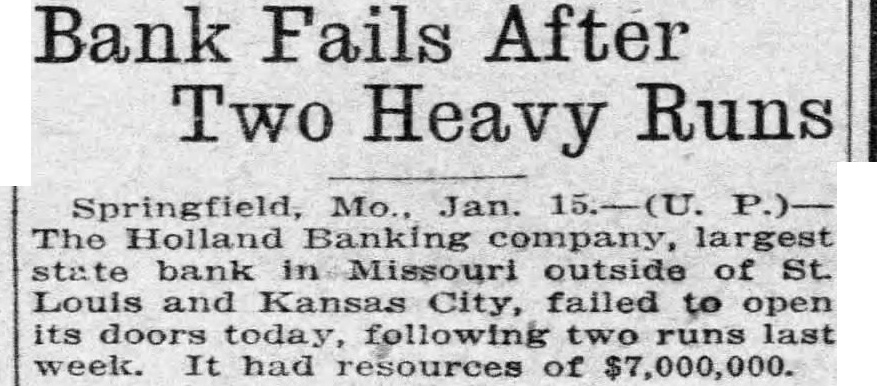
Bank Fails After Two Heavy Runs

Springfield, Mo., Jan. 15.—(U. P.)—The Holland Banking company, largest state bank in Missouri outside of St. Louis and Kansas City, failed to open its doors today, following two runs last week. It had resources of $7,000,000.


Article from The Seattle Star, January 15, 1924

Click image to open full size in new tab

Article Text

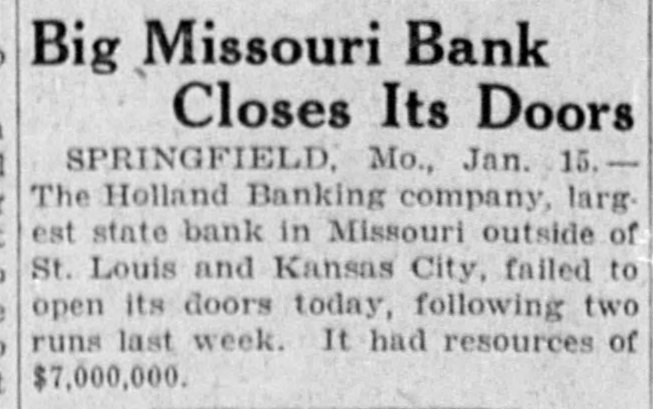
Big Missouri Bank Closes Its Doors SPRINGFIELD, Mo., Jan. 15.- The Holland Banking company, larg. est state bank in Missouri outside of St. Louis and Kansas City, failed to open its doors today, following two runs last week. It had resources of $7,000,000.


Article from Imperial Valley Press, January 15, 1924

Click image to open full size in new tab

Article Text

MO

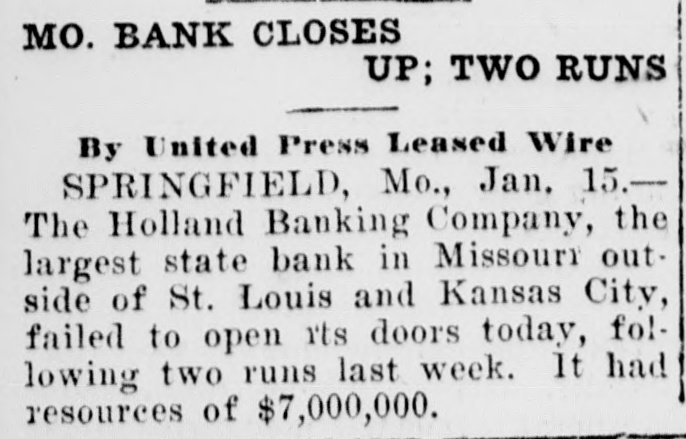
BANK CLOSES UP; TWO RUNS By United Press Leased Wire SPRINGFIELD, Mo., Jan. 15.The Holland Banking Company, the largest state bank in Missouri out. side of St. Louis and Kansas City, failed to open rts doors today, following two runs last week. It had resources of $7,000,000.


Article from The Daily Worker, January 16, 1924

Click image to open full size in new tab

Article Text

More Proof of Prosperity

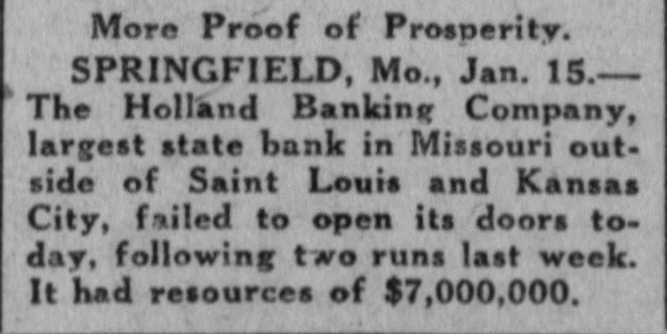
SPRINGFIELD, Mo., Jan. 15.The Holland Banking Company, largest state bank in Missouri outside of Saint Louis and Kansas City, failed to open its doors today, following two runs last week. It had resources of $7,000,000.


Article from The St. Louis Star and Times, January 16, 1924

Click image to open full size in new tab

Article Text

By a Staff Correspondent.

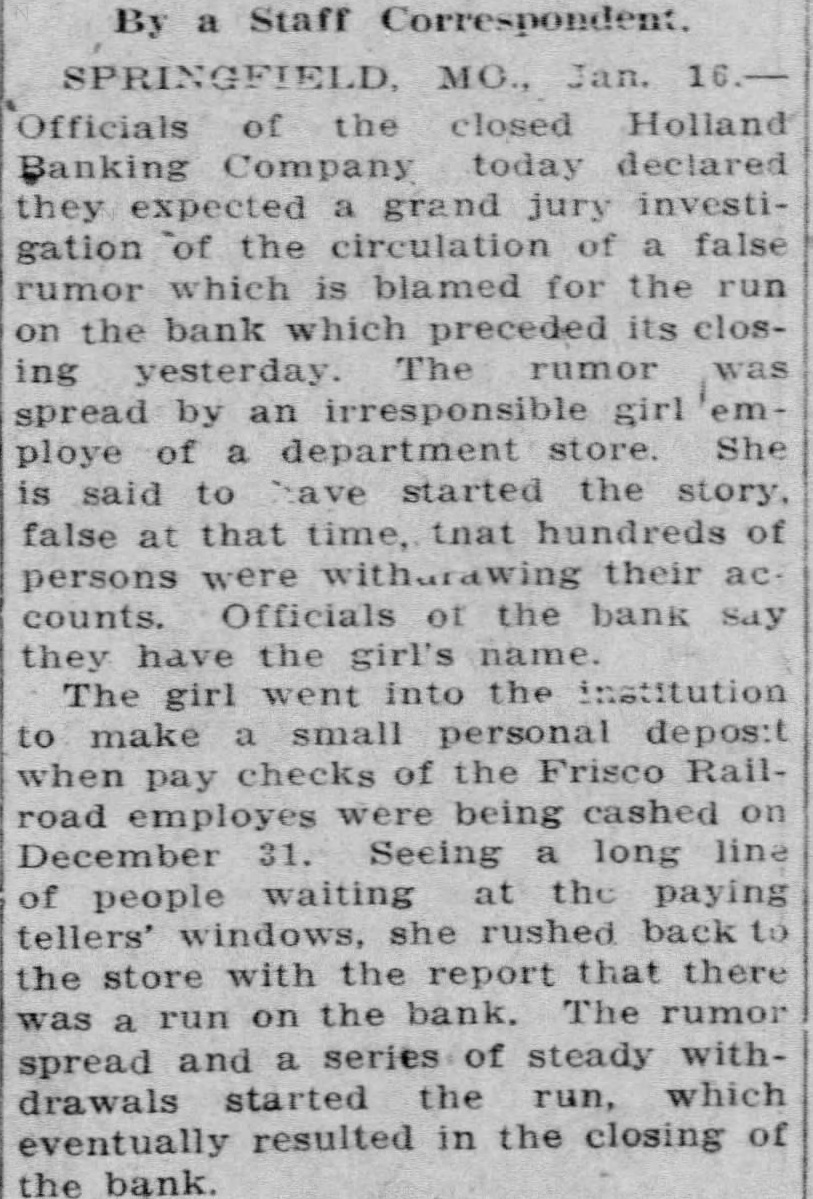
SPRINGFIELD, MO., Jan. 16.—Officials of the closed Holland Banking Company today declared they expected a grand jury investigation of the circulation of a false rumor which is blamed for the run on the bank which preceded its closing yesterday. The rumor was spread by an irresponsible girl employe of a department store. She is said to have started the story, false at that time, that hundreds of persons were withdrawing their accounts. Officials of the bank say they have the girl's name.

The girl went into the institution to make a small personal deposit when pay checks of the Frisco Railroad employes were being cashed on December 31. Seeing a long line of people waiting at the paying tellers' windows, she rushed back to the store with the report that there was a run on the bank. The rumor spread and a series of steady withdrawals started the run, which eventually resulted in the closing of the bank.


Article from The Springfield News-Leader, January 16, 1924

Click image to open full size in new tab

Article Text

Local Business Men Express Confidence in Holland Bank

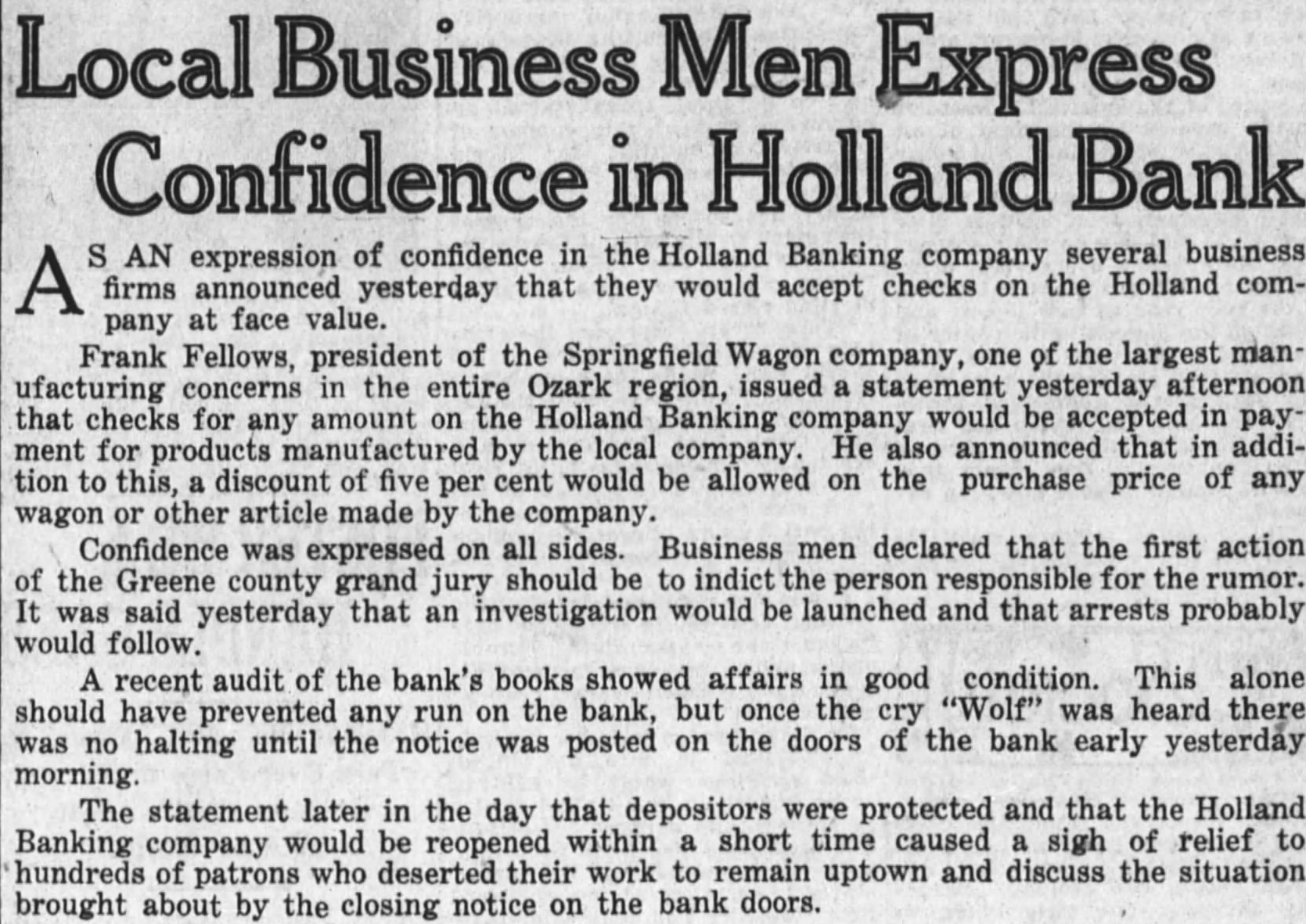
AS AN expression of confidence in the Holland Banking company several business firms announced yesterday that they would accept checks on the Holland company at face value.

Frank Fellows, president of the Springfield Wagon company, one of the largest manufacturing concerns in the entire Ozark region, issued a statement yesterday afternoon that checks for any amount on the Holland Banking company would be accepted in payment for products manufactured by the local company. He also announced that in addition to this, a discount of five per cent would be allowed on the purchase price of any wagon or other article made by the company.

Confidence was expressed on all sides. Business men declared that the first action of the Greene county grand jury should be to indict the person responsible for the rumor. It was said yesterday that an investigation would be launched and that arrests probably would follow.

A recent audit of the bank's books showed affairs in good condition. This alone should have prevented any run on the bank, but once the cry "Wolf" was heard there was no halting until the notice was posted on the doors of the bank early yesterday morning.

The statement later in the day that depositors were protected and that the Holland Banking company would be reopened within a short time caused a sigh of relief to hundreds of patrons who deserted their work to remain uptown and discuss the situation brought about by the closing notice on the bank doors.


Article from The Kansas City Times, January 16, 1924

Click image to open full size in new tab

Article Text

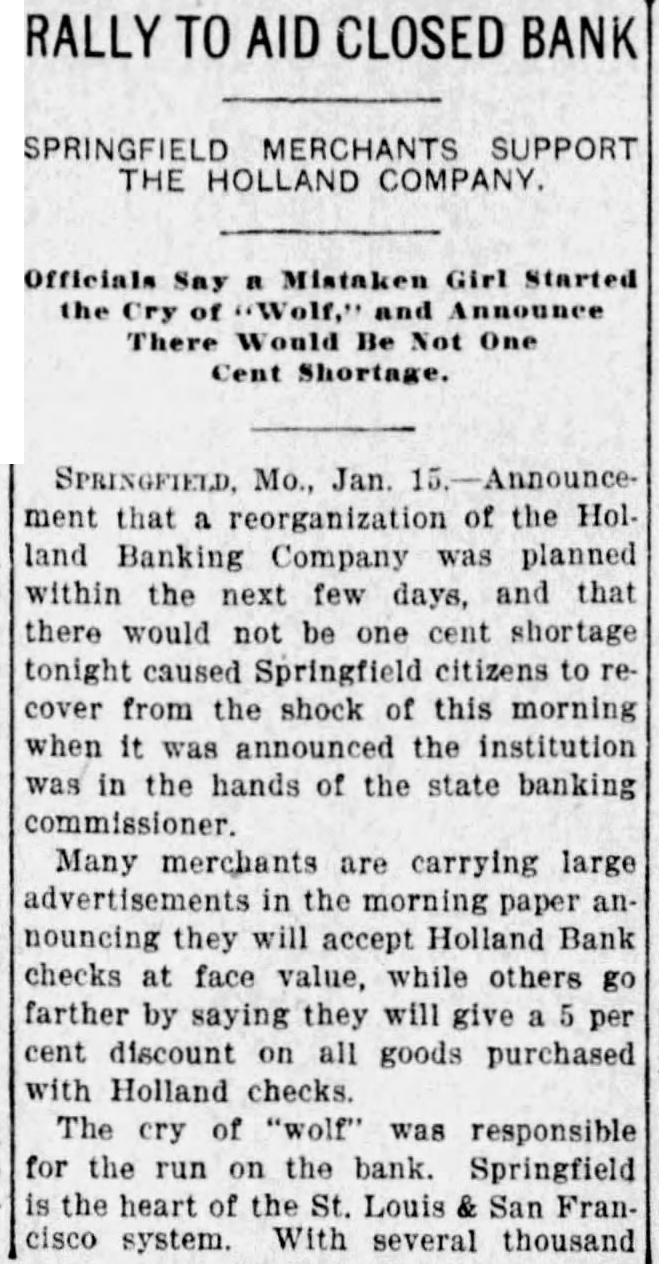
RALLY TO AID CLOSED BANK

SPRINGFIELD MERCHANTS SUPPORT THE HOLLAND COMPANY.

Officials Say a Mistaken Girl Started the Cry of "Wolf," and Announce There Would Be Not One Cent Shortage.

SPRINGFIELD, Mo., Jan. 15.—Announcement that a reorganization of the Holland Banking Company was planned within the next few days, and that there would not be one cent shortage tonight caused Springfield citizens to recover from the shock of this morning when it was announced the institution was in the hands of the state banking commissioner.

Many merchants are carrying large advertisements in the morning paper announcing they will accept Holland Bank checks at face value, while others go farther by saying they will give a 5 per cent discount on all goods purchased with Holland checks.

The cry of "wolf" was responsible for the run on the bank. Springfield is the heart of the St. Louis & San Francisco system. With several thousand


Article from Linn County Budget-Gazette, January 16, 1924

Click image to open full size in new tab

Article Text

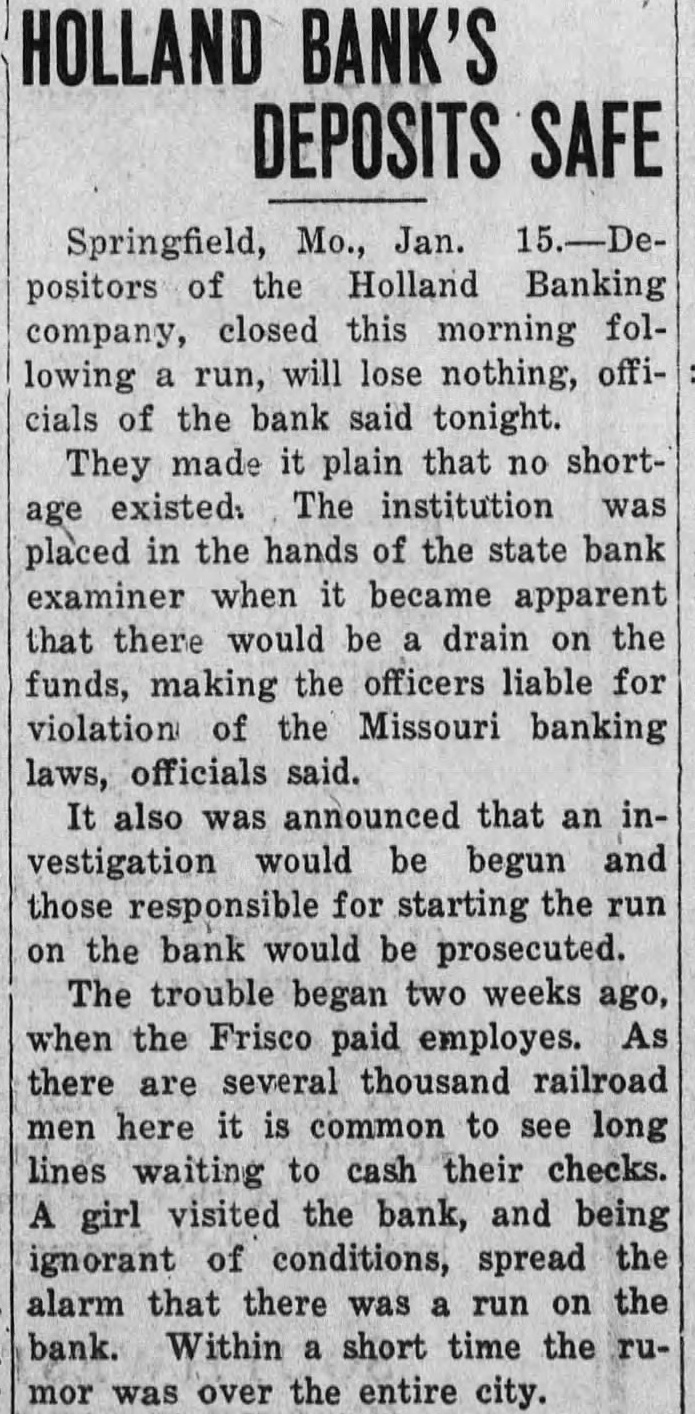
HOLLAND BANK'S DEPOSITS SAFE

Springfield, Mo., Jan. 15.—Depositors of the Holland Banking company, closed this morning following a run, will lose nothing, officials of the bank said tonight.

They made it plain that no shortage existed. The institution was placed in the hands of the state bank examiner when it became apparent that there would be a drain on the funds, making the officers liable for violation of the Missouri banking laws, officials said.

It also was announced that an investigation would be begun and those responsible for starting the run on the bank would be prosecuted.

The trouble began two weeks ago, when the Frisco paid employes. As there are several thousand railroad men here it is common to see long lines waiting to cash their checks. A girl visited the bank, and being ignorant of conditions, spread the alarm that there was a run on the bank. Within a short time the rumor was over the entire city.


Article from Pocahontas Star Herald, January 18, 1924

Click image to open full size in new tab

Article Text

The Holland Bank at Springfield, Mo., a $7,000,000 bank, closed its doors Tuesday after several days "run" of depositors. The bank's figures, however, show that it is not insolvent.


Article from Kansas City Journal, January 21, 1924

Click image to open full size in new tab

Article Text

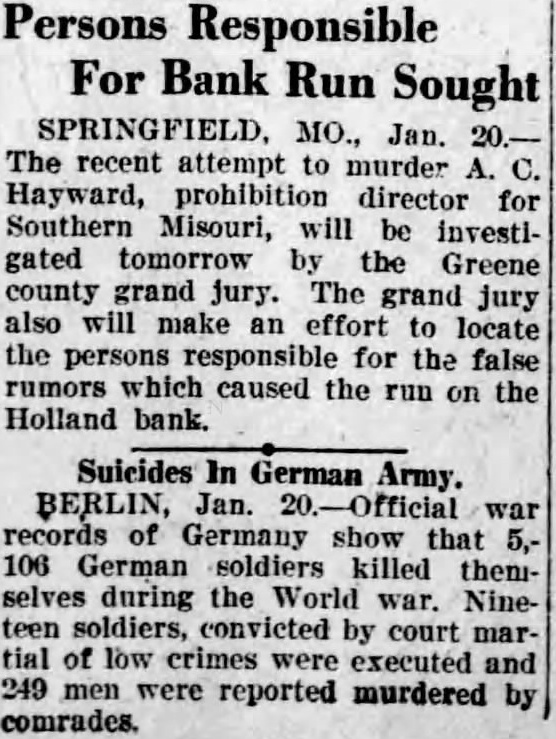
Persons Responsible For Bank Run Sought

SPRINGFIELD, MO., Jan. 20.—The recent attempt to murder A. C. Hayward, prohibition director for Southern Missouri, will be investigated tomorrow by the Greene county grand jury. The grand jury also will make an effort to locate the persons responsible for the false rumors which caused the run on the Holland bank.

Suicides In German Army.

BERLIN, Jan. 20.—Official war records of Germany show that 5,106 German soldiers killed themselves during the World war. Nineteen soldiers, convicted by court martial of low crimes were executed and 249 men were reported murdered by comrades.


Article from Carthage Evening Press, January 26, 1924

Click image to open full size in new tab

Article Text

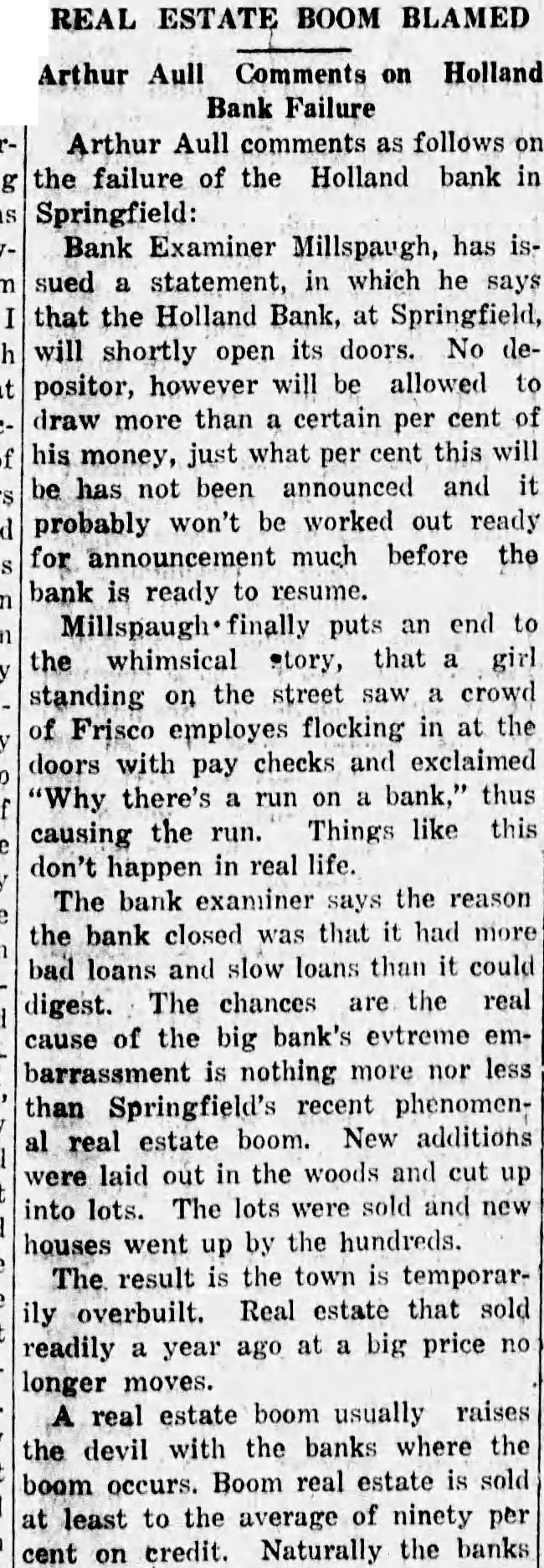
REAL ESTATE BOOM BLAMED

Arthur Aull Comments on Holland Bank Failure

Arthur Aull comments as follows on the failure of the Holland bank in Springfield:

Bank Examiner Millspaugh, has issued a statement, in which he says that the Holland Bank, at Springfield, will shortly open its doors. No depositor, however will be allowed to draw more than a certain per cent of his money, just what per cent this will be has not been announced and it probably won't be worked out ready for announcement much before the bank is ready to resume.

Millspaugh finally puts an end to the whimsical story, that a girl standing on the street saw a crowd of Frisco employes flocking in at the doors with pay checks and exclaimed "Why there's a run on a bank," thus causing the run. Things like this don't happen in real life.

The bank examiner says the reason the bank closed was that it had more bad loans and slow loans than it could digest. The chances are the real cause of the big bank's extreme embarrassment is nothing more nor less than Springfield's recent phenomenal real estate boom. New additions were laid out in the woods and cut up into lots. The lots were sold and new houses went up by the hundreds.

The result is the town is temporarily overbuilt. Real estate that sold readily a year ago at a big price no longer moves.

A real estate boom usually raises the devil with the banks where the boom occurs. Boom real estate is sold at least to the average of ninety per cent on credit. Naturally the banks


Article from Rich Hill Mining Review, January 31, 1924

Click image to open full size in new tab

Article Text

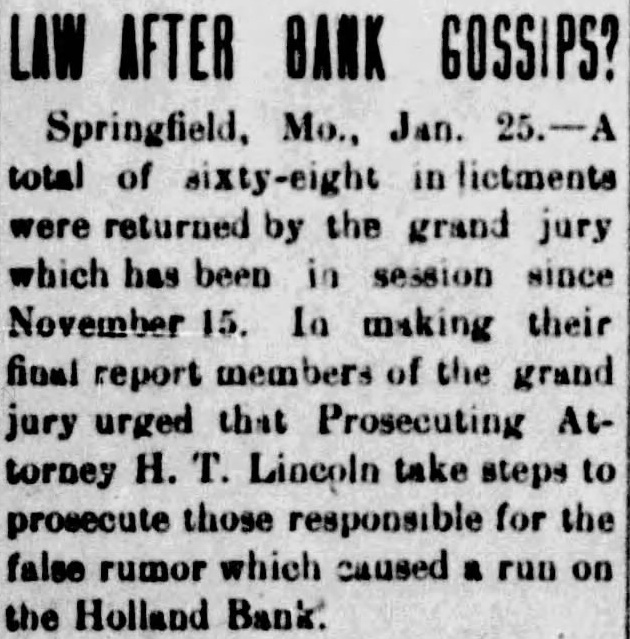
LAW AFTER BANK GOSSIPS?

Springfield, Mo., Jan. 25.—A total of sixty-eight indictments were returned by the grand jury which has been in session since November 15. In making their final report members of the grand jury urged that Prosecuting Attorney H. T. Lincoln take steps to prosecute those responsible for the false rumor which caused a run on the Holland Bank.


Article from The Springfield News-Leader, April 27, 1924

Click image to open full size in new tab

Article Text

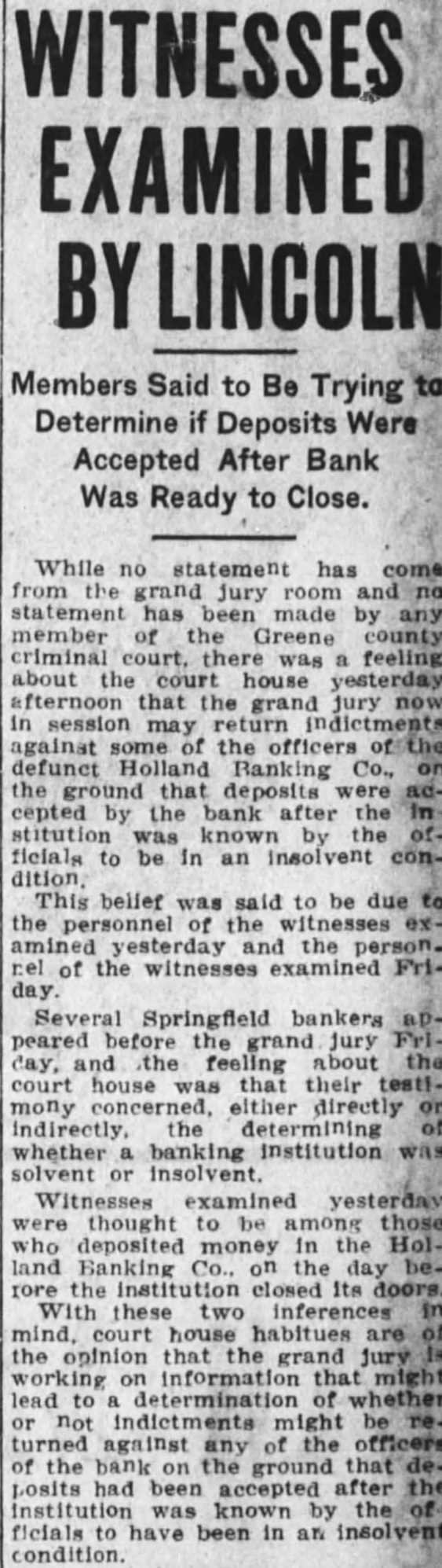
WITNESSES EXAMINED BY LINCOLN

Members Said to Be Trying to Determine if Deposits Were Accepted After Bank Was Ready to Close.

While no statement has come from the grand jury room and no statement has been made by any member of the Greene county criminal court, there was a feeling about the court house yesterday afternoon that the grand jury now in session may return indictments against some of the officers of the defunct Holland Banking Co., on the ground that deposits were accepted by the bank after the institution was known by the officials to be in an insolvent condition.

This belief was said to be due to the personnel of the witnesses examined yesterday and the personnel of the witnesses examined Friday.

Several Springfield bankers appeared before the grand jury Friday, and the feeling about the court house was that their testimony concerned, either directly or indirectly, the determining of whether a banking institution was solvent or insolvent.

Witnesses examined yesterday were thought to be among those who deposited money in the Holland Banking Co., on the day before the institution closed its doors.

With these two inferences in mind, court house habitues are of the opinion that the grand jury is working on information that might lead to a determination of whether or not indictments might be returned against any of the officers of the bank on the ground that deposits had been accepted after the institution was known by the officials to have been in an insolvent condition.


Article from The Chillicothe Constitution-Tribune, May 14, 1924

Click image to open full size in new tab

Article Text

Officials of Holland Bank Are Named In 23 Indictments.

True Bills Voted Against President E. L. Sanford, Board Chairman, Two Vice-Presidents and Cashier.

SPRINGFIELD, Mo., May 14—The special grand jury which investigated the Holland Bank failure today, returned 23 indictments against five officers of the bank, as follows:

E. L. Sanford, president, four indictments charging forgery, three charging acceptance of deposits with knowledge that the bank was in failing condition and one charging embezzlement.

E. N. Ferguson, chairman of the board, three indictments charging acceptance of deposits, one charging embezzlement.

Guy S. Mitchell, vice-president, same.

Claude F. Wright, cashier, same.

E. G. Rathbone, vice president, three indictments charging acceptance of deposits.

Sanford's bond was fixed at $40,000, or $5,000 on each indictment, and the bonds of the others at the same rate, except that Rathbone's is only $2,000 on each indictment.

Sanford, Mitchell and Rathbone appeared and furnished bond within two hours after the fact of the indictments was made known, and it was said that the others would follow within a short time.

With the indictments the grand jury submitted a report, in which it declared that a State Bank Examiner discovered the bank's weakened condition last July and recommended the closing of the bank, but the State Finance Department, after a conference at Jefferson City, permitted the bank to continue.

"The examiner last July found $135,000 in notes that were questionable," the report said. "The explanation given by the officers of the bank regarding these notes did not satisfy the examiner, so the officers were invited to accompany the examiner to Jefferson City to submit their explanation to the department, which conference resulted in permission to remain in operation.

"Subsequent revelation indicates that the examiner was right, and the bank should have been closed in July, 1923. In the July examination there were forged and suspicious notes in the files amounting to $210,000; and accommodation notes of $82,000, besides the $135,000 questionable notes making a total of 427,000.

Frank C. Millspaugh, present State Finance Commissioner, was at the head of the department last July.

The report also censured the inadequacy of the criminal statutes relating to banking, and said that "the banker criminally inclined has too much protection."

The special grand jury heard 82 witnesses in the bank case.

Article from The Chillicothe Constitution-Tribune, May 14, 1924

Click image to open full size in new tab

Article Text

Officials of Holland Bank Are Named In 23 Indictments.

True Bills Voted Against President E. L. Sanford, Board Chairman, Two Vice-Presidents and Cashier.

SPRINGFIELD, Mo., May 14—The special grand jury which investigated the Holland Bank failure today, returned 23 indictments against five officers of the bank, as follows:

E. L. Sanford, president, four indictments charging forgery, three charging acceptance of deposits with knowledge that the bank was in failing condition and one charging embezzlement.

E. N. Ferguson, chairman of the board, three indictments charging acceptance of deposits, one charging embezzlement.

Guy S. Mitchell, vice-president, same.

Claude F. Wright, cashier, same.

E. G. Rathbone, vice president, three indictments charging acceptance of deposits.

Sanford's bond was fixed at $40,000, or $5,000 on each indictment, and the bonds of the others at the same rate, except that Rathborne's is only $2,000 on each indictment.

Sanford, Mitchell and Rathbone appeared and furnished bond within two hours after the fact of the indictments was made known, and it was said that the others would follow within a short time.

With the indictments the grand jury submitted a report, in which it declared that a State Bank Examiner discovered the bank's weakened condition last July and recommended the closing of the bank, but the State Finance Department, after a conference at Jefferson City, permitted the bank to continue.

"The examiner last July found $135,000 in notes that were questionable," the report said. "The explanation given by the officers of the bank regarding these notes did not satisfy the examiner, so the officers were invited to accompany the examiner to Jefferson City to submit their explanation to the department, which conference resulted in permission to remain in operation.

"Subsequent revelation indicates that the examiner was right, and the bank should have been closed in July, 1923. In the July examination there were forged and suspicious notes in the files amounting to $210,000; and accommodation notes of $82,000, besides the $135,000 questionable notes making a total of 427,000.

Frank C. Millspaugh, present State Finance Commissioner, was at the head of the department last July.

The report also censured the inadequacy of the criminal statutes relating to banking, and said that "the banker criminally inclined has too much protection."

The special grand jury heard 82 witnesses in the bank case.

Article from The Albany Capital, June 5, 1924

Click image to open full size in new tab

Article Text

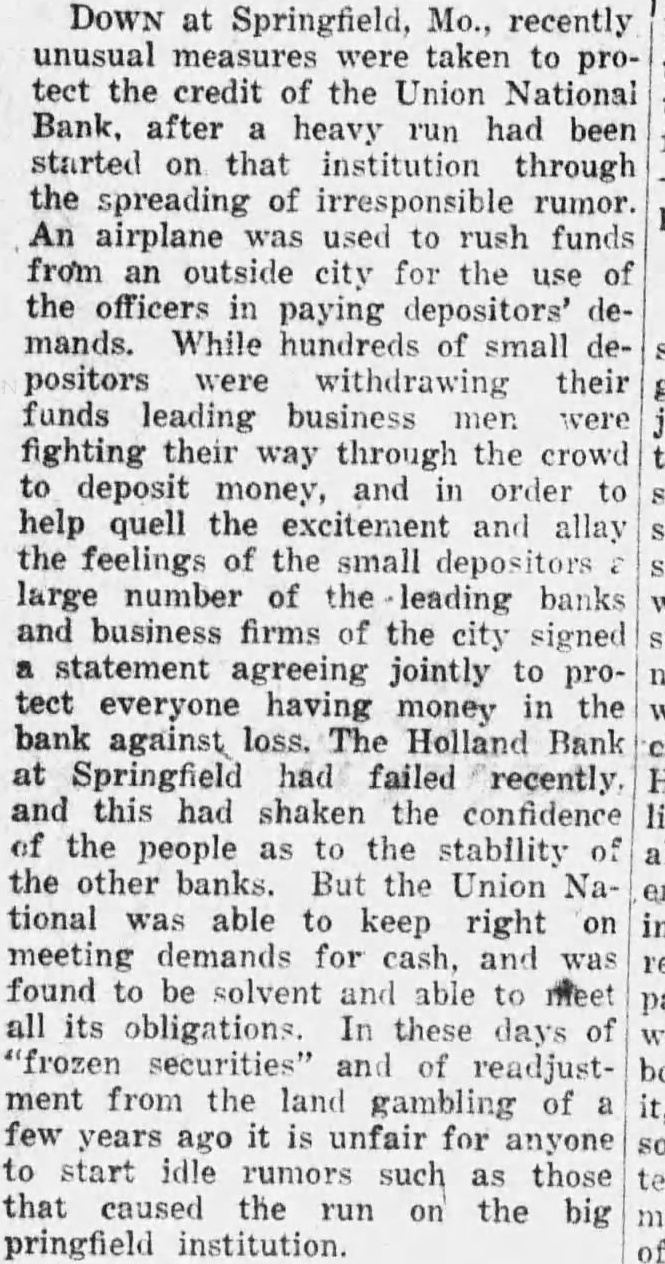
DOWN at Springfield, Mo., recently unusual measures were taken to protect the credit of the Union National Bank, after a heavy run had been started on that institution through the spreading of irresponsible rumor. An airplane was used to rush funds from an outside city for the use of the officers in paying depositors' demands. While hundreds of small depositors were withdrawing their funds leading business men were fighting their way through the crowd to deposit money, and in order to help quell the excitement and allay the feelings of the small depositors a large number of the leading banks and business firms of the city signed a statement agreeing jointly to protect everyone having money in the bank against loss. The Holland Bank at Springfield had failed recently, and this had shaken the confidence of the people as to the stability of the other banks. But the Union National was able to keep right on meeting demands for cash, and was found to be solvent and able to meet all its obligations. In these days of "frozen securities" and of readjustment from the land gambling of a few years ago it is unfair for anyone to start idle rumors such as those that caused the run on the big Springfield institution.


Article from St. Louis Post-Dispatch, October 4, 1924

Click image to open full size in new tab

Article Text

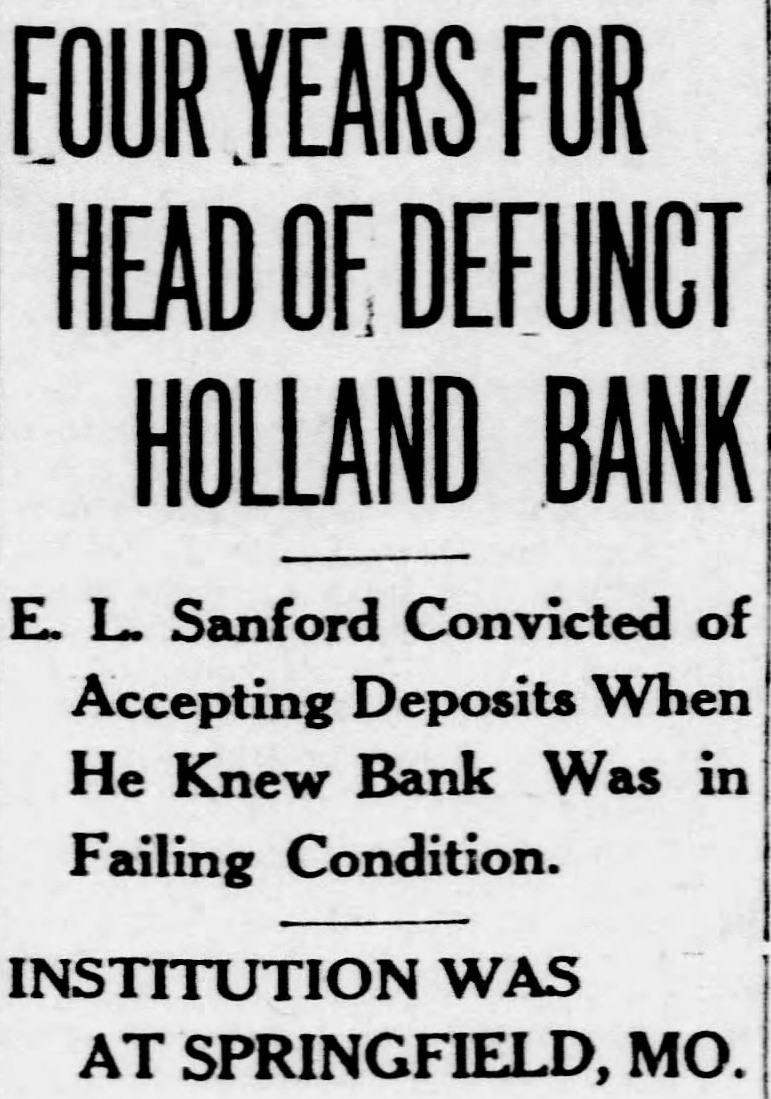
FOUR YEARS FOR HEAD OF DEFUNCT HOLLAND BANK

E. L. Sanford Convicted of Accepting Deposits When He Knew Bank Was in Failing Condition.

INSTITUTION WAS AT SPRINGFIELD, MO.


Article from St. Louis Post-Dispatch, October 4, 1924

Click image to open full size in new tab

Article Text

Plea of Defense Was That President Acted Only Through Desire of Preventing Crash.

By the Associated Press. WARSAW, Mo., Oct. 4.—A jury in the Benton County Circuit Court here last night found E. L. Sanford, former president of the defunct Holland Banking Co. of Springfield, guilty of having accepted deposits when the institution was known to him to be in a failing condition, and sentenced him to serve four years in the penitentiary.

Motion for a new trial immediately was filed by attorneys for the defense. The jury was out four hours.

The presentation of evidence on the part of the State and the defense was concluded Thursday night, and the arguments of attorneys began at the session yesterday morning, immediately after instructions had been given by Judge Calvird. Roscoe C. Patterson, former member of Congress and appointed to represent the Attorney General, opened the argument for the prosecution. Walter Owen of Clinton made the opening argument for the defense. W. F. Jackson of Warsaw then spoke for the prosecution. Following his address, O. E. Gorman of Springfield and Henry Lay of Warsaw spoke for the defense.

Closing Argument for State. The closing argument, on behalf of the State, was made by Harold T. Lincoln of Springfield, Prosecuting Attorney of Greene County.

The attorneys sought to emphasize facts brought out in the interest of their respective sides. The State contended that the evidence introduced during the trial showed that Sanford had known of the failing condition of the bank, and the defense contended that the defendant was not inspired by motives of personal gain, but had been influenced only by a desire to save the bank, when deposits had been received shortly before the bank closed its doors.

The case in which the verdict of the jury was returned last night resulted from the closing of the doors of the Holland Banking Co. in Springfield on Jan. 15 last. Following a run on the bank, continuing through several days, the officers of the bank decided to place the institution in the hands of the State Finance Commissioner.

This step was taken, according to officers of the bank, when it appeared that the run on the bank was demanding more money than could be provided if the legal reserve was to be maintained.

Effort to Refinance Bank. Immediately after the doors of the bank were closed, an effort to finance the institution was made by Springfield men, who made a trip to St. Louis and Kansas City to obtain funds for the reopening of the bank.

With the funds for the reopening in sight, it was said, criticism on the part of Springfield men of means caused an abandonment of the proposed reorganization and the matter of adjustment of the bank's affairs was left to the action of a committee representing larger depositors and the State Finance Commissioner.

The next step was the convening of a grand jury by Judge Orin Patterson, for service during the March term of the Greene County Criminal Court. This grand jury returned indictments against Sanford and other officials of the bank.


Article from The Weekly Kansas City Star, October 8, 1924

Click image to open full size in new tab

Article Text

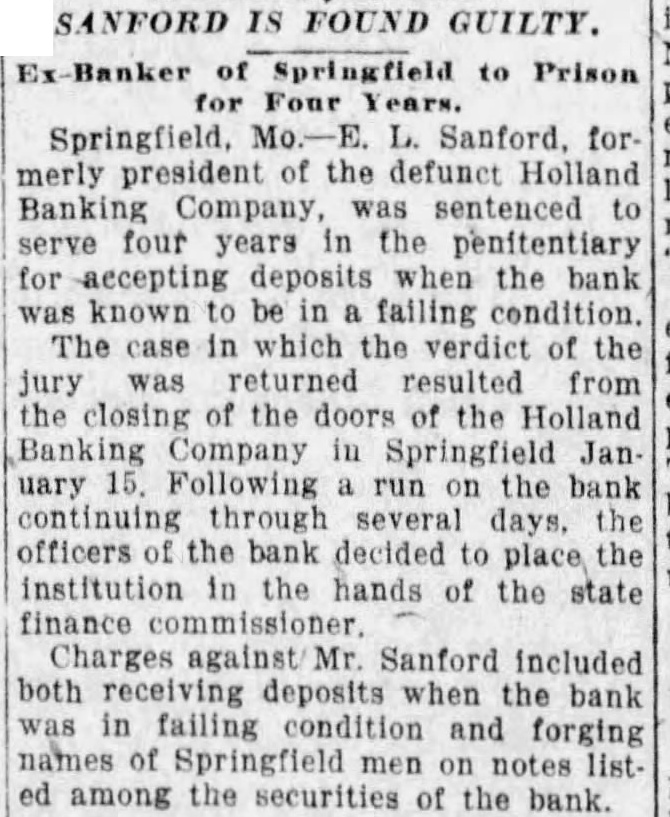
SANFORD IS FOUND GUILTY.

Ex-Banker of Springfield to Prison for Four Years.

Springfield, Mo.—E. L. Sanford, formerly president of the defunct Holland Banking Company, was sentenced to serve four years in the penitentiary for accepting deposits when the bank was known to be in a failing condition.

The case in which the verdict of the jury was returned resulted from the closing of the doors of the Holland Banking Company in Springfield January 15. Following a run on the bank continuing through several days, the officers of the bank decided to place the institution in the hands of the state finance commissioner.

Charges against Mr. Sanford included both receiving deposits when the bank was in failing condition and forging names of Springfield men on notes listed among the securities of the bank.


Article from Springfield Leader and Press, September 15, 1925

Click image to open full size in new tab

Article Text

HOLLAND BANK CLAIMS BEING TODAY

Action on Several Claims Deferred Pending Action of Supreme Court.

Hearings preference claims against the Holland Bank were sumed in the first division of the circuit court today. being lowed and being taken under advisement or judgment deferred pending action the court the in cases alleged to be similar. The claim Rose Glidden, for was court claimant filed his claim the Attorney Roscoe representing the liquidation stated statute shall after tion has been received the from the ating officer. while Judge rington and Judge Johnson the decisions the court hearing has large dia Claim Allowed The claim of the Frisco railway Mr. draft drawn on for the passed through all last day the for business by the court the lected Bushnell, charge the bank. the following day, the money turned by the the Utah the the claim Mrs. the matter Brickey the time filing the being that her filed the had than month the expiration the September filed her October the that year. local had would attend to the said Brickey preference Mrs. the Holland that officers she the bond said stated which posed Patterson deposit certificate matter the the taking claims of the In and state. the and the court filed by agreement, be judgment decision of the pending the ferred the case the supreme Poplar court Bluff against former finance comThe claim the Federal Reserve Bank Louis against Holland for deferred go the supending the judgment alleged similar preme Bank Oran, the which is pending the high court.


Article from Springfield Leader and Press, April 30, 1929

Click image to open full size in new tab

Article Text

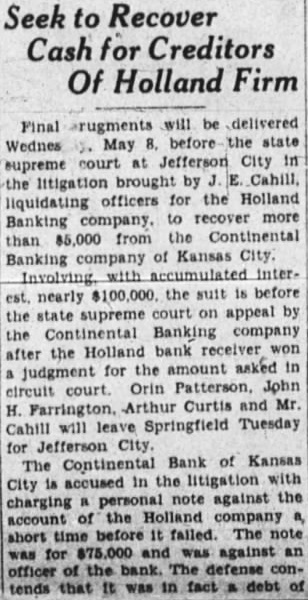
Seek to Recover Cash for Creditors Of Holland Firm

Final arugments will be delivered Wednes May 8, before the state supreme court at Jefferson City in the litigation brought by E. Cahill, liquidating officers for the Holland Banking company. to recover more than $5,000 from the Continental Banking company of Kansas City Involving accumulated interest, nearly $100,000. the suit is before the state supreme court on appeal by the Continental Banking company after the Holland bank receiver won judgment for the amount asked in circuit court. Orin Patterson, John H. Farrington, Arthur Curtis and Mr. Cahill will leave Springfield Tuesday for Jefferson City. The Continental Bank of Kansas City is accused in the litigation with charging personal note against the account of the Holland company a short time before it failed. The note was for $75,000 and was against an officer of the bank The defense conthat was in fact debt of tends


Article from Carthage Evening Press, March 5, 1930

Click image to open full size in new tab

Article Text

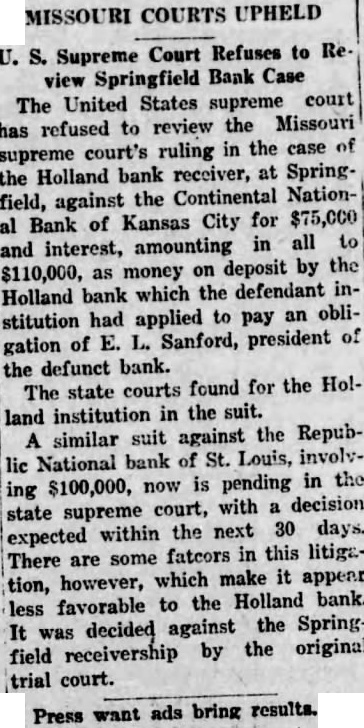
MISSOURI COURTS UPHELD

U. S. Supreme Court Refuses to Review Springfield Bank Case The United States supreme court has refused to review the Missouri supreme court's ruling in the case of bank receiver, at Springthe Holland field, against the Continental National Bank of Kansas City for $75,000 in all to and interest, amounting $110,000, as money on deposit by the Holland bank which the defendant institution had applied to pay an obligation of E. L. Sanford, president of the defunct bank. The state courts found for the Holland institution in the suit. A similar suit against the Republic National bank of St. Louis, involving $100,000, now is pending in the state supreme court, with a decision expected within the next 30 days. There are some fatcors in this litigation, however, which make it appear less favorable to the Holland bank. It was decided against the Springfield receivership by the original trial court.

Press want ads bring results.