Article Text
IT MIGHT EASILY BE ADOPTED IN HAMMOND
Civic Leaders Studying Plan Impressed With Its Practical Value
Hammond may very easily adopt the South Bend plan for stimulating business and liquidating closed banks, a committee of Hammond civic leaders reported today after spending yesterday in South Bend studying the plan in detail.
Mayor Charles O. Schonert, who headed the committee, was particularly impressed with practical value of the plan. Other members of the committee who asserted that the scheme may be adopted in Hammond, were Ed Simon, president of the Manufacturers' association; Irving Chayken, president of the Merchants' association, and John H. Rippe, receiver of the American Trust and Savings bank.
The committee now proposes to report their findings to all bank receivers in Hammond and then to Superior Judges Virgil S. Reiter and Clyde Cleveland, who maintain supervision over receiverships of closed state banks in this city.
PUBLIC MASS MEETING
Then, a public mass meeting will be held to place all details before the general public so that depositors of closed banks may be in a position to decide whether or not they wish to adopt the plan in the banks in which they maintain deposits.
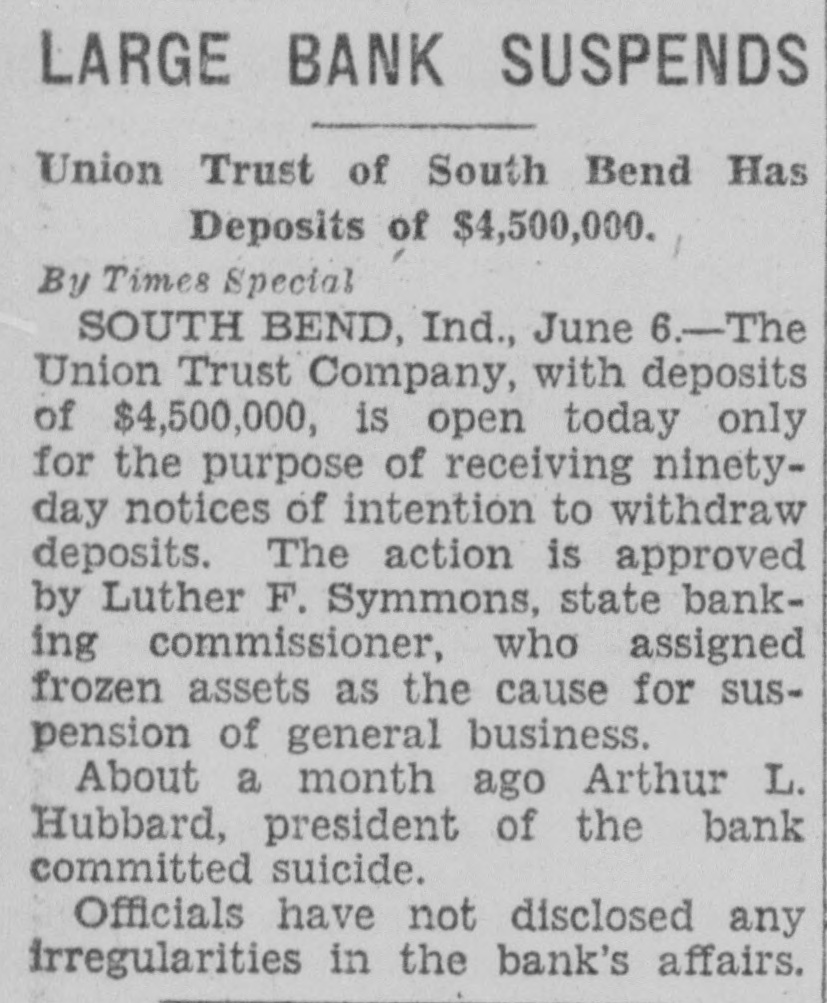
The committee arrived in South Bend early yesterday morning and immediately went into conference in the Chamber of Commerce headquarters there with George Firmin, secretary-manager of the chamber; C. F. Cunningham and W. W. Austin, liquidating agents for the Union Trust company, and Albert McGahn and J. D. Emmons, liquidating agents for the American Trust and Savings bank.
Following the morning conference, the group visited each closed bank which is participating in the plan. They studied the technical operation there and plied the liquidating agents with a host of questions.
The Hammond committee learned that depositors first obtain an assignment of their deposits from the bank in which their money was deposited. This assignment then is used as currency for merchandise, rent, professional services, and food.
Grocery stores accept the assignments up to 60 per cent of their face value. Furniture dealers, jewelry stores, and second hand automobile dealers accept the assignments up to 100 per cent of their face value.