Article Text
A Detroit Bank Suspends. DETROIT, Jan. 17.-The Third National bank of Detroit went into voluntary liquidation. The depositors will be paid in full. Pugilist Slavin Sent to Prison.
9819c0bb02587536None
Click image to open full size in new tab
A Detroit Bank Suspends. DETROIT, Jan. 17.-The Third National bank of Detroit went into voluntary liquidation. The depositors will be paid in full. Pugilist Slavin Sent to Prison.
Click image to open full size in new tab
NEWS OF THE DAY CONDENSED. T. Dwight Thatcher died at 1 o'clock p. m. at Topeka. The prosecution in the Coughlin trial has rested its cases Chris Jensen, hardware doaler at Nicollet, Minn., has assigned. E. P. Wilbur has been re-elected president of the Reading road. Twenty-five hundred soldiers have sailed from Naples for Palermo. Peter Wolford, one of the leading capitalists of Minneapolis, is dead. The matter of dividing the Episcopal diocese of Minnesota is under discussion. Five persons were injured in a collision at Chester, S. C. None fatally burt. W. H. Bootroyd. a Detroit publisher, dropped dead while attending a Masonic consistory. Dr. Washington Gladden of Columbus, O., lectured on municipal reform at Minicapolis. The grand jury found bills against Ferber and Berginan, Wood Lake, Minn., blind piggers. hier Ross of the Lead and Black Hills bank of Lead City, S. D., admits a shortage of $25,000. An attempt was made to blow up , 4. story building at Lancaster, Pa. No motive and no clue. Martin Wolf, who plead guilty to assault at Yankton, was sentenced to one year in the penitentiary. Eleven men and several women were cremated in an incendiary fire at a Sierra Mojada, Mex., mining camp. The Third National bank of Detroit has gone into voluntary liquidation All depositors will be paid in full. The charge of manslaughter against the engineer of the wrecked Michigan world's fair train has been dismissed. At Harris, Minn, Tuesday, 476 loads of potatoes were delivered by farmers, aggregating 15,000 bushels, or 20 carloads. James Bright of Covington, Ala., is in danger of lynching. His wife and babe have died mysteriously within a few days. A young man living in the town of Warsaw. Minn., is under arrest for pulling the tongue of a pony out by the roots. William Smith was arrested at Chicago. He is wanted in Kansas City for attempting to murder a man named Courer there. ) The long pending county seat fight in Traill county, N. D., has been decided in favor of Hillsboro bv the sunreme
Click image to open full size in new tab
NEWS OF THE DAY C01 LD. T. Dwight Thatcher died at ck p. m. at Topeka. ial & The prosecution in the Coug has rested its case. at Chris Jensen, hardware C Nicollet, Mian., has assigned. a E. P. Wilbur has been IN president of the Reading road. Twenty-five hundred soldier e sailed from Naples for Palermo. Peter Wolford, one of the : capitalists of Minneapolis, is dead The matter of dividing the Ep diocese of Minneseta is under disc: Five persons were injured in Maion at Chester, S. a Noh6 f hurt. W. H. Bootreyd, a Detroit publ: dropped dead while attending n Ma consistory. Dr. Washington Gladden of Co bus, O., lectured on municipal refor Minneapolis. The grand jury found bills aga Ferber and Bergnian, Wood Lake, Min blind piggers. Cashier Ross of the Lead and BI. Hills bank of Lead City, S. D., admit shortage of $25,000. An attempt was made to blow up a story building at Lancaster, Pa. I motive and no clue. Martin Wolf, who plead guilty t assault at Yankton, was sentenced t. one year in the penitentiary. Eloven men and several women were cremated in an incendiary fire at & Sierra Mojada, Mex., thining camp. The Third National benk of Detroit has gone into voluntary liquidation All depositors will be paid is full. The charge of manalaugi or against the engineer of the wrecke. Mi. digan world's fair train has been dismissed. At Harris, Minn., Tuesday, 476 loads of potatoes were delivered by farmers, loads. aggregating 15,000 bushell, or 20 James Bright of Covington, Ala,, is in danger of lynching. His wife and babe days. have died mysteriously within a few A young man living in the town of Warsaw, Minn., is under arrest for pulling the tongue of a pony out by the roots. William Smith was arrested at Chi cago. He is wanted in Kansas City for attempting to murder a man nåmen Courer there. The long pending county seat fight in Traill county, N. D., has been decided in favor of Hillsboro by the súpremé court of thestate. A sneak thief entered the Minnesote state capitol about NOOD stole da overcoat belonging to Military Store keeper Converse. An opium smuggler giving the name of S. E. Davis was caught at Spokane He confessed and $15,000 worth ol opium was recovered. The front of a Farmington (Minn. bank building was blown due by dyna mite. The bank had gone out of busi ness and the motive is a mystery.
Click image to open full size in new tab
ANOTHER CASHIER GONE WRONG Frederick Marvin, of Detroit, Charged With greating $50,000. DETROIT, MICH., Feb. 7.-United States Commissioner Graves, on the complaint of State Bank Examiner Caldwell, yesterday issued a warrant for the arrest of Frederick Marvin, late cashier of the Third National Bank of Detroit. Mr. Caldwell made the complaint on instructions of Comptroller Eckeis. The charge is the violation of the national banking law by converting to his own use the credits of the bank. The specific charges against Marvin are that in March last he converted two notes, the property of the bank, to his own use. For that reason he was removed from the cashiership of the bank, but owing to the financial disturbance which prevalled last summer the matter was kept dark until now. The Third National Bank recently went into liquidation, and has paid all depositore in full. The receiver is now collecting on the assets of the institution for the shareholders, and It was considered that no harm could be done by taking the action related above. The amount of the defalcation is not yet determined, but it is alleged that it will reach $50,000. Mr. Marvin has been missing for a week, and his whereabouts are at present unknown.
Click image to open full size in new tab
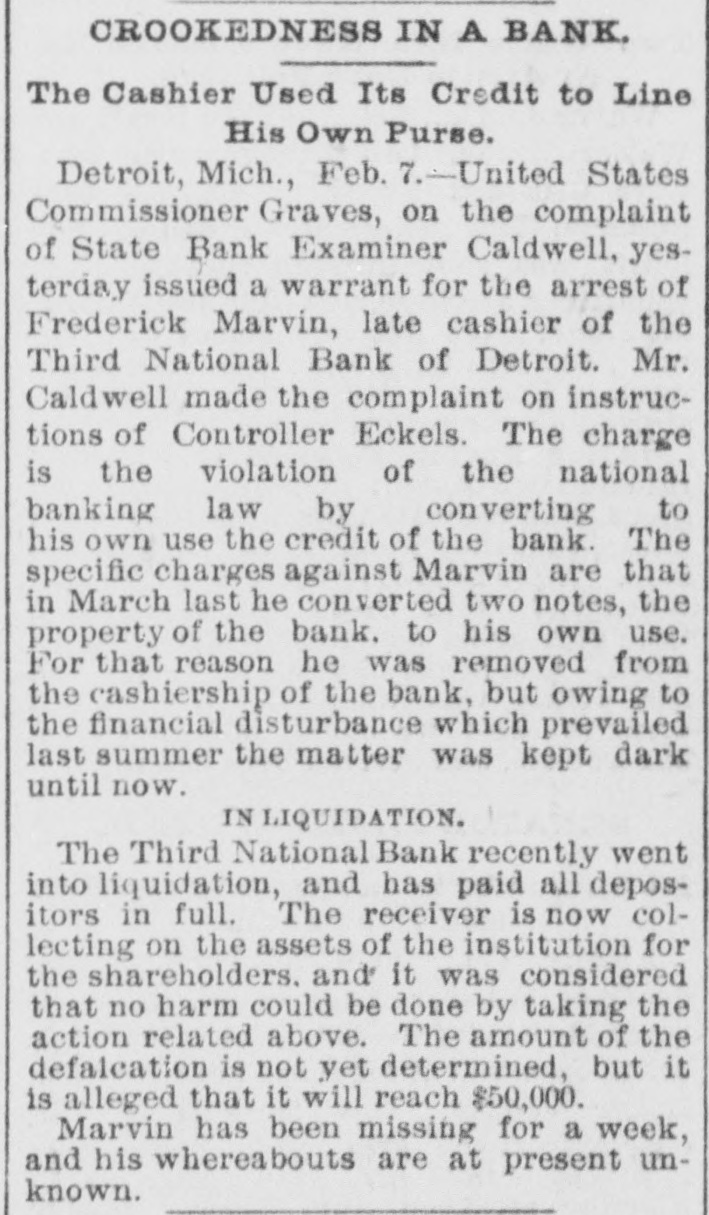
CROOKEDNESS IN A BANK. The Cashier Used Its Credit to Line His Own Purse. Detroit, Mich., Feb. 7.-United States Commissioner Graves, on the complaint of State Bank Examiner Caldwell, yesterday issued a warrant for the arrest of Frederick Marvin, late cashier of the Third National Bank of Detroit. Mr. Caldwell made the complaint on instructions of Controller Eckels. The charge is the violation of the national banking law by converting to his own use the credit of the bank. The specific charges against Marvin are that in March last he converted two notes, the property of the bank. to his own use. For that reason he was removed from the cashiership of the bank, but owing to the financial disturbance which prevailed last summer the matter was kept dark until now. IN LIQUIDATION. The Third National Bank recently went into liquidation, and has paid all depositors in full. The receiver is now collecting on the assets of the institution for the shareholders. and it was considered that no harm could be done by taking the action related above. The amount of the defalcation is not yet determined, but it is alleged that it will reach $50,000. Marvin has been missing for a week, and his whereabouts are at present unknown.
Click image to open full size in new tab
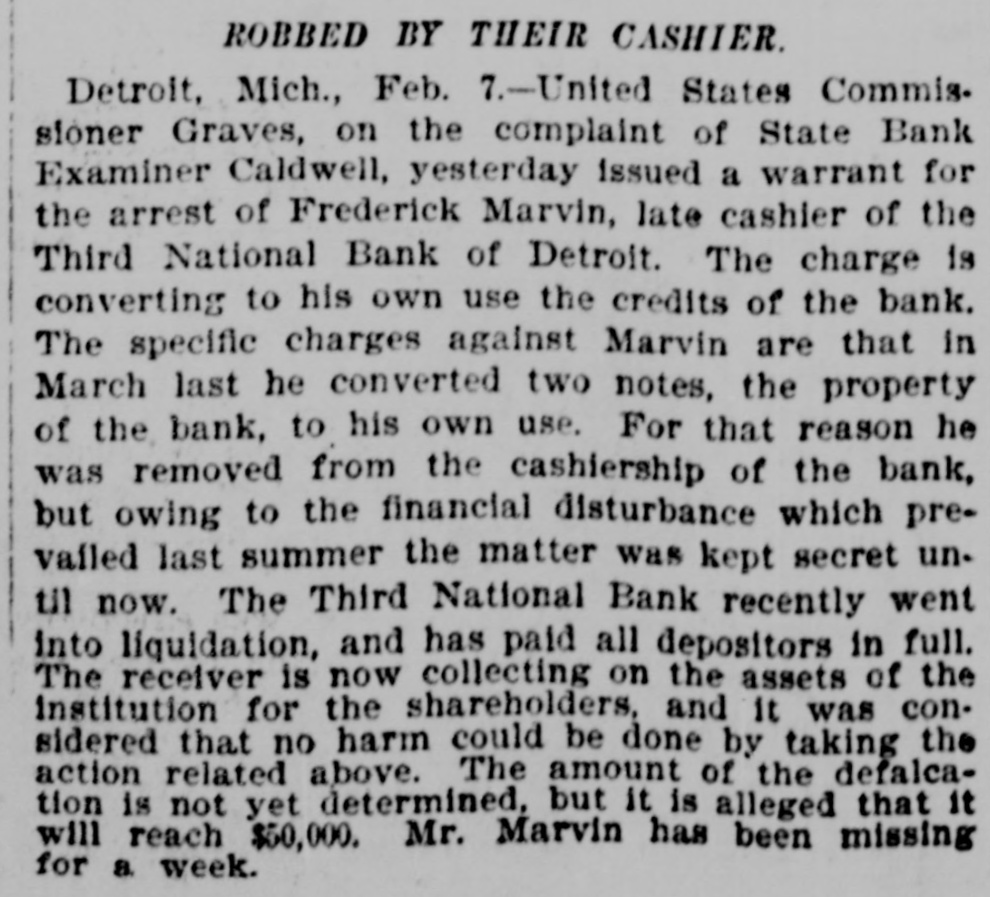
# ROBBED BY THEIR CASHIER. Detroit, Mich., Feb. 7. - United States Commissioner Graves, on the complaint of State Bank Examiner Caldwell, yesterday issued a warrant for the arrest of Frederick Marvin, late cashier of the Third National Bank of Detroit. The charge is converting to his own use the credits of the bank. The specific charges against Marvin are that in March last he converted two notes, the property of the bank, to his own use. For that reason he was removed from the cashiership of the bank, but owing to the financial disturbance which prevailed last summer the matter was kept secret until now. The Third National Bank recently went into liquidation, and has paid all depositors in full. The receiver is now collecting on the assets of the institution for the shareholders, and it was considered that no harm could be done by taking the action related above. The amount of the defalcation is not yet determined, but it is alleged that it will reach $50,000. Mr. Marvin has been missing for a week.
Click image to open full size in new tab
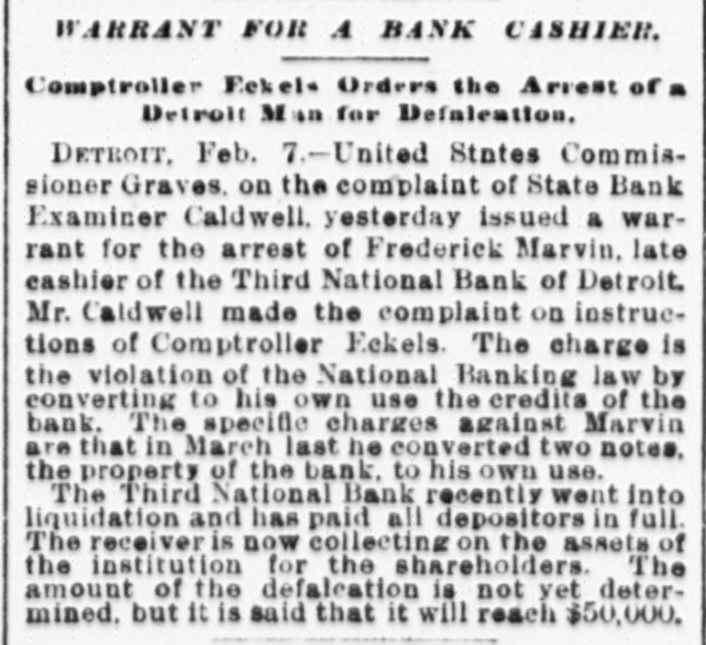
# WARRANT FOR A BANK CASHIER. Comptroller Fekels Orders the Arrest of a Detroit Man for Defaleation. DETROIT, Feb. 7.-United States Commissioner Graves, on the complaint of State Bank Examiner Caldwell, yesterday issued a warrant for the arrest of Frederick Marvin, late cashier of the Third National Bank of Detroit. Mr. Caldwell made the complaint on instruc-tions of Comptroller Eckels. The charge is the violation of the National Banking law by converting to his own use the credits of the bank. The specific charges against Marvin are that in March last he converted two notes, the property of the bank, to his own use. The Third National Bank recently went into liquidation and has paid all depositors in full. The receiver is now collecting on the assets of the institution for the shareholders. The amount of the defalcation is not yet determined, but it is said that it will reach $50,000.
Click image to open full size in new tab
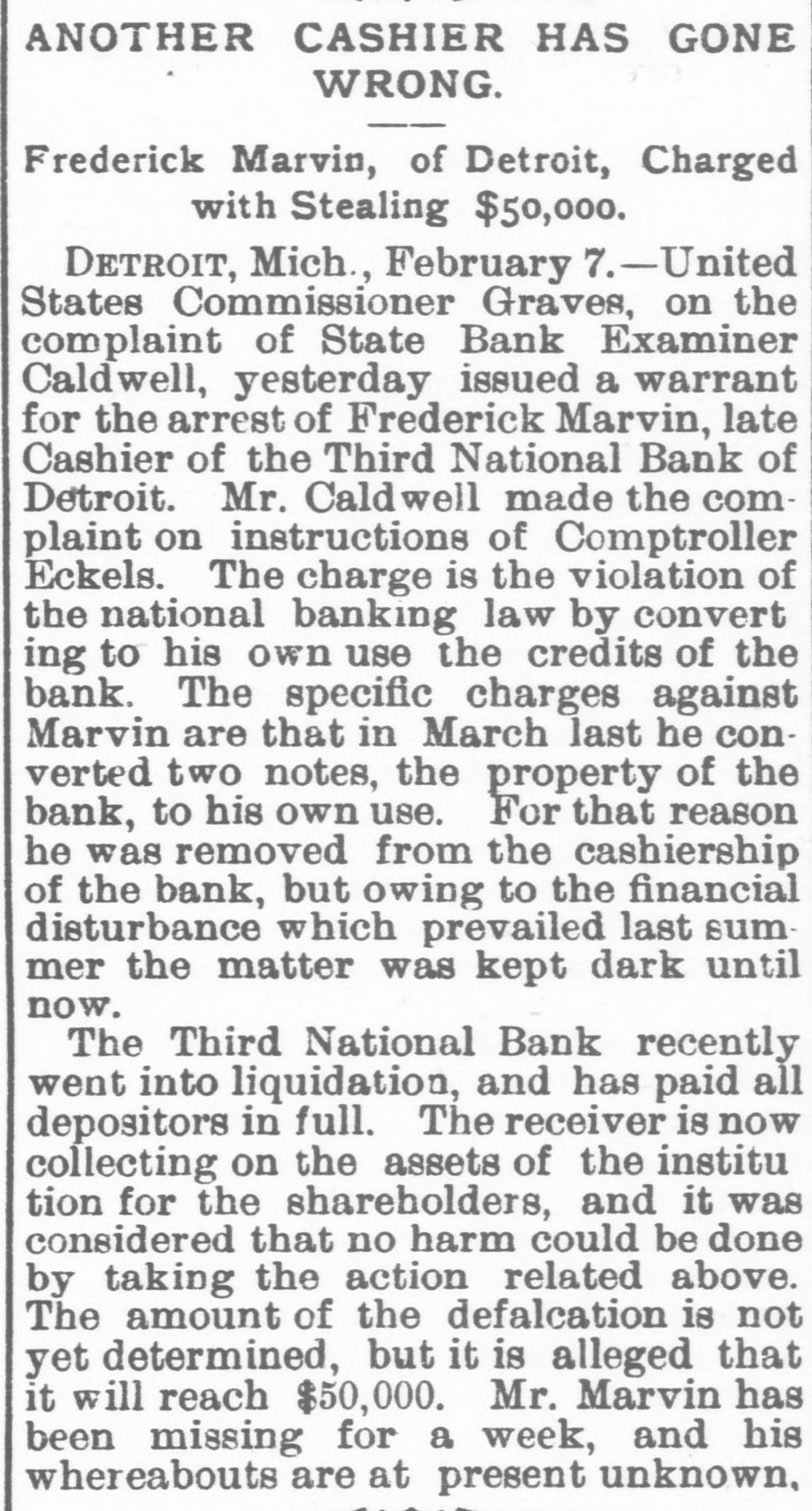
ANOTHER CASHIER HAS GONE WRONG. Frederick Marvin, of Detroit, Charged with Stealing $50,000. DETROIT, Mich., February 7.-United States Commissioner Graves, on the complaint of State Bank Examiner Caldwell, yesterday issued a warrant for the arrest of Frederick Marvin, late Cashier of the Third National Bank of Detroit. Mr. Caldwell made the complaint on instructions of Comptroller Eckels. The charge is the violation of the national banking law by convert ing to his own use the credits of the bank. The specific charges against Marvin are that in March last he converted two notes, the property of the bank, to his own use. For that reason he was removed from the cashiership of the bank, but owing to the financial disturbance which prevailed last summer the matter was kept dark until now. The Third National Bank recently went into liquidation, and has paid all depositors in full. The receiver is now collecting on the assets of the institu tion for the shareholders, and it was considered that no harm could be done by taking the action related above. The amount of the defalcation is not yet determined, but it is alleged that it will reach $50,000. Mr. Marvin has been missing for a week, and his whereabouts are at present unknown,

Click image to open full size in new tab
LATEST NEWS. Congressman Springer's friends are confident of his renomination in the Springfield district. Christian Scientists at Springfield, O., say they will go to jil rather than submit to vaccination. Two hundred negro converts were baptised through a hole cut in the canal ice at Indianapolis, Ind. Congressman G. W. Houk dropped dead while making a call in Washington. He was 68 years old. More than 200,000 persons in New York are out of employment. More than 80 per centare suffering. John Hart, the Rockford murderer, was sentenced by Judge Shaw to be hanged on Friday, March 16. Buffalo marine men take a gloomy view of the prospect for the lake carrying trade for the coming season. General von Loe, a strong Bismarckian, may be chosen to succeed Van Caprivi as chancellor of Germany. A wholesale traffic in the bodies of the pauper dead is believed to have been discovered in Milwaukee. Wisconsin is expeected to harvest 2,000,000 tons of ice this season. Indiana's crop is expected to fall short. The San Francisco Chamber of Commerce declared the income tax bill un wise, unjust and unnecessary. Governor Lewelling had no right to remove Mrs Lease, according to a Kansas supreme court decision. Fire insurance companies received $4,409,863 in premiums in Michigan last year and paid $2,543,021 losses. Twenty-seven viclous tramps who have terrorized the neighborhood of Canton, O., were raided by a local posse. Congressman Baldwin was expelled from the Duluth, Minn, Board of Trade for his stand on the tariff question. Gladstone told a correspondent he would not resign and that he would fight the English lords to the bitter end. Rev. John Dingledey was convicted of cruelty to inmates of an orphan' home at Richmond, Ind., and fined $600. Frederick Marvin, cashier of the Third National Bank at Detroit, has fled. He is short $100,000 in his accounts. In seventeen days Collector McClure destroyed nine stills and captured fifteen moonshiners in Polk county, Ark. Ex-President Harrison will leave Indianapolis Feb. 20 to deliver his law lectures at Stanford University. Wool-growers, in session at Denver, Colo., adopted earnest resolutions against the passage of the Wilson bill. Pittsburg, Kan., is excited over another a murder, a woman, the seventh during the months of January and February. Governor Waite has triumphed over the no Colorado senators. They have agreed to o consider bills sent from the house. 0 Lebanon, Ind., officials rescued Frank o Hall, who assaulted Mrs, Akers, from a J mob which had prepared to hang him. il Cripple Creek mine owners and nonunion miners have finally accepted the I eight-hour day and the strike is over. 1 Re-establishment of a military departp ment of the south is contemplated, with a probable headquarters at Atlanta, Ga. S Finding of an old and dirty will among 0 discarded books means many thousand 0 dollars to Webster heirs at Brazil, Ind. Judge Jenkins, of Milwaukee, refuses to a discuss the resolutions introduced by Cona gressmsn McGann for his impeachment. to For printing unpleasant things in his ta books Historian Bancroft was expelled a from the Society of California Pioneers. a in A report that ex-President Harrison te would shortly marry the widow of Leland Stanford called out an emphatic denial. A split is feared in the order of Elks. g Meetings of the grand lodge have been at called for Atlantic City and Jamestown. W a Mrs. Mary Wray celebrated her 102d sl birthday at Fairbury, Ill. Five generations were present, representing 247 years. ti pl Harry Hill was sentenced to seven li years' imprisonment for forgery at Atanta. His attorneys withdrew from the case. fa th Twenty-one pupils, seven of them girls, m were suspended from the Mount Horeb, th Wis., Academy for attending a masked ball. si fo J. Clayton, living in Cumberland counp y, Kentucky, was tortured by robbers unof il he revealed where his money was hidden.
Click image to open full size in new tab
FOR murdering his sweetheart, Ellen Smith, Peter Degraff was changed at Winston, N.C. THE supreme court of Kansas decided that Gov. Lewelling had no authority to remove Mrs. Mary E. Lease from the state board of charity. THE Jeffersonian democrats, or the Kolbites, and the people's party, in state convention at Birmingham, Ala., nominated a full state ticket, with R. F. Kolb for governer, to oppose the regular democratic ticket. AT Alton, III., Mrs. Mary Galloway (colored) celebrated her 110th birthday IT was said that Frederick Marvin, cashier of the Third national bank at Detroit, Mich., who had fled, was short $100,000 in his accounts. The schooner Bangor arrived at San Francisco fifteen days from Honoluin. The captain of the Bangor reports everything quiet at Honolulu. By a cyclone at Port Hudson, La, many persous were hurt; much property destroyed and a negro child killed. THE_rope broke as William Purvis was swung off the seaffold at Columbia, Miss., and the sheriff refused to hang him again. WHILE making a call in Washington George W. Houk, of Dayton, representing the Third Ohio district in congress, dropped dead. He was 69 years cld. ROBBERS tortured J. Clayton, living in Cumberland county, Ky., until he revealed where $1,800 was hidden. FIRE swept away the entire plant of the Ute Pass works at Colorado City, Col., the loss being $100,000. IN a 10-mile race at Jacksonville, Fla., Jack Prince, bicyclist, beat a horse. JUDGE SHAW sentenced John Hart, convicted of killing his two sisters at Rockford, III., to be hanged on Friday. March 16. AT her home in Zanesville, O.: Mrs. Mary E. Williams celebrated her 100th birthday. CHARLES PLUNKETT, Henry Rruce and Bob Plunkett were lynched in the Gulch country in Arkansas for the murder of an aged couple. ROBBERS murdered Henry Snoderly. aged 91. one of the wealthiest farmers of Union county, Tenn., and his wife, aged 70. THE National Farmers' Alliance at the annual meeting in Topeka, Kan., elected Marion Butler, of North Carolina. as president. Resolutions were adopted denouncing Secretary Morton as an enemy to the welfare of the American farmers, and therefore to the general welfare of the country. BURGLARS secured the combination of the safe in the poolroom of John Payne at Covington, Ky.; and robbed it of $1,400 in cash. A TORNADO which sweptover Indiana did great damage, unroofing houses and blowing down fences and trees. THE execution of Robert Marler took place at Pineville, Ky. He with two others had fired into a passing train, killing Mrs. Mary Bowling. IT was said that Henry Renken embezzled $15,000 from the Farmers' and Merchants' bank at Talmage, Neb., re cently suspended.
Click image to open full size in new tab
ANGRY STOCKHOLDERS. DETROIT, Mich., Dec. 13.-The facts brought out during the trial of Frederick Marvin, cashier of the defunct Third National Bank, in reference to the manner in which the institution had been run, have resolved the stockholder to take measures towards instituting civil suits against the nine directors of the bank to recover the value of their stock and the assessments which were paid by them to the receiver of the defunct bank.
Click image to open full size in new tab
Will Sue the Directors. DETROIT, Dec. 14-The facts brough out during the trial of Frederick Mai vin, cashier of the defunct Third N: tional bank, in reference to the manne in which that institution had been rur have resolved the stockholders to tak measures towards instituting civil sui against the nine directors of the banl to recover, if possible, the value ( their stock.
Click image to open full size in new tab
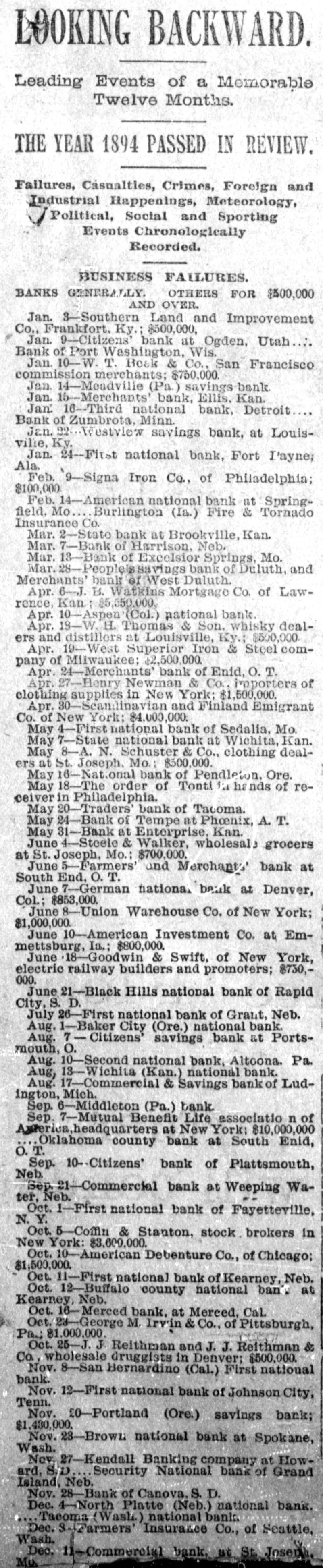
LOOKING BACKWARD. Leading Events of a Memorable Twelve Months. THE YEAR 1894 PASSED IN REVIEW. Failures, Casualties, Crimes, Foreign and Industrial Happenings, Meteorology, Political, Social and Sporting Events Chronologically Recorded. BUSINESS FAILURES. BANKS GENERALLY. OTHERS FOR $500,000 AND OVER. Jan. 3-Southern Land and Improvement Co., Frankfort. Ky.; $500,000, Jan. 9-Citizens' bank at Ogden, Utah Bank of Port Washington, Wis. Jan. 10-W. T. Beek & Co., San Francisco commission merchants; $750,000. Jan. 14-Mendville (Pa.) savings bank Jan. 16-Merchants' bank, Ellis. Kan. Jan. 16-Third national bank, Detroit Bank of Zumbrota, Minn. Jan. 324 Westview savings bank, at Louisvilie, Ky. Jan. 24-First national bank, Fort Payne; Ala. Feb. 9-Signa Iron Co., of Philadelphia; $100,000 Feb. 14-American national bank at Springfield, Mo Burlington (Ia.) Fire & Tornado Insurance Co. Mar. 2-State bank at Brookville, Kan. Mar. 7-Bank of Harrison, Neb. Mar. 13-Bank of Excelsior Springs, Mo. Mar.28--Peoplelssavings bank of Duluth, and Merchants' bank of West Duluth. Apr. 6--J. B. Watkins Mortgage Co. of Lawrence, Kan: $5,550,000, Apr. 10-Aspen (Col.) national bank. Apr. 18-W. Thomas & Son. whisky dealers and distillers at Louisville, Ky.; $500,000. Apr. 19-West Superior Iron & Steel company of Milwaukee: $2,500,000. Apr. 24-Merchants bank of Enid, O. T. Apr. 27-Henry Newman & Co., importers of clothing supplies in New York: $1,500,000. Apr. 30-Scandinavian and Finland Emigrant Co. of New York; $4,000,000. May 4-First national bank of Sedalia, Mo. May 7-State national bank at Wichita, Kan. May 8-A. N. Schuster & Co., clothing dealers at St. Joseph, Mo.: $500,000. May 16-National bank of Pendleton, Ore. May 18-The order of Tonti to ha nds of receiver in Philadelphia. May 20-Traders' bank of Tacoma. May 24-Bank of Tempe at Phoenix, A. T. May 31-Bank at Enterprise, Kan. June 4-Steele & Walker, wholesale grocers at St. Joseph, Mo.: $700,000. June -Farmers' and Merchants' bank at South End. O. T. June German national bank at Denver, Col: $853,000. June 8-Union Warehouse Co. of New York; $1,000,000. June 10-American Investment Co. at Emmettsburg, In.: $800,000. June 18-Goodwin & Swift, of New York, electric railway builders and promoters; $750,000. June 21-Black Hills national bank of Rapid City, S. D. July 26-First national bank of Grant, Neb. Aug. 1-Baker City (Ore.) national bank. Aug. 7 Citizens' savings bank at Portsmouth, O. Aug. 10-Second national bank, Altoona. Pa. Aug, 18-Wichita (Kan.) national bank. Aug. 17-Commercial & Savings bankof Ludington, Mich. Sep. 6-Middleton (Pa.) bank. Sep. 7-Mutual Benefit Life associatio n of America ,headquarters at New York: $10,000,000 Oklahoma county bank at South Enid, O.T. Sep. 10-Citizens' bank of Plattsmouth, Neb. Sep. 21-Commercial bank at Weeping Water, Neb. Oct. 1-First national bank of Fayetteville, N.Y. Oct. 5-Coffin & Stanton, stock. brokers in New York: $3,600,000. Oct. 10-American Debenture Co., of Chicago; $1,500,000. Oct. 11-First national bank of Kearney, Neb. Oct. 12-Buffalo county national bank at Kearney, Neb. Oct. 16-Merced bank, at Merced, Cal. Oct. 23-George M. Irvin & Co., of Pittsburgh, Pai $1,000,000. Oct. 25-J. J Reithman and J. J. Reithman & Co. wholesale druggists in Denver; $500,000. Nov. 8-San Bernardino (Cal.) First national bank. Nov. 12-First national bank of Johnson City, Tenn. Nov. 10-Portland (Ore.) savings bank; $1,430,000. Nov. 23-Brown national bank at Spokane, Wash. Nov. 27-Kendall Banking company at Howard, S.D. Security National bank of Grand Island, Neb. Nov. 28-Bank of Canova, S. D. Dec. 4-North Platte (Neb.) national bank. Tacoma (Wash.) national bank. Dec. S-Farmers' Insurance Co., of Seattle, Wash. Dec. 11-Commercial bank, at St. Joseph, Mo.
Click image to open full size in new tab
OFFICIALS OF A RUINED BANK ACCUSED. Detroit, April 23.-A bill of complaint to compel an accounting has been filed in the United States court here by stockholders in the defunct Third National Bank against the officers and directors of that institution. It is charged that the defendants "so negligently and carelessly conducted the affairs of the bank that its entire capital was lost, the stock rendered wortbless, and the stockholders made liable for and compelled to pay a large sum of money on account of the unpaid debts of the bank." The bill alleges that the officers knowingly violated and willingly permitted others connected with the bank to violate the provisions of law relative to the bank. The bill asks for a full accounting by the defendants, a determination of the responsibility for the wrecking of the bank, and the appointment of a receiver by the court.