7982. Pacific National Bank (Boston, MA)

Bank Information

Episode Type
Run → Suspension → Closure
Bank Type
national
Bank ID
2373
Charter Number
2373
Start Date
November 18, 1881
Location
Boston, Massachusetts (42.358, -71.060)

Metadata

Model
gpt-5-mini
Short Digest
70617130

Response Measures

Capital injected, Full suspension, Books examined

Receivership Details

Depositor recovery rate
65.3%
Date receivership started
1882-05-22
Date receivership terminated
1893-06-30
OCC cause of failure
Fraud
Share of assets assessed as good
18.7%
Share of assets assessed as doubtful
40.9%
Share of assets assessed as worthless
40.4%

Description

A run and immediate suspension occurred Nov 18, 1881 caused by large overdrafts/failed speculations of Theodore C. Weeks (bank-specific adverse info). The bank was reorganized and resumed in March 1882, but stopped payment again May 22, 1882, voted liquidation and applied for a receiver, leading to permanent closure. I therefore classify the overall episode as run → suspension → closure (despite an intervening resumption).

Events (7)

1. November 9, 1877 Chartered
Source
historical_nic
2. November 18, 1881 Run
Cause
Bank Specific Adverse Info
Cause Details
Heavy withdrawals triggered by failure of Theodore C. Weeks, who was allowed large overdrafts and by publicity about worthless collaterals and failures to meet payments at correspondent Eliot Bank.
Measures
Bank kept open to pay small checks until ~1:10pm; then stopped payment; directors called examiner and committee to examine affairs.
Newspaper Excerpt
a small run began...the amount paid out was $1,000, mostly small checks, up to 1:10 m., when payment was stopped altogether.
Source
newspapers
3. November 18, 1881 Suspension
Cause
Bank Specific Adverse Info
Cause Details
Directors posted notice of temporary suspension after failures involving overdrafts by Weeks and inability to meet drafts through correspondent banks.
Newspaper Excerpt
Owing to failures in which the bank is involved, payment is temporarily suspended.
Source
newspapers
4. March 1, 1882* Reopening
Newspaper Excerpt
The recently suspended Pacific National bank, of Boston, has resumed business. / The Pacific National Bank of Boston will resume business on Saturday. / The Pacific National Bank of Boston will resume business on Saturday (March 1882).
Source
newspapers
5. May 22, 1882 Receivership
Source
historical_nic
6. May 22, 1882 Receivership
Newspaper Excerpt
Its directors have voted to go into liquidation and have applied for a receiver. / Linus W. Price, receiver of the Pacific National Bank of Boston, is in the city. (Jan 1883 reference).
Source
newspapers
7. May 22, 1882 Suspension
Cause
Voluntary Liquidation
Cause Details
After resumption public confidence and business were insufficient; directors voted to liquidate and applied for a receiver.
Newspaper Excerpt
The Pacific National Bank...stopped payment today and will wind up business. Its directors have voted to go into liquidation and have applied for a receiver.
Source
newspapers

Newspaper Articles (22)

Article from New-York Tribune, November 19, 1881

Click image to open full size in new tab

Article Text

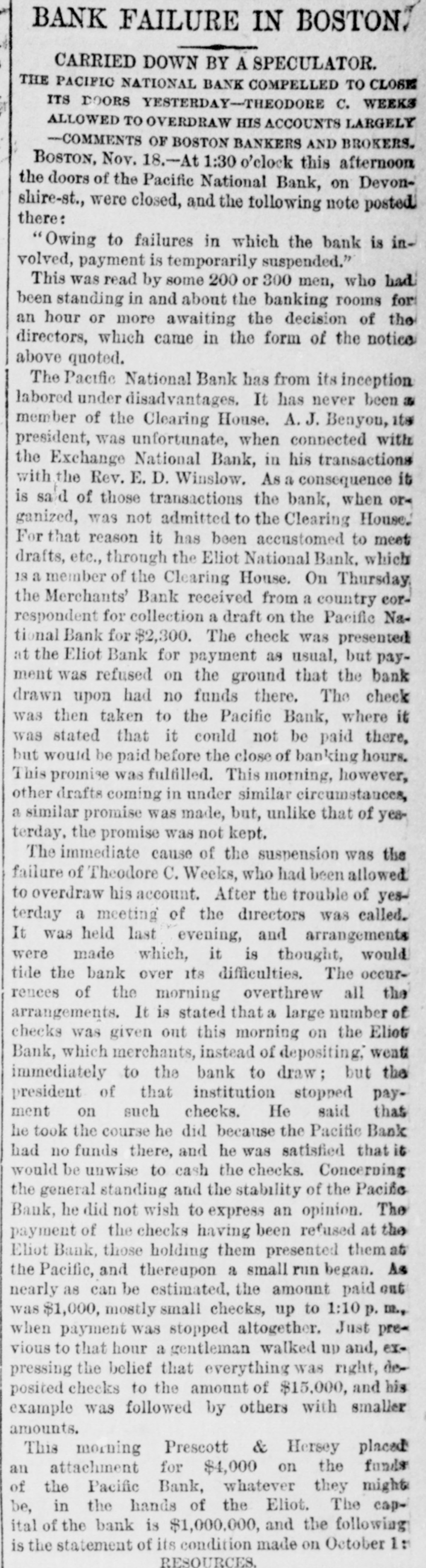
BANK FAILURE IN BOSTON. CARRIED DOWN BY A SPECULATOR. THE PACIFIC NATIONAL BANK COMPELLED TO CLOSE ITS DOORS YESTERDAY-THEODORE C. WEEKS ALLOWED TO OVERDRAW HIS ACCOUNTS LARGELY -COMMENTS OF BOSTON BANKERS AND BROKERS. BOSTON, Nov. 18.-At 1:30 o'clock this afternoon the doors of the Pacific National Bank, on Devonshire-st., were closed, and the following note posted there: "Owing to failures in which the bank is involved, payment is temporarily suspended." This was read by some 200 or 300 men, who had been standing in and about the banking rooms for an hour or more awaiting the decision of the directors, which came in the form of the notice above quoted. The Pacific National Bank has from its inception labored under disadvantages. It has never been a member of the Clearing House. A. J. Benyou, its president, was unfortunate, when connected with the Exchange National Bank, in his transactions with the Rev. E. D. Winslow. As a consequence it is said of those transactions the bank, when organized, was not admitted to the Clearing House. For that reason it has been accustomed to meet drafts, etc., through the Eliot National Bank, which 18 a member of the Clearing House. On Thursday, the Merchants' Bank received from a country correspondent for collection a draft on the Pacific National Bank for $2,300. The check was presented at the Eliot Bank for payment as usual, but payment was refused on the ground that the bank drawn upon had no funds there. The check was then taken to the Pacific Bank, where it was stated that it could not be paid there, but would be paid before the close of anking hours. This promise was fulfilled. This morning, however, other drafts coming in under similar circumstances, a similar promise was made, but, unlike that of yesterday, the promise was not kept. The immediate cause of the suspension was the failure of Theodore C. Weeks, who had been allowed to overdraw his account. After the trouble of yesterday a meeting of the directors was called. It was held last evening, and arrangements were made which, it is thought, would tide the bank over its difficulties. The occurrences of the morning overthrew all the arrangements. It is stated that a large number of checks was given out this morning on the Eliot Bank, which merchants, instead of depositing, went immediately to the bank to draw; but the president of that institution stopped payment on such checks. He said that he took the course he did because the Pacific Bank had no funds there, and he was satisfied that it would be unwise to cash the checks. Concerning the general standing and the stability of the Pacific Bank, he did not wish to express an opinion. The payment of the checks having been refused at the Eliot Bank, those holding them presented them at the Pacific, and thereupon a small run began. As nearly as can be estimated, the amount paid out was $1,000, mostly small checks, up to 1:10 m., when payment was stopped altogether. Just previous to that hour a gentleman walked up and, expressing the belief that everything was right, deposited checks to the amount of $15,000, and his example was followed by others with smaller amounts. This morning Prescott & Hersey placed an attachment for $4,000 on the funds of the Pacific Bank, whatever they might be, in the hands of the Eliot. The capital of the bank is $1,000,000, and the following is the statement of its condition made on October 1: RESOURCES
Article from Wheeling Register, November 19, 1881

Click image to open full size in new tab

Article Text

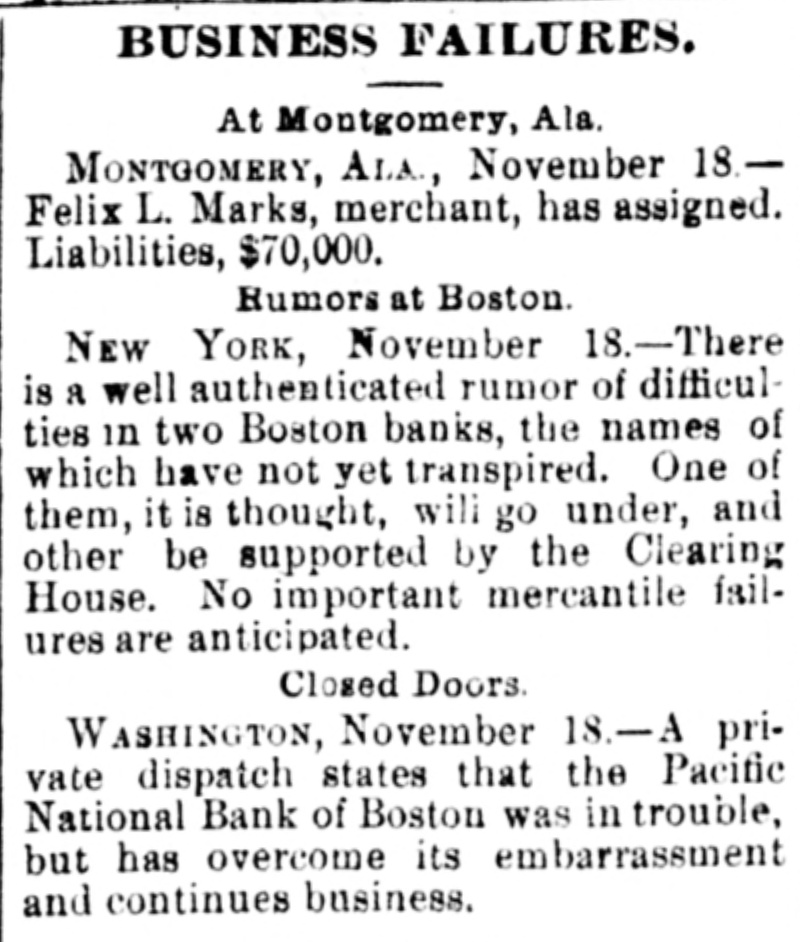
BUSINESS FAILURES. At Montgomery, Ala. MONTGOMERY, ALA, November 18.Felix L. Marks, merchant, has assigned. Liabilities, $70,000. Rumors at Boston. NEW YORK, November 18.-There is a well authenticated rumor of difficulties in two Boston banks, the names of which have not yet transpired. One of them, it is thought, will go under, and other be supported by the Clearing House. No important mercantile failures are anticipated. Closed Doors. WASHINGTON, November 18.-A private dispatch states that the Pacific National Bank of Boston was in trouble, but has overcome its embarrassment and continues business.


Article from The Rock Island Argus, November 19, 1881

Click image to open full size in new tab

Article Text

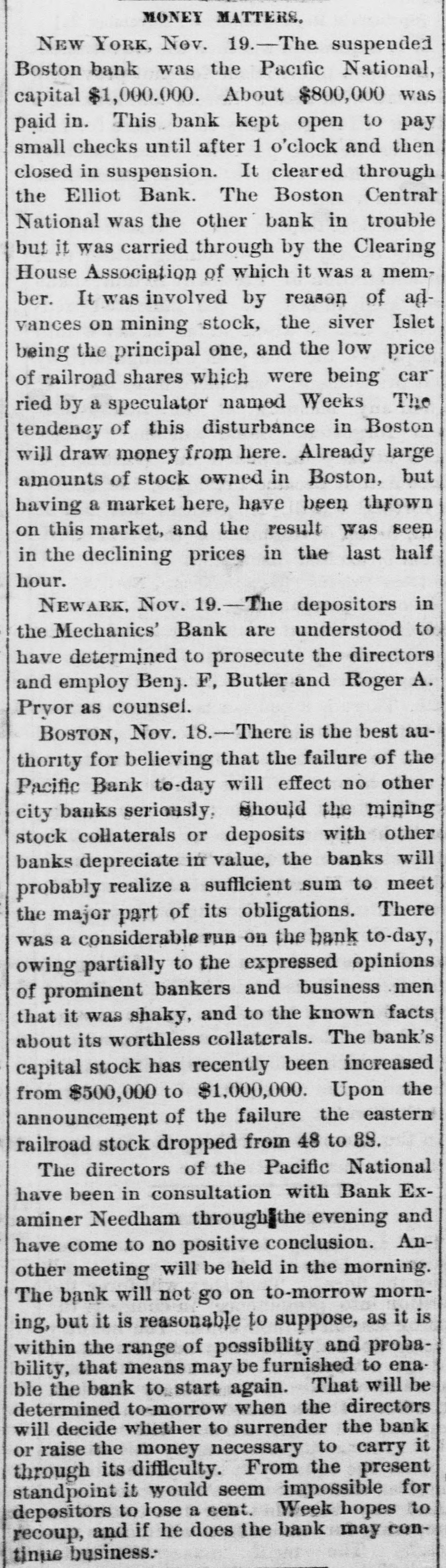
MONEY MATTERS. NEW YORK, Nov. 19.-The suspended Boston bank was the Pacific National, capital $1,000.000. About $800,000 was paid in. This bank kept open to pay small checks until after 1 o'clock and then closed in suspension. It cleared through the Elliot Bank. The Boston Central National was the other bank in trouble but it was carried through by the Clearing House Association of which it was a member. It was involved by reason of advances on mining stock, the siver Islet being the principal one, and the low price of railroad shares which were being car ried by a speculator named Weeks The tendency of this disturbance in Boston will draw money from here. Already large amounts of stock owned in Boston, but having a market here, have been thrown on this market, and the result was seen in the declining prices in the last half hour. NEWARK, Nov. 19.-The depositors in the Mechanics' Bank are understood to have determined to prosecute the directors and employ Benj. F, Butler and Roger A. Pryor as counsel. BOSTON, Nov. 18.-There is the best authority for believing that the failure of the Pacific Bank to-day will effect no other city banks seriously, Should the mining stock collaterals or deposits with other banks depreciate in value, the banks will probably realize a sufficient sum to meet the major part of its obligations. There was a considerable run on the bank to-day, owing partially to the expressed opinions of prominent bankers and business men that it was shaky, and to the known facts about its worthless collaterals. The bank's capital stock has recently been increased from $500,000 to $1,000,000. Upon the announcement of the failure the eastern railroad stock dropped from 48 to 88. The directors of the Pacific National have been in consultation with Bank Examiner Needham through the evening and have come to no positive conclusion. Another meeting will be held in the morning. The bank will not go on to-morrow morning, but it is reasonable to suppose, as it is within the range of possibility and probability, that means may be furnished to enable the bank to start again. That will be determined to-morrow when the directors will decide whether to surrender the bank or raise the money necessary to carry it through its difficulty. From the present standpoint it would seem impossible for depositors to lose a cent. Week hopes to recoup, and if he does the bank may continue business.


Article from New-York Tribune, November 20, 1881

Click image to open full size in new tab

Article Text

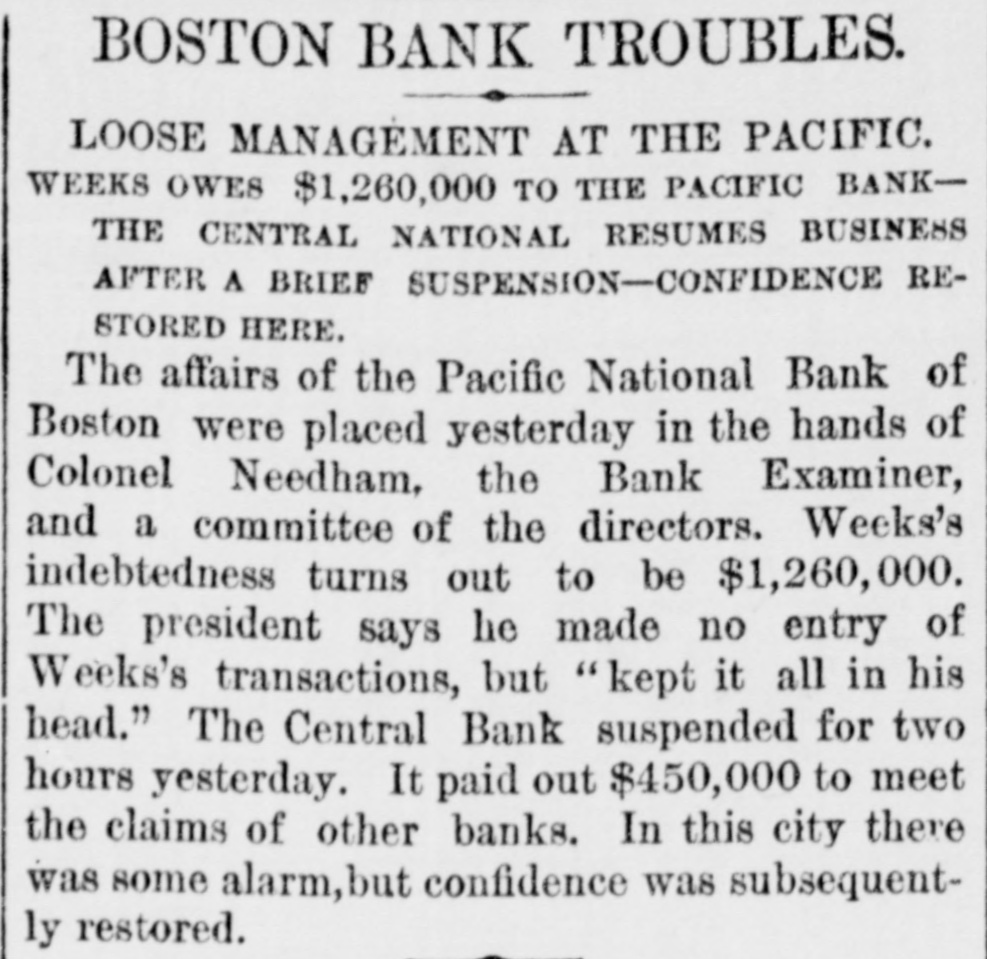
BOSTON BANK TROUBLES. LOOSE MANAGEMENT AT THE PACIFIC. WEEKS OWES $1,260,000 TO THE PACIFIC BANKTHE CENTRAL NATIONAL RESUMES BUSINESS AFTER A BRIEF SUSPENSION-CONFIDENCE RESTORED HERE. The affairs of the Pacific National Bank of Boston were placed yesterday in the hands of Colonel Needham, the Bank Examiner, and a committee of the directors. Weeks's indebtedness turns out to be $1,260,000. The president says he made no entry of Weeks's transactions, but "kept it all in his head." The Central Bank suspended for two hours yesterday. It paid out $450,000 to meet the claims of other banks. In this city there was some alarm, but confidence was subsequently restored.


Article from New-York Tribune, November 20, 1881

Click image to open full size in new tab

Article Text

SOME APPREHENSION IN THIS CITY, EFFECT OF THE TROUBLES OF THE CENTRAL NATIONAL-REFLECTIONS ON BOSTON CREDIT. The early reports from Boston yesterday were reassuring, and the little excitement caused on Friday by the failure of the Pacific National Bank was allayed by the better news. When it was announced that the Central National Bank, the losses of which were supposed to be small, had been obliged to suspend payment in consequence of its connection with the Pacific, there was no little consternation. The amount of money involved in the failure of the two institutions was not large, but the dread of still further complications, the limits of which might not be traced, became very great. The wildest rumors were set afloat in Wall Street, and the credit of banking institutions, believed to be among the most substantial in Boston, was impugned lightly. There seemed to be no little apprehension of further disaster, and the condition of the stock market became at once excited and sensitive, Prices rapidly declined from 1 to 4 per cent, and the depression was general, but a part of the loss was recovered afterward, and at the close there was a steadier feeling. After business hours many brokers admitted that the alarm was greatly out of proportion with the facts. There were not a few who anticipated fresh troubles and a greater decline in values. One veteran member of the Stock Exchange declared the disturbance to be the "m-m-muttering of the c-c-coming s-s-storm." The presidents of many of the leading Wall Street banks expressed the opinion that the effect of the Boston troubles had been greatly magnified : that the condition of the NewYork banks was good, and that there was no need of apprehending disaster in any of them. The later private dispatches received from Boston were encouraging in tone, and indicated that the Central Bank would be carried through its difficulties safely. Officers of the First National Bank. the New-York correspondent of the Central Bank, appeared to regard the condition of the Boston bank as not alarming, although a reorganization was deemed inevitable. The New York bank has still a considerable balance to the credit of the Central Bank, and it can suffer no loss from the embarrassment, however great it may prove to be. On this account the officers of the First National regarded the trouble complacently.


Article from Daily Kennebec Journal, November 21, 1881

Click image to open full size in new tab

Article Text

THE BANK TROUBLE IN BOSTON. A Run on the Central National. AFFAIRS MORE QUIET. Effect in Wall Street. Nov. 19. There was great appreon State street this after hours. The hension BOSTON, the clearing announcement morning until that all loans between had paid, and was been made promptly Nothing that the there banks had been no material advance. ne. V was made known in to the the and business moved way Pacific, regard in situation its usual at until 11 o'clock, when a run the National was When the doors opened positors. Central after begun heavy by this the upon bank deover $450,000 of due other promptly the balance paid banks. of the maintained, The amount run it, however, was steadily roo ns were crowded and upon its stoppage hour all the the bank morning. After the of an resumed payment. THE EXCITEMENT SUBSIDING. over the Pacific National Bank and the The suspension excitement reported practically embarof the Central Bank has The of no loss be entailed upon subsided. rassment will publicity depositors the fact the that of anxie- the Pacific Bank was sufficient to quell ty which prevailed on Friday, while the amtardy aid, extended to the Central its friends has its The among ple, by though patrons. restored accounts tranquility of by both banks are undergoing careful scrutiny the bank examiners, who will probably report on Monday. for a reorganization is still going and effort to The on, movement every will be the made presiLewis Coleman accept It is not definitely a rewill take nor be dency. have organization Mr. place, decided his that will work. it examiner has If matters as as is to that he a reason until he the finds hope will, completed favorable reorganization there It will take place and the bank will go on. is said that President Benyon favors the proposal to make Mr. Coleman president. THE EFFECT IN NEW YORK. The report of the failure of the Central Bank, right upon the announcement of the crash of the Pacific Bank, created considerable and methods as questionable anxiety include apprehension of banking the bolstering that prevail such in which of certain and large amounts of upon Boston, speculators, capital the mining lending stocks of and railroad stocks of uncertain market value, might not be confined to that city. There was considerable disturbance of loans by reason of the fright, and money on call rose to 1-64 and interest. The market was better during the last hour, and, by heavy of leading the excitement was purchases allayed. Mr. being operators, J. sustained A. Garland, the vice of National of this corressecond Bank president city, which National the is the First Bank pondent of the Central of Boston, said: The latest we have heard is that, by the advice of the bank examiner, the Central National has suspended temporarily until the bank accounts could be thoroughly examined. It looked this morning to us as if the to over would be but I suppose pressure became to great. successful, efforts The Central tide the National it Bank's balance in our bank is not yet exhausted, but, as soon as is. of course we shall out money on It not be for me would stop paying right hands." to its state account. Presi- the amount of its balance in our dent of the Gallatin he did the as a affair, not Tappen regard failure Bank serious said and that its effect would be transient. BOSTON, Nov. 20. It has been learned to day that the entire capital and also a heavy assessment upon the stockholders of the Pacific Bank will be necessary to cover the liabilities. It further appears that,the bank's dealings with Weeks are not by any means the extent of the transactions of the same nature. They have, for instance, been sustaining a large piano manufactursng company. The following is Weeks' method of transacting business: He would deposit to the Pacific his own or another broker's check and receive a certificate of deposit for the amount with the understanding that it should not be returned for payment until a certain numberof days. In this way President Benyon secured the free use of the money for a specified period, (usually from ten to thirty days.) A CARD FROM THE DIRECTORS. We, the directers of the Chntral National Bank, Boston, have causeda examination of its books to be an error found and sinhas and been assets therein, made, and with the not the gle exception of its claims against Pacific National Bank with collateral held to secure the same, will ultimately result in little if any loss to this bank. The bank will be open for business Monday morning, prepared to meet its obligations. Cashier Young's resignation has been demanded, and a new cashier will be on duty Monday morning.


Article from Knoxville Daily Chronicle, November 22, 1881

Click image to open full size in new tab

Article Text

BOSTON BANK SUSPENSION. Speculation in Stocks the Cause. After Closing Two Hours it Resumes. BOSTON, November 19.-At 11:30 a. m. the Central National Bank stopped paying checks. They don't wish it to be understood as a permanent suspension, but a temporary stoppage for the purpose of consul~ tation among the directors as to the proper course to pursue. At the clearing house to day the Central Bank was compelled to pay $400,000. There was great apprehension on State street this morning until after the clearing house meeting announced that all loans be tween the banks had been promptly paid, and that the rate had not materially advanced. This greatly allayed the general anxiety. The Central National Bank, which stopped payment at 11:30 a. m., at 1:30 p. m., resumed payment, The resumption of payment by the Central Bank has inspired a marked feeling of confidence, and there is a generally expressed opinion that the worst is over. BOSTON, November 19.-Theodore C. Weeks, advances to whom are said to have caused the failure of the Pacific National Bank, is well known upon the street as a shrewd and heavy operator in stocks; but being unable to procure funds to secure himself against an unexpected decline in the stocks of which he was a large holder, he has suffered financial defeat. A few months ago he was placed in a similar position by a sudden collapse of Boston, Hartford and Erie bonds, in which he was largely interested, but after making satisfactory arrangements with his creditors, he again appeared on the street, and it is understood that his losses were made good by a subse quent advance of the bonds. American Public Health Association. SAVANNAH, GA, November 21.The local transportation committee of the American Public Health Association have completed all aranges ments for a meeting of the association to be held here November 29 to December 2, and have to-day mailed papers and half rate tickets over the roads that have granted such concessions to 390 members, who have signified their intention to attend.


Article from Lancaster Daily Intelligencer, November 29, 1881

Click image to open full size in new tab

Article Text

LATEST NEWS BY MAIL. Kosciusko, Miss., burned out. Wesley Furnham, Trenton, N.J., drunk, drowned in canal. James P. Holland, implicated in murder of Burgess Jones in 1879, lynched by a mob at Dardonel, Arkansas. By the caving in of a stone quarry near Rondout. Edward Kearney and Michael Gillen killed, and two others seriously injured. An Ottawagrocer's cat has attained local notoriety by catching two rats at onceone with its teeth and one with its claws. Greonbury Cannon, a farmer, near Odessa, Del., while returning from his church Sunday was thrown from his wagon and fatally injured. The Legislature of Kentucky met yesterday. Williams C. Owens, of Scott county, was nominated by the Democrats for speaker of the House. John Spingart fatally injured in a rolling mill, in Trenton, by the falling of a blast pipe which was being put in the cupola of the building. Mary Jane Powers, 11 years of age, died in Morristown, New Jersey, from burns received by her clothes catching fire from burning leaves. $1,500,000 in cash will be necessary to enable the Pacific National bank, Boston, to resume business. In addition to this the capital stock of $1,000,000 must be sacrificed. The Bank of Prince Edward's Island, at Charlottestown, suspended capita!, $120. 000; circulation, $200,000; cashier made $300,000 unauthorized advancements; expects to come out all right. American rubber company's factory, East Cambridge, Mass., destroyed by fire last night, with valuable machinery. and a large stock of goods. Loss, $500,000; 600 persons, three-fourths of them women out of work. Charles Kukuk, well dressed, GO years of age, committed suicide by shooting in Lincoln park, Cincinnati. A gold watch and $30 were found upon him, with a note requesting that M. B. Kukuk, of Hoboken, New Jersey, be notified of his death. Chas. Culver Cady, of Pine Bluff, Ark., partially demented, strayed away from home and in his absence became heir to $20,000, His brother used every evertion to find him and recently discovered him in in Walcott. New York.


Article from New-York Tribune, December 3, 1881

Click image to open full size in new tab

Article Text

in the hands of the receiver on November 2 last. It had a capital of $500,000, a surplus of $400,000, and deposits of over $2,500,000. The capital and surplus are lost through the criminal conduct of the cashier, and the stockholders are personally liable for an amount equal to the capital stock. The depositors will, it is estimated, receive at the outcome from 60 to 80 per cent of their claims, depending upon the amount collected from the stockholders and that received from the estate for whose benefit the funds of the bank are alleged to have been abstracted, which estate is also now in the hands of a receiver appointed by the court. This bank was many times examined by skilled accountants of great experience. Either of these examinations would have disclosed the robbery of the cashier, if the examiners had not been deceived by forgeries which would have been likely to mislead the most thorough experts. Such disasters do not exhibit the weakness of the banking system, bat rather the weakness and wickedness of human nature. The system is strong, and carefully and elaborately guarded. Private companies and individuals are continuously suffering from embezzlements and forgeries. The Pacific National Bank of Boston suspended on November 18 ultimo. The last report of the examination of this bank gave what seemed to be a thorough exhibit of its affairs. A long communication was addressed by the Controller to the directors of the bank on February 19 last, informing them of such irregularities as then existed in the conduct of is business. They were specially informed that the irregular and illegal practice of loaning the credit of the back by the issue of certificates must be discontinued. The directors thus had full information in reference to the irregular and illegal methods of the bank which have since caused its ruin. Such a letter, in any properly conducted bank, addressed by the Controller to a board of directors composed, as was the case in this instance, of prominent merchants and business men, should have been sufficient to correct the abuse and save the bank from the disaster which has occurred. The law should certainly LC 30 amended as to make it a criminal offence for an officer of a bank clandestinely to make loans either by the use of certificates, as in this case, or otherwise. The first Information ever given upon the subject of the proportion of bank checks used in this country was complied in 1871 by the late President Garfie d, who was well known as % careful investigator of economic subjeets. This inquiry embraces the operations of fifty-two carefully selected banks. The total receipts were $157,000,000, 01 which it was found that 12 per cent was in casa and 88 per cent in checks and drafts." The receipts of all the National Banks, 2,132 in number, on September 17 were $295,233,779. Of this sum $4,078,044 consisted of gold coin, $500,301 of silver coin. and $13,026,570 of paper money. The remainder, amounting to $277,623,862. consisted of checks and drafts, and$6,592,337 of Clearing House certificates. The gold coin equalled 1.38 per cent of the total receipts: the silver coin. 0.17 of one per cent; the paper money, 4.36 per cent, and the checks and drafts 1.85 per cent, walle the checks, drafts and Clearing House certificates together were equal to 94 09 per cent of tue whole. On September 17, tuerefore, the total per centage of cash was 5.91 per cent only. The checks received by the banks in New-York City, including both State and National, on the 30th of June, 1881, and which were cleared on the following day, amounted to $141,000,000. Of this amount, $113,000,000 were creared oy 23 banks, all of watch wave relations to a greater or less extent with brokers. From an examination 01 the clearings or each or these 23 banks, it was found that the total of certified checks on that day amounted to about $80,000,0000, of which it 18 procable that at least 90 per cenc, or $72,000,000, represented stock transactions. About 10 per cent of this amount should be allowed for the daily payment and reborrowing of loans by brokers, which is accomplished by means of certified checks. It is therefore estimated by those who are conversant with these subjects that of the $141,000,000 of exchanges about $05,000,000 represent stock exchange transactions.


Article from Edgefield Advertiser, December 8, 1881

Click image to open full size in new tab

Article Text

Even the North is becoming unfortunate in failures and defaulters. Within a few weeks two National Banks have closed their doors, caused by the dishonesty and unfortunate speculations of their principal officers. And now another blow is struck at the people's confidence in these moneyed institutions by the suspension of the Pacific National Bank of Boston. Of course these financial disasters produce a momentary flutter in business circles, but it will soon blow over, and give place to another and perhaps a more startling nine day's wonder.


Article from The Portland Daily Press, December 9, 1881

Click image to open full size in new tab

Article Text

THE PACIFIC BANK. Arrangements for Resumption About Completed. THE STOCKHOLDERS TO BE ASSESS[ED IOO PER CENT. BOSTON, Dec. .-There is now little doubt of the resumption of business by the Pacific National bank under its charter with however an entire change of management. Weeks says he will be ready with his $500,000 to-morrow. The directors and stockholners have subscribed their $1,000,000 and $250,000 has been raised on $750,000 of debts classed by the examiner as "Bad". An assessment of 100 per cent will soon be levied by Comptroller Knox upon the stockholders. At a meeting of the directors of the Central and Pacific banksthis afternoon the following plan in connection with this assessment was adopted: The million syndicate mentioned above will take the stock and assume the assessments of such as are unable or unwilling to pay an d give such stockholders the right to purchase at the end of eighteen months on the basis of the 100 per cent assessment. The committee on behalf of the bank appointed by the directors went to Washington this evening for the purpose, of conferring with Comptroller Knox in regard to a plan of reorganizing. The executive board of managers for the bank under the reorganization has been substantially arranged. It is learned on reliable authority that Col. Needham found in his examination that three days before the suspension, President Benyon Insured 101 $10,000 and BULL for $0000, using funds of the bank to pay the policies, his excuse being that the insurance company threatened to withdr 1W their deposit if this was not done.


Article from The Morris County Chronicle, March 10, 1882

Click image to open full size in new tab

Article Text

NEWS OF THE WEEK Eastern and Middle States. WILLIAM LEET, a lad twelve years old, employed in a needle factory at Newark, N. J., was engaged in passing wire for needles through a set of rollers, when it broke, coiled around his body, and literally cut him in two. JOHN NOPPLE, of Philadelphia, aged thirtyone, stabbed himself to death with a pair of scissore. Two married men were instantly killed at in iron ore mine near Reading, Pa., by loosened ore and earth falling upon them. THE seventy-fifth birthday of Longfellow, the poet, was celebrated with appropriate exercises at Cambridge, Mass.. Portland, Melo1 d and other places. MRS. DANIEL WEBSTER, second wife of tax statesman, died & few days ago at New Rochelle, N. Y., aged eighty-four years. A FIRE at New Haven, Conn., destroyed the large dry goods store of Edward Malley & Co., doing damage estimated at $175,000. AN underground telegraph company has been established in New York city, with a capital of $200,000. THE Western New York Dairymen's association held a meeting at Jam estown and effected an organization with ex-Governor R. E. Fenton as president. A COMMITTEE of the American Agricultural association met in New York a few days ago and discussed the plans for a proposed national agricultural exposition to be held in the me. tropolis in 1883. IT is estimated that the recent loss of four Gloucester (Mass.) fishing schooners has made twenty-two widows and sixty-two fatherless children, many of whom are in destitute cir cumstances. THE will of Charles Albert Read, lately de ceased, of Newton, Mass., gives $50,000 to the treasury of the United States to be ap plied to the reduction of the war debt. To the attending physician of the testator $500 given on condition "that my head is severed from my body, as I have great horror of being buried alive." THE recently suspended Pacific National bank, of Boston, has resumed business. EDSON L. FULLER, awaiting sentence in the Vermont State prison at, Windsor for the mur der of Mr. Witham in Readsboro, hanged him self with his suspenders in his cell. He was found and cut down ten minutes later, bu could not be resuscitated.


Article from New-York Tribune, March 17, 1882

Click image to open full size in new tab

Article Text

THE NEWS THIS MORNING. FOREIGN.-The report that the Montenegrin Army has been mobilized is denied. The returns of the French exports and imports for January and February show a large increase over those of the same months last year. The Czar, it is said, has received proof that the Nihilists intend to abandon their policy of assassination. Dr. Lamson's friends are endeavoring to secure a respite for him, asserting that his mind is unsound. No loss of life was caused by the earthquake in Costa Rica. Edouard Foussier, the French dramatic author, is dead. CONGRESS.-In the Senate yesterday Mr. Logan explained his Educational bill. On motion of Mr. Edmunds the Senate, by a vote of 40 to 15, passed an amendment to the Post Office Appropriation bill restoring the franking privilege to Senators and Representatives. In the House, Mr. Taylor, of Ohio, spoke at length against the Chinese bill. A resolution was adopted directing the Committee on Foreign Relations to call for copies of all of Shipherd's correspondence relating to the Peruvian Company between himself and the officers of the Government. DOMESTIC.-Henry Riemeshaw, an insane man, attempted yesterday to assassinate Dr. John P. Gray, Superintendent of the State Lunatic Asylum at Utica. The Advisory Commission ended its labors at Philadelphia. The Pacific National Bank of Boston will resume business on Saturday. The Cumberland coal miners are still on strike. A collision occurred yesterday between two trains on the Baltimore and Ohio Railroad, in which several passengers were injured. A Republican State ticket was nominated in Rhode Island. Sergeant Mason was taken to the Albany Penitentiary yesterday. The Rev. Dr. Lyman Coleman, of Lafayette College, died at Easton, Penn. CITY AND SUBURBAN.-Dr. F. H. Hamilton read a paper on the Science of Plumbing before the Academy of Medicine last night. Ex-Governor Morgan talked with a TRIBUNE reporter in reference to the condition and prospects of business. Mayor Grace, Police Commissioner French and others spoke yesterday concerning the proposed investigation of city departments. Receiver Russell, of the Sixpenny Savings Bank, paid its last dividend. President Calhoun, of the Fourth National Bank, was buried. Commissioner Wales has written a letter to Assemblyman Roosevelt in regard to Park management. Gold value of the legal-tender silver dollar (412½ grains), 87.21 cents. Stocks opened active and strong, later were dull and irregular, and closed unsettled. THE WEATHER. TRIBUNE local observations indicate warmer and fair or partly cloudy weather. Thermometer yesterday: Highest, 40°; lowest, 32°; average, 36¾°.


Article from Knoxville Daily Chronicle, May 23, 1882

Click image to open full size in new tab

Article Text

Stopped Payment. BOSTON, May 22.-The Pacific National Bank, which suspended some months ago and resumed but a few weeks since, stopped payment today and will wind up business. Its directors have voted to go into liquidation and have applied for a receiver. The suspension is considered due to the lack of business since resumption, the public confidence not having been great enough to warrant any large dealings with the concern.


Article from Daily Globe, June 3, 1882

Click image to open full size in new tab

Article Text

Schemes of Stockholders. BOSTON, June 2.- - The stockholders of the Pacific National bank who subscribed to the so-called new stock at the time of the re-organization and who subsequently refused to pay their past assessment of $950,000 levied, have consolidated their interests to combat any suit which may be brought by the receiver to recover the $200,000 which they represent. They claim that owing to the resumption of business by the bank they are not liable.


Article from Evening Star, January 30, 1883

Click image to open full size in new tab

Article Text

# PERSONAL Mr. Robert R. Bishop, who ran against Ben Butler for governor of Massachusetts, arrived in town this morning, and is at the Riggs. Mr. J. F. Secor, jr., of Vallejo, Cal., is at the Metropolitan. Commodore Wells, commandant of the Portsmouth navy yard, is at the Ebbitt. Mr. Linus W. Price, receiver of the Pacific National Bank of Boston, is in the city. Senator Butler, Representatives Pound and Walter A. Wood, and Gen. Williamson, of Washington, were registered in New York last night.


Article from The Portland Daily Press, October 25, 1883

Click image to open full size in new tab

Article Text

# The Pacific Bank. A despatch from Boston yesterday said that a gentleman of Portland had expressed the following opinions concerning the proposed compromise in the Pacific Bank cases: Creditors of the Pacific National Bank, holding $700,000, being nearly one-third of all the bank's liabilities, have already filed with the American Loan and Trust Company their assent to the compromise plan made public by that company. The plan proposes a compromise only of the litigation between the stockholders, directors and creditors, covering up nothing which is uncovered, and uncovering nothing which is covered, if there is anything covered, leaving the receiver to work up the assets for the benefit of the creditors. The directors' side of the story has never yet been told to the public, but aside from this, no careful lawyer would value the chances of litigation against the directors at as much as $100,000, which the plan proposes they shall pay. The stockholders are advised by good legal talent that the last issue of stock is invalid, and that the Comptroller's assessment cannot be collected from the holders of more than the first $500,000 of stock, even if the court does not decide that the payment of the assessments made by the bank relieves the stockholders from the Comptroller's assessment Of the holders of this $500,000 of stock, the holders of at least $60,000 are probably unable to pay anything, and the holders of much of the other portions would be very much distressed if compelled to pay; and it is easy to see the probabilities are very great, even if the receiver obtains judgment against the stockholders, which he cannot do in less than four years in cases large enough to be taken to the Supreme Court, a still larger portion of the stockholders will be in such condition that executions cannot be enforced against them. Fifty thousand dollars of the certificates of deposit of the Pacific National Bank, which had been listed by the receiver as valid, were sold or bid in on 'Change in Boston, Sept. 29th, at 12½ cents on $1, and this sale is a practicai demonstration that the 20 per cent. guaranteed by this compromise is more than the claims against the bank are worth in the market. The amount which the compromise plan asks the stockholders to pay is not much, if any, more than an equivalent for the expense and anxiety of litigation, and will, in connection with the other features of the plan, undoubtedly yield the creditors more than the lawsuits which are pending and are threatened.


Article from The Vermont Watchman, October 31, 1883

Click image to open full size in new tab

Article Text

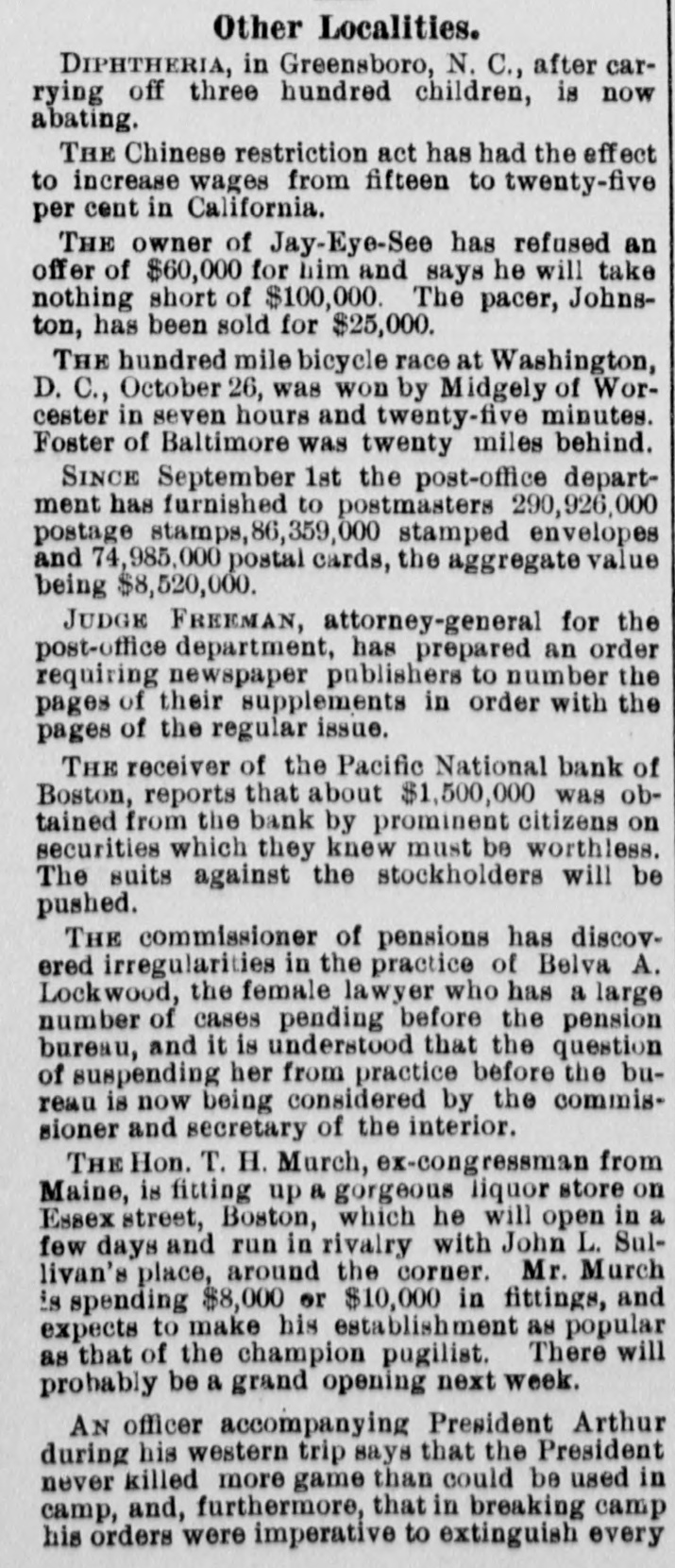
Other Localities. DIPHTHERIA, in Greensboro, N. C., after carrying off three hundred children, is now abating. THE Chinese restriction act has had the effect to increase wages from fifteen to twenty-five per cent in California. THE owner of Jay-Eye-See has refused an offer of $60,000 for him and says he will take nothing short of $100,000. The pacer, Johnston, has been sold for $25,000. THE hundred mile bicycle race at Washington, D. C., October 26, was won by Midgely of Worcester in seven hours and twenty-five minutes. Foster of Baltimore was twenty miles behind. SINCE September 1st the post-office department has furnished to postmasters 290,926,000 postage stamps, 86,359,000 stamped envelopes and 74,985,000 postal cards, the aggregate value being $8,520,000. JUDGE FREEMAN, attorney-general for the post-office department, has prepared an order requiring newspaper publishers to number the pages of their supplements in order with the pages of the regular issue. THE receiver of the Pacific National bank of Boston, reports that about $1,500,000 was obtained from the bank by prominent citizens on securities which they knew must be worthless. The suits against the stockholders will be pushed. THE commissioner of pensions has discovered irregularities in the practice of Belva A. Lockwood, the female lawyer who has a large number of cases pending before the pension bureau, and it is understood that the question of suspending her from practice before the bureau is now being considered by the commissioner and secretary of the interior. THE Hon. T. H. Murch, ex-congressman from Maine, is fitting up a gorgeous liquor store on Essex street, Boston, which he will open in a few days and run in rivalry with John L. Sullivan's place, around the corner. Mr. Murch is spending $8,000 or $10,000 in fittings, and expects to make his establishment as popular as that of the champion pugilist. There will probably be a grand opening next week. AN officer accompanying President Arthur during his western trip says that the President never killed more game than could be used in camp, and, furthermore, that in breaking camp his orders were imperative to extinguish every


Article from The Times, November 23, 1883

Click image to open full size in new tab

Article Text

The 96th birthday of Solidor Milon, one of the old guard, who remained with Napoleon at St. Helena until his death, was made the occasion of a banquet to the veteran by the Philadelphia Musical association. Milan has a parchment commission as second lieutenant bearing the seal of Napoleon. At the weekly meeting of the Baptist clergymen of Chicago, Rev. Duncan McGregor read a paper on "Readjustments" which startled his hearers. He put forth the claim that miracles will more and more come to be regarded as revelations of the spirit of Jesus rather than evidences of His power. Holders of claims against the Pacific National bank of Boston to the amount of $1,500,000 have agreed to a plan of settlement by which assets will be distributed as fast as realized upon, and the directors will be released by paying $100,000 and returning to the receiver securities worth $150,000. John W. Benway, of Dedham, Massachusetts, who was on the verge of delirium tremens, revenged himself upon John Long by placing a keg of powder on the piazza of the latter's house and firing it by a slow fuse. The explosion shattered the windows, but injured no one. Anton Rickert, a moulder of St. Louis has been industriously engaged in manufacturing silver dollars in plaster molds. He sent a small boy out with some samples, and the police held the lad until his parents came for him, when they were arrested. A package of counterfeits was found buried in the cellar. The Irish giant and the German giantess were married Tuesday in a Pittsburg church, in the presence of the mayor and councilmen. The wedding-cake was nine feet in circumference and three feet in diameter. The couple weigh 549 pounds, and their combined height is fifteen feet three inches. The striking miners at Iron Mountain, Michigan, although confronted by eighty special deputies from Chicago and Milwaukee, induced the engineers and pump-runners to leave their posts, and within one day the mines will be completely flooded. The strikers have been informed that they will be paid to date and discharged for the winter. Hon. Franklin Haven has resigned to his son the presidency of the Merchants' National bank of Boston, after a connection of half a century. H. Victor Newcomb has transferred to a New York syndicate a controlling interest in the United States National bank, at $150 per share, and Logan C. Murray will be elected president. The coroner's jury at Streator, Illinois, places the responsibility for the accident on the Burlington road, last Friday, on the shoulders of Conductor William H. Doyle and engineer Henry Young, of the extra freight train, besides centuring certain officers of the road. Five men will be arrested upon the finding. The chief culprits resides in Aurora, Ill. The citizens of Grand Haven, Michigan, held a meeting Monday night to express their appreciation of the heroism of the crew of the schooner Driver in rescuing the men of the propeller Akely. Seven lumbermen gave $100 each, and others raised the sum to $1,185. The sum of $220 was also contributed for the widow of Captain Struhl. The freight sent eastward by rail from Chicago last week was 52,048 tons, an increase of 1,598 over the preceding seven days. George W. Ristine, commissioner of the Transcontinental association, will receive a salary in excess of $12,000 per annum. A car-load of merchandise was recently sent from New York to Denver in six days and twenty hours over the Burlington road. Sullivan, the pugilist, likes nothing better than to amuse himself with a darky. It has transpired that he met his match, Saturday night, in the Tremont house bar-room in Chicago. He picked up a colored waiter at the counter and laid him on the floor, but in the attempt to have further fun with him was himself thrown upon his shoulders on the tiles. The negro, when he stopped to realize what a feat he had accomplished, went out of doors like a flash. An elopement in high life is the sensation of the hour at Springfield, Ohio. The wife of Harvey McClintock, is the important personage in the escapade. On Friday night McClintock came home to supper and found his wife gone and the house deserted. On a table in the parlor he found a note from his wife explaining that she had left for parts unknown with another man, whom she loved "better than life itself." There is much mystery surrounding the affaiir, which only adds to the circulation of the scandal. Nearly one thousand iron miners are on a strike near Norway, Michigan. On Saturday they formed a procession, secured a brass band and some flags, and paraded the streets until thoroughly chilled. Then they made a demand upon the superintendent of the Ludington mine for an advance in wages, and assaulted and threatened him until he complied. The chief officer of the Chapin mine took a train for Milwaukee, and the strikers say they will stop the pumps unless they are given more wages. The sheriff has been sent for, and militia will probably be called out. WASHINGTON.


Article from Wichita Eagle, April 3, 1884

Click image to open full size in new tab

Article Text

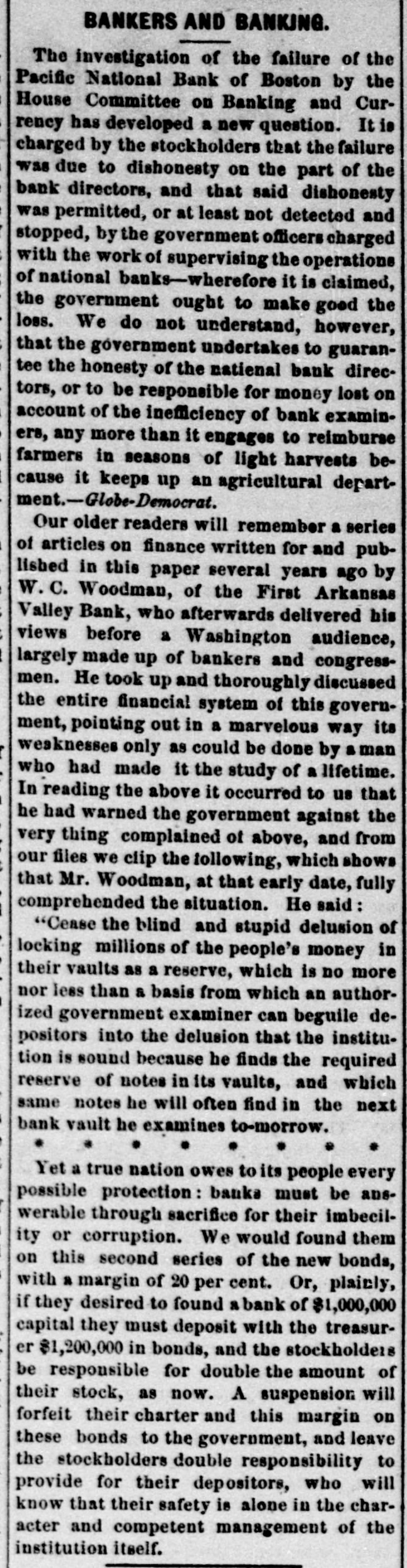
# BANKERS AND BANKING. The investigation of the failure of the Pacific National Bank of Boston by the House Committee on Banking and Currency has developed a new question. It is charged by the stockholders that the failure was due to dishonesty on the part of the bank directors, and that said dishonesty was permitted, or at least not detected and stopped, by the government officers charged with the work of supervising the operations of national banks-wherefore it is claimed, the government ought to make good the loss. We do not understand, however, that the government undertakes to guarantee the honesty of the natienal bank directors, or to be responsible for money lost on account of the inefficiency of bank examiners, any more than it engages to reimburse farmers in seasons of light harvests because it keeps up an agricultural department.-Globe-Democrat. Our older readers will remember a series of articles on finance written for and published in this paper several years ago by W. C. Woodman, of the First Arkansas Valley Bank, who afterwards delivered his views before a Washington audience, largely made up of bankers and congressmen. He took up and thoroughly discussed the entire financial system of this government, pointing out in a marvelous way its weaknesses only as could be done by a man who had made it the study of a lifetime. In reading the above it occurred to us that he had warned the government against the very thing complained of above, and from our files we clip the following, which shows that Mr. Woodman, at that early date, fully comprehended the situation. He said: "Cease the blind and stupid delusion of locking millions of the people's money in their vaults as a reserve, which is no more nor less than a basis from which an authorized government examiner can beguile depositors into the delusion that the institution is sound because he finds the required reserve of notes in its vaults, and which same notes he will often find in the next bank vault he examines to-morrow. Yet a true nation owes to its people every possible protection: banka must be answerable through sacrifice for their imbecility or corruption. We would found them on this second series of the new bonds, with a margin of 20 per cent. Or, plainly, if they desired to found a bank of $1,000,000 capital they must deposit with the treasurer $1,200,000 in bonds, and the stockholders be responsible for double the amount of their stock, as now. A suspension will forfeit their charter and this margin on these bonds to the government, and leave the stockholders double responsibility to provide for their depositors, who will know that their safety is alone in the character and competent management of the institution itself.


Article from River Falls Journal, April 3, 1884

Click image to open full size in new tab

Article Text

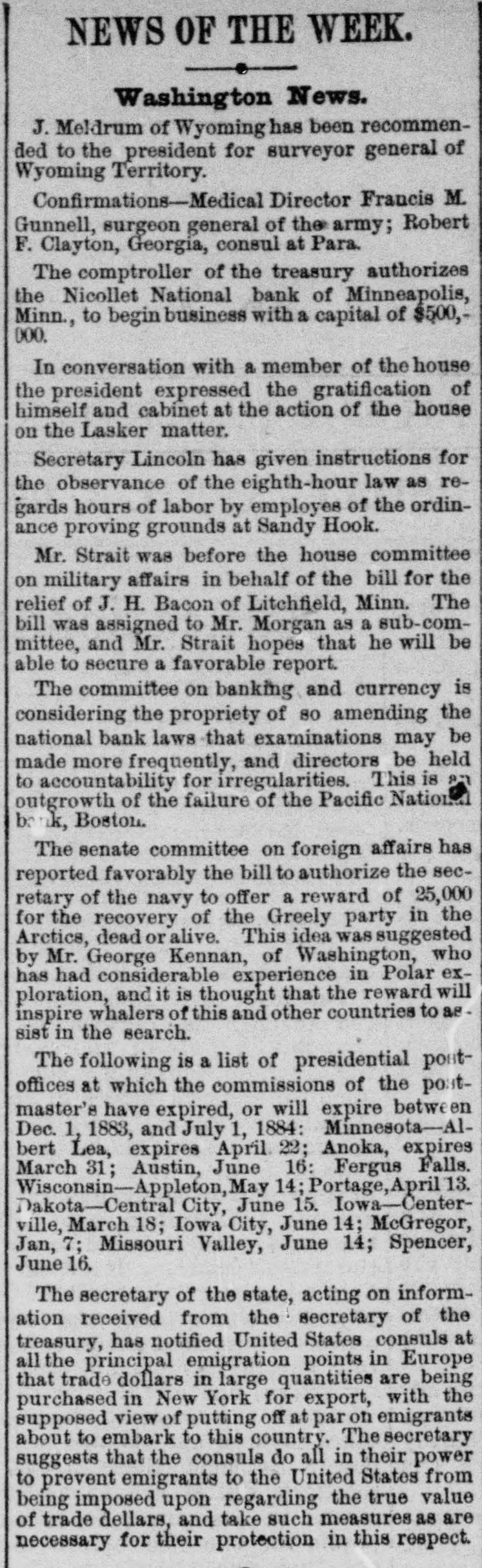
# NEWS OF THE WEEK. Washington News. J. Meldrum of Wyoming has been recommended to the president for surveyor general of Wyoming Territory. Confirmations-Medical Director Francis M. Gunnell, surgeon general of the army; Robert F. Clayton, Georgia, consul at Para. The comptroller of the treasury authorizes the Nicollet National bank of Minneapolis, Minn., to begin business with a capital of $500,000. In conversation with a member of the house the president expressed the gratification of himself and cabinet at the action of the house on the Lasker matter. Secretary Lincoln has given instructions for the observance of the eighth-hour law as regards hours of labor by employes of the ordinance proving grounds at Sandy Hook. Mr. Strait was before the house committee on military affairs in behalf of the bill for the relief of J. H. Bacon of Litchfield, Minn. The bill was assigned to Mr. Morgan as a sub-committee, and Mr. Strait hopes that he will be able to secure a favorable report. The committee on banking and currency is considering the propriety of so amending the national bank laws that examinations may be made more frequently, and directors be held to accountability for irregularities. This is an outgrowth of the failure of the Pacific National bank, Boston. The senate committee on foreign affairs has reported favorably the bill to authorize the secretary of the navy to offer a reward of 25,000 for the recovery of the Greely party in the Arctics, dead or alive. This idea was suggested by Mr. George Kennan, of Washington, who has had considerable experience in Polar exploration, and it is thought that the reward will inspire whalers of this and other countries to assist in the search. The following is a list of presidential post-offices at which the commissions of the postmaster's have expired, or will expire between Dec. 1, 1883, and July 1, 1884: Minnesota-Albert Lea, expires April 22; Anoka, expires March 31; Austin, June 16: Fergus Falls. Wisconsin-Appleton, May 14; Portage, April 13. Dakota-Central City, June 15. Iowa-Centerville, March 18; Iowa City, June 14; McGregor, Jan, 7; Missouri Valley, June 14; Spencer, June 16. The secretary of the state, acting on information received from the secretary of the treasury, has notified United States consuls at all the principal emigration points in Europe that trade dollars in large quantities are being purchased in New York for export, with the supposed view of putting off at par on emigrants about to embark to this country. The secretary suggests that the consuls do all in their power to prevent emigrants to the United States from being imposed upon regarding the true value of trade dollars, and take such measures as are necessary for their protection in this respect.


Article from The Indianapolis Journal, April 14, 1884

Click image to open full size in new tab

Article Text

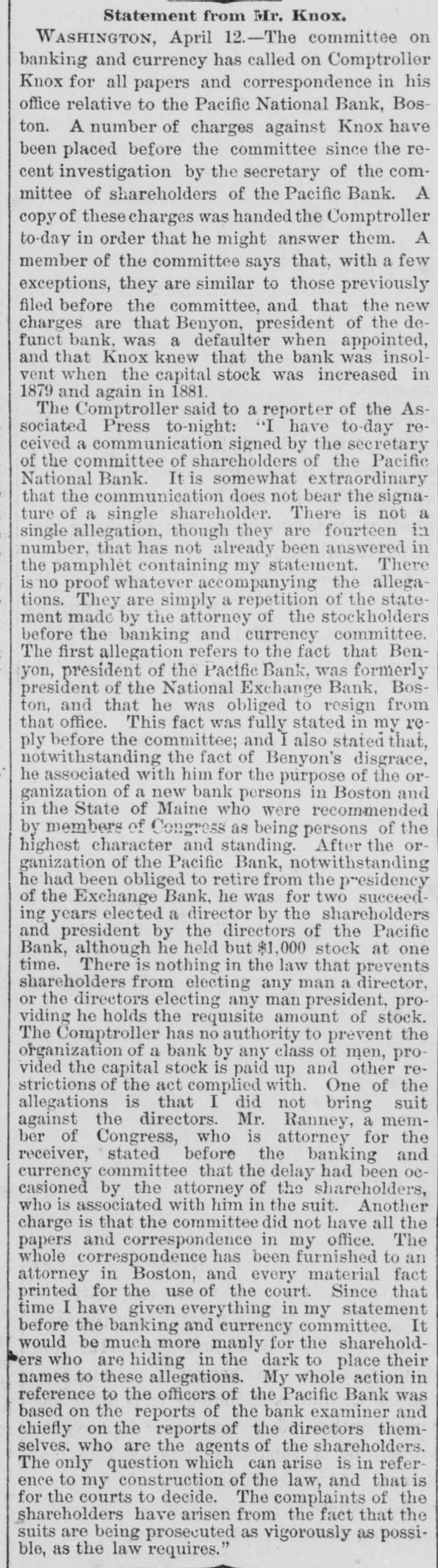
# Statement from Mr. Knox. WASHINGTON, April 12.-The committee on banking and currency has called on Comptroller Knox for all papers and correspondence in his office relative to the Pacific National Bank, Boston. A number of charges against Knox have been placed before the committee since the recent investigation by the secretary of the committee of shareholders of the Pacific Bank. A copy of these charges was handed the Comptroller to-day in order that he might answer them. A member of the committee says that, with a few exceptions, they are similar to those previously filed before the committee, and that the new charges are that Benyon, president of the defunct bank, was a defaulter when appointed, and that Knox knew that the bank was insolvent when the capital stock was increased in 1879 and again in 1881. The Comptroller said to a reporter of the Associated Press to-night: "I have to-day received a communication signed by the secretary of the committee of shareholders of the Pacific National Bank. It is somewhat extraordinary that the communication does not bear the signature of a single shareholder. There is not a single allegation, though they are fourteen in number, that has not already been answered in the pamphlet containing my statement. There is no proof whatever accompanying the allegations. They are simply a repetition of the statement made by the attorney of the stockholders before the banking and currency committee. The first allegation refers to the fact that Benyon, president of the Pacific Bank, was formerly president of the National Exchange Bank, Boston, and that he was obliged to resign from that office. This fact was fully stated in my reply before the committee; and I also stated that, notwithstanding the fact of Benyon's disgrace, he associated with him for the purpose of the organization of a new bank persons in Boston and in the State of Maine who were recommended by members of Congress as being persons of the highest character and standing. After the organization of the Pacific Bank, notwithstanding he had been obliged to retire from the presidency of the Exchange Bank, he was for two succeeding years elected a director by the shareholders and president by the directors of the Pacific Bank, although he held but $1,000 stock at one time. There is nothing in the law that prevents shareholders from electing any man a director, or the directors electing any man president, providing he holds the requisite amount of stock. The Comptroller has no authority to prevent the organization of a bank by any class of men, provided the capital stock is paid up and other restrictions of the act complied with. One of the allegations is that I did not bring suit against the directors. Mr. Ranney, a member of Congress, who is attorney for the receiver, stated before the banking and currency committee that the delay had been occasioned by the attorney of the shareholders, who is associated with him in the suit. Another charge is that the committee did not have all the papers and correspondence in my office. The whole correspondence has been furnished to an attorney in Boston, and every material fact printed for the use of the court. Since that time I have given everything in my statement before the banking and currency committee. It would be much more manly for the shareholders who are hiding in the dark to place their names to these allegations. My whole action in reference to the officers of the Pacific Bank was based on the reports of the bank examiner and chiefly on the reports of the directors themselves, who are the agents of the shareholders. The only question which can arise is in reference to my construction of the law, and that is for the courts to decide. The complaints of the shareholders have arisen from the fact that the suits are being prosecuted as vigorously as possible, as the law requires."