7948. First & Old Detroit National Bank (Detroit, MI)

Bank Information

Episode Type
Suspension โ†’ Closure
Bank Type
national
Bank ID
10527
Charter Number
10527
Start Date
February 14, 1933
Location
Detroit, Michigan (42.331, -83.046)

Metadata

Model
gpt-5-mini
Short Digest
acae0100b95eaa27

Response Measures

None

Receivership Details

Depositor recovery rate
100.0%
Date receivership started
1933-05-11
Share of assets assessed as good
29.4%
Share of assets assessed as doubtful
50.4%
Share of assets assessed as worthless
20.2%

Description

The articles refer to the First National Bank Detroit (matches the provided bank). The bank was closed under the Michigan/ federal bank holiday in mid-February 1933 and did not reopen; federal conservators/receivers took charge in March 1933 and the institution remained in receivership (assessment suits, liquidation and payouts followed). Cause of suspension is government action (state proclamation/federal banking holiday and subsequent federal conservatorship). Dates are taken from the newspaper items (Feb 14, 1933 is the bank holiday; conservators reported March 14, 1933 in one paper).

Events (6)

1. May 1, 1914 Chartered
Source
historical_nic
2. February 14, 1933 Suspension
Cause
Government Action
Cause Details
Michigan governor's proclamation of a state bank holiday (Feb 14, 1933) and the ensuing nationwide/federal holiday which resulted in the First National Bank Detroit failing to reopen.
Newspaper Excerpt
It was exactly 1:32 on the morning of Feb. 14, 1933, when Gov. Comstock signed his holiday proclamation ... two of the banks, the Guardian National and First National Detroit, did not reopen.
Source
newspapers
3. March 14, 1933 Receivership
Newspaper Excerpt
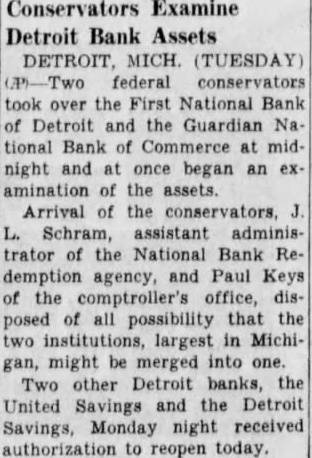
Conservators Examine Detroit Bank Assets MICH. federal conservators took the First National Bank Detroit ... and once began an examination of the assets. Arrival the conservators ... disposed of all possibility that the two largest in Michigan might be merged into one.
Source
newspapers
4. May 11, 1933 Receivership
Source
historical_nic
5. September 1, 1933 Other
Newspaper Excerpt
Federal receivers for Detroit's two big closed national banks took the offensive Friday in suits against eight directors ... The receivers in joint statement accompany the suit promised that there will be 'plenty of action' ... the failure of the government to furnish aid through the R.F.C. ... were to be blamed for the collapse here.
Source
newspapers
6. February 13, 1934 Other
Newspaper Excerpt
Within one year ... official notice issued today that 136,000 depositors with $1,000 or less in the Guardian National Bank of Commerce when it closed will be paid in full ... The holiday tied up Detroit banks and trust companies alone, and two of the banks, the Guardian National and First National Detroit, did not reopen.
Source
newspapers

Newspaper Articles (14)

Article from The Waterbury Democrat, March 2, 1933

Click image to open full size in new tab

Article Text

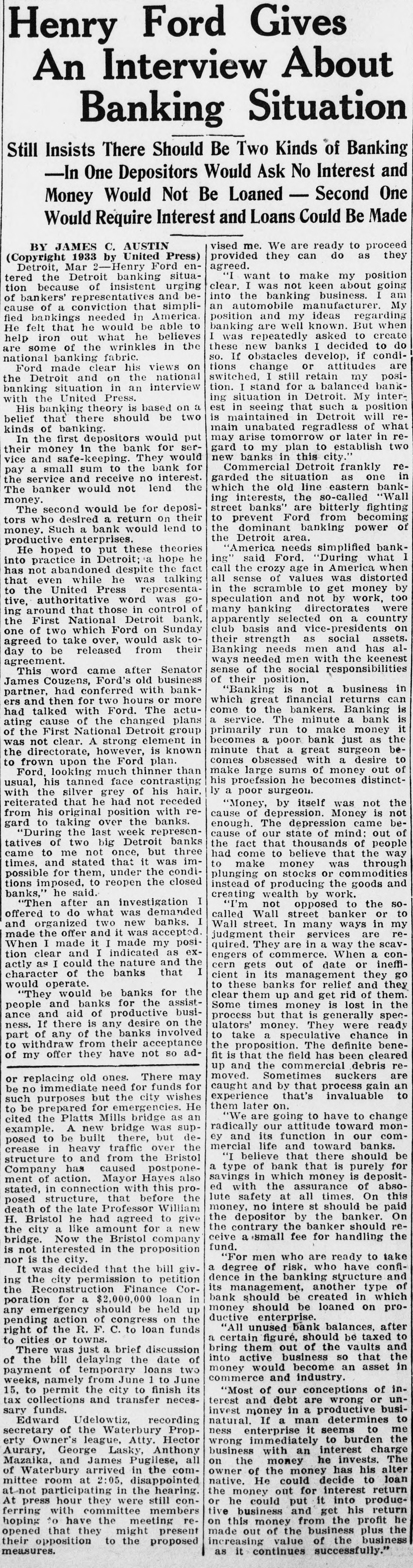
Henry Ford Gives An Interview About Situation Banking Still Insists There Should Be Two Kinds of Banking -In One Depositors Would Ask No Interest and Money Would Not Be Loaned - Second One Would Require Interest and Loans Could Be Made vised me. We are ready to proceed BY JAMES C. AUSTIN provided they can do as they (Copyright 1933 by United Press) agreed. Detroit, Mar 2-Henry Ford enwant to make my position tered the Detroit banking situaclear. I was not keen about going tion because of insistent urging into the banking business. I am of bankers' representatives and bean automobile manufacturer. My cause of a conviction that simpliposition and my ideas regarding fied bankings needed in America banking are well known. But when He felt that he would be able to I was repeatedly asked to create help iron out what he believes these new banks I decided to do are some of the wrinkles in the so. If obstacles develop. if condinational banking fabric. tions change or attitudes are Ford made clear his views on switched, I still retain my posithe Detroit and on the national tion. I stand for a balanced bankbanking situation in an interview ing situation in Detroit. My interwith the United Press. est in seeing that such a position His banking theory is based on a is maintained in Detroit will rebelief that there should be two main unabated regradless of what kinds of banking. may arise tomorrow or later in reIn the first depositors would put gard to my plan to establish two their money in the bank for sernew banks in this city. vice and safe-keeping. They would Commercial Detroit frankly repay a small sum to the bank for garded the situation as one in the service and receive no interest. which the old line eastern bankThe banker would not lend the ing interests, the so-called "Wall money. street banks' are bitterly fighting The second would be for deposito prevent Ford from becoming tors who desired a return on their the dominant banking power of money. Such a bank would lend to the Detroit area. productive enterprises. 'America needs simplified bankHe hoped to put these theories ing' said Ford. During what I into practice in Detroit; a hope he call the crozy age in America when has not abandoned despite the fact all sense of values was distorted that even while he was talking in the scramble to get money by to the United Press representaspeculation and not by work, too tive, authoritative word was gomany banking directorates were ing around that those in control of apparently selected on a country the First National Detroit bank, club basis and vice-presidents on one of two which Ford on Sunday their strength as social assets. agreed to take over, would ask toBanking needs men and has alday to be released from their ways needed men with the keenest agreement. sense of the social responsibilities This word came after Senator of their position. James Couzens, Ford's old business "Banking is not a business in partner, had conferred with bankwhich great financial returns can ers and then for two hours or more come to the bankers. Banking is had talked with Ford. The actua service. The minute a bank is ating cause of the changed plans primarily run to make money it of the First National Detroit group becomes a poor bank just as the was not clear. A strong element in minute that a great surgeon bethe directorate, however, is known comes obsessed with a desire to to from upon the Ford plan. make large sums of money out of Ford, looking much thinner than his proefssion he becomes distinctusual, his tanned face contrasting ly a poor surgeon. with the silver grey of his hair, reiterated that he had not receded "Money, by itself was not the from his original position with recause of depression. Money is not gard to taking over the banks. enough. The depression came because of our state of mind: out of "During the last week representatives of two big Detroit banks the fact that thousands of people came to me not once, but three had come to believe that the way times, and stated that it was imto make money was through possible for them, under the condiplunging on stocks or commodities tions imposed, to reopen the closed instead of producing the goods and banks," he said. creating wealth by work. I "Then after an investigation "I'm not opposed to the sooffered to do what was demanded called Wall street banker or to I and organized two new banks. Wall street. In many ways in my made the offer and it was accepted. judgment their services are reWhen I made it I made my posiquired. They are in a way the scavtion clear and I indicated as exengers of commerce. When a concern gets out of date or ineffiactly as I could the nature and the I character of the banks that cient in its management they go would operate. to these banks for relief and they "They would be banks for the clear them up and get rid of them. people and banks for the assistSome times money is lost in the ance and aid of productive busiprocess but that is generally specness. If there is any desire on the ulators' money. They were ready part of any of the banks involved to take a speculative chance in to withdraw from their acceptance the proposition. The definite benefit is that the field has been cleared of my offer they have not so adup and the commercial debris removed. Sometimes suckers are or replacing old ones. There may caught and by that process gain an be no immediate need for funds for experience that's invaluable to such purposes but the city wishes them later on. to be prepared for emergencies. He "We are going to have to change cited the Platts Mills bridge as an radically our attitude toward monexample. A new bridge was supey and its function in our composed to be built there, but demercial life and toward banks. crease in heavy traffic over the "I believe that there should be structure to and from the Bristol a type of bank that is purely for Company has caused postponesavings in which money is depositment of action. Mayor Hayes also ed with the assurance of absostated, in connection with this prolute safety at all times. On this posed structure, that before the money, no intere st should be paid death of the late Professor William the depositor by the banker. On H. Bristol he had agreed to give the contrary the banker should rethe city a like amount for a new ceive a small fee for handling the bridge. Now the Bristol company fund. is not interested in the proposition "For men who are ready to take nor is the city. a degree of risk. who have confiIt was decided that the bill givdence in the banking structure and ng the city permission to petition its management, another type of the Reconstruction Finance Corbank should be created in which poration for a $2,000,000 loan in money should be loaned on prony emergency should be held up ductive enterprise. pending action of congress on the "All unused bank balances, after right of the R. F. C. to loan funds a certain figurรฉ, should be taxed to o cities or towns. bring them out of the vaults and There was just a brief discussion into active business so that the of the bil! delaying the date of money would become an asset in payment of temporary loans two commerce and industry. weeks, namely from June 1 to June "Most of our conceptions of in5, to permit the city to finish its ax collections and transfer necesterest and debt are wrong or unsary funds. invest money in a productive businatural. If a man determines to Edward Udelowtiz. recording secretary of the Waterbury Propness enterprise it seems to me erty Owner's league, Atty. Hector wrong immediately to burden the business with an interest charge Aurary, George Lasky, Anthony Mazaika, and James Pugliese, all on the money he invests. The f Waterbury arrived in the comowner of the money has his alter native. He could decide to loan mittee room at 2:05. disappointed ton participating in the hearing. the money out for interest return At press hour they were still conor he could put it into productive business and get his return erring with committee members hoping : have the meeting reon this money from the profit he made out of the business plus the opened that they might present heir opposition to the proposed increasing value of the business measures. as it continues successfully."

Article from The Des Moines Register, March 14, 1933

Click image to open full size in new tab

Article Text

Conservators Examine Detroit Bank Assets MICH. federal conservators took the First National Bank Detroit and the Guardian Na tional Bank night and once began an amination the assets. Arrival the conservators, Schram, assistant administrator of National Bank Redemption agency, and Paul Keys the comptroller's office, disposed of all possibility that the two largest in Michigan, might be merged into one. Two Detroit banks, the United Savings and the Detroit Savings, Monday night received authorization to reopen today.


Article from The Akron Beacon Journal, June 27, 1933

Click image to open full size in new tab

Article Text

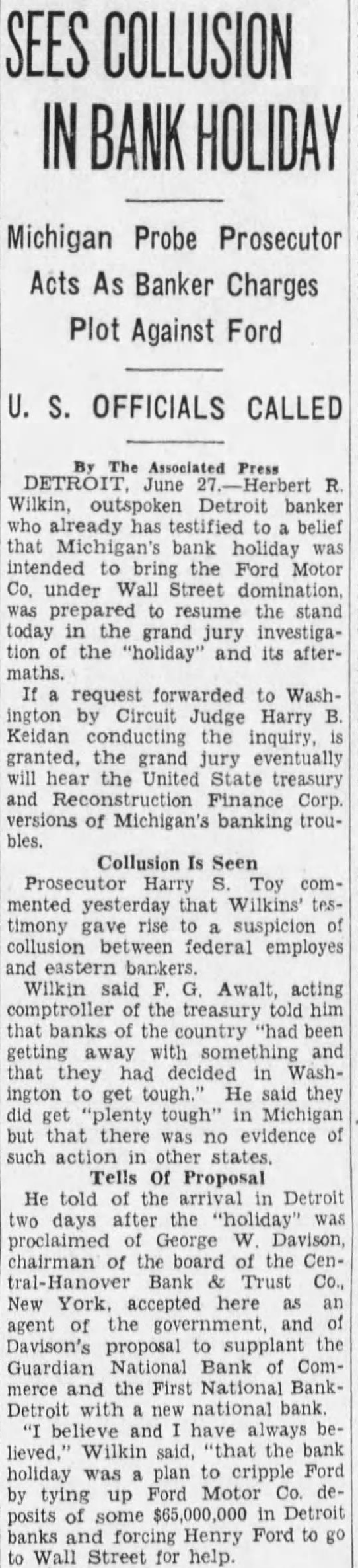
COLLUSION IN BANK Michigan Probe Prosecutor Acts As Banker Charges Plot Against Ford S. OFFICIALS CALLED The Associated DETROIT R Wilkin, Detroit banker already has testified to belief that Michigan's holiday was intended to bring Ford Motor Co. under Street domination. was prepared to resume the stand today grand jury investigation the "holiday" and its aftermaths. request forwarded to Washington by Circuit Judge Harry B. Keidan conducting the inquiry, granted, the grand eventually will the United State treasury and Finance Corp. versions of Michigan's banking trou- Collusion Seen mented that Wilkins' timony gave rise collusion federal employes and Wilkin said Awalt, acting the treasury told him that banks the country getting with and that they in ington get He said they did get "plenty tough" in Michigan but that there was no evidence such action other states. Tells Of Proposal He told the arrival in Detroit two days after the of George W Davison, chairman the board of the CenTrust Co., New York, accepted here agent of government, and Davison's proposal supplant the Guardian National Bank Commerce and the First National BankDetroit with new national bank. believe have always believed." Wilkin said, "that the bank holiday plan to cripple Ford by tying up Ford Motor deposits some $65,000,000 Detroit banks and forcing Henry Ford to Wall Street for help.


Article from Lansing State Journal, June 29, 1933

Click image to open full size in new tab

Article Text

BANK RECEIVERS WON'T TESTIFY AT JURY PROBE (Concluded from page 1) poenaed to appear for testimony. but that Mott has promised to appear when wanted. Attorneys Wednesday said it was planned to question Mott concerning the transfer last December of 30,000 shares of Guardian Detroit Union Group. Inc., stock to Harry Covington. another official of the Guardian group. When Schram was called to the stand. Marx read from the regulations of the treasury department rule prohibiting any officer or agent of the treasury from giving any of ficial information to anyone not officially authorized to receive it. He argued that the jury, being state insituation "her than federal one. has no jurisdiction over federal receivers. and that the latter are barred from giving testimony The attorney further declared that the state may not prosecute for violations by employes or officers of na. tional banks. He said the receivers were acting only as agents of the comptroller of the currency. and therefore "have no personal knowledge of these things. but only an official knowledge. He said the receivers had a request from Attorney General O'Brien to examine the records of the two banks. but that, due to the comp. troller's ruling, such a move could not be made. O'Brien furnished copy of the reply of the comptroller T. O'Connor, which said that the agreement of authorities that the court has no jurisdiction made impossible the granting of such requests "Connor in the letter said that the federal government assigned officials to investigate possible criminal acts in connection with the bank closing. and said agents of the department of justice now are engaged in such an inquiry. Marx told the court that he did not believe the comptroller could grant permission to the receivers to disclose information. and said the supreme court has indicated that it would "not be proper" for the secretary of the treasury to authorize a request. Detroit Bankers Called Davison, Chrysler Says DETROIT. June 29 (AP)-In a tele gram to the Detroit News. Walter P. Chryaler. president of the Chrysler corporation. whose name was men tioned testimony recently before the one-man Detroit bank jury, said Thursday that Detroit bankers had requested the aid of George W. Davison. New York banker. who came here after the state banking holiday. "Davison is director of the Chrys. ler corporation and chairman of the board of Central Hanover Bank and Trust company. which bank acts as Chrysler corporation's stock transfer agent and is one of the 50-odd banks in which Chrysler corporation carries balances, the motor manufacturer's telegram read. "We regard Mr. Davison as one of the ablest bankers in the United States We were informed at the time that Mr. Davison was invited to De. troit by Mr. Kanzler of the Guardian group and Mr. Mills of the Detroit Bankers company. and as large de. positors in both these institutions we were gratified with their evident disposition to avail themselves of the counsel and advice of one whose abilities and experience we regard so highly. Chrysler's name was brought into the open grand jury testimony by Herbert R. Wilkin. manager of the Guardian Detroit Union Group. who said there was business connection between Chrysler and Davison The motor magnate in his telegram said that "we were at all times accessible to the various parties working on this problem (reopening two national banks here) and we were consulted at different times by representatives of the various interests involved. including John K. McKee. of the Reconstruction Finance corporation. Ernest C. Kanzler, former chairman of the board of the Guardian Group. mentioned by Chrysler, was not avail. able for statement. but Wilson W. Mills. former chairman of the board of the First National Bank Detroit. said he would "testify to the whole story when I am called before the grand jury."


Article from Lansing State Journal, June 30, 1933

Click image to open full size in new tab

Article Text

First National-Detroit O. K. After Holiday, Witness Says (Concluded from page 1) the continuing in operation of the Union Guardian Trust company, unit. and the liquefying of Guardian Group unit banks to an extent of 50 percent. After th holiday. the Guardian National Bank of Commerce, member of the Guardian Group, and the First National Bank Detroit, failed to open. Kanzler described a trip he and mittee.' Clifford B. Longley, president of the trust company, made to Washington last January 26, seeking the loan. The witness said that in Washington they met Leyburn, Col. James criticized. Walsh, executive vice president of the Guardian Group. They made an appointment, he said, with Charles Miller, then president of the R. F. C. "Early in January had asked Leyburn to come to Detroit to discuss the situation of the national banks of our group," he said. "We wanted his advice as to how to fortify them against the falling economic conditions and heavy withdrawals. "The federal examiners had been through all the banks during the preceding weeks or months and were familiar with their conditions. We worked with Leyburn on the plan of obtaining a large enough loan to give the units a 50 percent liquidity. He get approved the plan and was very constructive, working with us day and "Our plan." the witness told Judge Keidan, "called for F. C. loan of about $48,000,000. This, with the 41 was $15,000,000 commitment already obtained by the trust company (a previous loan) would have made our total R. F. C. borrowing about $63,000,000. The R. F. C. offered us $37,000,000." Group in 16 Cities Kanzler said the Guardian group has banks in 16 cities- Detroit, Highland Park, Flint, Grand Rapids, Jack son, Saginaw, Port Huron, Lansing, Kalamazoo, Battle Creek, Dearborn, Royal Oak, Ionia, Trenton, Niles, and Hamtramck. These banks, he said, had capital and surplus of $42,000,000 and deposits as of last December 31 of nearly $300,000,000. including $138,000,000 in the Guardian National Bank of Commerce here. "In 11 of these 16 communities the Guardian units were the largest banks in town," he said. "In four more they were the second largest. Fifteen of these banks were the most liquid in their communities. Seven were 60 years old and 10 were more than 20 years old. They were well established and run by local men. Most of them opened after the national banking holiday national banks in Saginaw, Port Huron. Kalamazoo, and Battle Creek. and the state banks in Highland Park, Dearborn, Royal Oak and Pontiac. Under questioning by O'Hara, Kanzler said he was not paid executive in the Guardian Group from 1928, when he organized the Universal Credit corporation. Many other Detroit bank officers, including Henry E. Bodman, official of the Guardian Group: E. D Stair, head of the Detroit Bankers, Inc., and R. Perry Shorts. Saginaw banker. also received no salary for their group work Shorts recelved salary in the Saginaw bank. he said. Previous testimony was to the effect that Bodman received a fee as attorney for the group O'Hara brought up the matter of a loan of $382,000 to Kanzler, and the witness said "that was loan made to me personally June 14. 1930, by the old Guardian Detroit bank." It was always demand loan. and could have been turned into cash at any time," he said. "It was desirable loan then and now-it was one of those sold to the new bank. The best evidence that it was good loan is the fact that it since has been paid.' "The examiners' report for last No. vember also shows you have another indirect liability of $351,000," said O'Hara. "That was to the K-F-H corporation." said Kanzler. "It was loan which was endorsed by myself. George R. Fink, president of the National Steel corporation. and Carlton M. Higbie. The corporation took its name from our initials. If it cannot pay the loan, we will." Loan Never Questioned "Is this loan collectable?" asked Judge Keidan. "Yes, sir," said Kanzler. "It has never been questioned. The corporation was organized in 1929 to deal in securities and that loan was made in September, 1929. At one time it was as high $600,000, and has been reduced to this amount. There was collateral on the loan and we endorsed it only when the collateral did not present sufficient margin. The loan was approved by the bank's executive comKanzler said the bank examiners never criticized the loan, but said he "supposed there is no question" that some of the loans of directors were Returning to a discussion of the Guardian units, Kanzler said one ar gument for loan was that it would have meant "chain of banks able to face almost any situation. "Our purpose was to strengthen them because they had competitor banks which were comparatively weak," he said. "In January our Port Huron bank faced substantial run because bank across the street named the United States National bank had difficulty. It would not have withstood that run if it was not good. There is danger in banking group that one unit may get into difficulties and hurt the rest, so we wanted them all as strong as we could Park bank was 24 percent liquid, the Grand Rapids bank 30 percent, Jackson 35, Saginaw 47, Flint 19, Port Huron 32 before the run previously mentioned, Kalamazoo 43, Lansing 20, Battle Creek 35, Dearborn 24. Roy al Oak 87, Ionia 32, Niles 47, Trenton. and Hamtramck 44. "Did you ever ask the federal men why they opened other units and did not open the Guardian bank here when had liquidity of 41 percent?" O'Hara asked. "Washington insisted that the Guardian bank and First National would have to be treated alike, said Kanzler, never was able to find out the reason for that attitude which they began to express as soon as the holiday was declared. "As matter of fact," asked O'Hara, "all but one of the national banks in your group which they permitted to reopen were less liquid than the Guardian bank here. weren't they said the witness. "They opened the banks at Port Huron, and Battle Creek, which were less liquid They also opened the state banks at Highland Park and Dearborn which were less liquid. Kanzler, discussing events leading up to the refusal of the R. C. loan, said he "had no question but what the loan would be made. He said to cover the $48,000,000 requested, assets of face value of $65,000,000 selected as collateral, and total of $330,000,000 worth of assets available to pick from. O'Brien Wires Roosevelt DETROIT. June 30 mated by the refusal of federal receivLansing Bank Listed ers for Detroit's two closed national At the time the loan was sought banks to testify as to the causes surfrom the R. F. C., said Kanzler, the rounding the bank's closing, the grand Guardian National Bank of Commerce jury waited upon the reply of Presipercent liquid, the Highland dent Roosevelt to a message from Attorney General Patrick H. O'Brien, asking personal interview. Attorney General O'Brien, acting upon instructions by Judge Keidan. addressed lengthy telegram to the nation's Chief Executive in which he reviewed the progress of the investigation. He recited the fact that number of "witnesses of prominence and influence" have appeared in the hearing thus far, and have laid the blame at the door of federal officials and maintained that the banks now are solvent, and ended by asking the President to grant him (O'Brien) an interview which would enable him to present for the President's consideration all the facts in the case.


Article from The Flint Journal, July 6, 1933

Click image to open full size in new tab

Article Text

DENIES U. INTENT TO REOPEN BANKS (Continued) last Yesterday attorney for reopening after bank holiday "balked" by position from Chrysler General Motors officials office refusing take under the emergency banking law, indicated that the office intended to permit the said under tioning by Circuit Harry inquiry Closed For Crime said First closed pany. the holding for the Discussing in WashAlvin president Motor company Sen. James Couzens present, Long said they asked the senator about attitude but Couzens said on good comptroller's and did said comptroller saying the banks reopened they carry their leases on quarters banks organ ized the could get out First and tional banks had rented which probably dollars over the balance of the declared he did not agree with the the new of Detroit the quarters National building the bank's Harry Toy. that hamper plans First National Bank Detroit? would if is an absolute for advantages opening the old banks instead organizing new included the fact "part the assets would to the depositors, the cost of enforcible when liquidation begins that receivership penses out of assets which would benefit the asked Toy said explaining he did not by the fed receivers of the banks. Differed Only in Stock Plan the Bank replaced the two banks Long said the new differed from the plan mitted Washington depositors preferred not in the depositor's office capital larger the banks with capital than deposihad told for establish loan the and New York not forth the ever gest the did in General Motors plan asked McKee (John made know of of that the had been mitted that offered could not asked Something Always Prevented to our preventing them "Did think might forestall the think Long the take intended to permit reopening Questioned that Long said charge been many times." 'Do think fair state. ment the banks of of the asked Judge said Long The only unity from General Motors Chrysler group of played Would Be Major Benefit Long there doubt mind that of major to He further declared that as for the had called criminal acts the banks know nothing kind Discussing the new national bank local bank better position to local people had hold it to double. Martin to Gehrig. Warneke scoring on the play. Frisch hit home into the right field stands. The crowd wild, and threw straw hats and cushions air. Klein singled to Hafey hit the first ball and THREE HITS. NO ERHartnett went be hind the National leaguers. Cronin singled over ond. R. Ferrell sacrificed. Terry Frisch. Averill, batting for Crow singled center. scoring Cronin. Chapman bunted safely down the third for stopping Gehringer fouled Klein. Averill third after the Klem on Ruth. Babe walked away from the plate disgust. while the crowd cheered. Then Warneke whipped fast ball and fanned RUN, THREE HITS, NO ERRORS.


Article from Lansing State Journal, August 25, 1933

Click image to open full size in new tab

Article Text

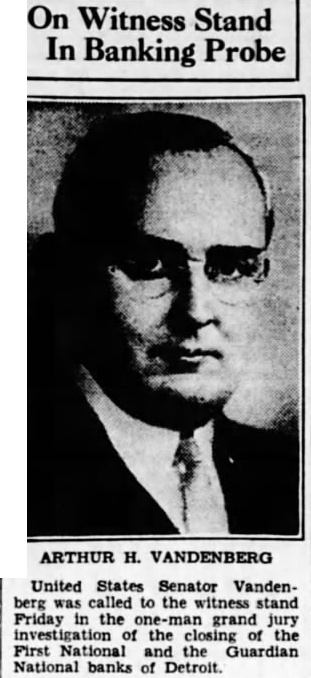
On Witness In Banking United States Senator Vandencalled the witness stand Friday in the one-man grand jury investigation closing First the Guardian National banks of Detroit.


Article from Birmingham Post-Herald, September 2, 1933

Click image to open full size in new tab

Article Text

BANK RECEIVERS TAKE OFFENSIVE Assessment Suits Filed Against Directors In Detroit Closing DETROIT. Sept. 1-(P)-Federal receivers for Detroit's two big closed national banks took the offensive Friday in suits against eight directors. while before the county one-man Grand Jury three other directors defended the conduct of their institutions against charges made by Senator James Couzens. The assessment suits were based on ten shares of stock in the banksthe First National Detroit and the Guardian National Bank of Commerce-held by each director. as "qualifying shares. Most of the stock of the two banks was held by the Detroit Bankers Company and the Guardian Detroit Union Group, Inc. The receivers in joint statement accompany the suit promised that there will be "plenty of action" and declared that "the one champion of the depositor is Uncle Sam. The statement came while the bankers again telling Judge Harry B. Keidan, sitting as one man Grand Jury. that failure of the government to furnish aid through the R. F. and the severity of bank examiners were to be blamed for the collapse here. It indicated also that the receivers are prepared to fight to finish the litigation over assess ment of stockholders in the two holding companies. The witnesses Friday were Wilson W. Mills. former chairman of the First National Bank Detroit: Emory W. Clark and Frederick M Alger, former directors of the institution Mills declared it was "utterly false" that he had dictated the method to be used by the bank's bookkeeping department in estimating its liquidity. He denied that there was any "kiting of checks' between the First National and any other bank. as Senator James Couzens had charged in previous testimony. and denied that "loans of millions" were made to friends of the directors "Not dollar was loaned on the basis of friendship he declared. Clark blamed Senator Couzens di- York subways associated in engineering projects in the West.


Article from The Ann Arbor News, February 13, 1934

Click image to open full size in new tab

Article Text

BANK TO PAY TIED UP CASH Detroit Depositors Given Relief on Anniversary of State Holiday 8,000,000 INVOLVED (Ry Associated Press) 13. Within one Feb. Detroit, of the anniversary of Michiday bank holiday, official notice issued today that 136,000 depositors with $1,000 or less in the Guardian National Bank of Commerce when it closed will be paid in full through a plan believed to unique in banking history. It was just one year ago that Gov. William A. signed proclamation, at the request of the state's major banking associa tions, all bank functions suspended for eight Before that period had elapsed, the bank holiday had spread to other states, to be climaxed on March by presidential procla mation closing all banks in the country Today's announcement told of completion of arrangements whereby 200 larger depositors in the Guardian National their claims to any share in an eight per cent financed by Reconstruction Corporation to make it possible for smallor depositors to get all of their money. All depositors already have shared in pro-rata payments totalling 60 per cent. The new pay-off, the announcement said, will begin about Feb. $8,000,000 Payoff This payment will amount to about $8,000,000. The 200 larger depositors, representing fair eross-section of Detroit's major industries, houses and more prominent individuals, have waivclaims approximate $4,000,000 amount. was exactly 1:32 on the morning of Feb. 14, 1933, when Gov. Comstock signed his "holiday' proclamation after series of conferences in which Undersecretary of the Treasury Arthur A. Ballatine, Secretary of Commerce Roy D. Chapin and other government officials had along with of most Michigan banks. The purpose, the governor explained, was to "prevent the withdrawals of large sums from the state of Michigan" when it became known that trouble in the Union Guardian Trust Co., an important unit of the Guardian Detroit Union Group. Inc., might cause widespread failures. Recalling his action and the unexpected sions, said he would do it again, "under the circumstances. "All could do would be declare another bank holiday under the same circumstances,' he said. believe it prevented greater national calamity. $698,544,766 Tied Up The holiday tied up Detroit banks and trust companies alone, and two of the banks, the Guardian National and First National Detroit, did not reopen. Since then, Guardian while First National depositors have 50 per of their accounts or approximately $200,000,000. Two new banks have opened, the National Bank of Detroit in the quarters the First National, and the Manufacturers Bank, in the quarters of the Guardian National. Now with Michigan industries. lad by motor car manufac in the midst of the greatest upturn in business and employment since the early days of the depression, the gloom which hung over the state year ago has lifted. Bank accounts are increasing, taxes being paid and the bank holiday is becoming NO far as the general public is concerned, just an unpleasant page in history.


Article from Battle Creek Enquirer, April 25, 1934

Click image to open full size in new tab

Article Text

ASSESSMENT SUIT MAY SUPREME COURT Differ on Whether Receivers of Banks or Holding Companies Should Collect. Detroit April 25.-(P)-It seemed likely today that the question of assessments against stockholders in Detroit's bank holding companies for the benefit of depositors in the closed First National Bank Detroit and Guardian National Bank of Commerce ultimately will be settled in the United States Supreme court Although Federal Judge Johnson J. Hayes ruled last month that the assessments were valid and that they should be collected by receivers of the two banks. there was different ruling Tuesday in circuit court There Judge Guy A. Miller held that the assessments were valid. but the they should be collected by the receivers for the holding companies the Detroit Bankers Co. and the Guardian Detroit Union Group Inc The bank receivers are federal agents The holding company receivers are appointed by the state Appeals are in preparation from both rulings. KILLED BY HORSE Lansing April William T. Langthorn 57-year-old farmer was injured fatally Monday when kicked in the head by horse


Article from Detroit Free Press, August 4, 1934

Click image to open full size in new tab

Article Text

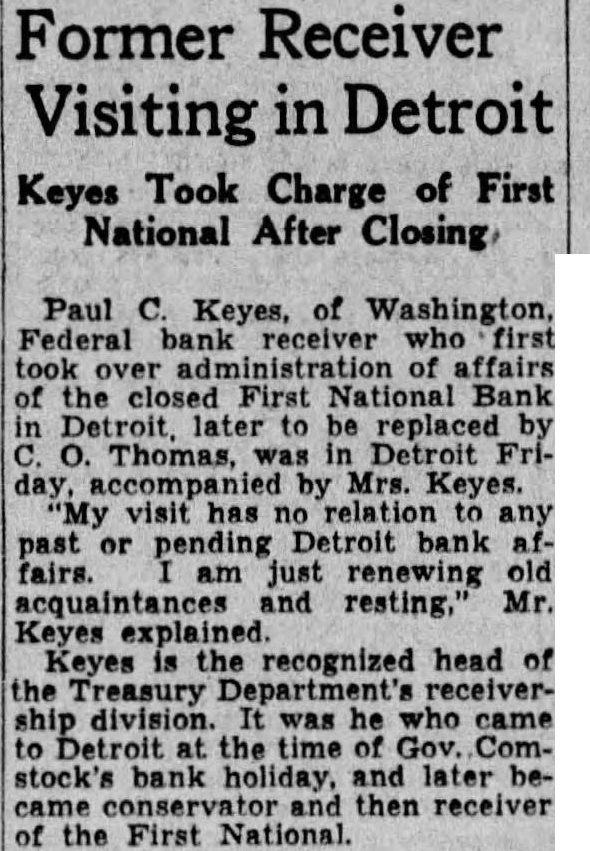
Former Receiver Visiting in Detroit Keyes Took Charge of First National After Closing Paul C. Keyes, of Washington, Federal receiver who first took over administration of affairs the closed First National Bank Detroit later to be replaced Thomas, was Detroit day, by Mrs. visit has any or pending Detroit bank fairs. am just renewing old acquaintances and resting,' Mr. Keyes Keyes is the recognized head of the Treasury Department's receivership division. It was he who came at the time Gov. Comstock's bank and later bethen receiver of the First National.


Article from The Ypsilanti Daily Press, November 23, 1940

Click image to open full size in new tab

Article Text

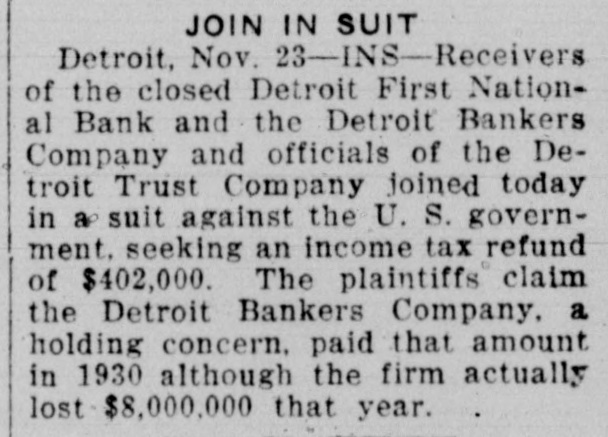
JOIN IN SUIT Detroit, Nov. 23-INS-Receivers of the closed Detroit First National Bank and the Detroit Bankers Company and officials of the Detroit Trust Company joined today in a suit against the U. S. government. seeking an income tax refund of $402,000. The plaintiffs claim the Detroit Bankers Company. a holding concern, paid that amount in 1930 although the firm actually lost $8,000,000 that year.


Article from Detroit Evening Times, April 15, 1941

Click image to open full size in new tab

Article Text

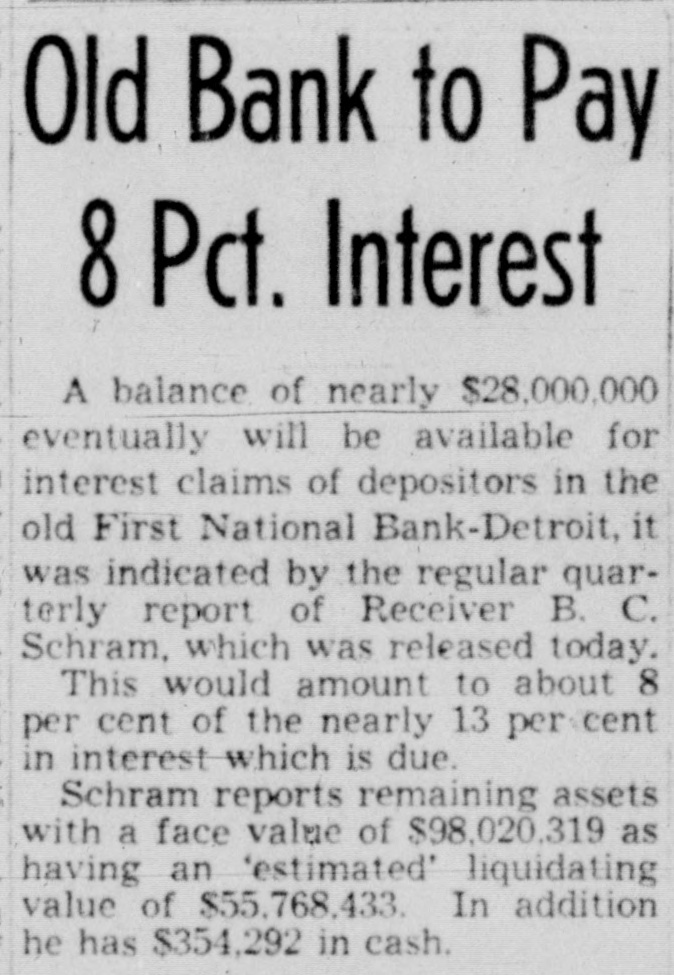
Old Bank to Pay 8 Pct. Interest A balance of nearly $28,000,000 eventually will be available for interest claims of depositors in the old First National Bank-Detroit, it was indicated by the regular quarterly report of Receiver B. C. Schram, which was released today. This would amount to about 8 per cent of the nearly 13 percent in interest-which is due. Schram reports remaining assets with a face value of $98,020,319 as having an 'estimated' liquidating value of $55,768,433. In addition he has $354,292 in cash.


Article from The Ypsilanti Daily Press, June 5, 1943

Click image to open full size in new tab

Article Text

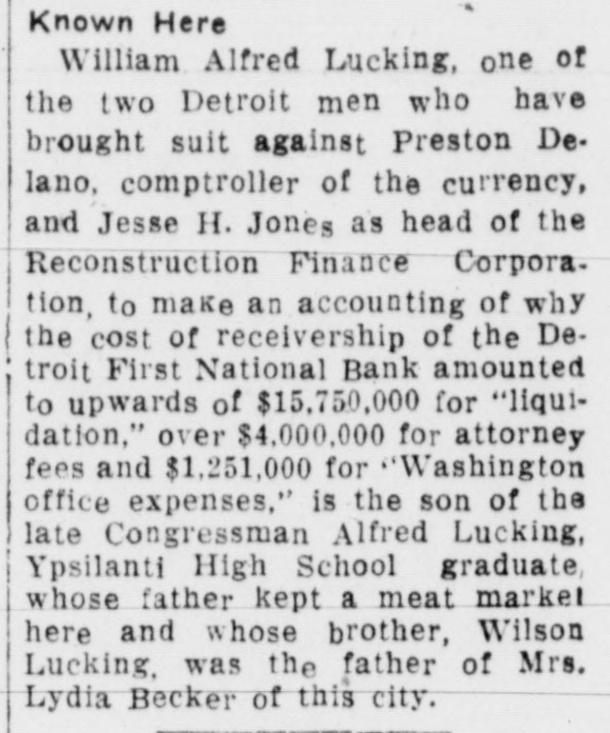
# Known Here William Alfred Lucking, one of the two Detroit men who have brought suit against Preston Delano, comptroller of the currency, and Jesse H. Jones as head of the Reconstruction Finance Corporation, to make an accounting of why the cost of receivership of the Detroit First National Bank amounted to upwards of $15,750,000 for "liquidation," over $4,000,000 for attorney fees and $1,251,000 for "Washington office expenses," is the son of the late Congressman Alfred Lucking, Ypsilanti High School graduate, whose father kept a meat market here and whose brother, Wilson Lucking, was the father of Mrs. Lydia Becker of this city.