7934. Ladies' Deposit (Boston, MA)

Bank Information

Episode Type
Run → Suspension → Closure
Bank Type
state
Start Date
October 19, 1880
Location
Boston, Massachusetts (42.358, -71.060)

Metadata

Model
gpt-5-mini
Short Digest
939c221f

Response Measures

Accommodated withdrawals, Full suspension

Other: This was a private fraudulent deposit scheme run by Sarah E. Howe; courts were involved and receivership was pursued.

Description

The Ladies' Deposit (Sarah E. Howe) was exposed in newspapers, triggering heavy withdrawals (a run), suspension/closing of operations and litigation / involuntary insolvency; managers were jailed and a receiver was sought — indicates permanent failure. Dates come from contemporaneous newspaper reports (Oct 19, 1880).

Events (4)

1. October 19, 1880 Receivership
Newspaper Excerpt
The Ladies' Deposit company was to-day placed in involuntary insolvency. ... The appointment of a receiver was urgently advocated by counsel for the complainants. The court reserved its decision.
Source
newspapers
2. October 19, 1880 Run
Cause
Bank Specific Adverse Info
Cause Details
Press exposés and revelations about the institution's fraudulent nature precipitated heavy withdrawals.
Measures
Paid out large sums to depositors during the run (reports of $10,000; other accounts $75,000-$100,000 paid out in one day).
Newspaper Excerpt
The recent newspaper articles caused the bank to pay out $10,000 the day before suspending operations.
Source
newspapers
3. October 19, 1880 Suspension
Cause
Bank Specific Adverse Info
Cause Details
After exposures and a rush of withdrawals the institution suspended operations/closed its doors and ceased payments.
Newspaper Excerpt
the recent newspaper articles caused them to pay out $40,000 the day before the suspension. ... Mrs. Howe concluded to close the doors
Source
newspapers
4. * Other
Newspaper Excerpt
The President and Agent in Jail. ... Mrs. Howe was later convicted and served jail time for the fraud.
Source
newspapers

Newspaper Articles (10)

Article from New-York Tribune, October 20, 1880

Click image to open full size in new tab

Article Text

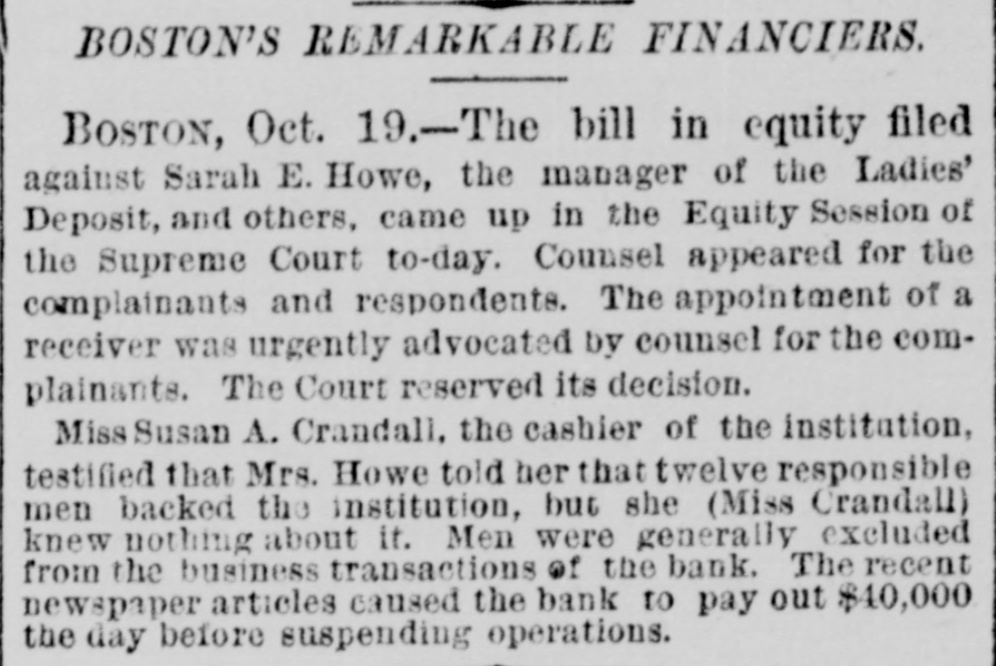
BOSTON'S REMARKABLE FINANCIERS. BOSTON, Oct. 19.-The bill in equity filed against Sarah E. Howe, the manager of the Ladies' Deposit, and others, came up in the Equity Session of the Supreme Court to-day. Counsel appeared for the complainants and respondents. The appointment of a receiver was urgently advocated by counsel for the complainants. The Court reserved its decision. Miss Susan A. Crandall, the cashier of the institution, testified that Mrs. Howe told her that twelve responsible men backed the institution, but she (Miss Crandall) knew nothing about it. Men were generally excluded from the business transactions of the bank. The recent newspaper articles caused the bank to pay out $10,000 the day before suspending operations.


Article from National Republican, October 20, 1880

Click image to open full size in new tab

Article Text

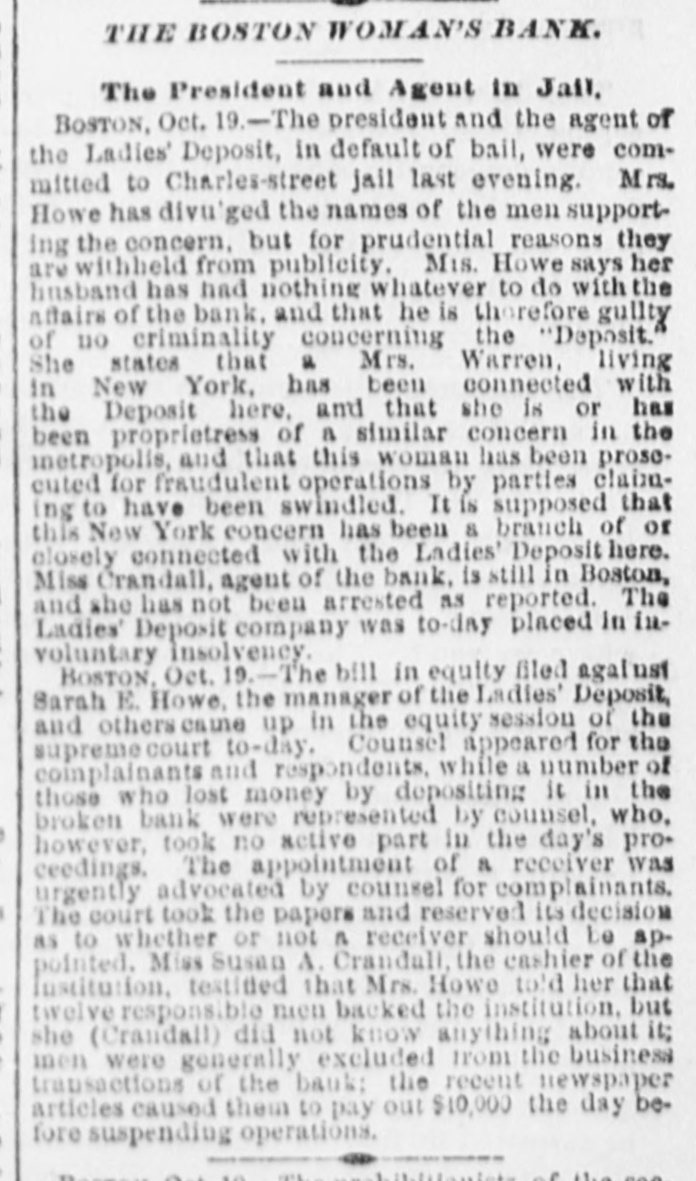
THE BOSTON WOMAN'S BANK. The President and Agent in Jail. BOSTON, Oct. 19.-The president and the agent of the Ladies' Deposit, in default of bail, were committed to Charles-street jail last evening. Mrs. Howe has divulged the names of the men supporting the concern, but for prudential reasons they are withheld from publicity. Mis. Howe says her husband has had nothing whatever to do with the affairs of the bank. and that he is therefore guilty of no criminality concerning the "Deposit. She states that a Mrs. Warren, living in New York, has been connected with the Deposit here. and that she is or has been proprietress of a similar concern in the inetropolis, and that this woman has been prosecuted for fraudulent operations by parties claiming to have been swindled. It is supposed that this New York concern has been & branch of of closely connected with the Ladies' Deposit here. Miss Crandall, agent of the bank. is still in Boston, and she has not been arrested as reported. The Ladies' Deposit company was to-day placed in involuntary insolvency. BOSTON. Oct. 19.-The bill in equity filed against Sarah E. Howe, the manager of the Ladies' Deposit, and others cause up in the equity session of the supreme court to-day. Counsel appeared for the complainants and respondents while a number of those who lost money by depositing it in the broken bank were represented by counsel, who, however, took no active part in the day's proceedings. The appointment of a receiver was urgently advocated by counsel for complainants. The court took the papers and reserved its decision as to whether or not n receiver should be appointed. Miss Susan A. Crandall, the cashier of the Institution, testidied that Mrs. Howe told her that twelve responsible men backed the institution. but she (Crandall) did not know anything about it; men were generally excluded from the business transactions of the bank: the recent newspaper articles caused them to pay out $10,000 the day before suspending operations.


Article from Daily Globe, October 20, 1880

Click image to open full size in new tab

Article Text

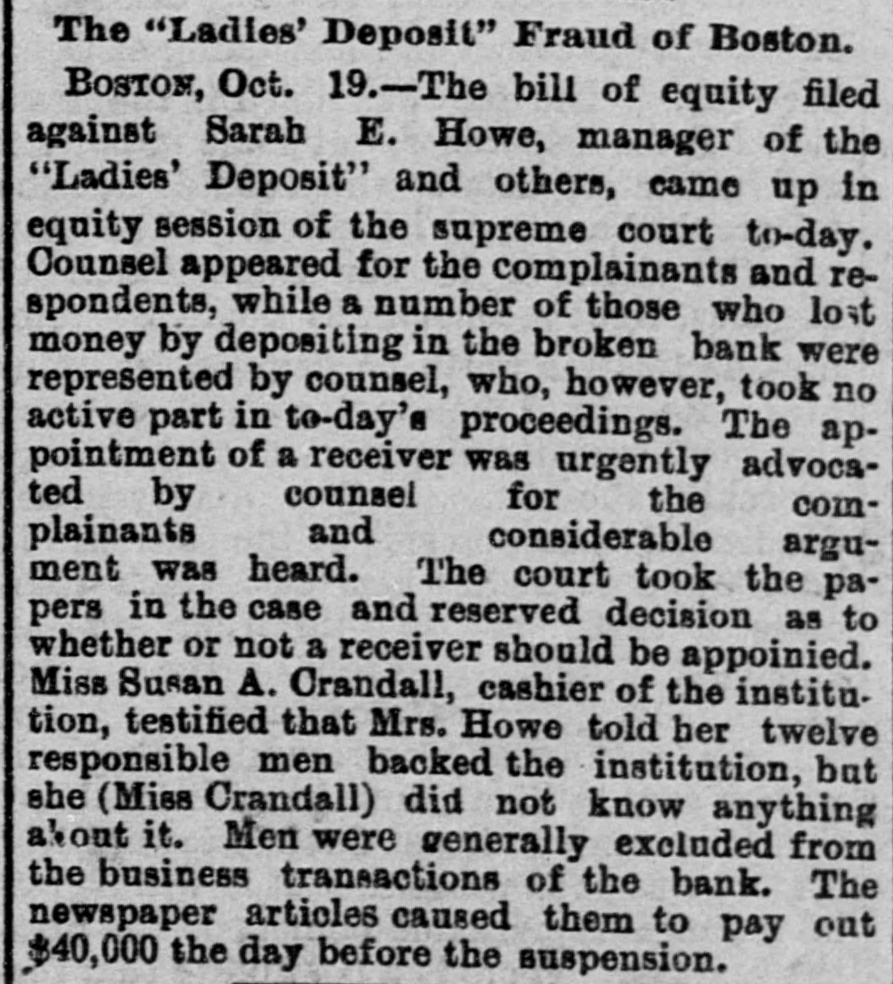
The "Ladies' Deposit" Fraud of Boston. BOSTON, Oct. 19.-The bill of equity filed against Sarah E. Howe, manager of the "Ladies' Deposit" and others, came up in equity session of the supreme court to-day. Counsel appeared for the complainants and respondents, while a number of those who lost money by depositing in the broken bank were represented by counsel, who, however, took no active part in to-day's proceedings. The appointment of a receiver was urgently advocated by counsel for the comand plainants considerable argument was heard. The court took the papers in the case and reserved decision as to whether or not a receiver should be appoinied. Miss Susan A. Orandall, cashier of the institution, testified that Mrs. Howe told her twelve responsible men backed the institution, but she (Miss Crandall) did not know anything about it. Men were generally excluded from the business transactions of the bank. The newspaper articles caused them to pay out $40,000 the day before the suspension.


Article from Walla Walla Statesman, November 13, 1880

Click image to open full size in new tab

Article Text

The Foel Hiller Should put in an appearance-The Great swindle of the Times. It seems about time that somebody should write another chapter of the "History of Popular Delusions," dealing entirely with the phenomenal swindles which during the past few years, have found ample scope and numerous victims among that portion of mankind who wish toget rich fast, First there was that Hanoverian institution, the most celebrated of alP which finally rose to the dignity of being made the bone of contention between political parties; more recently there was that pretty young Fraulein who established herself m Munich and boldly pretended to be carrying on her business under the patronage of both the Church and State, and lastly there is the Boston "Ladies Deposit, as big a fraud as any. The me hods of all these concerns were exactly the they promised to depositors an enormous rate of interest and paid it out of fresh deposits. Their fate also has been similar. Their operations, carried on for a time, unnoticed among the ignorant and foolish, finally attract the attention of the more enlightened, and ultimately of the authorities The newspapers set their SHARPEST REPORTERS to work to find out all about the people who are making their comfortable fortunes out of the dupes; the dupes take alarm; there is rush on the concern; the law is invoked, and down comes the whole baseless fabric. The Boston institution which came to grief finally on Saturday last promised 8 per cent. per month interest on all deposits of $200 and over The first three months' interest was paid in Advance, 80 that it was really even higher than thisninety-six per cent. per annum. For instance. by depositing $200 there, $48, the interest on that amount for three months, was at once returned, SO that the actual deposit was only $152. Preposterous as this appears, it drew money even from women of education and intelligence. The rules of the bank were that none but sin gle women, and then only such as did not own real estate, were eligible to its privileges, but it is not known how far these rules were observed The concern first attracted the attention of a reporter of the Boston Herald, some time last January, while passing through one of the South End streets of the city. A small lable pasted on the door of anot ryrepatable lo king house set forth the programme of the " LADIES' DEPOSIT. Subsequent investigation disclosed that the "Deposit" was located in a quiet side street, that it did not even hang out a sign to attract attention, and that it had already drawn in the money of many women of the demi-monde. The matter was reported to the police; twodet were detailed to inyestigate it further and report whether any unlawful methods were used, and whether any swindle was in progress. They learned that Mrs. Sarah E. Howe, wife of Florimand L. Howe, of Boston, was "President" and that she had associated with her other women of whom was called Mrs. J. A. Gordon. Mrs. Howe said she was representing some benevolent people who had established a large fund to aid working women and spinsters with slender fortunes to become independent; that the Quakers' Aid Society was behind it, and that several rich men had some times increased the wealth at her disposal by large bequests. The detectives kept the women in the strictes surveillance for months at a time, but could find nothing out of the way. Deposits were never solicited, and no depositor was refused her money on application: A young man dressed himself in FEMALE ATTIRE and tried to get at the system of business pursued in that way, but he failed to discover any material points which could be used in "showing up" what he and a large portion of the community regarded as a swindle. Meanwhile the "Ladies' Depo-it" slipped away from public notice, and. as it turned out later, had changed its quarters. The notority given it by the pitblication of several newspaper articles had attracted large sums of money. About six months ago Mrs. Howe, after looking about for more commodious quarters, purchased for $40,000 a handsome residence on Brookline street, just opposite the St. James Hotel. A fine conservatory was built and stocked with rare plants and flowers, while the house itself was richly furnished and decorated in the me st costly style. The neighborhood was on the qui vive for several weeks, for nobody knew who the purchaser was, or who the :ccupant was to be. The decorations were somewhat flashy but expensive, and speculation was rife among the gossips, who wondered what nabob was preparing to move in their circle. Their disappoint ment when an unprepossessing old woman richly but unbecomingly dressed, put in an appearance, was great. She wasabout sixty years of age, and deaf and ignorant to all appearance. This was Mrs. Howe, President of the "Badies' D. posit. With Mrs. Howe caine the "bank, andtwo parlors were assigned for its accommodation. Depositors poured in their cash and took out its earnings with commendable regul arity. Over a thousand names were on the books, whose owners held notes and pass books for sums aggregating $1,000,000. About a month ago the Boston Adrertiser began an earnest onslaught on the concern, and kept it up until finally a run was started on it, but for some days all demands were promptly paid. When about $75,000 had been paid out, how: ever. Mra. Howe concluded to close the doors, as the deposits no longer continued to come in. An excited crowd of women gathered in front of the house, of course, but they could get no satisfaction. A large number of suits were brought, and the two women were taken to jail, where they now are. In the judicial investigation, which has since been held it has been asserted that three-fourths of the depositors live outside of Boston, and that they never have drawntheir interests, which materially holped the "bank" to pay off city creditors. The fact has been revealed that a large number of Boston business men have, singularly enough, raised every dollar they could get by


Article from The Republican Journal, June 2, 1881

Click image to open full size in new tab

Article Text

News of Belfast and Vicinity. Belfast partakes sparingly of the revised New Testament. A handsome granite tablet is being made for the grave of Ex-Gov. Wm. G. Crosby. Clerk of Courts, Berry is having the outside woodwork of the Court House painted. The season of camping out, tents and hammocks is here. Summer visitors are beginning to arrive. Alden D. Chase's horse became frightened on Thursday last, and ran up High street from Edward Sibley's house, and on to Chase's store, without damage. Some hair breadth escapes occurred on the route. A class of twelve, four young gentlemen and eight young ladies, will graduate from the High school in this city at the end of the present term. This is the largest class to graduate since Mr. Kelley has had charge of the school. Mr. David Cook, of this city, at Isle au Haut, writes that last week, off Head harbor, a life preserver was picked up to which was attached a lady's silk handkerchief. The name, "Martha A. Clark, New York," is on one corner of the handkerchief. Lewiston is wrestling with the lobster question, claiming that the Portland dealers are extortionate in their prices. The Journal says Lewiston will have to look to St. John and Belfast for its lobster supply. Belfast gets its best lobsters from the islands to the east, and at about one-half the price which the Lewistoner pays for his long-tailed crustacean. Sch. Flora Condon laid at Carter's wharf on Friday, with her sails up all ready for sea. A breeze from the north suddenly struck the vessel, which parted her stern lines, and in swinging around the jibboom came in contact with a building on the wharf, breaking the spar off at the cap. The wreck was cleared away and the vessel proceeded. At the same time sch. Nathan Clifford swung around in the harbor and came across the jibboom of the Florida, tearing the mainsail of the former. The Boston Globe publishes a list of names, occupying four colunins, of the women swinelled by the Ladies' Deposit, of Boston, managed by Mrs. Sarah E. Howe. The institution failed last year, and a large number of innocent women were duped. The promise of large interest induced many ladies to go by our safe banks at home, and deposit with this Boston institution. The following are the Belfast women who were caught in the net-Mary J. Hutchins, $219.20; Neallie s. Pote, $169.60; Annie M. Pitcher, $254.40; Edith Stone, $179.75; and Annie M. White, $254.40. Thombs & Osborne, of this city, who deal largely in old iron, scraps, rags, &c., frequently find many curious articles in their stock, and sometimes rare mementoes. Last week while sorting over some rags a small and well preserved piece of parchment was found, which proved to be a Free Mason's certificate. The hand writing is very legible, and is as follows "To all whom it may concern: We hereby certify that Bro. John Lewis, who has signed his name to this certificate, is a regular registered Master Mason in Hiram Lodge, No. 10, in the registry of Nova Scotia, and has during his stay amongst us behaved as became a faithful Brother." The certificate is dated at Shelburne, N. S., Nov. 15, 1799, and signed by Jesse Sear, Master; Michael Gordon, S. Warden; John Miller, J. Warden; and Thomas Mehan, Secretary. # JANAUSCHEK'S JEWELS. The great actress is said to be the possessor of jewels to the value of $150,000, mostly presents from the crowned heads of Europe. Nearly all of these jewels were displayed on Thursday afternoon, at the jewelry store of Hiram Chase & Son, and were admired by a large number of people. The display consisted of a turquoise set of seven pieces, a coral set of five pieces, a magnificent cross presented by the late Emperor Nicholas, of Russia, thirteen stone rings, eight bracelets, six neck-chains, five pairs of eardrops, two pairs sleeve buttons, six brooches and two medals. Diamonds of almost fabulous value, sapphires, carbuncles and other precious stones were in the collection. A pair of large ear-rings, presented by the Queen of Holland, and valued at $18,000, the cross, from Emperor Nicholas; a large ring, given by Archduke John of Austria, and a diamond bracelet, a present from the King of Bavaria, were the most valued. At a meeting of the refunding committee last week, a sub-committee consisting of Edward Johnson, Dr. J. G. Brooks, C. B. Hazeltine and Wm. B. Swan, was appointed with instruction to devise some means to refund and to report on the first Monday evening in July, or at call of the Mayor. Messrs. Johnson and Hazeltine, who consulted several bankers and brokers at Boston, are sanguine that the debt can be refunded. It is believed that when the holders of the six per cents understand the situation they will be willing to exchange for a four per cent, secured bond. It is the plan of the committee to put the road in the hands of trustees as security for the new loan. This will take the railroad from behind the sixes leaving no other security than the good will of the people, which is not the best in these days of excessive taxation. It is a question whether or not the individual property is holden for this railroad debt. It is for the interest of all concerned that the debt be refunded, and we earnestly hope it may be accomplished. Mathews Bros., of the sash and blind factory, are filling an order for window sashes for a cottage in process of erection at Bar Harbor for a wealthy New Yorker, which illustrates the latest fashionable craze in architecture. The windows are to be of all sizes and shapes and will be irregularly placed in the building. Different sizes of glass are also used in the same window, the upper sash of some of the windows containing small panes, and the lower large ones. This is Queen Anne style. The same fashion extends to doors. The company is making doors for a Massachusetts man which are to go into a handsome house. No two doors in the same room are alike in pattern or finish. Such fashionable freaks are good for business, and that is the best thing that can be said of them. The company has just completed a set of quarter oak doors, the finest piece of work ever turned out from this factory. In addition to heavy mouldings the lower panel is finished in a style called bevelled blocks. Some very fine carved ornamental work adorns the centre of the doors. Grove cemetery is beautified year by year by the erection of handsome monuments, the grading of lots and the liberal cultivation of flowers. The improvements this season are at the entrance to the yard on the main thoroughfare. The first lot on the left, that of Philo Chase, Esq., has been newly graded and enclosed by polished granite posts and an iron railing. His son Edward, a young journalist, is buried here. The lot is handsomely decorated with flowers; upon a mound rests a representation of an open book in flowers, which is very unique. Opposite to this is the Nathaniel Wilson lot, upon which the trustees of Mr. Wilson's estate have just erected a granite monument. The monument and the enclosure are the finest pieces of work in the cemetery. The material is of Lincolnville granite and the work was done by the Fernald Bros., of this city. The lot is enclosed by a curbing of dressed granite, eighteen inches high, describing a circle sixteen feet in diameter. Six posts at regular intervals rise above the curbing, with steps and gate way at the entrance. The monument stands near the edge of the circle opposite the entrance, is three by five feet at the base, seven feet high and surmounted with a handsome cap. The four sides of the center piece are polished and bear the following inscriptions-On the front: "In memory of Nathaniel Wilson, a native of Belfast Born Dee. 26th, 1790. Died Oct. 27th, 1849." Rear tablet: "For nearly forty years in the service of his country." Right side: "The friend and benefactor of the people of his native town." Left side: "An intrepid man, a true man and an honest one." It will be remembered that Mr. Wilson is the gentleman, by whose will $30,000 comes to the city of Belfast for the purpose of founding a free public library.
Article from The Manitowoc Pilot, September 23, 1920

Click image to open full size in new tab

Article Text

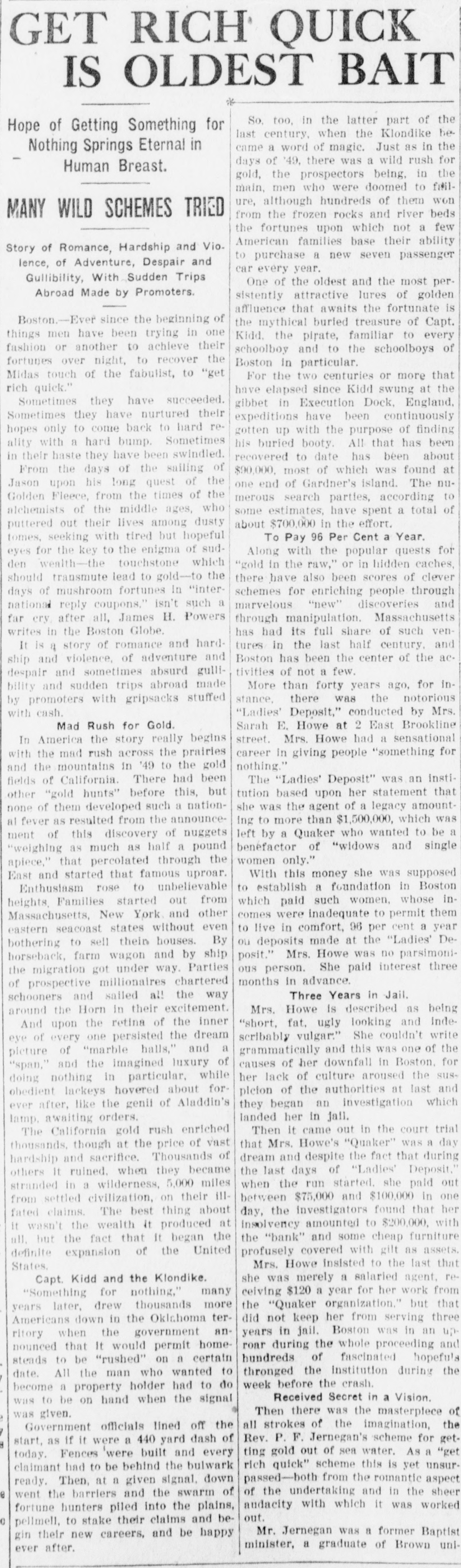
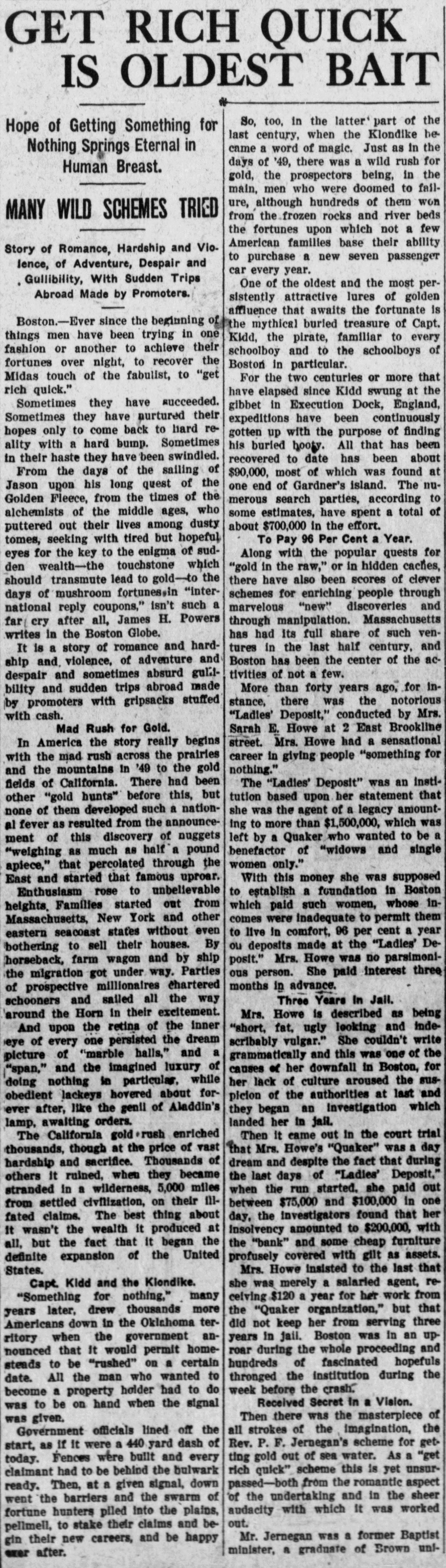
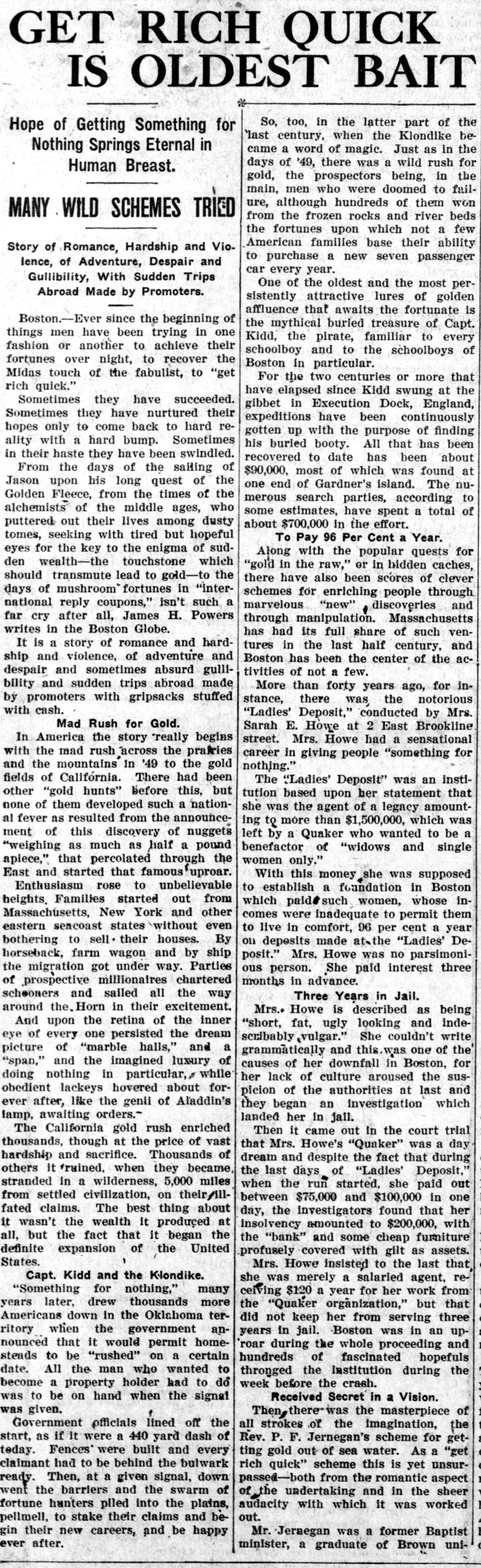
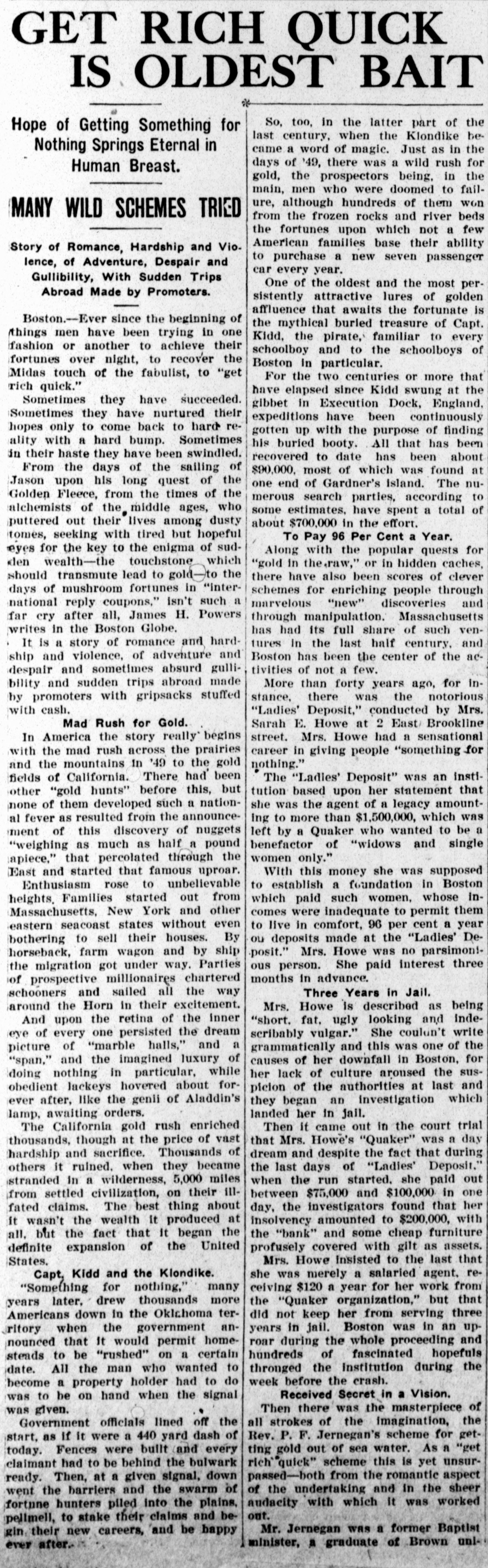
GET RICH QUICK IS OLDEST BAIT Hope of Getting Something for Nothing Springs Eternal in Human Breast. MANY WILD SCHEMES TRIED Story of Romance, Hardship and Vio- lence, of Adventure, Despair and Gullibility, With Sudden Trips Abroad Made by Promoters. Boston. Ever since the beginning of things men have been trying in one fashion or another to achieve their fortunes over night, to recover the Midas touch of the fabulist, to "get rich quick." Sometimes they have succeeded. Sometimes they have nurtured their hopes only to come back to hard re- ality with a hard bump. Sometimes in their haste they have been swindled. From the days of the sailing of Jason upon his long quest of the Golden Fleece, from the times of the alchemists of the middle ages, who puttered out their lives among dusty tomes, seeking with tired but hopeful eyes for the key to the enigma of sud- den wealth-the touchstone which should transmute lead to gold-to the days of mushroom fortunes in "inter- national reply coupons," isn't such a far cry, after all, James H. Powers writes in the Boston Globe. It is a story of romance and hard- ship and violence, of adventure and despair and sometimes absurd gulli- bility and sudden trips abroad made by promoters with gripsacks stuffed with cash. Mad Rush for Gold. In America the story really begins with the mad rush across the prairies and the mountains in '49 to the gold fields of California. There had been other "gold hunts" before this, but none of them developed such a nation- al fever as resulted from the announce- ment of this discovery of nuggets "weighing as much as half a pound apiece," that percolated through the East and started that famous uproar. Enthusiasm rose to unbelievable heights, Families started out from Massachusetts, New York, and other eastern seacoast states without even bothering to sell thein houses. By horseback, farm wagon and by ship the migration got under way. Parties of prospective millionaires chartered schooners and sailed all the way around the Horn in their excitement. And upon the retina of the inner eye of every one persisted the dream picture of "marble halls," and a "span," and the imagined luxury of doing nothing in particular, while obedient lackeys hovered about for- ever after, like the genii of Aladdin's lamp, awaiting orders. The California gold rush enriched thousands, though at the price of vast hardship and sacrifice. Thousands of others it ruined, when they became stranded in a wilderness, 5,000 miles from settled civilization, on their ill- fated claims. The best thing about it wasn't the wealth it produced at all, but the fact that it began the definite expansion of the United States. Capt. Kidd and the Klondike. "Something for nothing," many years later, drew thousands more Americans down in the Oklahoma ter- ritory when the government an- nounced that it would permit home- steads to be "rushed" on a certain date. All the man who wanted to become a property holder had to do was to be on hand when the signal was given. Government officials lined off the start, as if it were a 440 yard dash of today. Fences were built and every claimant had to be behind the bulwark ready. Then, at a given signal, down went the barriers and the swarm of fortune hunters piled into the plains, pellmell, to stake their claims and be- gin their new careers, and be happy ever after. So, too, in the latter part of the last century, when the Klondike be- came a word of magic. Just as in the days of '49, there was a wild rush for gold, the prospectors being, in the main, men who were doomed to fail- ure, although hundreds of them won from the frozen rocks and river beds. the fortunes upon which not a few American families base their ability to purchase a new seven passenger car every year. One of the oldest and the most per- sistently attractive lures of golden affluence that awaits the fortunate is the mythical buried treasure of Capt. Kidd, the pirate, familiar to every schoolboy and to the schoolboys of Boston in particular. For the two centuries or more that have elapsed since Kidd swung at the gibbet in Execution Dock, England, expeditions have been continuously gotten up with the purpose of finding his buried booty. All that has been recovered to date has been about $90,000, most of which was found at one end of Gardner's island. The nu- merous search parties, according to some estimates, have spent a total of about $700,000 in the effort. To Pay 96 Per Cent a Year. Along with the popular quests for "gold in the raw," or in hidden caches, there have also been scores of clever schemes for enriching people through marvelous "new" discoveries and through manipulation. Massachusetts has had its full share of such ven- tures in the last half century, and Boston has been the center of the ac- tivities of not a few. More than forty years ago, for in- stance, there was the notorious "Ladies' Deposit," conducted by Mrs. Sarah E. Howe at 2 East Brookline street. Mrs. Howe had a sensational career in giving people "something for nothing." The "Ladies' Deposit" was an insti- tution based upon her statement that she was the agent of a legacy amount- ing to more than $1,500,000, which was left by a Quaker who wanted to be a benéfactor of "widows and single women only." With this money she was supposed to establish a foundation in Boston which paid such women, whose in- comes were inadequate to permit them to live in comfort, 96 per cent a year ou deposits made at the "Ladies' De- posit." Mrs. Howe was no parsimoni- ous person. She paid interest three months in advance. Three Years in Jail. Mrs. Howe is described as being "short, fat, ugly looking and Inde- scribably vulgar." She couldn't write grammatically and this was one of the causes of her downfall in Boston, for her lack of culture aroused the sus- pleion of the authorities at last and they began an investigation which landed her in jall. Then it came out in the court trial that Mrs. Howe's "Quaker" was a day dream and despite the fact that during the last days of "Ladies' Deposit,' when the run started, she paid out between $75,000 and $100,000 in one day, the investigators found that her insolvency amounted to $200,000, with the "bank" and some cheap furniture profusely covered with gilt as assets. Mrs. Howe insisted to the last that she was merely a salaried agent, re- ceiving $120 a year for her work from the "Quaker organization," but that. did not keep her from serving three years in jail. Boston was in an up- roar during the whole proceeding and hundreds of fascinated hopefuls thronged the Institution during the week before the crash. Received Secret in a Vision. Then there was the masterpiece of all strokes of the imagination, the Rev. P. F. Jernegan's scheme for get- ting gold out of sea water. As a "get rich quick" scheme this is yet unsur- passed-both from the romantic aspect of the undertaking and in the sheer audacity with which it was worked out. Mr. Jernegan was a former Baptist minister, a graduate of Brown uni-


Article from The Fayette Falcon, September 24, 1920

Click image to open full size in new tab

Article Text

# GET RICH QUICK IS OLDEST BAIT Hope of Getting Something for Nothing Springs Eternal in Human Breast. # MANY WILD SCHEMES TRIED Story of Romance, Hardship and Vio- lence, of Adventure, Despair and Gullibility, With Sudden Trips Abroad Made by Promoters. Boston. Ever since the beginning of things men have been trying in one fashion or another to achieve their fortunes over night, to recover the Midas touch of the fabulist, to "get rich quick." Sometimes they have succeeded. Sometimes they have nurtured their hopes only to come back to hard re- ality with a hard bump. Sometimes in their haste they have been swindled. From the days of the sailing of Jason upon his long quest of the Golden Fleece, from the times of the alchemists of the middle ages, who puttered out their lives among dusty tomes, seeking with tired but hopeful eyes for the key to the enigma of sud- den wealth-the touchstone which should transmute lead to gold to the days of mushroom fortunessin "inter- national reply coupons," isn't such a far cry after all, James H. Powers writes in the Boston Globe. It is a story of romance and hard- ship and, violence, of adventure and despair and sometimes absurd guli- bility and sudden trips abroad made by promoters with gripsacks stuffed with cash. # Mad Rush for Gold. In America the story really begins with the mad rush across the prairies and the mountains in '49 to the gold fields of California. There had been other "gold hunts" before this, but none of them developed such a nation- al fever as resulted from the announce- ment of this discovery of nuggets "weighing as much as half a pound apiece," that percolated through the East and started that famous uproar. Enthusiasm rose to unbelievable heights, Families started out from Massachusetts, New York and other eastern seacoast states without even bothering to sell their houses. By horseback, farm wagon and by ship the migration got under way. Parties of prospective millionaires chartered schooners and sailed all the way around the Horn in their excitement. And upon the retina of the inner eye of every one persisted the dream picture of "marble halls," and a "span," and the imagined luxury of doing nothing in particular, while obedient lackeys hovered about for ever after, like the genil of Aladdin's lamp, awaiting orders. The California gold rush enriched thousands, though at the price of vast hardship and sacrifice. Thousands of others it ruined, when they became stranded in a wilderness, 5,000 miles from settled civilization, on their ill- fated claims. The best thing about it wasn't the wealth it produced at all, but the fact that it began the definite expansion of the United States. Capt. Kidd and the Klondike. "Something for nothing," many years later, drew thousands more Americans down in the Oklahoma ter- ritory when the government an- nounced that it would permit home- steads to be "rushed" on a certain date. All the man who wanted to become a property holder had to do was to be on hand when the signal was given. Government officials lined off the start, as if it were a 440 yard dash of today. Fences were bullt and every claimant had to be behind the bulwark ready. Then, at a given signal, down went the barriers and the swarm of fortune hunters piled into the plains, pellmell, to stake their claims and be- gin their new careers, and be happy ever after. So, too, in the latter part of the last century, when the Klondike be- came a word of magic. Just as in the days of '49, there was a wild rush for gold, the prospectors being, in the main, men who were doomed to fail- ure, although hundreds of them won from the frozen rocks and river beds the fortunes upon which not a few American families base their ability to purchase a new seven passenger car every year. One of the oldest and the most per- sistently attractive lures of golden affluence that awaits the fortunate is the mythical buried treasure of Capt. Kidd, the pirate, familiar to every schoolboy and to the schoolboys of Boston in particular. For the two centuries or more that have elapsed since Kidd swung at the gibbet in Execution Dock, England, expeditions have been continuously gotten up with the purpose of finding his buried hooty. All that has been recovered to date has been about $90,000, most of which was found at one end of Gardner's island. The nu- merous search parties, according to some estimates, have spent a total of about $700,000 in the effort. To Pay 96 Per Cent a Year. Along with the popular quests for "gold in the raw," or in hidden caches, there have also been scores of clever schemes for enriching people through marvelous "new" discoveries and through manipulation. Massachusetts has had its full share of such ven- tures in the last half century, and Boston has been the center of the ac- tivities of not a few. More than forty years ago, for in- stance, there was the notorious "Ladies' Deposit," conducted by Mrs. Sarah E. Howe at 2 East Brookline street. Mrs. Howe had a sensational career in giving people "something for nothing." The "Ladies' Deposit" was an insti- tution based upon her statement that she was the agent of a legacy amount- ing to more than $1,500,000, which was left by a Quaker who wanted to be a benefactor of "widows and single women only." With this money she was supposed to establish a foundation in Boston which paid such women, whose in- comes were inadequate to permit them to live in comfort, 96 per cent a year ou deposits made at the "Ladies' De- posit." Mrs. Howe was no parsimoni- ous person. She paid interest three months in advance. Three Years In Jail. Mrs. Howe is described as being "short, fat, ugly looking and inde- scribably vulgar." She couldn't write grammatically and this was one of the causes of her downfall in Boston, for her lack of culture aroused the sus- picion of the authorities at last and they began an Investigation which landed her in jail. Then it came out in the court trial that Mrs. Howe's "Quaker" was a day dream and despite the fact that during the last days of "Ladies' Deposit," when the run started, she paid out between $75,000 and $100,000 in one day, the investigators found that her Insolvency amounted to $200,000, with the "bank" and some cheap furniture profusely covered with gilt as assets. Mrs. Howe insisted to the last that she was merely a salaried agent, re- ceiving $120 a year for her work from the "Quaker organization," but that did not keep her from serving three years in jail. Boston was in an up- roar during the whole proceeding and hundreds of fascinated hopefuls thronged the institution during the week before the crash. Received Secret in a Vision. Then there was the masterpiece of all strokes of the imagination, the Rev. P. F. Jernegan's scheme for get ting gold out of sea water. As a "get rich quick" scheme this is yet unsur- passed-both from the romantic aspect of the undertaking and in the sheer audacity with which it was worked out. Mr. Jernegan was a former Baptist minister, a graduate of Brown uni-


Article from The Ely Miner, September 24, 1920

Click image to open full size in new tab

Article Text

GET RICH QUICK IS OLDEST BAIT So, too, in the latter part of the Hope of Getting Something for `last century, when the Klondike beNothing Springs Eternal in came a word of magic. Just as in the days of '49, there was a wild rush for Human Breast. gold, the prospectors being, in the main, men who were doomed to failure, although hundreds of them won MANY WILD SCHEMES TRIED from the frozen rocks and river beds the fortunes upon which not a few American families base their ability Story of Romance, Hardship and Vioto purchase a new seven passenger lence, of Adventure, Despair and car every year. Gullibility, With Sudden Trips One of the oldest and the most perAbroad Made by Promoters. sistently attractive lures of golden affluence that awaits the fortunate is Boston.-Ever since the beginning of the mythical buried treasure of Capt. things men have been trying in one Kidd, the pirate, familiar to every fashion or another to achieve their schoolboy and to the schoolboys of fortunes over night, to recover the Boston in particular. Midas touch of the fabulist, to "get For the two centuries or more that rich quick." have elapsed since Kidd swung at the Sometimes they have succeeded. gibbet in Execution Dock, England, Sometimes they have nurtured their expeditions have been continuously hopes only to come back to hard regotten up with the purpose of finding ality with a hard bump. Sometimes his buried booty. All that has been in their haste they have been swindled. recovered to date has been about From the days of the sailing of $90,000, most of which was found at Jason upon his long quest of the one end of Gardner's island. The nuGolden Fleece, from the times of the merous search parties, according to alchemists of the middle ages, who some estimates, have spent a total of puttered out their lives among dusty about $700,000 in the effort. tomes, seeking with tired but hopeful To Pay 96 Per Cent a Year. eyes for the key to the enigma of sudAlong with the popular quests for den wealth-the touchstone which "gold in the raw," or in hidden caches, should transmute lead to gold-to the there have also been scores of clever days of mushroom' fortunes in "interschemes for enriching people through national reply coupons," isn't such a marvelous "new" discoveries and far cry after all, James H. Powers through manipulation. Massachusetts writes in the Boston Globe. has had its full share of such venIt is a story of romance and hardtures in the last half century, and ship and violence, of adventure and Boston has been the center of the activities of not a few. despair and sometimes absurd gullibility and sudden trips abroad made More than forty years ago, for inby promoters with gripsacks stuffed stance, there was, the notorious with cash. "Ladies' Deposit," conducted by Mrs. Mad Rush for Gold. Sarah E. Howe at 2 East Brookline In America the story really begins street. Mrs. Howe had a sensational with the mad rush across the prakries career in giving people "something for and the mountains in '49 to the gold nothing." fields of California. There had been The "Ladies' Deposit" was an instiother "gold hunts" before this, but tution based upon her statement that none of them developed such a nationshe was the agent of a legacy amountal fever as resulted from the announceing to more than $1,500,000, which was ment of this discovery of nuggets left by a Quaker who wanted to be a "weighing as much as half a pound benefactor of "widows and single women only." apiece," that percolated through the East and started that famous uproar. With this money she was supposed Enthusiasm rose to unbelievable to establish a foundation in Boston heights. Families started out from which paid# women, whose inMassachusetts, New York and other comes were inadequate to permit them eastern seacoast states without even to live in comfort, 96 per cent a year bothering to sell their houses. By on deposits made at-the "Ladies' Dehorseback, farm wagon and by ship posit." Mrs. Howe was no parsimonithe migration got under way. Parties ous person. She paid interest three months in advance. of prospective millionaires chartered schooners and sailed all the way Three Years in Jail. around the, Horn in their excitement. Mrs.. Howe is described as being And upon the retina of the inner "short, fat, ugly looking and indeeye of every one persisted the dream scribably vulgar." She couldn't write picture of "marble halls," and a grammatically and one of the "span," and the imagined luxury of causes of her downfall in Boston, for doing nothing in particular, while her lack of culture aroused the susobedient lackeys hovered about forpicion of the authorities at last and ever after, like the genii of Aladdin's they began an investigation which lamp, awaiting orders.landed her in jail. The California gold rush enriched Then it came out in the court trial thousands, though at the price of vast that Mrs. Howe's "Quaker" was a day hardship and sacrifice. Thousands of dream and despite the fact that during others it "ruined, when they became, the last days of "Ladies' Deposit," stranded in a wilderness, 5,000 miles when the run started, she paid out from settled civilization, on their/illbetween $75,000 and $100,000 in one fated claims. The best thing about day, the investigators found that her it wasn't the wealth it produced at insolvency amounted to $200,000, with all, but the fact that it began the the "bank" and some cheap furniture definite expansion of the United profusely covered with gilt as assets. States. Mrs. Howe insisted to the last that Capt. Kidd and the Klondike. she was merely a salaried agent, re"Something for nothing," many ceiving $120 a year for her work from years later, drew thousands more the "Quaker organization," but that Americans down in the Oklahoma terdid not keep her from serving three ritory when the government anyears in jail. Boston was in an upnounced that it would permit homeroar during the whole proceeding and steads to be "rushed" on a certain hundreds of fascinated hopefuls date. All the man who wanted to thronged the institution during the week before the crash. become a property holder had to do Received Secret in a Vision. was to be on hand when the signal was given. Then, there* was the masterpiece of Government officials lined off the all strokes of the imagination, the start, as if it were a 440 yard dash of Rev. P. F. Jernegan's scheme for getting gold out of sea water. As a "get teday. Fences' were built and every claimant had to be behind the bulwark rich quick" scheme this is yet unsurready. Then, at a given signal, down passed-both from the romantic aspect went the barriers and the swarm of of the undertaking and in the sheer fortune hunters piled into the plains, audacity with which it was worked out. pellmell, to stake their claims and begin their new careers, and be happy Mr. Jernegan was a former Baptist ever after. minister, a graduate of Brown uni-


Article from The L'anse Sentinel, October 15, 1920

Click image to open full size in new tab

Article Text

# GET RICH QUICK IS OLDEST BAIT Hope of Getting Something for Nothing Springs Eternal in Human Breast. # MANY WILD SCHEMES TRIED Story of Romance, Hardship and Violence, of Adventure, Despair and Gullibility, With Sudden Trips Abroad Made by Promoters. Boston. Ever since the beginning of things men have been trying in one fashion or another to achieve their fortunes over night, to recover the Midas touch of the fabulist, to "get rich quick." Sometimes they have succeeded. Sometimes they have nurtured their hopes only to come back to hard reality with a hard bump. Sometimes in their haste they have been swindled. From the days of the sailing of Jason upon his long quest of the Golden Fleece, from the times of the alchemists of the middle ages, who puttered out their lives among dusty tomes, seeking with tired but hopeful eyes for the key to the enigma of sudden wealth-the touchstone which should transmute lead to gold to the days of mushroom fortunes in "international reply coupons," isn't such a far cry after all, James H. Powers writes in the Boston Globe. It is a story of romance and hardship and violence, of adventure and despair and sometimes absurd gullibility and sudden trips abroad made by promoters with gripsacks stuffed with cash. # Mad Rush for Gold. In America the story really begins with the mad rush across the prairies and the mountains in '49 to the gold fields of California. There had been other "gold hunts" before this, but none of them developed such a national fever as resulted from the announcement of this discovery of nuggets "weighing as much as half a pound apiece," that percolated through the East and started that famous uproar. Enthusiasm rose to unbelievable heights, Families started out from Massachusetts, New York and other eastern seacoast states without even bothering to sell their houses. By horseback, farm wagon and by ship the migration got under way. Parties of prospective millionaires chartered schooners and sailed all the way around the Horn in their excitement. And upon the retina of the inner eye of every one persisted the dream picture of "marble halls," and a "span," and the imagined luxury of doing nothing in particular, while obedient lackeys hovered about for ever after, like the genii of Aladdin's lamp, awaiting orders. The California gold rush enriched thousands, though at the price of vast hardship and sacrifice. Thousands of others it ruined, when they became stranded in a wilderness, 5,000 miles from settled civilization, on their ill fated claims. The best thing about it wasn't the wealth it produced at all, but the fact that it began the definite expansion of the United States. Capt, Kidd and the Klondike. "Something for nothing," many years later, drew thousands more Americans down in the Oklahoma territory when the government announced that it would permit homesteads to be "rushed" on a certain date. All the man who wanted to become a property holder had to do was to be on hand when the signal was given. Government officials lined off the start, as if it were a 440 yard dash of today. Fences were built and every claimant had to be behind the bulwark ready. Then, at a given signal, down went the barriers and the swarm of fortune hunters piled into the plains, pellmell, to stake their claims and begin their new careers, and be happy ever after. So, too, in the latter part of the last century, when the Klondike became a word of magic. Just as in the days of '49, there was a wild rush for gold, the prospectors being, in the main, men who were doomed to fail-ure, although hundreds of them won from the frozen rocks and river beds the fortunes upon which not a few American families base their ability to purchase a new seven passenger car every year. One of the oldest and the most persistently attractive lures of golden affluence that awaits the fortunate is the mythical buried treasure of Capt. Kidd, the pirate, familiar to every schoolboy and to the schoolboys of Boston in particular. For the two centuries or more that have elapsed since Kidd swung at the gibbet in Execution Dock, England, expeditions have been continuously gotten up with the purpose of finding his buried booty. All that has been recovered to date has been about $90,000, most of which was found at one end of Gardner's island. The numerous search parties, according to some estimates, have spent a total of about $700,000 in the effort. To Pay 96 Per Cent a Year. Along with the popular quests for "gold in the raw," or in hidden caches, there have also been scores of clever schemes for enriching people through marvelous "new" discoveries and through manipulation. Massachusetts has had its full share of such ventures in the last half century, and Boston has been the center of the activities of not a few. More than forty years ago, for instance, there was the notorious "Ladies' Deposit," conducted by Mrs. Sarah E. Howe at 2 East Brookline street. Mrs. Howe had a sensational career in giving people "something for nothing." The "Ladies' Deposit" was an institution based upon her statement that she was the agent of a legacy amounting to more than $1,500,000, which was left by a Quaker who wanted to be a benefactor of "widows and single women only." With this money she was supposed to establish a foundation in Boston from which paid such women, whose incomes were inadequate to permit them to live in comfort, 96 per cent a year ou deposits made at the "Ladies' Deposit." Mrs. Howe was no parsimonious person. She paid interest three months in advance. Three Years in Jail. Mrs. Howe is described as being "short, fat, ugly looking and indescribably vulgar." She coulun't write grammatically and this was one of the causes of her downfall in Boston, for her lack of culture aroused the suspicion of the authorities at last and they began an investigation which landed her in jail. Then it came out in the court trial that Mrs. Howe's "Quaker" was a day dream and despite the fact that during the last days of "Ladies' Deposit," when the run started, she paid out between $75,000 and $100,000 in one day, the investigators found that her insolvency amounted to $200,000, with the "bank" and some cheap furniture profusely covered with gilt as assets. Mrs. Howe insisted to the last that she was merely a salaried agent, receiving $120 a year for her work from the "Quaker organization," but that did not keep her from serving three years in jail. Boston was in an uproar during the whole proceeding and hundreds of fascinated hopefuls thronged the institution during the week before the crash. Received Secret in a Vision. Then there was the masterpiece of all strokes of the imagination, the Rev. P. F. Jernegan's scheme for getting gold out of sea water. As a "get rich quick" scheme this is yet unsurpassed-both from the romantic aspect of the undertaking and in the sheer audacity with which it was worked out. Mr. Jernegan was a former Baptist minister, a graduate of Brown uni-


Article from Charlevoix County Herald, November 5, 1920

Click image to open full size in new tab

Article Text

schoolboy and to the schoolboys of Boston In particular. For the two centuries or more that have elapsed since Kidd swung at the gibbet in Execution Dock, England, expeditions have been continuously gotten up with the purpose of finding his buried booty. All that has been recovered to date has been about $90,000, most of which was found at one end of Gardner's island. The numerous search parties, according to some estimates, have spent a total of about $700,000 in the effort. ### To Pay 96 Per Cent a Year. Along with the popular quests for "gold in the raw," or in hidden caches, there have also been scores of clever schemes for enriching people through marvelous "new" discoveries and through manipulation. Massachusetts has had its full share of such ventures in the last half century, and Boston has been the center of the activities of not a few. More than forty years ago, for instance, there was the notorious "Ladies' Deposit," conducted by Mrs. Sarah E. Howe at 2 East Brookline street. Mrs. Howe had a sensational career in giving people "something for nothing." The "Ladies' Deposit" was an institution based upon her statement that she was the agent of a legacy amounting to more than $1,500,000, which was left by a Quaker who wanted to be a benefactor of "widows and single women only." With this money she was supposed to establish a foundation in Boston which paid such women, whose incomes were inadequate to permit them to live in comfort, 96 per cent a year ou deposits made at the "Ladies' Deposit." Mrs. Howe was no parsimonious person. She paid interest three months in advance. ### Three Years in Jail. Mrs. Howe is described as being "short, fat, ugly looking and indescribably vulgar." She couldn't write grammatically and this was one of the causes of her downfall in Boston, for her lack of culture aroused the suspicion of the authorities at last and they began an investigation which landed her in jail. Then it came out in the court trial that Mrs. Howe's "Quaker" was a day dream and despite the fact that during the last days of "Ladies' Deposit," when the run started, she pald out between $75,000 and $100,000 in one day, the investigators found that her insolvency amounted to $200,000, with the "bank" and some cheap furniture profusely covered with gilt as assets. Mrs. Howe insisted to the last that she was merely a salaried agent, receiving $120 a year for her work from the "Quaker organization," but that did not keep her from serving three years in jail. Boston was in an uproar during the whole proceeding and hundreds of fascinated hopefuls thronged the institution during the week before the crash. ### Received Secret in a Vision. Then there was the masterpiece of all strokes of the imagination, the Rev. P. F. Jernegan's scheme for getting gold out of sea water. As a "get rich quick" scheme this is yet unsurpassed—both from the romantic aspect of the undertaking and in the sheer audacity with which it was worked out. Mr. Jernegan was a former Baptist minister, a graduate of Brown university and of the Newton Theological seminary. After a few years in the ministry his health broke down and he went south to recover. It was on the way back that "the heavenly vision" came to P. F. Jernegan, and the "Electrolytic Marine Salts company" took shape in his brain. The "heavenly vision," according to the claim of Jernegan, showed him a marvelous way of getting "something for nothing"—of getting gold from the water in the ocean by a secret process. He formed a company. He opened offices in this city at 53 State street and 235 Washington street. The "Marine Salts company" became a slogan of amazement and wonder. Mr. Jernegan showed to the doubting Thomases he met several thin metal plates upon which there had been crystallized small deposits of gold. He suggested the wonderful secret in his possession and spoke vaguely of the fabulous fortune that awaited him. Financiers, men and women of wealth, poor and prosperous—folks thronged his offices to buy shares of his stock. There was, he affirmed, about four cents' worth of gold in every ton of sea water. Now, just think of it, four cents' worth in every ton! And the Atlantic, Pacific, Indian, Arctic—all the oceans in the world were to pay tribute to his scheme, to make their deposits of gold in the pockets of his