7925. Detroit Savings Bank (Detroit, MI)

Bank Information

Episode Type
Run → Suspension → Closure
Bank Type
savings bank
Start Date
February 1, 1902*
Location
Detroit, Michigan (42.331, -83.046)

Metadata

Model
gpt-5-mini
Short Digest
50b694034dfb2f25

Response Measures

None

Description

Contemporary articles (Feb 10–11, 1902) report the Detroit Savings Bank was placed in the hands of George L. Maltz, banking commissioner after discovery that large advances/certified checks were made to Frank C. Andrews by the cashier — a bank-specific malfeasance. A run is also reported in later coverage; the commissioner closed/suspended the bank and reporting refers to failure of the bank's president. No article describes a successful reopening; sequence best classified as a run followed by suspension and ultimate failure/closure. I correct minor OCR spacing/punctuation errors but did not alter facts.

Events (2)

1. February 1, 1902* Run
Cause
Bank Specific Adverse Info
Cause Details
Depositors agitated after revelations about large advances/overdrafts to Vice President Frank C. Andrews (bank-specific misconduct) led to heavy withdrawals.
Measures
Bank refused to invoke 60-day settlement provision, kept doors open three hours later than usual to allow withdrawals; many redeposited funds before leaving.
Newspaper Excerpt
When a run on a Detroit savings bank occurred the other day the bank had money enough in its vaults to pay its depositors in full...
Source
newspapers
2. February 11, 1902 Suspension
Cause
Government Action
Cause Details
Banking commissioner George L. Maltz closed the bank after discovering that Cashier Henry R. Andrews had advanced more than a third of deposits to Vice President Frank C. Andrews without directors' knowledge.
Newspaper Excerpt
This bank is in the hands of George L. Maltz, banking commissioner.
Source
newspapers

Newspaper Articles (5)

Article from Adams County News, February 12, 1902

Click image to open full size in new tab

Article Text

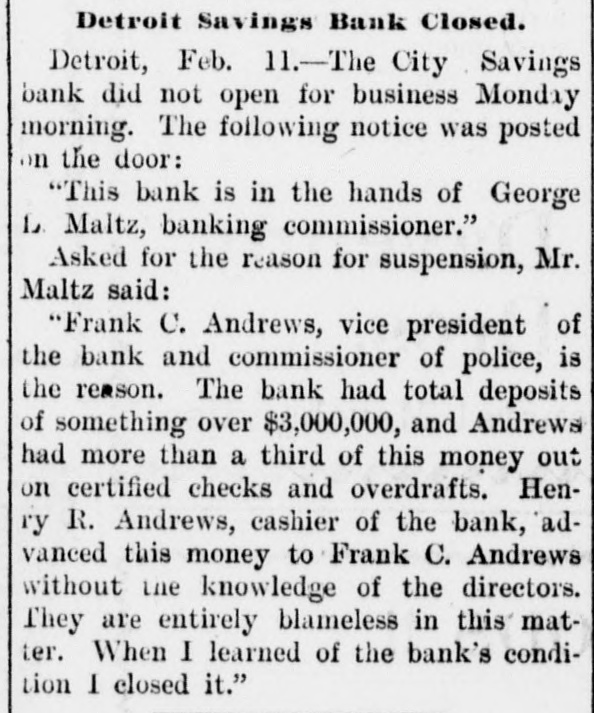
Detroit Savings Bank Closed. Detroit, Feb. 11.-The City Savings bank did not open for business Monday morning. The following notice was posted on the door: "This bank is in the hands of George L. Maltz, banking commissioner." Asked for the reason for suspension, Mr. Maltz said: "Frank C. Andrews, vice president of the bank and commissioner of police, is the reason. The bank had total deposits of something over $3,000,000, and Andrews had more than a third of this money out on certified checks and overdrafts. Henry R. Andrews, cashier of the bank, advanced this money to Frank C. Andrews without the knowledge of the directors. They are entirely blameless in this matter. When I learned of the bank's condition I closed it."


Article from The Nezperce Herald, February 14, 1902

Click image to open full size in new tab

Article Text

Detroit Savings Bank Closed. Detroit, Feb. 11.-The City Savings bank 'did not open for business Monday morning. The following notice was posted on the door: "This bank is in the hands of George L Maltz, banking commissioner." Asked for the reason for suspension, Mr. Maltz said: "Frank C. Andrews, vice president of the bank and commissioner of police, is the reason. The bank had total deposits of something over $3,000,000, and Andrews had more than a third of this money out on certified checks and overdrafts. Henry R. Andrews, cashier of the bank, andvanced this money to Frank C. Andrews without the knowledge of the directors. They are entirely blameless in this matter. When I learned of the bank's condition 1 closed it."


Article from The Florida Star, February 14, 1902

Click image to open full size in new tab

Article Text

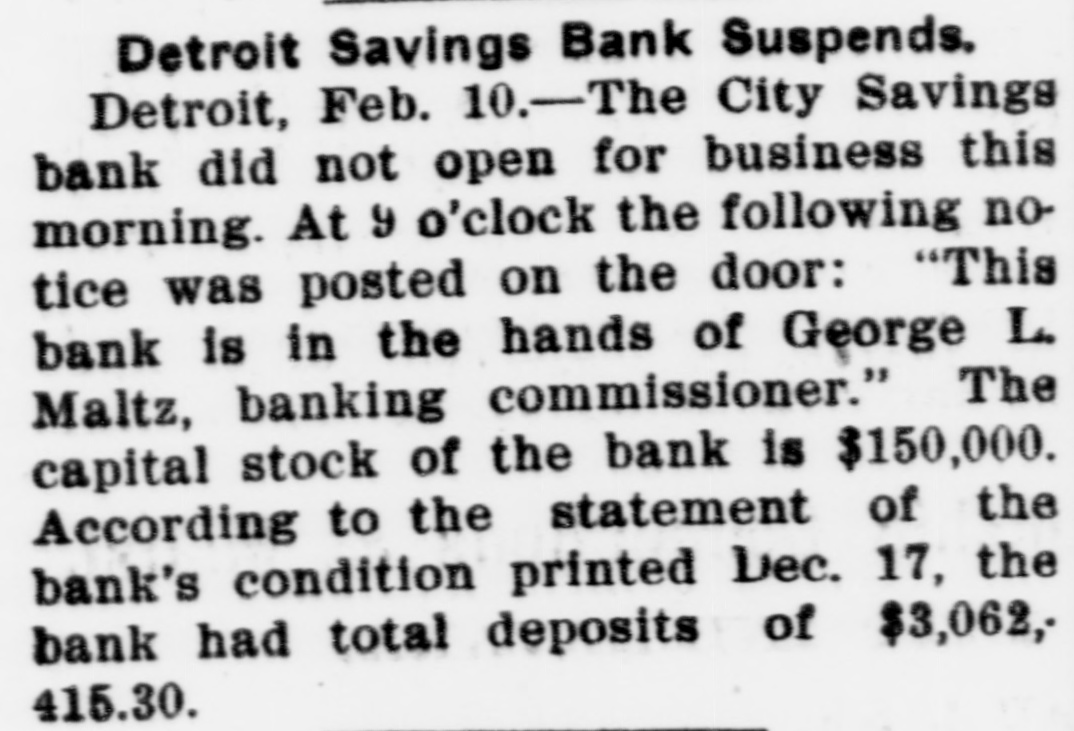
Detroit Savings Bank Suspends. Detroit, Feb. 10.-The City Savings bank did not open for business this morning. At y o'clock the following notice was posted on the door: "This bank is in the hands of George L. Maltz, banking commissioner." The capital stock of the bank is $150,000. According to the statement of the bank's condition printed Dec. 17, the bank had total deposits of $3,062,415.30.


Article from The Butte Inter Mountain, March 1, 1902

Click image to open full size in new tab

Article Text

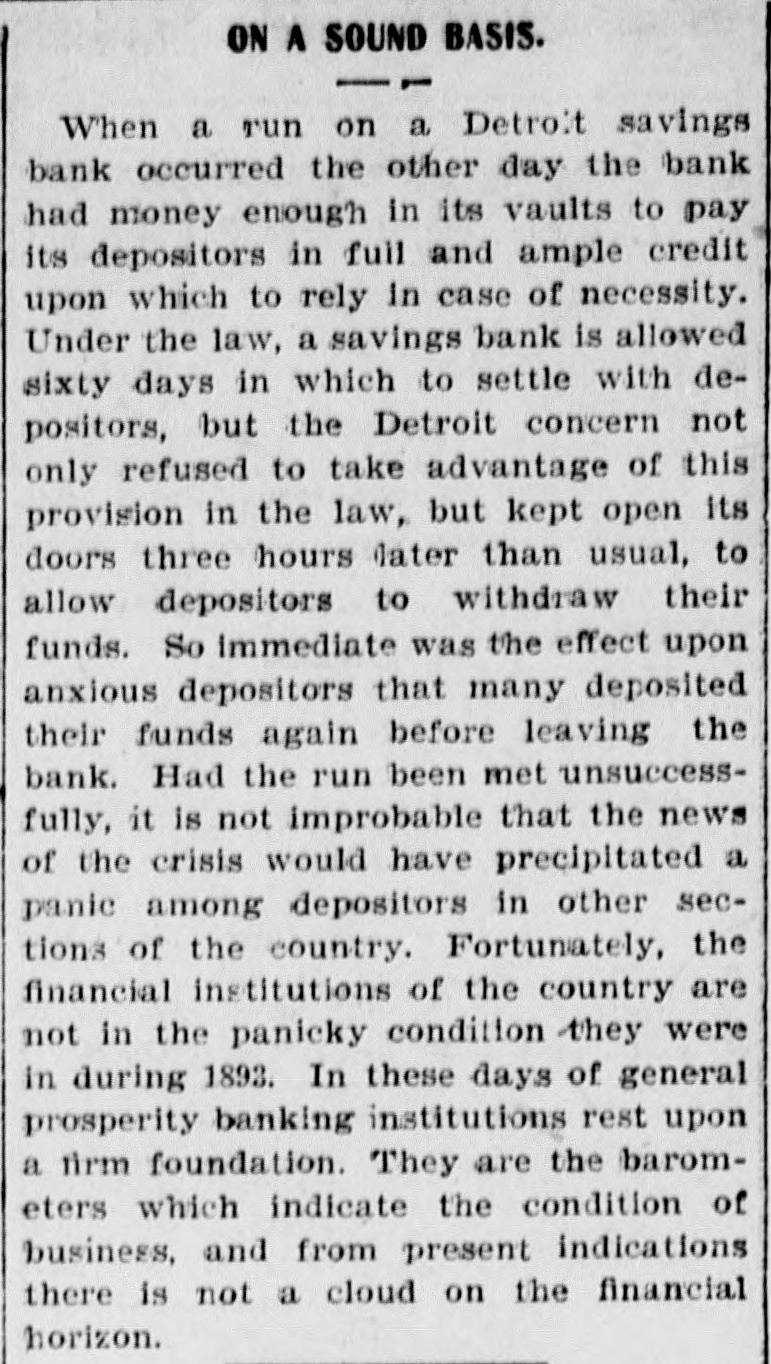
ON A SOUND BASIS. When a run on a Detroit savings bank occurred the other day the bank had money enough in its vaults to pay its depositors in full and ample credit upon which to rely in case of necessity. Under the law, a savings bank is allowed sixty days in which to settle with depositors, but the Detroit concern not only refused to take advantage of this provision in the law, but kept open its doors three hours later than usual, to allow depositors to withdraw their funds. So Immediate was the effect upon anxious depositors that many deposited their funds again before leaving the bank. Had the run been met unsuccessfully, it is not improbable that the news of the crisis would have precipitated a panic among depositors in other sections of the country. Fortunately, the financial institutions of the country are not in the panicky condition they were in during 1893. In these days of general prosperity banking institutions rest upon a firm foundation. They are the barometers which indicate the condition of business, and from present indications there is not a cloud on the financial horizon.


Article from New-York Tribune, March 16, 1902

Click image to open full size in new tab

Article Text

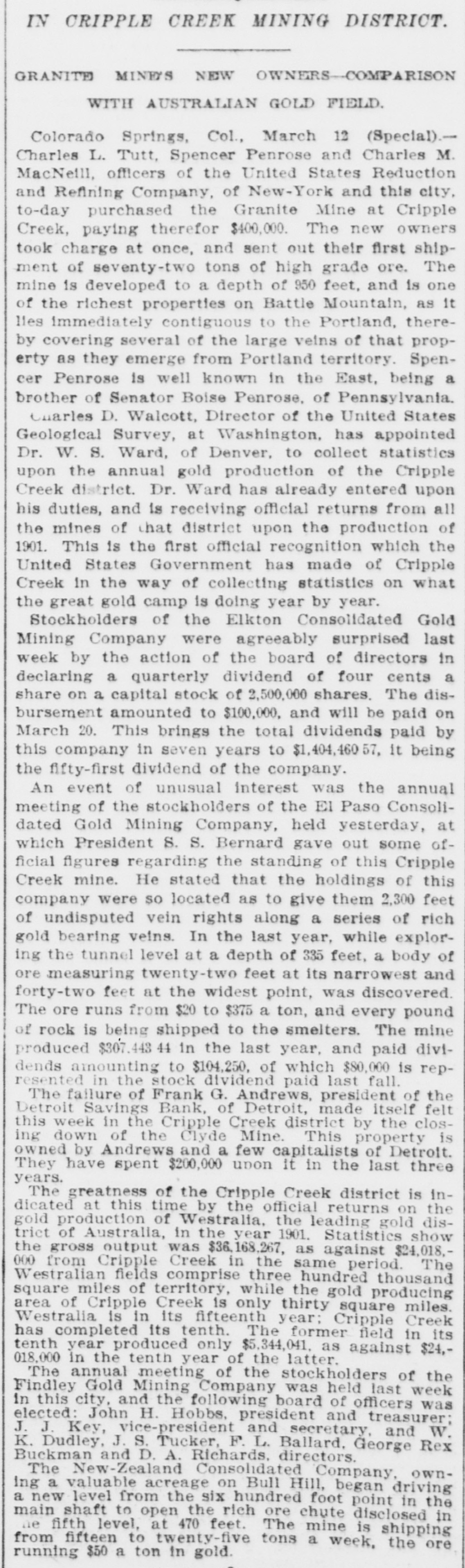
IN CRIPPLE CREEK MINING DISTRICT. GRANITE MINEYS NEW OWNERSCOMPARISON WITH AUSTRALIAN GOLD FIELD. Colorado Springs, Col., March 12 (Special).Charles L. Tutt. Spencer Penrose and Charles M. MacNelll, officers of the United States Reduction and Refining Company, of New-York and this city, to-day purchased the Granite Mine at Cripple Creek, paying therefor $400,000. The new owners took charge at once, and sent out their first shipment of seventy-two tons of high grade ore. The mine is developed to a depth of 950 feet, and is one of the richest properties on Battle Mountain, as it lies immediately contiguous to the Portland, thereby covering several of the large veins of that property as they emerge from Portland territory. Spencer Penrose is well known in the East, being a brother of Senator Boise Penrose, of Pennsylvania. Charles D. Walcott, Director of the United States Geological Survey, at Washington, has appointed Dr. W. S. Ward, of Denver, to collect statistics upon the annual gold production of the Cripple Creek district. Dr. Ward has already entered upon his duties, and is receiving official returns from all the mines of that district upon the production of 1901. This is the first official recognition which the United States Government has made of Cripple Creek in the way of collecting statistics on what the great gold camp is doing year by year. Stockholders of the Elkton Consolidated Gold Mining Company were agreeably surprised last week by the action of the board of directors in declaring a quarterly dividend of four cents a share on a capital stock of 2,500,000 shares. The disbursement amounted to $100,000, and will be paid on March 20. This brings the total dividends paid by this company in seven years to $1,404,460 57, it being the fifty-first dividend of the company. An event of unusual interest was the annual meeting of the stockholders of the El Paso Consolidated Gold Mining Company, held yesterday, at which President S. S. Bernard gave out some official figures regarding the standing of this Cripple Creek mine. He stated that the holdings of this company were so located as to give them 2,300 feet of undisputed vein rights along a series of rich gold bearing veins. In the last year, while exploring the tunnel level at a depth of 335 feet, a body of ore measuring twenty-two feet at its narrowest and forty-two feet at the widest point, was discovered The ore runs from $20 to $375 a ton, and every pound of rock is being shipped to the smelters. The mine produced $307.44 in the last year, and paid dividends amounting to $104,250. of which $80,000 is represented in the stock dividend paid last fall. The failure of Frank G. Andrews, president of the Detroit Savings Bank, of Detroit, made itself felt this week in the Cripple Creek district by the closing down of the Clyde Mine. This property is owned by Andrews and a few capitalists of Detroit. They have spent $200,000 upon it in the last three years. The greatness of the Cripple Creek district is indicated at this time by the official returns on the gold production of Westralia, the leading gold district of Australia, in the year 1901. Statistics show the gross output was $36,168,267. as against $24,018.000 from Cripple Creek in the same period. The Westralian fields comprise three hundred thousand square miles of territory, while the gold producing area of Cripple Creek is only thirty square miles. Westralia is in its fifteenth year; Cripple Creek has completed its tenth. The former field in its tenth year produced only $5,344,041. as against $24,018.000 in the tenth year of the latter. The annual meeting of the stockholders of the Findley Gold Mining Company was held last week in this city, and the following board of officers was elected: John H. Hobbs, president and treasurer; J. J. Key, vice-president and secretary, and W. K. Dudley, J. S. Tucker, F. L. Ballard, George Rex Buckman and D. A. Richards, directors. The New-Zealand Consolidated Company, owning a valuable acreage on Bull Hill, began driving a new level from the six hundred foot point in the main shaft to open the rich ore chute disclosed in ne fifth level, at 470 feet. The mine is shipping from fifteen to twenty-five tons a week, the ore running $50 a ton in gold.