7913. City Savings Bank (Detroit, MI)

Bank Information

Episode Type
Suspension โ†’ Closure
Bank Type
savings bank
Start Date
March 6, 1908
Location
Detroit, Michigan (42.331, -83.046)

Metadata

Model
gpt-5-mini
Short Digest
0fc4f834164bfc84

Response Measures

None

Description

Multiple articles (Mar 1908 onwards) repeatedly refer to the 'failed City Savings Bank' with the Union Trust Company acting as receiver. No articles describe a depositor run. The bank is in receivership (judge orders dividend in May 1908) and its real estate is auctioned in Feb 1909, indicating permanent closure. Dates use newspaper publication dates when specific failure dates are not given.

Events (4)

1. March 6, 1908 Receivership
Newspaper Excerpt
for which the Union Trust Company is receiver
Source
newspapers
2. March 6, 1908 Suspension
Cause
Government Action
Cause Details
Bank is described as 'failed' and a receiver (Union Trust Company) has been appointed; suspension/closure appears to be by receiver/court action
Newspaper Excerpt
the failed City Savings Bank, for which the Union Trust Company is receiver
Source
newspapers
3. May 4, 1908 Other
Newspaper Excerpt
The payment of another dividend to the depositors of the wrecked City Savings bank was ordered Monday morning by Judge Donovan.
Source
newspapers
4. February 20, 1909 Other
Newspaper Excerpt
Bidding was lively at the auction sale of City Savings bank real estate held at the county building ... The sale was conducted by the Union Trust Co., receiver for the defunct bank.
Source
newspapers

Newspaper Articles (10)

Article from The Evening World, March 6, 1908

Click image to open full size in new tab

Article Text

not in any way involved by any of Mr. Hance's financial difficulties. They also deny that the affairs of the failed City Savings Bank, for which the Union Trust Company is receiver, are entangled because of Mr. Hance's management. Mr. Hance was at his office yesterday as usual, and after supper last night spent the early evening at cards with his family. The suicide came on the eve of a two or three months' vacation with salary which the officers of the company were planning to give him. Close friends say that Mr. Hance's personal financial affairs had been badly entangled for some time and that he had been undergoing a tremendous mental strain as a result. About four weeks ago the Union Trust Company was in a measure reorganized, and Frank W. Blair, auditor of the People's State Savings Bank, was elected president, which office had been vacant for about a year following the death of William C. McMillan. While it is intimated by some that disappointment over the elevation of an outside man over him in the Union Trust Company contributed largely to Mr. Hance's depression. Henry Russell director and legal counsel, says that Mr. Hance had been told long before the election that he could not be made head of the institution.


Article from The Montgomery Advertiser, March 7, 1908

Click image to open full size in new tab

Article Text

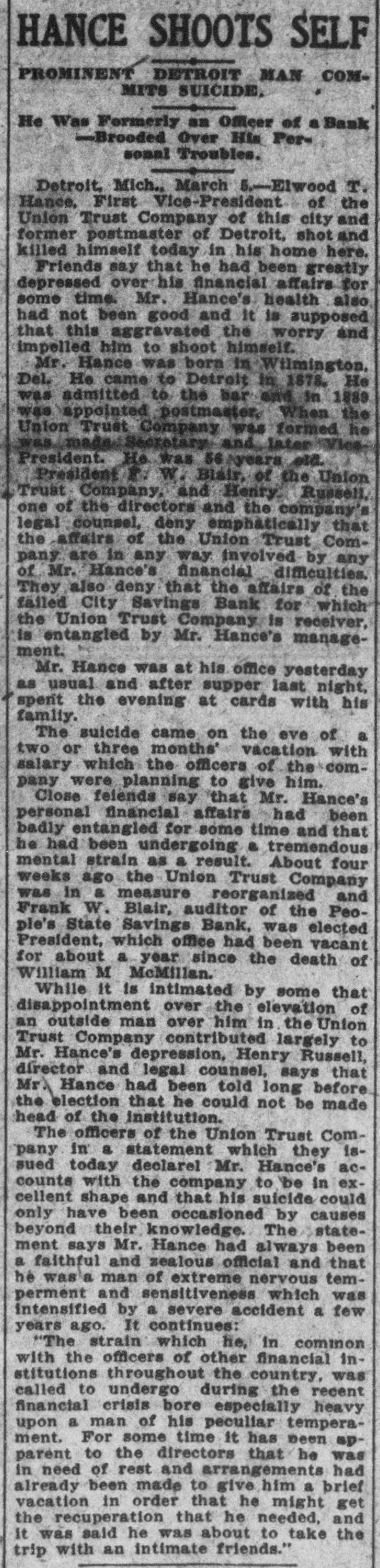
HANCE SHOOTS SELF PROMINENT DETROIT MAN COMMITS SUICIDE. He Was Formerly an Officer of a Bank Brooded Over His Personal Troubles. Detroit, Mich., March 5.-Elwood T. Hance, First Vice-President of the Union Trust Company of this city and former postmaster of Detroit, shot and killed himself today in his home here. Friends say that he had been greatly depressed over his financial affairs for some time. Mr. Hance's health also had not been good and It is supposed that this aggravated the worry and impelled him to shoot himself. Mr. Hance was born in Wtimington. Del. He came to Detroit in 1878. He was admitted to the bar and in 1889 was appointed postmaster, When the Union Trust Company was formed he was Secretary and later President. He was 56 grears eta. President F: W. Blair, of the Union Trust Company, and Henry. Russell, one of the directors and the company's legal counsel, deny emphatically that the affairs of the Union Trust Company are in any way involved by any of Mr. Hance's financial difficulties. They also deny that the affairs of the failed City Savings Bank for which the Union Trust Company is receiver, is entangled by Mr. Hance's management. Mr. Hance was at his office yesterday as usual and after supper last night, spent the evening at cards with his family. The suicide came on the eve of a two or three months' vacation with salary which the officers of the company were planning to give him. Close feiends say that Mr. Hance's personal financial affairs had been badly entangled for some time and that he had been undergoing a tremendous mental strain as a result. About four weeks ago the Union Trust Company was In a measure reorganized and Frank W. Blair, auditor of the People's State Savings Bank, was elected President, which office had been vacant for about a year since the death of William M McMillan. While It is intimated by some that disappointment over the elevation of an outside man over him in the Union Trust Company contributed largely to Mr. Hance's depression, Henry Russell, director and legal counsel, says that Mr. Hance had been told long before the election that he could not be made head of the institution. The officers of the Union Trust Company in a statement which they issued today declarel Mr. Hance's accounts with the company to be in excellent shape and that his suicide could only have been occasioned by causes beyond their knowledge. The statement says Mr. Hance had always been a faithful and zealous official and that he was'a man of extreme nervous temperment and sensitiveness which was intensified by a severe accident a few years ago. It continues: "The strain which he, in common with the officers of other financial institutions throughout the country, was called to undergo during the recent financial crisis bore especially heavy a man of his peculiar temperasome ment. upon For time it has that been he was upparent to the directors in need of rest and arrangements had been made to give him a brief in order already vacation that he he needed, might and get the recuperation that It was said he was about to take the trip with an intimate friends."


Article from The Bemidji Daily Pioneer, March 7, 1908

Click image to open full size in new tab

Article Text

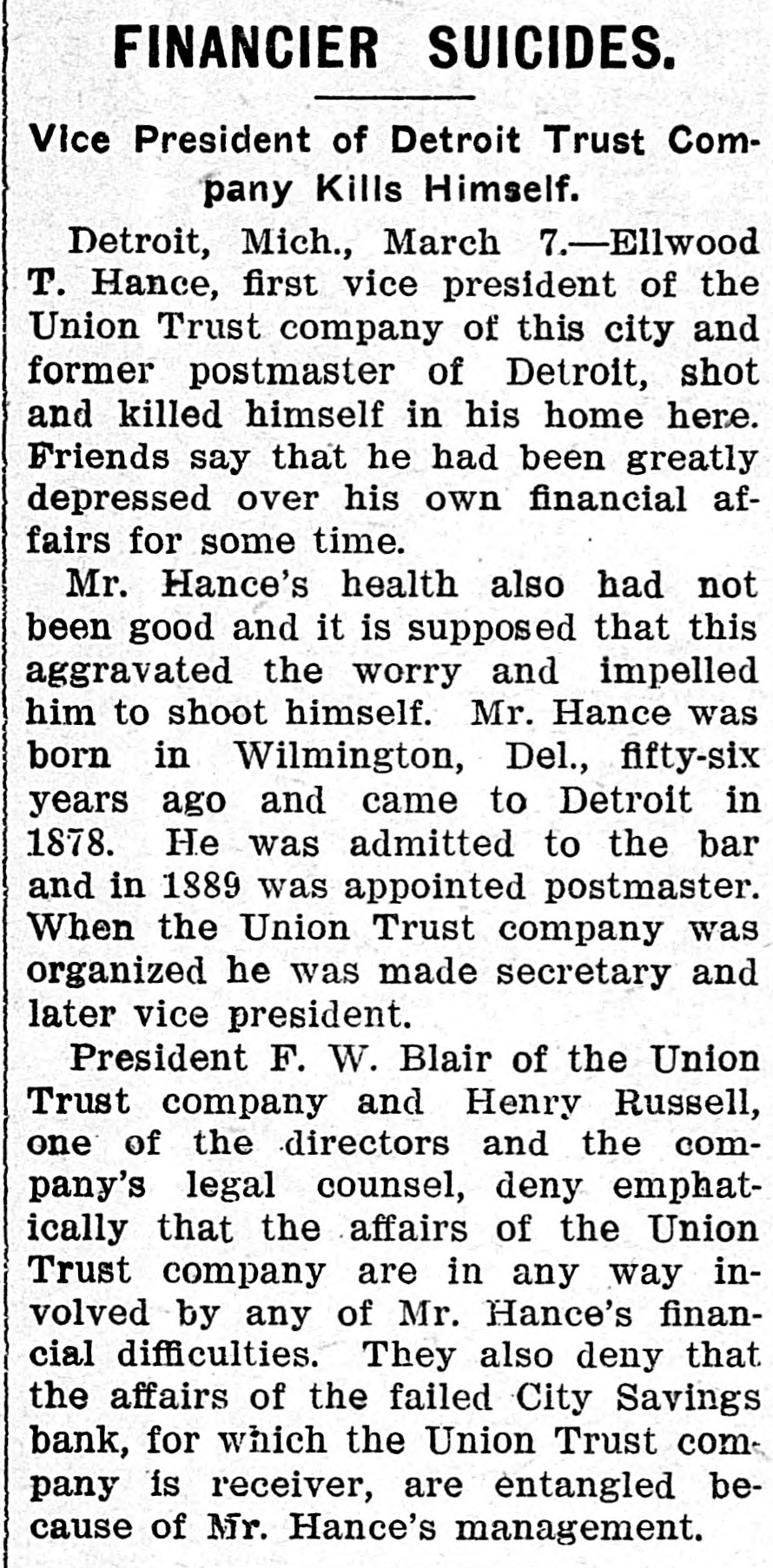
FINANCIER SUICIDES. Vice President of Detroit Trust Company Kills Himself. Detroit, Mich., March 7.-Ellwood T. Hance, first vice president of the Union Trust company of this city and former postmaster of Detroit, shot and killed himself in his home here. Friends say that he had been greatly depressed over his own financial affairs for some time. Mr. Hance's health also had not been good and it is supposed that this aggravated the worry and impelled him to shoot himself. Mr. Hance was born in Wilmington, Del., fifty-six years ago and came to Detroit in 1878. He was admitted to the bar and in 1889 was appointed postmaster. When the Union Trust company was organized he was made secretary and later vice president. President F. W. Blair of the Union Trust company and Henry Russell, one of the directors and the company's legal counsel, deny emphatically that the affairs of the Union Trust company are in any way involved by any of Mr. Hance's financial difficulties. They also deny that the affairs of the failed City Savings bank, for which the Union Trust company is receiver, are entangled because of Mr. Hance's management.


Article from The Salt Lake Herald, March 7, 1908

Click image to open full size in new tab

Article Text

# WORRY KILLS A # PROMINENT MAN Suicide of Ellwood T. Hance, Detroit Trust Company Official. # COMPANY NOT INVOLVED HIS OWN FINANCIAL AFFAIRS IN BAD SHAPE. Detroit, Mich., March 6.-Ellwood T. Hance, first vice president of the Union Trust company of this city, and former postmaster of Detroit, shot and killed himself early today in his home here. Friends say that he had been greatly depressed over his own financial affairs. His health has not been good for some time, and this is thought to have aggravated the worry. Mr. Hance was born in Wilmington, Del., fifty-six years ago, and came to Detroit in 1878. He was admitted to the bar, and in 1889 was appointed postmaster. When the Union Trust company was organized he was made secretary, and later vice president. # Trust Company Not Involved. President F. W. Blair of the Union Trust company, and Henry Russell, one of the directors and the company's legal counsel, deny emphatically that the affairs of the Union Trust company are in any way involved by any of Mr. Hance's financial difficulties. They also deny that the affairs of the failed City Savings bank, for which the Union Trust company is receiver, are entangled because of Mr. Hance's management. Mr. Hance was at his office yesterday, as usual, and spent the early evening at cards with his family. The suicide came just at the eve of a two or three months' vacation with salary, which the officers of the company were planning to give him. # Personal Affairs Entangled. Close friends say that Mr. Hance's personal affairs had been badly entangled for some time, and that he had been undergoing a tremendous mental strain as a result. About four weeks ago the Union Trust company was, in a measure, reorganized, and Frank W. Blair, auditor of the People's State Savings bank, was elected president which office had been vacant for about a year since the death of William C. McMillan. While it is intimated by some that disappointment over the elevation of an outside man over him in the Union Trust company contributed largely to Mr. Hance's depression, Henry Russell, director and legal counsel, says that Mr. Hance had been told long before the election that he could not be made head of the institution. # Official Statement. The officers of the Union Trust company in a statement issued at noon said: "The strain which he, in common with the officers of other financial institutions throughout the country, was called upon to undergo during the recent financial crisis, bore especially heavy upon a man of his peculiar temperament. For some time it has been apparent to the directors that he was in need of rest, and arrangements had already been made to give him a brief vacation. "He had no business relations with the company which could have been the occasion of any worry or depression, and his accounts and affairs are in excellent shape."
Article from Gainesville Daily Sun, March 8, 1908

Click image to open full size in new tab

Article Text

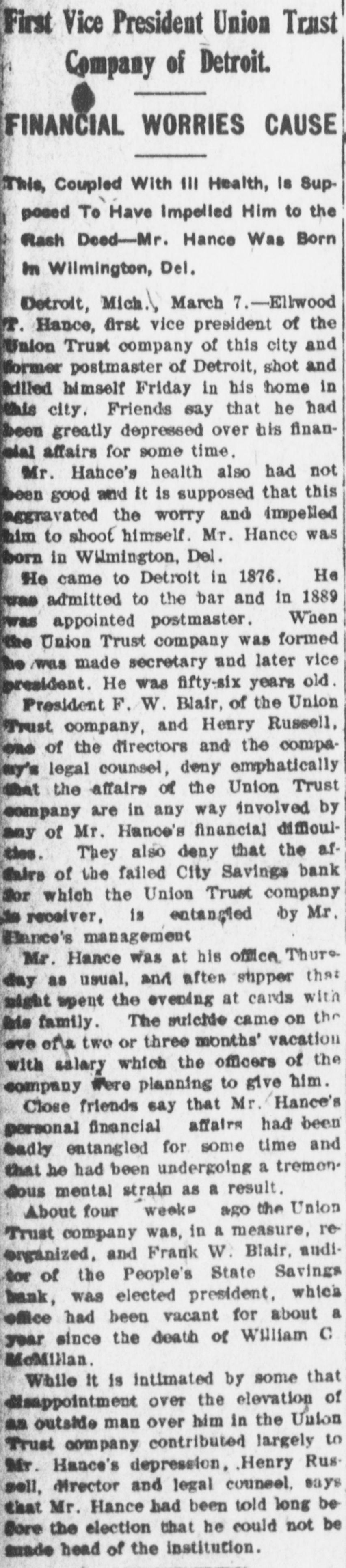
First Vice President Union Trust Company of Detroit. # FINANCIAL WORRIES CAUSE This, Coupled With Ill Health, Is Supposed To Have Impelled Him to the Rash Deed-Mr. Hance Was Born In Wilmington, Del. Detroit, Mich., March 7.-Ellwood T. Hance, first vice president of the Union Trust company of this city and former postmaster of Detroit, shot and killed himself Friday in his home in this city. Friends say that he had been greatly depressed over his finan-cial affairs for some time. Mr. Hance's health also had not been good and it is supposed that this aggravated the worry and impelled him to shoot himself. Mr. Hance was born in Wilmington, Del. He came to Detroit in 1876. He was admitted to the bar and in 1889 was appointed postmaster. When the Union Trust company was formed he was made secretary and later vice president. He was fifty-six years old. President F. W. Blair, of the Union Trust company, and Henry Russell, one of the directors and the company's legal counsel, deny emphatically that the affairs of the Union Trust company are in any way involved by any of Mr. Hance's financial difficulties. They also deny that the affairs of the failed City Savings bank for which the Union Trust company is receiver, is entangled by Mr. Hance's management Mr. Hance was at his office Thursday as usual, and after supper that night spent the evening at cards with his family. The suicide came on the eve of a two or three months' vacation with salary which the officers of the company were planning to give him. Close friends say that Mr. Hance's personal financial affairs had been badly entangled for some time and that he had been undergoing a tremen-dous mental strain as a result. About four weeks ago the Union Trust company was, in a measure, re-organized, and Frank W. Blair, audi-tor of the People's State Savings bank, was elected president, which office had been vacant for about a year since the death of William C. McMillan. While it is intimated by some that disappointment over the elevation of an outside man over him in the Union Trust company contributed largely to Mr. Hance's depression, Henry Russell, director and legal counsel, says that Mr. Hance had been told long before the election that he could not be made head of the institution.


Article from The Dakota Chief, March 12, 1908

Click image to open full size in new tab

Article Text

# A DETROIT TRAGEDY. Ellwood T. Hance, Former Postmaster, Shoots Himself. Ellwood T. Hance, aged 56, first vice president of the Union Trust company and former postmaster of Detroit, Mich., shot and killed himself early Friday. Friends say worry over financial affairs and ill health caused the deed. Officials of the Union Trust company deny emphatically that the affairs of the Union Trust company are in any way involved by any of Hance's financial difficulties. They also deny the affairs of the failed City Savings bank, for which the Union Trust company is receiver, are entangled because of Hance's management.


Article from The Charles Mix New Era, March 13, 1908

Click image to open full size in new tab

Article Text

# A DETROIT TRAGEDY. Ellwood T. Hance, Former Postmaster, Shoots Himself. Ellwood T. Hance, aged 56, first vice president of the Union Trust company and former postmaster of Detroit, Mich., shot and killed himself early Friday. Friends say worry over financial affairs and ill health caused the deed. Officials of the Union Trust company deny emphatically that the affairs of the Union Trust company are in any way involved by any of Hance's financial difficulties. They also deny the affairs of the failed City Savings bank, for which the Union Trust company is receiver, are entangled because of Hance's management,


Article from Dakota Farmers' Leader, March 13, 1908

Click image to open full size in new tab

Article Text

# A DETROIT TRAGEDY. Ellwood T. Hance, Former Postmaster, Shoots Himself. Ellwood T. Hance, aged 56, first vice president of the Union Trust company and former postmaster of Detroit, Mich., shot and killed himself early Friday. Friends say worry over financial affairs and ill health caused the deed. Officials of the Union Trust company deny emphatically that the affairs of the Union Trust company are in any way involved by any of Hance's financial difficulties. They also deny the affairs of the failed City Savings bank, for which the Union Trust company is receiver, are entangled because of Hance's management.


Article from The Detroit Times, May 4, 1908

Click image to open full size in new tab

Article Text

# ORDERS CITY # BANK DIVIDEND BUT JUDGE DONOVAN BELIEVES DELRAY WOULD BE ADVANTAGEOUS. The payment of another dividend to the depositors of the wrecked City Savings bank was ordered Monday morning by Judge Donovan. The amount of the dividend will not be known for several days, but will probably be 5 per cent to savings and 7 per cent to commercial depositors. The order was issued against the wishes of Judge Donovan, who believes that if he were given more time he could bring about a settlement of several of the larger claims, greatly increase the amount of the dividend, and cause a discharge of the receiver-ship. "Ordering a dividend at this time will tie up the matter for another year, at least, and perhaps longer," he says. "A settlement of the larger claims was not hopeless. The county auditors were ready to settle, so was Attorney General Bird, and only the city officials delayed matters.


Article from The Detroit Times, February 20, 1909

Click image to open full size in new tab

Article Text

# LIVELY BIDDING FOR # CITY BANK REALTY Bidding was lively at the auction sale of City Savings bank real estate held at the county building, Friday afternoon. The sale was conducted by the Union Trust Co., receiver for the defunct bank. The property offered was the last of the bank's realty holdings, and was part of the property on which the bank made a loan to Frank D. Andrus. Mr. Andrus bid in 48 lots on Fourteenth and Wabash-aves., for $15,500. Fred C. Shipman took one lot on the north side of the boulevard, between Second and Third-aves., for $1,825.