Articles use West Superior variant; suspension described as an assignment and later reorganization.
Events (4)
1.November 26, 1890Run
Cause
Local Banks
Cause Details
Run triggered by the failure of Bell & Eyster bank in Duluth, causing depositors to withdraw funds.
Measures
Other banks came to the assistance of the firm that night to restore confidence.
Newspaper Excerpt
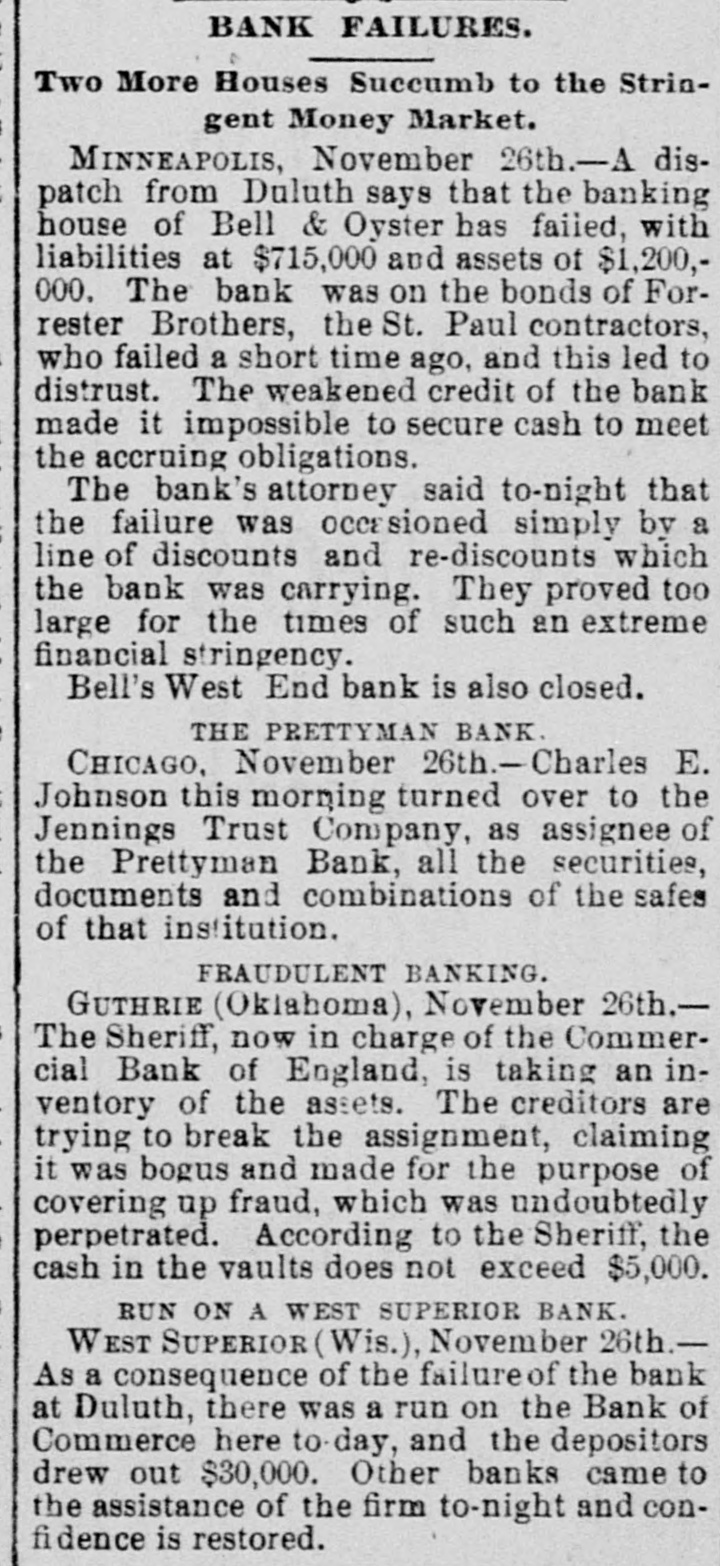
As a consequence of the failure of the bank at Duluth, there was a run on the Bank of Commerce to-day, and the depositors drew out $30,000.
Source
newspapers
+6 days
2.December 2, 1890Suspension
Cause
Local Banks
Cause Details
Unable to withstand large withdrawals (linked to Duluth bank failure) and could not obtain outside aid; resulted in assignment/suspension.
Newspaper Excerpt
The Bank of Commerce assigned to-day. Its deposits have been reduced nearly $200,000 since last Wednesday. The institution was unable to stand the drain or obtain outside aid.
Source
newspapers
+20 days
3.December 22, 1890Other
Newspaper Excerpt
W. H. Slack, as receiver of the defunct Bank of Commerce, has filed with the clerk of the Circuit Court a statement showing the condition of the affairs of the bank. ... The banking company will reorganize to-day with a capital of $200,000.
Source
newspapers
+42 days
4.February 2, 1891Reopening
Newspaper Excerpt
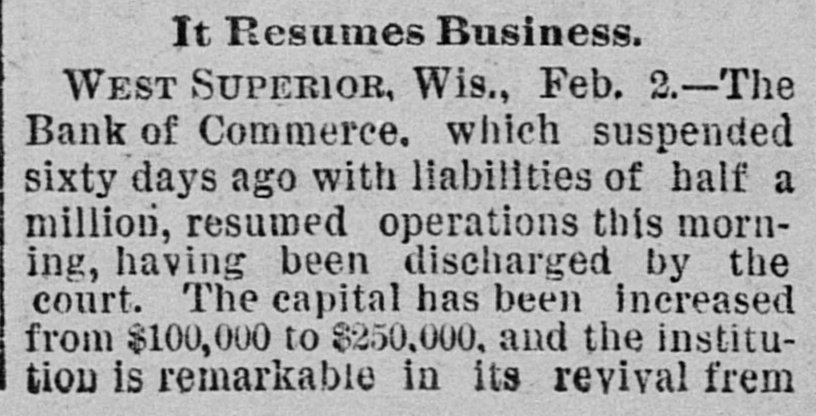
The Bank of Commerce, which suspended sixty days ago with liabilities of half a million, resumed operations this morning, having been discharged by the court.
Source
newspapers
Newspaper Articles (21)
1.November 27, 1890Sacramento Daily Record-UnionSacramento, CA
Click image to open full size in new tab
Article Text
BANK FAILURES
Two More Houses Succumb to the Stringent Money Market. MINNEAPOLIS, November 26th.-A dispatch from Duluth says that the banking house of Bell & Oyster has failed, with liabilities at $715,000 and assets of $1,200,000. The bank was on the bonds of Forrester Brothers, the St. Paul contractors, who failed a short time ago, and this led to distrust. The weakened credit of the bank made it impossible to secure cash to meet the accruing obligations. The bank's attorney said to-night that the failure was occasioned simply by a line of discounts and re-discounts which the bank was carrying. They proved too large for the times of such an extreme financial stringency. Bell's West End bank is also closed. THE PRETTYMAN BANK. CHICAGO, November 26th.-Charles E. Johnson this morning turned over to the Jennings Trust Company, as assignee of the Prettyman Bank, all the securities, documents and combinations of the safes of that institution. FRAUDULENT BANKING. GUTHRIE (Oklahoma), November 26th.The Sheriff, now in charge of the Commercial Bank of England, is taking an inventory of the assets. The creditors are trying to break the assignment, claiming it was bogus and made for the purpose of covering up fraud, which was undoubtedly perpetrated. According to the Sheriff, the cash in the vaults does not exceed $5,000. RUN ON A WEST SUPERIOR BANK. WEST SUPERIOR (Wis.), November 26th.As a consequence of the failure of the bank at Duluth, there was a run on the Bank of Commerce here to-day, and the depositors drew out $30,000. Other banks came to the assistance of the firm to-night and confidence is restored.
WEST SUPERIOR, Wis., Nov. 26.-As a consequence of the failure of a bank at Duluth, there was a run on the Bank of Commerce to-day, and depositors drew out $30,000. Other banks came to its assistance to-night and confidence is restored.
3.November 27, 1890The Salt Lake HeraldSalt Lake City, UT
Click image to open full size in new tab
Article Text
A Consequence of the Failure
WEST SUPERIOR, Wis., Nov. 26.-As a consequence of the failure of the bank at Duluth. there was a run on the Bank of Commerce to day, and depositors drew out $30,000. Other banks came to its assistance to-night and confidence is restored.
4.November 27, 1890Spokane Falls ReviewSpokane, Spokane Falls, WA
Click image to open full size in new tab
Article Text
Run on a Bank
WEST SUPERIOR, Wis., Nov. 26.-As a consequence of the failure of the bank at Duluth there was a run on the Bank of Commerce to-day, and depositors drew out $30,000. Other banks came to its assistance to-night and confidence is restored.
5.December 3, 1890The Helena IndependentHelena, MT
Click image to open full size in new tab
Article Text
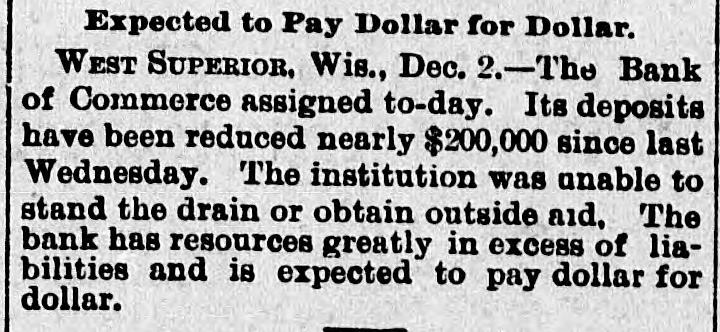
Expected to Pay Dollar for Dollar. WEST SUPERIOR, Wis., Dec. 2.-The Bank of Commerce assigned to-day. Its deposits have been reduced nearly $200,000 since last Wednesday. The institution was unable to stand the drain or obtain outside aid, The bank has resources greatly in excess of liabilities and is expected to pay dollar for dollar.
6.December 3, 1890Los Angeles HeraldLos Angeles, CA
Click image to open full size in new tab
Article Text
Another Bank Assignment
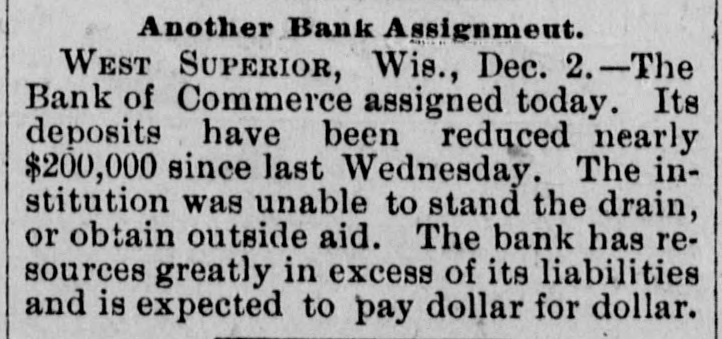
WEST SUPERIOR, Wis., Dec. 2.-The Bank of Commerce assigned today. Its deposits have been reduced nearly $200,000 since last Wednesday. The institution was unable to stand the drain, or obtain outside aid. The bank has resources greatly in excess of its liabilities and is expected to pay dollar for dollar.
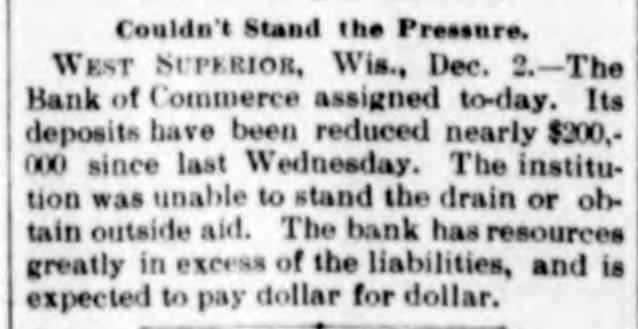
WEST SUPERIOR, Wis., Dec. 2.-The Bank of Commerce assigned to-day. Its deposits have been reduced nearly $200,000 since last Wednesday. The institution was unable to stand the drain or obtain outside aid. The bank has resources greatly in excess of the liabilities, and is expected to pay dollar for dollar.
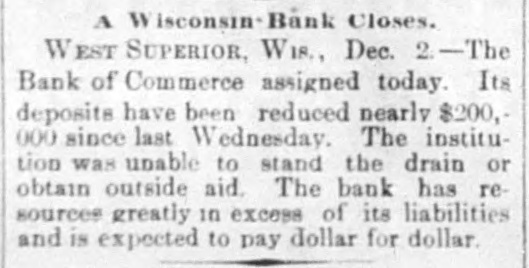
WEST SUPERIOR, Wis,, Dec. 2-The Bank of Commerce assigned today. Its deposits have been reduced nearly $200,000 since last Wednesday. The institution was unable to stand the drain or obtain outside aid. The bank has resources greatly in excess of its liabilities and is expected to pay dollar for dollar.
9.December 3, 1890Sacramento Daily Record-UnionSacramento, CA
Click image to open full size in new tab
Article Text
WEST SUPERIOR (Wis
), December 2d.The Bank of Commerce assigned to-day.
10.December 4, 1890Spokane Falls ReviewSpokane, Spokane Falls, WA
Click image to open full size in new tab
Article Text
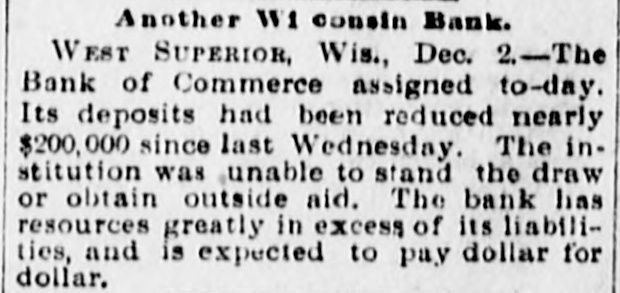
Another W1 consin Bank
WEST SUPERIOR, Wis., Dec. 2.-The Bank of Commerce assigned to-day. Its deposits had been reduced nearly $200,000 since last Wednesday. The institution was unable to stand the draw or obtain outside aid. The bank has resources greatly in excess of its liabilities, and is expected to pay dollar for dollar.
11.December 5, 1890The TimesOwosso, MI
Click image to open full size in new tab
Article Text
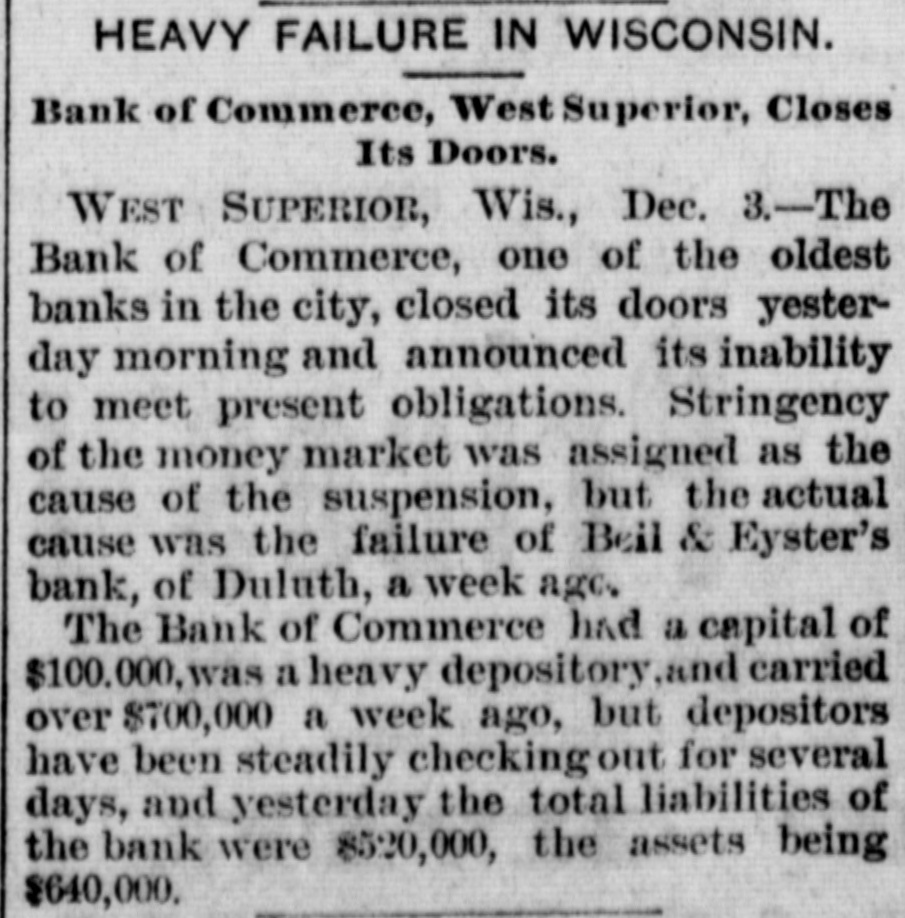
HEAVY FAILURE IN WISCONSIN
Bank of Commerce, West Superior, Closes Its Doors. WEST SUPERIOR, Wis., Dec. 3.-The Bank of Commerce, one of the oldest banks in the city, closed its doors yesterday morning and announced its inability to meet present obligations. Stringency of the money market was assigned as the cause of the suspension, but the actual cause was the failure of Beil & Eyster's bank, of Duluth, a week age. The Bank of Commerce hAd a capital of $100,000,was a heavy depository and carried over $700,000 a week ago, but depositors have been steadily checking out for several days, and yesterday the total liabilities of the bank were $520,000, the assets being $640,000.
12.December 6, 1890Daily Kennebec JournalAugusta, ME
Click image to open full size in new tab
Article Text
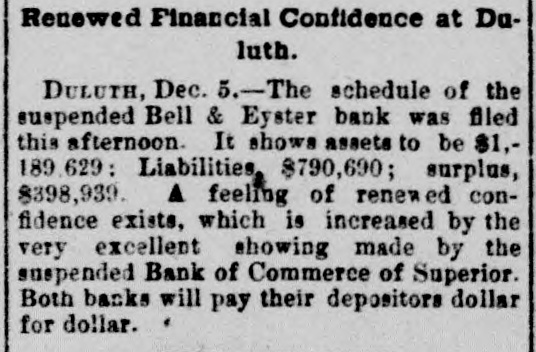
Renewed Financial Confidence at Duluth
DULUTH, Dec. 5.-The schedule of the suspended Bell & Eyster bank was filed this afternoon. It shows assets to be $1,189.629: Liabilities $790,690; surplus, A $398,939. feeling of renewed confidence exists, which is increased by the very excellent showing made by the suspended Bank of Commerce of Superior. Both banks will pay their depositors dollar for dollar.
13.December 6, 1890The Superior TimesSuperior, WI
Click image to open full size in new tab
Article Text
oua Suutomt fungo was found tacked to the of the Bank of Commerce: his bank will not open today, ) the continued stringency in y market. Will continue as soon as we can realize sent at this notice took the people ise does not half express it. in the bank the Wednesday : had been met and overe e confidence had been establis he bank had been extensively sed as not only solvent but trongest institutions of the not strange, then, that the generally should be greatly 1 when such a notice stared e face Tuesday morning. ses were offered for the : will now be very hard to eople believe any of them. ing Leader of Wednesday, ing the case has this to say: e run which the bank experier Wednesday, while it did not aterially affect it, WAS in serious than it seemed to be. number of accounts were ut through other banks-a 000 going out in this manner, , however, had hoped to tide afely, anl would have not their New York corres the Bank of North America, inted them. That bank d to rediscount for then to int of $50,000. They receive ram during the afternoon ng this. Comptroller Larson e meantime telegraphed 1 & Co., to place $150.00 e city for bonds in the h America to the credit of : of Commerce. Later on on sent another telegram roceeds of the bonds to be ted among the banks of were entitled to receive y, acording to the capital ch. The Bank of Commerce d during the latter part of noon another telegram from : of North America announ they had reconsidered their : to rediscount and would being necessary for them to their loans. This was a er and placed the bank in a us position. A meeting of ers of the city was held ing and the condition of the ommerce was discussed. asked that another telegran to the Bank of North ining that the one sent by
14.December 6, 1890Evening JournalWilmington, DE
Click image to open full size in new tab
Article Text
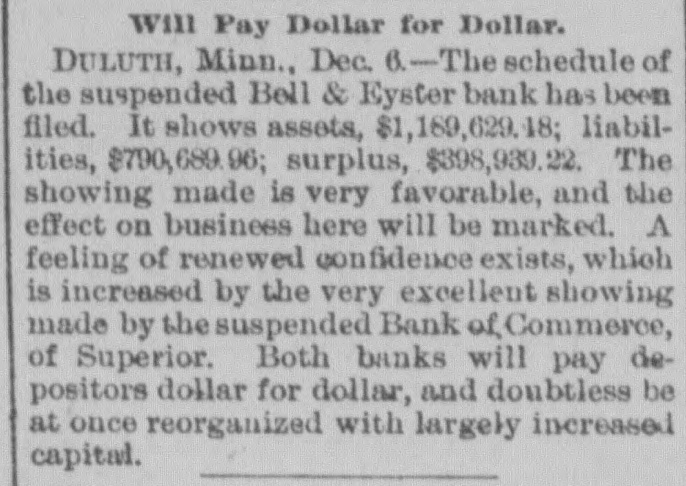
Will Pay Dollar for Dollar
DULUTH, Minn., Dec. 6.-The schedule of the suspended Bell & Eyster bank has been filed. It shows assets, $1,169,629.48; liabilities, $790,689.96; surplus, $398,939.22. The showing made is very favorable, and the effect on business here will be marked. A feeling of renewed confidence exists, which is increased by the very excellent showing made by the suspended Bank of, Commerce, of Superior. Both banks will pay depositors dollar for dollar, and doubtless be at once reorganized with largely increased capital.
15.December 6, 1890St. Paul Daily GlobeSaint Paul, MN
Click image to open full size in new tab
Article Text
A Favorable Showing, DULUTH, Minn., Dec. 5.-The schedule of the suspended Bell & Eyster bank was filed this afternoon. The showing made is very favorable, and the effect upon business here will be marked. A. feeling of renewed confidence exists, which is increased by the very excellent showing made by the suspended Bank of Commerce, of Superior. Depositors of both banks will be paid dollar for dollar, and both will doubtless be at once reorganized with largely increased capital.
16.December 24, 1890The EnterpriseWellington, OH
Click image to open full size in new tab
Article Text
Suspended Bank Will Reorganize
WEST SUPERIOR, Wis., Dec. 22.-W. H. Slack, as receiver of the defunct Bank of Commerce, has filed with the clerk of the Circuit Court a statement showing the condition of the affairs of the bank. The schedule of assets shows a total of $665,515, against $546,339 of liabilities. The banking company will reorganize to-day with a capital of $200,000.
17.January 23, 1891St. Paul Daily GlobeSaint Paul, MN
Click image to open full size in new tab
Article Text
Financial Transfusion
Special to the Globe. WEST SUPERIOR, Wis., Jan. 22.-The Bank of Commerce, which suspended on Dec. 22, will reopen its doors for business on Feb. 2. The bank has been entirely reorganized. Considerable outside capital having been put into the enterprise. Andrew Crawford, S. B. and C. C. Hase, of Chicago; Gen. J. H. Mul!en, of Minnesota, and E. T. Buxton, of New York, putting $150,000 into the institution.
18.January 23, 1891St. Paul Daily GlobeSaint Paul, MN
Click image to open full size in new tab
Article Text
Financial Transfusion
Special to the Globe. WEST SUPERIOR, Wis., Jan. 22.-The Bank of Commerce, which suspended on Dec. 22, will reopen its doors for business on Feb. 2. The bank has been entirely reorganized. Considerable outside capital having been put into the enterprise. Andrew Crawford, S. B. and C. C. Hase. of Chicago; Gen. J. H. Mullen, of Minnesota, and E. T. Buxton, of New York, putting $150,000 into the institution.
19.February 3, 1891St. Paul Daily GlobeSaint Paul, MN
Click image to open full size in new tab
Article Text
It Resumes Business
WEST SUPERIOR, Wis., Feb. 2.-The Bank of Commerce. which suspended sixty days ago with liabilities of half a million, resumed operations this morning, having been discharged by the court. The capital has been increased from $100,000 to $250,000, and the institution is remarkable in its revival frem
20.February 3, 1891Omaha Daily BeeOmaha, NE
Click image to open full size in new tab
Article Text
Bank of Commerce Reopens
WEST SUPERIOR, Wis., Feb. 2.-The Bank of Commerce, which assigned several months ago, reopened its doors this morning under the same name and with increased capital.
21.February 3, 1891Rock Island Daily ArgusRock Island, IL
Click image to open full size in new tab
Article Text
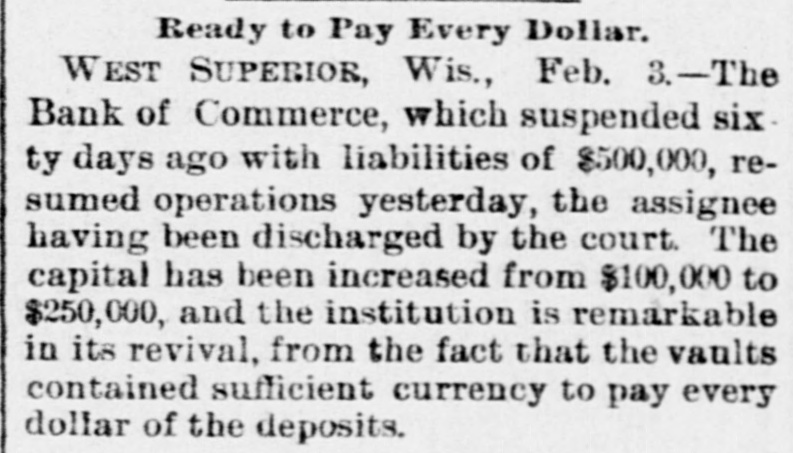
Ready to Pay Every Dollar
WEST SUPERIOR, Wis., Feb. 3.-The Bank of Commerce, which suspended sixty days ago with liabilities of $500,000, resumed operations yesterday, the assignee having been discharged by the court. The capital has been increased from $100,000 to $250,000, and the institution is remarkable in its revival, from the fact that the vaults contained sufficient currency to pay every dollar of the deposits.
Bank runs are almost always and everywhere a deterioration of bank fundamentals.
But not for you.
You are the measure-zero exception: great fundamentals, solid bank, and yet the Diamond Dybvig fairy spread its rumor. Depositors woke up. Your collateral was not prepositioned. The Clearinghouse had it for you.
Do not pass Go. Do not collect $200. Go directly to jail… or worse.