7900. Franklin Bank (Boston, MA)

Bank Information

Episode Type
Run → Suspension → Closure
Bank Type
state
Start Date
January 13, 1838
Location
Boston, Massachusetts (42.358, -71.060)

Metadata

Model
gpt-5-mini
Short Digest
ccfb451f

Response Measures

Full suspension

Other: Multiple articles describe Franklin Bank as having failed/suspended in 1836–1838 amid the broader Boston banking crisis tied to government drafts and mismanagement.

Description

Contemporary articles (Jan–Apr 1838) describe the Franklin Bank of Boston as having been run upon, indicted for mismanagement, and listed among failed/exploded banks alongside Commonwealth and Lafayette. The bank stopped/specifically 'failed' (suspended specie payments) and is discussed as one of the institutions to be wound up — indicating permanent closure. OCR in articles shows some inconsistent years (e.g., '1836' in one piece) but broader context and publication dates place events in Jan 1838.

Events (2)

1. January 13, 1838 Suspension
Cause
Government Action
Cause Details
Articles state failures were caused or accelerated by inability to meet government drafts/deposits being called (government demands on deposited public money).
Newspaper Excerpt
The Franklin having been one, and both have failed on government demands... The Franklin Bank ... failed some time since.
Source
newspapers
2. January 16, 1838 Run
Cause
Bank Specific Adverse Info
Cause Details
Press describes indictments, mismanagement, officers indicted and loans to insiders; loss of confidence led to heavy withdrawals ('run upon').
Measures
None reported in these articles (no temporary liquidity measures described).
Newspaper Excerpt
The Market Bank ... that it has been seriously run upon ... Franklin Bank (president, cashier and directors, indicted, and are to be tried for mismanagement; ... will pay probably 15 cents).
Source
newspapers

Newspaper Articles (8)

Article from Richmond Enquirer, January 18, 1838

Click image to open full size in new tab

Article Text

BASKRUPTCT.-The failure of the Commonwealth Bank of Boston, has produced great excitement in that City, and several meetings were held among the officers of the Bank Association.-' The result of their canvassings was the striking the name of the Commonwealth Bank from the roll of the Association. The refusal to receive its bills on deposite seals the news of the failure, but the Boston Post expresses a belief that its bills will be ultimately redeemed. The failure was caused by Government drafts, which the Bank was unable to meet. This is the second deposite bank which has failed in Bos. ton, the Franklin having been one, and both have failed on government demands. The bills of nearly half the banks in that city were mutually refused on deposite during Friday, but the Board of Commissioners on Saturday published their intention, that the bills of the associated banke will henceforth bo received in good faith by the banks belonging to the association. The Commonwealth, Franklin, and Lafayette Banks do not belong to the association, and the Massachusetts Bank, which since its foundation. never suspended specie payments, has never joined it." A Correspondent of the National Intelligencer states, "that the Commonwealth Bank has a very large amount of bills in circulation. All the fishing bounties in this State have lately been paid out in their bills. Some few individuals owe them a large amount. John K. Simpson, in particular, owed them a very heavy sum, and his (recent) death has probably hastened their destruction. He was President of the Bank."


Article from Morning Herald, January 20, 1838

Click image to open full size in new tab

Article Text

[From our Evening Edition of yesterday.] [From our Boston Correspondent. Excitement in Boston-Commonwealth and other broken Banks,-Middsesex Bank-A row anticipated. BOSTON, Jan. 16,1836. We are in a state of great uneasiness and feeverish excitement. Since the failure of the Commonwealth Bank, and the upsetting of some half a dozen hitherto supposed wealthy individnals the public have felt that not only the Commonwealth, but most of the Boston Banks are insolvent. There are many circumstances which have led them to this opinion. One or two I will mention. 1. The Commonwealth Bank is one of the oldest in the State. The confidence of the people in that institution was unbounded. Many rumors have been put in circulation from time to time about other banks touching their solvency, but the name of the Commonwealth, was never mentioned. It was considered as firm as the Everlasting Hills." 2. When the failure of the Commonwealth was known, the different banks in the city would not, in many instances, receive any bills, (excepting their own) on deposite, or in payment of notes. The' State Bank which belongs to the " Associated Banks" came out and gave a list of Sixteen different Banks, whose bills they would not receive. 3. The banks were many of them sued, and their apecie attached. All classes were seen going to and fro with their hands full of rags, in order to obtain the better currency." Brokers asked ten per cent for specie, and received it in exchange for rags ! You are aware that we have an Association" of the different banks, for the purpose of sustaining the whole of the Boston banks. The Association was formed immediately after the suspension of specie payments. Since that time, however, three of the Boston " Associated Banks" have failed. Knowing that New York is flooded with small bills of Boston banks, my immediate object is to make known, through your judicious journal, the banks which are in. solvent. I wish that your numerous readers would bear in mind the names of the "lame ducks" which are insolvent. LAFAYETTE BANK. FRANKLIN BANK. COMMONWEALTH BANK. CHELSEA BANK. NAHANT BANK. The Suffolk Bank, which is considered the "cock of the walk," has decided that the Middlesex Bank is down. How that is, I do not know-butI would urge the New Yorkers not to keep many of the Boston rags OR hand, for if Bostonians have no confidence in them, why should the New Yorkers? Last evening there was a large collection in State street, before the Commonwealth Bank. It wasexpectwould be a serious riot man was ed that there for the A of having de spatched to the Navy Yard, purpose a company of marines ready at a warning-when the bell on Brattle street should toll but nothing was then done. How soon there will be remains to be seen. Again, 1 say to the readers of "Bennett's Herald"Beware how you take Boston rags. Yours truly, C.H.


Article from The Madisonian, January 23, 1838

Click image to open full size in new tab

Article Text

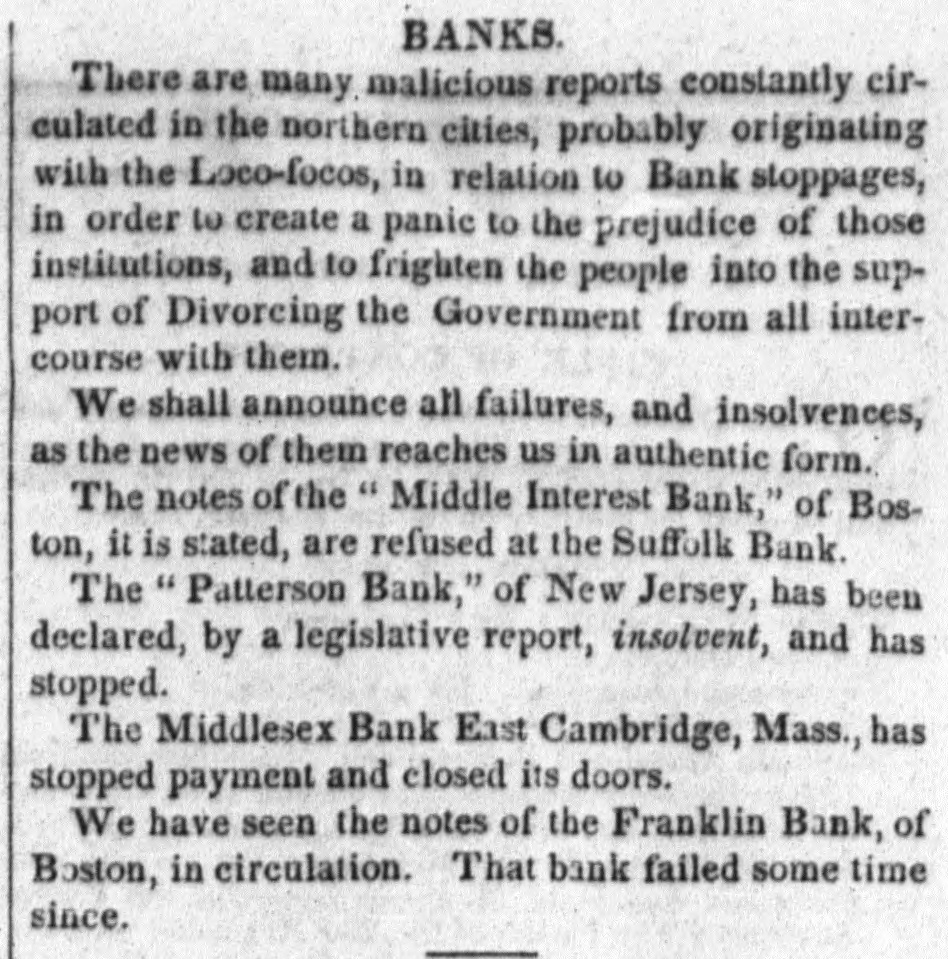
BANKS. There are many malicious reports constantly circulated in the northern cities, probably originating with the Loco-focos, in relation to Bank stoppages, in order to create a panic to the prejudice of those institutions, and to frighten the people into the support of Divorcing the Government from all intercourse with them. We shall announce all failures, and insolvences, as the news of them reaches us in authentic form. The notes of the "Middle Interest Bank," of Boston, it is stated, are refused at the Suffolk Bank. The "Patterson Bank," of New Jersey, has been declared, by a legislative report, insolvent, and has stopped. The Middlesex Bank East Cambridge, Mass., has stopped payment and closed its doors. We have seen the notes of the Franklin Bank, of Boston, in circulation. That bank failed some time since.


Article from The Caledonian, January 23, 1838

Click image to open full size in new tab

Article Text

From the Boston Atlas of January 13. # FAILURE OF THE COMMONWEALTH BANK, OF BOSTON. An extraordinary degree of sensation was produc- ed yesterday in this city by the announcement that the Commonwealth Bank, the favorite pet bank of the administration of this city, controlled exclusively by friends of the administration, and enjoying a large share of its bounty, had STOPPED PAYMENT. Startling as was this event to a large portion of the community, it was no matter of surprise to ourselves. It had been in a measure predicted in the columns of the Atlas several months previous; and the at- tention of the public had been repeatedly directed to the unsound condition of the bank. We invite the attention of our readers to the following remark- able passages. From the Atlas of June 5th, 1837. "Is it not true that one of the deposite banks in this city-the bank of the new fashioned "Democ- racy" (!!)-the Pet par excellence of the administra- tion-would have been compelled to stop payment on the day of the general suspension, even if the banks in New York and this city had continued to pay? Was it not brought up short the day before unable to pay its balances and with a few pieces of foreign gold and less than an hundred dollars in silver for the sum total of specie in its vaults?" From the Atlas of June 2d, 1837. "No sooner did they receive the deposites, than the pet banks commenced a career of the most blind, reekless and profligate speculations that ever dis- graced any age or nation. And who took the lead in them? Pet Bank Directors, officers and stock- holders-custom house officers-navy agents-lead- ing partizans of the administration. And where did the money come from? What paid for Eastern Lands, Western Lands, the piles of Granite on our wharves to insinuate nothing of the monument of Spoils Patriotism in the vicinity of Dorchester Heights? BILLS OF THE PET BANKS. And to whom were these loaned? To the whig merchant? NOT AT ALL. To the noisy partizan and the hopeful convert. The Pet Banks had a double duty of payment and proselytism; they were to reward the fidelity of old friends, to enlighten, encourage and stimulate the new born zeal of the converted." We do not wonder that the loco focos regard banks as dangerous institutions if they suppose them to be conducted as the result proves theirs to have been. We believe the fact is generally notorious that three or four of the principal stock-holders were indebted to the Commonwealth Bank to AN AMOUNT EXCEEDING THE ACTUAL CAPITAL!! We regard this disastrous explosion as directly chargeable upon the immediate friends and bene- ficiaries of the administration in this city. It is one of the legitimate fruits of the experiment. The pre- monitory symptoms were exhibited some months since in the crash of the auxiliary pet banks-the Franklin and the Lafayette. And now the mother pet, from which they drew their sustenance, has fallen through with them! The bank, which, pam- pered with the lavish deposits of the government treasure, undertook to exhaust the energies and prostrate the credit of the U. S. Branch Bank in this city, has itself fallen a victim to the experiment in which it was a particeps criminis: The retribu- tion is just, so far as it concerns itself, but the con- sequences to the community are indeed deplorable. We have not learned the exact amount of govern- ment money which has been swamped by this fail- ure, but is said to be $370,000. But there is one notorious fact connected with this event of a most extraordinary character. It is of a piece with many other vile transactions of the agents and officers of this administration. The fishermen of Gloucester, Marblehead, and other seaport towns, who on the first of January applied for the payment of the gov- ernment bounty upon the products of their industry and enterprise, were paid by the Collector of this port in checks upon the Commonwealth Bank, (in which he is a large stock-holder,) for which cheeks they received the bills of that institution. We learn that the amount of bills in circulation of the Commonwealth Bank on Saturday last was $236,000, and that the amount issued since that time is 800,000! In justice to the other Banks of the city, it should bo distinctly impressed upon the public mind, that the three Boston banks, which have thus far yielded to the devastating effects of Jackson's and Van Bu- ren's war upon the currency, are exclusively ad- ministration banks-managed by individuals imme- diately friendly to the administration, and receiving from the administration their means of expansion and their facilities for speculation. The mis-man- agement and mal-administration of these institu- tions have been notorious; and public attention has been repeatedly called, through the columns of the Atlas, to their insecure condition. It gives us pleasure to state that the apprehensions which we have expressed in regard to the Common- wealth Bank, do not exist in relation to the other banking institutions of the city. Public confidence in their security remains deservedly undiminished. It would be most unrighteous to criminate them in the downfall of the principal deposite bank of the administration. They have been implicated in no unnatural crusade against the currency. They have been stimulated into no unwholesome action by a surfeit of government patronage. They stand unshaken by the explosion.


Article from Richmond Enquirer, February 1, 1838

Click image to open full size in new tab

Article Text

in Cit. Richmond, Taursday, THE STATES the State Bank at Indian the The Branch of offensive course towards Com INDIAN adopted very Directors informed the commit apolis has Legislature its Board of that examinations neither by by the a tees mittee of of the Investigation Legislature policy, nor are by authorized the when resolutions the State of charter, by good took up the subject- declaring the language strong The House character were to be proposed, direct insult expression, to the people wanting their send of the was Directors then modified into One the member books, even propose papers Bank instanter but in respect it to the Door H keeper, of R and bring into the the House, for however, received effects, to inspection.- &c. of the This amendment, when the whole series their but one vote was next substituted morning by the appointed following to investi 26th resolutions, Whereas, the select State committee Bank, did on the communithe affairs of the the Branch Bank with gate last, address to be most consistent books of duty cation December enquiring how and it would convenience to have the Bank their sense examined the Board of Directors certain of resolution said to "And whereas, forwarded to said committee to said committee their an Bank, by in in reply, which, after books, granting they permission declared, that agent the only and legal that was mode examine of examining of examining the said the Bank interests by committee, of the official State contrary the mode whereas, to good policy said communical and Therefore be have it been Resolred by "And presented to this House, Bank, in volunteering an State, opinion and ly this House, that the and the interest of the this House, matters beyond it to communicating matters of policy the same to the its committee cognizance, of with which of the encroaches on has no this concern. Legislature has matters the right whatever to require connect- and sus said That Bank information affairs. That in all this House committee, approves and hereby to ed tains with the its course pursued proceed by without its unnecessary delay, the by instructs out them and complete to their unanimously investigations adopted but follow These What resolutions is the result were is not yet to the certained; Committee presume House- the Bank James has has succumbed submitted series to of give resolutions binding Omo-Mr the Senate, disclaiming o.ordinate any power Represental tives what in Con- they to instructions claiming to their "the right common to declare constituents believe grees, but to be the will of their the Specie Circular-against of manag They then protest in the against long established entire system exaction of the ing dues in gold "any the change public lands _against and silver- an and they deprecate the of public Sub Treasury system. have ppted, by vote proposed TENNESSEE The Senate against the Sub l'reasury it.-"The scheme, House 18 to 7, the resolutions their Senators concurrence oppose in the Senate's have and instructing receded from their Bank non and Internal improvement seven and author Bill, Governor increasing amendments the to number the to of appoint branches half to of the Directors in up works rising of the Internal Improvement. has been brought LOUISIANA The Various Bank question projects had Senate, been submitted- authoris in both 1st Houses. section of the of Bill a before board the of commissioners ing The the appointment was passed by a large revise majority the condition and the Banks of board currency These Commissioners are The to leading and currency main feature comof conduct the bill, of is the creation of to be appointed to by control the Ex- the of competent persons, it shall be carried posed whose special duty of the bill to be state. banks ecutive, and cause the this provisions committee and monthly liabilities of and published, affairs, ment into execution will be made By of the circulation 50 that every citizen and shape may his be the informed Banks, of the situation It of is their besides their first Monday duty to trans of Ja operations the General accordingly Assembly on statement the of banking their lia af containing of items nuary mit to of each year, precise a general and strict of for bilities fairs, and issues. know, and all in other order to aid them regulation in passing the Legislature wholesome to laws for their proper is that whereby if judicious important and provision of post the notes, bill, payable on the in Another the banks are permitted eighteen to hundred issue and Presidents forty, of or the sooner, banks can and first the of opinion March of majority be resumed of the before their that commer- time specie -The payments 2d section disqualifies and directors brokers, &c. and five all years who cial partners, stock citizens, jubbers and have not of resided the Board No are in the not State, U S from taken being on members it as late as the impossible 24th, and to what foresee may one question of the had New been Orleans be the action slips says, of the "it Legislature is on the New of the citizens Bank There question. have been meetings public among sentiment upon claim the esta. the Orleans, to ascertain National the Bank The Whigs Party were to held have public majority blishment in of the a City-but meeting the on Democratic the 24th to try conclusions with ASSACHUSETTS to R them. The issue is also, whom Banks was referred Banks The M Committee of of the the Commissioners H of prohibits of the the associated banks banks, the petition have reported dicidends bill, during which forfeiting the suspension to the of Com- spe cic from payments, paying any sum under for each penalty offence of equal to the amount mo! the uwealth dividend paid. entrusted with South an investi of The Committee, who of the were 'canklin Bank at Bos. 113 to in gation of unrav the affairs telling it said, even the perjury. most extraordinary It was char tered It appears, sue ton, are of abuses, 1823. with frauds, a capital and of that $100,000 in October increased 1836, Jo said to be so siah $150.000 Dunham in 1832 was electe he Presider was never He able unable to read to print write perfectly illiterate, difficulty that and was entirely In 1835, (gays the without any word great except of Worcester.) his own name. Mr. Drake of high faithful character and of skilful National accountant, Agis and gentleman was removed red from the of his cashier, he for intelligence and and Benjamin integrity, F. entered Hatherne on appointed the duties of had successor. fice was Hathorne, possessed when of but little others, property in the purchase He on been his office, concerned, for shares, himself with and the understanding, the place he ob his of the part, Franklin a! least, bank that he He should soon receive engaged India in specula Rubber tained tions, and in bought the the fancy of about stock of twenty the thousand large dolCompany to the payment amount for part, by obtaining in the bubbles on floated vast lars, loan from making the bank. Other the current engagements of public amount favor, follow. in the which His then notes of various and sums, as they to fell due, from funds time of ed. aggregate, were paid, given, taking moneys from was the president, of the to time, institution were While the correctness Mr. Richardson of repeatedly lathorne having made; some arisen, distrust examinations of sufficient the books to borrow were moneys the and ac to is but he having credit means, the actual inaccurate. deficiencies. Yet, system supply by such not discovered to be period, counts were by Hathorne, that during which this continued until de disclosed entries was commenced, July, 1837. He of false bank suspended its operations 1936, an in exhibition of the conclares the that in bank the summer was made, of for the Government purpose of which obtaining was return dition the deposits of the of the United made in States October 1836, liance to with the Secre- the re fulse. tary of The the Commonwealth, subscribed in compl and sworn by to some by quisition by of the Mr. Governor, Dunham, then was President, known by and him, at the himself, of the directors, he and admits was deliberately rendered of concealing incor rect time, in to its be material untrue, parts, for and the purpose deceiving the legisla blend the true Hisown condition private of institution, things, transactions that had they become could so not be ture. ed with those of the the cashier became the bank, drawers appropriate to take and bills, depositing own pleasure ing separated, its funds, and putting his there hand such into memorandum its checks, be with out such pledges, rapidly as suited followed his on. until creditor the Bank secured Other abuses insolvency The first for balance of came wrecked in of the United States. took the was the the Treasury Government deposites. The stockholders
Article from Morning Herald, April 2, 1838

Click image to open full size in new tab

Article Text

though the bank writer seems to be imprfectly acquainted with grammar. What was the design of the call on the part of the Senate, I have yet to learn, unless it was done to prejudice the minds of Congress against banks. Both houses have been exceedingly dull today. In one house, the Army Appropriation Bill, and in the HORACE. other, the Camberland Road. BOSTON, March 30, 1838. MR. BENNETT-We have little or no news in this region-still less business. Importing and jobbing, and, in fact, business of all kinds, seems to have paused in its operations. The banks are hauling in, and the merchants are obliged to pay the last dollar to cancel their liabilities. The associated banks here are determined to meet the Gothanites face to face; so that, whatever may be the determination on their part, they will agree upon, and act in concert. The managers of our banks have had some important private meetings, and from what can be learned out of doers, they intend to curtail and then resume, whether they have company or notin order, if possible, to re-establish the credit of the Boston banks. The Market Bank has published a statement, which is not very satisfactory to the public. That it is in difficulty, few question; and that it has been seriously run upon, is noterious. However, the report made by interested persons, is worth as much as any fairstory which was ever made by individuals who have property at stake. The banks here have fallen from an eminence which was once indeed a credit to Boston, but from which she will never recover. For instance, the exploded banks: American Bank will pay her bills in full. Commonwealth Bank (president deceased-cashier and some of the directors in pecuniary difficulties,) will pay about 40 per cent. Commercial Bank (president gone to Canada with $19,000 in gold,) will pay her bills probably in full. Their funds are loaned to a few individuals, which, if paid, will be favorable to the stockholders. Franklin Bank (president, cashier and directors, indicted, and are to he tried for mismanagement; president Dunham says he can't read or write so how,) will pay probably 15 cents. Fulton Bank (some of its officers are laboring under the pressure of the times.) will pay from 80 to 90 per cent. Kilby Bank (some of its officers have known what it is to be in hot water-funds of the institution distributed among the directors,) will pay not far from 90 cents. Lafayette Bank (the past and present presidents, with the directors, are indicted for mismanagement, and will have their trial in a few days one of their directors has just had his trial for stealing $10,000 of Lafayette bills, and has been acquitted; the bank has been miserably managed,) will pay possibly, 7 per cent. The banks to be wound up are the Washington Bank, Hancock Bank, and Oriental Bank; and many more, doubtless, will think it expedient to surrender, and die an honorable death rather than to linger on, and after all, be compelled to give up the ghost, in deep disgrace. Many failures have not taken place here within a short period, though in all probability they will occur in afew weeks to an alarming extent. Yet, indeed, the plan of mertgaging property is here all the go! The city clerk, with hisassistants, find but little leisure, while the lawyers are cudgelling their brains in devising howtheir clients can get out of a bad scrape, and not suspend payments. The mortgages of one large house which failed a short time since, covered one hundred and fifty pages. So, thus they contrive and plan. Many respectable houses, who are now in good standing, have get their stocks mortgaged The Misses Grimke are here and lecturing at the Odeon to crowded houses. Great anxiety is manifested to hear them. They are listened to with profound respect and attention. Abolition is making great headway in this State. I assure you, you might as well talk about putting spurs to the lightning, as even to (attempt to drive the thing faster, or to make Abolitionists more rapidly than they are ROW increasing in the East. The C. H. Lord prosper the cause of the just.


Article from Burlington Free Press, May 11, 1838

Click image to open full size in new tab

Article Text

# HOW SUB-TREASURER'S WILL WORK. We give the following from the N. Y. Courier for a double purpose: first, to correct the locofocos, some of whom pretend that the government has suffered immense losses by the pets, and thus account for the horrid treasury reports. This is not so. The second and main purpose is to show that government has lost and will loose enormously by subtreasurers. It appears from official documents, that of the whole amount of public money in the vaults of eighty-eight deposit banks at the period of suspension, but a few dollars will be uitimately lost to the Treasury. The amount thus and then deposited, was $32,126.058. Of this, thirty two millions twenty-seven thousand have been paid; about four millions and a half are either paid, drawn for, or secured according to the act of Congress: and only about fifty-six thousand have been put in suit. Of these fifty-six thousand about forty thousand appertain to the Commonwealth's Bank of Boston, the especial pet of Isaac Hill, and the Administration--and the balance to the Franklin Bank of the same city--the latter we believe, under the charge of a brother in law of Mr Woodbury, who enjoys the entire coufidence of his distinguished relative, and has imbibed a large portion of his eminent financial genius. Of the eighty-eight banks employed at the time of the suspension, forty-six have entirely liqidated the balance against them. Of the remaining twenty-eight, the balances against twenty had been drawn for on the 29th of March; and in eight the balances wete considered "available for public service and subject to draft." Thus it appears that no loss to the Treasury is apprehended from the Deposite Banks, with the exception possibly of the two cases above indicated of the institutions in Boston. Here is one side of the account. Let us see how it stands with individual agents and receivers general. For the facts we are indepted to an abstract of official documents published by the Madisonian: 1. WILLIAM LINN, receiver of Public Moneys of Vandalia. Here is a precious instance of political custody of Public Money. On the 20th of October, after one or two communications of a similar tenor, altogether unnoticed by the receiver, Mr Secretary Woodbury addressed him in the following language: "The public moneys have been permitted to accumulate in your hands, in violation of law and the instructions of the department, since the 31st of May last, and that it amounted on the 30th ultimo to the sum of $10.976 39; 1 am constrained by your continued neglect to call your immediate attention to the subject, and again to require that the whole of the public moneys in your possession be deposited forthwith." This was followed by a menace that in the event of his neglecting the admonitions of the department, Mr Woodbury would "submit the case to the Executive, and recommend the appointment of another in his place." Mr Linn continued to neglect the instructions of the department, and instead of being removed--was reappointed when his term of service expired, by President Jackson. Mr Woodbury continued to threaten--and the more he threatened the more Mr Linn would not pay up. The end of he story may be gathered from an interesting extract of Mr Woodbury's letter under date of 26th January, 1838: "Your letter of the 7th inst, is received, and your resignation accepted by the President. I regret that so large a balance stands unadjusted in your hands." 2. W. P. HARRIS--receiver at Columbia Mississippi. It appears that as long ago as March, 1834, the Secretary wrote to the "individual agent," complaining that his returns were in arrears for several months, and threatening that if he (Mr Harris) did not square his accounts, he (Mr Woodbury) would tell the President." This did not frighten Mr Harris, and the Secretary found it necessary to spur him up every month or two with other letters uniformly threatening to tell the President." This was certainly a formidable menace, but Mr Harris regarded it as a bugbear and humbug, and does not seem to have had half the fear of Gen. Jackson that was entertained by Mr Woodbury. It is evident that in Mississippi they did not think the roaring lion so frightful an animal as he


Article from The Rhode-Island Republican, May 16, 1838

Click image to open full size in new tab

Article Text

$32,126,058 the Total, ova made to the House of dated 26th appears ber resentatives, By report March, it Repof these eighty-eight banks, forty-six ssthe entire ase them. That of enhad that, discharged twenty-eight others, balances due of the them. from e-1in twenty 88had that date been drawn the by the (abalances tire balances at owing remaining remaining for, eight, and m. half H million as appears by a report to the 29th March,) were arfor the public made bout available service, considered and subnject to draft." '8The following banks have availed themhe selves of the act of the 12th of October last, d by giving bond with the requisite security ay $24,870 Buffalo, N. Y. Commercial Bank, to 781,316 Natchez, Miss. Agricultural Bank, Union Bank, 87,519 Nashville, Tenn. e 529,820 Louisvilla, Ky. Bank of Kentucky, 12,935 Bank of Wooster, Wooster, Ohio, 489,039 Detroit, Miche Bank of Michigan, of The following have claimed the benefit of the act of the 12th of October, " and bonds have been sent to them, which are, it is supposed, in the process of execution." $853,891 Branch Bank of Ala. Mobile, Ala. 864,409 Natchez, Miss. Planters' Bank, 10,304 Planters' Bank, Nashville, Ten. Franklin Bank, Cincinnati, Ohio, 328,924 377,762 Indiana, State Bank of Ind. 243,930 Farmers' & Mee. Bank, Detroit, Mich. The following banks have been sued: $39,636 Boston, Commonwealth Bank, do. Franklin Bank, 16,800 the same the several of the banks still " lil that, In report, Secretary held balan. states credit of officers," were in the course of paid out time to time, as which ces from at the disbursing needed." being is the history of the much abused banks. Of which held at the deposite This they period thirty-two of suspension, millions about them about a been twenty-seven by millions four have and already of half beand in the progress secured under the act Conand about fifty doling millions already gress, amply only thousand $16,800 of in suit. Of this sum, bank selected in 1836, under stances as elicited in in lars a placed lately the investiga- circumtions Boston, of not a very reputable and the entire to have been character, other at appears balance placed due there from 1st of October last, as at reported the bank to overto the amount of since the the Secretary the $2,600 therefore, that be date if shall be ultimately these common justice drawn of any thing banks, lost could by either hardly it to defect in the system. it is shown by the of e the own report, all Thus, attribute Treasury's that Secretary after the which has been not one will be lost by the banks, by the last mentioned dollar outery -Madisonian. made, unless inserted the above at the request of respected subscriber, we Having highly which would apoffer a few comments upon it, in pi pear to us necessary to place the subject in M its true position. [E: The above statement has reference solely to the liquidation of the debts due to the Government by the late Deposite Banks, and we are happy to perceive that a sum is considered liable to be ullost. That this is timately 60 small favorable eareful result manner mainly owing to the in which the government funds have been withdrawn from some of the Banks, and We time allowed to others in which to pay, we presume will not be denied. But the attempt to draw from the circumstances of cop the ultimate liquidation of all the governriot in the banks, an argument renewal of the ment in favor deposites of a connection beand them and the government, does not iss the at issue peoap tween meet question before the they The plain facts of the case, as par to us, are these-the ticl appear ple. government its equivadeposited in the bank specie or not lent, with the express stipulation of its repayment, when called for, in the same medium.-The banks suspended specie payments, and refused to pay the government er and other creditors, in any thing but irreto deemablepaper.-The governmentis bound the laws to offer nothing in payment to its but specie or its by creditors equivalent, banks, was and by this act of its agents, the tion thus rendered almost totally unable to comcon the ply with the requisitions of the laws; but drafts were as usual given on many of the full deposite banks, and the government creditor had the option of receiving depreciated bank paper in payment, or of protesting tha is draft, and waiting an uncertain period to his dues from the government, Most of these obtain legal currency. creditors in the preferred the first course, and in this way Me many of the deposite banks paid all their Ne debts to the government, while others have been unable even so to pay, and, on the the recommendation of the President, have been allowed several months to meet the demands ped of the Government upon them. We have thus briefly stated the facts, and So it remains for the people to decide if a syscou tem, which has brought discredit and emparrassment on the Government, and loss Ch the public creditor, is worthy of renewal fort even if no loss is ultimately sustained by the Government from its connection with tain he banks. the the the A water spout passed over Sullivan's