Island City Bank (New York, NY)

Episode Information

Episode Type
Suspension โ†’ Closure
Start Date
September 3, 1857
Location
New York, New York (40.714, -74.006)
Bank Type
state

Metadata

Notes

Articles describe fraud/insufficient assets and appointment of a receiver leading to permanent closure.

Events (4)

1. September 3, 1857 Suspension
Cause
Bank Specific Adverse Info
Cause Details
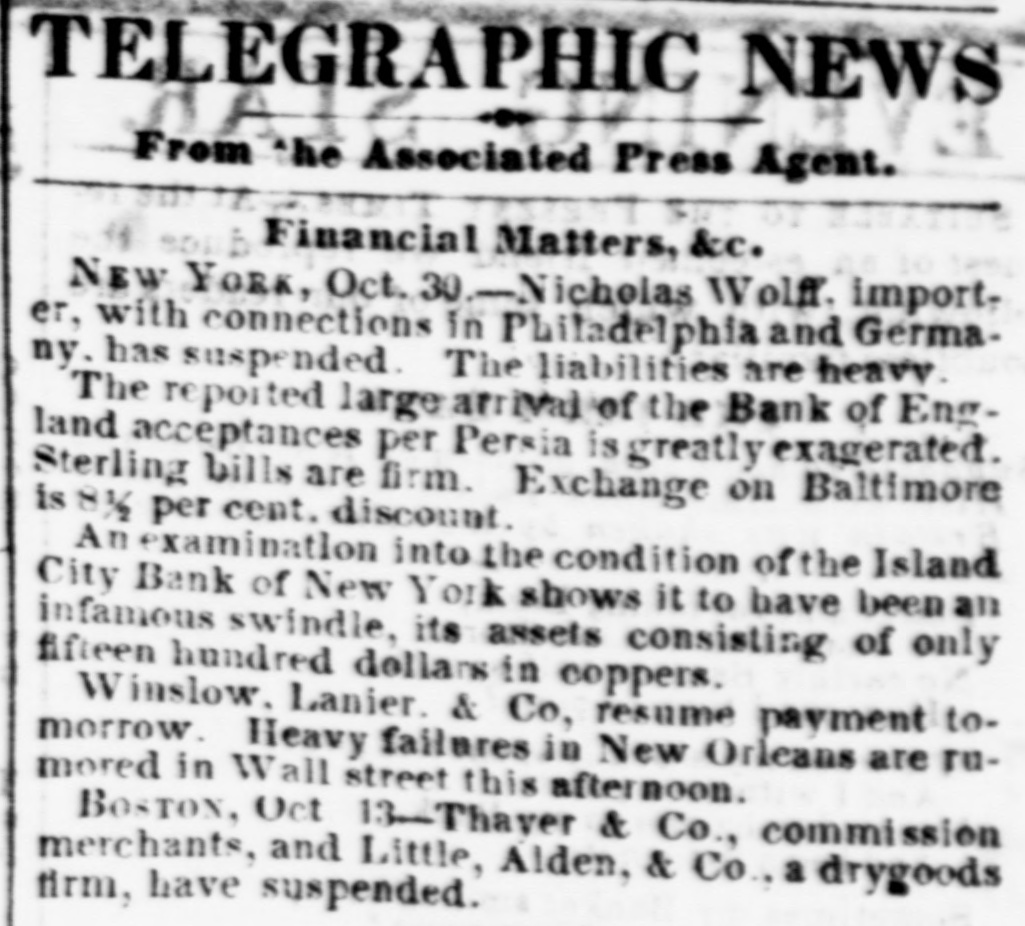
Examination showed the bank was an infamous swindle with assets nearly worthless (only about $1,500 in coppers); capital overstated and fictitious signatures on discounted notes.
Newspaper Excerpt
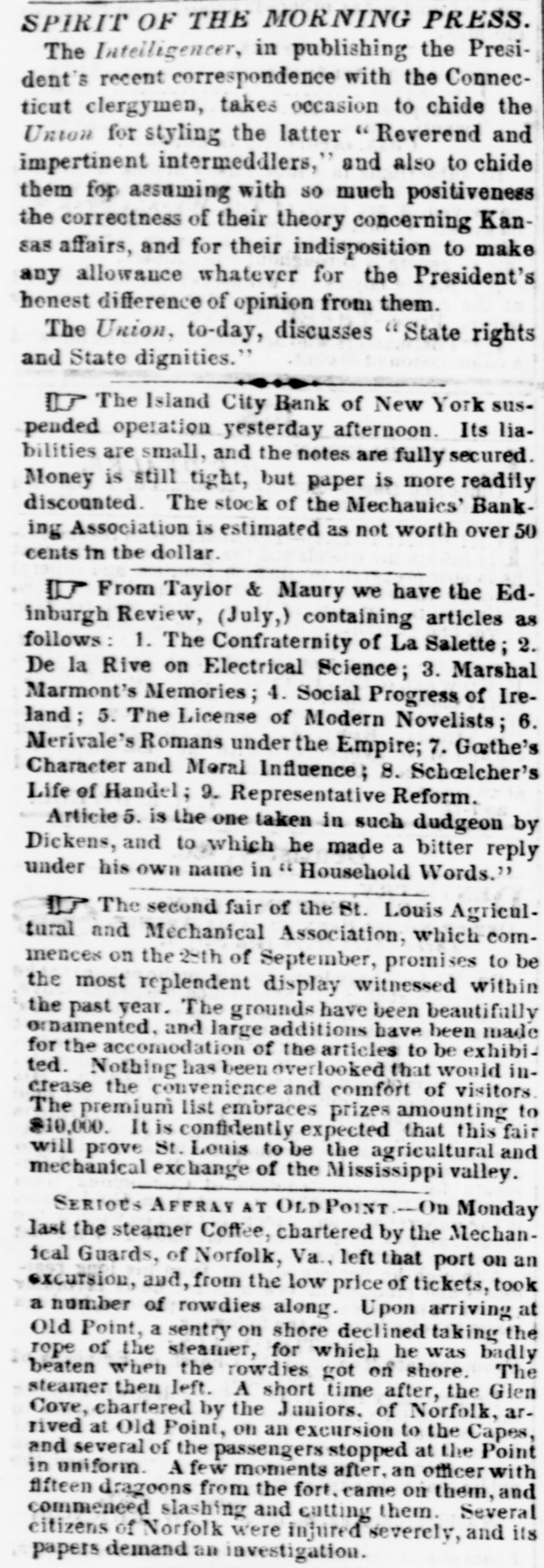
The Island City Bank of New York suspended operation yesterday afternoon.
Source
newspapers
2. October 10, 1857 Receivership
Newspaper Excerpt
The suit was brought against him by J. F. Butterworth, the receiver of the Bank.
Source
newspapers
3. October 10, 1857 Other
Newspaper Excerpt
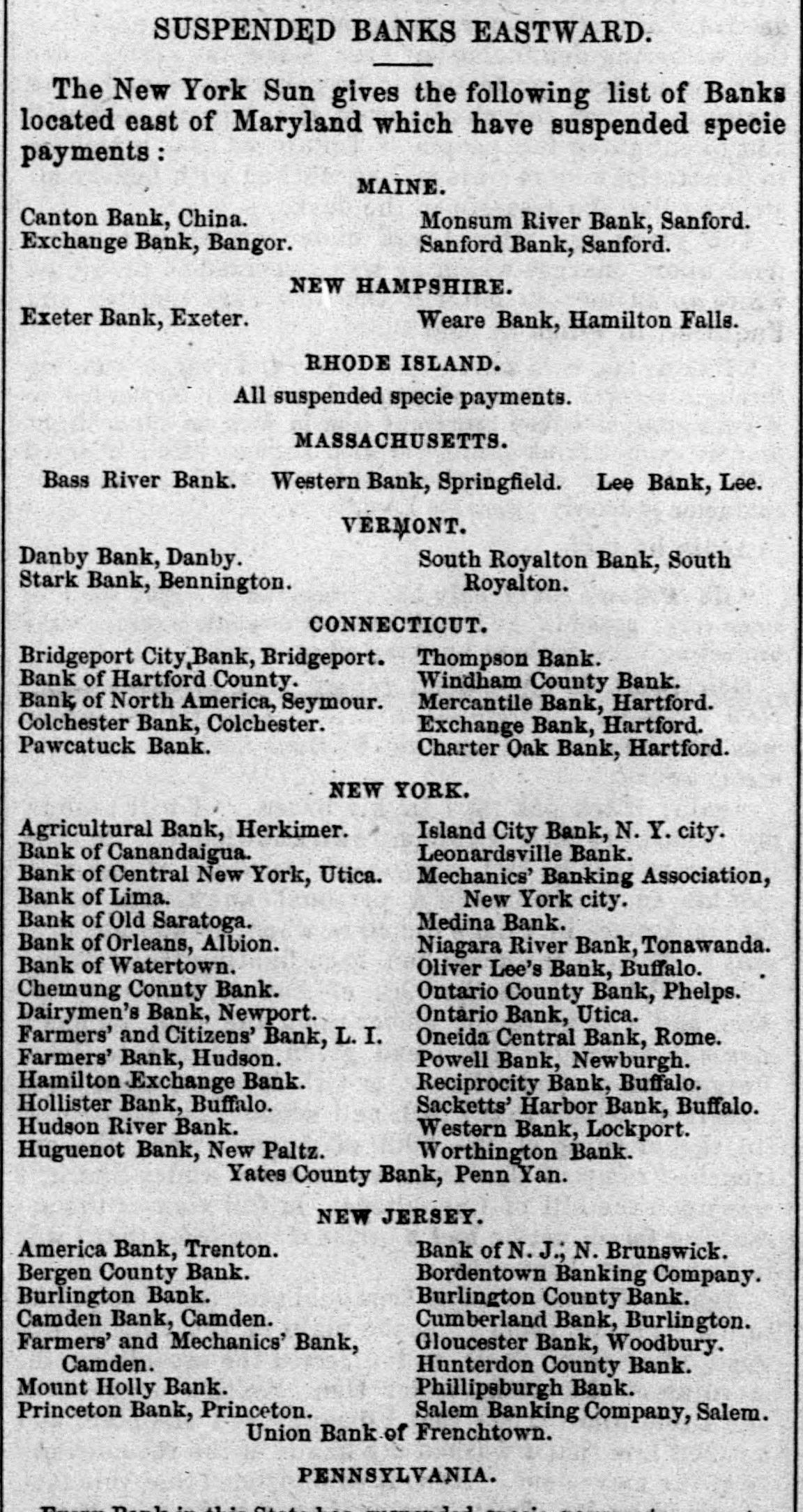
Island City Bank, N. Y. city listed among banks which have suspended specie payments : ... Island City Bank, N. Y. city.
Source
newspapers
4. November 13, 1857 Other
Newspaper Excerpt
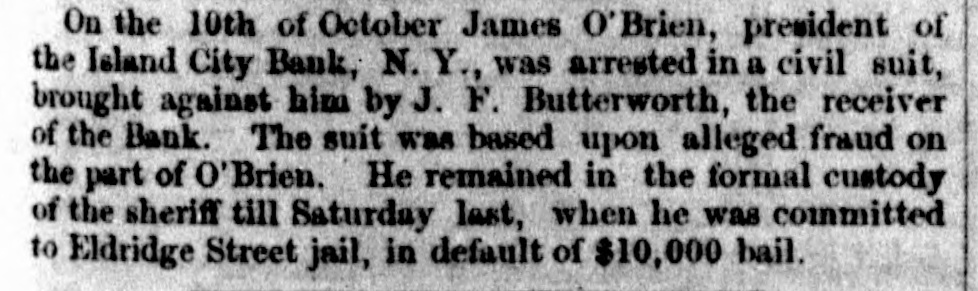
James O'Brien, president of the Island City Bank, N. Y., was arrested ... committed to Eldridge Street jail, in default of $10,000 bail.
Source
newspapers

Newspaper Articles (9)

Article from Evening Star, September 4, 1857

Click image to open full size in new tab

Article Text

SPIRIT OF THE MORNING PRESS

The Intelligencer, in publishing the President's recent correspondence with the Connecticut clergymen, takes occasion to chide the Union for styling the latter Reverend and impertinent intermeddlers," and also to chide them for assuming with so much positiveness the correctness of their theory concerning Kansas affairs, and for their indisposition to make any allowance whatever for the President's honest difference of opinion from them. The Union, to-day, discusses State rights and State dignities." The Island City Bank of New York suspended operation yesterday afternoon. Its liabilities are small, and the notes are fully secured. Money is still tight, but paper is more readily discounted. The stock of the Mechanics' Banking Association is estimated as not worth over 50 cents in the dollar. From Taylor & Maury we have the Edinburgh Review, (July,) containing articles as follows: 1. The Confraternity of La Salette; 2. De la Rive on Electrical Science; 3. Marshal Marmont's Memories; 4. Social Progress of Ireland; 5. The License of Modern Novelists; 6. Merivale's Romans under the Empire; 7. Gathe's Character and Moral Influence; 8. Schelcher's Life of Handel; 9. Representative Reform. Article 5. is the one taken in such dudgeon by Dickens, and to which he made a bitter reply under his own name in Household Words." B The second fair of the St. Louis Agricultural and Mechanical Association, which commences on the 28th of September, promises to be the most replendent display witnessed within the past year. The grounds have been beautifully ornamented, and large additions have been made for the accomodation of the articles to be exhibited. Nothing has been overlooked that would increase the convenience and comfort of visitors. The premium list embraces prizes amounting to $10,000. It is confidently expected that this fair will prove St. Louis to be the agricultural and mechanical exchange of the Mississippi valley. SERIOUS AFFRAY AT OLD POINT.-On Monday last the steamer Coffee, chartered by the Mechanical Guards, of Norfolk, Va., left that port on an excursion, and, from the low price of tickets, took a number of rowdies along. Upon arriving at Old Point, a sentry on shore declined taking the rope of the steamer, for which he was badly beaten when the rowdies got on shore. The steamer then left. A short time after, the Glen Cove, chartered by the Juniors, of Norfolk, arrived at Old Point, on an excursion to the Capes, and several of the passengers stopped at the Point in uniform. A few moments after, an officer with fifteen dragoons from the fort, came on them, and commeneed slashing and cutting them. Several citizens of Norfolk were injured severely, and its papers demand an investigation.


Article from Weekly National Intelligencer, October 10, 1857

Click image to open full size in new tab

Article Text

SUSPENDED BANKS EASTWARD

The New York Sun gives the following list of Banks located east of Maryland which have suspended specie payments : MAINE. Canton Bank, China. Monsum River Bank, Sanford. Exchange Bank, Bangor. Sanford Bank, Sanford. NEW HAMPSHIRE. Exeter Bank, Exeter. Weare Bank, Hamilton Falls. RHODE ISLAND. All suspended specie payments. MASSACHUSETTS. Bass River Bank. Western Bank, Springfield. Lee Bank, Lee. VERMONT. Danby Bank, Danby. South Royalton Bank, South Stark Bank, Bennington. Royalton. CONNECTICUT. Bridgeport City, Bank, Bridgeport. Thompson Bank. Bank of Hartford County. Windham County Bank. Bank, of North America, Seymour. Mercantile Bank, Hartford. Colchester Bank, Colchester. Exchange Bank, Hartford. Pawcatuck Bank. Charter Oak Bank, Hartford. NEW YORK. Agricultural Bank, Herkimer. Island City Bank, N. Y. city. Leonardsville Bank. Bank of Canandaigua. Bank of Central New York, Utica. Mechanics' Banking Association, Bank of Lima. New York city. Bank of Old Saratoga. Medina Bank. Bank of Orleans, Albion. Niagara River Bank, Tonawanda. Bank of Watertown. Oliver Lee's Bank, Buffalo. Chemung County Bank. Ontario County Bank, Phelps. Dairymen's Bank, Newport. Ontario Bank, Utica. Farmers' and Citizens' Bank, L.I. Oneida Central Bank, Rome. Farmers' Bank, Hudson. Powell Bank, Newburgh. Hamilton Exchange Bank. Reciprocity Bank, Buffalo. Hollister Bank, Buffalo. Sacketts' Harbor Bank, Buffalo. Hudson River Bank. Western Bank, Lockport. Huguenot Bank, New Paltz. Worthington Bank. Yates County Bank, Penn Yan. NEW JERSEY. America Bank, Trenton. Bank of N. J.; N. Brunswick. Bergen County Bank. Bordentown Banking Company. Burlington Bank. Burlington County Bank. Camden Bank, Camden. Cumberland Bank, Burlington. Farmers' and Mechanics' Bank, Gloucester Bank, Woodbury. Camden. Hunterdon County Bank. Mount Holly Bank. Phillipeburgh Bank. Princeton Bank, Princeton. Salem Banking Company, Salem. Union Bank of Frenchtown. PENNSYLVANIA.


Article from The Daily Dispatch, October 14, 1857

Click image to open full size in new tab

Article Text

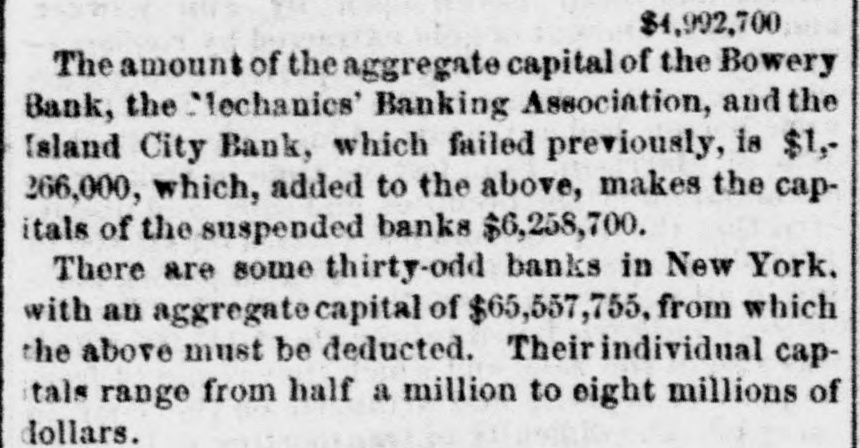
$4,992,700 The amount of the aggregate capital of the Bowery Bank, the 'lechanics' Banking Association, and the Island City Bank, which failed previously, is $1,266,000, which, added to the above, makes the capitals of the suspended banks $6,258,700. There are some thirty-odd banks in New York. with an aggregate capital of $65,557,755, from which the above must be deducted. Their individual captals range from half a million to eight millions of dollars.


Article from Evening Star, October 31, 1857

Click image to open full size in new tab

Article Text

TELEGRAPHIC NEWS From the Associated Press Agent. Financial Matters, &c. NEW YORK, Oct. 30.-Nicholas Wolff. importer, with connections in Philadelphia and Germany. has suspended. The liabilities are heavy. The reported large arrival of the Bank of England acceptances per Persia is greatly exagerated. Sterling bills are firm. Exchange on Baltimore is 8ยฝ per cent. discount. An examination into the condition ofthe Island City Bank of New York shows it to have been an infamous swindle, its assets consisting of only fifteen hundred dollars in coppers. Winslow, Lanier. & Co, resume payment tomorrow. Heavy failures in New Orleans are rumored in Wall street this afternoon. BOSTON, Oct 13-Thaver & Co., commission merchants, and Little, Alden, s Co., a drygoods firm, have suspended.


Article from The Weekly North Iowa Times, November 11, 1857

Click image to open full size in new tab

Article Text

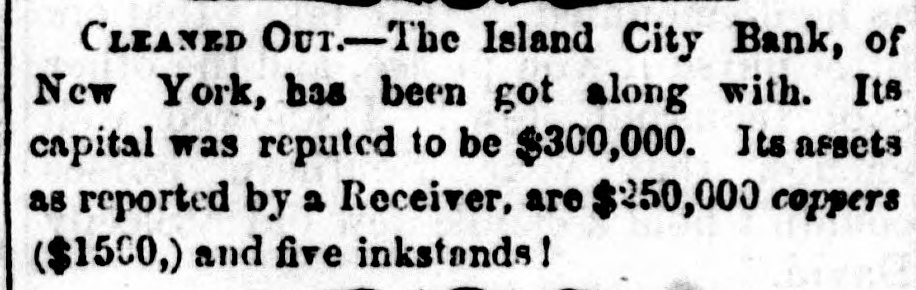
CLEANED Our

-The Island City Bank, of New York, has been got along with. Its capital was reputed to be $300,000. Its assets as reported by a Receiver, are $250,000 coppers ($1500,) and five inkstands!


Article from The Washington Union, November 13, 1857

Click image to open full size in new tab

Article Text

On the 10th of October James O'Brien, president of the Island City Bank, N. Y., was arrested in a civil suit, brought against him by J. F. Butterworth, the receiver of the Bank. The suit was based upon alleged fraud on the part of O'Brien. He remained in the formal custody of the sheriff till Saturday last, when he was committed to Eldridge Street jail, in default of $10,000 bail.


Article from The Hillsdale Standard, December 8, 1857

Click image to open full size in new tab

Article Text

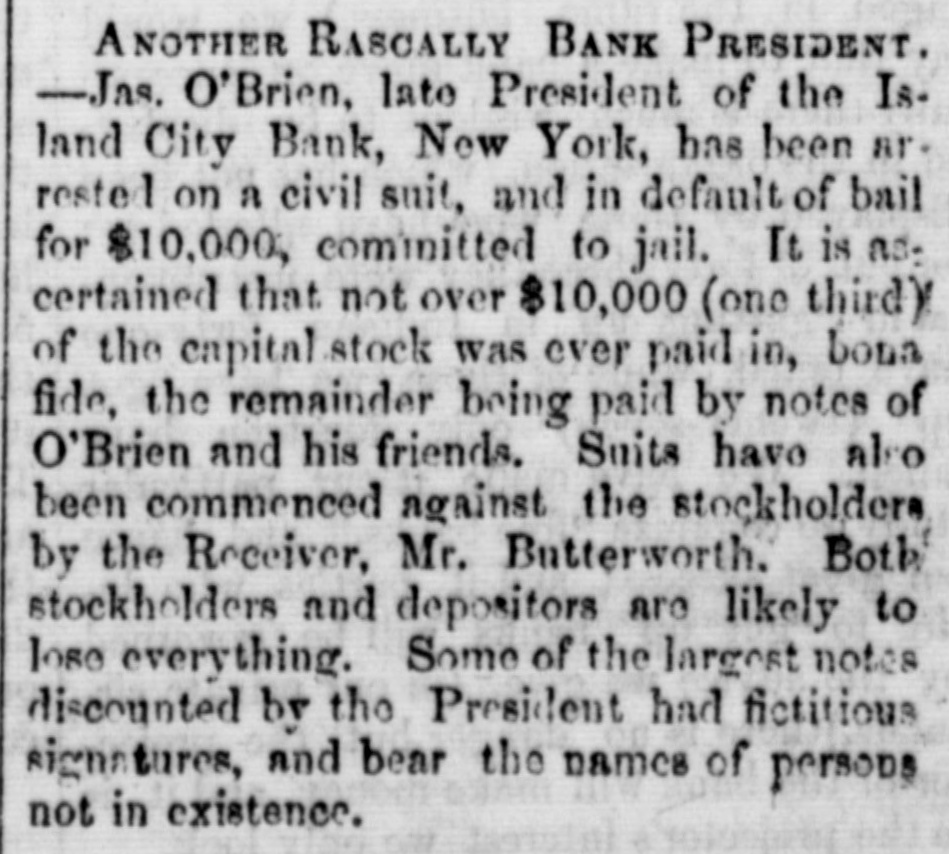
ANOTHER RASCALLY BANK PRESIDENT

Jas. O'Brien, late President of the Is. land City Bank, New York, has been ar. rested on a civil suit, and in default of bail for $10,000, committed to jail. It is as: certained that not over $10,000 (one third) of the capital stock was ever paid in, boun fide, the remainder being paid by notes of O'Brien and his friends. Suits have also been commenced against the stockholders by the Receiver, Mr. Butterworth. Both stockholders and depositors are likely to lose everything. Some of the largost notes discounted be the President had fictitious signatures, and bear the names of persons not in existence.


Article from The New York Herald, January 8, 1858

Click image to open full size in new tab

Article Text

Balance due from banks. $171,547 The condition of the Brooklyn banks at the same date was- Due from banks. $269,509 Due to banks. 98,851 Balance due from banks. $170,658 The New York banks presented a very weak position in their items of due to and due from banks, perhaps a necessity of their location at the commercial head of the whole country. There was due to banks from them. $13,894,055 Due from banks. 6,735,040 Balance due banks. $7,159,006

The condition of all the interior banks out of the four ities before mentioned, was- Due from banks. $4,151,835 Due to banks. 2,397,858 Balance due interior banks. $1,753,977 The balance due to banks by the four cities inclusive, was. $7,355,215 Deduct country banks. 1,753,977 Balance due to each other, and foreign banks.$5,601,238 This would appear to be a sufficiently large balance due from them to foreign banks and to each other; and there is but little or no doubt, upon an examination of the general position of the country banks' accounts and those of the different cities, that the redeeming banks in the city of New York-making a liberal allowance for a very large balance due foreign banks-were debtors to the interior ones, as a body, over $1,000,000; while a portion were posted daily in that city, under the quarter per cent system, as failed or suspended.

Allow the banks of the interior to concentrate their creditor balances to be used for mutual benefit, at a common centre of redemption, and under an organization which can prevent individual loss to each, and it would hereafter be unnecessary to bave bonfires of bank notes in the bank department, to enable country bankers to redeem their notes in the cities before mentioned, by a ruinous sale of their securities deposited in this office. The Superintendent commends to their consideration the old fable of the bubdie of sticks: separated they are weak; tied together by a string of their own making, (a clearing house for country bank notes,) strong and impregnable.

The necessary use of currency in the daily demands for its use, (not connected with la large mercantile transactions,) it being secured dollar for dollar by the very next property to coin in permanent value, prevents its concentration in such amounts as to endanger a suspension of specie payments by the banks of this State, upon their circulating notes alone. The convenience of the currency is such that its safety only is desired by the public.

As an evidence of the stability of our currency, the Superintendent may be permitted to say that as soon as business enabled him to leave his office after the suspension, the securities of the only then failed free bank, (the Island City Bank of New York,) whose securities he had the right to sell for the redemption of its notes, were sold within ten days after the suspension, and the notes promptly redeemed by his agent, the Bank of the Manhattan Company in New York, at par. It is proper to say these notes were secured by the stocks of this State alone.

This brings the Superintendent to a statement of what he deems necessary to the stability of bank capital and the security of the public, both as debtors and creditors of those institutions. In using the words debtor and creditor in juxtaposition, the Superintendent means that their interests are in a measure identical. An error in expansion of loans and discounts is followed by a more complicated one in the necessary attempt at a consequent contraction. The carrying of what may be called a spasmodic line of loans and discounts implies anything but capacity in banking, and is dangerous not only to the debtor and creditor, but also to the stockholders. The maintaining under adverse circumstances a steady line, is evidence that it was not carried beyond what prudence dictated even in prosperous times. Apply this principle to bank statements, and it does not require much sagacity to learn where the borrower, the depositer, and the stockholder, should do their business and invest their money.

The first proposition of the Superintendent is a country clearing house, to be voluntarily established in the city of New York or Albany, by the interior banks. Abundant power exists for that purpose in section 8, chapter 202, of the laws of 1840.

Second To amend the general bank law, preventing hereafter the receiving of bonds and mortgages as security for circulating notes, in the Bank Department.

Third-To compel by law all safety fund or incorporated banks to bave, on the 1st of July next, one-third of their actual circulation in secured notes; one-third more by the 1st of January, 1859; and all on the 1st of July, 1859.

In using the term actual circulation, the Superintendent means, after deducting the amount in their vaults of their own notes from that they arc entitled to use or have received from this office.

It may be objected to this measure, and with some force, that those banks, paying as they do one-half of one per cent per annum for the redemption of the bank fund stock, they should enjoy their present privilege of circulation without depositing security in the Bank Department The answer to this is, they are paying an old debt incurred as partners in a system that did not secure the creditors of those that failed long ago. The Legislature. instead of compelling immediate payment or abolishing the system, allowed the debt to be funded, thus making the final payment comparatively easy, and continued the special privileges of that class of banks.

It is hardly necessary to say that since their mutual debt was funded one of that class of banks (the Lewis County Bank) bas failed, and its bills will be without doubt a total loss, unless the Legislature devote to their payment whatever remaant there may be of the Bank Fund after paying its present liabilities. Three others have falled during the present financial difficultiss; the Reciprocity, late Sackets Harbor, the Yates County and the Bank of Orleans. While the Superintendent hopes that their notes may be paid from their assets, including the personal liability resting upon their stockholders, he cannot conceal from himself that the process will be so slow that a heavy loss will be sustained by the owners of those notes, from the necessity of their realizing upon them, and thus put them into the hands of the brokers at a heavy discount.

Fourth To compel every bank, banking association, or individual banker, in the State, doing business under special charters or articles of association, or under certificates filed in this office, to maintain a specie reserve in ita vaults of 20 per cent upon the amount due its depositors-allowing those banks located out of the city of New York, to return as specie any balance to their credit in a solvent bank in either the city of New York, Albany or Troy. The first impression that would strike the mind of a New York banker may be that this was making an unfair distinction between the banks of that city and those located in other parts of the State.

Let us examine if this is so in fact. New York city being the great commercial centre, not only of this State but of the United States, towards which, as a common nucleus, tend all values, whether the products of agriculture, mechanics, the sea, or the mines of the earth. From it in return is radiated another class of values; the manufactured goods or articles of luxury that enter into the consumption of the pecple of the interior of the whole country. She is the great entrepot of our foreign commerce, and the great point to which the concentrated business and wealth of this continent directly tend. Her natural position is such that her inhabitants must of necessity devote themselves to commercial and trading pursuits. She is literally not only the Gibraltar of this State, but of the entire country, against a suspension of specie payments, whether the demand for payment arises from our foreiga credits, or our accumulated domestic debt, leading to distrust and panic among our own people.

Whatever demand for coln in unusual quantities may be made in this State or elsewhere, New York city must furnish it, either through the banks or citizens located within her borders. Upon no other point in this State can come a demand that can lead to a general zuspension; and by a necessity that knows no law, the suspension of that city is followed throughout this State and the Union.

The demand for specie upon interior banks having but comparatively small deposits, amounts to nothing, as their great debt is for currency, so scattered and of such pressing daily use it can never be concentrated to produce a demand endangering their general stability. Admit that it may for a moment. It becomes a demand upon New York at once, and she is compelled from her locality, and the fact that values as before stated tend directly towards her, to furnish the coin.

Again: the country banks should be allowed to state as a part of what may be called their specie reserve funds, the balances due them from banks in good standing in the cities above referred to. That balance is better for the payment of country bank debts than coin in their vauits; and I think I may say that thousands of dollars of their indebtedness is paid by draft upon such balances where one dollar is paid in coin.

It may be objected to this entire proposition that it relates only to deposits. True, and why? A secured note is based upon a credit second only to coin; and to show its effective use to the interior banker, in time of pressure, I need only refer to the fact that upon return of notes there has been delivered of securities held by this department nearly $1,500,000 a week, for two weeks in succession, to redeem his circulating notes, which is the great debt of the country banker. This occurred imme before the ananension and was stopped by that
Article from New Orleans Daily Crescent, November 17, 1858

Click image to open full size in new tab

Article Text

New Orleans Ittoney Market

CRESCENT OFFICE, No. 70 Camp street, Tuesday Evening, November 16, 1858. The general money market was exceedingly quiet. The sales of paper on the street were at 7 @ 8 per cent. for March and April maturities. The offerings in bank were light, with some of the banks up to their income, with others not one-half. Specie continues to flow in, and unless there is an advance in sight funds on New York, attended with an enlarged demand, two or three of our inks will have to order their large balances back in The New York market, in regard to foreign exchange, sympathises with ours, or perhaps ours sympathises with that. It is immaterial how the case stands, as gold has got to come hither to move our large receipts of produce, or rather to invest in exchange-the proceeds of said exchange moving the produce. It would not be a very profitable or a paying business for an English spinner or a New England manufacturer wanting, say one thousand bales of cotton at a specified price, to send fifty or sixty thousand dollars in gold, with the orders and the price limited. So it is the heighth of folly for planters and growers of cotton to say if Mr. Bull or Mr. Yankee wants my cotton, let them bring the gold and they can have it at such and such prices and so on. This will all do very well for a confab and talk. The gigantic business of this country must be conducted by exchange, and the balance of trade, or purchases of our staple, must be settled in coin, for which purposes only a few millions of gold are necessary. We learn that the Governor of Arkansas, in his late message, recommends the suppression of all bank notes under fifty dollars. The intercourse between Arkansas and New Orleans is of consid rable importance, and the cotton raised in Arkansas forms one of the links of the intercourse, but Governor Conway need not expect that any law passed by the Legislature of his State will prevent a citizen of Arkansas from refusing 8 bank note of five, ten or twenty dollars. Does any one suppose that the proprietor of & wood-yard, on the banks of the Mississippi, now within the jurisdiction of Arkansas, will refuse from & steamboat the notes of either of the banks of Louisiana, be they for five or five hundred dollars. Does the member of the Legislature of Mississippi, who introduced a bill last week to suppress bank notes under twenty dollars from being circulated, suppose that any citizen of Mississippi will refuse the bank notes of this city for anything he may have for sale. Such laws as these are all fudge and fiddlesticks. Public opinion everywhere, it is ad: mitted, is against the issue of notes under five dollars, and those who assert that the panic and crisis of 1857 was brought about by the banks issuing notes under twenty dollars, know no more about finance and trade than the highly estimable gentleman who is represented to have his locality in Queen Luna's dominions. It is suggested that the members of the Legislatures of Mississippi and Arkansas will not commit themselves to such legislative foll, Does any one believe that the citizens of Bay St. Louis, Pass Christian, Mississippi City and Biloxi will refuse to receive a bank note under twenty dollars of the banks of New Orleans when tendered, or can any legislative enactment prevent the Jackson Railroad from receiving from the citizens of Louisisiana & bank note of live or ten dollars for passage or freight. We trust our neighbors of Mississippi will not make themselves ridiculous. The weather cleared off bright to-day, though tinged with something of a Lapland feeling. Business moved on quietly, though not brisk it was not dull. The Exchange market had the same downward tendency we noticed yesterday. Telegraph advices from New York of last evening, the 15th inst., quote a further decline in Sterling ex. change. The best of bankers' bills were offering at 109. This information was expected from the tenor of the private letters. of the 10th inst., which quoted 1091/2 @ 1091/4, with & heavy market. The best of francs were sold at 5.171/2 @ 5.18% These accounts had, however, no great influence on our market, only to strengthen the position of buyers, who offered 106 @ 106ยฝ for bills with documents, and clear bills at 1073/4 @ 107%. There were, however, some sales of bills of lading drafts under a great margin, at 107. The demand for remittance was slack. We quote 107% @ 10814, according to sums wanted. In francs there were some sales at 5.27ยฝ the range of the market being from 5.32ยฝ @ 5.26% In Northern funds there was not much doing. The counter rate for checks was %. Some sales were made at % discount, and large sums ouiside were sold at ยฝ and 1 discount. Short sight 1ยฝ @ 1ยฝ discount ; sixty days sight from 17/8 to 2, 2ยฝ, 2ยฝ @ 23/2 discount. The supply free, and the market closing altogether in favor of buyers. There was very little done in Stocks. We only heard of the sale of 100 shares Gas Company at 130, and 170 shares of Jackson Railroad, the price of which will be known to-morrow. Suppose & bank in Louisiana had failed, became bankrupted during the crisis of 1857, like the great Ohio Life Insurance and Trust Company, the Empire City Bank, Eighth Avenue Bank, Island City Bank and Bowery Bank, located in the great metropolis, New York the Bank of Pennsylvania, in Philadelphia, with the hundreds of other banks which failed, suspended, and never have resumed, or will never resume, would we in New Orleans have heard the last of it for ten or twenty years at least? We trow not. We find, however, that bad bank failures are not confined to this side of the Atlantic, as is well known by the bankruptcy of the Borough Bank of Liverpool, and other banks in England. But we are somewhat taken aback at the looseness and wantonness of the management of the Western Bank of Glasgow. which failed in 1857. Scotch banking has