7853. Central National Bank (Boston, MA)

Bank Information

Episode Type
Run → Suspension → Closure
Bank Type
national
Bank ID
2103
Charter Number
2103
Start Date
November 14, 1902
Location
Boston, Massachusetts (42.358, -71.060)

Metadata

Model
gpt-5-mini
Short Digest
e2878cc0

Response Measures

Capital injected, Full suspension, Books examined

Other: Eliot National Bank refused to take over assets; Clearing House declined aid; National Shawmut advanced 50% to depositors.

Description

Multiple contemporaneous articles report heavy withdrawals (~$2,000,000) immediately before the comptroller ordered the bank closed and a receiver appointed. Cause attributed to impaired assets and failure of liquidation arrangements (Eliot National refused to take assets); clearing house declined to aid. Bank was placed in receivership and closed permanently.

Events (4)

1. November 14, 1902 Other
Newspaper Excerpt
Statement: 'The failure is due to losses sustained. There is no apparent dishonesty on the part of the officers of the bank so far as the records of the comptroller's office show.'
Source
newspapers
2. November 14, 1902 Run
Cause
Bank Specific Adverse Info
Cause Details
Large impaired loans/excess loans and failed liquidation arrangements; rejection of assets by Eliot National prompted heavy withdrawals.
Measures
Many banks aided depositors; National Shawmut offered to advance 50% of deposits; clearing house declined to assist the Central.
Newspaper Excerpt
Wednesday sales of the Central's stock dropped $15 from par and yesterday depositors withdrew something like $2,000,000.
Source
newspapers
3. November 14, 1902 Suspension
Cause
Bank Specific Adverse Info
Cause Details
Closed by order of the acting comptroller after examiners reported losses equal to surplus and failed efforts to arrange voluntary liquidation; impaired assets and lack of quick assets cited.
Newspaper Excerpt
The Central National Bank ... did not open for business today, the comptroller of the currency having ordered the bank examiner to close its doors and take charge of its business.
Source
newspapers
4. November 25, 1902 Receivership
Newspaper Excerpt
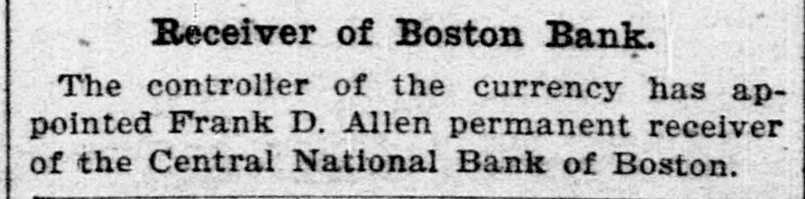
The controller of the currency has appointed Frank D. Allen permanent receiver of the Central National Bank of Boston.
Source
newspapers

Newspaper Articles (24)

Article from Spirit of the Age, November 8, 1902

Click image to open full size in new tab

Article Text

TUESDAY, Nov. 4, 1902. William T. Nelson of New York commits suicide; act caused by worry over friend's arrest. Coal arbitrators visit mines in the Hazleton region. "Jim Crow" car law goes into operation in New Orleans. Treasurer Roberts' annual report shows greatest cash balance in history of the country. Colombian government will renew negotiation of a canal treaty. Little Haverhill girl, supposed to have been abducted, claims to have been lost in Lawrence. Body of Ernest C. Mansfield, the Harvard student, found in Charles river. Alaskan natives dying by thousands from measles. Directors of Central national bank of Boston vote to wind up its business. S. T. Coy, a prominent paper manufacturer of Bellows' Falls, dead. Five hundred silversmiths go on strike in New York. Laura Biggar gives herself up to authorities at Freehold, N.J. Lebaudy brothers' new airship makes successful trial trip near Moisson, France. Dismissal of Grand Duke Paul Alexandrovitch from Russian army due to his marriage to Baroness Pistolkoff. Pennsylvania railroad promises 90minute runs between New York and Philadelphia. Wife of a New York real estate man, who is suing for divorce, charged with stealing husband's papers. Eleven Cuban children, destined for a Buddhist school in California, detained by immigration authorities in New York. Crown Prince of Siam arrives at Niagara Falls. Joseph Cloud was arrested at Brunswick, Me., charged with assaulting Mrs. John Griffin. He confessed. The aldermen of Fall River last night gave the Dartmouth and Westport Street Railway company the right to carry freight. Henry Brittin was held in $500 in Lewiston charged with the larceny of three barrels of whiskey and one barrel of brandy. While lighting the gas in a store window in Lowell the clothing of Miss Helen Priestly caught fire and she was probably fatally burned. The city council of Portland has passed a resolution favoring an abolishment of the lower branch and an increase of aldermen to three from each ward. The wholesale grocery firms of Chicago will have none of George B. Hanford's $500,000,000 grocery trust, for the formation of which a convention is called to meet in Detroit. John Hannan, the millionaire shoe manufacturer of New York, had a narrow escape from drowning at Narragansett Pier. As he was boarding a sailboat at the south pier dock he slipped and fell into the water. Although he was rescued at once, Mr. Hannan was speechless when taken aboard the boat. A 16-year-old hunter, David Fuller, was shot and instantly killed at Asqwith, Me., by Arthur Bagley. who fired into a clump of alders which were being shaken as if by a moving animal. Mark Fuller, his son, David, and Arthur Bagley of Henderson were hunting together. The stock of . O. Toby's store was extensively damaged by fire at Machiasport, Me. It was believed Mr. Toby sought death by burning with his property. Mr. Toby's store books were found outside the building, wrapped up and covered with his overcoat. Nothing else had been removed. He was not seen after leaving his home.
Article from Evening Star, November 14, 1902

Click image to open full size in new tab

Article Text

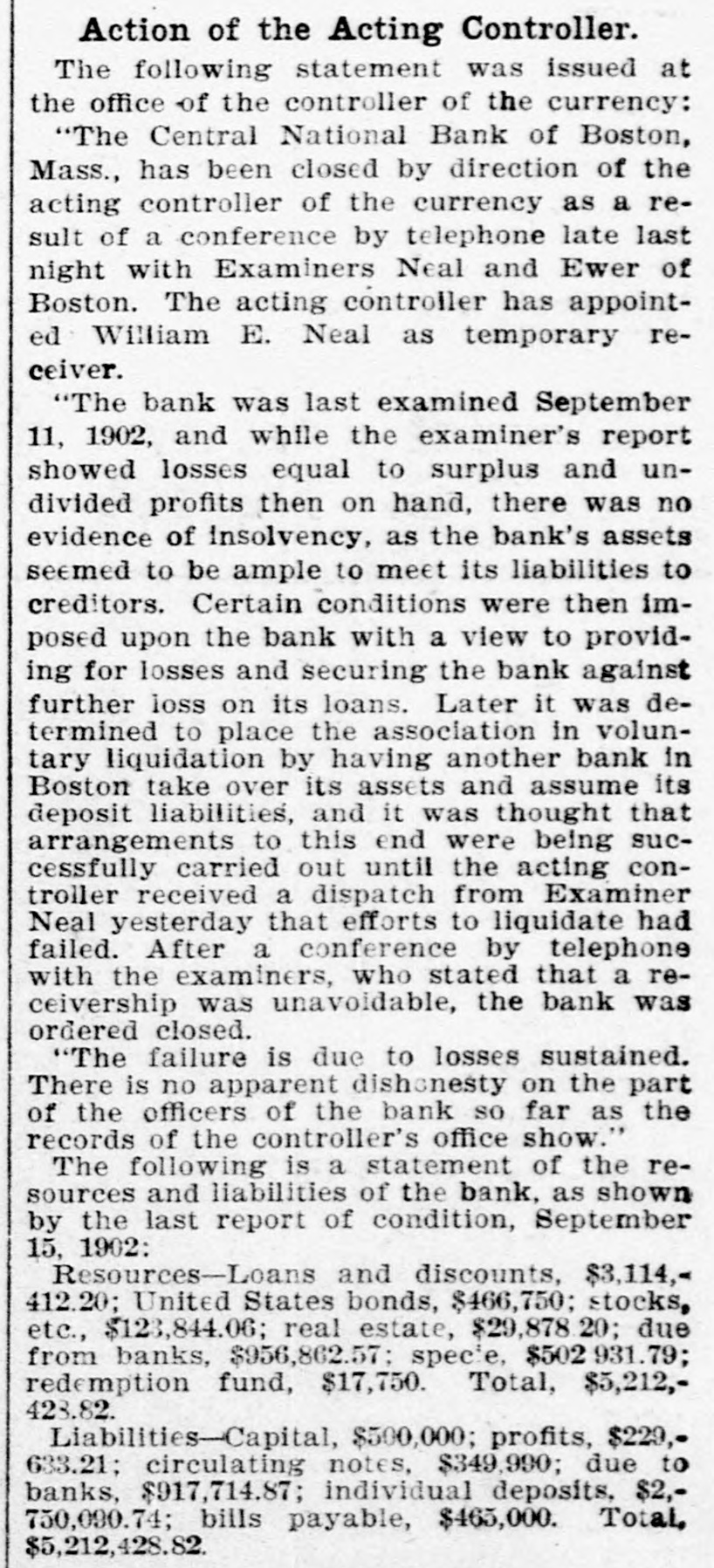
Action of the Acting Controller. The following statement was issued at the office of the controller of the currency: "The Central National Bank of Boston, Mass., has been closed by direction of the acting controller of the currency as a result of a conference by telephone late last night with Examiners Neal and Ewer of Boston. The acting controller has appointed William E. Neal as temporary receiver. "The bank was last examined September 11, 1902, and while the examiner's report showed losses equal to surplus and undivided profits then on hand, there was no evidence of insolvency, as the bank's assets seemed to be ample to meet its liabilities to creditors. Certain conditions were then imposed upon the bank with a view to providing for losses and securing the bank against further loss on its loans. Later it was determined to place the association in voluntary liquidation by having another bank in Boston take over its assets and assume its deposit liabilities, and it was thought that arrangements to this end were being successfully carried out until the acting controller received a dispatch from Examiner Neal yesterday that efforts to liquidate had failed. After a conference by telephone with the examiners, who stated that a receivership was unavoidable, the bank was ordered closed. "The failure is due to losses sustained. There is no apparent dishenesty on the part of the officers of the bank so far as the records of the controller's office show." The following is a statement of the resources and liabilities of the bank, as shown by the last report of condition, September 15, 1902: Resources-Loans and discounts, $3,114,< 412.20; United States bonds, $466,750; stocks, etc., $123,844.06; real estate, $29,878.20; due from banks, $956,862.57 specie, $502 931.79; redemption fund, $17,750. Total, $5,212,423.82. Liabilities-Capital, $500,000; profits, $229, 633.21; circulating notes, $349,990; due to banks, $917,714.87; individual deposits, $2,750,090.74; bills payable, $465,000. Total, $5,212,428.82


Article from Santa Fe New Mexican, November 14, 1902

Click image to open full size in new tab

Article Text

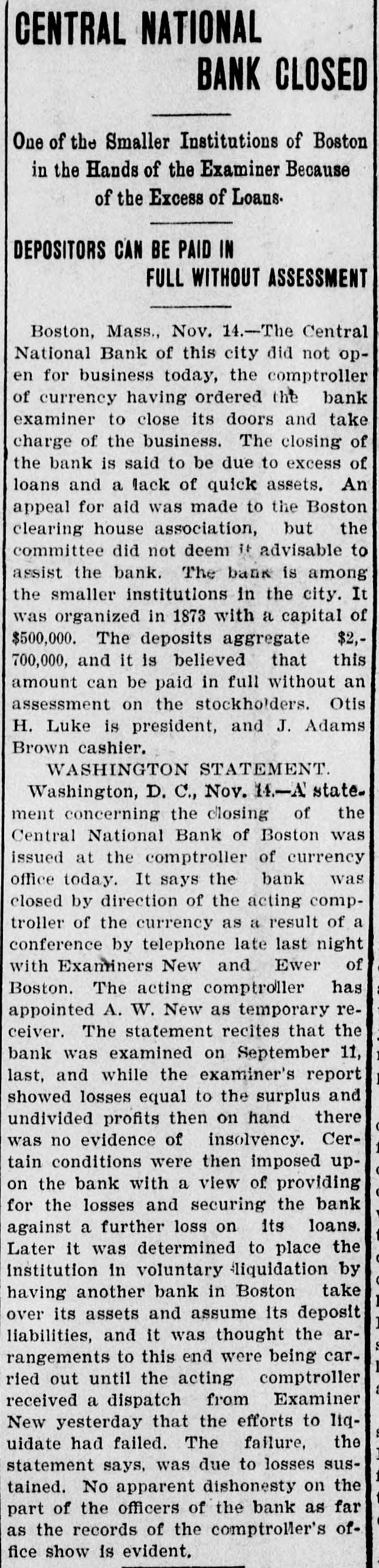
CENTRAL NATIONAL BANK CLOSED One of the Smaller Institutions of Boston in the Hands of the Examiner Because of the Excess of Loans. DEPOSITORS CAN BE PAID IN FULL WITHOUT ASSESSMENT Boston, Mass., Nov. 14.-The Central National Bank of this city did not open for business today, the comptroller of currency having ordered the bank examiner to close its doors and take charge of the business. The closing of the bank is said to be due to excess of loans and a lack of quick assets. An appeal for aid was made to the Boston clearing house association, but the committee did not deem it advisable to assist the bank. The bank is among the smaller institutions in the city. It was organized in 1873 with a capital of $500,000. The deposits aggregate $2,700,000, and it is believed that this amount can be paid in full without an assessment on the stockholders. Otis H. Luke is president, and J. Adams Brown cashier. WASHINGTON STATEMENT. Washington, D. C., Nov. 14.-A state. ment concerning the closing of the Central National Bank of Boston was issued at the comptroller of currency office today. It says the bank was closed by direction of the acting comptroller of the currency as a result of a conference by telephone late last night with Examiners New and Ewer of Boston. The acting comptroller has appointed A. W. New as temporary receiver. The statement recites that the bank was examined on September 11, last, and while the examiner's report showed losses equal to the surplus and undivided profits then on hand there was no evidence of insolvency. Certain conditions were then imposed upon the bank with a view of providing for the losses and securing the bank against a further loss on its loans. Later it was determined to place the institution in voluntary liquidation by having another bank in Boston take over its assets and assume its deposit liabilities, and it was thought the arrangements to this end were being carried out until the acting comptroller received a dispatch from Examiner New yesterday that the efforts to liquidate had failed. The failure, the statement says, was due to losses sustained. No apparent dishonesty on the part of the officers of the bank as far as the records of the comptroller's office show is evident.


Article from The Minneapolis Journal, November 14, 1902

Click image to open full size in new tab

Article Text

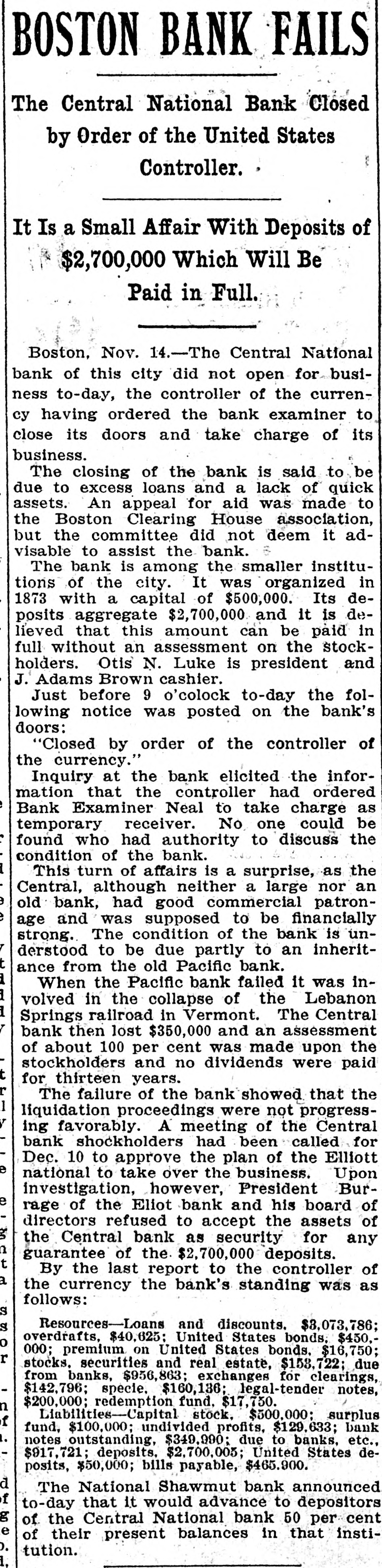
BOSTON BANK FAILS The Central National Bank Closed by Order of the United States Controller. It Is a Small Affair With Deposits of $2,700,000 Which Will Be Paid in Full. Boston, Nov. 14.-The Central National bank of this city did not open for business to-day, the controller of the currency having ordered the bank examiner to close its doors and take charge of its business. The closing of the bank is said to be due to excess loans and a lack of quick assets. An appeal for aid was made to the Boston Clearing House association, but the committee did not deem it advisable to assist the bank. The bank is among the smaller institutions of the city. It was organized in 1873 with a capital of $500,000. Its deposits aggregate $2,700,000 and it is delieved that this amount can be paid in full without an assessment on the stockholders. Otis N. Luke is president and J. Adams Brown cashier. Just before 9 o'colock to-day the following notice was posted on the bank's doors: "Closed by order of the controller of the currency." Inquiry at the bank elicited the information that the controller had ordered Bank Examiner Neal to take charge as temporary receiver. No one could be found who had authority to discuss the condition of the bank. This turn of affairs is a surprise, as the Central, although neither a large nor an old bank, had good commercial patronage and was supposed to be financially strong. The condition of the bank is understood to be due partly to an inheritance from the old Pacific bank. When the Pacific bank failed it was involved in the collapse of the Lebanon Springs railroad in Vermont. The Central bank then lost $350,000 and an assessment of about 100 per cent was made upon the stockholders and no dividends were paid for thirteen years. The failure of the bank showed that the liquidation proceedings were not progressing favorably. A meeting of the Central bank shockholders had been called for Dec. 10 to approve the plan of the Elliott e national to take over the business. Upon investigation, however, President Bure rage of the Eliot bank and his board of directors refused to accept the assets of go the Central bank as security for any h guarantee of the $2,700,000 deposits. t By the last report to the controller of a the currency the bank's standing was as follows: S S Resources-Loans and discounts. $3,073,786; overdrafts, $40,625: United States bonds. $450.o 000; premium on United States bonds. $16,750; r stocks. securities and real estate, $153,722; due from banks, $956,863; exchanges for clearings, $142,796; specie. $160,136; legal-tender notes, $200,000; redemption fund. $17,750. n Liabilities-Capital stock. $500,000; surplus f fund, $100,000; undivided profits, $129,633 bank 1. notes outstanding, $349.990; due to banks, etc., $917,721; deposits. $2,700,005; United States deposits, $50,000; bills payable, $465.900. d The National Shawmut bank announced f to-day that it would advance to depositors g of the Central National bank 50 per cent e of their present balances in that insti. tution. 1,


Article from The Indianapolis Journal, November 15, 1902

Click image to open full size in new tab

Article Text

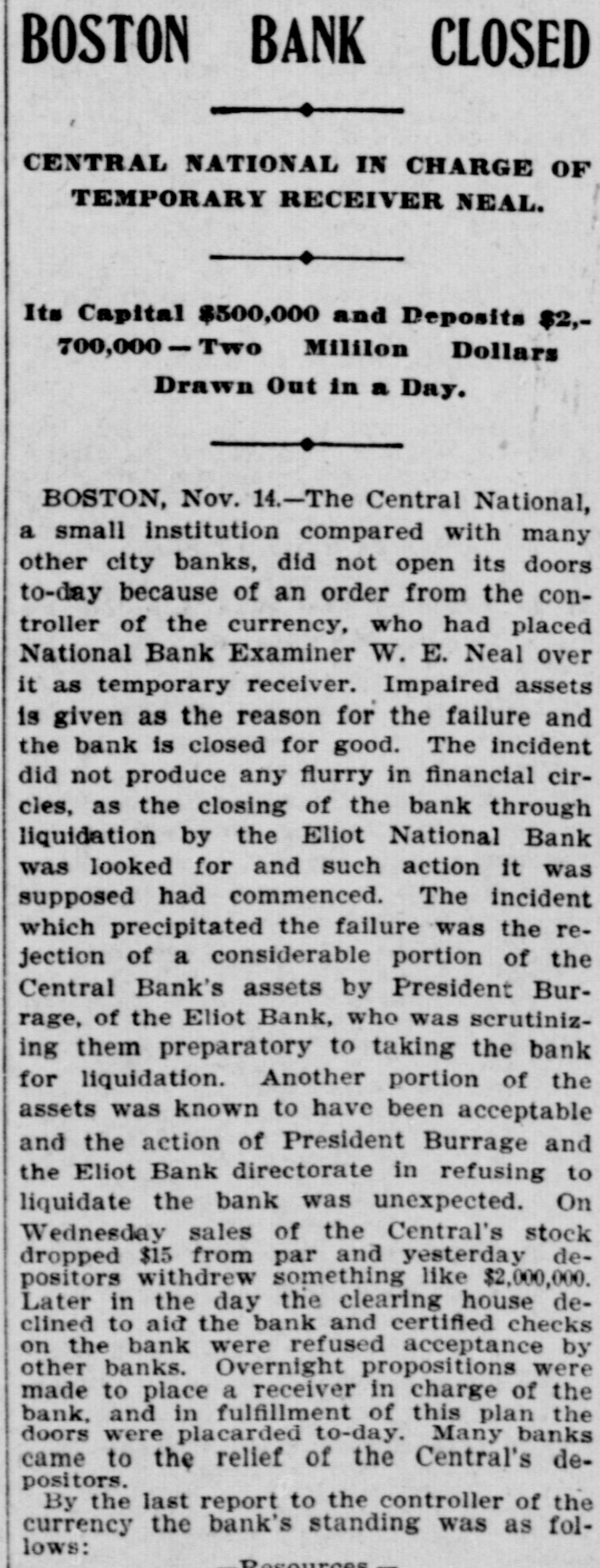
BOSTON BANK CLOSED CENTRAL NATIONAL IN CHARGE OF TEMPORARY RECEIVER NEAL. Its Capital $500,000 and Deposits $2,700,000-Two Mililon Dollars Drawn Out in a Day. BOSTON, Nov. 14.-The Central National, a small institution compared with many other city banks, did not open its doors to-day because of an order from the controller of the currency, who had placed National Bank Examiner W. E. Neal over it as temporary receiver. Impaired assets is given as the reason for the failure and the bank is closed for good. The incident did not produce any flurry in financial circles, as the closing of the bank through liquidation by the Eliot National Bank was looked for and such action it was supposed had commenced. The incident which precipitated the failure was the rejection of a considerable portion of the Central Bank's assets by President Burrage, of the Eliot Bank, who was scrutinizing them preparatory to taking the bank for liquidation. Another portion of the assets was known to have been acceptable and the action of President Burrage and the Eliot Bank directorate in refusing to liquidate the bank was unexpected. On Wednesday sales of the Central's stock dropped $15 from par and yesterday depositors withdrew something like $2,000,000. Later in the day the clearing house declined to aid the bank and certified checks on the bank were refused acceptance by other banks. Overnight propositions were made to place a receiver in charge of the bank, and in fulfillment of this plan the doors were placarded to-day. Many banks came to the relief of the Central's depositors. By the last report to the controller of the currency the bank's standing was as follows: Doonurons


Article from The Daily Morning Journal and Courier, November 15, 1902

Click image to open full size in new tab

Article Text

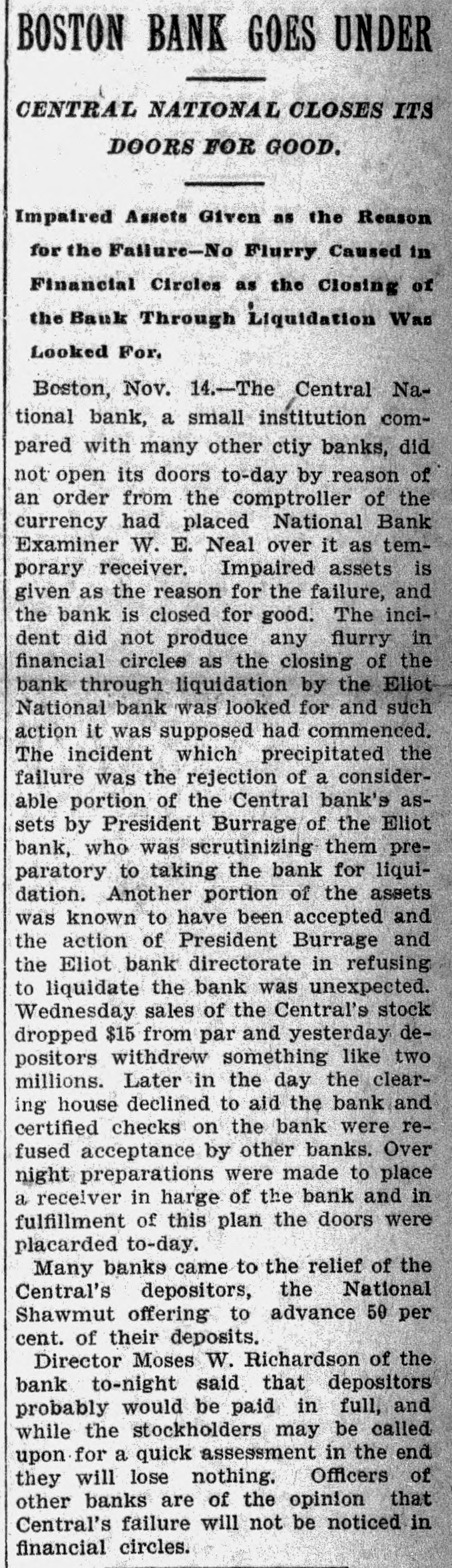
BOSTON BANK GOES UNDER CENTRAL NATIONAL CLOSES ITS DOORS FOR GOOD. Impaired Assets Given as the Reason for the Failure-No Flurry Caused in Financial Circles as the Closing of the Bank Through Liquidation Was Looked For. Boston, Nov. 14.-The Central National bank, a small institution compared with many other ctiy banks, did not open its doors to-day by reason of an order from the comptroller of the currency had placed National Bank Examiner W. E. Neal over it as temporary receiver. Impaired assets is given as the reason for the failure, and the bank is closed for good. The incident did not produce any flurry in financial circles as the closing of the bank through liquidation by the Eliot National bank was looked for and such action it was supposed had commenced. The incident which precipitated the failure was the rejection of a considerable portion of the Central bank's assets by President Burrage of the Eliot bank, who was scrutinizing them preparatory to taking the bank for liquidation. Another portion of the assets was known to have been accepted and the action of President Burrage and the Eliot bank directorate in refusing to liquidate the bank was unexpected. Wednesday sales of the Central's stock dropped $15 from par and yesterday depositors withdrew something like two millions. Later in the day the clearing house declined to aid the bank and certified checks on the bank were refused acceptance by other banks. Over night preparations were made to place a receiver in harge of the bank and in fulfillment of this plan the doors were placarded to-day. Many banks came to the relief of the Central's depositors, the National Shawmut offering to advance 50 per cent. of their deposits. Director Moses W. Richardson of the bank to-night said that depositors probably would be paid in full, and while the stockholders may be called upon for a quick assessment in the end they will lose nothing. Officers of other banks are of the opinion that Central's failure will not be noticed in financial circles.


Article from Arizona Republican, November 15, 1902

Click image to open full size in new tab

Article Text

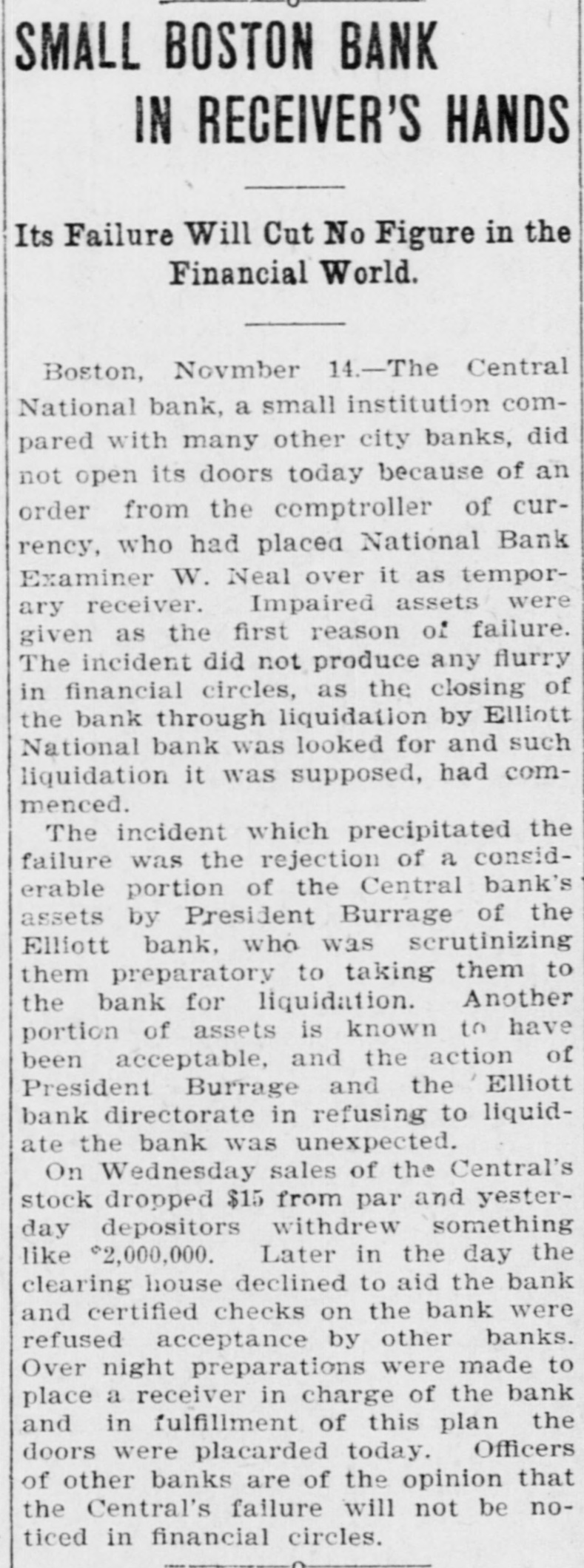
SMALL BOSTON BANK IN RECEIVER'S HANDS Its Failure Will Cut No Figure in the Financial World. Boston, Novmber 14.-The Central National bank, a small institution compared with many other city banks, did not open its doors today because of an order from the cemptroller of currency, who had placed National Bank Examiner W. Neal over it as temporary receiver. Impaired assets were given as the first reason of failure. The incident did not produce any flurry in financial circles, as the closing of the bank through liquidation by Elliott National bank was looked for and such liquidation it was supposed, had commenced. The incident which precipitated the failure was the rejection of a considerable portion of the Central bank's assets by President Burrage of the Elliott bank, who was scrutinizing them preparatory to taking them to the bank for liquidation. Another portion of assets is known to have been acceptable, and the action of President Burrage and the Elliott bank directorate in refusing to liquidate the bank was unexpected. On Wednesday sales of the Central's stock dropped $15 from par and yesterday depositors withdrew something like 2,000,000. Later in the day the clearing house declined to aid the bank and certified checks on the bank were refused acceptance by other banks. Over night preparations were made to place a receiver in charge of the bank and in fulfillment of this plan the doors were placarded today. Officers of other banks are of the opinion that the Central's failure will not be noticed in financial circles.


Article from Richmond Dispatch, November 15, 1902

Click image to open full size in new tab

Article Text

GENERAL. Disorderly slump in New York stock market to lowest prices of the week-Heavy trade in wheat at Chicago, with prices higher Furman defeats South Carolina College at foot-ball Battleship Illinois arrives at Norfolk from Europtan waters Dun's review says the prospects for continued business activity are bright-Four favorites win at Benning's Royal Lancer wins the Derby Gold Cup Central National Bank of Boston. suspends businessSubscriptions for proposed monument in Bull Run Cemetery are made so rapidly at Daughters of Confederacy convention that business of the body has to be temporarily suspended Southern Machinery Dealers Association adjourns. after electing officers including C. B. Jenkins, of Charleston. S C., president and Levin Jones of Richmond, vice-presidentRemains of General Nathaniel Greene are reinterred at base of monument to his memory in Savannah Reports of committees and presentation of resolutions takes up all of both sessions of the Federation of Labor- Coal strike commission begins hearing at Scranton. Presidon't Mitchell makes a six-thousand-word statement, and undergoes a searching Moody cross-examination Secretary takes a partridge hunt on Sullivan's Island Town marshal of Elyria, O. is seriously wounded in fierce battle with rubbers. who terrorize the town. and one of whom has his head blown off Battieships gathered in Hampton Roads are formally inspected General Chaffre warmly defends General Jacob Smith and the campaten in Samar Delta Kappa Enrilon adjourns to meet next year in Syracuse


Article from The Daily Republican, November 15, 1902

Click image to open full size in new tab

Article Text

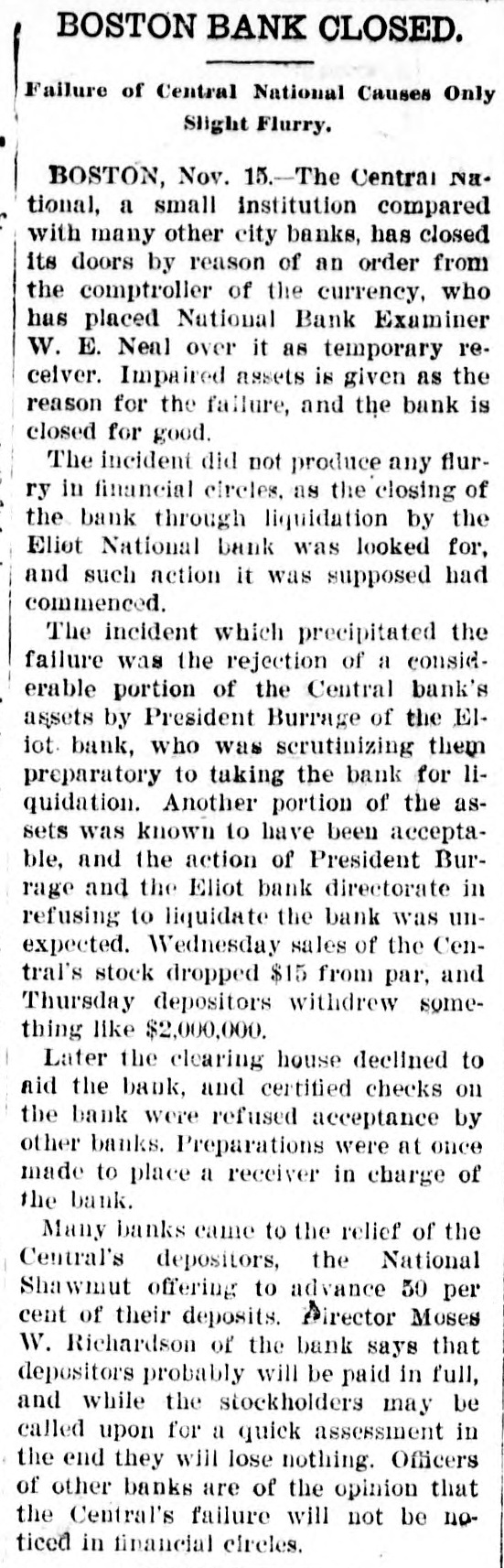
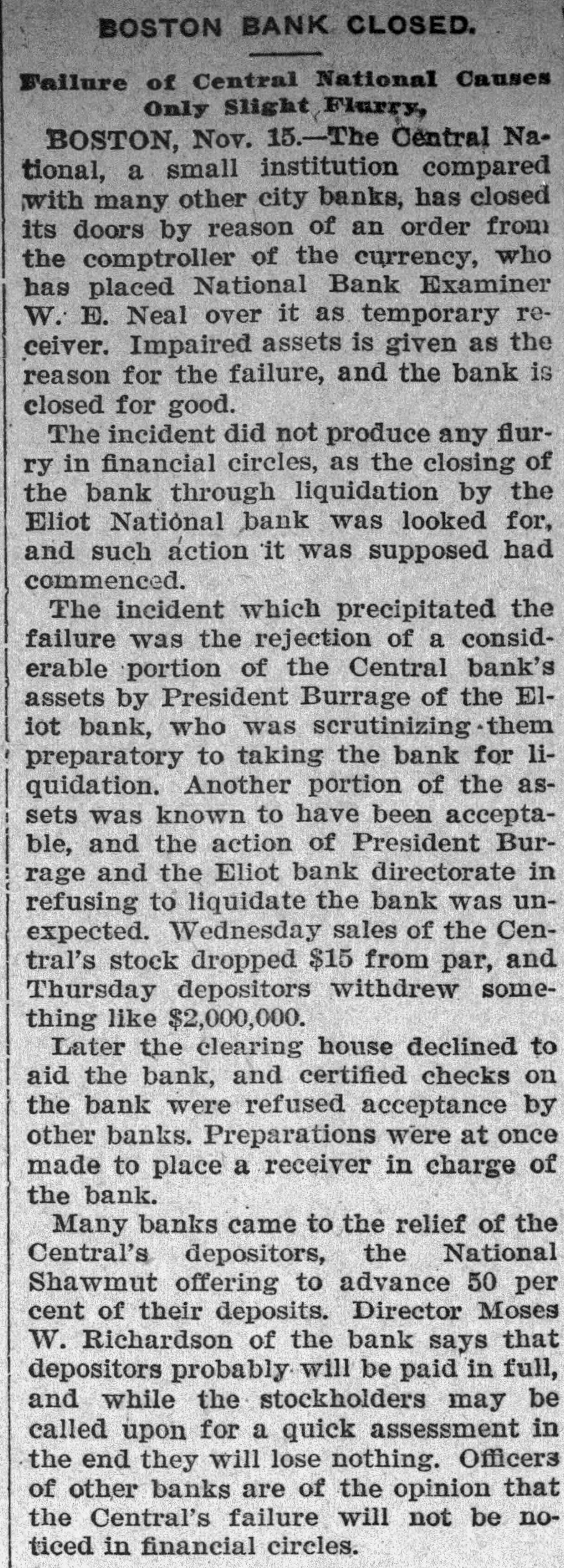
BOSTON BANK CLOSED. Failure of Central National Causes Only Slight Flurry. BOSTON, Nov. 15.-The Central National, a small institution compared with many other city banks, has closed its doors by reason of an order from the comptroller of the currency, who has placed National Bank Examiner W. E. Neal over it as temporary recelver. Impaired assets is given as the reason for the failure, and the bank is closed for good. The incident did not produce any flurry in financial circles, as the closing of the bank through liquidation by the Eliot National bank was looked for, and such action it was supposed had commenced. The incident which precipitated the failure was the rejection of a considerable portion of the Central bank's assets by President Burrage of the Ellot. bank, who was scrutinizing them preparatory to taking the bank for liquidation. Another portion of the assets was known to have been acceptable, and the action of President Burrage and the Ellot bank directorate in refusing to liquidate the bank was unexpected. Wednesday sales of the Central's stock dropped $15 from par, and Thursday depositors withdrew something like $2,000,000. Later the clearing house declined to aid the bank, and certified checks on the bank were refused acceptance by other banks. Preparations were at once made to place a receiver in charge of the bank. Many banks came to the relief of the Central's depositors, the National Shawmut offering to advance 50 per cent of their deposits. Director Moses W. Richardson of the bank says that depositors probably will be paid in full, and while the stockholders may be called upon for a quick assessment in the end they will lose nothing. Officers of other banks are of the opinion that the Central's failure will not be noticed in financial circles.


Article from New-York Tribune, November 15, 1902

Click image to open full size in new tab

Article Text

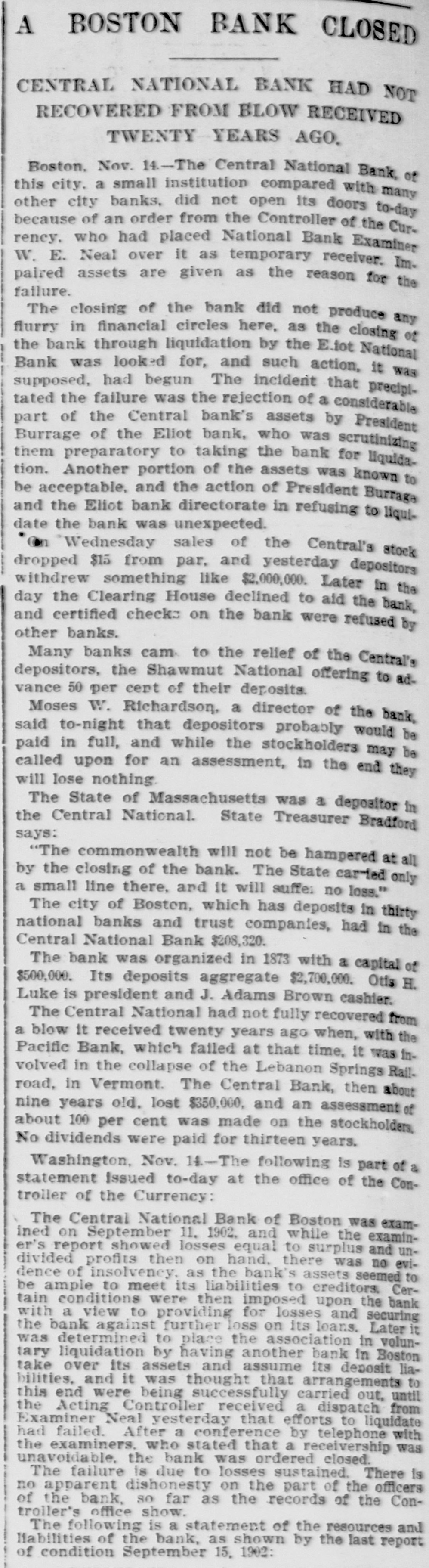
A BOSTON BANK CLOSED CENTRAL NATIONAL BANK HAD NOT RECOVERED FROM BLOW RECEIVED TWENTY YEARS AGO. Boston. Nov. 14.-The Central National Bank, of this city, a with other city open doors because of an of banks, small order institution did from net the Controller compared its the to-day many Currency. who had over W. E. Neal placed it as National temporary Bank receiver. Examiner Im. paired assets are given as the reason for the produce flurry in as the bank failure. The closing through financial of liquidation the circles bank here. did by the not the E.jot closing National any of Bank was looked for, and such action, it that supposed, tated the failure had begun the The rejection incident of precipt- was was a considerable part of the Central bank's assets by President Burrage was them preparatory for of the Eliot to taking bank, the who bank scrutinizing liquidation. Another portion of the assets was known to be and in to date was acceptable, the the Eliot bank bank and the unexpected. directorate action of President refusing Burraga liqui. 'on Wednesday sales of the Central's stock par, dropped withdrew $15 something from like and $2,000,000. yesterday depositors Later in the day the Clearing House declined to aid the bank, and on were by other Many certified banks. banks checks to the the relief bank refused cam of the Central's depositors, the Shawmut National offering to ad. vance 50 per cent of their deposits. Moses W. Richardson, a director of the bank, said to-night that depositors probably would be paid in full, and while the stockholders may be called upon for an assessment, in the end they will lose nothing The State of Massachusetts was a depositor In the Central National. State Treasurer Bradford says: "The commonwealth will not be hampered at all by the closing of the bank. The State carried only a small line there, and it will suffer no loss." The city of Bosten, which has deposits in thirty national banks and trust companies, had in the Central National Bank $208,320. The bank was organized in 1873 with a capital of $500,000. Its deposits aggregate $2,700,000. Otis H. Luke is president and J. Adams Brown cashier. The Central National had not fully recovered from a blow it received twenty years ago when, with the Pacific Bank, which failed at that time, it was volved in the collapse of the Lebanon Springs Rail. road, in Vermont. The Central Bank, then about nine years old. lost $350,000, and an assessment of about 100 per cent was made on the stockholders. No dividends were paid for thirteen years. Washington, Nov. 11-The following is part of a statement Issued to-day at the office of the Controller of the Currency: The Central National Bank of Boston was examined on September 11, 1902. and while the examiner's report showed losses equal to surplus and undivided profits then on hand, there was no evidence of insolvency, as the bank's assets seemed to be ample to meet its liabilities to creditors. Certain conditions were then imposed upon the bank with a view to providing for losses and securing the bank against further loss on its loans. Later it was determined to place the association in voluntary liquidation by having another bank in Boston take over its assets and assume its deposit liabilities, and it was thought that arrangements to this end were being successfully carried out, until the Acting Controller received a dispatch from Examiner Neal yesterday that efforts to liquidate had failed. After a conference by telephone with the examiners. who stated that a receivership was unavoidable, the bank was ordered closed. The failure is due to losses sustained. There is no apparent dishonesty on the part of the officers of the bank, so far as the records of the Controller's office show. The following is a statement of the resources and liabilities of the bank, as shown by the last report of condition September 15, 1902:


Article from Richmond Dispatch, November 15, 1902

Click image to open full size in new tab

Article Text

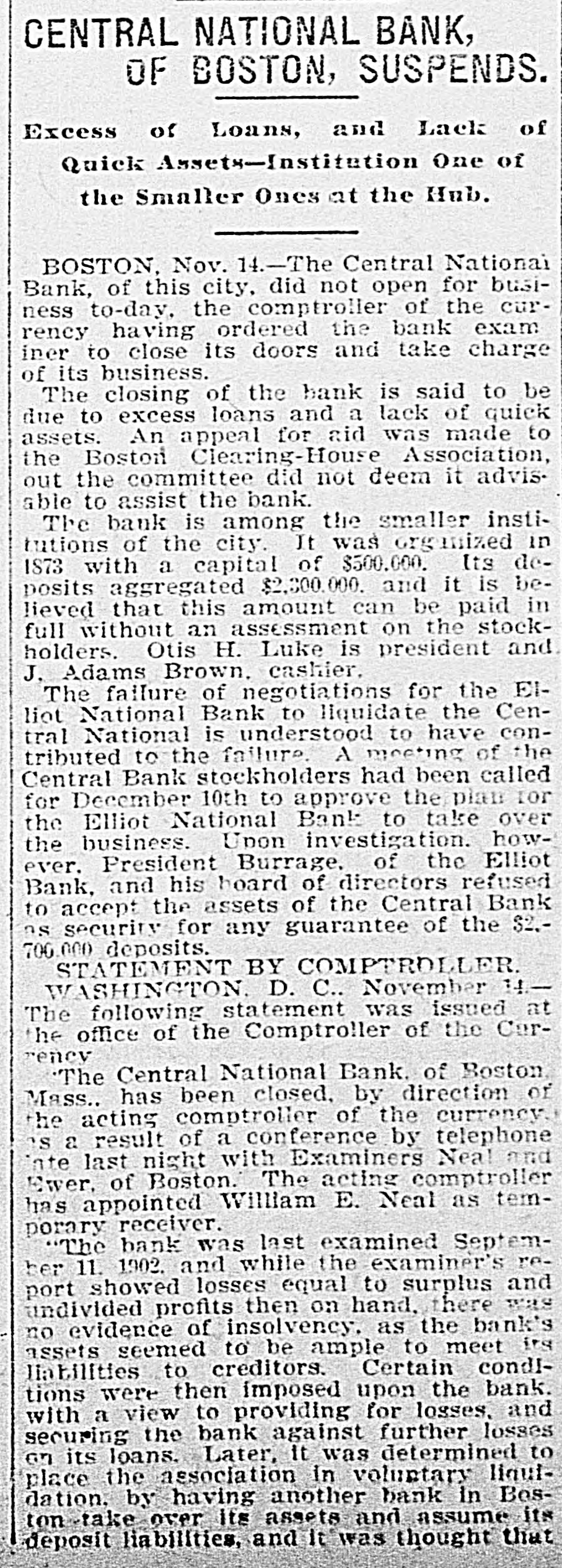
CENTRAL NATIONAL BANK, OF BOSTON, SUSPENDS. Excess of Loans, and Lack of Quick Assets-Institution One of the Smaller Ones at the Hub. BOSTON, Nov. 14.-The Central National Bank, of this city, did not open for business to-day, the comptroller of the currency having ordered the bank exam iner to close its doors and take charge of its business. The closing of the bank is said to be due to excess loans and a lack of quick assets. An appeal for aid was made to the Boston Clearing-House Association, out the committee did not deem it advisable to assist the bank. The bank is among the smaller institutions of the city. It was organized in 1873 with a capital of $500.000. Its deposits aggregated $2,300,000. and it is believed that this amount can be paid in full without an assessment on the stockholders. Otis H. Luke is president and J. Adams Brown. cashier. The failure of negotiations for the Elliot National Bank to liquidate the Central National is understood to have contributed to the failure. A meeting of the Central Bank stockholders had been called for December 10th to approve the plan for the Elliot National Bank to take over the business. Upon investigation. however. President Burrage. of the Elliot Bank, and his hoard of directors refused to accept the assets of the Central Bank as security for any guarantee of the $2.700.000 deposits. STATEMENT BY COMPTROLLER. WASHINGTON. D. C.. November H.The following statement was issued at the office of the Comptroller of the Carrency The Central National Bank. of Boston Mass.. has been closed. by direction of the acting comptroller of the currency. is a result of a conference by telephone inte last night with Examiners Neal and Ewer, of Boston. The acting comptroller has appointed William E. Neal as temporary receiver. "The bank was last examined Septemher 11. 1902. and while the examiner's report showed losses equal to surplus and undivided profits then on hand, there was no evidence of insolvency. as the bank's assets seemed to be ample to meet its liabilities to creditors. Certain conditions were then imposed upon the bank. with a view to providing for losses, and securing the bank against further losses on its loans. Later, It was determined to place the association in voluntary linuidation. by having another bank in Boston take over its assets and assume its deposit liabilities, and it was thought that


Article from The Savannah Morning News, November 15, 1902

Click image to open full size in new tab

Article Text

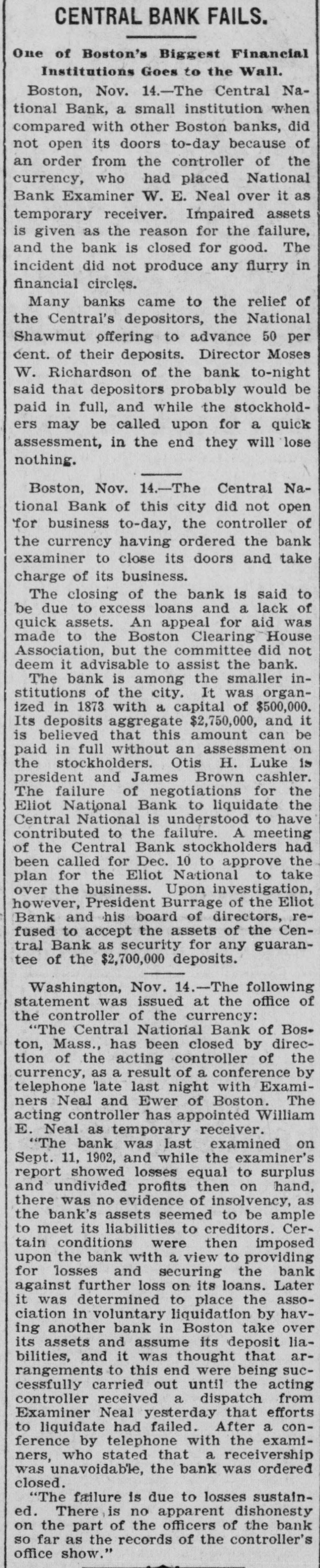
CENTRAL BANK FAILS. One of Boston's Biggest Financial Institutions Goes to the Wall. Boston, Nov. 14.-The Central National Bank, a small institution when compared with other Boston banks, did not open its doors to-day because of an order from the controller of the currency, who had placed National Bank Examiner W. E. Neal over it as temporary receiver. Impaired assets is given as the reason for the failure, and the bank is closed for good. The incident did not produce any flurry in financial circles. Many banks came to the relief of the Central's depositors, the National Shawmut offering to advance 50 per cent. of their deposits. Director Moses W. Richardson of the bank to-night said that depositors probably would be paid in full, and while the stockholders may be called upon for a quick assessment, in the end they will lose nothing. Boston, Nov. 14.-The Central National Bank of this city did not open for business to-day, the controller of the currency having ordered the bank examiner to close its doors and take charge of its business. The closing of the bank is said to be due to excess loans and a lack of quick assets. An appeal for aid was made to the Boston Clearing House Association, but the committee did not deem it advisable to assist the bank. The bank is among the smaller institutions of the city. It was organized in 1873 with a capital of $500,000. Its deposits aggregate $2,750,000, and it is believed that this amount can be paid in full without an assessment on the stockholders. Otis H. Luke is president and James Brown cashier. The failure of negotiations for the Eliot National Bank to liquidate the Central National is understood to have contributed to the failure. A meeting of the Central Bank stockholders had been called for Dec. 10 to approve the plan for the Eliot National to take over the business. Upon investigation, however, President Burrage of the Eliot Bank and his board of directors, refused to accept the assets of the Central Bank as security for any guarantee of the $2,700,000 deposits. Washington, Nov. 14.-The following statement was issued at the office of the controller of the currency: "The Central National Bank of Boston, Mass., has been closed by direction of the acting controller of the currency, as a result of a conference by telephone late last night with Examiners Neal and Ewer of Boston. The acting controller has appointed William E. Neal as temporary receiver. "The bank was last examined on Sept. 11, 1902, and while the examiner's report showed losses equal to surplus and undivided profits then on hand, there was no evidence of insolvency, as the bank's assets seemed to be ample to meet its liabilities to creditors. Certain conditions were then imposed upon the bank with a view to providing for losses and securing the bank against further loss on its loans. Later it was determined to place the association in voluntary liquidation by having another bank in Boston take over its assets and assume its deposit liabilities, and it was thought that arrangements to this end were being successfully carried out until the acting controller received a dispatch from Examiner Neal yesterday that efforts to liquidate had failed. After a conference by telephone with the examiners, who stated that a receivership was unavoidable, the bank was ordered closed. "The failure is due to losses sustained. There, is no apparent dishonesty on the part of the officers of the bank so far as the records of the controller's office show."


Article from Waterbury Democrat, November 15, 1902

Click image to open full size in new tab

Article Text

BOSTON BANK CLOSED. Failure of Central National Causes Only Slight Flurry, BOSTON, Nov. 15.-The Central National, a small institution compared with many other city banks, has closed its doors by reason of an order from the comptroller of the currency, who has placed National Bank Examiner W. E. Neal over it as temporary receiver. Impaired assets is given as the reason for the failure, and the bank is closed for good. The incident did not produce any flurry in financial circles, as the closing of the bank through liquidation by the Eliot National bank was looked for, and such action it was supposed had commenced. The incident which precipitated the failure was the rejection of a considerable portion of the Central bank's assets by President Burrage of the Eliot bank, who was scrutinizing them preparatory to taking the bank for liquidation. Another portion of the assets was known to have been acceptable, and the action of President Burrage and the Eliot bank directorate in refusing to liquidate the bank was unexpected. Wednesday sales of the Central's stock dropped $15 from par, and Thursday depositors withdrew something like $2,000,000. Later the clearing house declined to aid the bank, and certified checks on the bank were refused acceptance by other banks. Preparations were at once made to place a receiver in charge of the bank. Many banks came to the relief of the Central's depositors, the National Shawmut offering to advance 50 per cent of their deposits. Director Moses W. Richardson of the bank says that depositors probably will be paid in full, and while the stockholders may be called upon for a quick assessment in the end they will lose nothing. Officers of other banks are of the opinion that the Central's failure will not be noticed in financial circles.


Article from Daily Kennebec Journal, November 17, 1902

Click image to open full size in new tab

Article Text

BANK FAILURE. The Central National of Boston Closes Its Doors. Never Recovered from Blow from the Pacific Bank Failure. The Wreck Due to Losses SustainedAccounts Are Straight. Boston, Nov. 16.-The Central National Bank, a small institution compared with many other city banks, did not open its doors, Friday, by reason of an order from the comptroller of the currency, who had placed National Bank Examiner W. E. Neal over it as temporary receiver. Impaired assets is given as the reason for the failure and the bank is closed for good. The incident did not produce any flurry in financial circles as the closing of the bank through liquidation by the Eliot National Bank was looked for and such action it was supposed had commenced. The incident which precipitated the failure was the rejection of a considerable portion of the Central Bank's assets by President Burrage of the Eliot Bank, who was scrutinizing them preparatory to taking the bank for liquidation. Another portion of the assets was known to have been acceptable and the action of President Burrage and the Eliot Bank directorate in refusing to liquidate the bank was unexpected. Wednesday, sales of the Central's stock dropped $15 from par, and, yesterday, depositors withdrew something like two millions. Later in the day the Clearing House declined to aid the bank and certified checks on the bank were refused acceptance by other banks. Over night operations were made to place a receiver in charge of the bank and in fulfilment of this plan the doors were placarded, today. Many banks came to the relief of the Central's depositors, the National Shawmut offering to advance 50 per cent. of their deposits. Director Moses W. Richardson of the bank. Friday, said that depositors probably would be paid in full, and while the stockholders may be called upon for a quick assessment in the end they will lose nothing. Officers of other banks are of the opinion that the Central's failure will not be noticed in financial circles. The failure for negotiations for the Eliot National Bank to liquidate the Central National and the refusal of the Boston Clearing House Association to aid the latter bank are understood to be the immediate causes of the failure, but it is said in banking circles that the Central National never fully re-


Article from The Fulton County News, November 20, 1902

Click image to open full size in new tab

Article Text

SUMMARY OF THE LATEST NEWS. Domestic. Receivers for the National Asphalt Company and the Asphalt Company of America filed in court at Trenton, N. J., reports stating that they have made progress in reducing expenses by consolidating the underlying companies. During a controversy over a board bill James Masterson fatally shot M. P. Brittingham, proprietor of the Hotel Bratt. in Manchester, O., and then killed himself. Brittingham was shot three times. It was reported in Philadelphia that the Reading. the Baltimore and Ohio, and other Eastern railroads will follow the example of the Pennsylvania and increase the salaries of employes. The Anthracite Strike Commission began the hearing of evidence in Scranton, Pa., President Mitchell reading a long satement and then taking the witness stand. Col. Edward Butler, the millionaire politician of St. Louis, was convicted of bribery in Columbia, Mo., and sentenced to three years in the penitentiary. In the American Federation of Labor Convention yesterday at New Orleans a number of resolutions bearing upon labor conditions were introduced. The Methodist General Missionary Conference. in session in Albany, N. Y., made appropriations for the various missions in China and Korea. The Central National Bank of Boston closed its doors as a result of impaired assets. The failure had no effect in financial circles. William Becker, who sent threatening letters to a number of wealthy men in New York. was arrested on the charge of blackmail. One hundred and ten Presbyteries have thus far voted for revision of the creed, none having voted the other way. Superintendent Pratt. of the Carlisle Indian School. submitted his report to Indian Commissioner Jones. The twenty-second annual convention of the American Federation of Labor opened in New Orleans, and President Gompers, in his annual address, warned the members of the dangers of the conflicting claims of jurisdiction made by different bodies. Four men were killed and 40 more or less inured by the explosion of a large boiler in a scrap puddle furnace at the American Iron and Steel Manufacturing plant at Lebanon, Pa. Frank C. Andrews, the convicted vicepresident of the wrecked City Savings Bank of Detroit, Mich., was taken to the Jackson State Prison to begin serving his 15 years sentence. Mrs. Tingley has appealed from the decision of the board of inquiry in New York to deport the Cuban children designed for the Buddhist home at California. J. W. McNight, former president of the defunct German National Bank of Louisville, Ky., was sentenced to six years in the penitentiary for embezzlement. The grand jury of Freehold, N. J., has not yet indicted Laura Biggar on account of any charge growing out of her alleged marriage to Millionaire Bennett. A young woman ,in whose possession was found a watch chain stolen from one of the murdered Boston women, is likely to prove an important witness in the case. The General Missionary Conference of the Methodist Episcopal Church at Albany, N. Y., decided not to admit the secretaries of conferences as members. The coroner's jury held Charles Cawle-- of Homestead. Pa., responsible for the murder of his mother and four brothers and sisters. Rev. James Hill, a Marylander by birth, and senior member of the Indiana Conference of the M. E. Church, died at the age of 83.


Article from The L'anse Sentinel, November 22, 1902

Click image to open full size in new tab

Article Text

United States Senators Beveridge, of Indiana; Dillingham, of Vermont, and Burnham, of New Hampshire, are making a tour of the territories of the southwest with reference to their admission to statehood. Lester R. Brooks, a millionaire grain and lumber magnate, dropped dead in Minneapolis while playing chess. President Roosevelt has gone to Smedes, Miss., for a four days' black bear hunt. The whisky tax law enacted by the last Missouri legislature has been declared unconstitutional and void. Director of the Mint Roberts reports the world's production of gold in 1901 was $263,374,000, and of silver, $104,999,100. Lady Henry Somerset, the temperance advocate, sailed from New York for England on the St. Louis. The ninth annual convention of the Daughters of the Confederacy began at New Orleans. Five men suspected of the Gardner (Ill.) bank robbery, October 29, have been arrested in Chicago. Officials are taking steps to hasten the negotiations for the reciprocity treaty now pending between the United States and Cuba. Objections to recognition of the miners' union is emphasized in answers of coal operators filed with the arbitration commission. Leslie Combes, of Louisville, has been appointed minister to Guatemala. to succeed Dr. W. G. Hunter, resigned. The recent election in the territory of Hawaii resulted in a republican victory. President Roosevelt's annual message will recommend Sherman antitrust amendments to curb combines. Mrs. Eddy advises her followers to refrain from attempting to cure infectious diseases by Christian science. Prof. Samuel M. Lindsay, commissioner of education in Porto Rico, says the educational prospects of the island are good. All the members of the anthracite strike commission are at Scranton to begin the hearing of the differences existing between the miners and their employers. Foreign commercial men were given a banquet in Washington and were addressed by Secretary Shaw. The American Bankers' association in session in New Orleans elected as president Caldwell Hardy, of Norfolk, Va. Gen. Adna R. Chaffee wasa guest of honor at the annual dinner of the Merchants' association in San Francisco. The Pennsylvania Railroad company has increased the wages of 59,000 employes ten per cent. At Lewisburg, Tenn., John Davis, a negro, was hanged by a mob for the murder of Robert Adair, a farmer. The twenty-second annual convention of the American Federation of Labor met in New Orleans. Four men who attempted to hold up the south bound Monon express at Cyclone, Ky., were captured. President Roosevelt reached Smedes, Miss., and left for camp on the Little Sunflower river, in cypress swamp. where he will hunt for bears. Judge Madden, at Emporia, Kan., in the case against Prof. Vanora. a hypnotist decided that a man has the right to bury his wife alive. Brig. Gen. Hamilton S. Hawkins. U. S. A., retired, has been detailed as governor of the national soldiers' home in Washington. The explosion of a large boiler at Lebanon, Pa., killed four men. The Union Pacific is reported to have secured a majority of the stock of the Southern Pacific. Gen. Bliss has sailed for Cuba to negotiate a new commercial treaty. The Central national bank of Boston has been ordered closed by the comptroller of the currency and a receiver appointed. J. P. Morgan, Russell Sage and other prominent New York capitalists have been threatened with death by nihil-


Article from Evening Star, November 25, 1902

Click image to open full size in new tab

Article Text

Receiver of Boston Bank. The controller of the currency has appointed Frank D. Allen permanent receiver of the Central National Bank of Boston.


Article from Burlington Weekly Free Press, November 27, 1902

Click image to open full size in new tab

Article Text

New York-Michael B. Sullivan of Boston took fatal jump from Brooklyn bridge-Beef trust cases to be argued in Chicago Dec. 16-Germany and England considering serious action against Venezuela; debating just hat form the measures will assumeBandits hold up Rock Island train and secure considerable booty. MONDAY, NOV. 24. Gale off Cape Cod brings death to fishermen-President Eliot of Harvard finds good in labor unions. but also finds many evils; denounces boycott and violence-Colombia withdraws troops from isthmus-Several lives lost at fire In Ashland. Wis.; property lossover $500,000-Consul McNally calls the shooting at Guatemala a coid blood d murder--West-bound express held '.p and robbed by bandits near Davenport, In—Three boys drowned in the Androscoggin river near Lewiston. Me -President at school dedication and Union league banquet in Philadelphia -Sister Theresa of Carney hospital. Boston, completes 50 years of servi e -The mikado sends a gift and nn autograph letter to Mrs. U. S. Grant Anthracite commissioner says the main points have been agreed upon-Federation convention to meet in Boston in 1903: Gompers re-elected--Engineers running west of Chicago to demand 15 percent increase in wagesWool trade threatened by a general strike at the port of Buenos Ayres Ohio court ides a husband may eject his mother-inlaw from house United States government to hold Cuba to her obligations-Death of Herr Krupp, the German gunmaker, and richest man in Germany. TUESDAY, NOV. 25. Anthracite strike conferees called to Washington: belief that outside settlement of differences is near-Frank D. Allen made permanent receiver of the Central National bank. Boston-Trade in live stock in Massachusetts to be brought to a standstill on account of the "feot and mouth disease"-Ma loaded freight cars burned at Taunton, Mass: loss $40,000-San FranciscoHonolulu cable likely to be ready by Christmas-Rabbi Silverman of New York declares Zionism is not feasible -Dartmouth mill weavers. New Bed ford. vote to strike if grievances are not adjusted-Porto Ricans in Hawaii anxious to leave: they have proved 2 failure as plantation laborers-Hazing at West Point to be taken up by congress-Nebraska Indians want to send their children to public schoolsPeace in Panama not likely to haveany effect on canal negotiations— Western cattle syndicates illegally acquire steads from war widows-Archbishop Chappelle defends friars and clares they will stay in the Philippines -Pension commissioner advises retirement of old clerks. who cannot now do efficient work-Secretary Root will favor plan allowing army officers to deposit funds with paymaster and receive interest on balances Czar of Russia said to fear demand for his abdication-Germans in Russia returning to their mother vana strike very serious: strikers killed. several police wounded-New invasion of Venezuela from Colombia. but only rebels are blamed minister hauls down the Chinese flag at the Tong Shan coal mines-Resoiution in British house of commons to ratify Brussels convention abolishing sugar bounties. WEDNESDAY. NOV. 26. Coal settlement all off again. as a result of protest made by independente operators to presidents of coal-carryroads-Havana strike settled through the intervention of General Gomez--After an all-night session the Newton, Mass., board of aldermen passes a bill calling for expenditures of more than not to command Zeigler's Arctic expedition-Northern securities hearing in New York adjourns to Dec. 1-Labor Federation will blacklist congressmen who oppose anti-injunction campaign-President favors early trust legisiation-Cabinet discusses treaties with Cuba and Colombia-Taft and Guidi make working plans to settle friar question --Commissioner for Porto Rico reports good progress in all lines-Legistation for Philippine money to be taken up by congress- Republican leaders oppose the president's tariff commission idea-Civil service commission to investigate Congressman Loud's defeat, supposed to be due to letter car riers-Ashley M. Gould to be associate justice of the supreme court of the District of Columbia, and Francis M. Wright to be judge of the court of elaims--Serious strikes in Buenos Ayres-New cabinet for British Co lumbia-Chamberlain starts for South Africa-Armed bands still active in Macedonia-It is now admitted that 2500 deaths resulted from Guatemala earthquake-British employers protest against American plan of paying good wages to encourage increased output-Castro says battle of La Victoria was a death blow to rebels: he expects to proclaim peace by first of January. THE OLD SQUARE PIANO. The old square plano-there it stands:


Article from The Broad Ax, December 27, 1902

Click image to open full size in new tab

Article Text

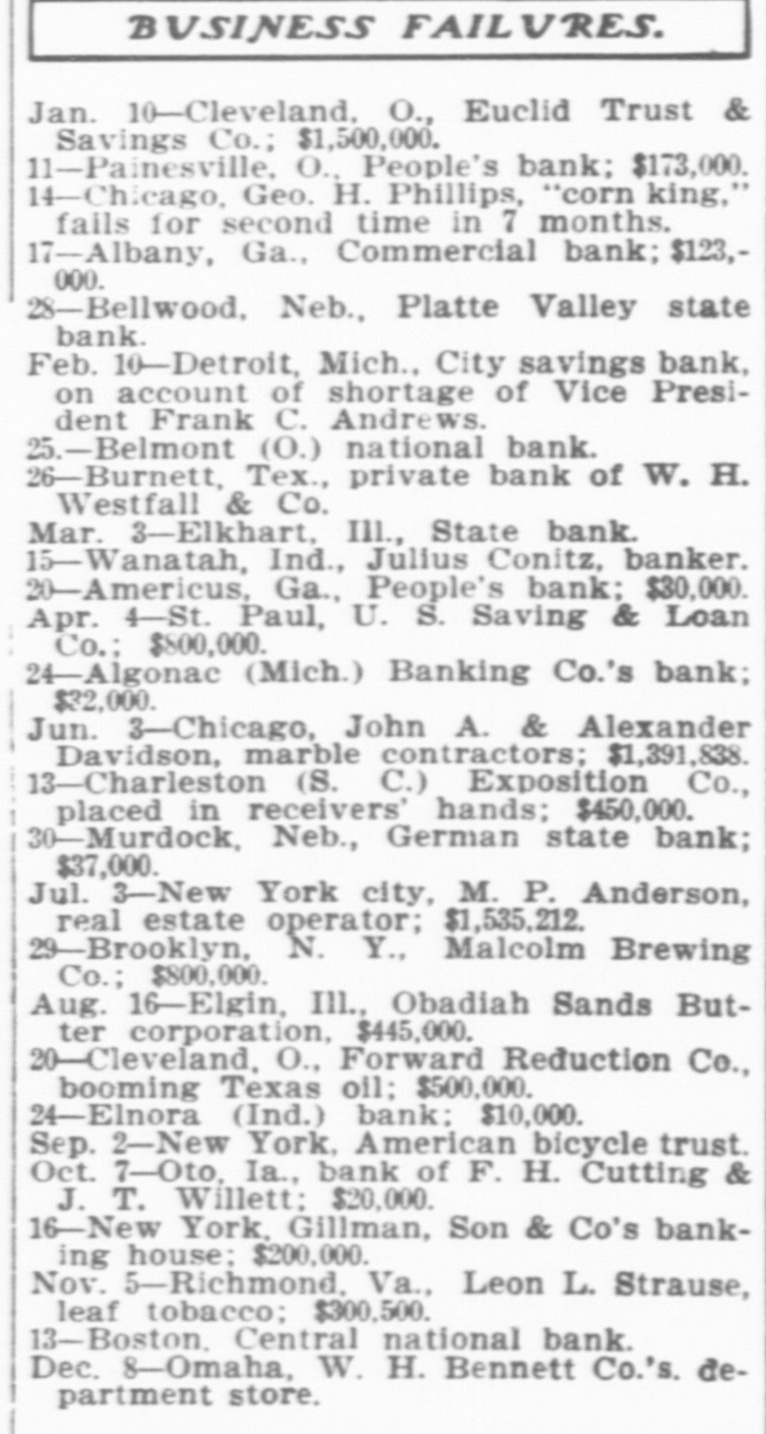
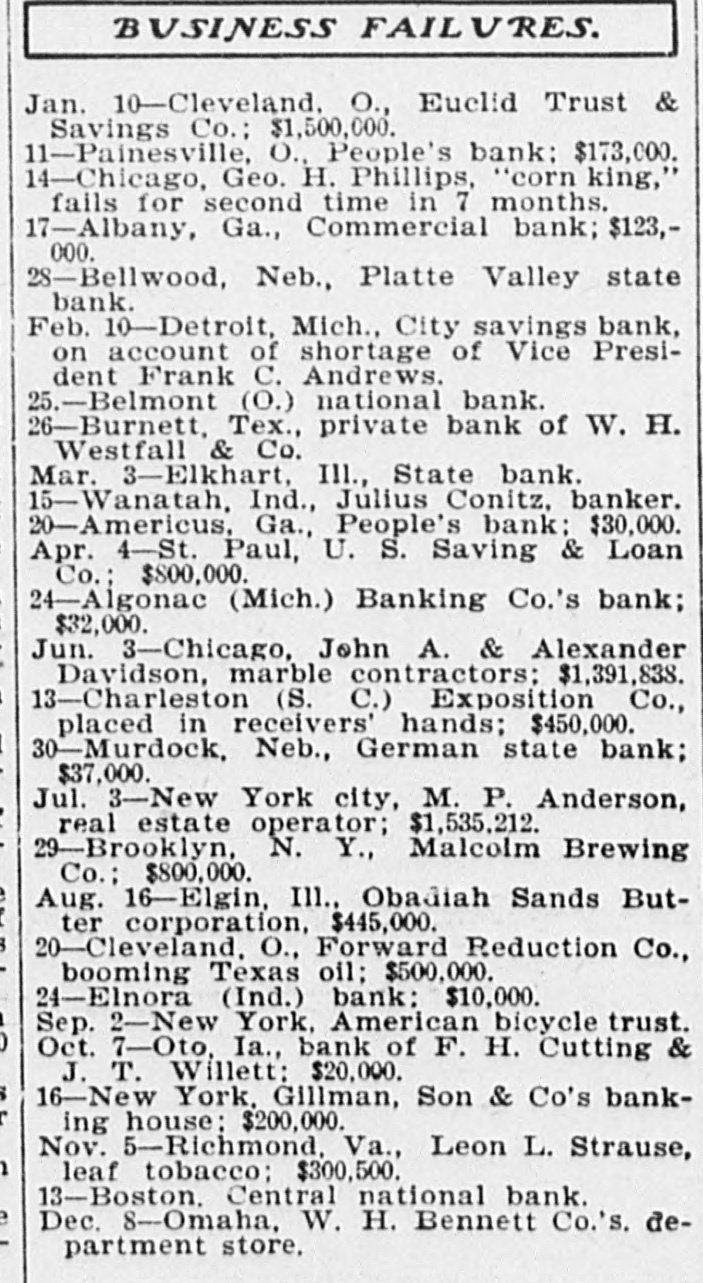
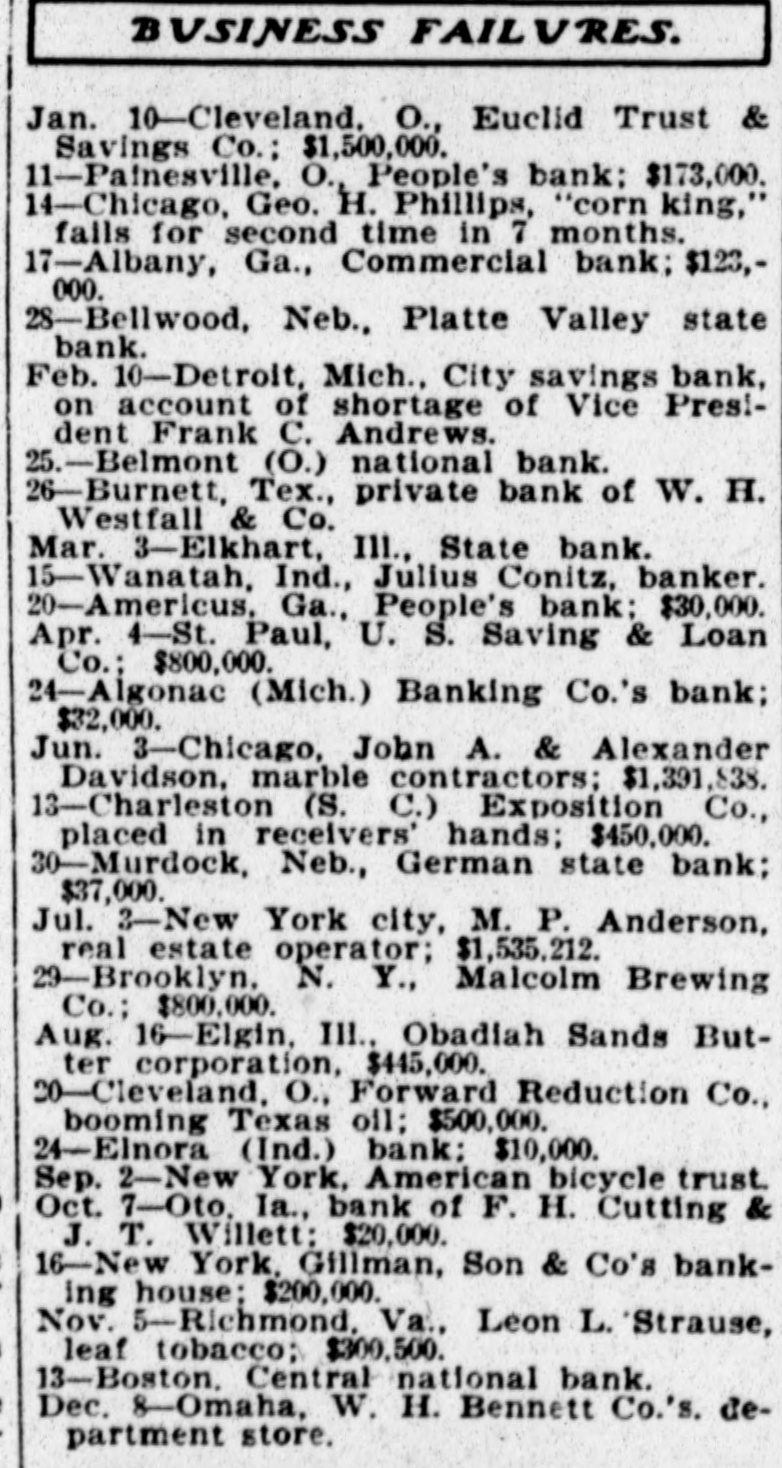
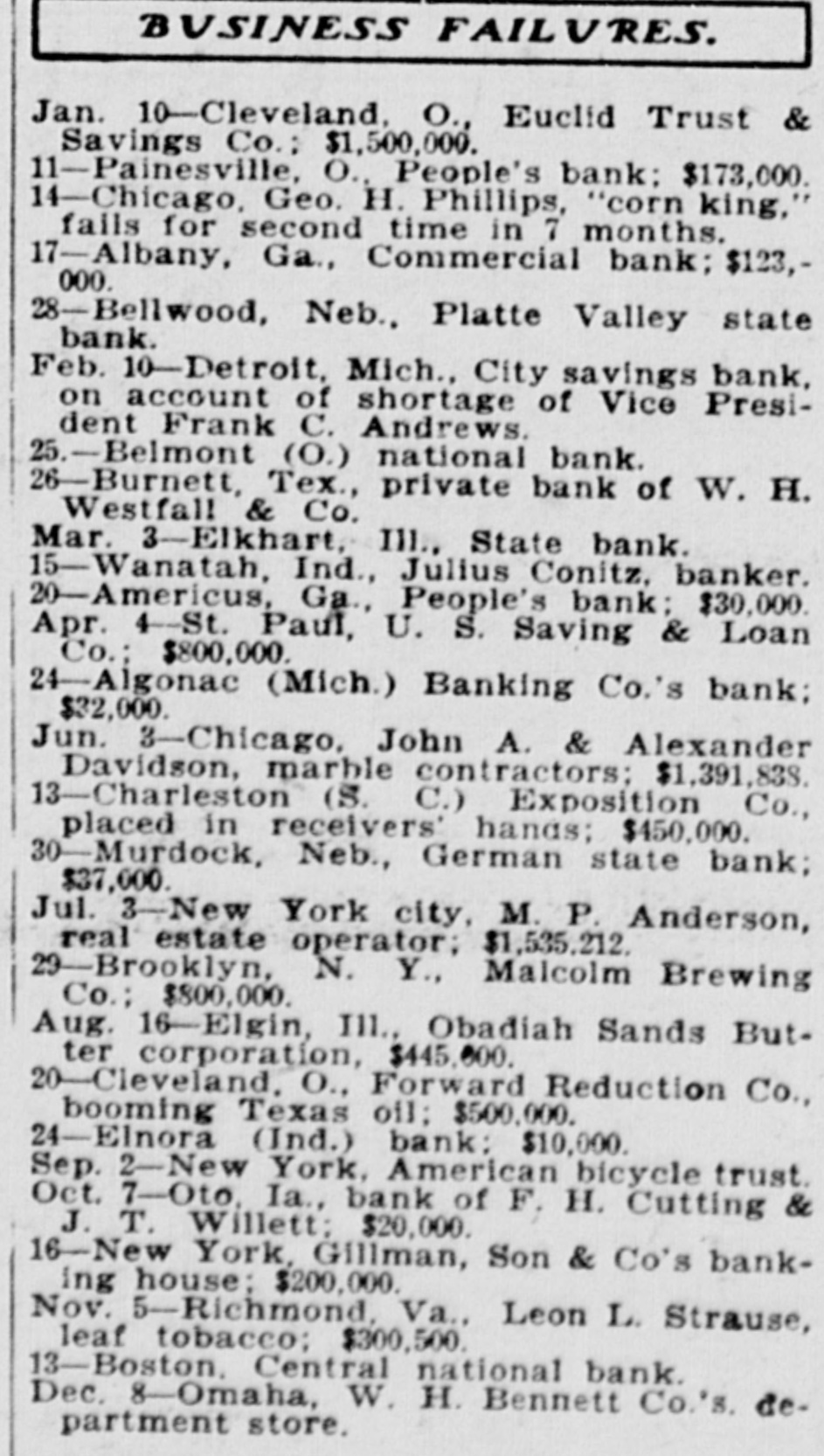
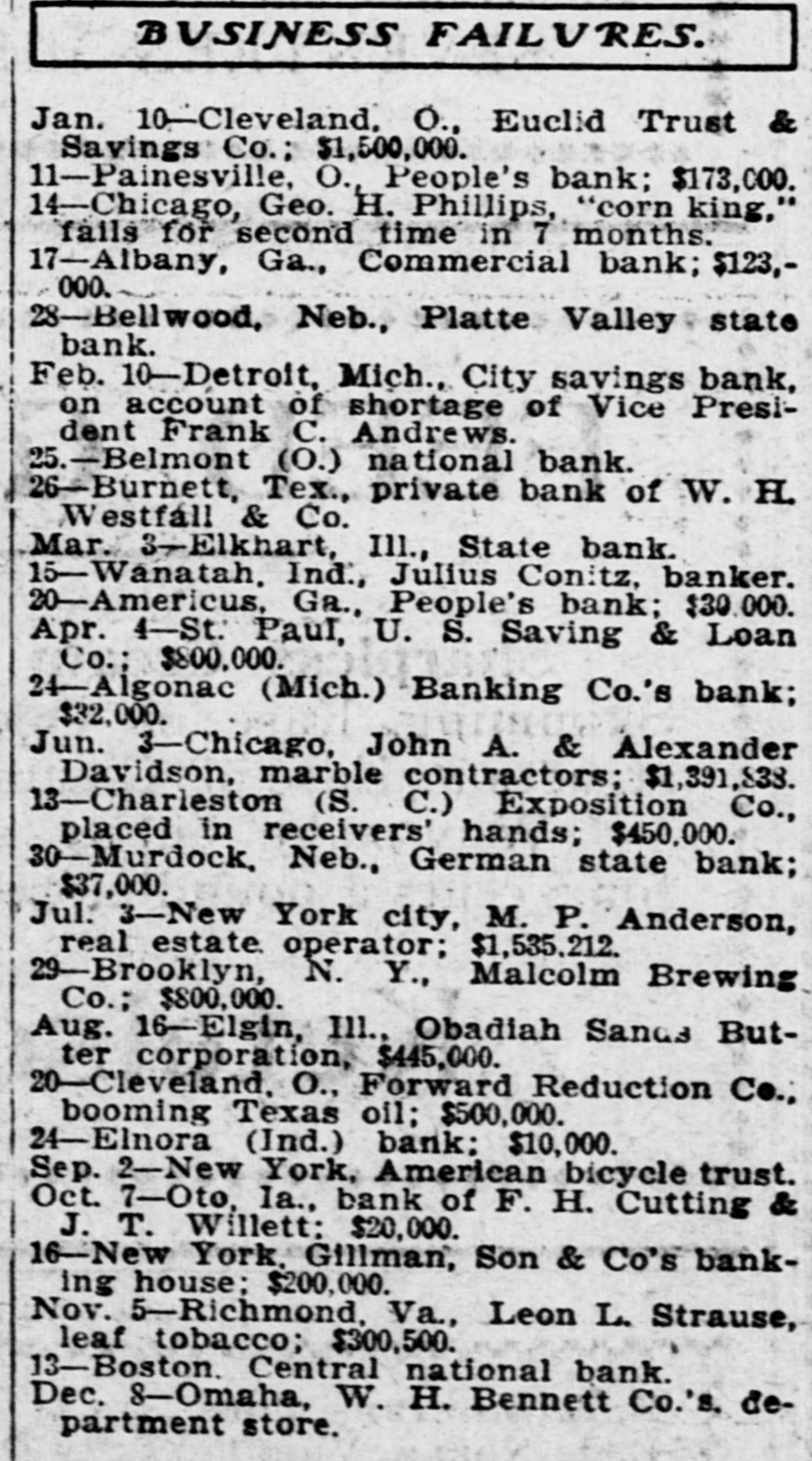
BUSINESS FAILVRES. Jan. 10-Cleveland, 0., Euclid Trust & Savings Co.; $1,500,000. 11-Painesville, 0., People's bank; $173,000. 14-Chicago, Geo. H. Phillips, "corn king," fails for second time in 7 months. 17-Albany, Ga., Commercial bank; $123,000. 28-Bellwood, Neb., Platte Valley state bank. Feb. 10-Detroit, Mich., City savings bank, on account of shortage of Vice President Frank C. Andrews. 25.-Belmont (0.) national bank. 26-Burnett, Tex., private bank of W. H. Westfall & Co. Mar. 3-Elkhart, III., State bank. 15-Wanatah, Ind., Julius Conitz, banker. 20-Americus, Ga., People's bank; $30,000. Apr. 4-St. Paul, U. S. Saving & Loan Co.; $800,000. 24-Algonac (Mich.) Banking Co.'s bank; $32,000. Jun. 3-Chicago, John A. & Alexander Davidson, marble contractors; $1,391,838. 13-Charleston (S. C.) Exposition Co., placed in receivers' hands; $450,000. 30-Murdock, Neb., German state bank; $37,000. Jul. 3-New York city, M. P. Anderson, real estate operator; $1,535,212. 29-Brooklyn, N. Y., Malcolm Brewing Co.; $800,000. Aug. 16-Elgin, Ill., Obadiah Sands Butter corporation, $445,000. 20-Cleveland, O., Forward Reduction Co., booming Texas oil; $500,000. 24-Elnora (Ind.) bank; $10,000. Sep. 2-New York, American bicycle trust. Oct. 7-Oto, Ia., bank of F. H. Cutting & J. T. Willett: $20,000. 16-New York, Gillman, Son & Co's banking house; $200,000. Nov. 5-Richmond, Va., Leon L. Strause, leaf tobacco; $300,500. 13-Boston. Central national bank. Dec. 8-Omaha, W. H. Bennett Co.'s. department store.


Article from Perrysburg Journal, January 2, 1903

Click image to open full size in new tab

Article Text

BUSINESS FAILURES. Jan. 10-Cleveland, O., Euclid Trust & Savings Co.: $1,500,000. 11-Painesville, O., People's bank: $173,000. 14-Chicago, Geo. H. Phillips, "corn king," fails for second time in 7 months. 17-Albany, Ga., Commercial bank; $123,000. 28-Bellwood, Neb., Platte Valley state bank. Feb. 10-Detroit, Mich., City savings bank, on account of shortage of Vice President Frank C. Andrews. 25.-Belmont (O.) national bank. 26-Burnett, Tex., private bank of W. H. Westfall & Co. Mar. 3-Elkhart, III., State bank. 15-Wanatah, Ind., Julius Conitz, banker. 20-Americus, Ga., People's bank: $30,000. Apr. 4-St. Paul, U. S. Saving & Loan Co.: $800,000. 24-Algonac (Mich.) Banking Co.'s bank; $32,000. Jun. 3-Chicago, John A. & Alexander Davidson, marble contractors; $1,391,838. 13-Charleston (S. C.) Exposition Co., placed in receivers' hands; $450,000. 30-Murdock, Neb., German state bank; $37,000. Jul. 3-New York city, M. P. Anderson, real estate operator; $1,535,212. 29-Brooklyn, N. Y., Malcolm Brewing Co.: $800,000. Aug. 16-Elgin, Ill., Obadiah Sands Butter corporation, $445,000. 20-Cleveland, O., Forward Reduction Co., booming Texas oil; $500,000. 24-Elnora (Ind.) bank: $10,000. Sep. 2-New York, American bicycle trust. Oct. 7-Oto, Ia., bank of F. H. Cutting & J. T. Willett: $20,000. 16-New York, Gillman, Son & Co's banking house: $200,000. Nov. 5-Richmond, Va., Leon L. Strause, leaf tobacco; $300,500. 13-Boston. Central national bank. Dec. 8--Omaha, W. H. Bennett Co.'s. department store.


Article from The L'anse Sentinel, January 3, 1903

Click image to open full size in new tab

Article Text

BUSINESS FAILVRES. Jan. 10-Cleveland. O., Euclid Trust & Savings Co.; $1,500,000. 11-Painesville, O., People's bank: $173,000. 14-Chicago, Geo. H. Phillips, "corn king," fails for second time in 7 months. 17-Albany, Ga., Commercial bank; $123,000. 28-Bellwood, Neb., Platte Valley state bank. Feb. 10-Detroit, Mich., City savings bank, on account of shortage of Vice President Frank C. Andrews. 25.-Belmont (O.) national bank. 26-Burnett, Tex., private bank of W. H. Westfall & Co. Mar. 3-Elkhart, III., State bank. 15-Wanatah, Ind., Julius Conitz, banker. 20-Americus, Ga., People's bank; $30,000. Apr. 4-St. Paul, U. S. Saving & Loan Co.; $800,000. 24-Algonac (Mich.) Banking Co.'s bank; $32,000. Jun. 3-Chicago, John A. & Alexander Davidson, marble contractors; $1,391,838. 13-Charleston (S. C.) Exposition Co., placed in receivers' hands; $450,000. 30-Murdock, Neb., German state bank; $37,000. Jul. 3-New York city, M. P. Anderson, real estate operator; $1,535,212. 29-Brooklyn. N. Y., Malcolm Brewing Co.; $800,000. Aug. 16-Elgin, III., Obadiah Sands Butter corporation, $445,000. 20-Cleveland, O., Forward Reduction Co., booming Texas oil; $500,000. 24-Elnora (Ind.) bank: $10,000. Sep. 2-New York, American bicycle trust. Oct. 7-Oto. Ia., bank of F. H. Cutting & J. T. Willett: $20,000. 16-New York, Gillman, Son & Co's banking house: $200,000. Nov. 5-Richmond, Va., Leon L. Strause, leaf tobacco; $300,500. 13-Boston, Central national bank. Dec. 8-Omaha, W. H. Bennett Co.'s. department store.


Article from Ceredo Advance, January 7, 1903

Click image to open full size in new tab

Article Text

BUSINESS FAILVRES. Jan. 10-Cleveland, O., Euclid Trust & Savings Co.: $1,500,000. 11-Painesville, O., People's bank; $173,000. 14-Chicago, Geo. H. Phillips, "corn king," fails for second time in 7 months. 17-Albany, Ga., Commercial bank; $123,000. 28-Bellwood, Neb., Platte Valley state bank. Feb. 10-Detroit, Mich., City savings bank, on account of shortage of Vice President Frank C. Andrews. 25.-Belmont (O.) national bank. 26-Burnett, Tex., private bank of W. H. Westfall & Co. Mar. 3-Elkhart, III., State bank. 15-Wanatah, Ind., Julius Conitz, banker. 20-Americus, Ga., People's bank; $30,000. Apr. 4-St. Paul, U. S. Saving & Loan Co.; $800,000. 24-Algonac (Mich.) Banking Co.'s bank; $32,000. Jun. 3-Chicago, John A. & Alexander Davidson, marble contractors; $1,391,838. 13-Charleston (S. C.) Exposition Co., placed in receivers' hands; $450,000. 30-Murdock, Neb., German state bank; $37,000. Jul. 3-New York city, M. P. Anderson, real estate operator; $1,535,212. 29-Brooklyn, N. Y., Malcolm Brewing Co.; $800,000. Aug. 16-Elgin, Ill., Obadiah Sands Butter corporation, $445,000. 20-Cleveland, O., Forward Reduction Co., booming Texas oil; $500,000. 24-Elnora (Ind.) bank: $10,000. Sep. 2-New York, American bicycle trust. Oct. 7-Oto, Ia., bank of F. H. Cutting & J. T. Willett; $20,000. 16-New York, Gillman, Son & Co's banking house; $200,000. Nov. 5-Richmond, Va., Leon L. Strause, leaf tobacco; $300,500. 13-Boston, Central national bank. Dec. 8-Omaha, W. H. Bennett Co.'s. department store.


Article from Iron County Register, January 8, 1903

Click image to open full size in new tab

Article Text

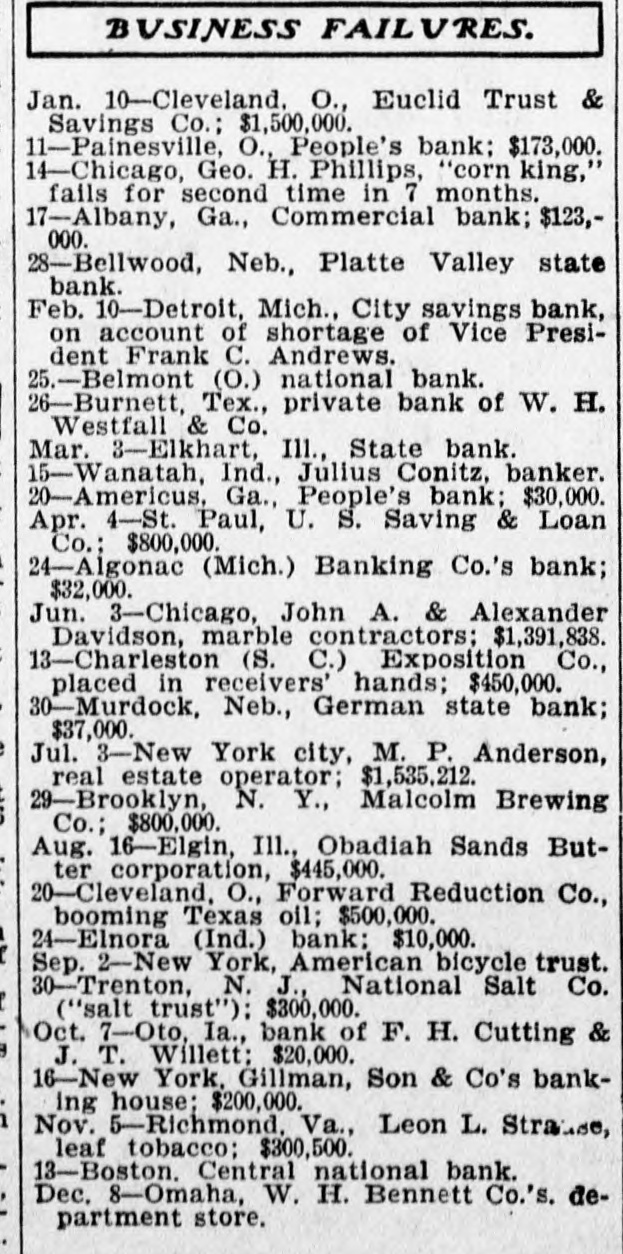
BUSINESS FAILVRES. Jan. 10-Cleveland. O., Euclid Trust & Savings Co.: $1,500,000. 11-Painesville, O., People's bank: $173,000. 14-Chicago, Geo. H. Phillips, "corn king," fails for second time in 7 months. 17-Albany, Ga., Commercial bank; $123,000. 28-Bellwood, Neb., Platte Valley state bank. Feb. 10-Detroit, Mich., City savings bank, on account of shortage of Vice President Frank C. Andrews. 25.-Belmont (O.) national bank. 26-Burnett, Tex., private bank of W. H. Westfall & Co. Mar. 3-Elkhart, Ill., State bank. 15-Wanatah, Ind., Julius Conitz. banker. 20-Americus. Ga., People's bank: $30,000. Apr. 4-St. Paul, U. S. Saving & Loan Co.: $800,000. 24-Algonac (Mich.) Banking Co.'s bank; $32,000. Jun. 3-Chicago, John A. & Alexander Davidson, marble contractors; $1,391,838. 13-Charleston (S. C.) Exposition Co., placed in receivers' hands; $450,000. 30-Murdock, Neb., German state bank; $37,000. Jul. 3-New York city, M. P. Anderson, real estate operator; $1,535,212. 29-Brooklyn, N. Y., Malcolm Brewing Co.; $800,000. Aug. 16-Elgin, Ill., Obadiah Sands Butter corporation, $445,000. 20-Cleveland, O., Forward Reduction Co., booming Texas oil; $500,000. 24-Elnora (Ind.) bank: $10,000. Sep. 2--New York, American bicycle trust. 30-Trenton, N. J., National Salt Co. ("salt trust"): $300,000. Oct. 7-Oto, Ia., bank of F. H. Cutting & J. T. Willett: $20,000. 16-New York, Gillman, Son & Co's banking house; $200,000. Nov. 5-Richmond, Va., Leon L. Strause, leaf tobacco; $300,500. 13-Boston. Central national bank. Dec. 8-Omaha, W. H. Bennett Co.'s. department store.


Article from The Kinsley Graphic, January 9, 1903

Click image to open full size in new tab

Article Text

BUSINESS FAILVRES. Jan. 10-Cleveland, O., Euclid Trust & Savings Co.; $1,500,000. 11-Painesville, 0., People's bank; $173,000. 14-Chicago, Geo. H. Phillips, "corn king," fails for second time in 7 months. 17-Albany, Ga., Commercial bank; $123,000. 28-Bellwood, Neb., Platte Valley state bank. Feb. 10-Detroit, Mich., City savings bank, on account of shortage of Vice President Frank C. Andrews. 25.-Belmont (0.) national bank. 26-Burnett, Tex., private bank of W. H. Westfall & Co. Mar. 3-Elkhart, III., State bank. 15-Wanatah, Ind., Julius Conitz, banker. 20-Americus, Ga., People's bank; $30.000. Apr. 4-St. Paul, U. S. Saving & Loan Co.; $800,000. 24-Algonac (Mich.) Banking Co.'s bank; $32,000. Jun. 3-Chicago, John A. & Alexander Davidson, marble contractors; $1,391,838. 13-Charleston (S. C.) Exposition Co., placed in receivers' hands; $450,000. 30-Murdock, Neb., German state bank; $37,000. Jul. 3-New York city, M. P. Anderson, real estate. operator; $1,535,212. 29-Brooklyn, N. Y., Malcolm Brewing Co.; $800,000. Aug. 16-Elgin, III., Obadiah Sands Butter corporation, $445,000. 20-Cleveland, O., Forward Reduction Co., booming Texas oil; $500,000. 24-Elnora (Ind.) bank; $10,000. Sep. 2-New York, American bicycle trust. Oct. 7-Oto, la., bank of F. H. Cutting & J. T. Willett: $20,000. 16-New York, Gillman, Son & Co's banking house; $200,000. Nov. 5-Richmond, Va., Leon L. Strause, leaf tobacco; $300,500. 13-Boston. Central national bank. Dec. 8-Omaha, W. H. Bennett Co.'s. department store.