Home Savings Bank (Chicago, IL)

Episode Information

Episode UID
7837577191272
Episode Type
Run β†’ Suspension β†’ Closure
Bank Type
savings
Bank ID
783757719 hash
Start Date
December 18, 1905
Location
Chicago, Illinois (41.850, -87.650)

Metadata

Model
gpt-5-mini (chosen from majority vote of a three-model LLM ensemble)
Short Digest
205b509ddbf97e0b

Response Measures

None

Description

Clearing house pledged to pay depositors; Comptroller forced winding up of the banks.

Events (2)

1. December 18, 1905 Run
Cause
Bank Specific Adverse Info
Cause Details
Withdrawals triggered by revelations of heavy losses and large loans/investments by controller John R. Walsh.
Measures
Clearing House banks pledged funds to meet demands; extra tellers and police formed lines to orderly pay depositors.
Newspaper Excerpt
A large crowd of depositors gathered before the Savings bank about an hour before the time for opening the doors... About 500 men were in line when the bank opened and the work of paying them off went on rapidly.
Source
newspapers
2. December 18, 1905 Suspension
Cause
Government Action
Cause Details
Comptroller Ridgely and clearing house examiners compelled the institutions to suspend and wind up after examinations revealed unsafe condition due to Walsh's loans.
Newspaper Excerpt
The Chicago National Bank, the Home Savings Bank, and the Equitable Trust Company... concluded to wind up their affairs and quit business in this city.
Source
newspapers

Newspaper Articles (24)

Article from The Daily Tribune, December 18, 1905

Click image to open full size in new tab

Article Text

NATIONAL PANIC NARROWLY AVERTED Three Chicago Banks Go to the Wall. Clearing House Comes to Rescue and Prevents a PanicStocks Tumble and Great Excitement Follows. Chicago, Dec. 18--Three big Chicago banks went to the wall this morning. but a national panic is averted. The banks are The Chicago National. Home Savings bank. Equitable Trust Co. They are all forced into liquidation by the heavy losses of their owner, John R. Walsh, who's entire fortune is swept away. He has been a heavy plunger in private enterprises. The Chicago clearing house came to the rescue of the three banks and all depositors are to be paid in full, and a national panic is thereby averted. Wall street operations are in a panic. A terrific decline in stocks 00curred on the exchange. Colorado Fuel and Iron fell 2 points.


Article from The Providence News, December 18, 1905

Click image to open full size in new tab

Article Text

taken over on terms which will enable the three institutions to pay their depositors In full. "Mr." Ridgley, comptroller of the currency. and Captain Eubank of the auditor's department at Springfield, were seen and expressed themselves as greatly. pleased at the action of the Chicago banks and stated that it reflected great credit upon the Associated Banks of Chlcago, which have again indicated their ability to meet any emergency in a manner entirely satisfactory to the public." The meeting of the Chicago Clearing House association began at noon Sunday. Notices were sent to the members of the board by Mr. Forgan after it had been learned of the condition of the banks and the trust company. BEHIND CLOSED DOORS. Clerks were notified and fifty or more with ten stenographers hurried to the First National bank Behind closed doors the clearing house association began its work of finding a way that might enable them to ride the financial sea in safety. That a pante would be likely to follow was the first thought of the committee Resolutions were adopted and heads of other banks pledged themselves to give assistance. The amount involved in the failure would not be stated by the committee members. All information concerning the meeting of the committee was kept secret until 2 o'clock this morning and half an hour later the association gave the statement to the press The names of the committee who drew up the statement are: James B. Forgan, president, First National Bank, chairman; John G. Mitchell, president of the Illinois Trust and Savings Bank: Orson B. Smith. president of the Merchants Loan and Trust company: James B. Eckles president of the Commercial National Bank: Ernest A. Hamill, president of the Corn Exchange National Bank. DEPOSITORS NOTIFIED. In addition to the formal statement of the failure and the announcement that the banks involved, would not open their doors this morning. the following statement was made and signed by the clearing house committee of the Chicago Assoclated Banks: "To the public: Depositors of the Chicago National Bank. the Home Savings Bank and the Equitable Trust company. are respectfully advised that their deposits will be paid in full upon demand." RELIEVED CRITICAL SITUATION The following statement was given out later by Comptroller of the Currency WIIliam B. Ridgely: The action of the Chicago Clearing House banks in coming to the aid of the Chicago National bank. the Home Savings bank. and the Equitable Trust company, has relieved a most critical situation which, if it had not been taken properly in hand, might have led to very serious consequences, not only in Chicago, but elsewhere. The action of the Clearing House banks makes it absolutely certain that all the creditors of the three institutions will receive their money immediately and should thus relieve any apprehension on the part of the public in regard to the financial troubles in Chicago. The critical situation in which these three concerns have been placed, has been due to the large loans made to the railway, coal mining and other industries owned and controlled by Mr. John D. Walsh. This again emphasizes the danger of managing officers of banks being Interested in outside institutions, requiring large amounts of money. CONDITION CRITICIZED. The comptroller's office has for some time been criticizing the condition of the Chicago National bank, and calling upon its officers and directors to reduce the amount of these loans and the investments in bonds of Mr. Walsh's corporations. In spite of repeated promises that this should be done, these Items have been continued in the bank. and in order to prevent further encroachments it was necessary for the comptroller to take radical action The comptroller's office has for some time been endeavoring to make an examination of the Chicago National bank simultaneously with an examination of the state institutions by the state bank examiner, but was not able to bring this about until a few days ago. The result of the examinations revealed such a serious condition that it was necessary to take immediate action. The comptroller telephoned from Washington, instructing Bank Examiner Bosworth to bring the matter at once to the attention of the clearing house committee and left for Chicago on the first train to be on hand personally to take what-


Article from Alexandria Gazette, December 18, 1905

Click image to open full size in new tab

Article Text

Lansburgh & Bro., 420 to 426 Seventh Street, WASHINGTON, D. C. Bank Failures. Chicago, Dec. 18.-The failure of the Chicago National Bank, the Home Savings Bank, and the Equitable Trust Company was announced early this morning by the representatives of the Chicago Clearing House Association, after a long session of 18 hours. The depositors of the three institutions will be paid in tull, the Chicago Clearing House banks pledging themselves to this purpose. John R. Walsh is head of the three institutions involved, and the trouble was brought about by investments in coal and railway enterprises of Mr. Walsh. The deposits of the Chicago National Bank are estimated at more than $16,000,000, and the Home Savings Bank has depos ts of more than $5. 000,000, belonging to more than 8,000 persons. The deposits of the Equitable Trust Company amount to more than $4,000,000. In addition to the formal statement of suspension and the announcement that the banks involved would not open their doors this morning, an announcement was made, signed by the clearing house committee of the Chicago Associated Banks, to the effect that deposits will be paid in full upon public monies on deposit in the Chicago demand. As earlyas 8 o'clock a a crowd began to gather in front of the banks waiting for the doors to open. John A. R. Walsh has resigned as president of the Chicago National Bank, and was succeeded by Charles H. Bosworth, National Bank examiner, whose investigations brought about the crash.


Article from The Providence News, December 18, 1905

Click image to open full size in new tab

Article Text

8 CHICAGO BANKS FAIL. DEPOSITORS WILL BE PAID (Continued from Page One.) the conference about 7 o'clock Sunday evening. The comptroller feels that great credit is due not only to the clearing house committee, but to all the other clearing house banks, for the prompt. vigorous action and the broadminded spirit shown in meeting this emergency. MR. WALSH VERY BUSY. J. R. Walsh, president of the failed institution. was very busy at his residence this morning and declined to be disturbed when called up over the telephone. His daughter, however, quoted Mr. Walsh as saying that all information concerning the failures, for the present at least, would be given out by the Clearing House assoclation. CAPITAL AND RESOURCES. The Chicago National bank was organized in November, 1881, with an authorized capital of $300,000, increased to $500,000 in 1887, and to $1,000,000, in 1901. Its resources, according to one of the latest reports made to the comptroller of the currency, are $21,000,000 of which nearly $11,000,000 are loans and discounts with $4,000,000 cash on hand. The liabilities include nearly $14,000,000 in idividual deposits $4,700,000 due to other banks. The Home Savings bank, was organized originally in 1867, with a capitalization of $100,000. A recent statement of the resources shows an aggregate of $4,232,271, of which $3,782,000 is reported as being held in municipal, railroad and other bonds. The savings deposits aggregates $3,982,653. The Equitable Trust company was chartered by the state of Illinois Aug. 27. 1889, to act as executor, administrator, trustee, guardian, assignee or receiver. and to receive and to execute trusts of every character. The capital stock is $500,000. Its resources are $4,612,351. The liabilities include $2,707,568. of deposits in trust: $454,324 certificates of deposit: $491,574 through various trusts. YESTERDAY'S MEETING. The meeting was called to order in the office of President Forgan of the First National bank at 3 o'clock yesterday afternoon and was in continuous session until 5 o'clock this morning, A careful canvass of the situation revealed that the Chicago National bank had deposits to the amount of $16,000,000, the Home Savings bank had savings deposits to the extent of $4,000,000, divided among about 8000 depositors. The Habilities of the two banks and of the Equitable Trust company were roughly estimated at $26,000,000. The assets of the three Institutions made up about $20,000.000 of this amount and the directors and officers of the Chicago National bank came to the front with securities amounting to about $3,000.000 more. This left a deficit of about $3.000,000, and the Chicago banks represented at the meeting declared at once that they would meet the situation and care for the deficit. If it is proved necessary toadvance any more than $5,000,000 to meet all demands. the banks pledged themselves to make up the same. The great difficulty confronting the bankers In the meeting was to arrange a legal settlement of the case in the very short time at their disposal before the hour of commencing business for this morning. It was finally arranged that

Article from The Seattle Star, December 18, 1905

Click image to open full size in new tab

Article Text

cited crowd. Two lines were formed, mostly of depositors of the savIngs Institution. WASHINGTON, Dec. 18.-Comptroller Ridgely, at Chicago, has telegraphed Secretary Shaw that the situation has been re'leved by the clearing house committee, and that Examiner Bosworth has been appointed to control the run on the three banks. He further guaranteel that the other banks will pay their liabilities. The last statement of the closed bank showed resources and liabilities of the Chicago National was $19,854,198.98; of the Home Savings, $3,948,477.13. Walsh Resigns Presidency. Walsh resigned the presidency of the Chicago National at a meeting of the directors this morning. Walsh was born in Ireland 37 years ago, and came to Chicago as/a clerk for J. McNally, news dealer, and finally formed the American News company. He is interested in numerous enterprises. The comptroller of the currency places the bank failure principally upon Walsh's railway investments. Walsh was a factor in polities, but has been III for three months, and the past week has reduced his vitality.


Article from The Topeka State Journal, December 19, 1905

Click image to open full size in new tab

Article Text

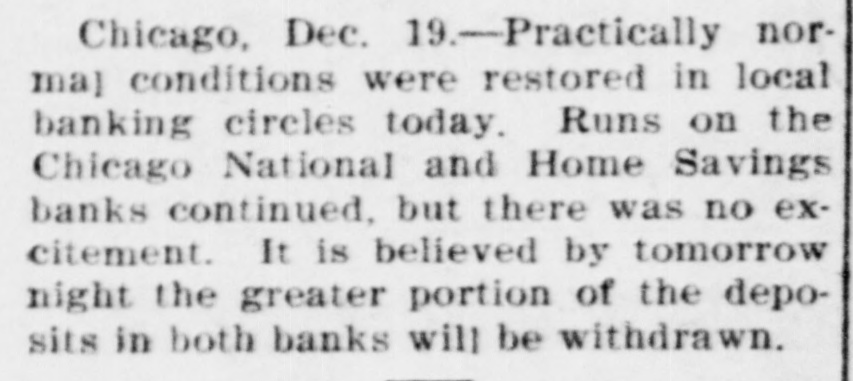
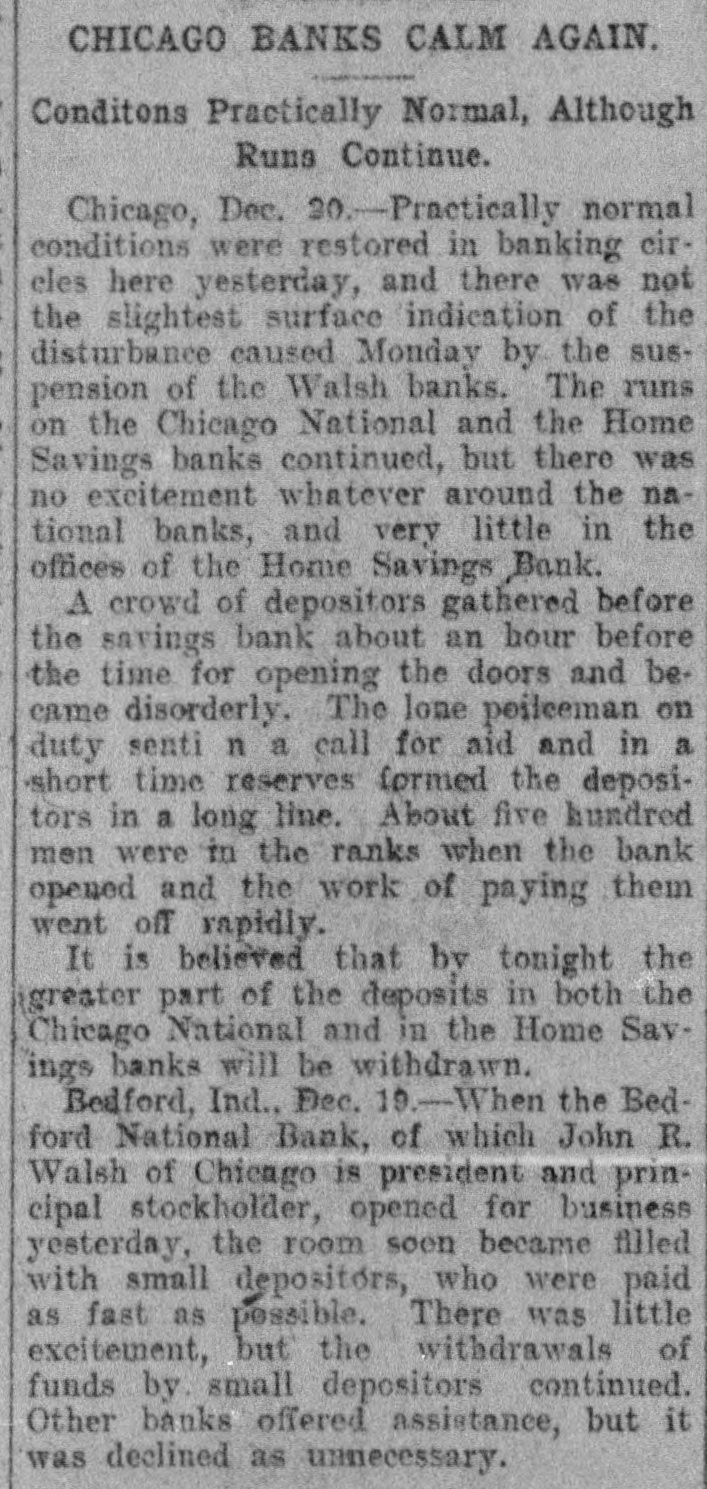
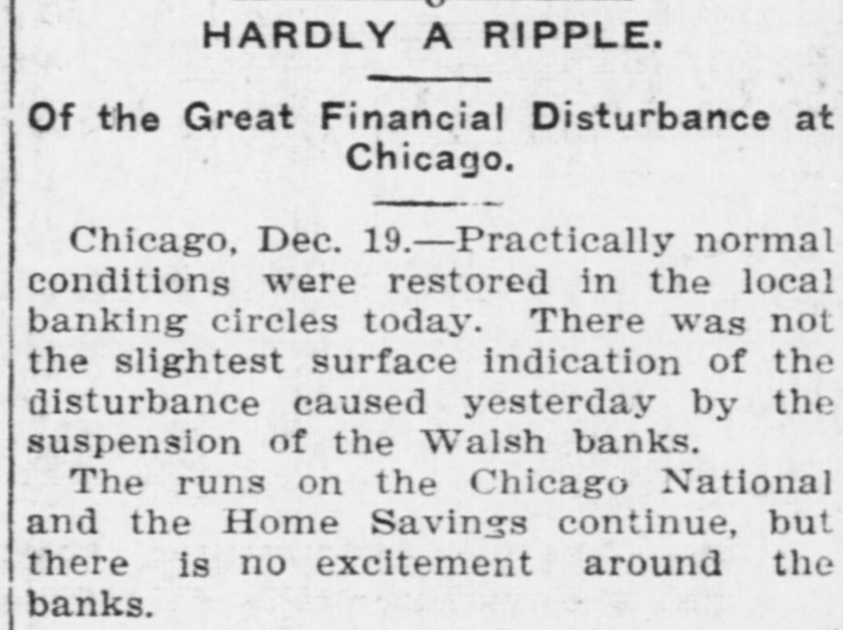
500 MEN IN LINE. When the Home Savings Bank Opened This Morning. Chicago, Dec. 19.-Practically normal conditions were restored in local banking circles today and there was not the slightest surface indication of the disturbance caused yesterday by the suspension of the Walsh bank. The runs in the Chicago National and Home Savings banks continued, but there was no excitement whatever around the National bank and but very little in the offices of the Home Savings bank. A large crowd of depositors gathered before the Savings bank about an hour before the time for opening the door and all of them apparently desired to be the first to obtain money. There was but one policeman on duty in front of the building and he was hopelessly overmatched. He sent in a call for aid and in a short time Lieutenant Hartford with a detail of officers had arrived and formed the depositors in a long line. The pushing and shoving to be first through the doors having been stopped by the officers quiet was at once restored. About 500 men were in line when the bank opened and the work of paying them off went on rapidly. It is believed that by tomorrow night the greater part of the deposits in the Chicago National and the Home Savings bank will be withdrawn. United States District Attorney Morrison and State's Attoiney Healy both stated this morning that nothing in connection with the operations of the bank had been called to their attention.


Article from The Morning Astorian, December 19, 1905

Click image to open full size in new tab

Article Text

James B. Forgan, president of the First National bank, as head of the clearing house committee of the Chicago Associated banks, gave forth the statement. The assets of these institutions, it was asserted, were involved in coal and railway properties of John R. Walsh, the president of the Chicago National bank. John R. Walsh, head of the institutions which have been declared insolvent, was not at the meeting. The following were the members of the committee at the meeting. James B. Forgan, chairman; John J. Mitchell, James H. Eckles, Orson B. Smith, Ernest A. Hamill. The statement was issued at the offices of the First National bank. It is as follows: "The Chicago National bank, the Home Savings bank, and Equitable Trust Company, which have been controlled and managed by John R. Walsh and his associates have concluded to wind up their affairs and quit business in this city. After a thorough and careful examination of their affairs by the Chicago clearing house banks, it is stated that all of the depositors of these institutions will be paid in full upon demand, the Chicago Clearing House banks having pledged themselves to this result, thus putting all the resources of the Chicago banks behinb the depositers of these three institutions. The difficulty with the institutions has been that investments have been made in assets connected with the railway and coal enterprises of John R. Walsh. "These assets were not immediately available to meet deposits and have been taken over on terms which will enable the three institutions to pay their dem positors in full. Mr. Ridgly, comptroller of the currency, and Charles Eubank, of the auditor's department at Springfield, were seem and expressed themselves as greatly pleased with the action of the Chicago banks, and stated that it rekected great credit upon the associated banks of Chicago which have again indicated their ability to meet and emergency in a manner entirely satisfactory to the public." The meeting of the Chicago clearing house association began at noon Sunday. Notices were sent to the members of the board by Mr. Forgan after it 00 had been learned of the condition of the banks and the trust company. t Clerks were notified and fifty or more with ten stenographers hurried to the First-National Bank. Behind closed doors the Clearing House Association be gan its work of finding a way that might enable them to ride the financial sea in safety. That a panic would be likely to follow was the first thought of the committee. Resolutions were adopted and heads of other banks. pledged themselves to give assistance. The amount involved in the failure would not be stated by 8 the committee members. it All informatin concerning the meetW ing of the committee was kept secret W until three o'clock this morning and half


Article from The Seattle Star, December 19, 1905

Click image to open full size in new tab

Article Text

AKRON, Ohio, Dec. 19.-Seven years' competition with Rockefeller in an attempt to control the Ohio gas field, contributed largely to the Walsh failure For three years the Walsh company has been giving gas to consumers in this vicinity at about half the actual cost. It develops that Grace Taggart has $8,000, practically her entire fortune, in the Equitable Trust company, one of the failed concerns. Rockefeller "Busted" Him. At 3 o'clock, the closing hour, It was announced that all depositors inside the doors will be paid today, others will have to wait until tomorrow. Officials refuse to attempt to estin ite how much has been paid. but paying tellers who have been handling cash all day are sure that $5,000,000 have been paid out today through the clearing house. CHICAGO, Dec. 19.-Depositors of the Chicago National and Home Savings banks gathered at an early hour this morning, taking the police unawares and great confusion resulted. Applicants are getting their money as fast as tellers can count it. Walsh's bank failures resulted today in a run on the Bedford National of Bedford. Ind., of which Walsh was president. Money arrived all night to stem the attack. Prosecution Not Ready This morning United States Dist-


Article from Deseret Evening News, December 19, 1905

Click image to open full size in new tab

Article Text

CHICAGO BANK FAILURE. Practically Normal Conditions Restored in Chicago Banking Circles. Chicago, Dec. 19.-Practically normal conditions were restored in local banking circles today and there was not the slightest surface indication of the disturbance caused yesterday by the suspension of the Walsh banks. The runs on the Chicago National and Home Savings banks continued but there was no excitement whatever around the national banks and but very little' in the offices of the Home Savings bank. A. large crowd of depositors gathered before the Savings bank about an hour before the time for opening the doors and all of them apparently desired to be the first to obtain money. There was but one policeman on duty in front of the building and he was hopelessly overmatched. He sent in a call for aid and in a short time Lieut. Hartford with a detail of offloers had arrived and formed the depositors in a long line. After the pushing and shoving to be first through the doors had been stopped by the officers quiet Was restored. About 500 men were in line when the bank opened and the work of paying them off went on rapidly. It is believed that by tomorrow night the greater part of the deposits in the Chicago National and the Home Savings bank will be withdrawn. United States Dist.-Atty. Morrison and State's Attorney Healy both stated this morning in connection with the operations of the bank had been called to their attention.


Article from The Pensacola Journal, December 19, 1905

Click image to open full size in new tab

Article Text

Their Places Being Filled by ClΓ©aring House Ass'n. PROMPT ACTION OF OTHER CHICAGO BANKS ALONE PREVENTED SITUATION THAT MIGHT HAVE LED TO SERIOUS CONSEQUENCES-AMPLE FUNDS TO PAY ALL DEPOSITORS. By Associated Press Chicago, Dec. 18.-Steps have been taken by Comptroller of the Currency Ridgely to compel three of the largest financial institutions of Chicago to wind up their affairs through the Clearing House Association. After a forty-eight hours conference the Chicago National Bank, Home Savings Bank and Equitable Trust Company, allied institutions under the general management of John R. Walsh, president of the Chicago National, decided to close up. A careful examination of their atfairs showed that the Chicago Nationa] has deposits of sixteen million dollars, the Home Saving four millions divided among eight thousand depositors. The liabilities of the three institutions are estimated at twenty-six millions and the assets of the three institutions at about twenty millions. Directors and officers of the Chicago National came to the front with three millions in securities, leaving a deficit of three millions still to be faced. Chicago banks at once declared they would meet the deficit and, if necessary, pledged themselves to meet further .demands above this amount. Comptroller Ridgely, commenting on the situation, gave high praise to the Chicago banks and bankers saying: "The action of the Chicago clearing house relieved a most critical situation which, if not taken promptly in hand, might have led to serious consequences not only in Chicago, but elsewhere." Two hours before the time for opening the banks crowds of depositors gathered front of the Chicago National and Home Savings, waiting for the banks to open. Inside ample provisions had been made for the impending run, large piles of money be. ing laid out. At noon to-day it.was announced that all officers and directors of the banks had resigned and their places filled by the Clearing House Association. Bank Examiner C. H. Bosworth took President Walsh's place In the Chicago National.


Article from The Hawaiian Star, December 19, 1905

Click image to open full size in new tab

Article Text

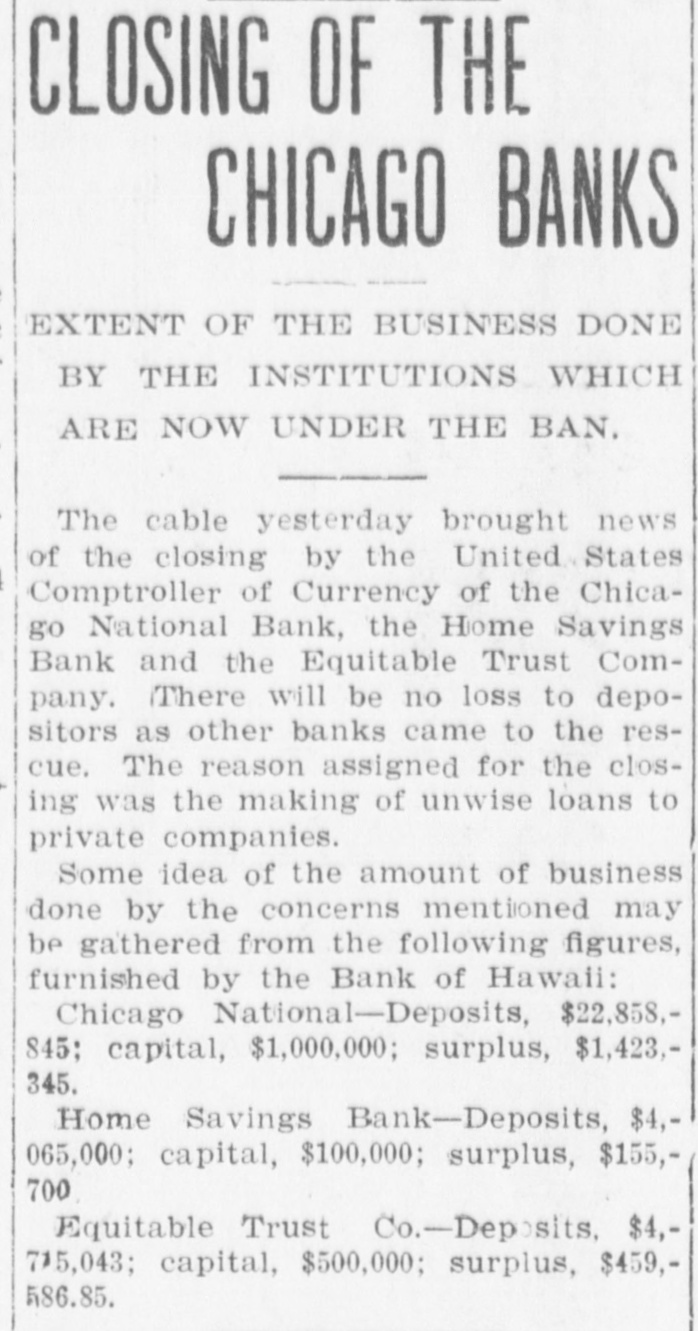
CLOSING OF THE CHICAGO BANKS EXTENT OF THE BUSINESS DONE BY THE INSTITUTIONS WHICH ARE NOW UNDER THE BAN. The cable yesterday brought news of the closing by the United States Comptroller of Currency of the Chicago National Bank, the Home Savings Bank and the Equitable Trust Company. There will be no loss to depositors as other banks came to the rescue. The reason assigned for the closing was the making of unwise loans to private companies. Some idea of the amount of business done by the concerns mentioned may be gathered from the following figures, furnished by the Bank of Hawaii: Chicago National-Deposits, $22,858.845; capital, $1,000,000; surplus, $1,423,345. Home Savings Bank-Deposits, $4,065,000; capital, $100,000; surplus, $155,700 Equitable Trust Co.-Deposits, $4,715,043; capital, $500,000; surplus, $459,586.85.


Article from East Oregonian : E.O, December 20, 1905

Click image to open full size in new tab

Article Text

I Chicago, Dec. 20.-Assurances of the clearing house committee that all depositors in the Chicago National bank and Home Savings bank will be paid, and the prompt payment of those appearing for the last two days, has relieved the tension. As a result, but few appeared to draw their money this morning-not more than 150, who were mostly depositors. The announcement that to draw money now will cause a loss of interest, has decided most to wait until January 1. The run on the Bedford, Ind., National bank is subsiding, business men there feeling the bank is safe. Blount Has Resigned. Fred M. Blount, former vice president of the Chicago National, has resigned as treasurer of the drainage board. Blount says he is custodian of the public funds and knows that all the money is safe.


Article from The Bon Homme County Independent, December 21, 1905

Click image to open full size in new tab

Article Text

Chicago, Dec. 20.-All officers and directors of the Chicago National have resigned and their places were taken by men selected by the clearing. house association. * Mr. and Mrs. Walsh have turned over to the officials of the clearing house all of their property. New York, Dec. 18-News of the insolvencies of important Chicago trading institutions came with a great shock to Wall street this morning and convulsive liquidation of stocks made wild work with early quotations. Holdinges of certain stocks were thrown over for any price they would bring. A decided panicky feeling prevailed. Much to the delight of Thomas W. Lawson, Amalgamated Copper declined 7Β½ points; Union Pacific, 2%. and almost the entire list showed losses of 1 to 3 points. The market was enormously active during the first hour but by that time liquidation had spent its first fury and there were some wide recoveries. I Chicago, Dec. 20.-Action has been taken by Comptroller of the Currency Ridgely that will compel the Chicago National and Home Savings banks and the Equitable Trust company. dominated by John R. Walsh, of this city, to wind up their. amain., Other .national banks of the city have come to the rescue, and it is declared on authority of the clearing house association. the comptroller and also by officers of the Chicago National bank that not a single depositor will lose a cent. Difficulties of the three banks. which are practically, branches of the same institution, are attributed by the comptroller to large loans made by the Chicago National, bank to railroad, coal, mining and other private enterprises controlled by Walsh. Warned by Ridgely. Some time ago the comptroller called attention of the officers of the -bank to the fact that they were making loans to hese enterprisΓ©s of Walsh, which. in opinion. were too large for. the sufety of the institution Repeated promises were made that the situation should be rectified. but. no action satisfactory to the comptroller. was taken. Three days ago he came to Chicago for the purpose of making an intestigation into the affai: of the three banks and found them in such condition that he judged immediate atLion to be necessary, 4. Other Banks to the Resoued Officials of different Chicago banks were told of the situation and a hurrigd call was sent out for & meeting of representatives of the Chicago Clearing! House association and officers of city banks. The meeting W scatled to at 3 o'clock yesterday afternoon and was in continuous; session antH 5 lock this morning. Careful critivate of the Anduntion rewealed the Chicago National bank had Reposits to an amount of $16,000,000 and the Home: Savings had deposits *of $4000, divided among 8,000 deposited ors. 1 Extents of the Failure The two Banks and of the Equipable Trust. were roughly timated at $26,000,000. Assets of the thre institution beut $20.000,000 of this amount and the ctors and officials of the Chicago National bank/camie to the frontswith securities amounting to About thank millions more. "This left a deficit Ant about $3,000,000


Article from Ottumwa Tri-Weekly Courier, December 21, 1905

Click image to open full size in new tab

Article Text

THE WALSH SMASH-UP. Though the word "smash-up" is not endorsed by the most careful grammarians, it expresses more accurately than any other the exact nature of the financial event that caused Chicago business circles Monday to stand aghast and sent many a ripple of surprise across the usually tranquil face of the whole middle west. Even New York's financial barometer, the Wall street market, was panicky when it was found that because of this one man's wild speculations three banks, supposed to be among the strongest in Chicago. were compelled to wind up their affairs. It was John R. Walsh's own particular private smash-up. It will not catch a single depositor in any of his banks for a solitary cent of loss. Chicago and her financial interests may well feel proud of the manner in which the clearing house association came to the front with assurances, backed by millions of dollars, that the creditors of the three insolvent institutions would not lose anything. It testifies eloquently to the splendid condition of the country-this readiness with which the Chicago bankers rallied to the support of the public, for it was the public and not Walsh that they protected. Walsh is bankrupt-"broke" would be a more expressive term. This fact was made clear during the meeting of bankers which lasted from 3 o'clock Sunday afternoon until 5 o'clock Monday morning. No amount of money could save him from bankruptcy and possibly he may have to face worse possibilities in the form of charges in court. But the bankers thought of his duty to the public and immediately decided that the duty was theirs as well. They ascertained that there was a shortage in his banks of about $3,000,000 and immediately the clearing house association announced that it would make good that amount or any other amount that was found to be lacking. As a matter of course, and as was fully expected, a run on the banks took place, but every one of the anxious depositors was paid in full. Extra clerks were employed to facilitate the work of paying out money. There vas money piled high upon the counters. Coin and bills were plentiful and as fast as a pass book was slipped under the window the full amount for which it was good was given to the depositor. At the Home Savings bank, where the state laws gave the institution the right to demand sixty days' notice of withdrawal, the statute was not invoked, and when the money was asked for it was paid without a word. The failure is the failure of Mr. Walsh and not of the banks. He had secured loans that made the condition of the banks unsafe, and the banks consequently had to be closed to deposits. But all this was done in a legal and formal way, and the credit of Chicago's banking fraternity was not impaired in the least. The rompt work of those bankers there eflects credit upon the banking fraternity of the whole middle west and of the nation itself. Mr. Walsh's smash-up is the result of unwise business ventures. Personally he is "down and out" in a business way, but the men and women who entrusted their savings to the banks he dominated are not to lose a farthing. Such action is reassuring to the general public. It means that financial conditions on the whole are good. It means that the moneyed institutions, the institutions that deal in money, are on a firm foundation.


Article from Eagle River Review, December 22, 1905

Click image to open full size in new tab

Article Text

REE BANKS CAGO INSTITUTIONS OF R. WALSH GO OUT. ago National, Equitable impany and Home Savings lose Business-Two Banks JO ALL quidation of the Chicago Nation k, the Home Savings Bank, Equitable Trust Company, all ago, was announced at ck Monday morning by represe es of the Chicago Clearing ciation, after a session lasti teen hours. James B. ident of the First National ead of the clearing house of the Chicago Associated bank : forth the statement. The hese institutions, it was asserte e involved in coal and railw erties of John R. Walsh, of the Chicago National statement was issued in the he First National Bank. It is ws: 'he citizens of Chicago will tedly be surprised to learn Chicago National Bank, the ngs Bank, and the Equital , Company, which have been ed, managed, and officered 1 R. Walsh and his associat : concluded to wind up their and quit business in the city ago, but they will be gratified 1 that after a thorough and xamination of their affairs by ago Clearing House banks of the depositors of these ; will be pand in full upon d, the Chicago clearing s having pledged themselves result, thus putting all the ces of the Chicago banks depositors of these three 3. The difficulty with the ; has been that their investmen : been made in assets connect the railway and coal enterpris ohn R. Walsh. These assets immediately available to meet ts in full." e meeting of the Chicago Cleari se Association began at noon Notices were sent members of d by Mr. Forgan after the conditi e banks and the trust company learned. Clerks were notified or more with their stenograph ied to the First National bank. closed doors the Clearing ciation began its work of finding that might enable them to ride cial sea in safety. at a panic would be likely to was the first thought of the e. Resolutions were adopted si of other banks pledged themselv ive assistance. The amount 1 the failure would not be discuss he committee members. addition to the formal stateme he failure, the following announ : was made, signed by the e committee of the Chicago :squeq I 'o the Public: Depositors of the National bank, the Home , and the Equitable Trust Compa respectfully advised that their is will be paid in full upon deman Syndicate Takes Control. syndicate was formed during


Article from The Grenada Sentinel, December 23, 1905

Click image to open full size in new tab

Article Text

blown to pieces and the interior OI the mine badly damaged. Edward Joris, the Belgian, and in three others charged with participation sultan, the attempt to assassinate the been in Constantinople, last July, have sentenced to death and other life. accomplices to penal servitude for While being loaded at Lexington, Ky., Gonfor shipment to Mexico City, imp. handisalvo, winner of the Czarwitch just cap, dropped dead. He had been St. bought by Cavanaugh Bros., of Louis, at a pretty long price. Engineer-in-Chief William Shock, U. of S. navy, retired, died in Washington He bronchial trouble, aged 84 years. civil was a veteran of the Mexican and wars. Three of the largest financial national institutions in the west, the Chicago the bank, the Home savings bank and by Equitable Trust Co., all controlled in John R. Walsh, of Chicago, and a great measure owned by him, have sus- Chicago bended. The allied banks of have pledged their resources that every cent. Repositor shall be paid to the last duties Miss Alice Roosevelt paid the on the various presents and her souvenirs brought back from the orient with personal check for $1,206.15. Earl Rush and Glen Jones es- were Irowned and three others narrowly Eel caped a like fate, by the -ice on river, at Logansport, Ind., breaking with them white skating. As the result of a panic caused by the street car taking fire following 1 lowing out of a fuse, at Cleveland, O., was Anna Staba, a 13-year-old girl, rampled to death. In connection with the Annapolis azing case congress comes in for re- some riticism for adopting a resolution for nstating three midshipmen expelled azing after passing a law providing or dismissal for the offense. Fire destroyed the north wing of at the Northern Michigan normal school Marquette and damaged the library uilding. Loss, $52,000; no insurance The bureau of statistics, department that if commerce and labor, estimates United he commerce between the reach, States and the Philippines will or the current calendar year, $20,000,00, against $15,000,000 in 1904. John A Burbank, a former in territorial governor of Dakota, died at his home illness, Richmond, Ind., after a brief '82 pes which uo that e uo punoj quioq V President Loubet of France was trav- on ling with a shooting party, proved, affair. xamination, to be a harmless Some uneasiness has been caused in to France by the Spanish proposal conhange the meeting place of the Alerence on Moroccan reforms from eciras to Madrid. Prof. S. Stanhope Orris, and professor meritus of Princeton university, the ne of the foremost scholars in Pa., Inited States, died at Harrisburg, f paralysis, aged 70 years. Marquis Ito is said to have in accepted n appointment as resident general Two Korea. men who held up the Colby tate bank at Colby, Wis., were and capured in a saloon in Wausau, Wis., They 1! of the stolen money recovered. of work laimed to be farm hands, out nd Mrs. Wm. desperate. Marsh and her two in children a nd James Dwyer lost their lives theater re that destroyed the Verbeck n Lorain, O. Two of the principal blocks in bank Dallas, 11., including the First national dend the Weekly Review office, were but troyed by fire. Loss, $80,000, with ittle insurance. Dr. W. S. Forbes, professor of an- Jefferson tomy and clinical surgery at died at medical college, Philadelphia, is home, in that city of angina pecoris, aged 74 years. Charles B. Eames, vice-president was of he St. Louis creadit-clearinghouse, off illed at his home while burning he stock of an old add muzzle-loading rmy rifle which he had bought to bulo his collection of old firearms, a head. et from the gun penetrating his Baron, Former State Senator W. R. resident of the defunct Chamberlain disank, has been bound over to the on a court at Tecumseh, Neb., with rict perjury in connection


Article from The Fulton County News, December 27, 1905

Click image to open full size in new tab

Article Text

PRESIDENT WALSH BORROWS FUNDS. Chicago Banking nstitutions Involve $26,000,000. Chicago (Special).-Three of the largest financial institutions in the Westthe Chicago National Bank, the Home Savings Bank and the Equitable Trust Company-all of them controlled by John R. Walsh, of Chicago, in great measure owned by him, suspended operations Monday. Their affairs will be liquidated as rapidly as possible, and they will go out of business. Mr. Walsh, who was president of the Chicago National Bank and of the Equitable Trust Company, and all the other officers and all the directors of the Chicago National Bank have resigned. National Bank Examiner C. H. Bosworth has succeeded Mr. Walsh at the head of the Chicago National Bank, and the places of the directors have been filled by men appointed by the Chicago Clearing house. Back of the new management stand the allied banks of Chicago, which have pledged their resources that every depositor shall be paid to the last cent, and that no customer of any one of the three institutions shall lose anything by reason of the suspension. This action prevented a disastrous financial pania As it was, the only effect on the financial world of Chicago was the decline on the Stock Exchange of 2Β½ in the price of National Biscuit common stock. The National Biscuit Company has employed the Equitable Trust as transfer agent, and had besides dealings with the Chicago National Bank, but it is not affected by the failure in the slightest degree. The closing of the two banks had the effect, also, of shutting off all demand on the local exchange for bank stocks, none of them being purchased. The immediate cause of the collapse of the institutions controlled by Mr. Walsh is said to be the large amount of money which they have lent to various private enterprises of his, notably the Southern Indiana Railway and the Bedford Quarries Company, of Indiana. Mr. Walsh says that if he could have had a little more time and been left untrammeled in his operations he could have saved his banks and made enormous profits for himself and his associates. He bases this statement on his estimate of the value of the bonds of the Southern Indiana Railroad Company. The Comptroller, the State Auditor and the members of the Chicago Clearing house committee place the value of the bonds at one-half the valuation of Mr. Walsh, and it was their refusal to accept his valuation that caused the suspension of the banks. The liabilities of the three institutions are estimated in the aggregate at $26,000,000. Against this amount the banks and the trust company have resources that are, on a conservative estimate, worth $16,000,000. The bonds of the Southern Indiana Railroad Company are estimated by Mr. Walsh at $16,000,000 They are considered by the Comptroller. the State Auditor and the clearing house committee to be worth a little more than half that sum. Their value is a matter to be determined in the future, and the presidents of the local banks admit that if the estimate of Mr. Walsh is found to be correct the two banks and the trust company will not only pay all of their debts, but leave a surplus besides.


Article from The Miller Sun, December 27, 1905

Click image to open full size in new tab

Article Text

HREE BANKS QUIT. ICAGO INSTITUTIONS OF JOHN R. WALSH GO OUT. icago National, Equitable Trust Company and Home Savings Bank Close Business-Two Banks Alone Carry $22,500,000 of Deposits. Liquidation of the Chicago National nk, the Home Savings Bank, and , Equitable Trust Company, all of icago, was announced at 3:30 lock Monday morning by representves of the Chicago Clearing House sociation, after a session lasting thteen hours. James B. Forgan, esident of the First National Bank, head of the clearing house commit: of the Chicago Associated banks, ve forth the statement. The assets these institutions. it was asserted, re involved in coal* and railway perties of John R. Walsh, Presiit of the Chicago National Bank. el statement was issued in the office the First National Bank. It is as lows: "The citizens of Chicago will unibtedly be surprised to learn that : Chicago National Bank, the Home vings Bank, and the Equitable Company, which have been conlled, managed, and officered by in R. Walsh and his associates e concluded to wind up their afrs and quit business in the city of icago, but they will be gratified to rn that after a thorough and careexamination of their affairs by the icago Clearing House banks that of the depositors of these instituas will be pand in full upon dend, the Chicago clearing house ks having pledged themselves to s result, thus putting all the rerees of the Chicago banks behind depositors of these three instituis. The difficulty with the instituhs has been that their investments e been made in assets connected h the railway and coal enterprises John R. Walsh. These assets were immediately available to meet deits in full." The meeting of the Chicago Clearing use Association began at noon Sun. Notices were sent members of the rd by Mr. Forgan after the condition the banks and the trust company had n learned. Clerks were notified and y or more with their stenographers ried to the First National bank. Bed closed doors the Clearing House sociation began its work of finding a y that might enable them to ride the incial sea in safety. That a panic would be likely to fol- was the first thought of the comtee. Resolutions were adopted and ds of other banks pledged themselves give assistance. The amount involvin the failure would not be discussed the committee members. in addition to the formal statement the failure, the following announcent was made, signed by the clearing ise committee of the Chicago assocbanks: pa To the Public: Depositors of the Chio National bank, the Home Savings k. and the Equitable Trust Company


Article from The Topeka State Journal, January 1, 1906

Click image to open full size in new tab

Article Text

Business Failures Jan. 3-First national bank of Faribault, Minn., closed; receiver appointed. 9-Brott cotton mills, Massachusetts, capital $1,200,000. 27-Standard Rope & Twine Co., N. Y., for $12,000,000. 29-Pan-American bank, Chicago; assets $17,200, liabilities $75,900. Mar. 5-Arnold Brewing Co., Saulte St. Marie, Mich.; liabilities $85,000; assets $65,000. 7-Coe Co., Minneapolis; liabilities, $200,000. Apr. 3-Ladoga, Ind., bank; assets $80,000, liabilities $109,000. 24-Canton, O., state bank closes Lexington, Okla., First national bank falls. 26-Barberton, O., First national bank Jun. 2-Ladysmith, Wis., First national bank closed. 19-Fyfe & Munson, Chicago, placed in receiver's hands. 23-Vicksburg, Mich., exchange bank. 26-Knight, Donnelly & Co., Chicago. 28-Terre Haute, Ind., national bank closed doors. Jul. 5-Spring Valley, Ill., and Toluca, III., national banks close. 6-Hagerstown, Ind., Commercial bank; liabilities, $125,000. 19-Spring Valley, O., bank closes. 20-City national bank, Kansas City, Mo. Aug. 3-West Liberty, Ky., bank closes. 21-Western bank, Louisville, Ky.; due to overloans. Sep. 19-Minot, S. D., national bank closes doors. Oct. 6-Peoria (I11.) national bank closes because of Dougherty indictments. Nov. 1-Kingfisher (Okla.) national bank closed by comptroller of currency. Dec. 18-John R. Walsh's three banks in Ch'cago. Chicago National, Home Savingsand Equitable company in liquidation. Local clearing house guarantees payment of $26,000,000. Public and private accounts involved. 27-Merchants Trust company, American Savings bank and Mechanics Savings bank, Memphis, Tenn., close doors; first named in liquidation.


Article from Rocky Ford Enterprise, January 19, 1906

Click image to open full size in new tab

Article Text

CONDENSED TELEGRAMS The Grand Trunk railroad has placed an order for eighty-one locomotives at a cost of $1,398,800. The first tournament of the Western Bowling Congress will open in Salt Lake City March 7th. The General Assembly of Kentucky has elected Judge T. H. Paynter United States senator to succeed J. C. S. Blackburn. Recently five and three fourths miles of rails were laid on the Cape-to-Cairo railway in twelve hours, this constituting a world's record. Postmaster General Cortelyou has approved a recommendation for the use by rural carriers of automobiles in serving their routes. An Atlanta dispatch says that the Southern railway has just placed an order for 8,729 freight cars, involving an outlay of more than $5,000,000. Napoleon Lajole has signed a contract to manage and captain and play second base for the Cleveland American league for the season of 1906. Judge c. C. Goodwin, the Utah pioneer newspaper man, has resumed daily newspaper work as editor-inchief of the Salt Lake Evening Telegram. William J. Bryan has given a prize to Bowdoin College for the best essay discussing the principles of free government. It is called the Philo Sherman Bennett prize. Three Chinese implicated in the as sassination of American missionaries at Lienchou were executed in the premises of the joint commission on December 7th. and many others were punished. Yellow fever has disappeared from Havana. Since the first appearance of the disease in October there have been sixty-nine cases, twenty-three of which resulted fatally and forty-six of which were discharged cured. In a test/run by a Baltimore & Ohio special train from Garrett to Chicago Junction, Ohio, a speed of nearly 100 miles an hour was reached at several points. the whele run of 128 miles being made in 126 minutes Isaac Saylor. his daughter. Mrs. Peter Martin and her five children were burned to death on the 8th inst. at their home in Pleasantview, Juan ita county. Pennsylvania, in a fire which destroyed their home. A Chicago dispatch says that Rev. George D. Rogers. pastor of the First Baptist church of Highland Park. near Fort Sheridan. has declared himself without reserve in favor of the re-establishment of the army canteen. W. F. Scott. state game warden of Montana, and president of the National Association of Game and Fish Wardens and Commissioners, has called a meeting of that organization to take place in St. Paul January 25th and 27th. Pat Crowe was arraigned in the Dis trict Court at Omaha on the 6th inst. in a charge of robbing E. A. Cudahy of $25,000 in the kidnapping case. He pleaded not guilty and his trial was set for February 7th. His bond was fixed at $7,000. Near Crane, Missouri, while railway laborers were thawing out dynamite, the explosive caught fire. In attempting to save It one of the men kicked the dynamite and It exploded. William McNeal and Joe Kepoe were killed and several others injured. Jack Goff. who was President Roosevelt's guide during his Colorado hunt. ing trip last spring has had a serious encounter with two mountain lions in Yellowstone park. He says he was not seriously injured but thinks he was lucky to escape with his life. At San Francisco, January 8th. the Union labor party took charge of the municipal administration. All of the incoming officials were heartily greeted by their predecessors and initlated into the duties connected with the various offices which they will occupy. Local owners of claims in the Copper Mountain district have turned down the offer of the New York syndicate to bond and lease some of the properties. Samples of ore taken to New York ran over $30,000 in gold to the ton and the New Yorkers are said to be very anxious to obtain an interest in the properties. Secretary Bonaparte has written a letter of reprimand to Commander Lucien Young in connection with the boller explosion on the gunboat Bennington. The reprimand is somewhat mild in tone and the letter in not alto gether uncomplimentary to Comman der Young. who, it is said, may consent to its publication. From advance sheets of the Official Catholic Directory, published in Milwaukee, it is found that the total Catholic population of the United States is 12,651,944. an increase of 189,151 over the previous year. The total number of Catholic priests, in cluding seculars and regulars. is 14, 484, an increase of 627. All power of control in the Chicago National and the Home Savings bank, formerly controlled by John R. Walsh, has passed from the stockholders to the presidents of six other Chicago banks who form the committee that has in charge the liquidation of the assets of the two banks. Stockholders of both banks will investigate their management. It is announced from Ardmore. I. T. that the Rough Riders will send to Miss Alice Roosevelt, on the occasion of her marriage to Congressman Long


Article from The Sun, June 6, 1906

Click image to open full size in new tab

Article Text

RECEIVER FOR WALSH ROADS. Bankers Who Liquidated His Banks See No Other Solution. CHICAGO, June 5.-Receivership proceedings against the railroads of John R. Walsh are imminent. This became known to-day when it was revealed that there is dissention which amounts almost to open quarrelling among the banks of the Clearing House Association which advanced more than $14,000,000 to liquidate the Chicago National and Home Savings banks last December. Members of the Clearing House committee, managing directors of the Walsh deal, are divided into two factions. unable to agree on the course to take to clear the banks of the Walsh tangle. The demand for a receivership became insistent a few days ago, when it became known to the Associated Banks that the financial affairs of the Southern Indiana. Chicago Southern and Illinois Southern roads are in a bad way. "There has been a great deal of grumbling among the banks for some months." said in close touch with the situation one of the most a through man heavily interested deal to banks, to-day. "Ever since the sell the Walsh roads fell through in New York grumbling has grown louder. The bankers are not satisfied to have their money tied up in a venture which looks more hopeless every day. The only course open to give relief seems to be a receivership for the roads. " The Southern Indiana is the only road of the Walsh group which has shown earning capabilities. No financial statement was ever made of the Chicago Southern or Southern Illinois. The Southern Indiana, to its last annual statement. was to pay on according making enough interest its its stock indebtedness and 11. per cent. on Since the coal strike was declared on May 1, the bankers have learned. the Southern Indiana has not been a paying property. On top of the banks' other troubles has come a report that Secretary of the Treasury Shaw gave strong intimation to national bankers that they should unload the bonds of Walsh's roads now carried as assets of their institutions. There remain something like $12,000,000 of Walsh paper and securities in the associated banks. It has become clear to the banks, according to one of their attorneys, that in reserving the stock in his railways, which they thought of little consequence, Walsh made them victims of a sharp trick. The stock carries the voting power and control of the roads. As long as the roads pay interest on bonds Walsh will be in command of the situation. He will dictate the policy of the railways and their management. The banks are left "holding the bag." When Walsh's banks went out of business it he transferred to a is asserted House bank committee whose president is on the Clearing all the accounts of his railroads and other interests, amounting to many thousands of dollars. This bank president is reported to be standing by Walsh in the present crisis and seeking to avert the threatened receivership. Work on the investigation of the criminal charges made against Walsh IS progressing rapidly in the office of District Attorney C. B. Morrison. Special Bank Examiner Moxey, who is inspecting the bank and railroad company books. conferred with Mr. Morrison to-day. Assistant Attorney-General Pagin has seen all of the evidence thus far gathered so as to be ready to draw an indictment should the case progress that far.


Article from Iowa State Bystander, November 15, 1907

Click image to open full size in new tab

Article Text

WALSH CASE STATED CASE AGAINST EX-BANKER IS OUTLINED TO THE JURY. NOTES CITED AS BOGUS Government Charges $14,000,000 Was Taken from Defendant's Banks and No Record Made of Transaction. Chicago. - The trial of John R. Walsh in the federal court for the alleged misapplication of the funds of the defunct Chicago National bank, of which he was president, got under full swing Wednesday. At 12:05 p. m. the jury which is to decide the fate of the financier was selected. A few minutes later it was sworn in by Judge Anderson and received its instructions as to how it should conduct itself during the trial. In the afternoon it listened to the opening statement of the prosecution in the case against the former banker. Assistant District Attorney Dobyns outlined the charges of misapplication of funds through alleged fictitious notes and other means. Dobyns Begins Statement. The assistant district attorney began by saying that at the time named in the indictment John R. Walsh was president of the Chicago National bank and the Equitable Trust company. and vice president of the Home Savings bank, which three institutions had some $26,000,000 in their coffer He said: "Mr. Walsh was in undisputed control of these three banks. At the same time he was interested in several uncertain and highly speculative enterprises." Mr. Dobyns then enumerated the Waish properties. "Not one of these was an established or prosperous concern," be said. Describes Banker's Methods. Mr. Dobyns described in detail various methods by which he declared Walsh took the money of his banks for his private enterprises. "As a last resort, when he could not get hold of the bank's money any other way," said Mr. Dobyns, "he finally got so that he would sign other people's names to fictitious notes, attach to them bonds of his various enterprises as collateral and thus obtain additional loans on these fictitious notes backed by this cheap collateral. "Walsh began these operations away back in the early '90s in a small, modest way. His schemes grew until at the end he was taking out of his balance hundreds of thousands and millions on a single deal." The attorney then reviewed the investigations of the bank by the examiners and its suspension. Allege Removal of $14,000,000. During the address it developed that the government will attempt to show that $14,000,000 was removed from the Chicago National bank, the Home Savings bank and the Equitable Trust company, while there was not a thing on the books of the concerns to show such transactions. It is said that months of work on the part of National Bank Examiner Edward P. Moxey and his assistants brought out the things on which the government's charges to this effect are made. The government will seek to prove, it is said, that the alleged manipulation of the bank books was so clever as to conceal the removal of the money, but that by digging down into the banks' vaults the examiners discovered bond-department checks and cashiers' checks that exposed the alleged falsifications on the books. Before court opened the defense


Article from The Washburn Leader, February 7, 1908

Click image to open full size in new tab

Article Text

which he was president. The penalty is not less than five nor more than ten years' imprisonment. No substitute fine is allowed. The fight for the convietion of Walsh began with the suspension of the Chicago National bank. the Home Savings bank and the Equitable Trust company three


Article from The Washington Herald, November 7, 1909

Click image to open full size in new tab

Article Text

names. When it comes to the matter of the law's dealing with them there begins to be a sharp divergence. Charles W. Morse already has tasted of the bitterness of imprisonment. John R. Walsh has not spent an hour in jail, although the crime of which he was convicted and is now under sentence of five years' imprisonment in the Federal penitentiary in Leavenworth, Kans., was committed four years ago, Morse, through the devotion of his wife, regained his liberty, only to be thrust back behind the bars. It was a long and hard task to procure the bond in the first place, It served only as a temporary expedient. Walsh goes to his office in Chicago every day when his seventy-two years will allow him to go, and that is most 01 the time. In spite of his three-score years and twelve. he still has a lot of the energy and fight that made him in former days one of the most conspicuous capitalists and financiers in the West. He has been privileged to be with his devoted family, whose loyalty, in a quieter way, is as beautiful as that of Mrs. Morse toward the Wall street banker He is as welcome as in the old days to the clubs. Those in whose debt he is to the extent of millions are about the last men in Chicago to say for publication anything against the man who weeked the Chicago National Bank and its allied institutions. Similarity of Crimes. Morse and Walsh both were charged with transgressing the banking laws. They used the money of others in a way that the statutes did not sanction, if the charges against them be true. There may have been differences of detail in the alleged wrongful things they did. but the principle involved was the same Compared with Walsh, the Wall street man is still in the prime of life. He might spend a term in prison and come out strong and ready to begin life over again. Recent reports that he added $7,000,000 to his fortune the short time he was out on bond, whether true or not, indicate that the blows that have fallen on him have not put him out of the running as a winner of wealth. For him there is hope after whatever penalty he may pay For Walsh a prison cell probably would mean, sooner or later, a death chamber Mr Walsh is used to hard work, to reckoning with vast detail. Prison life will be no laughing matter for such a man. He has for years been a lord of business over men, brooking no interference with his will He can't be that in Leavenworth. His age renders it unlikely that he will be able to do any physical work His friends feel that once he is restrained behind iron bars the warrant of his death will have been virtually signed. That is the reason they are making with him SO vigorous a fight to ward off the day of reckoning. In the case of this man the mills of the courts are grinding slowly In one month more it will be four years since the three banks, of which Walsh was the executive head, quit doing business and the associated banks of Chicago began to pay the depositors what Walsh owed them The man whose financiering wrecked the banks is still under a big obligation to the Institutions which came to the rescue of the hundreds of depositors. His debt to them is something like $7,000,000 It is the supreme effort of Mr. Walsh just now to raise money to satisfy these creditors, 80 that he will not have to sacrifice many millions of dollars of securities and property History of Walsh's Crime, It was on the morning of December 18. 1905, that the Chicago National Bank, the Home Savings Bank, and the Equitable Trust Company ceased to do business and closed their doors. That was on a Monday morning. Far into the night of Sunday-In fact, till almost the coming of dawn-representatives of the other banks in the Chicago clearing-house had been in conference trying to devise a way to save the banks from wreck and the city from a financial panic. Walsh and his advisers were in that conference. The man who had presided as the financial genius over the trio of banking institutions protested long and loudly that if he were given one more opportunity he would ward off collapse. Over the business of the banks went experts. They scrutinized this account and that. They observed with alarm the long list of menacing obligations, gasped with surprise when informed of the manner in which the funds of the bank-the money of the depositors-were being used to promote private enterprises. They reckoned up the securities for liabilities, figured closely on the conversion possibilities of collateral at hand. They were disposed to be eminently fair, but when they were through canvassing the situation its general aspect was SO forbidding that closing the doors of the institutions was decided on. How Panic Whs Averted. That was the beginning of the end The next morning, which was Monday, there were notices on the Walsh banks which told their tale briefly. The newspapers, which had been purposely let into the secret to help save Chicago from a panic, contained long stories of the fall of the Walsh banks. Every story was quick to say that the associated banks had agreed in conference to guarantee the payment of all deposits, dollar for dollar. All the depositors had to do was to find out what his balance was and write out a check for the amount to another bank chosen for the doing of his future business. He would be given credit for the amount Those who preferred might take their books to the failed banks after they reopened and get their money there. In saving the depositors from losing a cent in the Walsh banks the institutions coming to the rescue were saving themselves the burden of a "scare," which might have far-reaching consequences and precipitate other crashes. On the 5th of October, 1909. nearly four years after that memorable Monday morning, the Circuit Court of Appeals affirmed the sentence of five years running against Mr. Walsh, who had been duly convicted in the lower Federal court for violating the banking laws. Owes Banks $7,000,000. At the time the sentence was affirmed, as already stated. Mr. Walsh owed the banks which stood between his institutions and a local financial panic over $7,000,000. secured by the stock and bond issues of certain corporations in which Walsh was interested. The interest havdefaulted