Plankinton Bank (Milwaukee, WI)

Episode Information

Episode UID
7772889491121
Episode Type
Run β†’ Suspension β†’ Reopening
Bank Type
state
Bank ID
777288949 hash
Start Date
May 13, 1893
Location
Milwaukee, Wisconsin (43.039, -87.906)

Metadata

Model
gpt-5-mini (chosen from majority vote of a three-model LLM ensemble)
Short Digest
2ac9527056b076b1

Response Measures

None

Description

Failure tied to large loans to F. A. Lappen; assignee and receiver later handled bank before resumption.

Events (4)

1. May 13, 1893 Run
Cause
Bank Specific Adverse Info
Cause Details
Run triggered by the bank's implication in the F. A. Lappen failure (large loans to Lappen)
Measures
Refused some withdrawals under thirty days' notice rule; large sums sent from Chicago by express to reassure depositors
Newspaper Excerpt
There was a sharp run on the Plankinton bank today. A crowd of three hundred was around the bank before the doors were opened
Source
newspapers
2. June 1, 1893 Suspension
Cause
Bank Specific Adverse Info
Cause Details
Continued withdrawals and poor showing of assets due to large unsecured loans to F. A. Lappen left bank unable to meet demands; assignee made assignment to William Plankinton and bank closed operations
Newspaper Excerpt
The Plankinton Bank... closed its doors this morning and made an assignment this afternoon. A notice was placed upon the door
Source
newspapers
3. February 18, 1894 Reopening
Newspaper Excerpt
The resumption of the Plankinton bank at Milwaukee, with an unimpaired capital, is one of the encouraging signs of the times.
Source
newspapers
4. March 9, 1895 Receivership
Newspaper Excerpt
Judge Johnson has decided to appoint a receiver for the defunct Plankinton bank, to collect from the stockholders a sum equal to the amount of their capital stock, under the state banking law.
Source
newspapers

Newspaper Articles (24)

Article from Deseret Evening News, May 13, 1893

Click image to open full size in new tab

Article Text

MORE FAILURES The Edwardsburg Bank Closes Its Boors. EDWARDSBURG, Mich., May 13.Tee doors if the Edwardsburg bank were closed this morning and a notice posted on it by the cashier saying that the suspension was only temporary, and that the depositors would not lose anything if they would stand by him. MILWAUKEE. May 23.-There was a sharprunon the Plankintonbank today. A crowd of three hundred was around the bank before the doors were opened and from the commencement of bus. inesa till the closing hour the tellers were kept busy paying out money. The depositors were refused money under the rule requiring thirty days' notice before withdrawal of the funds. By noon, however, the scare was practically at an end. The district of the Plankinton bank was due to the large amounts for which it was involv. ed in the Lappen failure. Thus far the attachments in the Lappen failure aggregate $409,424. The Plankinton stood the run without asking for and from any other banks, though they stood ready to furnish money if needed. At noon It was reported that a large sum had arrived for the bank from Chicago by express


Article from Alexandria Gazette, May 13, 1893

Click image to open full size in new tab

Article Text

TELEGRAPHIC BREVITIES. A run was made on the Plankinton, Wis., bank to-day, but money was sent by a special train from Chicago which reassured the deposits. One thousand women of Owensboro, Ky., have banded together and pledg. ed themselves to wage a continuous crusade against the liquor dealers and manufacturers of that city. A watchman named Humbach has confessed that he set fire to the new Methodist church in Scranton, Pa., recently erected at a cost of over $172.000, and which was destroyed by fire Two men suppposed to be those who robbed the Mobile and Ohio express car ou the night of the 11th, were arrested at Barkley, Ky., and taken to Laketon last night. The grand jury at Chattanooga, Tenn., yesterday returned twenty-five indictments against citizens alleged to have been concerned in the lynching of Alfred Blount, a negro, who outraged an aged white woman. There is a prospect of a duel between Colonel Louis J. Brumby, aged 21, editor of the Free Press, and Colonel Thomas Harris, aged 45, editor of the New Capital, of Ocala, Fla., a challenge having been sent and accepted. C. W. Mosher, who as president of the Capital National Bank, of Lincoln, Neb., wrecked that institution some months since, causing a loss of more than $1,000,000, made his escape from the custody of the U.S marshal last night. Mary Sexton, an unmarried woman, 19 years of age, was shot and killed early this morning in her apartments on Chrystie street, New York, and it is supposed that William Flannelly, a waiter in a Bowery music hall, did the shooting, though he asserts that the woman shot herself. For a long time a feud has existed between members of rival mining camps in the Sierra Madre mountains, sixty miles east of Mazatlan, Mex. A few night ago, an employe from each camp met on the narrow mountain road. One threw the other over a precipice and he was dashed to pieces on the rocks below. The fatal encounter led to a general conflict between the two camps Thursday, in which ten men were killed and a number badly wounded. Deputy.Sheriff C. B. Schutts, of Grand county, N. M., was murdered by three Mexican prisoners whom he was conveying to jail at Silver City yesterday. B. B. Bowenby, another deputy, was hit but escaped unhurt. The prisoners escaped across the line into old Mexico.


Article from The State Chronicle, May 14, 1893

Click image to open full size in new tab

Article Text

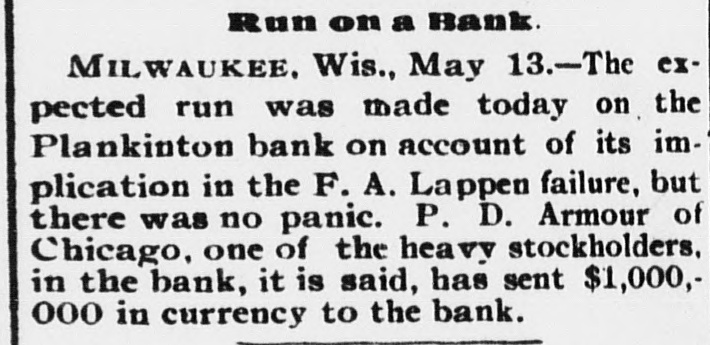
The Plankinton is Safe. By Southern Associated Press. MILWAUKEE, Wis., May 13.-As ex. pected a run is being made on the Plankinton Bank on account of its implication in the F. A. Lappen failure. The scene around the bank is one of activity, but there is no panic and no indication of one. The feeling among business men is one of security. P. D. Armour, of Chicago, one of the heavy stockholders in the bank, is understood to have sent $1,000,000 in currency to the institution by express this morning. Depositors are being paid as rapidly as they can present their claims. The Plankinton estate, which is also largely interested in the bank, is also understood to have come to the rescue with a large amount of cash.


Article from Deseret Evening News, May 15, 1893

Click image to open full size in new tab

Article Text

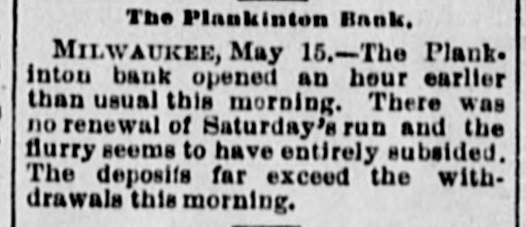
The Plankinton Bank. MILWAUKEE, May 15.-The Plank. inton bank opened an hour earlier than usual this morning. There was no renewal of Saturday's run and the flurry seems to have entirely subsided. The deposits far exceed the withdrawals this morning.


Article from New-York Tribune, May 16, 1893

Click image to open full size in new tab

Article Text

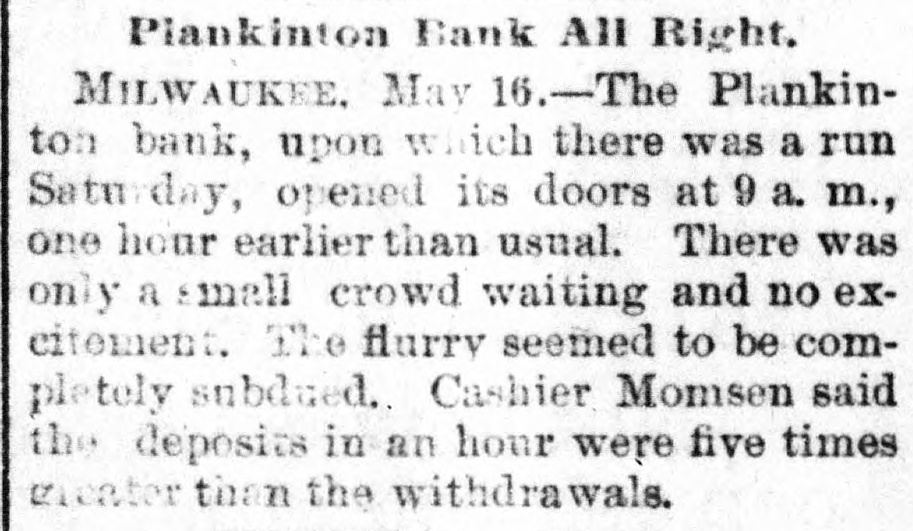
The three Australian bank failures just announced are the latest of a long series that have occurred within the last few weeks. The heaviest disaster was the downfall of the Australian Joint Stock Bank, on April 20, with liabilities of Β£13,000,000. its de posits aggregating Β£11,000,000. on April 30. came the suspension of the National Bank of Australia, the liabilities of which in the Colonies alone were Β£7,500,000. The suspension of the Bank of Victoria (limited) was announced on May 9. Its liabilities were about Β£2,500,000, its subscribed capital was Β£1,200,000, and its deposits, according to the balonce-sheet of list December, amounted to more than Β£7,000,000. Perhaps the chief of the minor failures was that of the Colontal Bank of Australia, on May 5. Each of the institutions named had many branches throughout the Colonies. as well as offices In London. In almost every case the suspension was due to heavy withdrawals of deposits. THE PLANKINTON BANK ALL RIGHT. Milwaukee, May 15.-The Planktaton Bank, upon which there was a run Saturday. opened its doors at 9 a. m. to-day, one hour earlier than usual. There was only a small crowd waiting and no excitement. The flurry seemed to be completely subdued. Cashier Momsen said the deposits in an hour were five times greater than the withdrawals. The affairs of the suspended Lappen companies are in statu quo. An effort is being made by creditors to reorganize the business into a stock company.


Article from The Madison Daily Leader, May 16, 1893

Click image to open full size in new tab

Article Text

Piankinton Bank All Right. MILWAUKEE. May 16.-The Plankinton bank, upon which there was a run Saturday, opened its doors at 9 a. m., one hour earlier than usual. There was only a small crowd waiting and no exeitement. The flurry seemed to be completely subdued. Cashier Momsen said the deposits in an hour were five times greater than the withdrawals.


Article from The Morning Call, June 2, 1893

Click image to open full size in new tab

Article Text

TOO MUCH MONEY. One Banker's Excess of Confidence. IT TRUSTED A MERCHANT. And Now the Bank and the Mercantile Concern Are Involved in Common Ruin. Special to THE MORNING CALL, MILWAUKEE, Wis., June 1.-The Plankinton Bank, which stood a hard run two weeks ago after it became known through the failure of F. A. Lappen & Co. that the institution had loaned $219,000 to the firm, closed its doors this morning and made an assignment this afternoon. A notice was placed upon the door which stated that on account of the failure of the efforts to reorganize the bank and the constant withdrawal of deposits it was thought best to close. The Lappen inventory was finished yesterday evening, and the poor showing of assets made by it settled the bank. The Plankinton's recorded claims against the Lappen business aggregated $219,000. and the claims which take precedence of the Plankinton aggregate $55,000. The inventory of the Lappen stock shows a total of only $208,000, and, allowing for the satisfaction of prior claims, this left but $153,000 toward making good the Plankinton claim. The Plankinton's principal correspondents abroad were the National Bank of the Republic and the United States National Bank of New York and Continental National of Chicago, and the condition of its business with these concerns is said to be bad. An assignment was made to William Plankinton this afternoon. He is placed under bonds to the amount of $1,600,000, and his bondsmen are John L. Mitchell, Charles Ray and David Ferguson. According to the bond the bank's assets are $1,600,000. With the failure of the Plankinton Bank the chances for the reorganization of the Lappen business fell flat, of course. Sheriff Dun now has in his hands more than $450,000 in claims against the Lappens. The Lappen indebtedness to the bank is secured by Lappen's personal notes, which are considered practically worthless. How Lappen succeeded in placing the bank in the position it finds itself is a mystery. He secured loan after loan of $10,000 each, even after common rumor said Lappen was not wholly sound. Many sensational rumors are in circulation regarding the matter. The capital stock of the bank is $200,000. There has been no regular run on the bank of late. Since the scare two weeks ago, however, large depositors who did not take part in the run at that time have been steadily withdrawing accounts and transferring them to other banks. The opinion prevails that Plankinton will personally see that all claims are paid, and as he is many times a millionaire there seems to be some ground for the belief.


Article from The Morning Call, June 3, 1893

Click image to open full size in new tab

Article Text

SMALLER FAILURES. The Crisis in the East Is by No Means at an End. PAULING, Ohio, June 2.-Potter's bank, one of the oldest and heretofore considered one of the safest in the county, closed its doors this morning. President Ayres and Vice-President Potter will make no statement as Cashier Sponster cannot be found. BOSTON, June 2.-Thorp & Martin, manufacturers of typewriters, have failed. Liabilities $100,000; assets nominally the same. NEWARK, N. J., June 2.-Judge Andrew Kirkpatrick has been appointed receiver for the Domestic Sewing Machine Company. TOPEKA, June 2.-The Attorney-General has decided that all building associations doing business in the State must comply with the State banking law and place themselves under supervision of the State Bank Commissioner. MILWAUKEE, June 2.-The assignee of Plankinton assumed official charge of the Plankinton bank this morning. The depositors feel sure of getting dollar for gollar. Some small depositors are withdrawing their funds from other banks, but no serious run has yet taken place. CHICAGO. June 2.-Cheverton, Martin & Co., private bankers, made a voluntary assignment 10-day. The assets are scheduled at $100,000 and the liabilities at $70,000. According to M. S. Martin, junior partner of the firm, the failure is due to the unsettled condition of the money market. NEWPORT, Ky., June 2.-The Victoria Cordage Company, a member of the great cordage trust, yesterday made an assignment in the county court. The plant is valued at $200,000, and the other assets and liabilities are unknown.


Article from The Morning News, June 4, 1893

Click image to open full size in new tab

Article Text

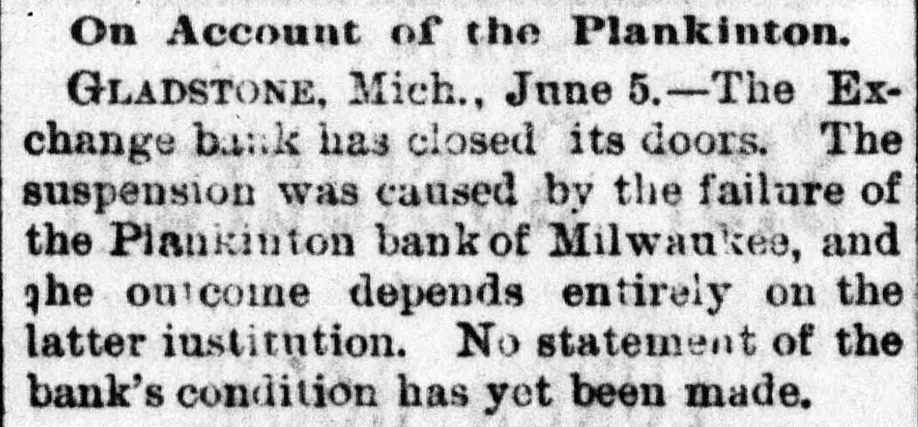
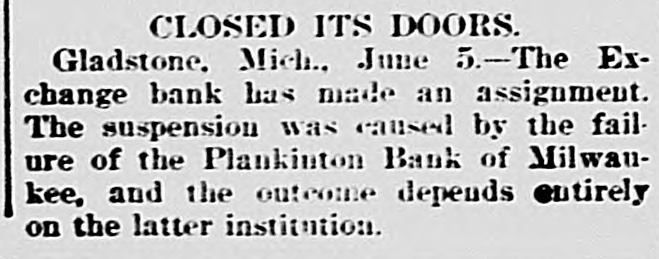
A MICHIGAN BANK CLOSED. Gladstone, Mich., June 3.-The Exchange Bank last night made an assignment for the benefit of its creditors and has closed its doors. The suspension is caused by the failure of the Plankinton Bank of Milwaukee, and the outcome depends entirely on the latter institution. RUNS ON MILWAUKEE BANKS. Savings Department Depositors Take a Foolish Fright. Milwaukee, Wis., June 3.-Runs were made to-day, as yesterday, on practically all the banks in the city. In greater or lesser degree small savings depositors, always timid and easily alarmed, have taken fright at the Plankinton Bank failure and have disregarded the cause of that failure, which business men represent to be only the careless and foolhardy speculations of one man. The commercial and savings departments are requiring notice of depositors that at the end of thirty or sixty days, whichever it is according to law in their case, they will withdraw their savings. The officials of both institutions, however, feel no alarm.


Article from Richmond Dispatch, June 4, 1893

Click image to open full size in new tab

Article Text

MILWAUKEE BANK RUNS. Small Depositors Give Notice of Withdrawal of Their Savings. (By tolograph to the Dispatch.) MILWAUKEE. WIS, June 3.-Runs were made to-day as yesterday on practically all the banks in the city to a greater or lesser degree. The small savings depositors, always timid and easily alarmed, have taken fright at the Plankinton Bank failure and have disregarded the causes of that failure, which the business-men represent to be only the careless and foolhardy speculations of one man. The Commercial and the Second Ward banks were crowded to. day with depositors in their savings departments who are giving notice in order that at the end of the thirty or sixty days, whichever it 18 according to the law in their case, they will withdraw their savings, The officials of both institutions, however, feel no alarm.


Article from The Cape Girardeau Democrat, June 10, 1893

Click image to open full size in new tab

Article Text

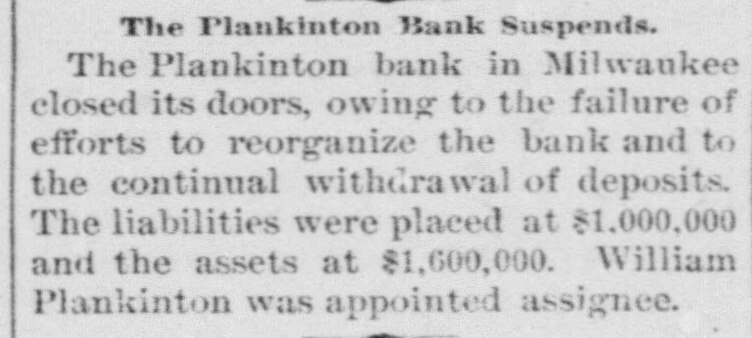
OJEFFERSON DAVIS' remains were reirterred in Holly wood cemetery at Richmond, Va. THE prohibitionists of Iowa in state convention at Des Moines made nominations as follows: For governor, B.O. Aylesworth. of Des Moines: lieutenant governor. J. C. Reed, of Delta: superintendent of public instruction. Miss Belle H. Mix. of Danvillet supreme judge. .1. A. Harvey; of Polk City: railroad commissioner; E. H. Gillette of Des Moines. The resolutions favor woman suffrage, declare the liquor 4 issue the paramount one, and denounce Sunday opening of the world's fair. By a cave-in at the Ivanhoe tunnel hear Leadville, Col., three men were killed, two others fatally and one seriously injured. 1 IN Cineinnati the Victoria Cordage company failed for $400,000. THE oldest banking institution in Tacoma, Wash., the Merchants' national bank. has suspended payment temporarily with $900,000 liabilities and $1,000,000 assets. A CYCLONE wrecked many houses near Forest City. Ark., and Mrs. Thomas. a widow, and her 13-year-old daughter were instantly killed. THE doors of the Plankinton bank of Milwaukee were closed with liabilities of $1,100,000. Continued withdrawal of deposits was given as the cause. FIRE destroyed the Home brewery and rice mill at New Orleans, causing a loss of $250,000. Thirty horses perished in the flames. FRED SARGENT shot and killed his wife at Battle Creek, Neb., and then fatally wounded himself. IN collision with the steamer Corsica in Lake Huron an unknown schooner was sunk and all on board perished. IN Chicago a new counterfeit two-dollar treasury note has made its appearance. It is described as imitating the series of 1891 and as bearing the check letter "B." and the counterfeit signatures of W. S. Rosecrans, register, and E. H. Nebeker, treasurer. IN a fit of jealousy W. G. Morrow shot and killed Effic Baker at Greenville, Miss., and then fatally shot himself. AT Springfield, O., Martin Petritus fatally shot Mrs. Frank Wiethom because she would not leave her husband for him and then shot himself. THE doors of Potter's bank. the oldest bank in Paulding county. and heretofore considered one of the safest, were closed at Paulding. O. A CYCLONE spread death and destruetion near Cotton Plant. Ark. The plantation of John Gazallo was left without a house of any kind standing. The width of the cyclone was about 1 1/2 miles. FIRE swept away the plant of the American Strawboard company at Lima. O., causing a loss of $300,000. A WASHOUT wrecked a mail train near Ridgeway, S. C., and the engineer and fireman were killed.


Article from The Indianapolis Journal, June 27, 1893

Click image to open full size in new tab

Article Text

# F. T. DAY'S WHEREABOUTS. He Is at One of the Mineral Springs in the Vicinity of the City. F. T. Day, of Milwaukee, the ex-president of the Plankinton Bank, which suspended some time ago, is not in Indianapolis, although he was here last week. His friends say that he left Milwaukee only at the urgent insistance of his medical advisers. The complications arising at the time of the closing of the bank and the chagrin at the failure so disturbed Day's mind that his nervousness made his condition dangerous. He first went to West Baden, Ind., and afterwards came here. Dr. W. N. Wishard was called to attend him and after the sensational dispatch was sent out from Milwaukee, Day authorized his physician to send out a denial from Indianapolis. Mr. Day wanted to return to Milwaukee at once, but his physician insisted that he remain away until his condition improved or until his presence at Milwaukee was imperative. His brother, T. C. Day, lives in this city, and gave his brother care and attention while he was here. Mr. T. C. Day left the city yesterday, and it is believed he has accompanied his brother to some of the mineral springs near here, presumably Martinsville. One of the ex-president's friends, in speaking about the sensational reports, said yesterday: "Mr. Day has been grossly misrepresented. He is worth between $500,000 and $600,000, having valuable interests in Wisconsin and some of the adjoining States. He was forced out of the bank by a combination which wanted to put in another man as president. Any examination of his methods will show that they are perfectly honest and legitimate. He was so worried by the efforts to bring disaster upon him that he became very nervous. He was in a bad condition when he came here, and these reports, that he fled from Milwaukee for fear of an investigation of his affairs by the grand jury, greatly distressed him. The grand jury has not indicted him, and I do not think they will. Mr. Day comes from an old English family. I have known his brother in this city for a long time, and he is a man who prides himself on his integrity. The ex-president's father was a Methodist minister and a man who was greatly beloved. I believe Mr. Day, of Milwaukee, is an honest man. He will return to Milwaukee at once if he is notified that he is wanted. I think there will be a number of people who will have to take back a great deal of what they have said about him in his absence." A. R. Flanders, a Milwaukee newspaper man, is here in an effort to see Mr. Day. He says that Frank A. Lappen, Day's companion, and the man to whom Day loaned $290,000 of the bank's money without any security, has also left Milwaukee. Dr. Wishard declines to give ex-President Day's present address. Mr. Flanders does not say that banker Day left Milwaukee about the time that the call for the grand jury was issued, in order to escape the subpΕ“na to appear as a witness, but he says the departure was simultaneous with that event. From a telegram received from Milwaukee last night, Mr. Flanders came to the conclusion that something had been heard from Mr. Day. It read as follows: Have requested Day, through proper channel, to respond to subpΕ“na. Advise me of any charge. LEOPOLD HAMMEL, District Attorney. What these proper channels are and where they lead to Mr. Flanders was not informed. It is presumed that the banker concluded to end suspense by letting the State's counsel know where he is. It is said that the grand jury has not been called together before in Milwaukee but once in twenty years, and that time was about ten years ago. The jury has been in session for about three weeks, and there is no telling whether an indictment is to be found until the jury adjourns. The bank had a capital stock of $200,000, but, according to the statements filed by the assignee for Mr. Day, he was himself a borrower to the amount of $300,000, and he in turn, loaned to Frank A. Lappen $290,000. The bank was a State bank, but if it had followed the conservative rules governing a national bank, no one person could have borrowed more than $20,000. Had it done so there would have been no failure.


Article from The Cape Girardeau Democrat, July 22, 1893

Click image to open full size in new tab

Article Text

WEST AND SOUTH. AN assignment was made by the Kansas City Safe Deposit and Savings i bank. one of the largest institutions of I its kind in Missouri, with liabilities of $1,700,000 and assets of $2,000,000. t THE wife of Charles Gollmer, of A1ton, III., gave birth to her twenty, second child. FLAMES destroyed the factory of the Lake Superior Mineral Paint company and adjacent buildings at West Superior, Wis., the loss being $100,000. EIGHTY-THREE persons were poisoned by eating bad cheese at Mansfield, O., and twelve of the sufferers may die. IN Chicago the Hercules Iron Works company failed for $200,000. A RECEIVER was named for the North Galveston (Tex.) Land & Improvement association, the liabilities being $500. 000. PETER JACKSON and James Corbett have signed articles to fight next June for a purse of $20,000. BY a gasoline explosion Mrs. H. Vanarsdale, aged 28, wife of the leading dry goods merchant at Beatrice, Neb., and Mary Hogenfeldt, her servant, were burned to death. CARRIE and Pearl Plant (sisters) started to walk from Muskegon, Mich., to the world's fair. IN the cold-storage warehouse fire ruins on the world's fair grounds ten more bodies were discovered, making twenty-three in all. JOHN L. DAVIS' private bank at Auburn, Ind., and the Holt county bank at O'Neill, Neb., closed their doors. A FIRE destroyed the main building of the packing house of John Morrell & Co. at Ottumwa, Ia., with its contents, causing a loss of $500,000. IN Chicago Charles M. Barnes, a wholesale bookseller and stationer, failed for $113 000. THE state league of republican clubs will meet in Des Moines, Ia., on August 15. AT Ocala, Fla., Robert Larkin (colored) was lynched for .criminally assaulting Fannie Alexander, a white girl. FLAMES at Princeton, Ind., destroyed two churches, a hotel, bank and many business houses, the total loss being $300,000. SHOCKS of earthquake were felt at Albuquerque, N. M., being severe enough to stop clocks in different parts of the city and to rattle dishes and crockery on the shelves. THE Springfield (Mo.) Bank of Commerce closed its doors with deposits of $176,000, and the Bank of Garnett, Kan., stopped business with heavy liabilities. IN Chicago Oscar Neebe, the anarchist recently released from the Joliet (III.) penitentiary by Gov. Altgeld, was married to Mrs. Eliza Hepp. Neebe's first wife died while he was in prison. THE indicted officials of the Plankin ton bank in Milwaukee, that failed recently, include Judge Jenkins, of the United States circuit court. THE Viking ship from Norway, a fac simile of the one in which Leif Ericson is claimed to have touched upon American shores 400 years before Columbus sailed from the harbor of Palos, arrived in Chicago. FLAMES destroyed twelve business buildings at Maxwell, Col., the loss be$100,000. WILLIAM Cook, of Pemberville, O., while drunk made a murderous assault with a club upon his four children, injuring three of them fatally. FOR fourteen years Annie Morris has been masquerading as Frank Blunt. Her arrest at Milwaukee revealed her identity. GEORGE SHIRLEY, engineer, and Brakeman Brookbank were mortally wounded in a freight wreck at Henryville, Ind. TILLIE WILLIAMS. Otto Reineck and Annie Watson, a noted Chicago gang of thieves, were sentenced at Denver to ten years each in the penitentiary.


Article from The Manitowoc Pilot, August 3, 1893

Click image to open full size in new tab

Article Text

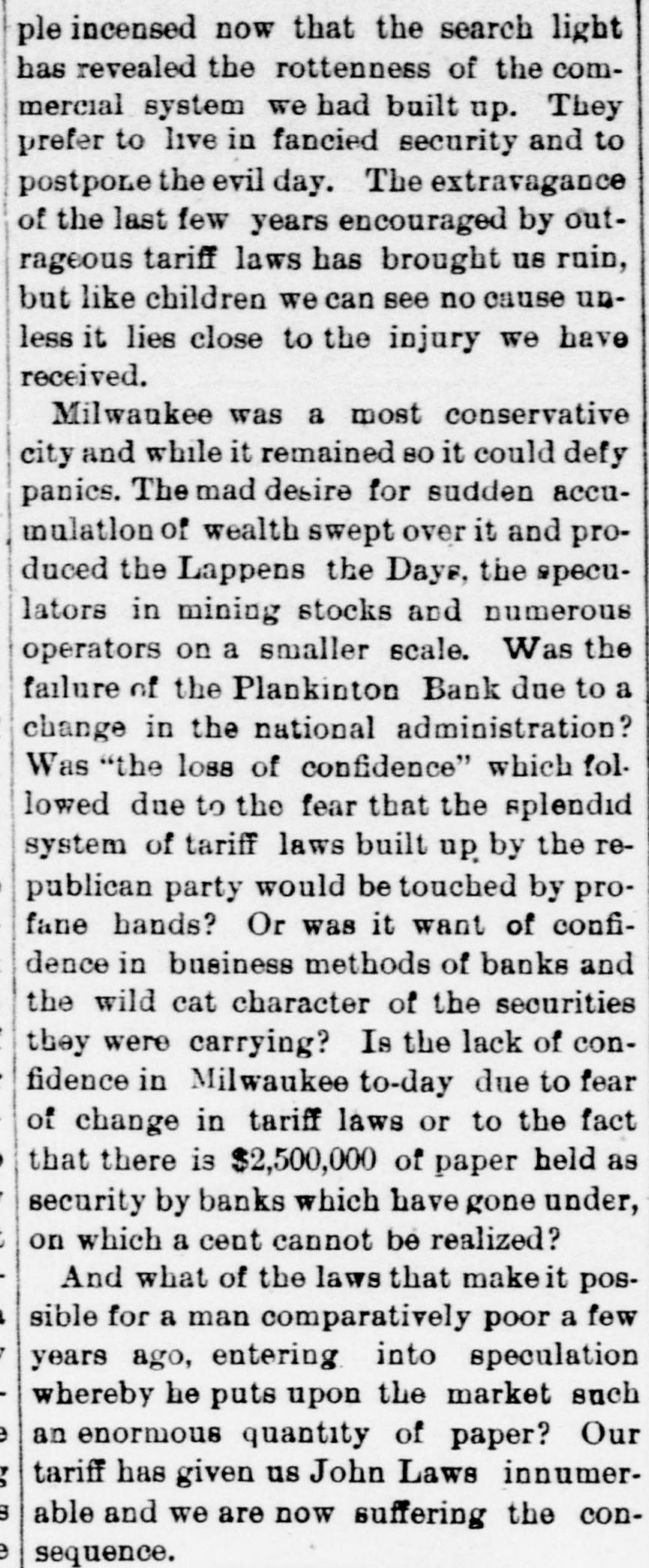
# THE TARIFF AND THE PANIC ple incensed now that the search light has revealed the rottenness of the commercial system we had built up. They prefer to live in fancied security and to postpone the evil day. The extravagance of the last few years encouraged by outrageous tariff laws has brought us ruin, but like children we can see no cause unless it lies close to the injury we have received. Milwaukee was a most conservative city and while it remained so it could defy panics. The mad desire for sudden accumulation of wealth swept over it and produced the Lappens the Days, the speculators in mining stocks and numerous operators on a smaller scale. Was the failure of the Plankinton Bank due to a change in the national administration? Was "the loss of confidence" which followed due to the fear that the splendid system of tariff laws built up by the republican party would be touched by profane hands? Or was it want of confidence in business methods of banks and the wild cat character of the securities they were carrying? Is the lack of confidence in Milwaukee to-day due to fear of change in tariff laws or to the fact that there is $2,500,000 of paper held as security by banks which have gone under, on which a cent cannot be realized? And what of the laws that make it possible for a man comparatively poor a few years ago, entering into speculation whereby he puts upon the market such an enormous quantity of paper? Our tariff has given us John Laws innumerable and we are now suffering the consequence.


Article from Rock Island Argus, December 4, 1893

Click image to open full size in new tab

Article Text

Status of Milwankee Suspended Banks. MILWAUKEE, Dec. 4.-In a circular issued by Washington Backer, receiver of the Mitchell bank, the following terms are proposed: Ten per cent. in cash on demand after the bank opens, 10 per cent. in six months from Jan. i. 1894, and the balance in four equal payments in ten. eighteen, twenty-four, and thirty months from Jan. 1, with interest at the rate of 3 per cent. from July 25. 1893. Under the proposition for the reopening of the Piankinton bank, each depositor is guaranteed his money within two years, with interest at 3 per cent. Judge Johnson, of the circuit court, who is familiar with the affairs of all the suspended banks, says the Plankinton bank could be opened immediately with safety to the creditors, the Mitchell next, and the Commercial within six months.


Article from St. Paul Daily Globe, December 14, 1893

Click image to open full size in new tab

Article Text

ALL ALL who have a personal or professional acquaintance with Judge James G. Jenkins, of Milwaukee, will be gratified at learning that the indictment found against him in connection with the suspension of the Plankinton bank has been dismissed. Judge Jenkins has borne an exceptionally high character all his life, and is incapable of a dishonest or dishonorable act. He was unfortunate in becoming connected as a director with the bankrupt bank, but had no part in its management, nor had he any responsibility for its condition.


Article from St. Paul Daily Globe, February 18, 1894

Click image to open full size in new tab

Article Text

THE resumption of the Plankinton bank at Milwaukee, with an unimpaired capital, is one of the encouraging signs of the times. It is the last of the large financial concerns that recently suspended to resume business, and but two small savings banks have gone out of business permanently. The banks reorganized since the panic have been placed on a better footing than they previously enjoyed.


Article from River Falls Journal, March 8, 1894

Click image to open full size in new tab

Article Text

David W. Mackay died in Milwaukee of pneumonia after an illness of two weeks. He had been principal of the Eighth District school for ten years. William Brocken's child was scalded to death at Marengo by falling into a washtub of boiling water. Thirty-eight of the millers, grainmen and bankers of-Superior met and established a board of trade. The store at Bruce owned by P. Kopleman was closed by the sheriff and goods sold at auction. Divorced and jilted, Henry Schroeder, of Milwaukee, decided life was not worth living and hanged himself. Claimants at Ashland to Omaha reservation lands have organized into a club to push their interests. Benjamin Bixby, charged with causing the death of his wife at Glenwood, has been discharged from custody. A 5-year-old son of M. M. Porter, E prominent lumberman at Shawano, was run over and killed. The effects of the Adams Express company were shipped from Mil vaukee to Chicago, the company going out of business there. $300,000. Arthur C. Osborn and Miss Grace Cushman, a Chicago eloping couple, were married in Milwaukee. State relief for the Hurley miners has ceased and Iron county must look after its unemployed. Howard Morris and C. F. Rand, receivers of the Penokee and Gogebic mines, have been authorized to issue $800,000 in certificates. LaCrosse banks and business houses were flooded with counterfeit dollars and half dollars bearing the 1893 date. Fred Wills, of Edgerton, who was granted a divorce about two weeks ago, has remarried Mrs. Wills. The forty-sixth annual sta encampment of the Independent Order of Odd Fellows was held in Racine. The corner stone of the new $1,000,000 city hall in Milwaukee was laid in the presence of a large number. A $9,000 fire destroyed the Olson tobacco warehouse at Cambridge. Carl Jonas, lieutenant governor of the state, has been appointed consul genΓ§ral at St. Petersburg and will resign his office to accept his appointment. Curtis Mann, a resident of Waukesha county since 1858, died in Oconomowoe at the age of 79 years. In 1868 he was elected to the state senate, serving one term. Judge Bundy refused to dissolve the injunction restraining the city treasurer of Chippewa Falls from disposing of funds drawn from the Seymour bank on the day of its faiulre. Robert Fitzgerald, a woodsman, was found frozen to death near Pembine. Application to Comptroller Eckels was made for the reorganization of the defunct Plankinton bank of Milwaukee into a national bank with a capital of Steps were taken at Milwaukee by officials of the Wisconsin Central road to take the corporat on out of the receiver's hands. Jacob C. Horn, present at the Fort Dearborn massacre in Chicago and in the Black Hawk, Mexican and civil wars, died at Winneconne. C. J. Melms, of Milwaukee, jumped from a passenger train in Wyoming, having suddenly become demented, and was fatally injured. The Epworth league state convention at La Crosse elected E. W. Chafin president, A. E. Dixon vice president and F. D. Hopkins secretary. Rudolph J. Peschmann, who murdered Mrs. Anna Schums at the Cream City hotel in Milwaukee on January 12, and then set fire to the house in the hope of hiding his crime, was sentenced to life imprisonment. As the result of a quarrel Theodore Erickson shot his mother near La Crosse and then cut his own throat. Both will probably live. An unknown young man was killed by a falling tree at Arpin. Robert McBurney, of Rhinelander, was arrested on complaint of his divorced wife for murdering child two years ago. A. W. Lawrence's loss near Sturgeon Bay by the burning of his barns and eighteen horses is estimated at $11,000, or $5,450 al ove insurance. Two Swede girls are conducting a revival on the west side of Wausau. Their methods are similar to those of the Salvation Army, and it is said they accomplish much good among their countrymen. The Commercial bank of Milwaukee has resumed business with a capita.


Article from Little Falls Weekly Transcript, September 14, 1894

Click image to open full size in new tab

Article Text

TELEGRAPHIC BREVITIES. News of Minor Importance In Condensed Form. Testimony in the Plankinton bank case at Milwaukee shows the failed concern was rotten to the core. A movement to run Senator Don Cameron for president as the Camidate of a free silver party is said to be under way. A pitched battle took place between union. and non-union longshoremen in Savannah, Ga. One man was fatally shot. Two persons were killed and three seriously injured by a collision on the Fitchburg road near North Adams, Mass. Professor Hermann von Helmhaltz, the distinguished German physiologist and scientist, died at Berlin, aged 74 years. A severe electric storm swept Northern Illinois. Many buildings were blown down and horses and cattle were killed. The receiverships of the 24 branch lines of the Northern Pacific are to be terminated, effecting a saving of $60,000 a year. Merley Mohammed, the eldest son of the late sultan of Morocco, has been proclaimed emperor by the rebel tribes of the South. A shortage has been discovered in the accounts of the commandant of the Iowa soldiers' home. The commandant and adjutant are suspended. Sergeant Whitehead of the Butte (Mon.) police force, in charge of the silver statue now on exhibition in Minneapolis, was drowned in Lake Minnetonka Sunday.


Article from River Falls Journal, October 25, 1894

Click image to open full size in new tab

Article Text

The News Condensed. Joseph Delois, of Mishicott, was in jail at Milwaukee charged with forging postal money orders. An explosion in the Library block in Milwaukee caused a loss of $10,000. The Milwaukee internal revenue of fice discovered that a New York wholesaler was evading the new law requiring the stamping of playing cards, and the new cards were seized. Sophomores beat freshmen in the annual fall field day games at thestate university in Madison. N. S. Hopkins ran a mile in 4 minutes and 35 seconds, a new university record. At Juneau Judge Sloan upheld the lease of the Horicon marsh by the Horicon and Dana shooting clubs. James Crowley, a veteran of the soldiers' home in Milwaukee, was stabbed and killed by an unknown man. Arthur Phillips, 20 years old, accidentally shot off his right arm at the shoulder at Shell Lake, death result ing ten hours later. A suit was filed in the United States circuit court at Madison to test Secretary Hoke Smith's decision in the Ashland county land cases, involving, be sides the title to land, about $50,000 worth of standing pine. City Attorney Hamilton, of Milwau kee, says that the city has no right to own and operate street railroads. The twenty-fifth anniversary of the establishment of Temple Emanuel congregation in Milwaukee was cele brated. The old Rock county poorhouse and insane asylum at Johnstown was burned. Loss, $10,000. Winnebago Indians were being enrolled at Black River Falls for the annual payment, and will get nearly $20 each. There are 1,300 of them. A new state normal school wasdedicated at Stevens Point. The $90,000 claim of the Plankinton bank in Milwaukee was sold to the National exchange bank for $58,000. William K.rby, 85 years of age, one of Milwaukee's oldest residents and for years head of the notion house of Kirby, Newbre & Co., died at his home. H. Nelson, aged 50 years, a laborer in the sawmill at Sherry, had one leg sawed off by an edging saw. The Seymour bank matter at Chippewa Falls Was settled, depositors getting forty cents on the dollar. Commissioner Lamoreux's annual report shows 668,813 acres of vacant public lands in the state on June 30, 1894. There was much complaint that hunters in the northern portion of the state, some of them state game wardens, were hunting deer with dogs. A young man named Richard Schlotzer accidentally shot himself while out hunting 12 miles east of Marshfield. Ward Stone, arrested in La Crosse for bigamy, did not deny the charge. He married in La Crosse, leaving a wife and two children at Eagle River. Police raided an opium den in Milwaukee and Sam Wing, the keeper, and two white girls were surprised there. The girls escaped. The game wardens of Douglas and Bayfield counties arrested a number of persons for slaughtering deer by the use of lanterns, which is as much in violation of the law as hunting with dogs. Impeachment proceedings against Health Commissioner Dr. Walter Kempster for the manner in which he handled the smallpox epidemic in Milwaukee were begun in the common council. William Lahl attempted to murder his wife in Milwaukee by running a bayonet through her. The woman escaped and Lahl, fearing the consequences of his act, hung himself.


Article from St. Paul Daily Globe, March 10, 1895

Click image to open full size in new tab

Article Text

Receiver for Plankinton Bank. MILWAUKEE, March 9.-Judge Johnson has decided to appoint a receiver for the defunet Plankinton bank, to collect from the stockholders a sum equal to the amount of their capital stock, under the state banking law. Judge James Jenkins paid in $3,500 to the Plankinton bank today. The John Plankinton estate expressed willingness to pay in $38,000. William Plankinton, in his own right, offered to pay in $5,000. H. O. Armour did likewise as to $5,000, and Mary Thompson tendered $1,000. This is the amount of the liability of these parties as stockholders in this bank. The receiver will be instructed to file a claim for $96,000 with Mr. Momson, the assignee of F. T. Day.


Article from Rock Island Argus, April 10, 1895

Click image to open full size in new tab

Article Text

Dividend for Plankinton Bank Creditors. MILWAUKEE, April 10-The - first dividend by the receiver for the stockholders of the Plankinton bank and the third dividend by the bank will be paid today. The payment will be a 10 per cent. dividend upon the money still owing de positors by the bank, which is something like $700,000 of the original debt of $1,100,000.


Article from St. Paul Daily Globe, April 12, 1895

Click image to open full size in new tab

Article Text

STOCKHOLDERS PAY UP. Another Dividend for Plankinton Bank Creditors. MILWAUKEE, Wis., April 11.Receiver Fletcher who had in charge the collection of the amounts due from the several stockholders of the Plankinton bank, reported today to Judge Johnson the payment of the followIng amounts: H. O. Armour, $5,000; United States Judge James G. Jenkins, $8,500; trustees of John Plankinton estate, $38,500; William Plank-


Article from The Dickinson Press, April 13, 1895

Click image to open full size in new tab

Article Text

First Dividend. Milwaukee, April 11.-The payment of the first dividend by the receiver for the stockholders of the Plankinton bank, and. the third dividend by the bank will be made to-morrow.