Fidelity Savings Bank (Chicago, IL)

Episode Information

Episode UID
7732990290932
Episode Type
Run β†’ Suspension β†’ Closure
Bank Type
savings
Bank ID
773299029 hash
Start Date
August 31, 1877
Location
Chicago, Illinois (41.850, -87.650)

Metadata

Model
gpt-5-mini (chosen from majority vote of a three-model LLM ensemble)
Short Digest
5d5f2e8f91ed7853

Response Measures

None

Description

Run followed failures of other local savings banks; suspension quickly led to receiver appointment and liquidation.

Events (3)

1. August 31, 1877 Run
Cause
Local Banks
Cause Details
Run began after collapse/failure of other Chicago savings banks (State Savings etc.) and general contagion of depositor distrust.
Measures
Paid out cash to depositors during the run; directors limited payments under notice rules and pledged private property to support depositors.
Newspaper Excerpt
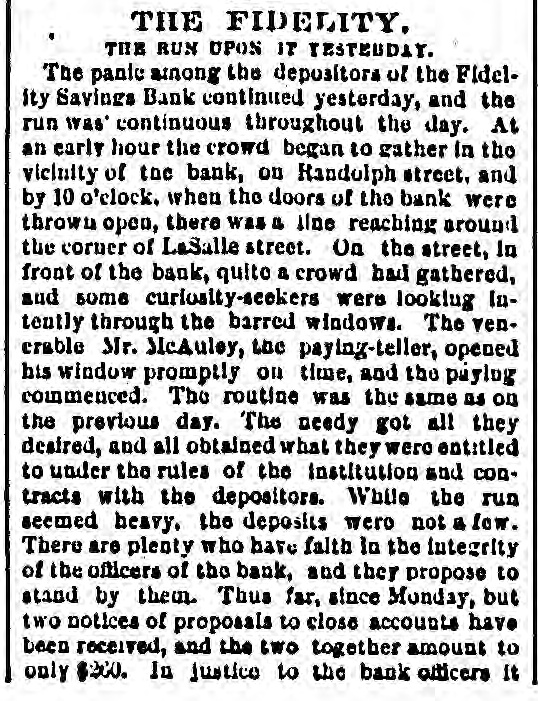
THE FIDELITY, THE RUN UPON IT YESTERDAY. The panic among the depositors of the Fidelity Savings Bank continued yesterday, and the run was continuous throughout the day.
Source
newspapers
2. September 24, 1877 Suspension
Cause
Government Action
Cause Details
Court action: petition filed for appointment of a receiver and bank closed pending court decision.
Newspaper Excerpt
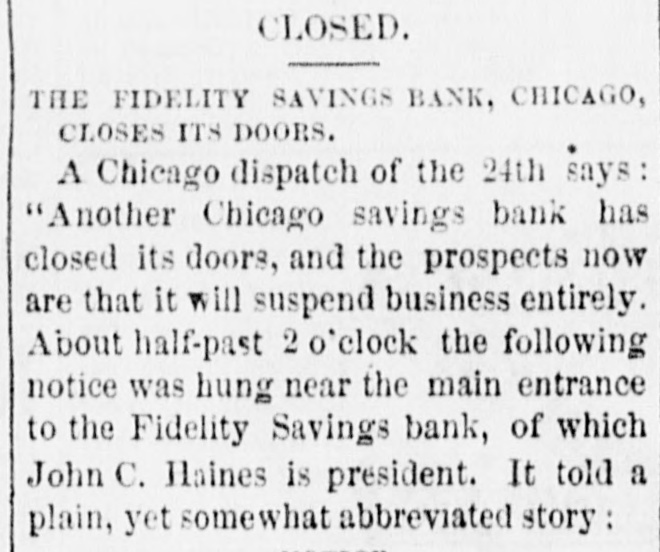
Early callers at the Fidelity Savings bank this morning found its doors closed and a hastily penned card thereon informing depositors that as notice had been served that a petition for a receiver would be filed in the superior court to day, the bank would remain closed pending the decision of that question in court.
Source
newspapers
3. September 25, 1877 Receivership
Newspaper Excerpt
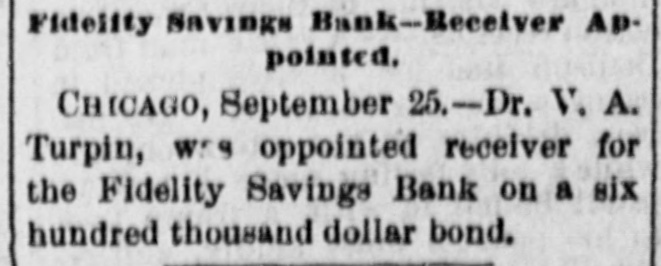
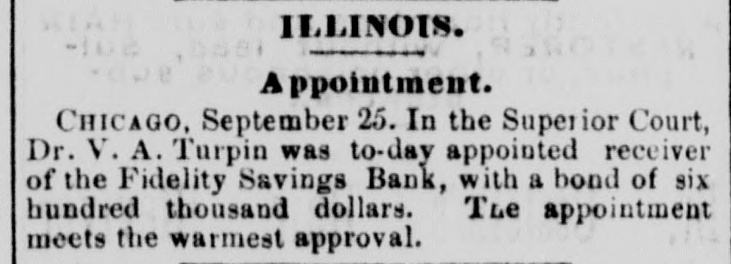
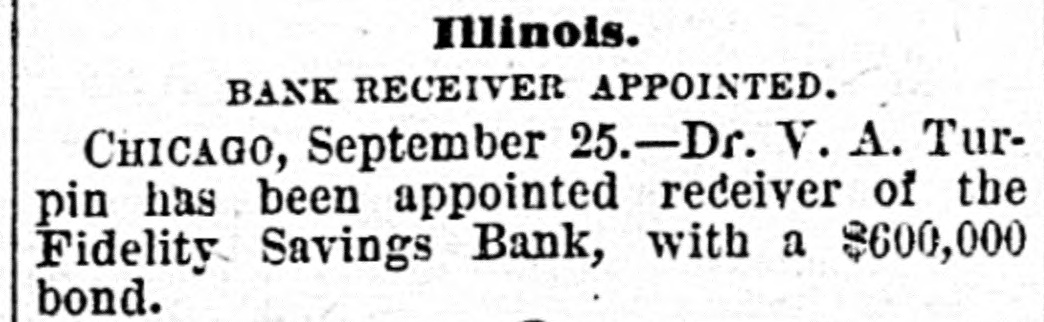
Dr. V.A. Turpin was appointed receiver of the Fidelity Savings Bank, with bond at $600,000. The appointment meets with the warmest approval, the depositors especially being pleased.
Source
newspapers

Newspaper Articles (22)

Article from Chicago Daily Tribune, August 31, 1877

Click image to open full size in new tab

Article Text

THE FIDELITY, THE RUN UPOS IT TESTEUDAY. The panic among the depositors of the Fidelity Savings Bank continued yesterday, and the run was' continuous throughout the day. At an early hour the crowd began to gather In the viciulty of the bank, on Randolph street, and by 10 o'clock. when the doors of the bank were thrown open, there was a line reaching around the corner of LaSalle street. On the street, In front of the bank, quite a crowd had gathered, and some curiosity-seekers were looking Intently through the barred windows. The venerable Mr. McAuley, the paying-teller, opened his window promptly on time, and the paying commenced. The routine was the same as on the previous day. The needy got all they desired, and all obtained what they were entitled to under the rules of the institution and contracts with the depositors. While the run seemed heavy. the deposits were not a few. There are plenty who have faith In the integrity of the officers of the bank, and they propose to stand by them. Thus far, since Monday, but two notices of proposals to close accounts have been received, and the two together amount to only $200. In justice to the bank officers it


Article from Chicago Daily Tribune, September 1, 1877

Click image to open full size in new tab

Article Text

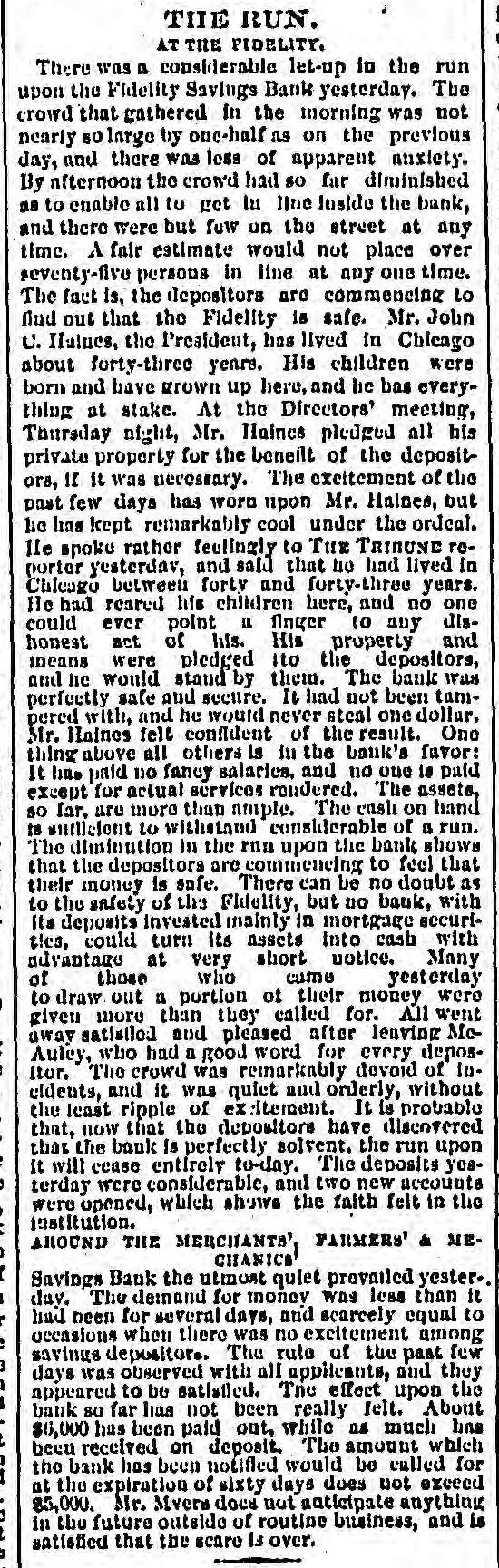
THE RUN. AT THE FIDELITY. There was a considerable let-up in the run upon the Fidelity Savings Bank yesterday. The crowd that gathered in the morning was not nearly so large by one-half as on the previous day, and there was less of apparent anxiety. By afternoon the crowd had so far diminished as to enable all to get lu line Juside the bank, and there were but few on the street at any time. A fair estimate would not place over seventy-five persons in line at any one time. The fact is, the depositors are commencing to find out that the Fidelity is safe. Mr. John C. Halues, the President, has lived in Chicago about forty-three years. His children were born and have grown up here, and lie has everything at stake. At the Directors' meeting, Thursday night, Mr. Haines pledged all his private property for the benefit of the depositors, If it was necessary. The excitement of the past few days has worn upon Mr. Haines, but be has kept remarkably cool under the ordeal. lle spoke rather feelingly to THE TRINUND reporter yesterday, and sald that he had lived In Chicago between fortv and furty-three years. lle had reared his children here, and no one could ever point a finger to any dishonest act of his. His property and means were pledged ito the depositors, and he would stand by them. The bank was perfectly safe and secure. It had not been tampered with, and he would never steal one dollar. Mr. Haines felt confident of the result. One thing above all others is in the bank's favor: It has paid no fancy salaries, and no one is paid except for actual services rendered. The assets, so far, are more than ample. The cash on hand is sufficient to withstand considerable of a run. The diminution in the run upon the bank shows that the depositors are commencing to feel that their money is safe. There can be no doubt as to the safety of the Fldelity, but no bank, with Its deposits invested mainly in mortgage accurities, could turn its assets into cash with advantage at very short notice. Many of those who came yesterday to draw out a portion of their money were given more than they called for. All went away satisfied and pleased after leaving McAuley, who had a good word for every depositor, The crowd was remarkably devoid of lucidents, and it was quiet and orderly, without the least ripple of x itement. It is probable that, now that the depositors have discovered that the bank is perfectly solvent. the run upon it will cease entirely to-day. The deposits yesterday were considerable, and two new accounts were opened, which shows the faith felt in the institution. AROUND THE MERCHANTS', FARMERS' & MECHANICS Savings Bank the utmost quiet provailed yesterday. The demand for money was less than it had been for several days, and scarcely equal to occasions when there was no excitement among savings depositor. The rule of the past few days was observed with all applicants, and they appeared to be satisfied. The effect upon the bank so far has not been really felt. About $0,000 has been paid out, while as much line been received on deposit. The amount which the bank has been notified would be called for at the expiration of sixty days does not exceed $5,000. Mr. Mvers does uot anticipate anything in the future outside of routine business, and is satisfied that the scare is over.


Article from Chicago Daily Tribune, September 2, 1877

Click image to open full size in new tab

Article Text

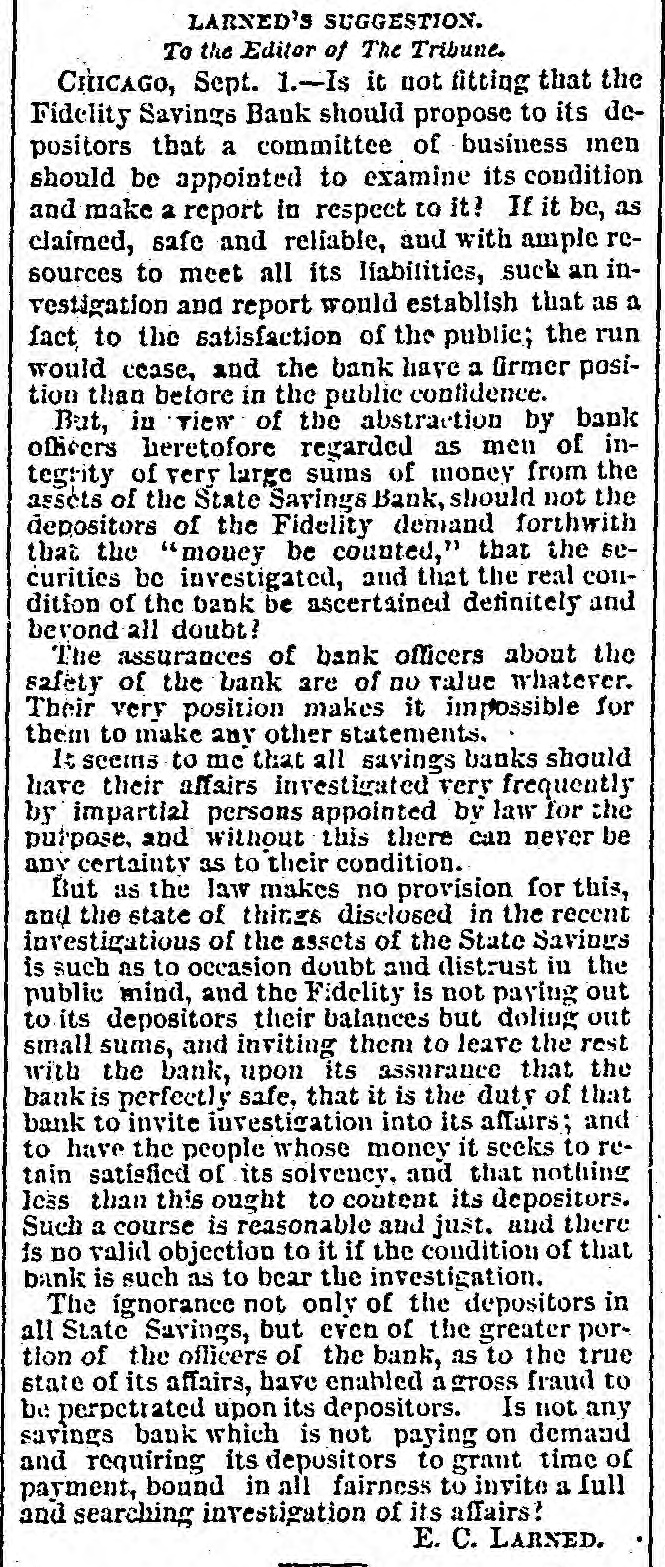
LARNED'S SUGGESTION. To the Editor of The Tribune. CHICAGO, Sept. 1.-Is it not fitting that the Fidelity Savings Bank should propose to its depositors that a committee of business men should be appointed to examine its condition and make 2 report in respect to it? If it be, as claimed, safe and reliable, and with ample resources to meet all its liabilities, such an investigation and report would establish that as a fact to the satisfaction of the public; the run would cease, and the bank have a firmer position than before in the public confidence. But, in view of the abstraction by bank officers heretofore regarded as men of integrity of very large sums of money from the assets of the State Savings Bank, should not the depositors of the Fidelity demand forthwith that the "mouey be counted," that the securities be investigated, and that the real condition of the bank be ascertained definitely and bevond all doubt? The assurances of bank officers about the safety of the bank are of no value whatever. Their very position makes it impossible for them to make any other statements. 1t seems to me that all savings banks should have their affairs investigated very frequently by impartial persons appointed by law for the purpose, and without this there can never be any certainty as to their condition. But as the law makes no provision for this, and the state of things disclosed in the recent investigations of the assets of the State Savings is such as to occasion doubt and distrust iu the public mind, and the Fidelity is not paying out to its depositors their balances but doling out small sums, and inviting them to leave the rest with the bank, upon its assurance that the bank is perfectly safe, that it is the duty of that bank to invite investigation into its affairs; and to have the people whose money it seeks to retain satisfied of its solvency, and that nothing less than this ought to content its depositors. Such a course is reasonable and just. and there is no valid objection to it if the condition of that bank is such as to bear the investigation. The Γ­gnorance not only of the depositors in all State Savings, but even of the greater portion of the officers of the bank, as to the true state of its affairs, have enabled a gross fraud to be perpetrated upon its depositors. Is not any savings bank which is not paying on demand and requiring its depositors to grant time of payment, bound in all fairness to invito a full and searching investigation of its affairs? E. C. LARNED.


Article from Chicago Daily Tribune, September 2, 1877

Click image to open full size in new tab

Article Text

THE RUN. IT IS PLAYED OUT. When the Fidelity opened its doors yesterday morning, the crowd waiting for admittance was not very large. The fact is, the run has speut itself, and the panic among the depositors is over. At no time were there over forty persons in the line of those desiring to draw out their money yesterday. All that came got all they wanted or expected, and none went away dissatisfied. The depositors have become satisfied :hat the bank IS safe and in good hands. The Fidelity Directors are determined to stand Lv it, and no depositor can possibly Jose a cent under the present management. The assets, of course, could not be turned into cash at a moment's notice. The bank was kept open from 6 10 S o' lock in the evening, and all who desired could draw out their money. The deposits unu-ually large. even for ordinary times, and many new accounts were opened, including one with over $1,000, another with $557.73. and another for $500. There were also quite a numher of immor accounts. Everything passed on swimmingly, and by to-morrow morning it will hardly be apparent that a run ever occurred on the Fidelitv. At a meeting of the Board of Directors of the Fidelity Savings Bank yesterdav, it was determined to reduce the rate of interest from 6 to per cent after October. At 6 per cent the Lank has not been making any money on deposits lately, and it is proposed hereafter to keep a portion of the assets in securities that shall be immediately convertible into cash. Several National Bank Presidents happened in yesterday and offere.1 aid if necessary, but were told it was not needed. At the Merchants', Farmers' & Mechanics' Bank there was little or no excitement, and all passed off as on ordinary days. But few came to withdraw their money, and the depositors were not a few. In the morning a delegation of depositors of the State Savings Institution wasted upon Mr. Myers and asked him to talk at the Tabernacle meeting, and he accepted the invitation.


Article from The Rock Island Argus, September 24, 1877

Click image to open full size in new tab

Article Text

The Fidelity Savings Bank at Chicago Suspended. CHICAGO. Sept. 24.-Early callers at the Fidelity Savings bank this morning found its doors closed and a hastily penned card theron informing depositors that as notice had been served that a petition for a receiver would be filed in the superior court to day, the bank would remain closed pending the decision of that the question in court. Motion was made, and as the officers of the bank made no opposition, Judge Moore decided to appoint the receiver this afternoon, by which time he hoped the officers and depositions would have agreed upon the man. The petition alleged that the officers had been sacrifcing valuable securities in order to realize cash upon them. and that the bank is already insol. vent. It is believed that the assets will be much larger in proportion than those of the state savings bank. The last quar terly statement gives as reserves in cash and exchange $341,222: government bonds 279,432; other bonds $50,061; de wand loans, secured by coliaterals, $234,848; time loans secured $438,749; first mortgage loans on real estate $606,362; depository building $85,878; real estate $102,000; property account $18,454; safe depository vaults $121,520. Other small items make the total resources $2,280,511. d The liabilities were, capital $200,000, surplus $100,000; profit and loss $3,447; due m depositors $1,977,034. Total $2,280,511.


Article from The Cheyenne Daily Leader, September 25, 1877

Click image to open full size in new tab

Article Text

ILLINOIS. Another Chicago Bank Closes Its Doors. Chicago, Sept. 24. Early callers at the Fidelity Savings bank this morning found its doors closed and a hastily penned card thereon informing depositors that as yet had not been served, that a petition for a receiver would be filed in the Superior court to-day, and that the bank would remain closed pending the decision of that question in the court. The motion was made, and the officers of the bank made the necessary deposition. The court decided to appoint the receiver this afternoon, by which time he hoped the officers and depositors would have agreed upon the man. The petition alleges that the officers have been sacri-


Article from The Wheeling Daily Intelligencer, September 25, 1877

Click image to open full size in new tab

Article Text

The Fidelity Savings Bank. CHICAGO, September 24.-Early callera at the Fidelity Savings Bank this morning found its doors closed and a hastily as a tors penned that card notice thereon had informing been served, deposi- petition for a receiver would be filed in the Superior Court to-day, and the bank would remain closed pending the decision of that question. In the Court a motion wasmade that as the officers of the bank had made no opposition, a receiver be appointed at once. Judge Moore decided to appoint the receiver this afternoon, by which time he hoped that the officers and depositors would have agreed upon the man. The petition alleges that the officers have been sacrificing valua. ble securities in order to realize cash upon them, and that the bank is already insolvent. It is believed that the assets will be much larger in proportion than tbose of the State Savings Bank. The last quarterly statement gives as resources, cash and exchange $341,222; Government bonds, $279,432; other bonds, 50,061; Demand loans secured by collaterals, $234,838: Time loans, secured, $438,749; first mortgage loans on real estate,$606,342, bank and depository building, $85,878, real estate, $102,000; property account, $18,554; safe depository vaults, $121,520. Other small items make the total resources $2,280,511. The liabilities were, capital, $20,000; surplus, $100,000; profit and loss, $3,447; due depositore, $197,764. Total, $228,051. The Grand Juryjhas indicted Spencer, Gould and Balkley, officers of the State Savings Bank, for the embezzlement of $900,000. None of them are in the city, nor is their present whereabouts known. The sixth annual session of the National Agricultural College will be held here beginning to-morrow and lasting till the 27th. All agricultural societies, col. leges and organizations are requested to send delegates. A large attendance is anticipated. Owing to some opposition to the appointment of a Receiver developed this afternoon, Judge Moore delayed action on the motion before him until to-morrow. The bank book value assets of the Fidelity aggregate $1,531,460. The estimated value as made out by the bank officers is considerably less, namely, $1,175,900. Of the latter sum the principal amounts are: cash, $64,518; collateral loans, $115,000; bonds and mortgages, $380,000; real estate, $420,000; demand collateral loan, $70,000; bills of exchange, $27,000; bills discounted, $25,000. The deposit liabilities are $1,370,000.


Article from The Cincinnati Daily Star, September 25, 1877

Click image to open full size in new tab

Article Text

Financial Thieving. National Associated Press to the Star. OMAHA, Sept. 25.-The parties who robbed the U. P. train are believed to have gone in a northeasterly direction from the line of the road, and there is a strong probability that the efforts now bein made for their capture will prove successful. CHICAGO, Sept. 25.-In the Superior Court this morning Dr. V.A. Tarpin was appointed receiver of the Fidelity Savings Bank, with bond at $600,000. The appointment meets with the warm. est approval, the depositors especially being pleased.


Article from Eureka Daily Sentinel, September 25, 1877

Click image to open full size in new tab

Article Text

fire will not extend below the floor of the model room. The most valuable records of the Patent, Land, Indian and Pension offices as well as those of the Interior Department proper, are stored on the first two floors of the building, beneath the model room, and none of them have yet been reached by the flames. The heat was so intense at one time that the window frames and awnings on G street were ignited, but the fire was extinguished before making much progress. The number of models is variously estim ated at from 50,000 to 75,000. A numher of the more important were on exhibition and storage in the west hall, which, with the north ball, iscompletelv wrecked and roofs burned. The fire at this time, 2:30, is cleaned to the attic of the east ball, from which nearly all the models have been removed to lower floors. The loss in rejected models will be very great to the Government. In the Patent Office build ing are the offices subordinate to the Interior Department, except the Pension Office. The Land, Patent and Indian Offices suffer by the mixing of documents in the effort to save them. Many rooms of the lower floors are covered with water. A cordon of police have been thrown around the building, and a detachment placed in. side. while a detachment of marines are between the burning building and Postoffice. At 3 o'clock the fire was confined to the northwest corner and under control. WASHINGTON, 3:10 P. M., Sept. 24. The writing buildingon G street opposite the Patent Office is now on tire, and two or three houses on Seventh street opposite the Indian Bureau have caught. The General Postoffice has been closed and public work seems suspended throughout the city. Bank Suspension in Chicago. CHICAGO, Sept. 24. Early callers at the Fidelity Savings Bank this morning, found its doors closed and a hastily penned card thereon, informing depositors that as notice had been served that a petition for a receiver would be filed in the Superior Court to-day. the bank would remain closed pending the decision of that question. In the court a motion was made. and as the officers of the bank made no opposition, Judge Moore decided to appoint a receiver this afternoon, by which time he hoped the officers and depositors would have agreed upon a man. The petition alleges the officers have been sacriticing valuable securities in order to realize cash upon them, and that the bank is already insolvent. It is believed the assets will be much larger in proportion than those of the State Savings Bank. The last quarterly statement showed resources to the amount of $2,280,511, or a surplus over liabilities of $100,000. A Valuable Package Stolen From a Bank. CORTLAND, N. Y., Sept. 24. A package containing government and railroad bonds, certificates, stock, mortgages and promissory notes, estimated at $200,000. was stolen from the First National Bank of Cortland Saturday. The loss was not discovered until this morning The securities. were


Article from New-York Tribune, September 25, 1877

Click image to open full size in new tab

Article Text

# THE FIDELITY SAVINGS BANK would have cried, who are now trying to find out of how much they have been robbed. But it is just such blind confidence in a manage- ment that breeds scoundrels. The best of men, because they are strongly trusted, are strongly tempted, and stand in the greater need of that moral defence which constant watchfulness and publicity only can give. How serious this blow will prove to business interests, it is difficult to say. Apparently, Mr. Morton had borrowed over $1,000,000, using fraudulent certificates as security. No doubt other large sums had been borrowed upon the genuine stock, which was held worth over $1,000,000 on the very morning of the exposure, and which nobody could sell at any price that night. These large loans, for which the security has suddenly vanished, may cause some trouble. But the worst effect will be the grave distrust which must be pro- duced where Mr. Morton was held so high. Destruction of confidence, at a time when confidence is peculiarly needed, involves more than the loss of one or two millions. The event will bear good fruit, however, if it teaches men in positions of trust to beware of gambling in stocks. Like many others, it seems, Mr. Morton had faith in the coal roads, and lost largely in Philadelphia and Reading, and his earliest fraud was prompted by over- whelming losses on that stock. We shall have a better chance of financial recovery when it comes to be a rule rigidly observed by men intrusted with the care of the money of others, and rigidly enforced by stockholders, that no man in that position ought ever to indulge in speculation. This is not the first, nor by many will it be the last, of frauds arising from the same cause. The fall of the Fidelity Savings Bank has not been wholly unexpected. Though it has made a long struggle, the persistency of the run upon it, which began after the failure of the State Savings Bank, clearly indicated a general impairment of confidence. The capital was only $200,000, but it had a surplus of $98,000 more in October last, and was espe- cially well known because of the activity of its President. Its fall is not likely to cause serious disturbance at Chicago, as it will hardly occasion surprise, but every such event tends immediately to increase the drain upon New- York banks, and; more broadly, to intensify the distrust and apprehension which make a revival of business so difficult. The one thing unquestionably solid in our condition, is the enormous productivenesss of our industry. The great crops will not take to themselves wings, and vanish in a night. The yield of petroleum and of the precious metals does not cease, nor the foreign demand for our wheat and corn, cotton, provisions, and manufactured products. Faith that the country will finally recover, in spite of all its losses, is not ill-founded, for it is a faith in the great resources of the land, and in the en- terprise, invention and industry of the people. The recovery will be the more sure and steady when it comes, and will be the less liable to interruption from startling failures or shocking disclosures, for the removal of crippled firms, the closing of banks which have lost public confidence, and the exposure of men who have abused great trusts. Above all, it will be a more steady and sure recovery if the people first learn that the best of men need constant support and publicity in the management of fiduciary trusts, and that the corporation which closes its books to the public is presumably unsound.
Article from Chicago Daily Tribune, September 25, 1877

Click image to open full size in new tab

Article Text

Examination Made of the Bank by an Expert During August. Formal Transfer of the State Savings to Receiver Otis. THE FIDELITY. THE CRISIS COMES. . SUSPENDED BY ORDER OF THE COURT. The crisis caine a little sooner than was crpected. That was all. There had been a general Idea that some of these fine days some depositor would present himself at the payingteller's window in the Fidelity Savings Bank, pull out of an luside pocket a well-worn and somewhat dirty expired notice," shove it In the amiable Teller's face, and demand his dueats. According to this same popular Idea, payment thereof would be relused, whereupon the said depositor would proceed in his wrath to hunt up a lawyer, who, with the glittering prospect of a big fee before his eyes, would proceed to draw up an application for a Receiver. But Albert A. and Mary A. Johnson didn't wait until their notices expired. They were not going to verify popular prediction in that way. With a singular disregard for the preconceived notions of the general public in this regard, they resolved to got ahead of evcrybody else; to take hoary old time by the forelock, as it were; to sound the bank's knell, and be in at the death before anybody else. And they carried out this resolve to their own satisfaction, and to the great delight of their dexterous legal adviser and colaborer. There were rumors on Saturday that somebody was getting the matter in the proper legal shape, and that the application would be made vesterday morning. There have been simllar rumors for the past week, but none of them could be traced to any authoritative source, and they came to be regarded as general talk. But the story which was whispered about on the airect-corners Saturday took on a more positive form, and, although a reporter sought to run It down and get at the fountain head of truth, as it were, he only brought up in the regions of rumor and speculation, which was just where he started out. Even Mr. Haines himself positively affirmed late Saturday mornIng that be know nothing about it, and that he proposed to open his bank yesterday morning and proceed with business as usual. And be was there yesterday morning as early as 9 o'clock, with his clerks and everybody else on deck, prepared, as he says, to go ahead. SOMETHING or A CROWD had gathered even at that early hour, each depositor intent on getting the first place in the line, or as near that as possible. Every last one was waiting for 10 o'clock, when the doors should open and they would file in with all eacort of two policement to take their places at the marble counter and begin another day's run. At 9:30 is minion of the law arrived. ne was admitted through the door leading into the suiety, deposit vaults, and thence suade his way back to the bank apartments proper, where he duly Informed Mr. James and his confreres that be had been deputed by Judge Moore to comeover and give noLice that a Receiver would be applied for at 10 o'clock, or shortly thereafter. According to all accounts, there were no tears shed, no particular scenes ensued, and the bank people proceeded to draw up the following notice, which door: one of the boys pasted upon the outside centre NOTICE. Notice having been served that an injunction and Receiver had been applied for before Judge Moure, of the Superior Court, this morning, this bank will be closed to await the action of the Court To say that the depositors, who crowded around the clerk and proceeded to slowly spell out the notice us be put it up, were astonished, surprised. maddened, and disgusted, would only partly express the true state of their Gelings as they realized that the crush had come. Men swore and bitterly cursed their late, while women leaned up against the stone pillars and the from casements and gave way to tears. It was the sume sud picture which has been wilneeded of late in front of the State Savings Institution and Sidney Myers' gorgeous but nonproductive bee-hive, but with this exception: nobody had run away, nobody had stolen anything, and the "bust With occasioned not by any dishonesty of the head of the banks, but by the fearful shrinkage of values, by the errors in judgment which led to bad investments. and by the daily exhaustion of the bank's financial energies through the agency of & loug-continued, steady run, precipitated and kept up DY the failure of other institutions of a like character. Naturally, then, the feeling towards Mr. Haines was not unfriendly. His depositors still had faith in his honesty, and were even disposed to look with SOMETHING LIKE HOPEFULNESS on the future, which, they believed. would see thein with the greater portion, If not all, of their money back in their own hands. During the day the crowds came and went, and, although little there was much of regret and not a


Article from The Sun, September 26, 1877

Click image to open full size in new tab

Article Text

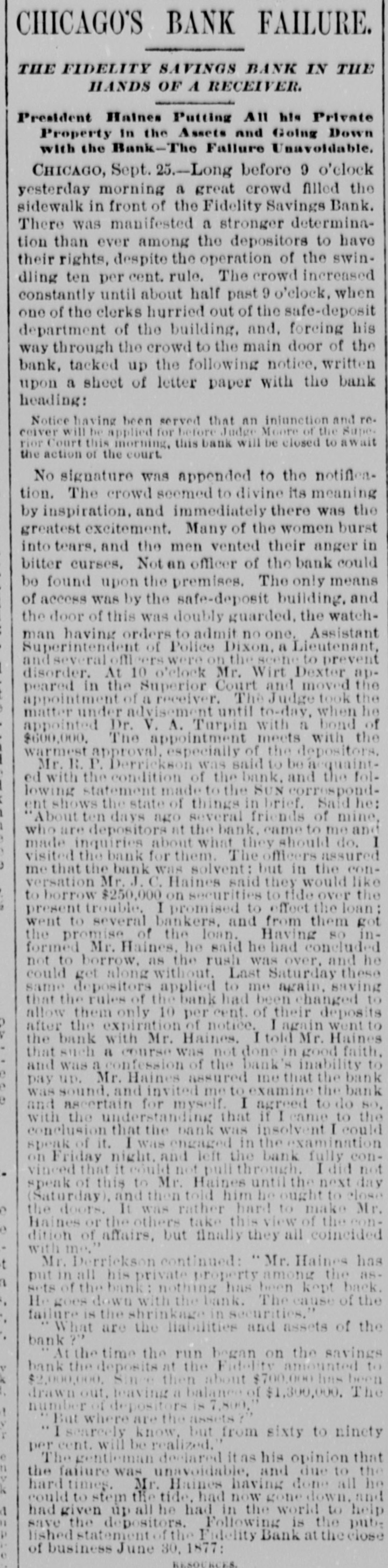
CHICAGO'S BANK FAILURE. THE FIDELITY SAVINGS BANK IN THE HANDS OF 4 RECEIVER. President Haines Putting All his Private Property In the Assets and Going Down with the Bank-The Fallure Unavoidable. CHICAGO, Sept. 25.-Long before 9 o'clock yesterday morning a great crowd filled the sidewalk in front of the Fidelity Savings Bank. There was manifested a stronger determination than ever among the depositors to have their rights, despite the operation of the swindling ten per cent. rule. The crowd increased constantly until about half past 9 o'clock, when one of the clerks hurried out of the safe-deposit department of the building. and, foreing his way through the crowd to the main door of the bank, tacked up the following notice, written upon a sheet of letter paper with the bank heading: Notice having been served that an injunction and receiver will be applied for before Judge Moore of the Supe. rior Court this morning, this bank will be closed to await the action of the court. No signature was appended to the notification. The crowd seemed to divine its meaning by inspiration, and immediately there was the greatest excitement. Many of the women burst into tears, and the men vented their anger in bitter curses. Not an officer of the bank could be found upon the premises. The only means of access was by the safe-deposit building. and the door of this was doubly guarded, the watchman having orders to admit no one, Assistant Superintendent of Police Dixon, a Lieutenant, and several offi ers were on the scene to prevent disorder. At 10 o'clock Mr. Wirt Dexter appeared in the Superior Court and moved the appointment of a receiver. The Judge took the matter under advisement until to-day, when he appointed Dr. V. A. Turpin with a bond of $600,000. The appointment meets with the warmest approval. especially of the depositors. Mr. R. P. Derrickson was said to be acquainted with the condition of the bank, and the following statement made to the SUN correspondent shows the state of things in brief. Said he: "About ten days ago several friends of mine, who are depositors at the bank. came to me and made inquiries about what they should do. I visited the bank for them. The officers assured me that the bank was solvent: but in the conversation Mr. J. C. Haines said they would like to borrow $250,000 on securities to tide over the present trouble. I promised to effect the loan went to several bankers, and from them got the promise of the loan. Having so informed Mr. Haines, he said he had concluded not to borrow. as the rush was over, and he could get along without. Last Saturday these same depositors applied to me again, saving that the rules of the bank had been changed to allow them only 10 per cent. of their deposits after the expiration of notice. I again went to the bank with Mr. Haines. I told Mr. Haines that such a course was not done in good faith. and was a confession of the bank's inability to pay up. Mr. Haines assured me that the bank was sound, and invited me to examine the bank and ascertain for myself. I agreed to do so, with the understanding that if I came to the conclusion that the bank was insolvent I could speak of it. I was engaged in the examination on Friday night. and left the bank fully convinced that it could not pull through. adid not speak of this to Mr. Haines until the next day (Saturday), and then told him he ought to close the doors. It was rather hard to make Mr. Haines or the others take this view of the condition of affairs. but finally they all coincided with me." Mr. Derrickson continued: Mr. Haines has put in all his private property among the assets of the bank nothing has been kept back. He goes down with the bank. The cause of the failure IS the shrinkage in securities." What are the liabilities and assets of the bank ?" At the time the run began on the savings bank the deposits at the Fidelity amounted to $2,000,000. Since then about $700,000 been drawn out, leaving a balance of $1,300,000. The number of depositors is 7,8002 But where are the assets "I scareely know, but from sixty to ninety per cent. will be realized. The gentleman declared itas his opinion that


Article from Watertown Republican, September 26, 1877

Click image to open full size in new tab

Article Text

ANOTHER of Cnicago's savings banks -the Eidelity, John C. Haines, President-closed its doors Monday, and it is believed that this is the last of this class of institutions in Chicago that will suspend. It became very apparent, soon after the State Savings Institution collapsed, that the Fidelity would probably be pushed to the wall by its "running" depositors, and the subsequent failure of the Merchants', Farmers, and Mechanics' Savings Bank, by increasing the excitement, had the effect of hastening the catastrophe. It must be said for Mr. Haines and his Directors that they fought desperately until the last to avert the necessity to which they have finally been forced to yield; and there is reason to believe that the depositors of the Fidelity will be more fortunate than those of the other two collapsed concerns, it being expected that they will ultimately receive 70 or 80 per cent of their funds. There were about 7,800 depositors to whom is now due apout $1,3000,000.


Article from The Donaldsonville Chief, September 29, 1877

Click image to open full size in new tab

Article Text

Domestic. 03 Senator Morton is better. Thirty-one buildings burned at Lowell, Ills. Fidelity Savings Bank of Chicago has suspended. The post-office at Catskill, N.Y., was burglarized. Secretary Schurz is entertaining a delegation of Sioux chiefs. John Rhodes, convicted of murder, was hanged at Newcastle, Del. Gen Sherman and his staff were at Portland, Oregon, on the 23rd. Gov. Rice has been renominated by the Massachusetts Republicans. A furious snow storm occurred at Mount Washington on the 21st. A fire at Keyport, N.J., destroyed all the business portion of the town. Mrs. Gustave Donafort committed suicide by drowning herself at New Orleans. The Chinese quarter of Grass Valley Cal., was destroyed by au incendiary fire. John Ohern, aged 18 months, was run over and killed by a New Orleans street car. Twelve persons were poisoned seriously from eating ice cream at Macon, Ga. Francois Senac, a New Orleans butcher, committed suicide by hanging himself. Gen. Geo. B. McClellan accepts the Democratic nomination for Governor of New Jersey. The Grand Lodge of Odd Fellows adjourned at Baltimore to meet at Austin in 1878. Three floors of a large linseed oil factory at Cincinnati fell, with 15,000 bnshels flaxseed. Col. Rogers, the president's private secretary, dislocated his elbows by falling down stairs. Two North Carolinians were avrested at Baltimore with counterfeit money in their possession. Goodwin & Behre, extensive St. Louis soap and candle makers, filed a voluntary petition in bankiuptcy. The schooner Ocean Wave, with a crew of seven or eight souls, was lost off Galveston during the recentstorm. The officers of the defunct State Savings Bank of Chicago have been indicted for embezzlement of $700,000. A lady and her two daughters were poisoned at Clevelaud by eating toadstools, which they mistook for mushroons. Two iron foundries, employing 3200 men, have resumed work at Pittsburg. Striking coopers in the same city have gone to work, A package containing government bonds and other securities valued at $200,000 was stolen from the First National Bank at Cortland, N.Y The Black Warrior river, Alabama, rose suddenly sixty-three feet, entirely sweeping away the crops of cotton and fodder along its course.


Article from The Post, October 11, 1877

Click image to open full size in new tab

Article Text

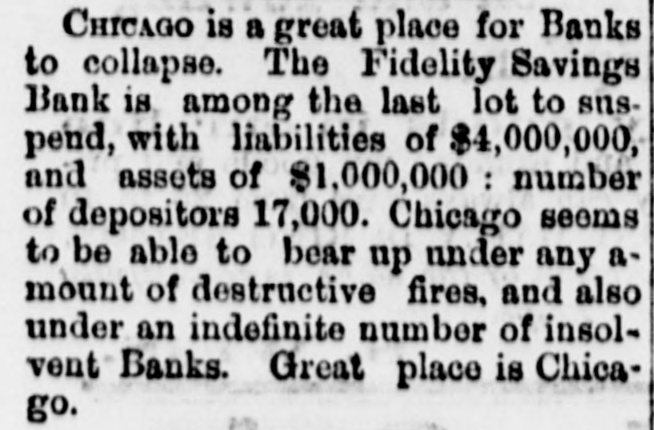
CHICAGO is a great place for Banks to collapse. The Fidelity Savings Bank is among the last lot to suspend, with liabilities of $4,000,000, and assets of $1,000,000 : number of depositors 17,000. Chicago seems to be able to bear up under any amount of destructive fires, and also under an indefinite number of insolvent Banks. Great place is Chicago.


Article from The New York Herald, October 30, 1877

Click image to open full size in new tab

Article Text

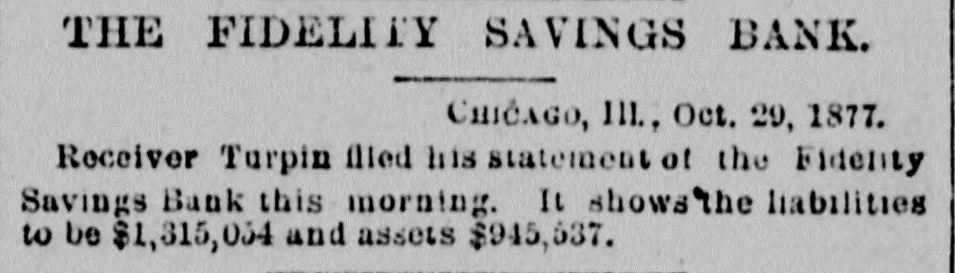
THE FIDELITY SAVINGS BANK. CHICAGO, 111., Oct. 29, 1877. Receiver Turpin filed his statement of the Fidenty Savings Bank this morning. It shows the liabilities to be $1,315,054 and assets $945,537.


Article from Chicago Daily Tribune, November 28, 1877

Click image to open full size in new tab

Article Text

THE BANKS. ALL quier. A reporter visited all the suspended banks, National as well as savings, yesterday, but was hardly compensated In Information for the wear and tear of his constitution and shoo-leather. At the Third National, Mr. Watson was seen. He knew of nothing. No Receiver had yet been appointed. It seems, however, that telegrama have been received from Washington, stating that Huntington A. Jackson will be the successful one. Ills papers have not been made out, but they are expected here by Thursday. Regarding the Receiver of the Central, rumor bath It that Mr. Burley is the man. But he has no advices to that effect, nor could the roport be verified. As is known, he is now in charge of the bank. He has enough cash on hand to pay a dividend of 20 per cent at once. The creditors of both the Central and Third will, in time, certainly get 100 cents on the dollar. Absolutely nothing was obtainable at the savIngs banks,-that is, as to collections, dividends, etc. A female depositor dropped into the State about 1 o'clock and asked for "tho clerks." This a pretty bank." said the woman. " It is a smashed bank," rejoined the reporter. " Yes, remarked she, and I would like to get hold of some of them, wouldn't 1 smash 'em." "Them" was indefinite, 80 the reporter, not wishing to be mistaken for a bank employe, pointed out Judge Otis and Mr. Chamberlain, and withdrew. Both the gentlemen named were whole last night. There is a noticeable falling-off in the crowd at the Fidelity, though the drawing of the 10 per cent was pretty steady all day. Only a third of the depositors have thus far received what is due to them. Many, perhaps, do not yet know that the institution is in liquidation. Dr. Ward, of the Beehive, Was notified in the afternoon that the Committee appointed by the depositors will come to see him again this morning. These centlemen say they are after the fellows who hold their beads high, though they are deeply in debt, and they purpose exposing them to the community. One of the Committee, whom a reporter saw yesterday, said he didn't think any harm would be done by publishing the names of the bank's debtorsthat the money was due, and would have to be paid. W. S. Hinckley, Receiver of the Chicago SavIngra Institution & Trust Company, filed a petition yesterday setting out that among the assets of the bank are some office furniture, collectable debts, and Incumbered real estate. The debts ought to be collected and the other property sold, in his opinion, and Judge Moore gave him leave to do as he wished in the matter. John C. Winterbotham, one of the stockholders of the Fidelity Savings Bank, who has been sued by the Receiver of the bank to recover ou his statutory liability, filed his separate answer yesterday. No deals in glittering generalities, denying vaguely that he la under any moral or legal obligation to pay any of the debts of the corporation, and claiming that he was not one of the original stockholders, but purchased bis stock at the Instance of some parties connected with the management of the bank


Article from Chicago Daily Tribune, January 9, 1879

Click image to open full size in new tab

Article Text

, ? THE FIDELITY. MEETING OF DEPOSITORS of the Fidelity Savings Bank was announced for last night at Maskell Hall, on Desplaines street. The attendance was very small. "Conchshell " Reynolds called the score of men to order, and suggested that the business be proceeded with. Thereupon Mr. Felix J. Griflin was called upon to preside, and Mr. Janies Dalton was made Secretary. Immediately thereafter ensued a series of explanations of the small attendance, and it was concluded that noother meeting would be held before action was taken. After a subscription had been taken to pay ballrent the meeting adjourned till next Wednesday night at Maskell Hall at 8 o'clock. From the conversation heard last night it was apparent that the depositors of the defunct bank think that Receiver Turplu is making unnecessary delay about distributing the funds which be bus in bis possession, and they are not, therefore, in the best tranie of mind. To show their spirit, may be mentioned an incident of last night. One of the Indignant sufferers, one who bad a rich brogue in this speech and a clay. pipe in his mouth, got up and said that one of the men present was an oilleer of the *Fiddelity " Bank. The speaker wanted to know why he was present. Au explanation showed that the person in question was once a watchman in the institution, and that be bad lost some money which be had deposited there. The explanation Was not sufficient to convince the turbulent speaker that "an employe of the Fiddlety Bank" was not aware at the time of the collapse that the failure was to take place, and to refused to regard him in any light but one one of susplcion. The officers of the recoptacle for savings were continually and Venomously referred to as "robbers" and "thieves." The said officers will doubtless not care to take a very prominent part in the future deliberations of the unfortunate depositors. Even the philanthropic and patriarchal Couchshell Reynoids comes in for a share of abuse. IIe is not a depositor. Inose who weredepositors; fail to see the purity and philanthropy of his disinterested motives, and unjustly accuse has of being connected in some way with an undefined scheine for holding back the money which Receiver Turpiu la caring for. The venerable and mild-mannered Conchsbell' (whose jocular appellation 18, by the way, strongly suggestive of a fossiliferous formation) was aut upon, so to speak, last night. 110 doubtless expected to be awarded the Chairmanship of the meeting for his unsellish devotion to the cause of the unpoverished depositor. He didn't get it. A depositor did.'


Article from Chicago Daily Tribune, January 15, 1879

Click image to open full size in new tab

Article Text

The Receiver of the Fidelity Savings Bank was authorized yesterday by Judge Moore to sell Lot 84, Block 40, in the Canal Trustees' Sub-Division of the W. Β½ and W. Β½ of the N. E. ΒΌ of Sec. 17, 59, 14, to T. F. Bailey for $2,000, to be paid in deposit-books at 45 cents on the dollar. Also, to sell a note made by Emma R. and Fred J. Stimpson for $350 for $230, also to be paid in books at the same rate. UNITED STATES COURTS. The Western Electric Manufacturing Company


Article from New Ulm Weekly Review, April 16, 1879

Click image to open full size in new tab

Article Text

State, etc., etc. THE United States Senate, on the 10th, decided, by a vote of 85 to 28, that Charles H. Bell was entitled to a seat in that body by virtue of appointment of the Governor of New Hampshire. Mr. Bell was consequently sworn in to fill the vacancy from that State. THE Massachusetts House of Reprecentatives, on the 10th, rejected a bill to secure women the right to vote on municipal affairs in cities and towns. A bill to give women the right to vote for members of School Committees was passed. JOHN TAYLOR has been re-elected President of the Twelve Apostles and Trustee of the Mormon Church. No successor to Brigham Young, as President of the Church, has been elected. THE Fidelity Bank building, the Fidelity Safe Deposit Vaults and Hooley's Theater, property belonging to the defunct Fidelity Savings Bank of Chicago, were sold at auction, on the 10th, for the sum of $192,400. JOHN P. PHAIR, the Vermont murderer, who had been three times reprieved, was hanged, on the 10th, at the State Peniten tiary in Windsor. THE New Orleans authorities have determined to quarantine for twenty days all vessels arriving from ports in the West Indies, the Gulf of Mexico south of Texas, and South America, after the 1st of May, with the object of preventing the introduction of yellow fever. AT the rolling-mill in Cleveland, Ohio, on the 10th, a bar of iron being run through the rollers encircled a boy in its fantastic folds, and literally burned his body in two. SEVEN Indians attacked Serg't


Article from Chicago Daily Tribune, July 16, 1879

Click image to open full size in new tab

Article Text

THE COURTS. Receiver Turpin's Exhibit of the Fidelity Bank Assets. An Interesting but Not Valuable Exhibit for the Depositors. Now Suite, Judgments, Divorces, Con. feasions, Etc. By a law which went Into force the 1st of July, a Receiver of a savings bank, on request of any ten depositors of the bank, is -bound to file In court an inventory of the bank's assets. Such a notice was served some time ago on v. A. Turpin, Receiver of the Fidelity Savings Bank, and yesterday he filed a complete schedule of the bank's assets, which is as follows: REAL ESTATE. Value not given. The bank building. safe depository, and Haverly's Theatre. The W. 50 feet of the S. 80 feet of Lot 5, Block 55. O. T. Lot 36, Block B. John Wentworth's Subdivision of S. 60 notes of the W. % of the N. W. 14 Sec. 34. 30, 14. known as 1838 Watesh avenue. Non. 4013 and 4015 Prairle avenuc. Lots 1, 2, 23, 24, Block 8, in Hyde Park. Lot 7 of John McAsseay's resubdivision of Lots 20, 27. 28, 20, Block 2. of Lewis Stone's Subdivision of the S. W. part of the N. E. x of Sec. 30, 40. 13. Lot 6. Grove Block of Jared Onge's Subdivision of E. 1/2 N. W. 14 Fractional Sec. 17. 42. 13. The W. 16 Sec. 20, 36, 12. S. K. 14 Sec. 20. 36, 12. E. " S. E. % 17. 30, 12. S. 120 acres S. W. 14 Sec. 10, 30. 12. Blocks 1 to 4. Cartle's Subdivision of E. 18 scres of E. " of S. E. 14 Sec. 11, 30, 13. Undivided 1-12 of Lots 1 and 2, Block 5, Wolcott's Addition. Lot 110, Block 11, of Austinville. Lot 11, Division 3, in South Shore Subdivision of N. fraction 1/2 Sec. 30, 38. 15, and re-subdivision of Lots 1, 2, 4, 64. 00, 120, 127, and 198 of Westfall's Subdivision in Sec. 30, 38. 15. Sub-Lot 25 in Bucker & Longley's Subdivision on Vernon avenue. Lot 145. being part of Sec. 10,30, 13. Lots 30 and 33, McKinney's enbdivision of Block 1. Lots 1. 2, 3. and 4. Block of In Garland's Subdivision of S. W. N of Sec. 21, 42, 13. Lote 3, 6, 7, 8, McKinney's Subdivision of Block 24 of Garland's Subdivision. The S. 5 Lot 11 of subdivision of Lots 17 and 28 in Egan's South Addition to Chicago, Lot 6, Block 55. In Cornell. Lots 11, 12, 13, 14, 15. 10, 17. Block 25, of Kimbark's Addition to llyde Park. The S. " of N. ½ of N. W. 14 of N. W. y of Sec. 4, 37, 14. Lots of 3. 6, 7, 0 to 12, Block 1. Lots 1 and 4. Block 2, in Peter Shimp's Subdivision in Sec 9, 38, 14, incumbered for 550. Lots 13 to 20, Block 1, also Lots 9, 12, 13, 16. and 17, Block of and Lote 3, 6, 7. 0, 10 to 17, Inclusive. and 20, Block 5, same subdivision. incumbered for $3, 850, The W. ½ S. E. K Sec. 34, 32, 8, Grundy County. Lots 81 to 83, Inclusive, Block 23, Sheffield's Addition. Lots 11 and 13 in Conrad Seipp's Subdivision of W. ½ of N. W. 14. Nee. 25, 38, 14. Lots 1 to 3, inclusive, Block. 21 original plat of Waterka. Lots 1 to 4, inclusive, Block!! in Wright & Windett's Subdivision of N: W. M of S. E. 5 ors. W. X Sec. D. 38, 14. Also in Bowen's Addition to South Chicago the following lots: 1 to 24, inclusive, Block 3: 1 to 0 40, inclusive. and 42 to 46, inclusive, Block 4: 11 to 30, inclusive, Block 5; 1 to 12. and 35 to 40, inclusive. Block 6; the N. 5 Block 7; Block 8, except the E. ½ of the .210 feet: Block 9: Lots 1 a to 0, inclusive, Block 10; Blocks 12. 13, 14; Lots 1 to 52, inclusive, Block 15: Lots 1 to 38, inclusive, 10 to 43, and 46 to 52, inclusive, Block 10; 0 Block 17. Part of Lot 14. Block 3, in Ellie' West Addition to Ohicago. An undivided ½ of the 8 N. W. 14 of S. W. 1/4 Sec. 18, 37, 15. An undiit vided one-third of part of the S. % of the N. W. d is Sec. 18. 37, 16. The N. 1/2 of N. W. 14. exa cept 21 21-100 acres, and S. E. 14 of N. W. 4 of Sec. 14, 37, 14. Also 17 18.100 acres In N. E. 14 of Sec. 27, 37. 14. Also 132 3-10 исгов in Sec. 2, 30, 14. Lots 1 to 8, inclusive. Block 1 and Lots r 18 to 25, inclusive. Block 1. Lots 1 to 8, Inclusive. and 24 and 25, Block of Lot 2. Block a in Bowen's Riverdale Subdivision of S. % of S. W. K of N. W. is of Sec. 34, 37. 14. Blocks a and 4, Warren's Addition to Wildwood. Also the following lots in Irondale: Lots 7 and 8, 13 to 20, and 31 in to 47, inclusive. Block 3. Lots in to 11, 13, 44, n 25, 34, 30, 40 to 48, inclusive. Bluck 159, all Im. 10 proved by two-story houses. Lots in 0, it 8, D, 10, and 18 to 29. inclusive


Article from Chicago Daily Tribune, January 24, 1880

Click image to open full size in new tab

Article Text

IT will interest depositors In the collapsed Fidelity Savings Bank of this city to know that lawyers' fees to the amount of $17,000 have been paid since the Receiver took hold, and that the Receiver claims $6,000 a year ns his individual compensation. These charges have been allowed after examination by a Master in Chancery.