Article Text
AMERICAN PANICS.
FIRST ISSUE OF PAPER MONEY-A RAG PANIC.
1690.-Paper money first introduced in New England to pay the expenses of the expedition to Quebec under Sir William Phipps. The expedition was unsuccessful. To satisfy its expenses bills of credit were issued by the Massachusetts Bay Colony, which example was followed by the others. A great number of bills of credit were thrown upon the market and were depreciated fifty per cent. The commerce of the colonies was entirely disarranged, and did not recover from the shock for two or three years.
MORE WAR AND MORE RAGS.
1747-8. The successful expedition against Louisburg (1745) had been paid for with a new issue of paper money, three millions. These bills of credit were of no value abroad, and speedily depreciated at home. In Massachusetts one hundred pounds sterling in hard cash were worth eleven hundred pounds paper currency. The infant colonies however, struggled through this terrible blow.
1780. During the war of the Revolution commerce of all kinds was prostrated. Grass grew in the streets of Boston, New York, Newport, Salem and Charleston-all important commercial ports at that time. From the year 1772-8 to 1789 there was but little specie in the country, and Congress had issued 160 millions of paper money, which so far depreciated after the war as to be entirely worthless. A shoemaker in Malden, Massachusetts, papered the walls of his shop with them.
THE ADAMS' PANIC OF '98.
1798. Threatened war with France. The Bank of England had suspended. All Europe was at war. The administration of Mr. Adams was not a happy one, and political feeling never ran so high. All these things together brought about a senseless panic, and nearly all the best merchants were obliged to stop payment. The prisons of the principal cities were filled with bankrupt merchants. The panic ceased when the war rumor was found to be a false alarm.
THE EMBARGO STAGNATION-1807.
1806. Napoleon issues the Berlin decree, putting the British islands under blockade, and commanding the seizure of vessels which should attempt trade with them. Our commerce languished in consequence.
1807, NOVEMBER 11.- The British government issued the Orders in Council closing the American trade with any part of Europe which excluded the British flag.
DECEMBER 17. Napoleon issues the Milan decree, commanding that any vessel which touched at a British port should be subject to seizure and condemnation.
DECEMBER 22.-Congress passes the Embargo act, by which all American vessels were forbidden to leave port. This was adopted in consequence of the Berlin decree.
1808. The effect of the Embargo act was to cause great distress among all classes of people, but more particularly those engaged in the shipping interest. The agricultural interest likewise suffered, as our redundancy of produce could not be exported. Trade of all kinds was at a stand still, and thousands of merchants were ruined.
1809. The Embargo still continued. The state of the country is thus described in the report of a committee of the Massachusetts Legislature:-
JANUARY 9. "Our agriculture is discouraged. The fisheries abandoned. Navigation forbidden. Our commerce at home restrained, if not annihilated. The revenue extinguished."
MARCH 15. The Embargo raised.
HARD TIMES OF 1812, '13, '14, '15.
1812. War is declared with England. The importation of specie is stopped and the banks suspend. Throughout the next two years there was great distress in commercial circles, and the peace of 1815 found the country prostrate.
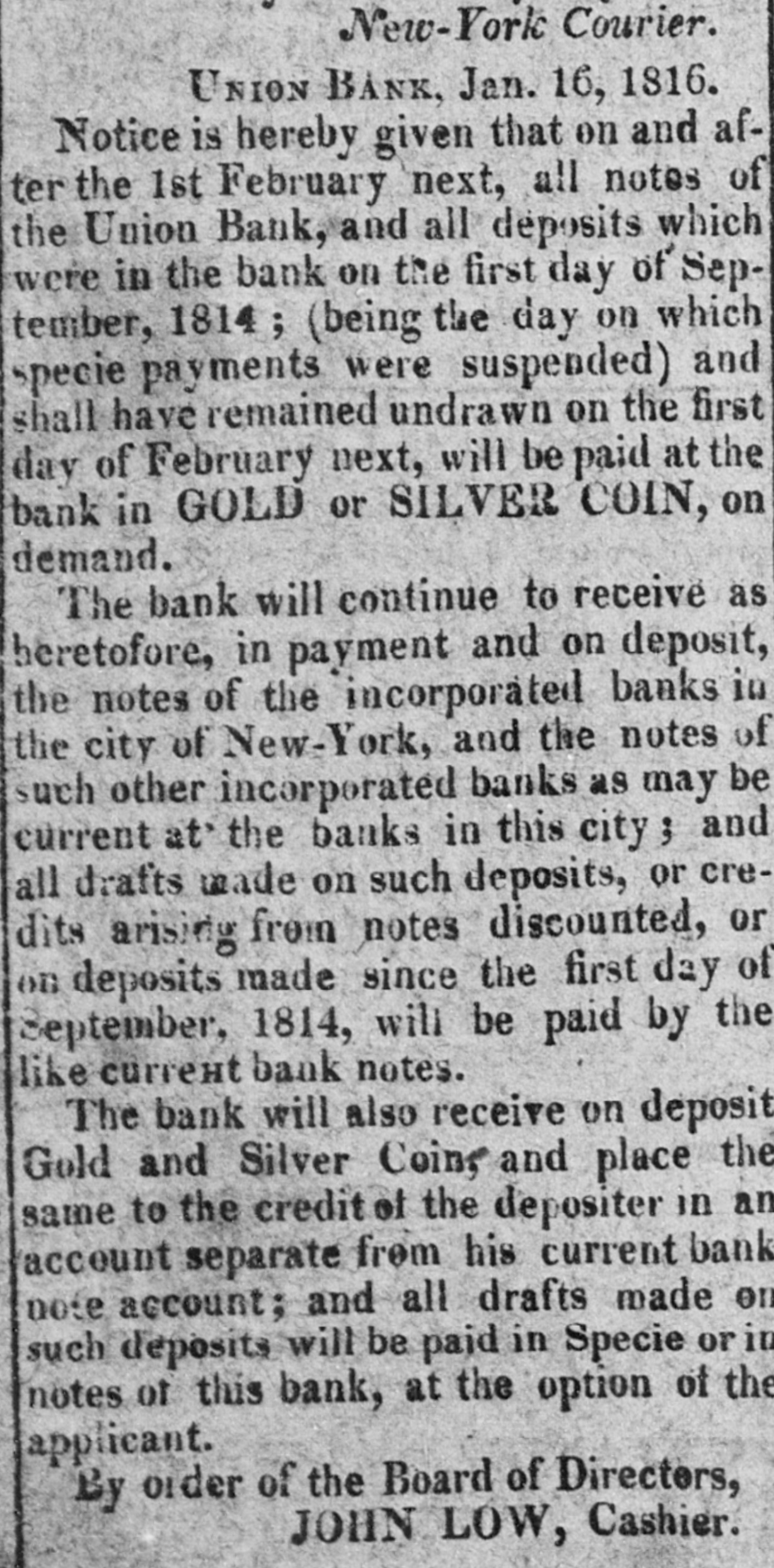
1816, FEBRUARY. The Union Bank of New York, resumed specie payments.
APRIL 10. Mr. Madison having changed his views with regard to a National Bank, approves a charter for such an institution with a capital of thirty-five millions. The New York Legislature passes an act to force the banks to resume by the first of June, 1817, and to pay interest at the rate of twelve per cent to the holders of their notes.
1817. The Bank of the United States extends its loans and inflates prices; large amounts of specie flow in from Europe. A contraction is the inevitable result, and a revulsion by which several thousand merchants are ruined.
FLUSH TIMES OF 1825-PANIC OF 1826.
1825-Trade and commerce revived. Everybody is flush of money, and a mania for speculation arises like that of the South Sea bubble in England and Law's bank in France.
APRIL-Morris Canal and Banking Company incorporated. Capital limited to one million. Twenty millions offered. At Philadelphia men were hired to fight their way through the crowd to get shares in the Bank of Southwark. At Providence, Rhode Island, twice the sum required was subscribed for the Blackstone Canal. At New York all sorts of stock bubbles are inflated and the mania for speculation is terrible.
MAY. The New York Water Works Company chartered, with a capital of two millions. Twenty millions offered.
1826, JULY. The failure of several extensive moneyed concerns excites general distrust. There is a run on the banks by depositors and noteholders, but specie is generally refused. During the previous year the balance of exports and imports of specie had been nearly three millions against the United States, but in August a reaction took place, and specie flowed into the country in large amount.
THE TOUGH TIMES OF '37.
1832, JULY 10.-Message of President Jackson vetoing the United States Bank law.
OCTOBER. -Removal of the deposits. General war between the banks and the administration.
1833, '4, '5. The banks expand. Imports are doubled. Twice as much specie goes out of the country as is brought into it.
1835, DECEMBER 16. The great fire in New York destroys property to the value of seventeen millions of dollars in the commercial part of the city. No failures followed immediately, the banks continuing to expand. Nearly all the fire insurance companies were unable to pay their losses and forced to wind up their affairs, thus causing a double misfortune to the insured and the stockholders.
1836. During this year speculations of all kinds were rife. Western lands and fancy stocks occupied the attention of Wall street.
AUGUST.-Rathbun, extensive real estate speculator in Buffalo, smashed. He owned the Patterson Bank. The HERALD of the 9th predicted a crisis and advised all its readers to refuse notes of banks west of Albany.
SEPTEMBER 6. First shinplaster currency issued by a savings bank in Illinois. The HERALD again predicts a crisis.
SEPTEMBER 10 to 20. The crisis approaches. The banks begin to contract, but let money at usurious rates through brokers. Stocks began to fall. Mr. Dallas commences the Pennsylvania war against the United States Bank. Stock falls five per cent. The HERALD announces that the crisis so long predicted has come at last, and although the speculators had laughed at the ideas of the HERALD, they now begin to believe it.
OCTOBER 5. The pressure in the money market increases. Money commands three and four per cent. Stocks fall again.
OCTOBER 12. The panic commences. Three millions of paper offered at the State Bank, and two millions thrown out. The Messrs. Higginson, a large Broad street commission house, go by the board for several hundreds of thousands.
OCTOBER 14.-More failures. The banks refuse to discount; money was a quarter per cent a day for short loans. Stocks had another tumble. The HERALD at this period remarked: "The loss by the fire now began to be felt, and the effect of excessive speculations in real estate, stocks, railroads and everything."
OCTOBER 21. An attempt was made to bull up the stock board without success. The exchanges of the country became entirely disarranged, and two or three stock brokers went in.
OCTOBER 24. The banks threw out everything, and ten or twelve of the best mercantile houses went by the board.
NOVEMBER. There was a lull this month in the panic, and stocks rose a little. All articles of luxury went down, but articles of necessity increased in price. Flour began to go up, and great distress among the poor was anticipated.
DECEMBER 5. Great excitement against the banks. Discounts suddenly cut off. During the month the banks let out a little, but business of all kinds was stagnant. A new Congress met and relief was expected from that quarter. Real estate and rents declined a little. Several failures in Boston.
1837, JANUARY.-Nothing new in Wall street this month. The short crops and demand for produce in Europe induced the holders of grain to keep it back for a rise, and flour went up to $11, an advance of thirty per cent over the preceding winter.
FEBRUARY 13-A great meeting was held in the Park to consider the oppression of the times, and the high prices of food, fuel, rent, &c. After the meeting had adjourned a mob attacked the flour store of Eli Hart & Co., in Washington street, and destroyed a large quantity of the stock. Wall street very much unsettled. Stocks flat.
MARCH 15. News received in New York of the failure of the great New Orleans house, Herman, Briggs & Co., for eight millions.
MARCH 16. Several failures at Boston and New Orleans. The money pressure becomes severe in all the other cities. Mr. Webster makes a gloomy speech at Niblo's Saloon.
MARCH 17. The great banking house of the Josephs failed to meet their engagements with the banks. Wall street in a ferment. The Josephs' paper amounts to three millions. News of heavy failures in the South and East.
MARCH 24. More failures of bankers in Baltimore and