Click image to open full size in new tab
Article Text
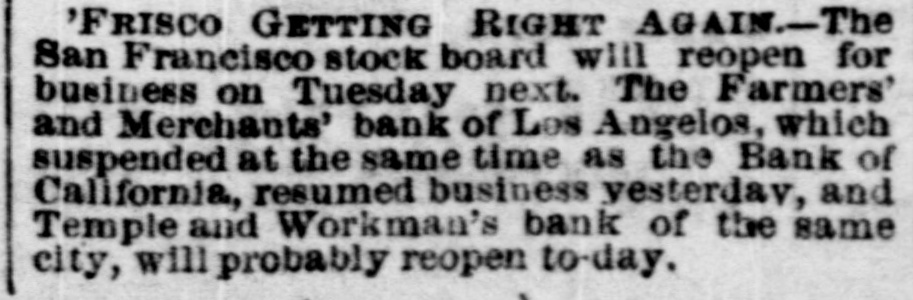
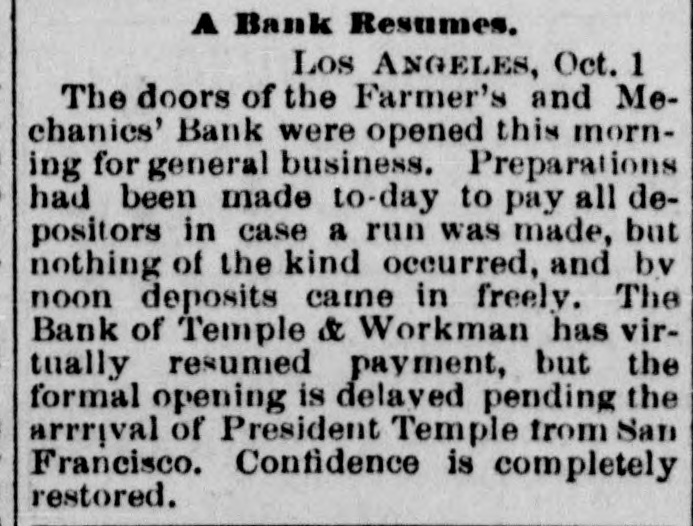
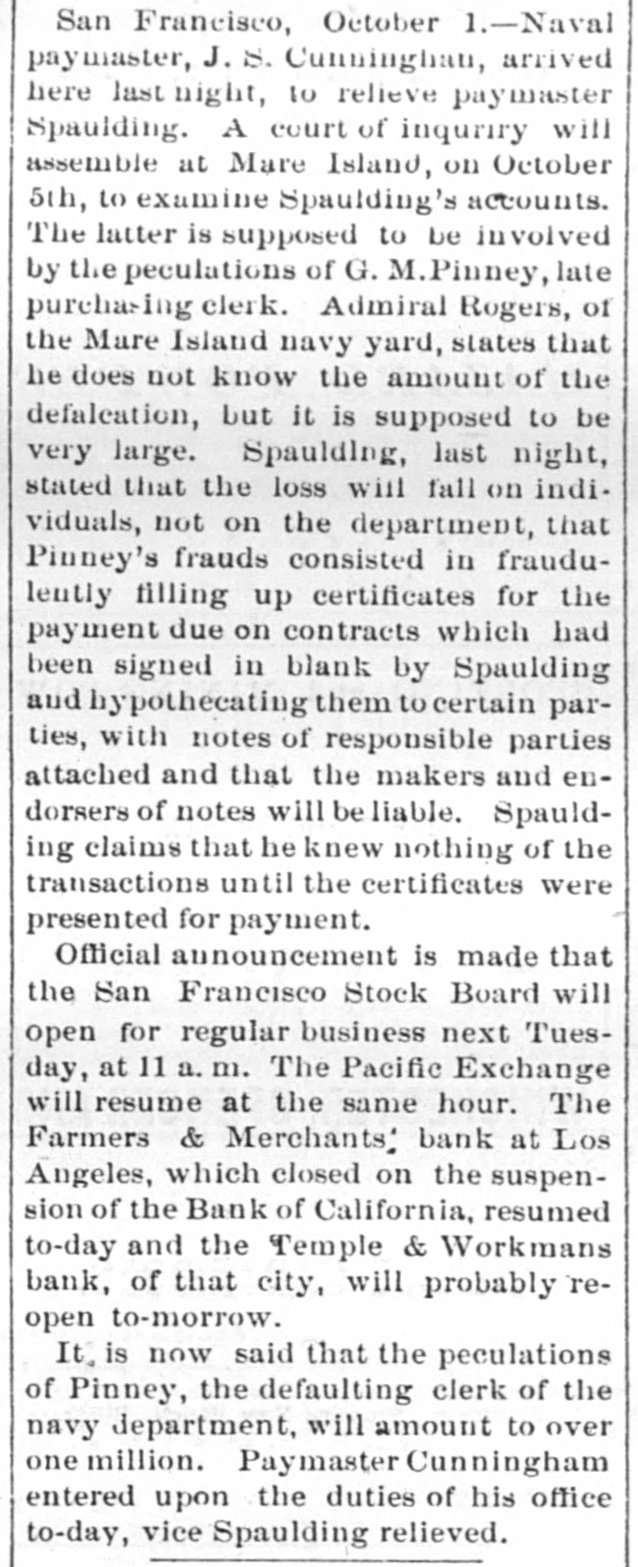
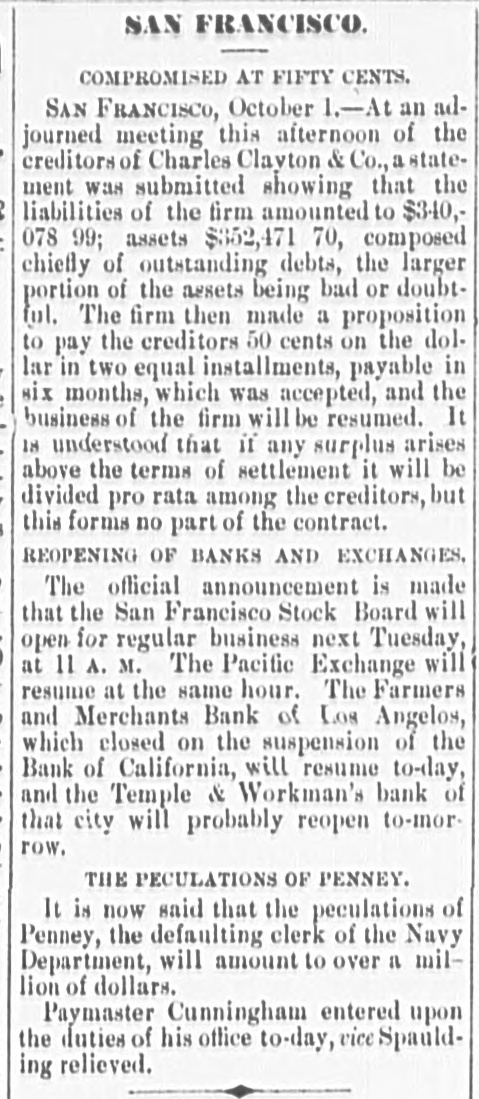
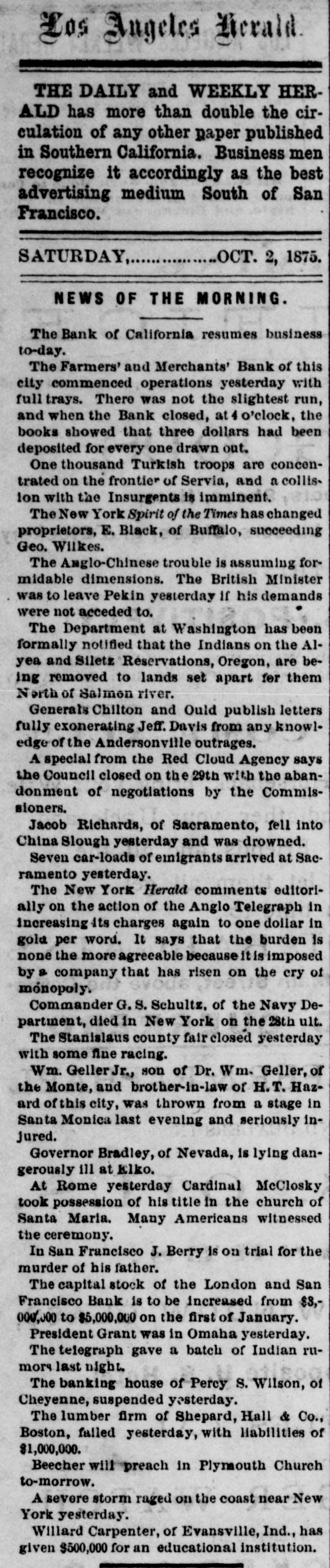
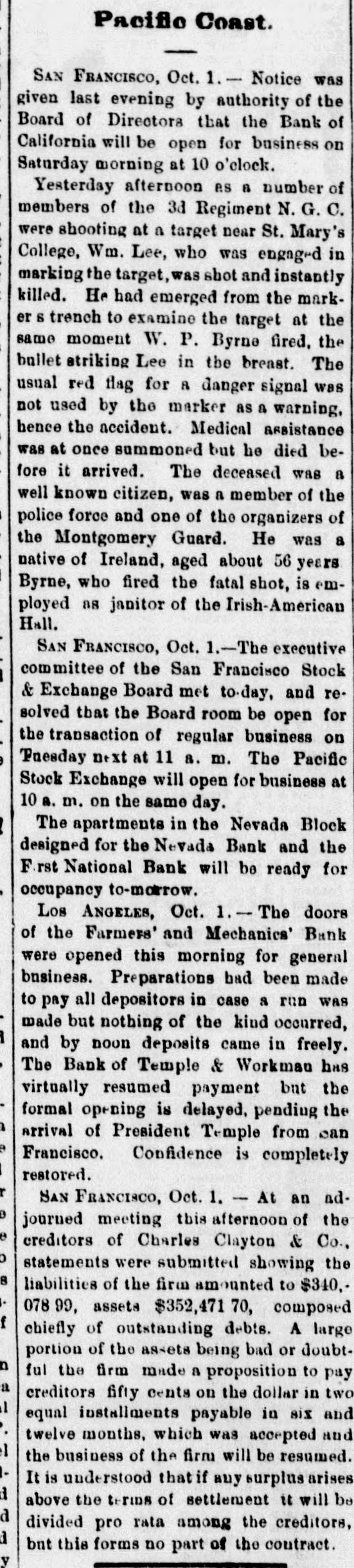
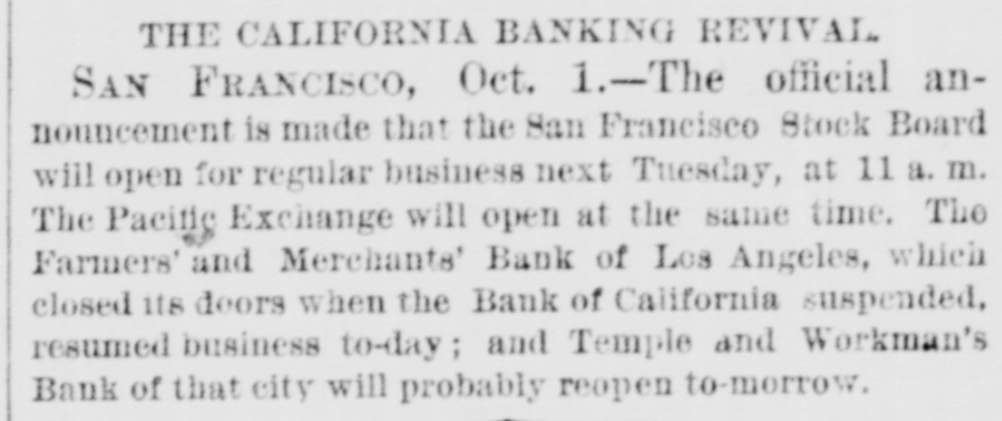
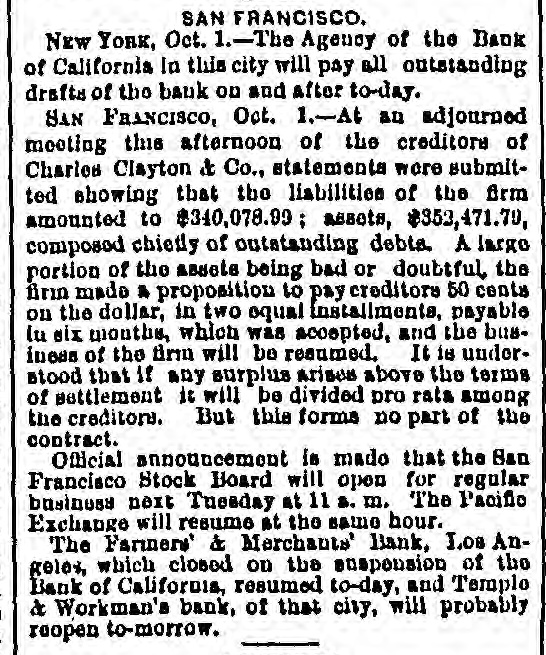
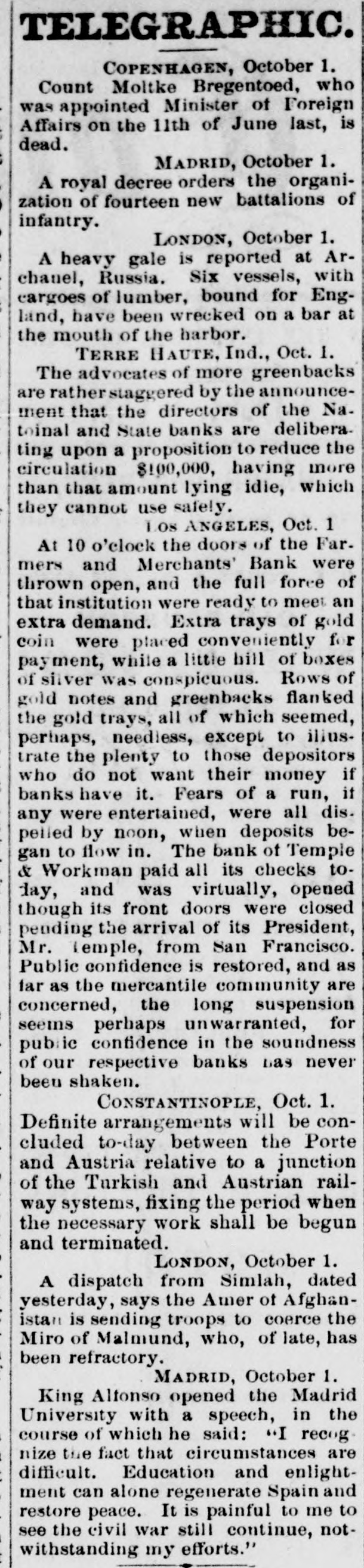
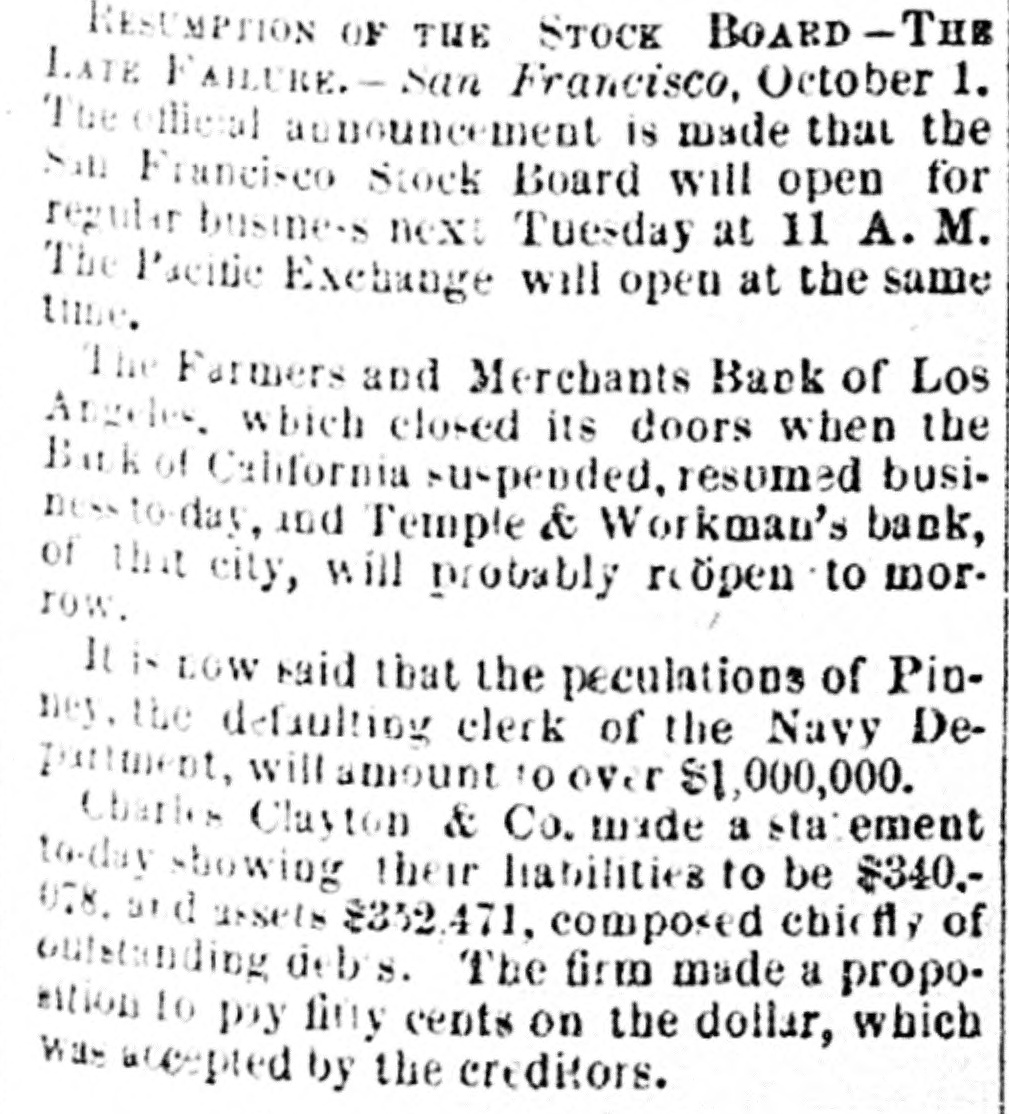
MISCELLANEOUS. San Francisco's Financial Troubles. SAN FRANCISCO, Oeteber2-Theeredito: of Charles Clay ton & Co. accept fifty cents on the dollar. The The Stock Board opens to-day. Farmers and Merchants' Bank of Los Angeles opened yesterday The Navy Paymaster's Defalcation. It is said the defalcation in the navy paymaster's department 18 over $1,000,000. The Bank of California. A crowd gathered around the bank, and the president said preparatious had been made to pay all claims not herwise provided for At ten o'clock the street and eidewalks were jammed, and the door swung open amid the cheers of the crowd. Flage were at the mast head. and there was salute firing on Meigs wharf at half-past ten o'co Gold is flowing both ways. and is believe d the deposits will equal, if not exceed, the payments. The Right of Religious Processions. TORONTO, Canada, October A public meeting, held last night, for the purpose of considering processions on Sunday. was very largely attended. A number of prom inent Orangement were present who deliv ered conciliatory epeeches. Mayor Med calf occupied the chair He said it was his duty to see the law carried out against It friends and foes without distinction. Roman Catholic processions were distaste ful to the Protestants of Toronto, they should seek an alt-ration of the law. At present, be assured them, the Catholics had a perfect right to walk in procession. Preparing for Guibord's Funeral. MONTREAL. October The members of L'institut Canadien held a meeting and decided to hold Guibord's funeral on Friday or Saturday of next week. Preliminary arrangements were made to-day. and all the details will be fully carried out A requisition is to be made on the military for assistance. and secret preparations will be deposited in the grave and render it dangerous for meddle rs to disturb the body The superintendent of the institute yester day visited the Protestant cemetery vault. and opening Guibord's offin found the outline of the body still distinctly traceable This is the first time the coffin has been opened since being closed. The Black Hills Treaty a Failure. CHEYENNE, October 2-The commis sioners to treat for the Black Hills have reached Throckmorton. homeward bound The attempt to obtain the hills was a fail are. Death of an Army Surgeon. NASHVILLE, October -Surgeon James F. Weeds, United States army is dead. Obsequies of Ex-President Johnson. Business was generally suspended to-day in honor of the obsequies of ex Preside Johnson. A large number of dist t nguished citiz ns of Tennessee and other States rived to participate in the ceremonies Letters of regret were eived from Secre tary Belknap, Governor Tilden of New York, Whyte of Maryland Garland of Arkansas, and McCreary of Keutucky, Hon. Gideon Welles of Connecticut, Senator Merriman, Adjutant General nd. ex-Governor Letcher of Virginia, Henry C Cary of Philadelphia, and many others. Tue procession comprising thirteen divi sione will move at o'clock under supervision of Marshal-in- Chief Brevet Major General G. Pennypacker, of the United State army: General William V. Richards, of staff and thirty-seven aids. Ex Senator Fowler will deliver the memorial address in Representative Hall evening. Later. The memorial pageant in honor of ex President Johnson was a full and complete success, without disturbance or accident The procession commenced moving at 2:30 P. M. It was the largest turnout of the populace ever witnessed in this city. It was made up of military, civic, mechanics and literary societies, and was two hours pass ng the Capitol. The streets designated as the line of march were crow ded with people early hour. and at two o'clock there were least 30,000 people on the streets. All the public buildings and a large number of business houses and private residences were draped in mouning. The President's salute, twei one guis, was fired at sunrise from Capitol Hill. All the bells in the city and Edgefield tolled from seven to eight o'clock in the morning. During the movement of the procession minute guns were fired: and one every filteen minutes through the day, closing with a national salvo of thirty gune at sunset. Ex-Senator Fowler delivered the memorial address at the Capitol this evening The address was very elaborate, requiring two hours for delivery, and is resume of the ex President's private and political history from his childhood to the grave. He said: "Not unwarned, God suddenly called him to another aphere. Being long afflicted with disease of the heart, known to himself, be was stricken with paralysis in the midst of his family. For a short time he rallied, but the complication with the dieese of the heart terminated in a few days his life, on the thirty first day of July, 1875. Years before be had selected a beautiful mount near Greenville for his burial place. Mr. Fowler spoke of the beautiful spot where the President is laid, and said: "The earth has no grander spot, and it is temple where god might dwell. The warfare rest now in peace. No reverential saorilegious hand will disturb your remains in your harmonious sepulcher. He has passed beyond the reach of envy and calumny. Rivals and enemies can escape from their own corroding tormentors and can do justice to his memory Those whose lives and property his clemency relieved can pay the grateful tribute too long withheld. Buildings for the Centennial. PHILADELPHIA. October -The State of Ohio has commenced the erection of its building on the centennial grounds. Similar buildings will be put up by Maseachueett Connecticut, New York, New Jersey, Penn sylvaria, Delaware, Illinois, Indians, Michigan, Wisconsin, Kaneaa and Missouri. Tue English a mmesion applied for an tension of space in the park for the erestion third building Washington's Headamarters at Newburg. NEWBURG N. Y., October 2-The trustees of "Wasbington's Headquarters," in this city, this morning adopted resolution ordering that the p:operty be closed to the public, and remain closed until the city of lewburg or the State of New York is will. and provide for the protection This was done because funds for the proper Memphia. was heavy