Freedman's Savings & Trust Company (Washington, DC)

Episode Information

Episode UID
7632989590862
Episode Type
Run โ†’ Suspension โ†’ Closure
Bank Type
federal
Bank ID
763298959 hash
Start Date
October 17, 1871
Location
Washington, District of Columbia (38.895, -77.036)

Metadata

Model
gpt-5-mini (chosen from majority vote of a three-model LLM ensemble)
Short Digest
4b644a7d29316fa6

Response Measures

None

Description

Bank experienced runs in early 1870s, suspended April 1874 and went into liquidation under commissioners.

Events (8)

1. October 17, 1871 Run
Cause
Bank Specific Adverse Info
Cause Details
Rumors of defalcation involving paymaster of Freedmen's Bureau triggered withdrawals.
Newspaper Excerpt
Rumors of a defalcation are rife. There is a run on the Freedmen's Savings Bank in consequence.
Source
newspapers
2. October 15, 1872 Run
Cause
Bank Specific Adverse Info
Cause Details
Depositors feared District Government inability to meet obligations and heavy loans to contractors on District paper.
Newspaper Excerpt
A run upon the Freedman's Savings Bank, in Washington, began on Monday and continued up to last night.
Source
newspapers
3. September 23, 1873 Run
Cause Details
Article reports end of a run; underlying cause not re-stated in this item.
Newspaper Excerpt
The run on the Freedman's Savings Bank has entirely ceased
Source
newspapers
4. April 27, 1874 Run
Cause
Bank Specific Adverse Info
Cause Details
Uneasy depositors withdrew funds, linked to institution's exposures and losses; officers fell back on the sixty day's notice.
Measures
Invoked sixty days' notice (refused to pay immediate demands)
Newspaper Excerpt
the Freedmen's Bank was the subject of a run on the 27th inst., by uneasy depositors
Source
newspapers
5. April 27, 1874 Suspension
Cause
Bank Specific Adverse Info
Cause Details
Heavy withdrawals and impaired assets from investments (Board of Public Works warrants and real estate) forced suspension of payments.
Newspaper Excerpt
The Freedmen's Bank closed its doors and suspended payments to-day.
Source
newspapers
6. July 2, 1874 Other
Newspaper Excerpt
The Freedmen's Sayings and Trust Company received orders yesterday from the National Board of Trustees at Washington to stop taking in and paying out money. ... it is understood that the bank there has suspended and gone into liquidation. and The President of the bankrupt Freedman's Savings and Trust Company ... (reports of bankruptcy/liquidation).
Source
newspapers
7. August 31, 1874 Other
Newspaper Excerpt
The sixty days' notice at the Freedman's Savings Bank expired yesterday, but affairs remain unchanged and business is still suspended, The commissioners to wind up its affairs are busily engaged collecting the assets and loans of the bank.
Source
newspapers
8. February 9, 1878 Other
Newspaper Excerpt
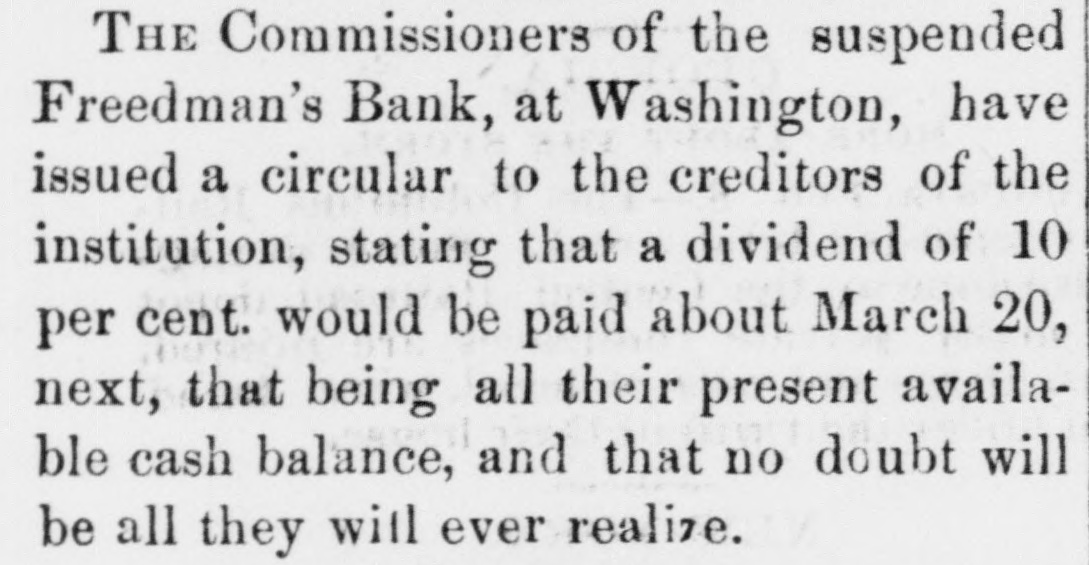
The Commissioners of the suspended Freedman's Bank, at Washington, have issued a circular ... a dividend of 10 per cent. would be paid about March 20, next, that being all their present available cash balance.
Source
newspapers

Newspaper Articles (21)

Article from The Charleston Daily News, October 18, 1871

Click image to open full size in new tab

Article Text

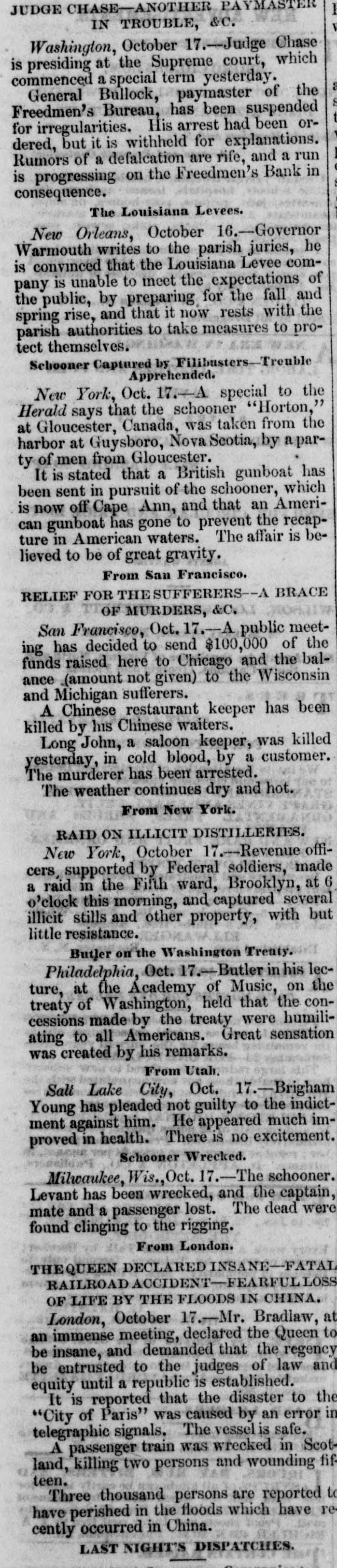
MORE DEFALCATIONS. WASHINGTON, October 17. General Bulloch, the paymaster of the Freedmen's Bureau, is suspended for irregularities. His arrest had been ordered, but is withheld for explanation. Rumors of a defalcation are rife. There is a run on the Freedmen's Savings Bank in consequence.


Article from Chicago Daily Tribune, October 18, 1872

Click image to open full size in new tab

Article Text

A run upon the Freedman's Savings Bank, in Washington, began on Monday and continued up to last night. Thebank asserts its ability to meet all demands. The cause of the run is the supposed inability of the District Government to meet its obligations, and the fact that contractors have borrowed large sums from the bank upon the District's paper.


Article from Chicago Daily Tribune, October 24, 1872

Click image to open full size in new tab

Article Text

There was no ground, it is asserted, for the recent panic with regard to the Freedmen's Savings Bank, in Washington, as it has no less than four millions on deposit. -


Article from New-York Tribune, September 24, 1873

Click image to open full size in new tab

Article Text

THE SITUATION IN WASHINGTON. THE RUN ON THE SAVINGS BANKS ENDED. WASHINGTON, D. C., Sept. 23.-The run on the Freedman's Savings Bank has entirely ceased, and comparatively few depositors are at the door of the Washington City Savings Bank awaiting their turn.


Article from Nashville Union and American, April 29, 1874

Click image to open full size in new tab

Article Text

THE Washington correspondent of the Louisvllle Courier-Journal states that the Freedmen's Bank was the subject of a run on the 27th inst., by uneasy depositors, and the officers fell back on the sixty day's notice. The Cincinnati Times' special says: "The Freedmen's Bank closed its doors and suspended payments to-day."


Article from Spirit of Jefferson, May 5, 1874

Click image to open full size in new tab

Article Text

IF The Freedmen's Bank in Washington city suspended payment on the 27th ultimo. Like the late co-operative store in Charlestown, it "took in" the "freedmen," but fails to "pay out."


Article from Alexandria Gazette, July 2, 1874

Click image to open full size in new tab

Article Text

The Freedmen's Savings Bank. NEW YORK, July 2.-The Freedmen's Sayings and Trust Company received orders yesterday from the National Board of Trustees at Washington to stop taking in and paying out money. A Washington dispatch says it is understood that the bank there has suspended and gone into liquidation.


Article from New-York Tribune, July 2, 1874

Click image to open full size in new tab

Article Text

The President of the bankrupt Freedman's Savings and Trust Company at Washington and the cashier of the branch in this city endeavor to explain in other columns several causes of its failure. Little stress is laid on the chief cause, which was the withdrawal of deposits in all the branches for investment solely in Washington, and largely in the warrants of the Board of Public Works. Explanations are more plentiful with the Company than good securities, but they will hardly satisfy the unfortunate depositors.


Article from Wilmington Daily Commercial, July 3, 1874

Click image to open full size in new tab

Article Text

e. The Freedmen's Bank at Washington, with its branches, suspended yesterday, and will go into liquidation.


Article from The Weekly Clarion, July 16, 1874

Click image to open full size in new tab

Article Text

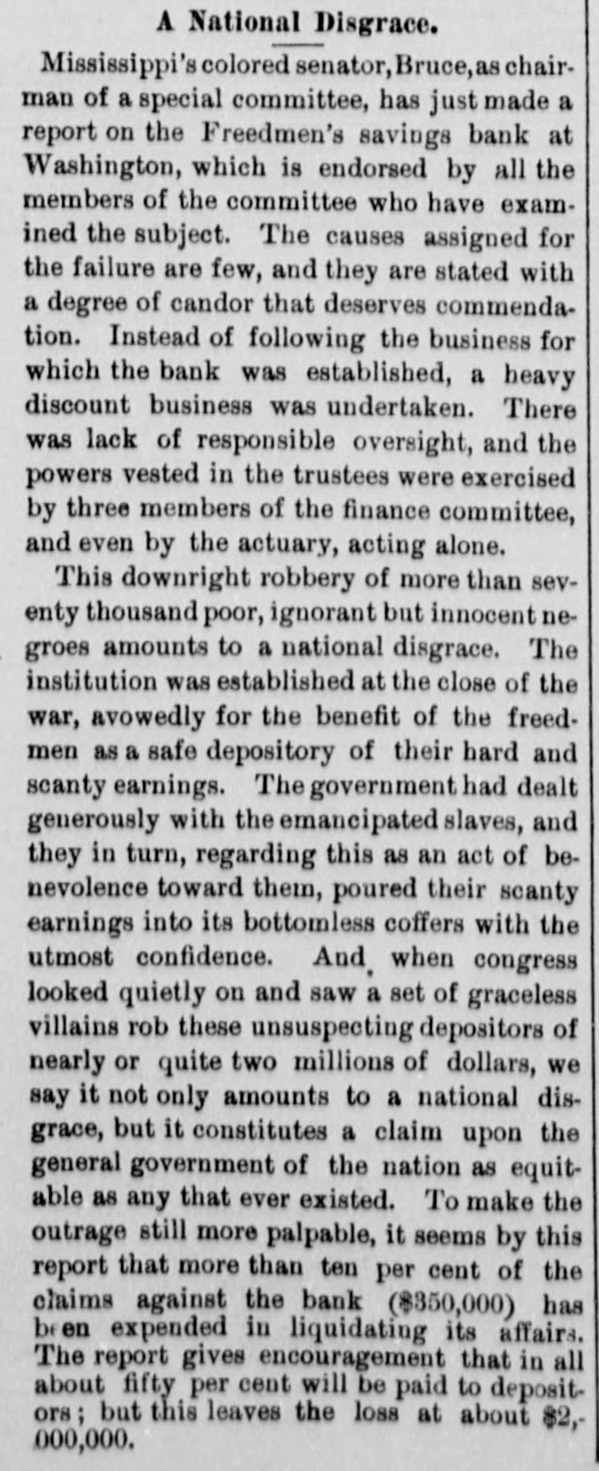
The Freedman's Savings Bank. The latest report is that the mother Freedman's Savings Bank which has its head-quarters at Washington, and its affiliated branches all over the Union, will be able to pay ninety-fivece in the dollar on its liabilities. This is a better showing than was apprehended when it suspended payment. This institution is an offshoot of the defunct Freedman's Bureau, and was established under pretence of a safe and profitable investment of the earnings of thrifty and industrious class of colored people who have been outrageously swindled while the sanctified knaves who originated and managed the concern, have accumulated fortunes.


Article from The Daily Phoenix, August 8, 1874

Click image to open full size in new tab

Article Text

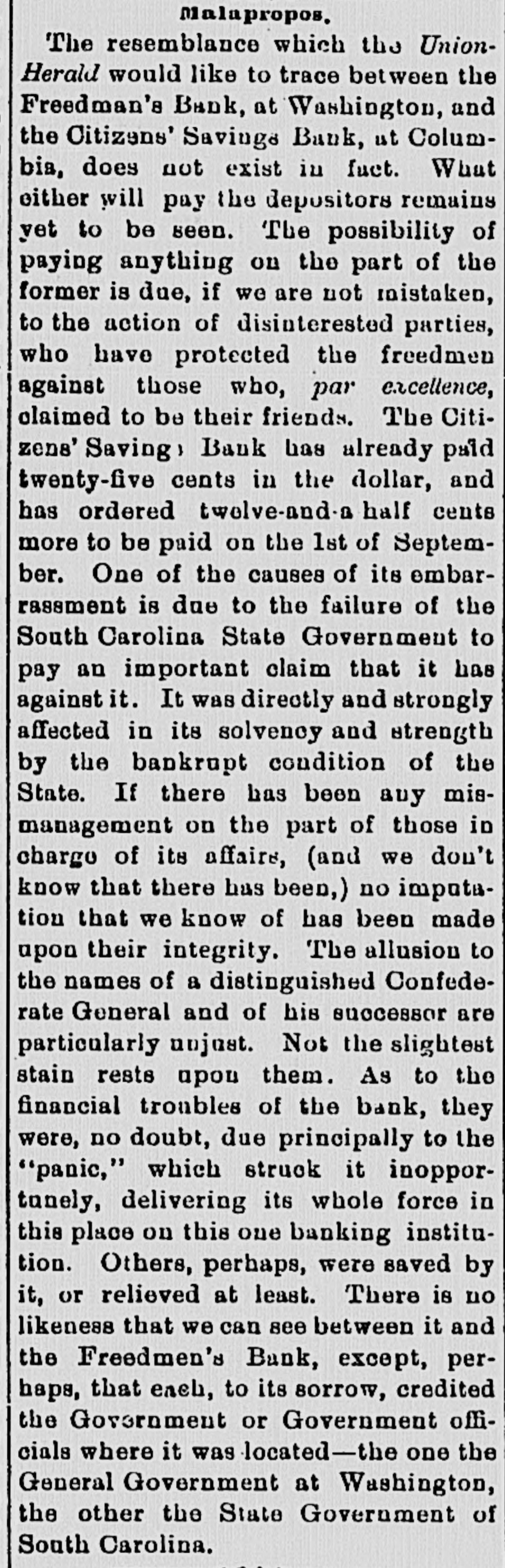
Malapropos, The resemblance which the UnionHerald would like to trace between the Freedman's Bank, at Washington, and the Citizens' Savings Bank, at Columbia, does not exist in fact. What either will pay the depositors remains yet to be seen. The possibility of paying anything on the part of the former is due, if we are not mistaken, to the action of disinterested parties, who have protected the freedmen against those who, par excellence, claimed to be their friends. The Citizens' Saving) Bank has already paid twenty-five cents in the dollar, and has ordered twelve-and-a half cents more to be paid on the 1st of September. One of the causes of its embarrassment is due to the failure of the South Carolina State Government to pay an important claim that it has against it. It was directly and strongly affected in its solvency and strength by the bankrupt condition of the State. If there has been any mismanagement on the part of those in charge of its affairs, (and we don't know that there has been,) no imputation that we know of has been made upon their integrity. The allusion to the names of a distinguished Confederate General and of his successor are particularly unjust. Not the slightest stain rests upon them. As to the financial troubles of the bank, they were, no doubt, due principally to the "panic," which struck it inopportunely, delivering its whole force in this place on this one banking institution. Others, perhaps, were saved by it, or relieved at least. There is no likeness that we can see between it and the Freedmen's Bank, except, perhaps, that each, to its sorrow, credited the Government or Government officials where it was located-the one the General Government at Washington, the other the State Government of South Carolina.


Article from The Wheeling Daily Register, August 31, 1874

Click image to open full size in new tab

Article Text

Freedman's Savings Bank. The sixty days' notice at the Freedman's Savings Bank expired vesterday, but affairs remain unchanged and business it still suspended, The commissioners to wind up its affairs are busily engaged collecting the assets and loans of the bank. They declare that when 20 per cent is collected It dividend will be paid indepositors.


Article from Clearfield Republican, November 4, 1874

Click image to open full size in new tab

Article Text

# LOYAL SWINDLING. The suspended Freedmen's Savings Bank of Washington owes $2,800,000 and has on hand only $42,000. Another evidence of how white Radical thieves plunder poor colored people. There was not a single Democrat connected with the swindling concern.


Article from The Cairo Bulletin, September 16, 1875

Click image to open full size in new tab

Article Text

# FREEDMEN'S BANK The commissioners of the Freedmen's Bank say that they are $85,000 short of the amount necessary to pay 20 per cent. When this concern was in running order it had the universal confidence of black men in the Southern States, who deposited their available earnings in it for safe keeping. All the bank had to fear, in its


Article from The Morning Star and Catholic Messenger, October 3, 1875

Click image to open full size in new tab

Article Text

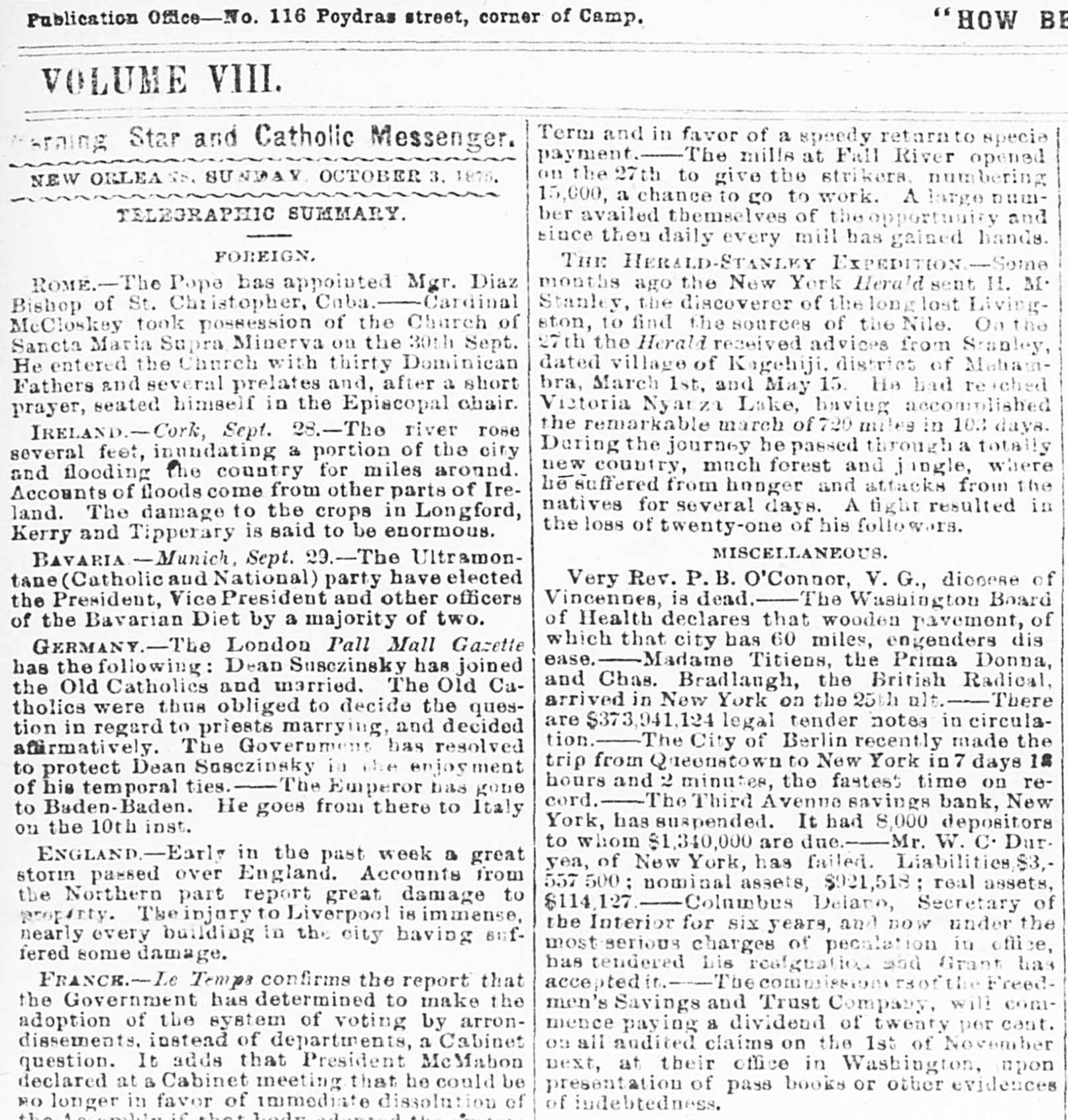
Publication Office-No. 116 Poydras street, corner of Camp. "HOW BE VOLUME VIII. Term and in favor of a speedy retarnto specie string Star and Catholic Messenger. payment The mills at Fall River opened on the 27th to give the strikers. numbering NEW ORLEA SS. SUNDAY OCTOBER 3. 1875. 15,000, a chance to go to work. A large oumTELEGRAPHIC SUMMARY. ber availed themselves of heapportunity and since then daily every mill has gained hands. FOREIGN. THE HERALD STANLEY EXPEDITION-Some months ago the New York Herald sent H. M. ROME.- The Pope has appointed Mgr. Diaz Bishop of St. Christopher, Caba. Cardinal Stanley, the discoverer of the longlost Livingston, to find the sources of the Nile. On the McCloskey took possession of the Church of Sancta Maria Supra Minerva on the 30th Sept. 27th the Herald received advices from Stanley, He entered the Church with thirty Dominican dated village of Kagehiji. district of MetramFathers and several prelates and, after a short bra, March 1st, and May 15. He had reached Victoria Nyarza Lake, having accomplished prayer, seated himself in the Episcopal chair. the remarkable march of 720 miles in 103 days. IRELAND.-Cor Sept. 28.-The river rose Dering the journey he passed through a totally several feet, inundating a portion of the city new country, much forest and jongle, where and flooding the country for miles around. he suffered from honger and attacks from the Accounts of floods come from other parts of Irenatives for several days. A fight resulted in land. The damage to the crops in Longford, the loss of twenty-one of his followers. Kerry and Tipperary is said to be enormous. MISCELLANEOUS. BAVARIA-Munich, Sept. 29.-The UltramonVery Rev. P.B. O'Connor, V. G., dicoese of tane (Catholic and National) party have elected the President, Vice President and other officers Vincennes, is dead. The Washington Board of the Bavarian Diet by a majority of two. of Health declares that wooden pavement, of which that city has 60 miles, engenders dis GERMANY.-The London Pall Mall Gazette ease. Madame Titiens, the Prima Donna, has the following: Dean Susezinsky has joined and Chas. Bradlaugh, the British Radical, the Old Catholics and married. The Old Caarrived in New York on the 25th alt. There tholics were thus obliged to decide the quesare $373,941,124 legal tender notes in circulation in regard to priests marrying, and decided tion. The City of Berlin recently made the affirmatively. The Government has resolved trip from Queenstown to New York in 7 days 12 to protect Dean Sasezinsky in the enjoyment hours and 2 minutes, the fastest time on reof his temporal ties. The Emperor has gone cord. The Third Avenue savings bank, New to Baden-Baden. He goes from there to Italy York, has suspended. It had 8,000 depositors on the 10t h inst. to whom $1,340,000 are due. Mr. W. C. DurENGLAND-Early in the past week a great yea, of New York, has failed. Liabilities $3,storm passed over England. Accounts from 557 500 nominal assets, $921,518; real assets, the Northern part report great damage to $114,127 Columbus Delano, Secretary of property. Theinjary to Liverpool is immense, the Interior for six years, and now under the nearly every building in the city having sufmost serious charges of peculation in office, fered some damage. has tendered Lis realguation and Grant has FRANCE.-Le Temps confirms the report that accepted it. The commissione rsofthe Freedthe Government has determined to make the men's Savings and Trust Company, will comadoption of the system of voting by arronmence paying a dividend of twenty per cant. dissements. instead of departments, a Cabinet on all audited claims on the 1st of November question. It adds that President McMabon next, at their office in Washington, upon declared at a Cabinet meeting that he could be presentation of pass books or other evidences RO longer in favor of immediate dissolution of of indebtedness.


Article from The Daily Clarion, February 9, 1878

Click image to open full size in new tab

Article Text

THE Commissioners of the suspended Freedman's Bank, at Washington, have issued a circular to the creditors of the institution, stating that a dividend of 10 per cent. would be paid about March 20, next, that being all their present available cash balance, and that no doubt will be all they will ever realize.


Article from National Republican, March 18, 1879

Click image to open full size in new tab

Article Text

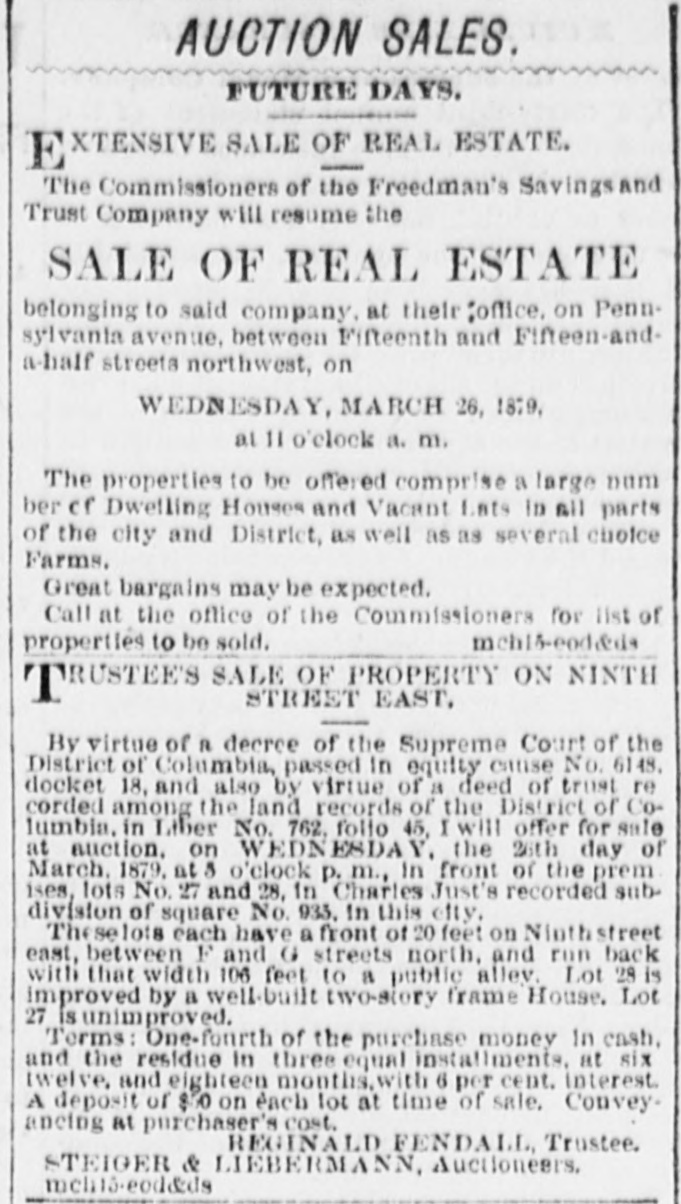
AUCTION SALES. FUTURE DAYS. XTENSIVE SALE OF REAL ESTATE. E The Commissioners of the Freedman's Savings and Trust Company will resume the SALE OF REAL ESTATE belonging to said company. at their :office. on Pennsylvanta avenue, between Fifteenth and Fifteen-anda-half streets northwest, on WEDNESDAY, MARCH 26, 1879, at 11 o'clock a. m. The properties to be offered comprise a large num ber of Dwelling Houses and Vacant Lats in all parts of the city and District, as well as as several choice Farms. Great bargains may be expected. Call at the office of the Commissioners for list of mchi5-eod&ds properties to be sold. TRUSTEE'S SALE OF PROPERTY ON NINTH STREET EAST, By virtue of R. decree of the Supreme Court of the District of Columbia, passed in equity cause No. 6148. docket 18, and also by virtue of a deed of trust re corded among the land records of the District of Columbia. in Liber No. 762, follo 45, I will offer for sale at auction. on WEDNESDAY, the 26th day of March. 1879, at 5 o'clock P: m., in front of the prem. ises, lots No. 27 and 28, in Charles Just's recorded subdivision of square No. 935, in this city, Theselots each have a front of 20 feet on Ninth street east, between F and G streets north, and run back with that width 106 feet to a public allev. Lot 28 is improved by a well-built two-story frame House. Lot 27 is unimproved. Terms: One-fourth of the purchase money in cash, and the residue in three equal installments, at six twelve, and eighteen months, with 6 per cent. interest. A deposit of $50 on each lot at time of sale, Conveyancing at purchaser's cost. REGINALD FENDALL, Trustee. STEIGER & LIEBERMANN, Auctioneers. mchis-eoddeds


Article from Wood County Reporter, February 26, 1880

Click image to open full size in new tab

Article Text

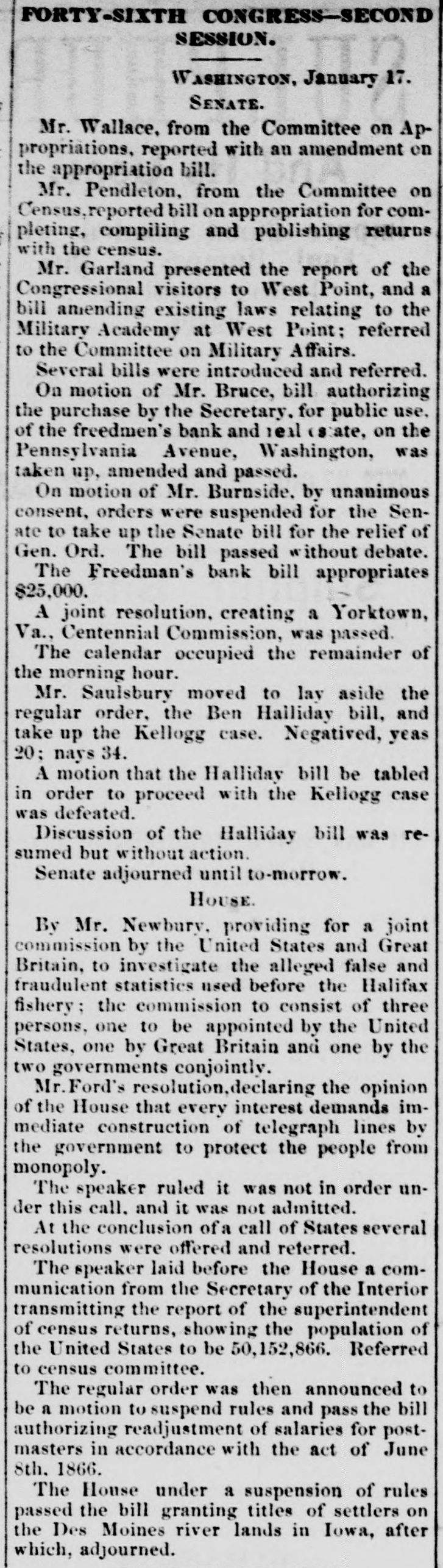
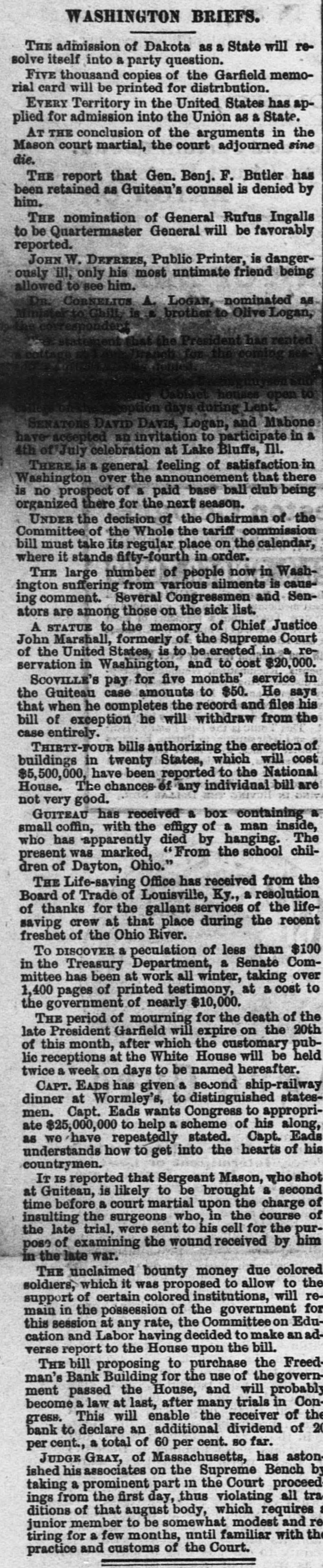
THE WEEK'S WORK. Selected From Every Source. WASHINGTON. THE president on the 20th inst. nominated Rowland E. Trowbridge, of Michigan, commissioner of Indian affairs, vice Hayt removed, THE senate, in executive session Feb. 20, confirmed Frank Mason, of Ohio, U. S. consul at Basle, Switzerland; and rejected the nominatian of Edward Sparder, for census supervisor for first district of Louisiana. THE commitlee on territories, on the 20tb inst., decided the passage of the bill extending the jurisdictictien of the U. S. courts in civil and criminal matters to the Indian Territory, and providing for the acquirement of citizenship by Indians and the allotment of lands to them in severalty under prescribed conditions. THE senate on the 20th inst. confirmed the following nominations; Louis H. Ayme, consul of the United States at Merida; Byram C. Stiffany, register of the land office at Grand Forks, Dakota; Edgar W. Mann, register of the land office at Cheyenne; William J. Anderson, receiver of public moneys at Grand Forks, Dakota; William H. James, postmaster at Berea, Ohio. THE senate select committee on Freed men's bank met Feb. 20th. Anson M Sperry, general field agent and inspector of branches, testified to the solvency of the bank and to the murvelous increase in its business from the start up to 1874, the time of its failure. The deposits had grown from $300,000 in 1866 to $10,000,000 in 1872, and to $55,000,000 in 1874. He stated the cause of the bank's failure was primarily, the violation of the company's charter in entering general business in the branches, which opened the doors to wild speculation in real estate loans and other doubtful securities. The worst complications and losses, he said, arose from operations in Washington. He had never known the bank to sustain a loss through the dishonesty of colored men in charge of any of the branches. Marshal Frederick Douglass, former president of the bank, resumed his testimony, from which it appeared that during his short administration he had been able to gain but little insight into the true inwardness of the concern.


Article from The Interior Journal, September 24, 1880

Click image to open full size in new tab

Article Text

The Republican Record. "Our party," says a Republican contemporary, "points with pride to its record." Let us refer to some features of Republican record during the last twelve years. Briefly stated:- EIGHT YEARS OF GRANT, With his offensive nepotism and disreputable pets. The Boss Shepherd Ring in Washington. The Whisky Ring in St. Louis. Plundering carpet-baggers in the South. The "Black Friday" scandal. The bloody shirt and the inculcation of sectional hate. The Credit Mobilier bribery. The DeGolyer contract. The back pay steal. The Freedmen's Bank swindle. The Belknap disgrace. The financial panic of 1873. The gathering of troops at Washington to overawe the Democrats and defeat the will of the people. The infamous steal of the Presidency. Reckless squandering of the people's money. FOUR YEARS OF HAYES, A minority President, fraudulently placed in office. The reward of every man prominently concerned in the theft of the Presidency by the bestowal of a fat office. Civil Service Reform sham. Persistent demand for troops at the polls. The will of the people frustrated by repeated use of the veto. A minority party with this infamous record demands four years more of power. The people say: "No!"


Article from The Abilene Reflector, March 4, 1886

Click image to open full size in new tab

Article Text

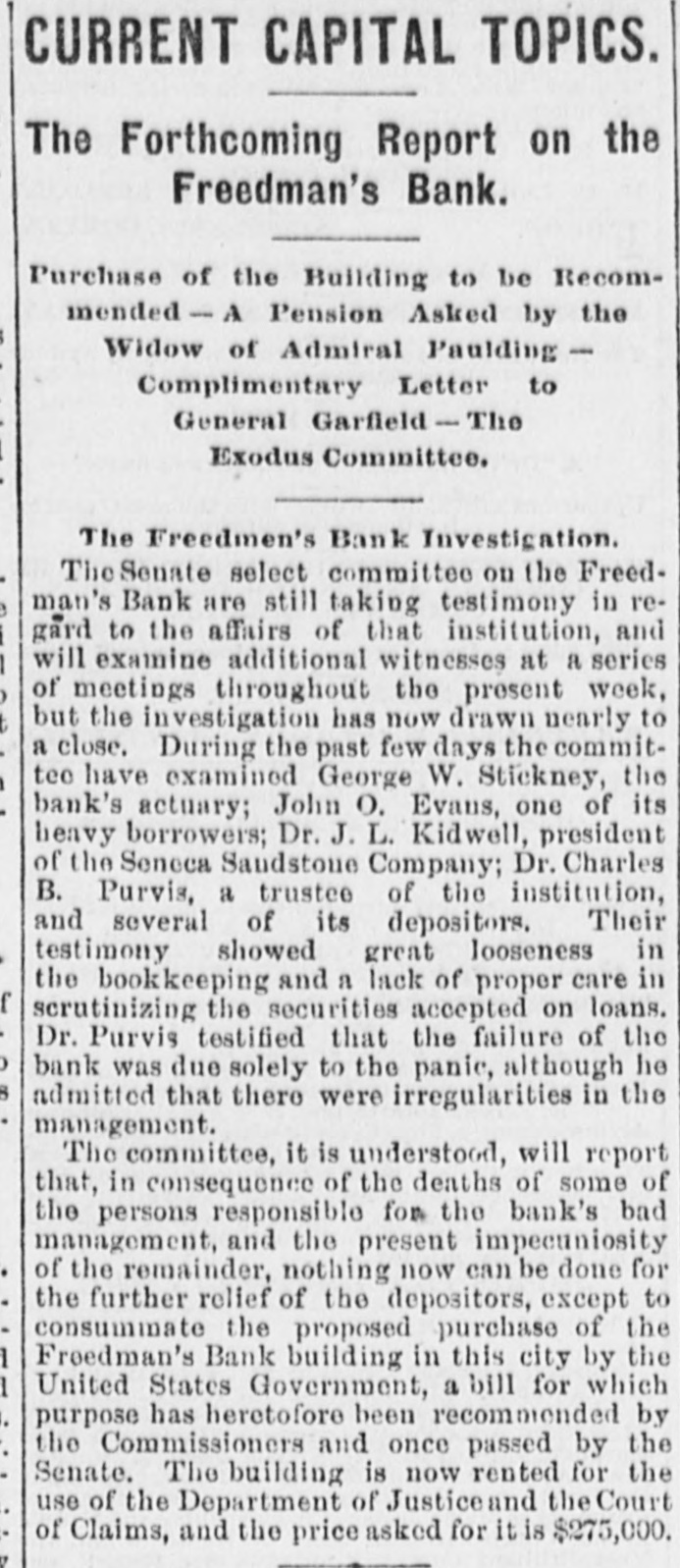
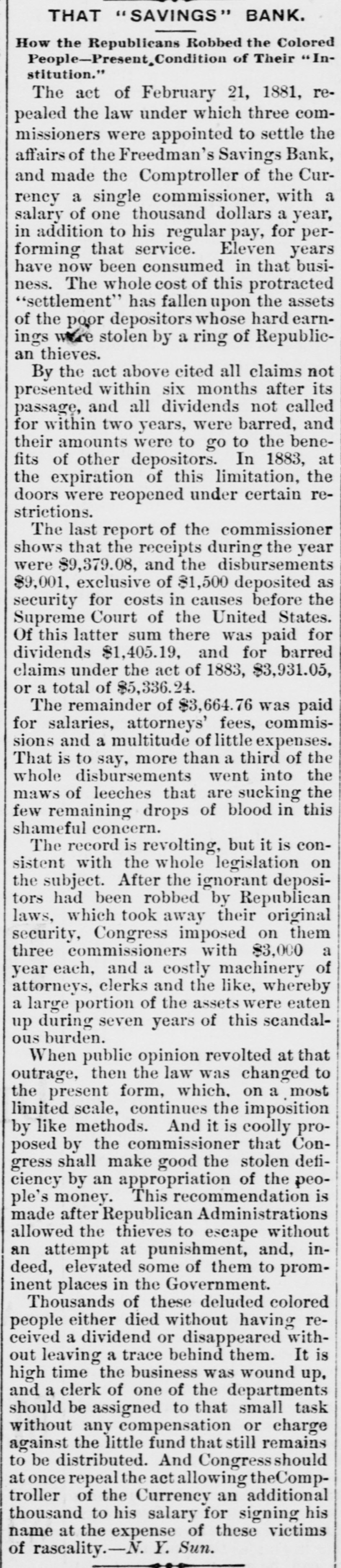
THAT "SAVINGS" BANK. How the Republicans Robbed the Colored People-Present, Condition of Their "Institution." The act of February 21, 1881, repealed the law under which three commissioners were appointed to settle the affairs of the Freedman's Savings Bank, and made the Comptroller of the Currency a single commissioner, with a salary of one thousand dollars a year, in addition to his regular pay, for performing that service. Eleven years have now been consumed in that business. The whole cost of this protracted "settlement" has fallen upon the assets of the poor depositors whose hard earnings we stolen by a ring of Republican thieves. By the act above cited all claims not presented within six months after its passage, and all dividends not called for within two years, were barred, and their amounts were to go to the benefits of other depositors. In 1883, at the expiration of this limitation, the doors were reopened under certain restrictions. The last report of the commissioner shows that the receipts during the year were $9,379.08, and the disbursements $9,001, exclusive of $1,500 deposited as security for costs in causes before the Supreme Court of the United States. Of this latter sum there was paid for dividends $1,405.19, and for barred claims under the act of 1883, $3,931.05, or a total of $5,336.24. The remainder of $3,664.76 was paid for salaries, attorneys' fees, commissions and a multitude of little expenses. That is to say, more than a third of the whole disbursements went into the maws of leeches that are sucking the few remaining drops of blood in this shameful concern. The record is revolting, but it is consistent with the whole legislation on the subject. After the ignorant depositors had been robbed by Republican laws, which took away their original security, Congress imposed on them three commissioners with $3,000 a year each, and a costly machinery of attorneys, clerks and the like, whereby a large portion of the assets were eaten up during seven years of this scandalous burden. When public opinion revolted at that outrage, then the law was changed to the present form, which. on a most limited scale, continues the imposition by like methods. And it is coolly proposed by the commissioner that Congress shall make good the stolen deficiency by an appropriation of the people's money. This recommendation is made after Republican Administrations allowed the thieves to escape without an attempt at punishment, and, indeed, elevated some of them to prominent places in the Government. Thousands of these deluded colored people either died without having received a dividend or disappeared without leaving a trace behind them. It is high time the business was wound up, and a clerk of one of the departments should be assigned to that small task without any compensation or charge against the little fund that still remains to be distributed. And Congress should at once repeal the act allowing theComptroller of the Currency an additional thousand to his salary for signing his name at the expense of these victims of rascality.-N. Y. Sun.


Article from The Times Dispatch, May 5, 1910

Click image to open full size in new tab

Article Text

MAY PAY DEPOSITORS Committee Reports Favorably on Freedman's Bank Bill. Washington, D. C., May 4.-The bill to pay the depositors of the Freedman's Bank, carrying an appropriation of $1,291,000, was favorably reported out of the Committee on Banking and Currency in the House to-day. Three Democratic members of the committee-Representatives Gillespie, of Texas: James, of Kentucky, and Pujo, of Louisiana-voted against the bill. The Freedman's Bank was organized in 1865 by prominent Republicans and Abolitionists as a philanthropic Institution. A charter was granted by the Federal government, and the bank established in Washington, where many millions in deposits were received from former slaves in all parts of the United States. The original charter required the bank to invest its funds in government bonds, but this was changed by act of Congress in 1871, allowing it to invest in real estate. The funds were consequently invested in suburban property in the city of Washington, and the panic of 1873 drove it to the wall. But 62 per cent. of the deposits were paid, and bills have been pending for years to reimburse the depositors who did not receive their money. It was reported favorably from committee in the Sixtieth Congress, but failed to pass. The proponents of the bill take the ground that the government had stood sponsor for the institution in so many ways that it could not escape a degree of liability.