7630. Crescent City Bank (New Orleans, LA)

Bank Information

Episode Type
Run → Suspension → Closure
Bank Type
state
Start Date
February 22, 1873
Location
New Orleans, Louisiana (29.955, -90.075)

Metadata

Model
gpt-5-mini
Short Digest
66ed5f94

Response Measures

Accommodated withdrawals, Books examined

Other: Receiver/liquidation actions and court litigation over transfers of assets; bank ultimately placed in receivership and liquidation.

Description

Articles report a run on Crescent City Bank following the failure of Lizardi & Co. in Feb 1873; the bank initially met withdrawals (cash in excess of deposits). Later (1874) litigation and statements describe insolvency, transfers, and a receiver (liquidation/dividends), indicating the bank suspended and entered receivership/closure. OCR errors in source texts corrected (e.g., 'Lizardi' and some garbled figures). Dates for suspension/receivership are taken from 1874 court reporting (Mar 1874) referencing failures and receiver Charles Case.

Events (3)

1. February 22, 1873 Run
Cause
Correspondent
Cause Details
Run triggered by the failure of the house Lizardi & Co., which had remitted or handled funds for the bank causing dishonored bills and withdrawals.
Measures
Met the withdrawals; had cash funds in excess of deposits; ability to meet the run restored confidence.
Newspaper Excerpt
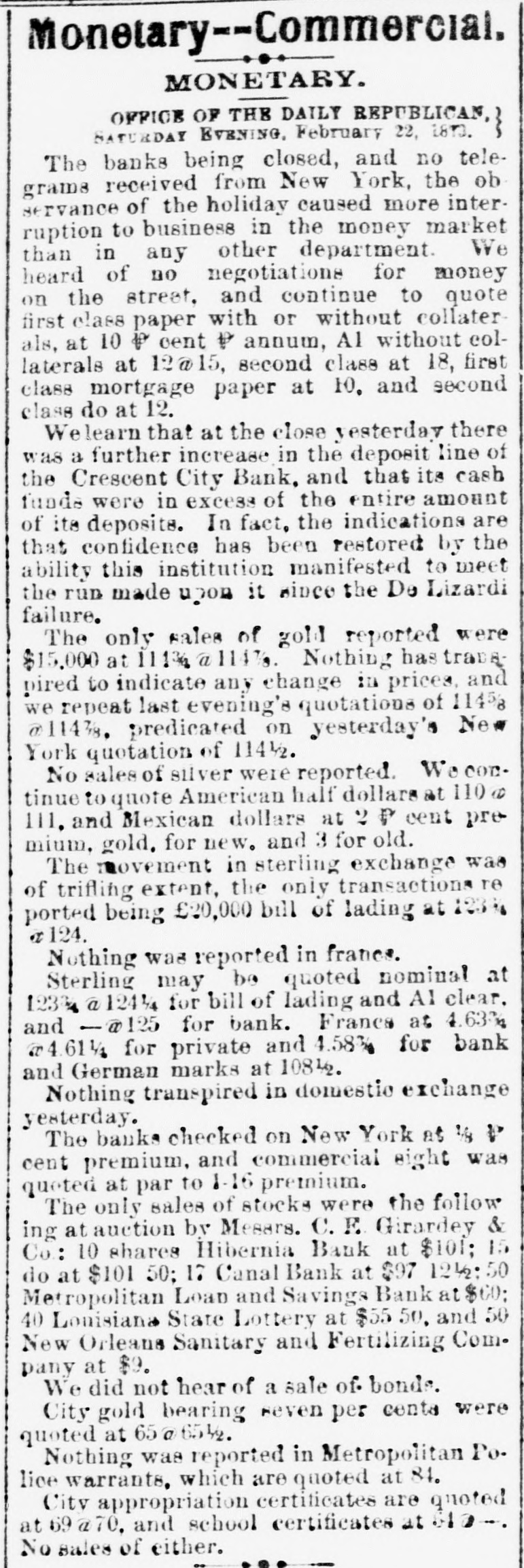
welearn that at the close yesterday there was a further increase in the deposit line of the Crescent City Bank, and that its cash funds were in excess of the entire amount of its deposite. In fact, the indications are that confidence has been restored by the ability this institution manifested to meet the run made upon it since the Do Lizardi failure.
Source
newspapers
2. February 26, 1874 Suspension
Cause
Correspondent
Cause Details
Insolvency attributed to losses on remittances/acceptances tied to Lizardi & Co.; transfers and preferences following that failure led to insolvency and legal action.
Newspaper Excerpt
The failure of Lizardi & Co., and the misappropriation by that house of the funds which the Crescent City Bank had remitted to it to protect the drafts of the bank, made the latter insolvent.
Source
newspapers
3. March 29, 1874 Receivership
Newspaper Excerpt
The Crescent City Bank Case. ... The failure of Lizardi & Co., and the misappropriation by that house of the funds which the Crescent City Bank had remitted to it ... made the latter insolvent. ... The decree is, therefore, as prayed in the bill, that the transfer be declared null and the defendant be compelled to account for the assets received. ... receiver, vs. Citizens' Bank ... Charles Case, receiver, vs. Citizens' Bank of Louisiana. ... receiver of the Crescent City Bank ... a dividend of 25 per cent has been already declared for the latter, ... progress in the liquidation ... is very much retarded by legal proceedings both at home and abroad.
Source
newspapers

Newspaper Articles (9)

Article from New Orleans Republican, February 23, 1873

Click image to open full size in new tab

Article Text

Monetary--Commercial. MONETARY. OFFICE OF THE DAILY REPUBLICAN, } SATURDAY EVENING. February 22, 1813. The banks being closed, and no telegrams received from New York, the ob servance of the holiday caused more interruption to business in the money market than in any other department. We heard of no negotiations for money on the street. and continue to quote first class paper with or without collater als, at 10 F cent ₽ annum, Al without collaterals at 12@15, second class at 18, first class mortgage paper at 10. and second class do at 12. Welearn that at the close yesterday there was a further increase in the deposit line of the Crescent City Bank, and that its cash funds were in excess of the entire amount of its deposite. In fact, the indications are that confidence has been restored by the ability this institution manifested to meet the run made upon it since the Do Lizardi failure. The only sales of gold reported were $15,000 at 111% a 114% Nothing has trabapired to indicate any change in prices, and we repeat last evening's quotations of 11458 @ 11478. predicated on yesterday's New York quotation of 114 1/2. No sales of silver were reported. Wecon. tinue to quote American half dollars at 110 @ 111. and Mexican dollars at 2 P cent premium, gold. for new. and 3 for old. The movement in sterling exchange was of trifling extent, the only transactions re ported being £20,000 bill of lading at 123% at 124. Nothing was reported in francs. Sterling may be quoted nominal at 123% a 1244 for bill of lading and AI clear. and -@125 for bank. Francs at 4.6334 @4.614 for private and 4.58% for bank and German marks at 1081/2. Nothing transpired in domestic exchange yesterday. The banks checked on New York at % P cent premium, and commercial eight was quoted at par to 1.16 premium. The only sales of stocks were the follow ing at auction by Mesars. C. F. Girardey & Co: 10 shares Hibernia Bank at $101; 15 do at $101 50; 17 Canal Bank at $97 124250 Metropolitan Loan and Savings Bank at $60; 40 Louisiana State Lottery at $55.50, and 50 New Orleans Sanitary and Fertilizing Company at $9. We did not hear of a sale of bonds. City gold bearing seven per centa were quoted at 65 a 6542. Nothing was reported in Metropolitan Po. lice warrants. which are quoted at 8t. City appropriation certificates are quoted at 69 @ 70. and school certificates at StaNo sales of either.


Article from New Orleans Republican, March 29, 1874

Click image to open full size in new tab

Article Text

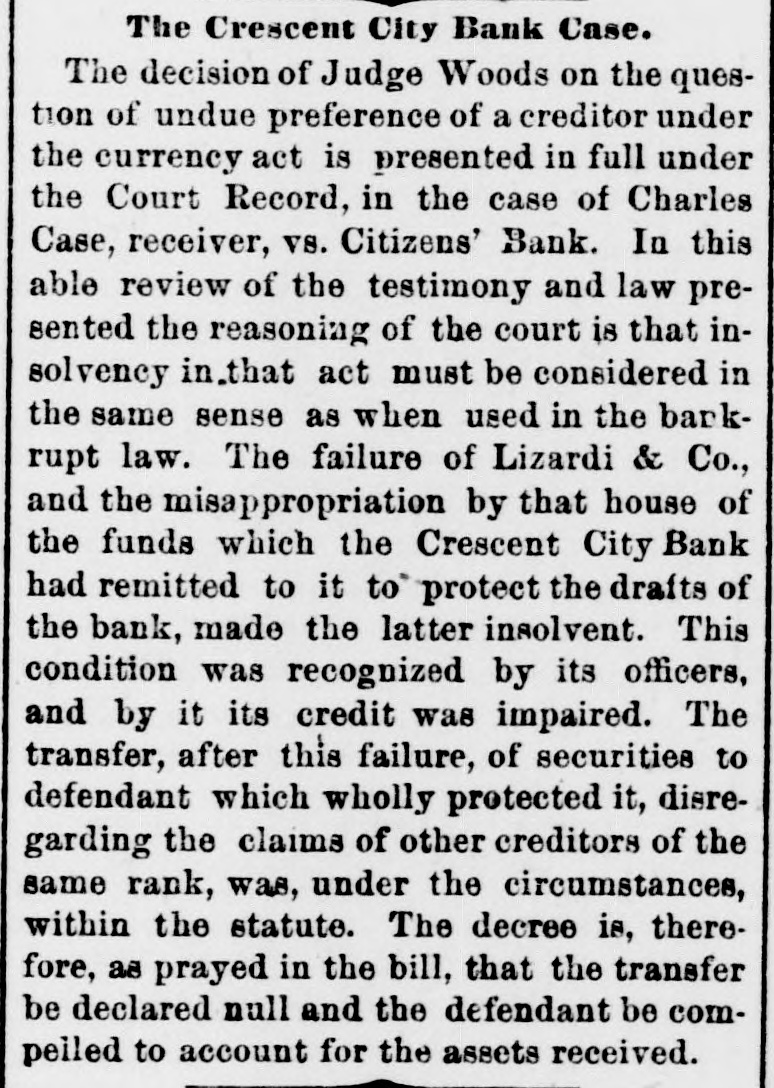
The Crescent City Bank Case. The decision of Judge Woods on the question of undue preference of a creditor under the currency act is presented in full under the Court Record, in the case of Charles Case, receiver, vs. Citizens' Bank. In this able review of the testimony and law presented the reasoning of the court is that insolvency in_that act must be considered in the same sense as when used in the barkrupt law. The failure of Lizardi & Co., and the misappropriation by that house of the funds which the Crescent City Bank had remitted to it to" protect the drafts of the bank, made the latter insolvent. This condition was recognized by its officers, and by it its credit was impaired. The transfer, after this failure, of securities to defendant which wholly protected it, disregarding the claims of other creditors of the same rank, was, under the circumstances, within the statute. The decree is, there. fore, as prayed in the bill, that the transfer be declared null and the defendant be compelled to account for the assets received.


Article from New Orleans Republican, March 29, 1874

Click image to open full size in new tab

Article Text

SATURDAY, MARCH 28, States Circuit Court. N. N. United Frisbie, Esq., is appointed United Commissioner. The following decision was rendered by Judge Woods: Case, receiver Orleans, of Crescent VS. Citi- City Bank of Louisiana. section National Charles Bank of New the currency The (13 fifty-second Stat, 115) declares bonds, bills of "that of exchange all transother of the evidences notes, of deposits of debt to owing its credit, on to real any all signment of asociation avor, of valuablette <<<<<<<<<<<<<<<<<<<<<<<<< or judgments mortgages, or sureties decrees or bullion or creditors, for either, in the its or <<<<<<<<<<<<<<<<<<<<<<<<< with a view to manner of its act, assets or with in the a view to except the preference in payment null void." its creditor circulating to another, notes, shall be utterly the tatute, Relying the THE National the Bank of eceiver Bank, files of this Citizens' the first ember, sixth of drew February, bills Lon- of xchange the Crescent City Bank CANADA Crescent City Hank of £26,501 after 7d amounting cash, sold being the in payable same in to sixty the defendant, That Citizens' and afterward, Bank. about Co., February having, after 26, 1873, the cceptance by said Lizardi them, & failed, and before defendant Bank from bills, the Crescent on said City bills, emanded against loss indemnity the ademnity for the purpose of Bank such transferred and to defendant Crescent City promissory amounting notes, to bills $150.000, of vidences were of then debt and there the That property at the hich said Crescent City Bank. the Crescent City for Bank of had said drawn transfer and had on negotiated said Lizardi capi- & to bills an amount of exchange largely bank exceeding had provided its Li- at ardi stock; & Co. that with the funds the failure to meet of the Lizardi same and & naturity; that bills by would be dishonored and that the said held liable therefor, said said funds bank provided for lost the to the bank and by eason had of the been failure thereof then of and Lizardi of other & Co., its losses inolvency endant; bank by reason that was was said transferred known then notes, insolvent; to bills itself insolvency to the and and that defendant evidences the of the depreference debtemplation Bank to that with over the a view other transfer to cred- give de- of The bill be declared prays void and account the for ( c t the the com- CitiThe the t R tl THE THE corporation.denies.com corporation.denies.com that a Crescent City Bank the drawn & C & them; Co. with that by and the the said bills lost to the bank L P the to the defendant m th The complainant files the general replica- to re In passing upon the nt cessary case it is for material the com- void th ha onsider lainant to what establish of it the is notes, in order bills, to render etc., to the kr so itizens' The transfer transfer Bank. must have act of been insolvency, made with after or a pr & kr <<<<<<<<<<<<<<<<<<<<<<<<< of an one and creditor the THE the prevent bank in Ba th B pplication I know manner of prescribed of no reason the to why the by the enrreney act. word a currency insolvency act the same word in an om to traders: -l-runt act. rit


Article from New Orleans Republican, March 29, 1874

Click image to open full size in new tab

Article Text

of New Orleans, by Edward & Co., Mr. £35,000; A. Carriere, £5000; £4000; and Sherman 00; by & Co., So that by other porsons. of the house of the failure bills outCo. there Crescent were City Bank of & by Co. the to the amount Co of the house of of Lizardi these & bills, and acceptors of February, bills, the fourteenth any of the the he maturity of to Sumner, the tively Crescent known City Bank, on other of notes, bills, twenty-sixth and v-sixth the of debt, the Crescent on the City fully Bank secured to the to & the latter was on Lizardi the held by it drawn City Bank to of Crescent the thirteenth of Li19, 400. On the failure went sequence of City Bank since the its circulation, Crescent and has the quidation. Bank lost nothing Bank, ha having by cured Crescent by the City bills Eugene held by Kelly it on Canal Carriere Bank, received by no and of the bills held cipital payment £54,500. The was ting Crescent to City Bank show the commission Crescent of City the an vency by the the bank, usolvency lotes, bonds, of anether. etc., and the precreditor to not. however, make the alone do necessary to addivoid. case to It establish is two transfer was made of the in Crescent contem- a insolvency 2. That it was to made the Citizens' with a preference creditors, and to prevent manner of act. said assets in the be currency established these he plainant those has already in stated, his bill. the to case annexed point it is obupon the was first the Crescent time of City the insolvent uire, bills, at the etc., to the Febra- Citinotes, the twenty-sixth twenty sixth of conevidence a report fourteenth of the of Feb- Co., bank very on day the that Lizardi & o iled. the resources included are stated an item cash at under in which the is head of by "other the testi- the THE Davis, item is the shown book-keeper of bonds, stocks of cent 11 sist of amount a class to ninety The per bonds nds which is on $564,000. account of $564,000 & B 00,000 80 that bonds. this statement mainly that this of from consisted se.958 01 States to re the United the bank the circulation of It was not, till emium thereon. was not available the E in E item it liabilities of item UI a ent of the which this the at exhibit same item 24, is found February 28 VO February statement of the in wasnot bank. a fair This the is made liabilities appar- of that among is not set down N capital stock bonds deposited L ve 10 reulation, to offset the with the premium should erefore, of statement $561 958 of the re- re. bank. the This leaves 14. the On etc 3,896 50 on February of the bank are of 303 the liabi 12. showing lities $10,593 an excess 38 only. po liabilities of February Lizardi as urteenth of On that day, the ndon, failed. Mr John Davis, --evidence of City Bank, lia of the Crescent outstanding. drawn the bills Lizardi & Co., to City Bank which on reduced £111 000, of exchange at Ged current rate $604,000. The fine uld be about about $606,000 to $ & I Co., forward These remittances were and Co by of Lizardi exchange drawn & Co. by L 604,000 Bank on Lizardi February V Mit a bank which liabilities on to the ources over on that day by $10,593, and has withdrawn Si Bar Lizardi & Co. for an indefi- the lable resources $606,000, with sana Mar sing he sum in of the end a makes large per- poroda This statement of the Crescent "inability in the ordinary Ju deci pay -in its debts other words or suspen- makes St than Lag to its added of A vener. by the This failure the loss available of Lizardi capital re- & thire Orle ust have mus the fusa it; than bank president $95,000. known of twenty-sixth the of this Crescent sixth con- of known peac cour tion mini fact before he heard he should must of not baveknown have failure have known of Liator 1 1874 testifies he that on despatch the fifteenth from Hen received a who held bills of New York, on Lizardi & et liam 0 City of £35,000; Bank that and the that ac- calle ourt due and that that day, such bank; dishonor and ed in b c bein judg aid: the failure no preferred of the to payments. Summers, the telegram City Bank, mote try shou of the Crescent according Crescent to it. to to a at the bis cashier acting of the the emittances of his estifies that Lizardi & misappro- Co., read trying bank the to bills bills were came back. had therefore the remittances break were mat found we thought the it would such if the to b


Article from The New Orleans Bulletin, May 13, 1874

Click image to open full size in new tab

Article Text

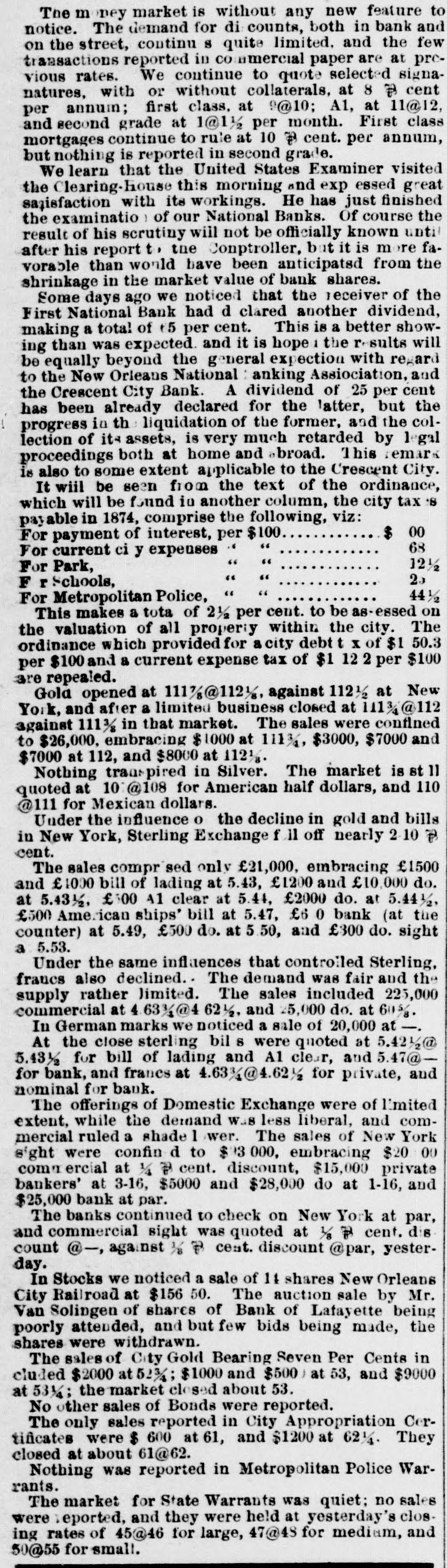
on the street, continu S quite limited. and the few transactions reported in oumercial paper are at previous rates. We continue to quote selected signanatures, with or without collaterals, at 8 B cent per annum; first class, at 9@10; A1, at 11@12, and second grade at 1@1½ per month. First class mortgages continue to rule at 10 B cent. per annum, but nothing is reported in second grade. We learn that the United States Examiner visited the Clearing-House this morning and exp essed great saşisfaction with its workings. He has just finished the examinatio of our National Banks. Of course the result of his scrutiny will not be officially known until after his report t, the Conptroller, but it is m re favorable than would have been anticipated from the shrinkage in the market value of bank shares. Some days ago we noticed that the receiver of the First National Bank had d clared another dividend, making a total of 65 per cent. This is a better showing than was expected. and it is hope 1 the results will be equally beyond the general expection with regard to the New Orleans National anking Assiociation, and the Crescent City Bank. A dividend of 25 per cent has been already declared for the latter, but the progress in th liquidation of the former, and the collection of its assets, is very much retarded by legal proceedings both at home and abroad. This remark is also to some extent applicable to the Crescent City. It wiil be seen from the text of the ordinance, which will be found in another column, the city tax 'S payable in 1874, comprise the following, viz: $ 00 For payment of interest, per $100 " 68 For current ci y expenses " " 12½ For Park, " " 2. F r Schools, " " 44½ For Metropolitan Police, This makes a tota of 2½ per cent. to be as-essed on the valuation of all property within the city. The ordinance which provided for acity debt t X of $1 50.3 per $100 and a current expense tax of $1 12 per $100 are repealed. Gold opened at 111%@112%, against 112½ at New York, and after a limited business closed at 111%@112 against 1113/3 in that market. The sales were confined to $26,000, embracing $1000 at 111%, $3000, $7000 and $7000 at 112, and $8000 at 112½. Nothing transpired in Silver. The market is st 11 quoted at 10:@108 for American half dollars, and 110 @111 for Mexican dollars. Under the influence o the decline in gold and bills in New York, Sterling Exchange full off nearly 2-10 if cent. The sales comprised only £21,000, embracing £1500 and £1000 bill of lading at 5.43, £1200 and £10,000 do. at 5.43 ½, £100 A1 clear at 5.44, £2000 do. at 5.44½, £500 American ships' bill at 5.47, £6 0 bank (at the counter) at 5.49, £500 do. at 5.50, and £300 do. sight a 5.53. Under the same influences that controlled Sterling, francs also declined. The demand was fair and the supply rather limited. The sales included 225,000 commercial at 4.63%@4 62½, and 25,000 do. at 60%. In German marks we noticed a sale of 20,000 at At the close sterling bil S were quoted at 5.42½@ 5.43½ for bill of lading and A1 clear, and 5.47@for bank, and francs at 4.63%@4.62% for private, and nominal for bank. The offerings of Domestic Exchange were of limited extent, while the demand was less liberal, and commercial ruled a shade 1 wer. The sales of New York sight were confin d to $ 3 000, embracing $20 00 comn ercial at 1/4 P cent. discount, $15,000 private bankers' at 3-16, $5000 and $28,000 do at 1-16, and $25,000 bank at par. The banks continued to check on New York at par, and commercial sight was quoted at ½ # cent. dis count @-, against ½ B cest. discount @par, yesterday. In Stocks we noticed a sale of 14 shares New Orleans City Railroad at $156 50. The auction sale by Mr. Van Solingen of shares of Bank of Lafayette being poorly attended, and but few bids being made, the shares were withdrawn. The sales of City Gold Bearing Seven Per Cents in cluded $2000 at 523/4; $1000 and $500 at 53, and $9000 at 53½; the market closed about 53. No other sales of Bonds were reported. The only sales reported in City Appropriation Certificates were $ 600 at 61, and $1200 at 621/4. They closed at about 61@62. Nothing was reported in Metropolitan Police Warrants. The market for State Warrants was quiet; no sales were eported, and they were held at yesterday's closing rates of 45@46 for large, 47@4S for medium, and 50@55 for small.


Article from New Orleans Republican, May 13, 1874

Click image to open full size in new tab

Article Text

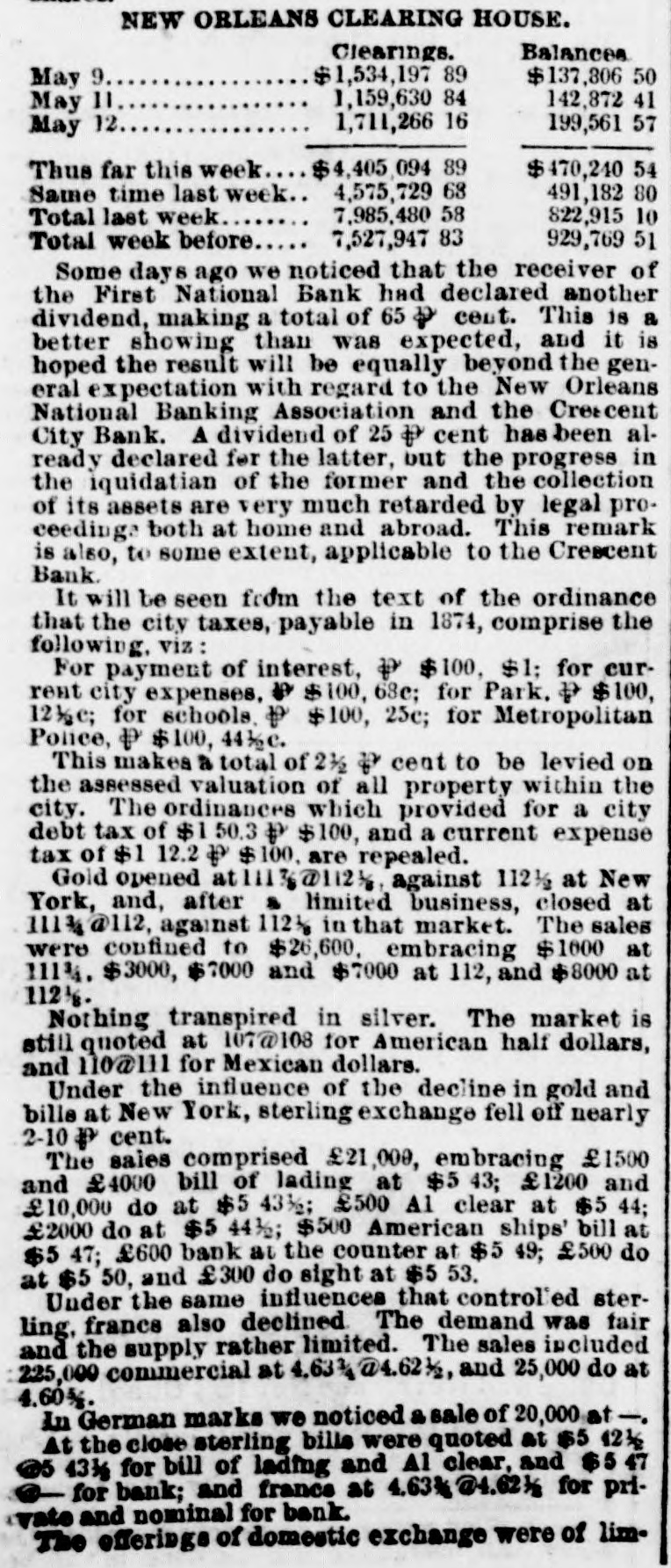
NEW ORLEANS CLEARING HOUSE. Balances Clearings. $1,534,197 89 $137,806 50 May 9 142,872 41 1,159,630 84 May 11 1,711,266 16 199,561 57 May 12 Thus far this week $470,240 54 $4,405,094 89 Same time last week 4,575,729 68 491,182 80 7,985,480 58 Total last week 822,915 10 Total week before 929,769 51 7,527,947 83 Some days ago we noticed that the receiver of the First National Bank had declared another dividend, making a total of 65 cent. This is a better showing than was expected, and it is hoped the result will be equally beyond the general expectation with regard to the New Orleans National Banking Association and the Creacent City Bank. A dividend of 25 P cent has been already declared for the latter, but the progress in the iquidatian of the former and the collection of its assets are very much retarded by legal proceedings both at home and abroad. This remark is also, to some extent, applicable to the Crescent Bank. It will be seen from the text of the ordinance that the city taxes, payable in 1874, comprise the following. viz: For payment of interest, P $100, $1; for current city expenses, $100, 68c; for Park. P $100, 12½c; for schools. ₱ $100, 25c; for Metropolitan Police, ₱ $100, 44½c. This makes a total of 2½ P cent to be levied on the assessed valuation of all property within the city. The ordinances which provided for a city debt tax of $150.3 P $100, and a current expense tax of $1 12.2 P $100, are repealed. Gold opened at1i13@li2k, against 112½ at New York, and, after a limited business, closed at 1114@112, against 112½ in that market. The sales were confined to $26,600, embracing $1000 at 111%. $3000, $7000 and $7000 at 112, and $8000 at 112½. Nothing transpired in silver. The market is still quoted at 107@108 for American half dollars, and 110@111 for Mexican dollars. Under the influence of the decline in gold and bills at New York, sterling exchange fell off nearly 2-10 P cent. The sales comprised £21,000, embracing £1500 and £4000 bill of lading at $5 43; £1200 and £10,000 do at $5 43½; £500 Al clear at $5 44; £2000 do at $5 44½; $500 American ships' bill at $5 47; £600 bank at the counter at $5 49; £500 do at $5 50, and £300 do sight at $5 53. Under the same influences that control'ed sterling, francs also declined The demand was fair and the supply rather limited. The sales included 225,000 commercial at 4,634,44,62%, and 25,000 do at 4.60%. In German marks we noticed & sale of 20,000 at -, At the close sterling bills were quoted at $5 12½ @5 43½ for bill of lading and Al clear, and $5 47 a for bank; and france at 4.63k@4.62kg for private and nominal for bank. The offerings of domestic exchange were of lim-


Article from The Donaldsonville Chief, September 5, 1874

Click image to open full size in new tab

Article Text

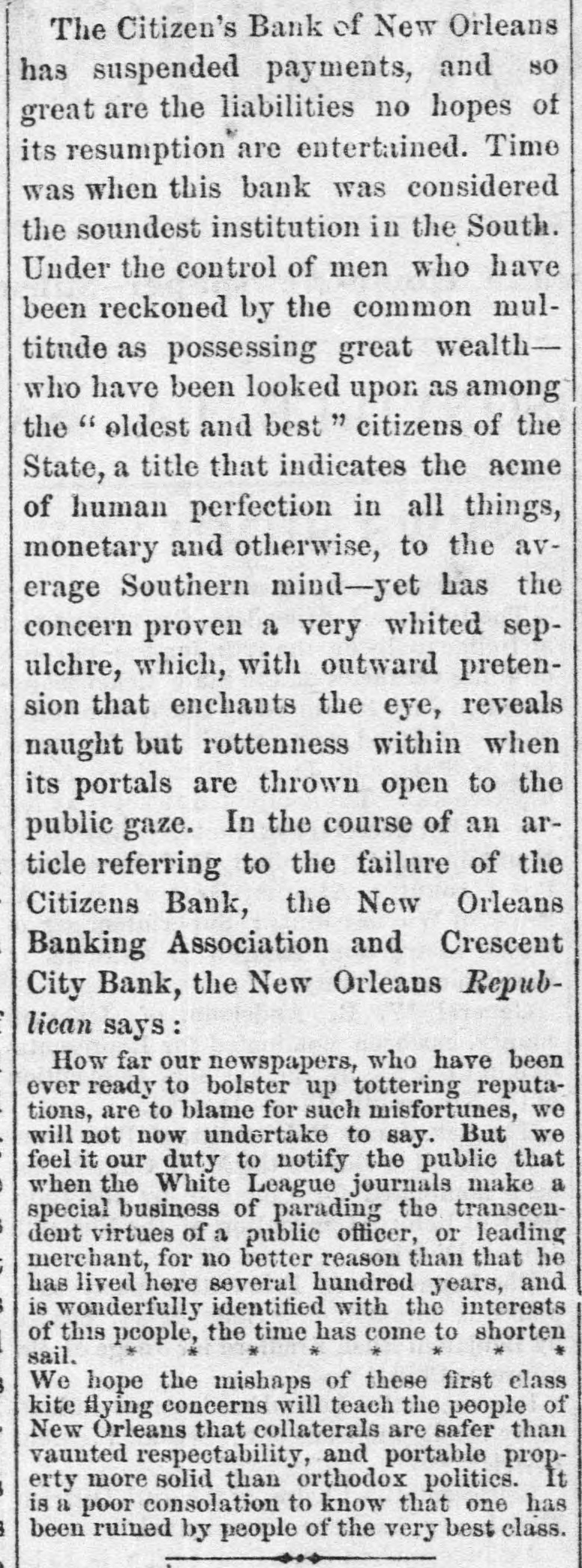
The Citizen's Bank of New Orleans has suspended payments, and so great are the liabilities no hopes of its resumption are entertained. Time was when this bank was considered the soundest institution in the South. Under the control of men who have been reckoned by the common multitude as possessing great wealthwho have been looked upon as among the "oldest and best citizens of the State, a title that indicates the acme of human perfection in all things, monetary and otherwise, to the average Southern mind-yet has the concern proven a very whited sepulchre, which, with outward pretension that enchants the eye, reveals naught but rottenness within when its portals are thrown open to the public gaze. In the course of an article referring to the failure of the Citizens Bank, the New Orleans Banking Association and Crescent City Bank, the New Orleans Republican says How far our newspapers, who have been ever ready to bolster up tottering reputations, are to blame for such misfortunes, we will not now undertake to say. But we feel it our duty to notify the public that when the White League journals make a special business of parading the transcendent virtues of a public officer, or leading merchant, for no better reason than that he has lived here several hundred years, and is wonderfully identified with the interests of this people, the time has come to shorten * * * sail. We hope the mishaps of these first class kite flying concerns will teach the people of New Orleans that collaterals are safer than vaunted respectability, and portable property more solid than orthodox politics. It is a poor consolation to know that one has been ruined by people of the very best class.


Article from New Orleans Republican, July 17, 1875

Click image to open full size in new tab

Article Text

# TRIAL OF AUDITOR CLINTON # SUPERIOR CRIMINAL COURT Third Day. The heat kept many speétatore from the court, but there were enough to make the quarters uncomfortably close in some places. Colonel Field asked for James B. Wands. The sheriff reported hearing he had been teen, but he had not been found. The Attorney General then asked for some of the Auditor's funding entries, and Mr. Voorhies said there was no need of an order; the Anditor would furnish anything asked for. The receipt of W. C. Sanford, dated August 29, 1874, for eighty-three consolidated bonds, was introduced. Hon. P. G. Deslonde, Secretary of State, was sworn-Was present at the meetings of the funding board when the Sanford claim was discussed; several days were occupied with it; had no opinion in regard to it, except was opposed at first to funding; do not know who presented it; it was not presented by him; did not think the Treasurer did; Colonel Lowell might, but can not swear to it; Benham and Sanford were not present; the Assistant Attorney General gave a verbal opinion, and afterward a written one; desired the opinion of Attorney General Field; did not get it till too late; think some of the vouchers, a sample, may have been before the board; knows Mr. Sanford; ean not remember that there were no envelepes or packages of his application; some of the warrants had not been signed; can not say whether Sanford brought up the warrants; the first meeting of the board was in April; no warrants were tunded till August. To Mr. Semmes, on cross-examination- The opinion of the Assistant Attorney General was asked on the legality of the funding, not on the validity of the vouchers: have been secretary and had custody of the minutes of the funding untit they were taken away March 8, 1875; the Attorney General said the warrants were not fundable; it was resolved to burn the eertificates funded in 1875. A half hour recess was taken, and at the conclusion Mr. Dealonde produced all the papers he had. Hon. Antoine Dubuclet, State Treasurer, sworn-Am a member of the funding board; can not say that I was present at every meeting; remember the Sanford application, and that the warrants were brought up by one of the Auditor's clerks; Assistant Attorney General Dibble was called upon for au opinión; there were warrante in favor of several parties; they were there several times; don't recolleet that there was much discussion; ean not say who made the presentation; four members of the board were present; Judge Dibble was there; do not know where the warrants are; funded obligations are usually destroyed; warrants have been burned three times; only know Sanford by sight; was served with the injunction on the appropriation bill. Colonel Charles W. Lowell sworn-Was Speaker of the House of Representatives in 1874 and member of the funding board. [Looking at receipt for warrante, signed "C. W. Lowell, by George W. Benham."] Never saw this till it was shown in the Superior District Court the other day; never knew it was extant; never applied to the Auditor for warrante; never gave any one authority to apply for them; had no conversation with the Auditor about them. The rule of the funding board was to refer applicants to the fiscal agent and let the application come through the bank. On the twenty-eighth of August Mr. Baldwin was absent and Mr. Pike, the eashier, acted; suppose the Sanford application came that way; Sanford asked to have them funded; so did Benham; he was before the board; a sample of the paper was brought there; the question propounded was, if the Auditor will sign will the board fund these warrants; Assistant Attorney General Dibble was sent for, for his opinion; can only give the explanation of receiving these warrante as told by Benham; know they were distributed to himself, Dewees, Wands and others because they claimed a share in them; claim a share now; have got nothing of the $14,000; Mr. Benham was a member of the Legislature of 1873 and 1874; the Governor was absent from the meeting; was informed he was sick; don't know where Wands is; am not his keeper; saw him three days ago on Carondelet street; he said he was not coming to court, because he had no business there; he had not received a subpœna; do not know who asked the Auditor to issue warrants, To Mr. Semmes-The warrants are not indorsed by me; Mr. Oglesby's is perhaps by him; Messrs. Wande and Matthews were not in town; this was an arrangement between Benham and me; he told me there was a chance of speculation in the class of paper called Pinckney Smith paper; that if some could be procured, a reasonable amount, they could be paid; Mr. David F. Power said so; procured $38,000 of them and received his check on the Louisiana National Bank for them for $9500, and turned them over; the basis was twenty-five per cent; only know from hearsay who held my others; was told it was the receiver of the Crescent City Bank; got a receipt; [read the receipt for vouchers, all for mileage and per diem, signed by David F. Power]; me and others were pressing me all the time to fund them; there were samples of the paper before the board; the whole matter was discussed; the entire statement of the case was made. To Colonel Field-Bought the vouchers to make money; would make the same speculation any time; have never been


Article from The New Orleans Bulletin, July 17, 1875

Click image to open full size in new tab

Article Text

of his warrants. They were signed by the Auditor. "The question presented to the Assistant Attorney General was: 'If the Auditor signs these warrants, will the board fund them?'" "Judge Dibble was in the building and was sent for. "Sanford was a sort of confidential clerk of Benham's. I know Dewees and others claimed an interest in the warrants. I only know from the records that the bonds were given to Sanford. "The Governor was sick when we held these meetings, at least I was so informed. [Laughter.] "I can't tell you where Wands is. I saw him three days ago on Carondelet street, when the case was opened. I asked him if he was coming down to court, and he said he had no business there, as he had no subpœna. "I don't know that the Auditor had been requested to audit vouchers like the Benham ones and refused before. Benham never owed me $14,000, never that amount of money." CROSS-EXAMINATION "He didn't owe me any specific amount. "When warrants are funded they are indorsed by the party in whose favor they are. I indorsed mine, Oglesby his, etc. There was an arrangement with Benham about them. Benham said to me one day that warrants could be got at a reasonable rate, and asked me if I would furnish the money. Powers told me one day that there was a movement in warrants. He purchased $38,000 worth. "The vouchers were delivered to me by Powers. Benham told me he was acting for the Receiver of the Crescent City Bank at the time of the purchase. I have the receipt here. "The receipt was for the Pinckney Smith vouchers. These I hold in my hand are of the same class, but one is only in the receipt. "The matter of the issue of these warrants and their fundabiltty was pressed by Benham before they were funded upon the members of the board. I don't know that he presséd the Attorney General. "At the time the application of Sanford was made to the board a sample of the warrants was also shown." RE-LIRECT "Benham when he told me I could make some money, he did not say how. I didn't care how so he made it. He only said he had a chance to make some money-that's all. "I purchased only $38,000, but I don't know when he got the balance. Benham and the Auditor at that time were quite intimate. He was in that office frequently. When I sold I got a check. From that time up to August Benham told me he had filed them with the Auditor. It was either the day the appropriation bill was signed or just after. He told me all the time abont these vouchers. For my services I was to get something. I voted for the funding of them expecting to get one-fifth. There was a big debt against them; money borrowed from the bank." RE-CROSS "Benham is a man of wealth. His credit was good. I asked for a settlement with Benham." Mr. Dubuclet, cashier of the Treasurer, testified: "I have the injunction served upon the Treasurer from the Superior District Court." On the question being asked whether he would pay any warrant under this injunction, Mr. Semmes objected, and the matter was discussed and the question was withdrawn. "On the 20th March I received, in the same case, entitled State of Louisiana vs. Charles Clinton, enjoining payment of warrants under section 2 of the Appropriation bill of 1874." Mr. Boyer-"I am a broker in coin. Have been here sixteen years. I am familiar with State securities here. Mr. Semmes objected to Col. Field showing how Pinckney Smith warrants stood on the streets. He said that the accused was charged with illegally funding certain warrants, but the general value in the market had no bearing on this case. Col. Field responded. He said that he was glad the witness Lowell had shown up as in a mirror the rascality of that time. In the latter part of 1874, as a part of the conspiracy, Benham, a member of the Legislature, who took part in the passage of the very law, goes to a member of the Funding Board (Lowell) and procures the funding of these securities. This, he said, shows how affairs were carried on at that time. He thought the value of this trash ought to be shown. Mr. Semmes retorted that he thought there was some deep secret behind the prosecution of this case. There seemed to be some obstacle in the way of somebody, and the Auditor was to have the vengeance of the crowd vented upon him because he was in the way. The mode of prosecuting the case would seem to indicate this. The Court-The question must be confined to the vouchers in this case. Their value alone can be shown, but it must be confined to the Benham vouchers. The witness being shown vouchers, says: "These kind of papers were worth when first issued something, but aftewards were considered unsalable. Afterwards a demand was created for them. They ruled at about fifteen cents on the dollar." CROSS-EXAMINATION "Auditor's warrants then did not sell for more than forty cents. The vouchers I sold I can not say had been indorsed by the chairmen of committees, but I think they were. I know certainly they were signed by J. Pinckney Smith. I only sold one, and that is my criterion of their value." Mr. P. Calloway on the stand: "I am a broker and speculator since 1864. In 1874 Pinckney Smith warrants were worth from ten to sixteen cents on the dollar. Prior to that they were considered worthless. In 1872 the committee approved $116,000. I remember buying. I presented warrants I received from Gen. Longstreet's checks, when he peremptorily said: 'I warrant nothing but for staff officers.' I feel when off the stand a hostility toward Clinton, but not on the stand. You Mr. Semmes would feel a hostility towards him if you had been treated by him as I have." Mr. Callaway was asked the cause of his hostility and he entered into a long and energetic account, and was applauded by the lobby once. Mr. H. Newgass being shown vouchers, says: "There were very few parties buying these warrants. I sold some at about thirteen or fourteen cents. The Pinckney Smith warrants were also considered fancy. Nobody knew what they were issued for.