Citizens State Bank (Kimball, NE)

Episode Information

Episode UID
76047371475
Episode Type
Suspension โ†’ Closure
Bank Type
state
Bank ID
7604737 routing
Routing Number
76-0473
Start Date
November 28, 1922
Location
Kimball, Nebraska (41.236, -103.663)

Metadata

Model
gpt-5-mini (chosen from majority vote of a three-model LLM ensemble)
Short Digest
03c944935827cf60

Response Measures

None

Description

Closure preceded receivership; Nov. 28 date inferred from 1923 article (likely Nov 28, 1922).

Events (2)

1. November 28, 1922 Suspension
Cause
Bank Specific Adverse Info
Cause Details
Bank closed and went into receivership (insolvency/failure leading to suspension).
Newspaper Excerpt
closed its doors November 28.
Source
newspapers
2. May 15, 1923 Receivership
Newspaper Excerpt
Receiver of Kimball Bank to Pay Depositors $278,000 ... C. G. Stoll, receiver for the Citizens State bank, which closed its doors November 28, expects to start paying depositors May 15.
Source
newspapers

Newspaper Articles (4)

Article from The Omaha Morning Bee, May 12, 1923

Click image to open full size in new tab

Article Text

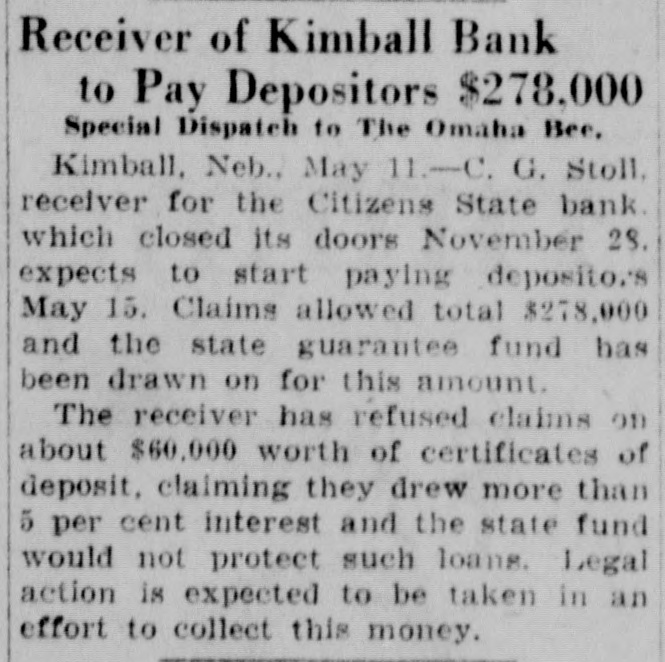
Receiver of Kimball Bank to Pay Depositors $278,000 Special Dispatch to The Omaha Bee. Kimball, Neb., May 11.-C. G. Stoll. receiver for the Citizens State bank. which closed its doors November 28. expects to start paying deposito.'s May 15. Claims allowed total $278,000 and the state guarantee fund has been drawn on for this amount. The receiver has refused claims on about $60,000 worth of certificates of deposit, claiming they drew more than 5 per cent interest and the state fund would not protect such loans. Legal action is expected to be taken in an effort to collect this money.


Article from The Omaha Morning Bee, May 15, 1923

Click image to open full size in new tab

Article Text

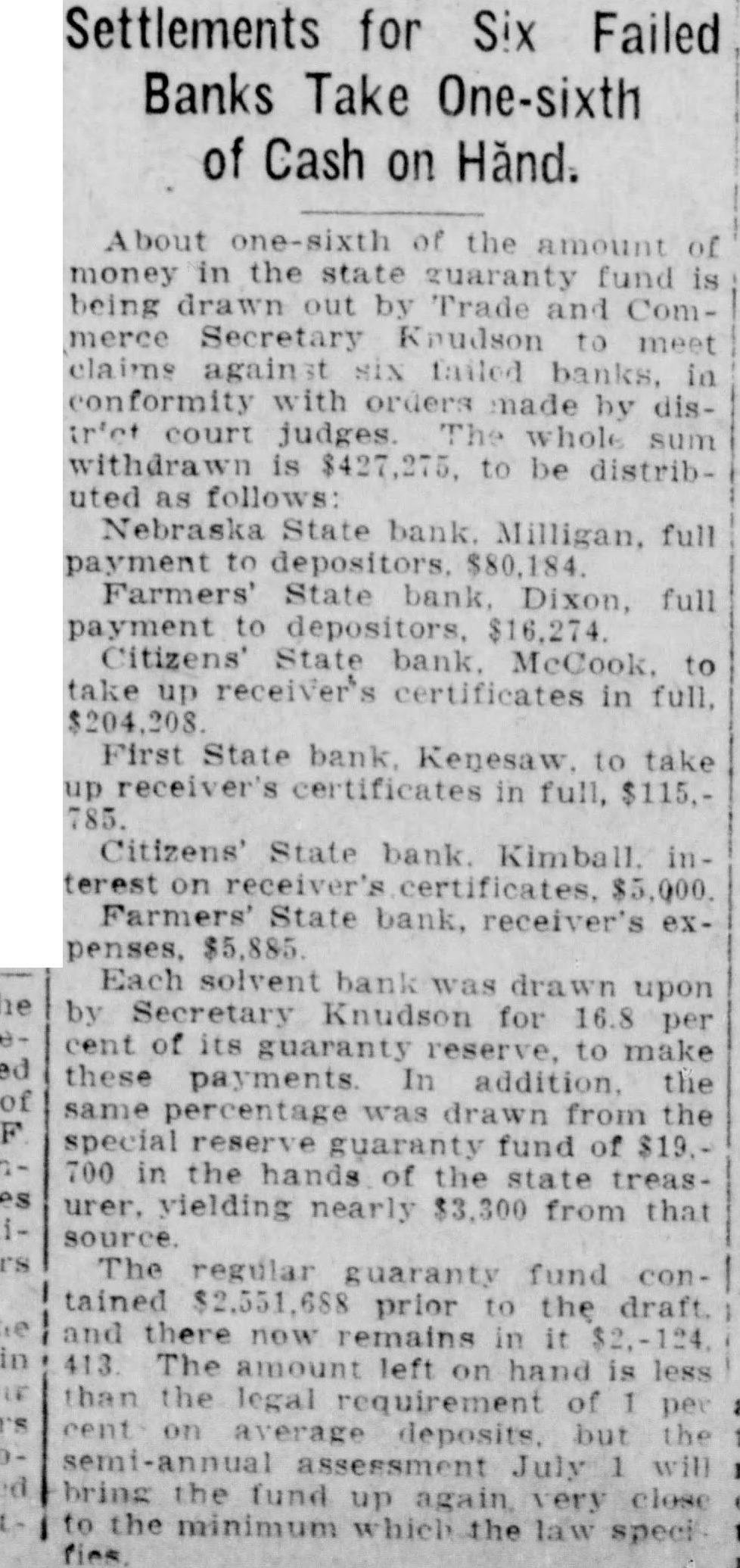
By Associated Press. Washington, May 14.-The military governor of Shantung, the State department was advised today by Con. sul John K. Davis, has agreed verbally to call off the attack on the ban. dits who wrecked the Suchow-Pekin express and to take them to the Chinese army. The brigands, Davis reported. had expressed willingness to release foreigners still held captive if this was done. He said the governor had informed him the siege was raised Saturday night. Obtained Leave of Absence. Shanghal, May 15.-J. A. Henley of San Francisco, one of the prisoners captured by the Suchow bandits who arrived at Lincheng two days ago from brigands' stronghold, was not granted his unconditional release by his captors, but had obtained 24 hours "leave of absence" from the robber chief. from whom the American also borrowed $20 and a mule to make his trip down from the hills, accord. ing to reports brought here today. Henley, according to Marcel Josset, of the British-American Tobacco company staff. who arrived on the midnight express from Tsaochwang, be. came popular with the bandits and was permitted to pass through the lines to visit the relief camps in the foothille The San Francisan came down from the brigand's lair Saturday, clad in a pair of pajamas, carrying $20 be had borrowed from the robber chief. riding a donkey he had obtained from the same source and under instructions from the Origands to return by Sunday night or the remainder of the captives would be shot. Hostages All Well. Joset said that squads of coolie pack carriers are taking supplies up to the bandits' headquarters and that all the hostages are well. according to the last reports when he left Tsaochwang. He added, however, that any hostile movement by the troops in the district would result in the immediate execution of the foreign prisoners. Officers in command of the troops have reiterated their previous assurances that the soldiers would be withdrawn. but whether this promise has been kept is not known at Tsaochwang It now is pretty definitely established that 15 men are being held by the bandits. together with Senora Verea, wife of one of them, who has repeatedly refused to abandon her husband. It also is believed that upwards of 100 Chinese are held in the brigands stockades, many of them wealthy and prominent. Dozens Seek to Buy Bank Certificates Special Dispatch to The Omaha Bee. Lincoln. May 14.-Applications by the dozens for purchase of receivers' certificates of failed banks are pour ing into the office of the secretary of trade and commerce. The issuance and sale of these certificates was made legal by the bank bill passed by the legislature. They call for 7 per cent interest The certificates are issuell against assets of failed banks. If the assets do not take care of th certificates issued to care for all bills payable of the failed bank. the balance is drawn from the state guaranty fund. The first issue of certificates under the new law. was by the receiver of the defunct Citizens' State bank 0ยฐ Kimball The total was $278,000.


Article from Lincoln Journal Star, June 25, 1926

Click image to open full size in new tab

Article Text

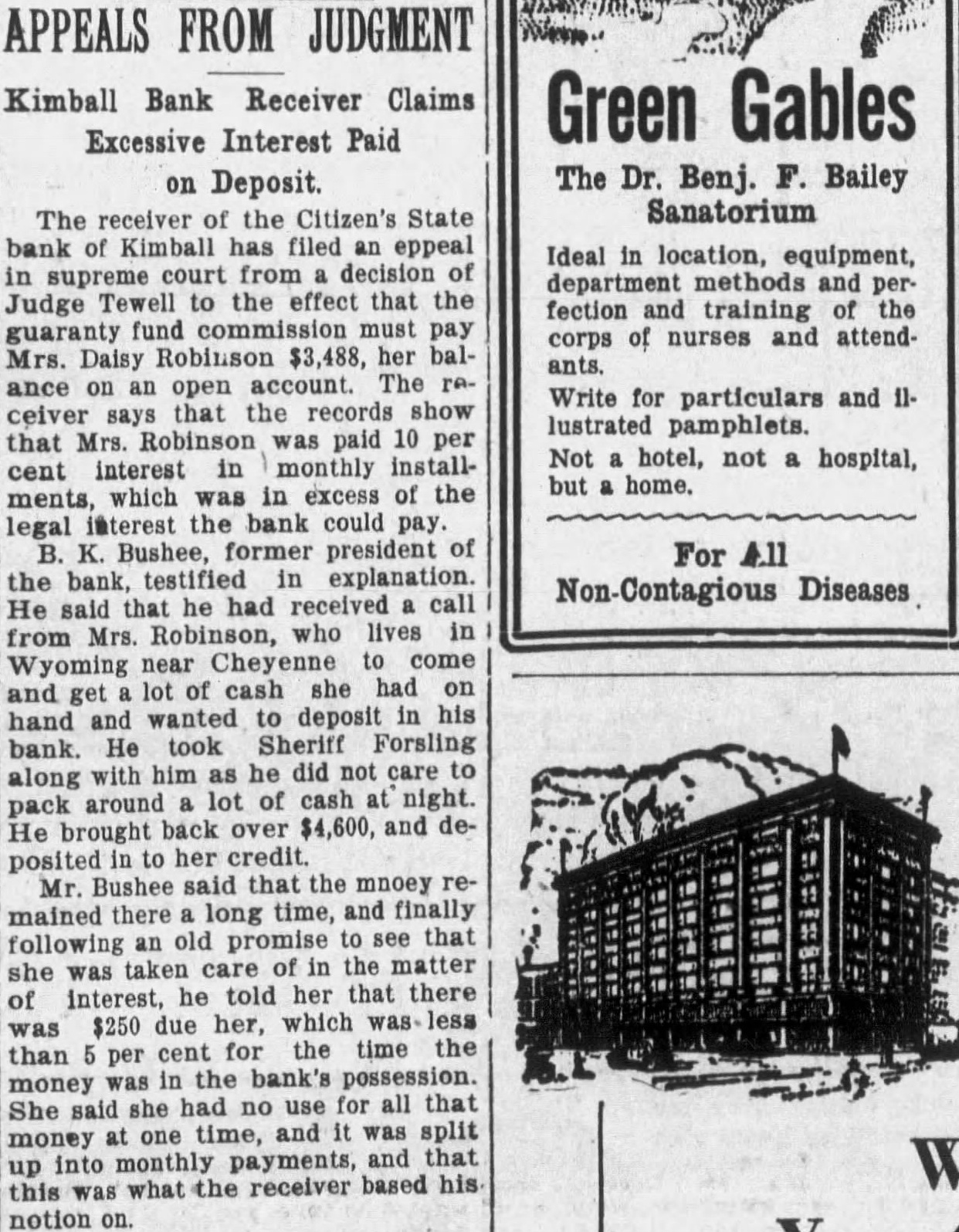
FUND HELD NOT LIABLE WINS $25,000 CASE IN THE SUPREME COURT. Two Receivers Battled Over Question If Responsibility for Loss Rested With American of Omaha. The state guaranty fund won two cases, totaling claims for over $27,000 and interest, and lost one for $2,109, by reason of supreme court decisions rendered Friday. The judgments it won were for in excess of $25,000 claimed by the receiver of the Carroll Trust and Sav ings bank of Carroll, Iowa, and for $1,400 claimed by two children of Cashier Amos of the failed Citizens State bank of Kimball, upon which excess interest was paid. It lost for $2,109 in favor of the Nebraska National bank of Hastings. The Carroll bank claim was based upon an alleged deposit of $25,000 in the American State bank of Omaha, also in receiver's hands. The was an involved one. John Rolfsema, president and chief owner of the Iowa bank, had $25,000 of the Omaha bank and placed the proceeds there as deposit in the name of his bank. He afterwards paid off the note by drafts drawn upon Chicago, the proceeds. which went into his personal account. Subsequently, to reimbures his bank for this appropriation of the money, he gave deed to his farm. The court says this was full settlement by the bank and amounted to ratification of what he had done. says the transaction, so far as borrowing money on his individual note and putting the proceeds to the credit of the bank was concerned, coupled with repayment of the note, was equivalent to the bank borrowing the money and subsequently paying the debt. It points out that it was not until the bank got into receiver's hands was any claim made that the legal effect of the transaction was that of deposit still in the Omaha bank to the credit of the Carroll institution. This status does not exist and not liable. The Nebraska National bank of Hastings was correspondent for the Farmers State bank of Belvidere, which failed at time when it had an overdraft in the Hastings insti tution by reason of the payment by the latter of drafts drawn upon The court says that where bank with checking account in correspondent bank draws a draft on the latter and the drawee pays the draft in good faith in the regular course of business pursuant to custom between the two institutions, theerby creating an draft of the drawer bank, which is closed in the meantime by reason of and having reason believe that funds or eredits are in transit to fully cover the overdraft, may in equity be to the rights of the original holder of the exchange, and may participate to the extent of the overdraft in the bank guaranty fund.


Article from Lincoln Journal Star, June 25, 1926

Click image to open full size in new tab

Article Text

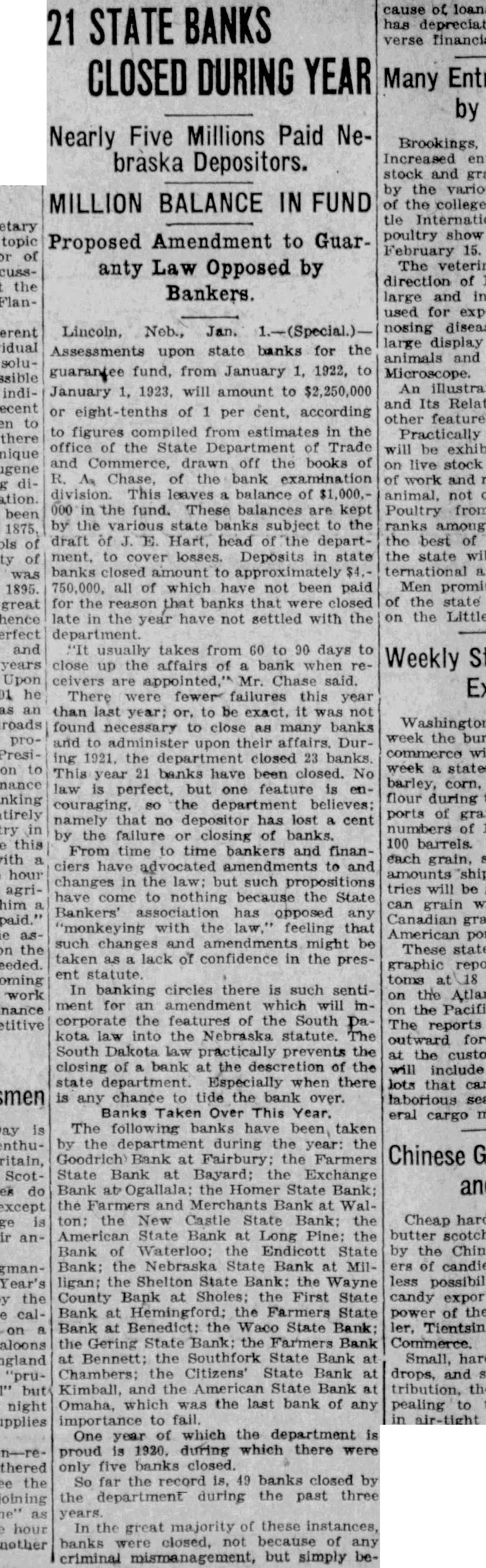
FUND HELD NOT LIABLE WINS $25,000 CASE IN THE SUPREME COURT. Two Receivers Battled Over Question If Responsibility for Loss Rested With American of Omaha. The state guaranty fund won two cases, totaling claims for over $27,000 and interest, and lost one for $2,109, by reason of supreme court decisions rendered Friday. The judgments it won were for in excess of $25,000 claimed by the receiver of the Carroll Trust and Sav ings bank of Carroll, Iowa, and for $1,400 claimed by two children of Cashier Amos of the failed Citizens State bank of Kimball, upon which excess interest was paid. It lost for $2,109 in favor the Nebraska National bank of Hastings. The Carroll bank claim was based upon alleged deposit of $25,000 in the American State bank of Omaha, also in receiver's hands. The transaction an involved one. John Rolfsema, president and chief owner of the lowa bank, had borrowed of the Omaha bank and placed the proceeds there as deposit in the name of his bank. He afterwards paid off the note by drafts drawn upon Chicago, the proceeds of which went into his personal account. Subsequently to reimbures his bank for this of the money, he gave deed to his farm. says this was full settlement by the bank and amounted to a ratification of what he had done. It says the transaction, so far as borrowing money on his individual note and putting the proceeds to the credit of bank was concerned, coupled with his later repayment of the note, was equivalent to the bank borrowing the money and subsequently paying the debt. It points out that it was not until the bank got into receiver's hands was any claim made that the legal effect of the transaction was that of deposit still in the Omaha bank to the credit of the Carroll institution. This status does not exist and the fund is not liable. Nebraska National bank of Hastings was correspondent for the Farmers State bank of Belvidere, which failed at time when it had an overdraft in the Hastings institution by reason of the by the latter of drafts drawn upon The court says that where bank with account in correspondent bank draws draft on the latter and the pays the draft in good faith in the regular course of business pursuant to custom between the two institu tions. theerby creating an over draft of the drawer bank, which is closed in the meantime by reason insolvency, and having reason to believe that funds or eredits in transit to fully cover the overdraft. may in equity be subrogated to the rights the original holder of the exchange, and may participate to the extent of the overdraft in the bank guaranty fund.