Banking House of A Castetter (Blair, NE)

Episode Information

Episode UID
76010471454
Episode Type
Suspension โ†’ Closure
Bank Type
state
Bank ID
7601047 routing
Routing Number
76-0104
Start Date
February 27, 1921
Location
Blair, Nebraska (41.544, -96.125)

Metadata

Model
gpt-5-mini (chosen from majority vote of a three-model LLM ensemble)
Short Digest
022b17bd281adecc

Response Measures

None

Description

President F. H. Claridge disappeared Feb 27, 1921 and is described as a fugitive; large deficiencies and receiver appointment follow.

Events (3)

1. February 27, 1921 Suspension
Cause
Bank Specific Adverse Info
Cause Details
President's disappearance and discovery of massive bad paper and discrepancies (roughly $800,000) made the bank unable to open.
Newspaper Excerpt
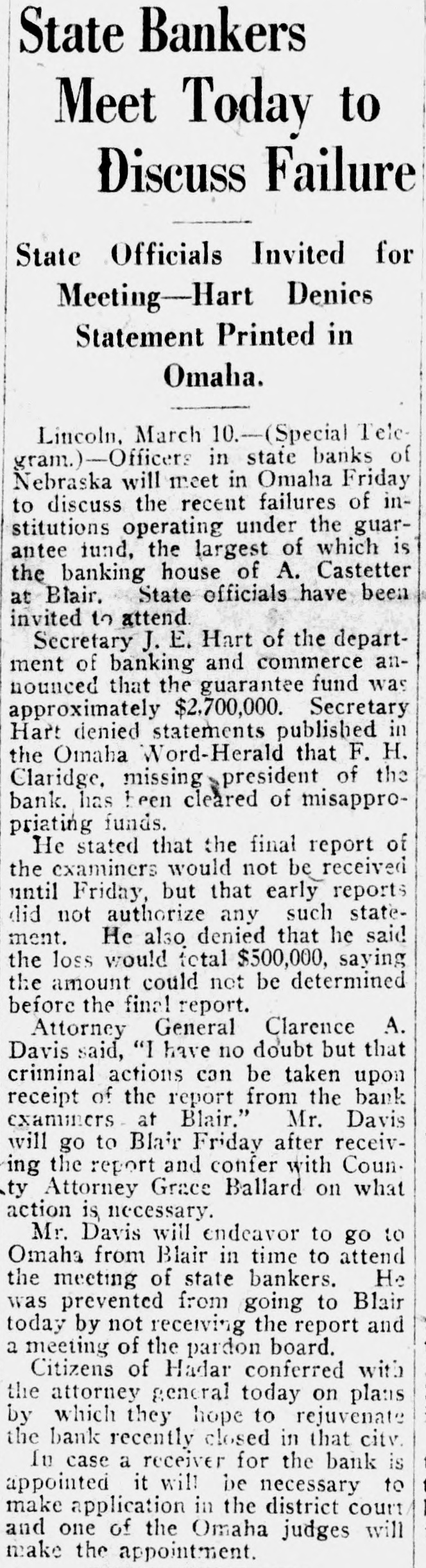
Fred H. Claridge, president of the banking house of A. Castetter at Blair, whose disappearance February 27, uncovered one of the most disastrous bank failures in Nebraska history...
Source
newspapers
2. March 14, 1921 Receivership
Newspaper Excerpt
J. E. Hart of the department and commerce, Secretary of banking and Mr. Davis began checking up the bank's affairs Saturday. The examination will probably be concluded next Tuesday, when a receiver will be appointed.
Source
newspapers
3. March 14, 1928 Other
Newspaper Excerpt
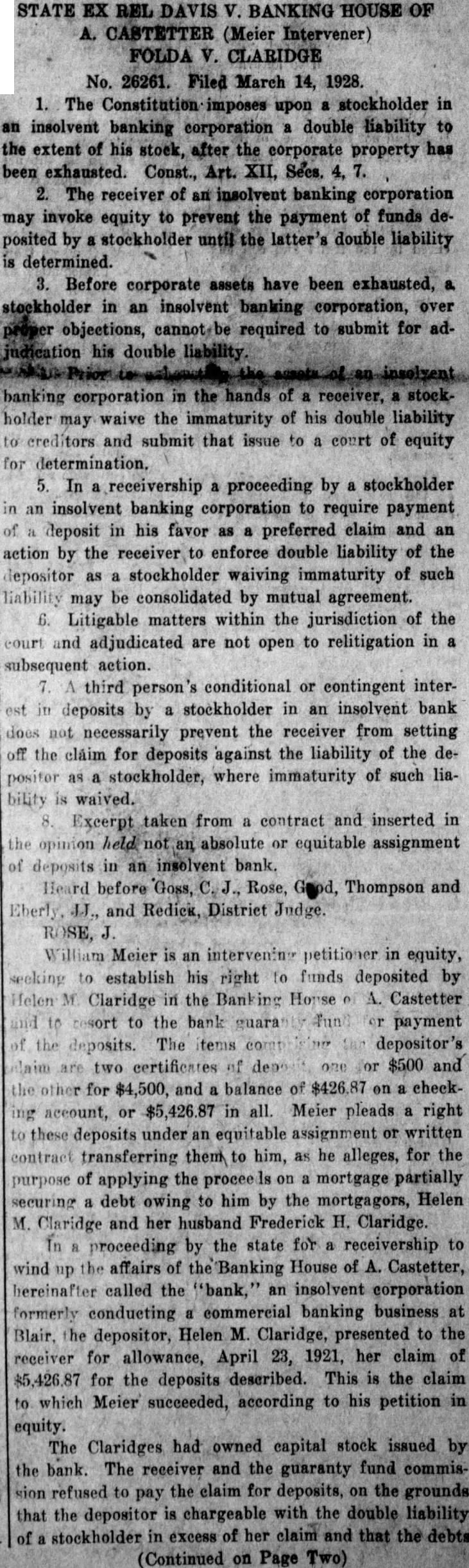
In a proceeding by the state for a receivership to wind up the affairs of the Banking House of A. Castetter, hereinafter called the bank, an insolvent corporation formerly conducting a commercial banking business at Blair...
Source
newspapers

Newspaper Articles (2)

Article from Omaha Daily Bee, March 14, 1921

Click image to open full size in new tab

Article Text

Warrant Is Issued for Bank Head Missing President of Blair Institution Charged With Violating Law on Four Counts. State Offers Reward Fred H. Claridge, president of the banking house of A. Castetter at Blair, whose disappearance February 27, uncovered one of the most disastrous bank failures in Nebraska history, today is a fugitive, not only from the wrath of trusting patrons whose confidence he betrayed, but from the criminal prosecutors of the state itself. A reward is offered by the state for Claridge's arrest, Attorney General Clarence A. Davis announced Saturday night. Complaints citing four specific counts against him were filed and a warrant was issued for his arrest. J. E. Hart of the department and commerce, Secretary of banking and Mr. Davis began checking up the bank's affairs Saturday. The examination will probably be concluded next Tuesday, when a receiver will be appointed. Cannot Be Opened. The bank cannot be opened, Mr. ) Davis declared. So great is the financial loss through "bad" paper that it will take weeks before an accurate checking can be made, according to Mr. Hart. A partial report from the state examiner shows the straits of the bank involve discrepancies of more than $800,000. Attorney General Davis characterizes it as one of the "most disastrous bank failures in Nebraska." Embarrassments of the bank are simumarized roughly by examining officials as follows: Worthless securities, $250,000. Doubtful securities, $300,000. "Frozen" securities, $250,000. This makes a total of $800,000. Of this amount, however, a considerable part of the $250,000 "frozen" securities represents loans on which a large sum will be realized eventually. Much of this is tied up in real estate investments, which will take time to liquidate. There will be some salvage also in the $300,000 listed as "doubtful securities." The nearest present estimate fixes the final loss at upward of $400,000. Davis Issues Statement. Attorney General Davis issued this statement to reassure depositers and others concerned in the bank's af fairs: "The affairs of the bank will be handled in such manner as will safeinterest. a guard every if We need shall be, go to to extreme lengths, le those avoid 'squeezing' both who are deposi- involved. This applies to tors and signers of notes. Depositors (Turn to Page Three. Column One.)


Article from Nebraska Legal News, March 31, 1928

Click image to open full size in new tab

Article Text

STATE EX REL DAVIS V. BANKING HOUSE OF A. CASTETTER (Meier Intervener) FOLDA V. CLARIDGE No. 26261. Filed March 14, 1928. 1. The Constitution imposes upon a stockholder in an insolvent banking corporation a double liability to the extent of his stock, after the corporate property has been exhausted. Const., Art. XII, Secs. 4, 7. 2. The receiver of an insolvent banking corporation may invoke equity to prevent the payment of funds deposited by a stockholder until the latter's double liability is determined. 3. Before corporate assets have been exhausted, a. stockholder in an insolvent banking corporation, over proper objections, cannot be required to submit for adjudication his double liability. Prior the assets of an insolvent banking corporation in the hands of a receiver, a stockholder may waive the immaturity of his double liability to creditors and submit that issue to a court of equity for determination. 5. In a receivership a proceeding by a stockholder in an insolvent banking corporation to require payment of a deposit in his favor as a preferred claim and an action by the receiver to enforce double liability of the lepositor as a stockholder waiving immaturity of such liability may be consolidated by mutual agreement. 6. Litigable matters within the jurisdiction of the court and adjudicated are not open to relitigation in a subsequent action. 7. A third person's conditional or contingent interest in deposits by a stockholder in an insolvent bank does not necessarily prevent the receiver from setting off the clรกim for deposits against the liability of the depositor as a stockholder, where immaturity of such liability is waived. Excerpt taken from a contract and inserted in the opinion held not an absolute or equitable assignment of deposits in an insolvent bank. Heard before Goss, C. J., Rose, Good, Thompson and Eberly, JJ., and Redick, District Judge. ROSE, J. William Meier is an intervening petitioner in equity, seeking to establish his right to funds deposited by Helen M Claridge in the Banking House A. Castetter and to esort to the bank guara Fund or payment of the deposits. The tems depositor's claim are two certificates of depo one or $500 and the other for $4,500, and a balance of $426.87 on a checking account, or $5,426.87 in all. Meier pleads a right to these deposits under an equitable assignment or written contract transferring them\ to him, as he alleges, for the purpose of applying the procee on a mortgage partially securing a debt owing to him by the mortgagors, Helen M. Claridge and her husband Frederick H. Claridge. In a proceeding by the state for a receivership to wind up the affairs of the Banking House of A. Castetter, hereinafter called the "bank," an insolvent corporation formerly conducting a commercial banking business at Blair, he depositor, Helen M. Claridge, presented to the receiver for allowance, April 23, 1921, her claim of $5,426.87 for the deposits described. This is the claim to which Meier succeeded, according to his petition in equity. The Claridges had owned capital stock issued by the bank. The receiver and the guaranty fund commission refused to pay the claim for deposits, on the grounds that the depositor is chargeable with the double liability of a stockholder in excess of her claim and that the debts (Continued on Page Two)