
7594. Canal Bank & Trust Company (New Orleans, LA)

Bank Information

Episode Type
Run Only
Bank Type
trust company
Start Date
March 20, 1879
Location
New Orleans, Louisiana (29.955, -90.075)

Metadata

Model
gpt-5-mini
Short Digest
23c5357c

Response Measures

Accommodated withdrawals, Public signal of financial health

Description

Articles describe a heavy run on the Canal Bank during the March 1879 panic triggered by failures of other New Orleans banks (Southern, Mechanics' & Traders'). The Canal Bank remained open and later published a reassuring statement and resumed normal payments, so this is classified as a run only (no suspension of the Canal Bank reported). Clearing House limits and bank statement are noted as measures taken to calm the situation.

Events (2)

1. March 20, 1879 Run
Cause
Local Banks
Cause Details
Run was precipitated by the collapse/suspension of other New Orleans banks (Southern Bank, Mechanics' & Traders'), which created a local panic and heavy withdrawals at the Canal Bank.
Measures
Clearing-House resolution limiting daily withdrawals to $200 and requiring certified checks for larger drafts; Canal Bank published a statement showing large available specie and treasury notes to reassure depositors.
Newspaper Excerpt
Another crash following in such quick succession CREATED A PANIC, and there was a heavy run on the Canal, Louisiana State, Germania, Union and People's banks.
Source
newspapers
2. March 25, 1879 Other
Newspaper Excerpt
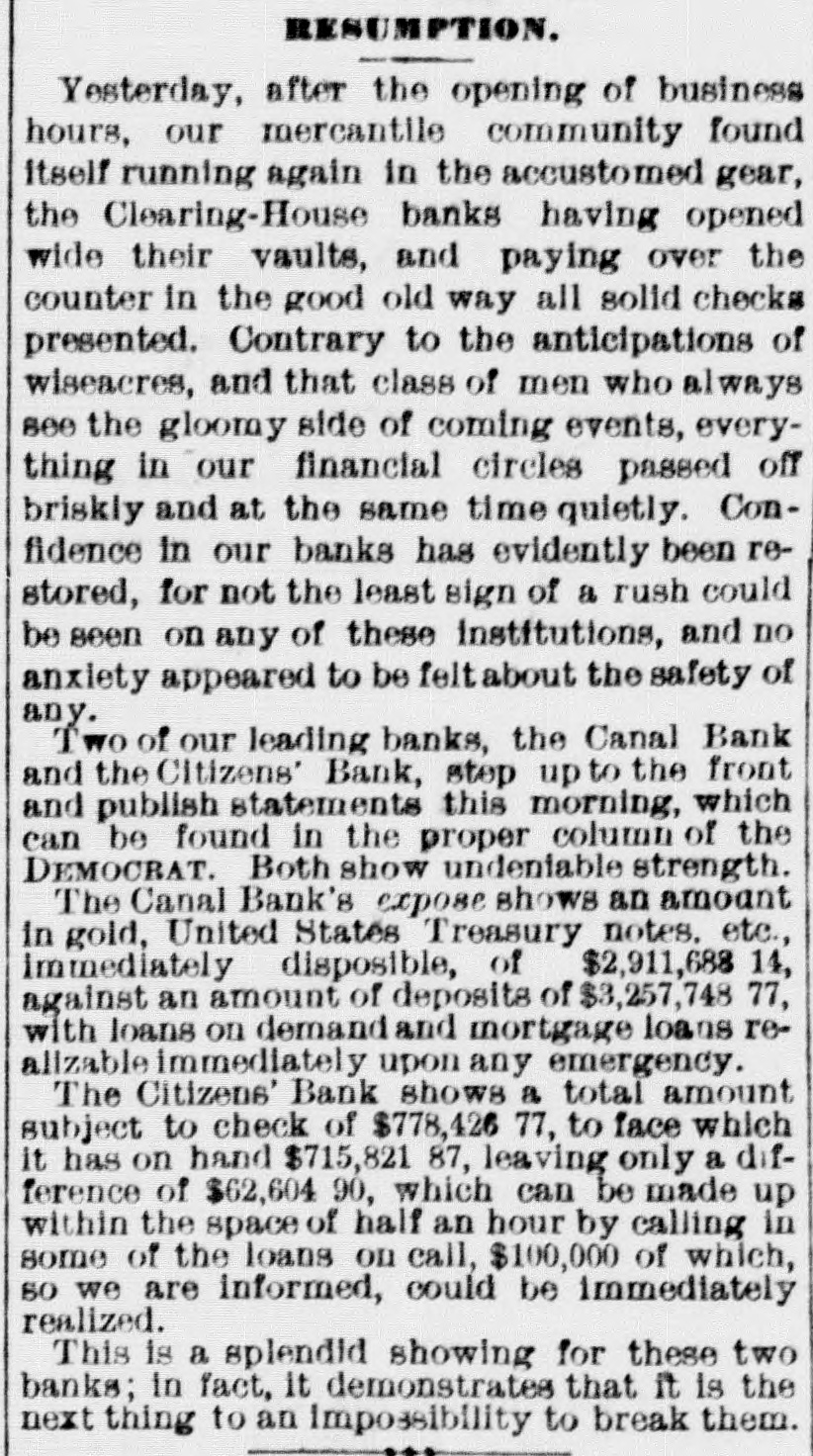
The Clearing House passed a resolution declaring that until March 29th no depositor can draw more than $200 in one day, and that all other drafts are payable in certified checks. ... The Canal Bank's expose shows an amount in gold, United States Treasury notes, etc., immediately disposible, of $2,911,688.14, against an amount of deposits of $3,257,748.77, ... it demonstrates that it is the next thing to an impossibility to break them. (resumption article March 26).
Source
newspapers

Newspaper Articles (3)

Article from Daily Globe, March 25, 1879

Click image to open full size in new tab

Article Text

THE NEW ORLEANS BANKS. 4 Very Rotten State of Affairs Developed. [New Orleans Special (March 20) to Chicago Times.] Several days ago the attention of the Times correspondent was attracted to the statement of the Southern bank, wherein assets given at $672,728.30 were found by the quotations of that day to be worth but $273,669.12, and that the bank was short $429,256. The Times man at once called the attention of Mr. Thomas Layton, admitting that the analysis of statement was correct, and that its publication would RUIN THE BANK, asked for delay to straighten its affairs, at the same time exhibiting a letter from the London Joint Stock bank which prompted an early remittance of $30 a share of the stock it had. The condition of the bank was also known to Messrs. Bradish Johnson and John T. Moore, two of the directors, both of whom were made cognizant of the facts, and all three pledged their faith that if public attention was not attracted to the true condition of affairs, the depositors, to whom $628,869 was due, would be paid. These same parties, by an understanding with C. E. Girardy, DECLARED THE BANK INSOLVENT under act 166, of 1855. C. E. Girardy presenting a check, which was protested, the sheriff who accompanied him seized the bank and read an order from the Fourth district court declaring Thomas Layton, John T. Moore and C. E. Girardy receivers. This had the effect of placing the principal officers in possession and depriving the depositors of all recourse. A deposit of $2,900 was received at the moment the bank closed its doors Monday evening, never to open again for business. It is estimated that $700,000 is the full loss involved, and it is known that the bank has existed for years upon a nominal capital. ANOTHER COLLAPSE. The suspension of the Mechanics' & Traders' bank, which occurred on Tuesday, occurred by an identical process. Deposits were received up to noon, when suddenly the sheriff appeared with a citation, answer and order of court containing the appointments of G. Lanaux, J. A. Blaffer and A. Lehman receivers, all on the same sheet of paper, and, with the exception of the signatures, in the same handwriting. Here an over-valuation of $238,000 is apparent in the statement as assets, and the actual deficit is probably double the amount. Another crash following in such quick succession CREATED A PANIC, and there was a heavy run on the Canal, Louisiana State, Germania, Union and People's banks. In the latter institution $500,000 was drawn out on Tuesday. At a meeting of the funding board S. H. Kennedy presented a resolution of the board of directors declining to any longer pay the past due State coupons. The board failed to withdraw the $374,000 of State funds he has on deposit. During the evening THE CLEARING HOUSE passed a resolution declaring that until March 29th no depositor can draw more than $200 in one day, and that all other drafts are payable in certified checks. It is asserted that but for this resolution the Union, State National and German banks would have failed to-day. This morning certified checks were selling at 1 per cent. discount, and it is apprehended that they will be lower, in consequence of the number of sight drafts from the west for much larger amounts than the limit allowed. Among the more intelligent financiers this is regarded as the forerunner of crash, which will swallow up every bank out of line. MEETING OF DEPOSITORS. At a meeting of the depositors of the broken New Orleans Savings bank to-night, the committee of experts reported the total liabilities to be $1,432,000; assets, $817,044, with a deficit of $614,955. The law incorporating this bank declares it a felony for any trustee to use the means of the institution for any purpose, but notwithstanding that fact, David Urquhart, president of the board, loaned $90,000 to a concern in which he is a partner, and nearly every trustee is heavily indebted. No prosecution is even hinted. AN EXPLANATION of the frightful rottenness and the great apprehension which exists can only be made in one way. During the spring of 1877, $22,000,000 accumulated in the banks in consequence of an utter lack of confidence produced by the Presidential controversy. When Nicholls was installed this large sum was used for speculating in State consols. The banks carried the bonds on margins, and when bonds reached 93 New York and Amsterdam unloaded to the extent of $10,000,000. The margins by which these bonds floated were swept out of existence when THE STATE DEFAULTED upon her interest. The bulk of the State debt has, by the course of depreciation, been thrown back upon the banks and insurance offices of the city, and the threatened repudiation, which would deprive them of the greater portion of their capital, has created this feeling of uncertainty. The suspension ordered last night may be prolonged, but it is believed sufficient money can be raised for the ordinary movement of tlade. The disaster is attributed to the IMBECILITY OF FRANCIS T. NICHOLLS, who was informed shortly after his inauguration of the exact status of the State debt, and it is held he was urged to reanimate confidence and restored the bonds to European bondholders by a vigorous financial policy, but the gentleman who gave him the information and made a suggestion which would have supplied to commerce ample capital was politely told to mind his own business. Want His Name Samuel But Not Tilden. [St. Charles (Minn.) Times-Dem.] The Winona Herald raises at the head of its editorial columns the following: For President in 1880, Samuel J. Tilden. Subject to the decision of the National Democratic convention. Our friend Whipple of the Herald is generally pretty clear headed, and in his political predictions is always more than half right. In the above he is about two-thirds right, the Samuel J. being correct, but the Tilden he could better have written Randall. We make no prediction, nor do not wish to be understood as stating any preference for a Presidential candidate at this early dav

Article from The New Orleans Daily Democrat, March 26, 1879

Click image to open full size in new tab

Article Text

RESUMPTION. Yesterday, after the opening of business hours, our mercantile community found Itself running again in the accustomed gear, the Clearing-House banks having opened wide their vaults, and paying over the counter in the good old way all solid checks presented. Contrary to the anticipations of wiseacres, and that class of men who always see the gloomy side of coming events, everything in our financial circles passed off briskly and at the same time quietly. Confidence in our banks has evidently been restored, for not the least sign of a rush could be seen on any of these institutions, and no anxiety appeared to be felt about the safety of any. Two of our leading banks, the Canal Bank and the Citizens' Bank, step up to the front and publish statements this morning, which can be found in the proper column of the DEMOCRAT. Both show undeniable strength. The Canal Bank's expose shows an amount in gold, United States Treasury notes. etc., immediately disposible, of $2,911,688 14, against an amount of deposits of $3,257,748 77, with loans on demand and mortgage loans realizable immediately upon any emergency. The Citizens' Bank shows a total amount subject to check of $778,426 77, to face which it has on hand $715,821 87, leaving only a difference of $62,604 90, which can be made up within the space of half an hour by calling in some of the loans on call, $100,000 of which, 80 we are informed, could be immediately realized. This is a splendid showing for these two banks; in fact, it demonstrates that it is the next thing to an impossibility to break them.


Article from The Redwood Gazette, April 3, 1879

Click image to open full size in new tab

Article Text

THE NEW WORLD. THE National House of Representatives was organized, on the 18th, by the election of Mr. Randall as Speaker; Mr. Adams as Clerk; Mr. Thompson as Sergeant-at-Arms; Mr. Field as Doorkeeper; Mr. Stewarta Postmaster, and Rev. Mr. Harrison as Chaplain. These were the officers of the last House. Mr. Randall received 144 votes. A SCIENTIFIC examination of the sulphur, which fell in the shower over the Lehigh Valley, the other day, proves it to be the pollen from a species of pine, caught up on the wind and carried from*the Jersey forests. THE President sent in the following message to Congress on the 19th: FELLOW-CITIZENS OF THE SENATE AND HOUSE OF REPRESENTATIVES: The failure of the last Congress to make the requisite appropriations for legislative and judicial purposes, for the expenses of the several Executive Departments of the Government, and for the support of the army, has made it necessary to call a session of the Forty-sixth Congress. The estimates of the appropriations needed, which were sent to Congress by the Secretary of the Treasury at the opening of last session, are renewed. and are herewith transmitted to both the Senate and House of Representatives. Regretting the existence of the emergency which requires a special session of Congress at a time when it is the general judgment of the country that public welfare will be best promoted by permanency in our legislation, and by peace and rest, I commend these few necessary measures to your considerate attention. RUTHERFORD B. HAYES. (Signed) WASHINGTON. March 19. 1879. A HAVANA (Cuba) dispatch of the 19th says the British steamer Bolivar had collided with the Haytien steamer Michael, in West Indian waters, and that the latter sank, and sixty persons were drowned. Two MEN were instantly killed and four seriously injured by a premature explosion of dynamite in the Pottsville (Pa.) Colliery, on the afternoon of the 19th. A TRIANGULAR shooting affray occurred at Vicksburg, Miss., on the night of the 18th, which resulted in the instant killing of Capt. W. H. Andrews and W. L. Greene, and the fatal wounding of Capt. W. F. Fitzgerald. The trouble arose over an election of officers in the Hiternian Society. REV. DR. DEKOVEN, of Racine, a distinguished Episcopal divine, died on the 19th, from apoplexy of the heart. Dr. DeKoven was once elected, by the Diocesan Convention, Bishop of the Diocese of Illinois, but the Standing Committees refused to confirm the choice. ON the 19th, Surrogate Colvin rendered a decision affirming the validity of the late Com. Vanderbilt's will. It was stated that the contestant would appeal. A HOUSE a few miles from Ponca, Nebraska, was burned a few days ago, and Mrs. Bigley, ninety years old, perished in the flames. ON the 20th, the Republicans of Rhode Island met in State Convention and renominated the present State officers. The State Convention of the Democracy was also in session and nominated Thomas W. Logan for Governor; J. D. Bailey for Lieutenant-Governor; David S. Baker, Jr., for Secretary of State, and Charles H. Page for Attorney-General. AGENERALCOURT-MARTIALhas been ordered for the trial of Col. Stanley, of the Twenty-Second Infantry and Col. Hazen, of the Sixth Infantry. The Southern Bank of New Orleans, the oldest bank in the city, failed a few days ago, and was placed in the hands of receivers. The amount of loss involved is stated to be $700,000. The Mechanics' and Traders' Bank followed suit, and, as soon as the facts became known, a panic ensued, and a run was precipitated, the objective points being the Canal, Louisiana State, Germania, Union and People's Banks. On the 20th, the Clearing House, as a measure tending to allay the excitement, passed a resolution declaring until March 29 no depositor should draw out more than $200 in one day, and that all other drafts should be paid in certified checks. The following is a list of banks whose temporary suspension was announced on the 20th: Germania National; Hibernian National; Louisfana National; Mutual National; New Orleans National; State National; Union Na. tional; Bank of La Fayette; Citizens' Bank of Louisiana: Citizens' Savings Bank; Lou-